
Market Overview
| Study Period | 2021 - 2031 |
|---|---|
| Forecast Data Period | 2026 - 2031 |
| Base Year Market Size (2025) | USD 1.03 Billion |
| Market Size (2026) | USD 1.1 Billion |
| Market Size (2031) | USD 1.53 Billion |
| Growth Rate (2026 - 2031) | 6.87 % |
| Market Concentration | High |
Major Players
*Disclaimer: Major Players sorted in no particular order Image © Mordor Intelligence. Reuse requires attribution under CC BY 4.0. |
|
Argentina Hair Care Market Analysis by Mordor Intelligence
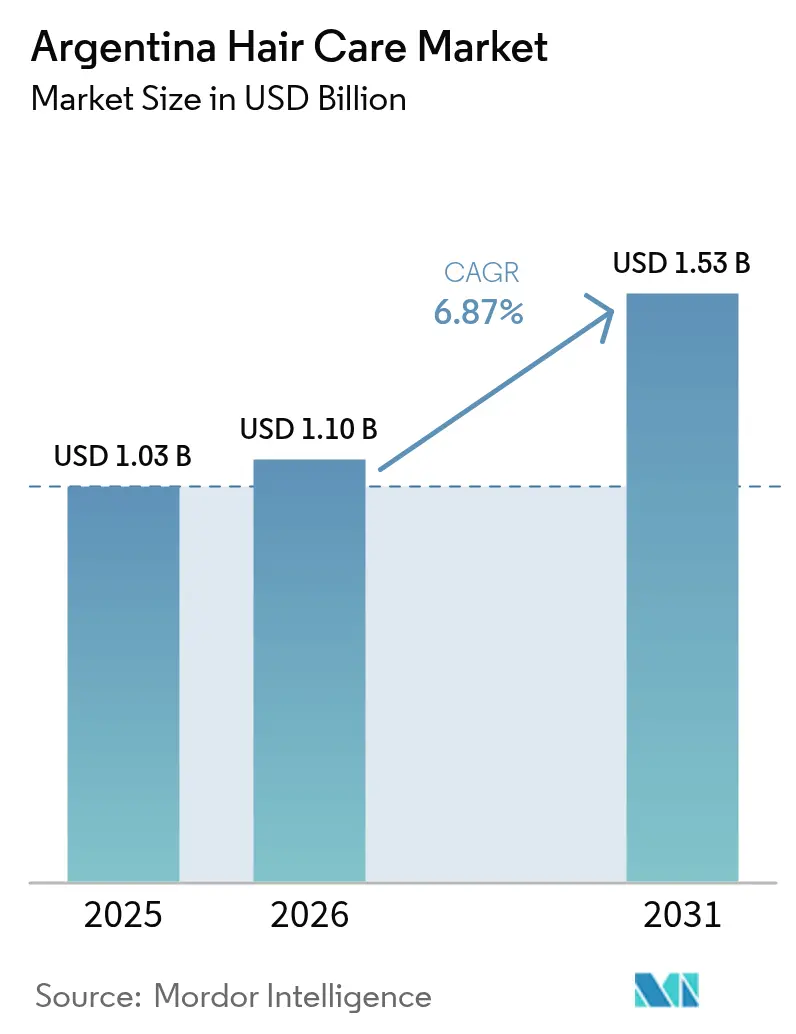
The Argentine Hair Care Market size is expected to grow from USD 1.03 billion in 2025 to USD 1.1 billion in 2026 and is forecast to reach USD 1.53 billion by 2031 at 6.87% CAGR over 2026-2031. The market growth is driven by increasing consumer awareness of personal grooming and hair health, growing demand for natural and organic products, and expanding urban population with access to premium hair care products. The rise of e-commerce platforms has improved product accessibility and variety for consumers across different demographics. The market is also influenced by changing lifestyle preferences, particularly among younger consumers and men, who are increasingly purchasing specialized products like dry shampoos, styling products, and targeted hair treatments. Consumer interest in sustainability has become a significant growth factor, with increasing demand for products featuring eco-friendly packaging and ethically sourced ingredients.
Key Report Takeaways
- By product type, shampoo captured 39.93% of the Argentine hair care market share in 2025, while hair-styling products are projected to post the strongest 7.18% CAGR to 2031.
- By category, mass products retained 77.82% revenue share in 2025; the premium line is set to expand at a 7.65% CAGR through 2031.
- By ingredient type, conventional formulations accounted for 72.96% share of the Argentina hair care market size in 2025, whereas natural and organic items are pacing at an 8.11% CAGR to 2031.
- By distribution channel, supermarkets and hypermarkets held 49.12% share in 2025; online retail is rising quickest at an 8.56% CAGR.
Note: Market size and forecast figures in this report are generated using Mordor Intelligence’s proprietary estimation framework, updated with the latest available data and insights as of 2026.
Argentina Hair Care Market Trends and Insights
Drivers Impact Analysis*
| Driver | (~) % Impact on CAGR Forecast | Geographic Relevance | Impact Timeline |
|---|---|---|---|
| Strong demand for products formulated with clean label ingredients | +1.2% | National, with concentration in Buenos Aires and urban centers | Medium term (2-4 years) |
| Influence of social media and celebrity endorsement | +0.9% | National, strongest in urban areas with high social media penetration | Short term (≤ 2 years) |
| Demand for multi-functional and damage control products | +0.8% | National, particularly in metropolitan areas | Medium term (2-4 years) |
| Growing demand for personalized hair care solutions | +0.7% | Buenos Aires and major urban centers initially | Long term (≥ 4 years) |
| Urbanization drives diverse hair care product adoption | +0.6% | National, with spillover from Buenos Aires to secondary cities | Medium term (2-4 years) |
| Sustainable packaging appeals to eco-conscious consumers | +0.5% | National, led by environmentally aware urban consumers | Long term (≥ 4 years) |
| Source: Mordor Intelligence | |||
Strong Demand for Products Formulated with Clean Label Ingredients
The Argentine hair care market is demonstrating an increasing shift toward clean label formulations, as consumers systematically analyze ingredient compositions and opt for products that are free from parabens, sulfates, and silicones. Urban consumers in Argentina conduct thorough research on ingredient safety through digital platforms, including social media channels and beauty-focused content, to inform their purchasing decisions. Unilever's strategic introduction of the Sedal Bomba de Nutrición product line, incorporating natural components such as avocado and shea butter, has established a significant market presence in the shampoo and conditioner segments. The Argentine National Administration of Medicines, Food, and Medical Technology (ANMAT) has implemented stringent regulatory measures by prohibiting specific harmful substances in cosmetic formulations, including 4-Amino-3-hydroxytoluene and 1,2,4-Trihydroxybenzene.
Influence of Social Media and Celebrity Endorsement
Social media platforms and celebrity endorsements significantly influence consumer purchasing decisions in Argentina's hair care market. Instagram, TikTok, and YouTube have changed how consumers perceive beauty standards and engage with hair care brands. Argentine consumers, especially millennials and Gen Z, rely on beauty influencers, hairstylists, and celebrities for product guidance and styling tips. This has increased demand for specific hair care products that support trending styles, including hair coloring, straightening, and curl enhancement products. Companies partner with regional influencers and celebrities to develop targeted social media campaigns. These collaborations enhance brand awareness and credibility, as consumers often trust influencer recommendations. Additionally, the growth of short-form videos and consumer reviews has facilitated rapid product adoption and strengthened brand loyalty in the market.
Demand for Multi-Functional and Damage Control Products
The Argentina hair care market exhibits a notable transition in consumer purchasing patterns, with a growing preference for products that deliver multiple functional benefits in a single formulation. This shift is predominantly influenced by the country's economic conditions, as consumers seek cost-effective hair care solutions. The mass segment market shows increased penetration of products incorporating cleansing, conditioning, and treatment functionalities within single formulations. Unilever's hair care portfolio achieved mid-single digit growth in 2024, attributed to product innovations across its Sunsilk and Dove brands, specifically in the damage repair category with additional functional benefits. The market trajectory indicates sustained growth in multi-functional hair care solutions, particularly as consumers prioritize addressing hair damage concerns.
Growing Demand for Personalized Hair Care Solutions
The escalating demand for personalized hair care solutions in Argentina is fundamentally driven by evolving consumer preferences, increasing disposable incomes, and enhanced digital platform accessibility. The market demonstrates a pronounced shift towards customized hair care products, as consumers actively seek solutions that precisely target individual concerns such as dryness, frizz, damage, and color protection, while simultaneously adhering to their requirements for sustainability and ingredient transparency. The pervasive influence of social media and beauty blogs has transformed urban consumer awareness regarding natural, organic, and multifunctional hair care products, generating substantial demand for personalized solutions across diverse hair types and lifestyle requirements. The robust growth of e-commerce platforms has strategically enhanced consumer access to specialized products, including premium and bespoke hair care formulations, reflecting the market's definitive transition towards individualized hair care solutions. According to the United Nations Educational, Scientific, and Cultural Organization (UNESCO), Argentina's internet penetration reached 90% of households as of 2024, reinforcing this systematic progression towards personalized product selection [1]Source: United Nations Educational, Scientific and Cultural Organization (UNESCO), "Assessing Internet Development in Argentina", unesco.org.
Restraints Impact Analysis*
| Restraint | (~) % Impact on CAGR Forecast | Geographic Relevance | Impact Timeline |
|---|---|---|---|
| Adoption of traditional at-home hair care solutions | -0.8% | National, stronger in rural and lower-income areas | Medium term (2-4 years) |
| Health concerns over chemical ingredients | -0.6% | National, particularly among educated urban consumers | Short term (≤ 2 years) |
| Import restrictions limit access to advanced hair care technologies | -0.5% | National, affecting premium and specialized products | Short term (≤ 2 years) |
| Complex tax structures affect business profitability | -0.4% | National, impacting all market participants | Long term (≥ 4 years) |
| Source: Mordor Intelligence | |||
Adoption of Traditional At-Home Hair Care Solutions
Argentina's challenging economic environment poses significant restraints on the hair care market's growth trajectory. According to the National Institute of Statistics and Censuses (INDEC), with inflation reaching 254.2% annually as of January 2024, consumers are increasingly shifting towards traditional, cost-effective hair care alternatives. This transition to homemade remedies, including olive oil, avocado, and egg-based treatments, is particularly evident among middle and lower-income segments. National Institute of Statistics and Census (INDEC) data indicates that 42.5% of Argentine households in large metropolitan areas were below the poverty line in 2024, further constraining consumer spending on commercial hair care products [2]Source: National Institute of Statistics and Censuses (INDEC), "Argentina records highest inflation in three decades", indec.gob.ar. While market leaders are responding by incorporating traditional ingredients and developing concentrated formulations that require less frequent application, the persistent economic instability continues to impact market expansion and consumer purchasing patterns.
Health Concerns Over Chemical Ingredients
The prevalence of chemical constituents in hair care formulations presents a substantial impediment to the advancement of Argentina's hair care market. The heightened consumer consciousness regarding potentially detrimental chemical compounds, specifically sulfates, parabens, formaldehyde, and phthalates, has precipitated an increased demand for ingredient transparency and safer product alternatives. Digital communication platforms facilitate the comprehensive dissemination of ingredient-related information among consumers, consequently influencing purchasing behavior and organizational reputation. This market dynamic necessitates manufacturing entities and importing organizations to implement comprehensive product reformulation strategies or procure certifications for natural alternatives, culminating in increased production expenditure and prolonged product development intervals.
*Our forecasts treat driver/restraint impacts as directional, not additive. The impact forecasts reflect baseline growth, mix effects, and variable interactions.
Segment Analysis
By Product Type: Shampoo Leads Innovation Wave
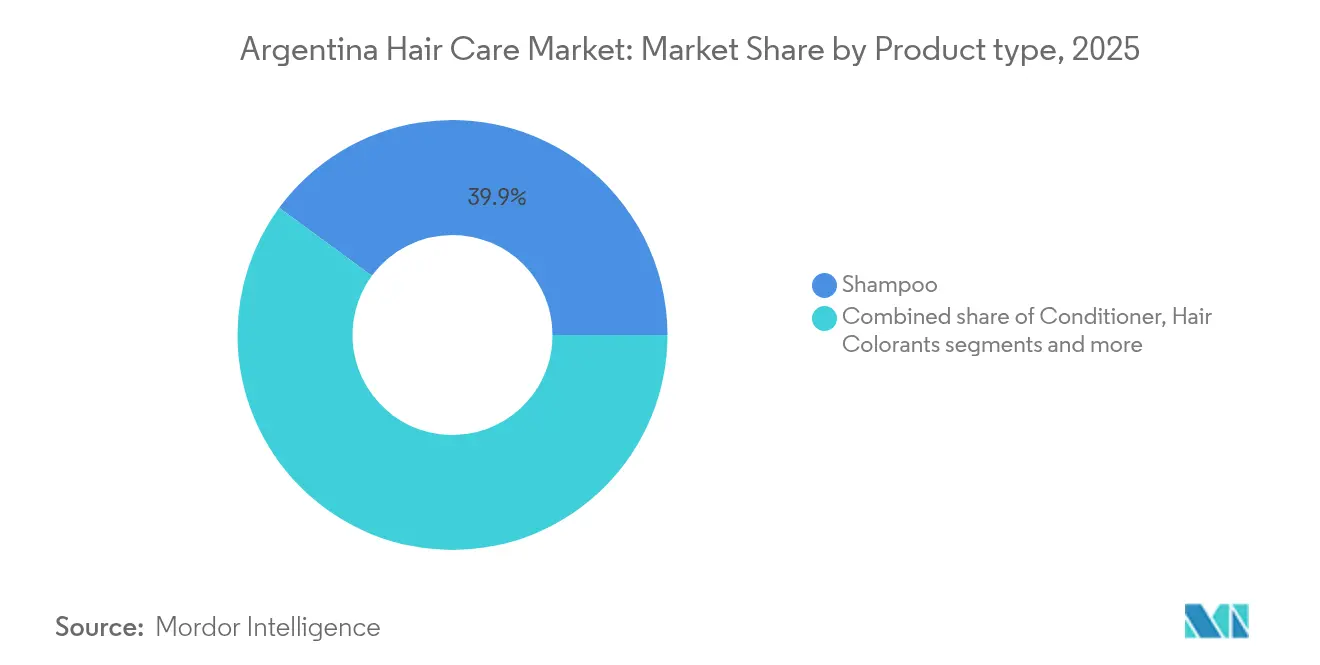
In Argentina's hair care market, shampoo maintains its dominant position, representing 39.93% of the total market value in 2025. This leadership stems from shampoo's status as an essential product used regularly across all consumer segments. The segment's strength is reinforced by the continuous demand for basic hair hygiene and the wide range of options, including anti-dandruff, color-protect, sulfate-free, and herbal variants.
The Hair Styling Products segment is experiencing significant growth, with a projected CAGR of 7.18% through 2031, surpassing traditional categories. This expansion is driven by heightened personal grooming awareness, particularly among younger consumers and urban professionals. Social media trends, celebrity influences, and changing lifestyles have encouraged the adoption of diverse hair styling routines. Consumer preferences are shifting toward multifunctional products, with increased demand for gels, waxes, sprays, and creams that combine styling capabilities with benefits such as heat protection and nourishment. This trend indicates an evolving and diversifying hair care market in Argentina.



By Category: Premium Segment Defies Economic Headwinds
Mass-market hair care products maintain a substantial 77.82% market share in Argentina during 2025, demonstrating the predominant price sensitivity among consumers. This significant market concentration in affordable products is attributed to Argentina's persistent economic challenges, characterized by elevated inflation rates and diminished purchasing power, which have established price as the primary determinant in consumer purchasing behavior. The market demonstrates a clear preference for manufacturers offering efficacious solutions at competitive price points, particularly in essential hair care categories such as shampoos and conditioners.
The premium hair care segment exhibits a compound annual growth rate of 7.65%, indicating an enhancement in consumer confidence within middle- and upper-income demographics. These consumer segments demonstrate increased investment in specialized hair care solutions, incorporating advanced formulations and natural ingredients. The proliferation of e-commerce platforms has facilitated enhanced accessibility to international and premium brands, resulting in increased market segmentation and diversification within Argentina's hair care industry.
By Distribution Channel: Supermarkets/Hypermarkets Maintain Strategic Dominance
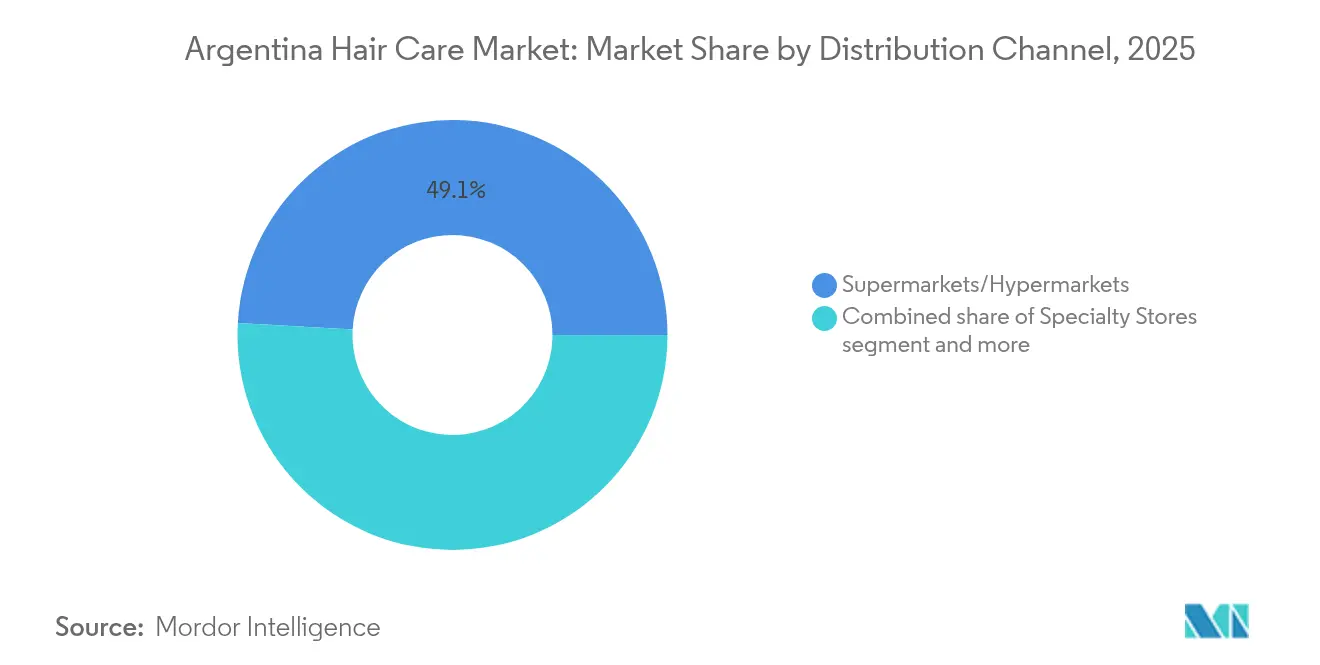
Supermarkets/hypermarkets maintain market dominance in Argentina's hair care distribution landscape in 2025, accounting for 49.12% of the market share. These retail establishments sustain their market leadership through strategic locations, comprehensive product portfolios, and competitive pricing structures. The expansion of prominent retail corporations continues, as demonstrated by Carrefour's operational growth from 651 to 679 retail establishments across Argentina in 2024, underscoring the significance of traditional retail infrastructure in consumer accessibility.
The online retail segment exhibits superior growth metrics with a CAGR of 8.56%. This expansion is attributed to increasing consumer adoption of digital commerce platforms, which provide enhanced accessibility, extensive product assortment, and individualized purchasing experiences. The proliferation of e-commerce distribution channels is facilitated by heightened internet accessibility, increased mobile device utilization, and social media marketing influence, establishing digital retail as an integral distribution channel for both mass-market and premium hair care merchandise.
By Ingredient Type: Natural and Organic Redefines Value Proposition
In Argentina's hair care market, natural and organic formulations are growing at 8.11% CAGR, the highest rate across all product segments. This growth reflects changing consumer preferences toward health-conscious, environmentally friendly, and ingredient-transparent products. The shift is driven by increased awareness of synthetic chemical risks, social media influence, sustainability movements, and clean beauty trends, leading Argentine consumers to choose shampoos, conditioners, and treatments with plant-based, paraben-free, and biodegradable ingredients.
Conventional and synthetic ingredient-based products maintain market dominance with a 72.96% share in 2025. This position stems from their wide availability, lower prices, and consumer trust in established brands using synthetic formulations. While natural products continue to gain market share, their higher costs and limited availability in rural or lower-income areas restrict broader market penetration. However, the sustained growth of natural and organic options indicates a transformation in Argentina's hair care market.
Geography Analysis
Argentina's hair care market is predominantly urban-focused, with 92% of the population living in cities as of 2023, according to the United States Department of Commerce . Urban areas combine sophisticated beauty routines with higher disposable incomes and better product accessibility. Buenos Aires and its metropolitan area influence consumption patterns significantly, driving premium product adoption and functioning as the primary market for new brand launches and product innovations. Consumers in the capital region show higher acceptance of international brands and premium-priced products, supported by their higher average incomes and exposure to global beauty trends through social media and travel.
The market shows distinct regional differences between Argentina's wealthy central regions and the northern provinces. Northern consumers display lower premium beauty product purchases and prefer traditional retail channels. Cities like Córdoba, Rosario, and Mendoza present growth opportunities as economic recovery extends beyond Buenos Aires and distribution infrastructure improves.
The market's geographic concentration influences hair care brand strategies, requiring initial establishment in Buenos Aires before expanding to secondary markets. While rural areas have limited access to premium brands, they offer future growth potential through increasing urbanization and expanding digital commerce infrastructure. Argentina's diverse climate zones create specific product requirements - from humidity control products in subtropical regions to moisturizing treatments in arid areas - necessitating regional adaptation of product formulations and marketing approaches.
Regulatory Landscape
Argentina's hair care products fall under the cosmetics framework overseen by ANMAT (Administracion Nacional de Medicamentos, Alimentos y Tecnologia Medica), aligned with Mercosur technical requirements (for example, GMC No. 05/05) that govern safety, labeling, and conditions for manufacturing and import. ANMAT also sets substance restrictions within cosmetic formulations, reinforcing clean-label reformulation activity in shampoos, conditioners, treatments, and styling products.
Recent policy moves emphasize administrative simplification and digitization for establishments and imports. Disposicion 7939/2025 (implemented in February 2026) enabled certain cosmetic, personal hygiene, and perfume establishments to obtain habilitation through a digital sworn declaration (DDJJ), and Disposicion 236/2026 (April 2026) introduced an Aviso de Puesta en el Mercado pathway for imported cosmetics. Separately, Disposicion 4033/2025 (July 2025) ended ANMAT intervention for personal-use import requests, while companies placing products on the market continue to carry primary responsibility via the company and its technical director, alongside provincial and municipal environmental and workplace-safety compliance.
Competitive Landscape
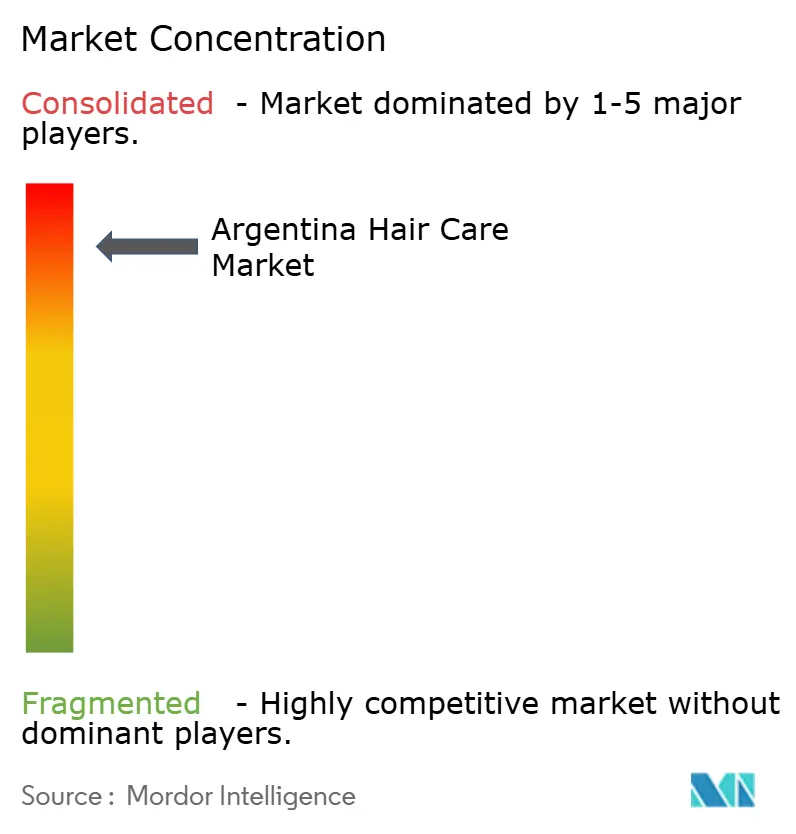
The competitive landscape of Argentina's hair care market exhibits a consolidated structure characterized by the predominant presence of multinational corporations. Key market participants, including Unilever PLC, L'Oréal S.A., Natura & Co Holding SA, and Henkel AG & Co. KGaA, maintain significant market share through their comprehensive brand portfolios. These organizations have established their market positions through the implementation of extensive distribution networks, substantial brand equity, and systematic product innovation initiatives, particularly in formulations incorporating natural ingredients and targeted hair treatment solutions.
The market demonstrates evolving competitive dynamics through strategic corporate acquisitions within premium segments, accompanied by substantial investments in research and development capabilities. This strategic focus facilitates the development of advanced formulations and innovative product offerings. Domestic manufacturers contribute to market competition through the production of regionally adapted products that address specific consumer preferences and price sensitivities. The competitive emphasis has shifted from price-based differentiation to scientific innovation and product sophistication, reflecting the market's progression toward premiumization.
Market participants are implementing strategic initiatives focused on environmental sustainability, particularly in packaging solutions and natural ingredient formulations. This strategic direction aligns with increasing consumer demand for environmentally responsible products and demonstrates the market's adaptation to evolving consumer preferences and regulatory requirements in the hair care segment.
Argentina Hair Care Industry Leaders
-
Unilever PLC
-
L'Oréal S.A.
-
Natura & Co Holding SA
-
Henkel AG & Co. KGaA
-
Capilatis S.A.
- *Disclaimer: Major Players sorted in no particular order

Market Opportunities and Future Outlook
Regulatory streamlining in 2025-2026 creates whitespace for faster portfolio expansion, especially for importers and brands scaling SKUs across natural, treatment, and styling segments. The DDJJ-based establishment habilitation under ANMAT (Disposicion 7939/2025, implemented February 2026) and the import-focused Aviso de Puesta en el Mercado (Disposicion 236/2026, April 2026) reduce friction in market entry processes, supporting broader assortments in channels where consumers actively compare ingredients and performance claims.
Sustainability and local capacity additions are translating into tangible execution avenues for hair care. L'Oreal Groupe Argentina reported in April 2026 that 10 of its 16 local brands offer refillable packaging options under its L'Oreal for the Future program, aligning with rising consumer scrutiny of packaging and ingredient transparency. On the supply side, Algabo reported a USD 6 million investment across 2025-2026 to expand its Tortuguitas facility with a goal to double capacity to 5 million units per month, signaling an opportunity for competitively priced local production, private label partnerships, and faster replenishment for supermarkets/hypermarkets and online retail.
Recent Industry Developments
- January 2026: L'Oreal presented two beauty tech hair and skin innovations at CES 2026, reinforcing its R&D-led positioning around higher-performance routines and device-adjacent regimens. The visibility of science-forward innovation supports premiumization narratives that spill into retail hair care claims and regimen building.
- November 2025: Henkel Argentina introduced braille-enabled packaging on its Authentic Beauty Concept professional hair care line, positioning accessibility and inclusive design as a differentiator. The move strengthens brand equity in salon-adjacent hair care and can influence packaging choices across premium segments.
- September 2024: L'Oreal Paris introduced the Elvive Glycolic Gloss line in Argentina, extending the skinification trend into mainstream retail hair care through glycolic-acid-based shine and treatment claims. The launch added momentum to treatment-led regimens and higher-value routines beyond basic cleansing and conditioning.


Research Methodology Framework and Report Scope
Market Definition and Coverage
For this study, the Argentina hair care market is defined as the value of hair care products sold for consumer use in the country, counted at the point of sale across offline and online retail channels.
Scope exclusions: The sizing excludes professional salon service revenues and hair appliances, such as dryers, straighteners, and clippers.
Segmentation Overview
-
By Product Type
- Shampoo
- Conditioner
- Hair Colorants
- Hair Styling Products
- Other Product Types
-
By Category
- Premium Products
- Mass Products
-
By Ingredient Type
- Natural and Organic
- Conventional/Synthetic
-
By Distribution Channel
- Specialty Stores
- Supermarkets/Hypermarkets
- Online Retail Stores
- Other Channels
Data Sources, Market Sizing, and Validation
Desk Research
Desk work starts by building a clean fact base on Argentina personal care spending, retail turnover, and category definitions. We use public sources such as national statistics releases, customs and trade tables, central bank inflation and exchange-rate series, and tax and regulatory notices that affect labeled cosmetics and toiletries, which helps keep the model tied to actual purchasing conditions.
Next, the category is shaped using company filings and investor presentations, brand and retailer product catalogs, industry association websites, and well tracked news coverage about pricing and promotions. In a few places, paid subscriptions for company financials, patent lookups, and shipment-level import and export checks are used to confirm who sells what and whether supply flows are changing. The desk sources mentioned here are illustrative only, and many additional public references were reviewed to collect, cross-check, and clarify inputs.
Primary Interviews and Surveys
Primary work is used to test assumptions that are hard to read from public data, especially price laddering, channel mix shifts, and which claims are actually driving trade-ups in Argentina hair care. Interviews are conducted with manufacturers, distributors, retail managers, and category experts across the country, so gaps from desk research can be filled and then checked back against the final totals.
Distribution of primary research fieldwork respondents
| Company type | Respondent position |
|---|---|
| Top tier: 27% | CXOs: 19% |
| Mid tier: 54% | Functional/Unit leaders: 23% |
| Smaller Players: 19% | Managers: 58% |
Market-Sizing & Forecasting
The core sizing is built using a top-down approach where household demand and retail sell-through signals are reconstructed from Argentina-specific consumption patterns, channel presence, and price movements, then converted into a value pool in USD. To keep the totals realistic, results are corroborated using selective bottom-up checks, such as sampled price per pack by product type across leading retailers, distributor channel checks, and supplier revenue cues where they are publicly visible.
Inputs that usually move the model include average shelf price and promotion intensity, inflation pass-through timing, shifts between supermarkets, specialty stores, and online baskets, and the mix between everyday wash products versus colorants, treatments, and styling items. Because the market is sensitive to macro swings, currency conversion timing is handled consistently by aligning local price trends with the year-average exchange rate before market values are finalized.
For forecasting, scenario analysis is used, where the expected path for inflation, real wage recovery, and category premiumization is agreed through expert feedback and then applied to volume and price separately before recombining them. When bottom-up signals are missing for smaller channels, conservative proxies are used, and the gaps are later stress-tested during validation so the final forecast does not overreact to limited inputs.
Data Validation & Update Cycle
Outputs are checked in several steps so that obvious jumps and quiet drifts are both caught. We compare the model totals against independent signals, including changes in retail sales value, trade movement for relevant finished goods, and the pricing trajectory observed in the market, and then we follow up on any large variance.
Before sign-off, assumptions and calculations go through multi-step analyst reviews, and callbacks are triggered when an input looks out of line with what respondents are seeing on shelves. Reports are refreshed annually, with interim updates when a material event shifts pricing, availability, or channel behavior, and a final review pass is completed close to delivery so clients receive the latest view.
Mordor Intelligence's Argentina Hair Care Market Market Size Compared Against Other Published Estimates
Published market sizes for Argentina hair care can look far apart, even when they sound like they cover the same category. In our experience, the difference usually comes from how each source draws the boundary between hair care and adjacent personal care items, along with how pricing and currency are handled during high-inflation periods.
By tracking category-level price movements and currency timing, Mordor Intelligence keeps the model focused on retail hair care products sold in Argentina, rather than mixing in salon services, appliances, or narrow single-product scopes that can push totals up or down.
Benchmark comparison
| Source | Market Size | Gaps in Research Methodology |
|---|---|---|
| Mordor Intelligence | USD 1.03 B (2025) | |
| Trade Publisher A | USD 685.98 M (2024) | This estimate is limited to shampoos, which is a smaller scope than full hair care, and it uses a different base year that also changes the inflation and FX context. |
| Industry Tracker B | USD 49.68 M (2024) | This number reflects only natural hair care products, so the included demand pool is much narrower and does not represent total category spending across mass and premium products. |
The spread in the table is largely explained by scope, since one source sizes just shampoo and another sizes only natural products, while the full market counts a wider basket used by everyday consumers. When the product boundary is kept consistent and key price and FX assumptions are checked against market reality, the resulting value is easier to audit and reuse for planning.


Key Questions Answered in the Report
What is the current value of the Argentina hair care market?
The Argentina hair care market size is USD 1.1 billion in 2026 and is projected to reach USD 1.53 billion by 2031.
Which product type is growing fastest?
Hair-styling products are expanding at a 7.18% CAGR due to social-media-driven experimentation among younger urban consumers.
How significant is online retail in this category?
Online channels are recording an 8.56% CAGR, aided by Mercado Libre’s logistics reach and L’Oréal’s 20% digital revenue contribution.
Why are natural ingredients gaining traction?
Clean-label demand rose after regional toxicology reports and ANMAT vigilance efforts, pushing natural and organic formulas to an 8.11% growth pace.
Page last updated on:


 Your data is secure and never sold or shared.



