
Apricot Oil Market Size and Share
Market Overview
| Study Period | 2022 - 2032 |
|---|---|
| Market Size (2027) | USD 260.07 Million |
| Market Size (2032) | USD 347.70 Million |
| Growth Rate (2027 - 2032) | 5.98 % |
| Fastest Growing Market | Asia-Pacific |
| Largest Market | Europe |
| Market Concentration | Medium |
Major Players *Disclaimer: Major Players sorted in no particular order Image © Mordor Intelligence. Reuse requires attribution under CC BY 4.0. | |
Apricot Oil Market Analysis by Mordor Intelligence
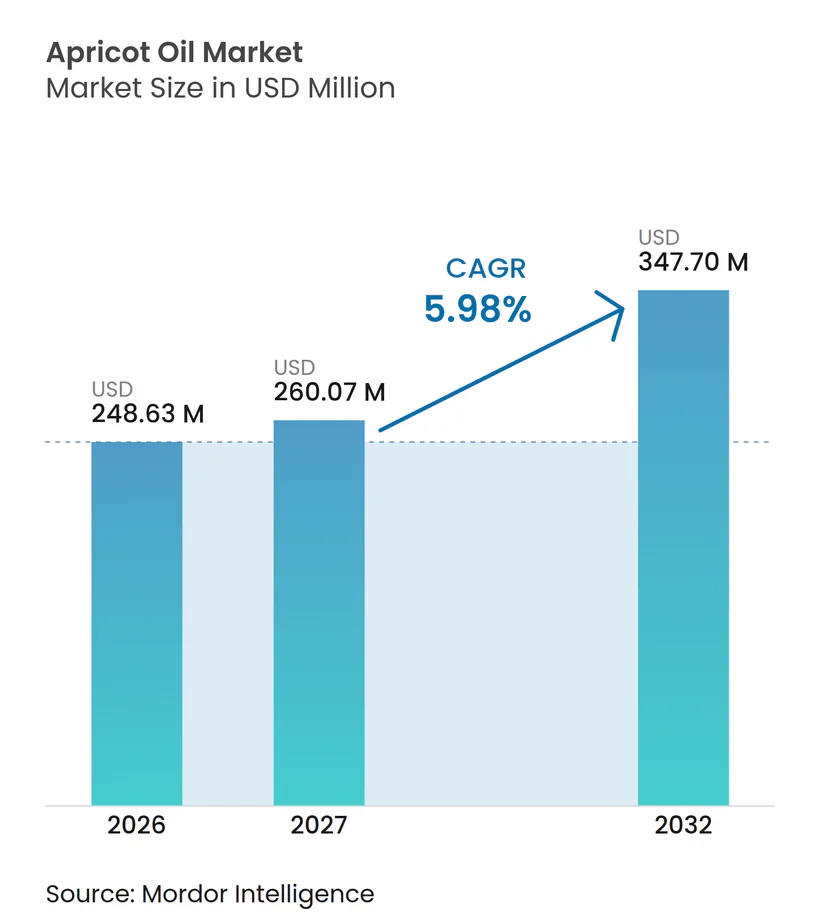
The apricot oil market size is expected to grow from USD 248.63 million in 2026 to USD 260.07 million in 2027 and is forecast to reach USD 347.70 million by 2032 at a 5.98% CAGR over 2027-2032. The apricot oil market is experiencing steady growth, supported by increasing demand for plant-derived ingredients across cosmetics, personal care, food, and pharmaceutical applications. Growing consumer preference for natural and organic formulations is encouraging manufacturers to incorporate botanical oils into their product portfolios. The market is also benefiting from greater utilization of agricultural by-products, improved oil extraction and processing capabilities, and expanding applications of specialty oils in personal care and wellness products. Rising awareness of ingredient quality, product transparency, and formulation benefits is further supporting demand. Additionally, expanding digital distribution channels are improving product accessibility and enabling specialty oil manufacturers to reach a broader customer base.
Key Report Takeaways
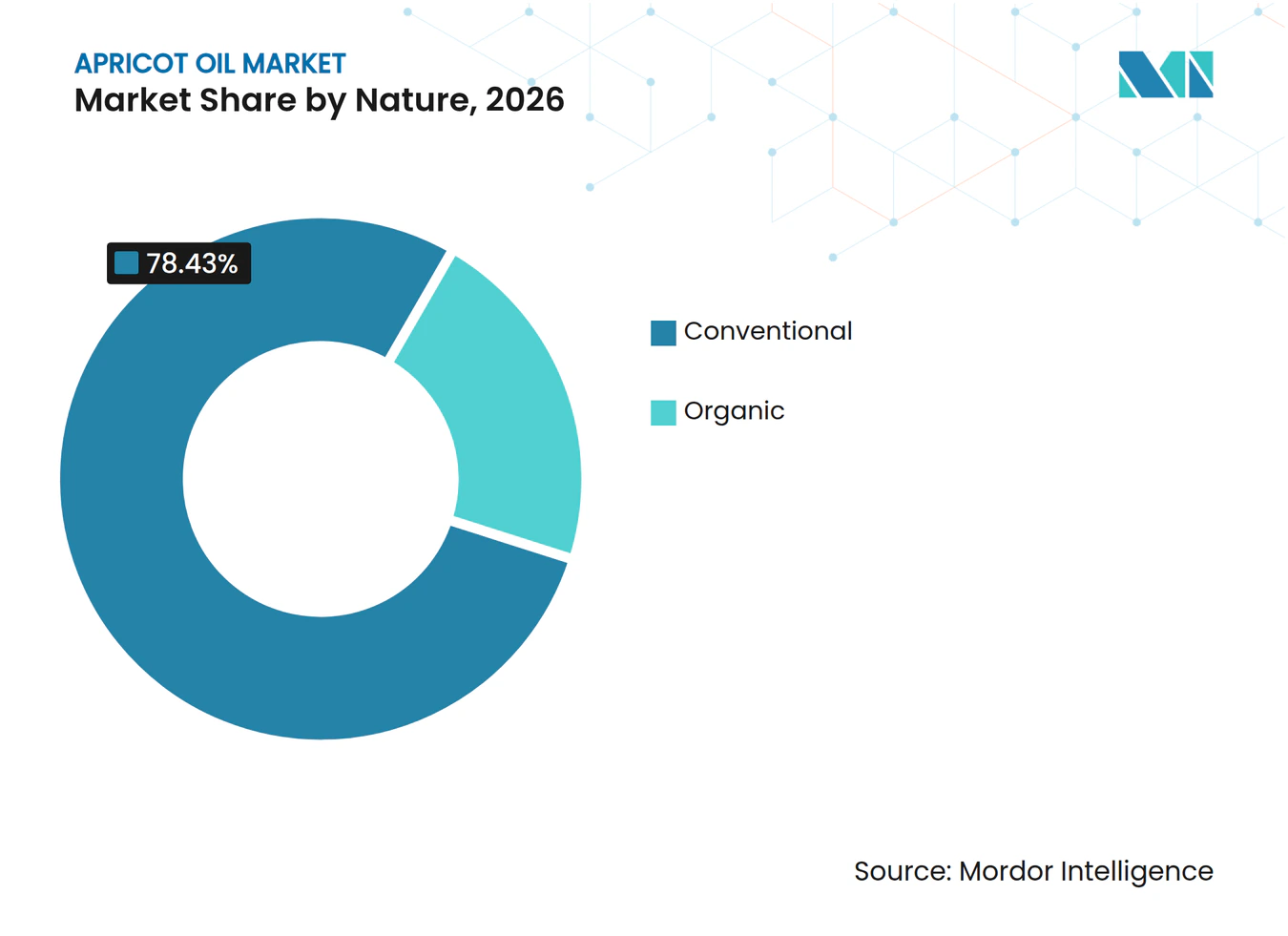
- By nature, conventional oil held 78.43% of the Apricot Oil Market share in 2026, while organic oil is forecast to grow at a 7.68% CAGR during 2027-2032.
- By end use, industrial applications held a 94.63% share of the Apricot Oil Market in 2026, while retail is forecast to grow at a 6.87% CAGR during 2027-2032.
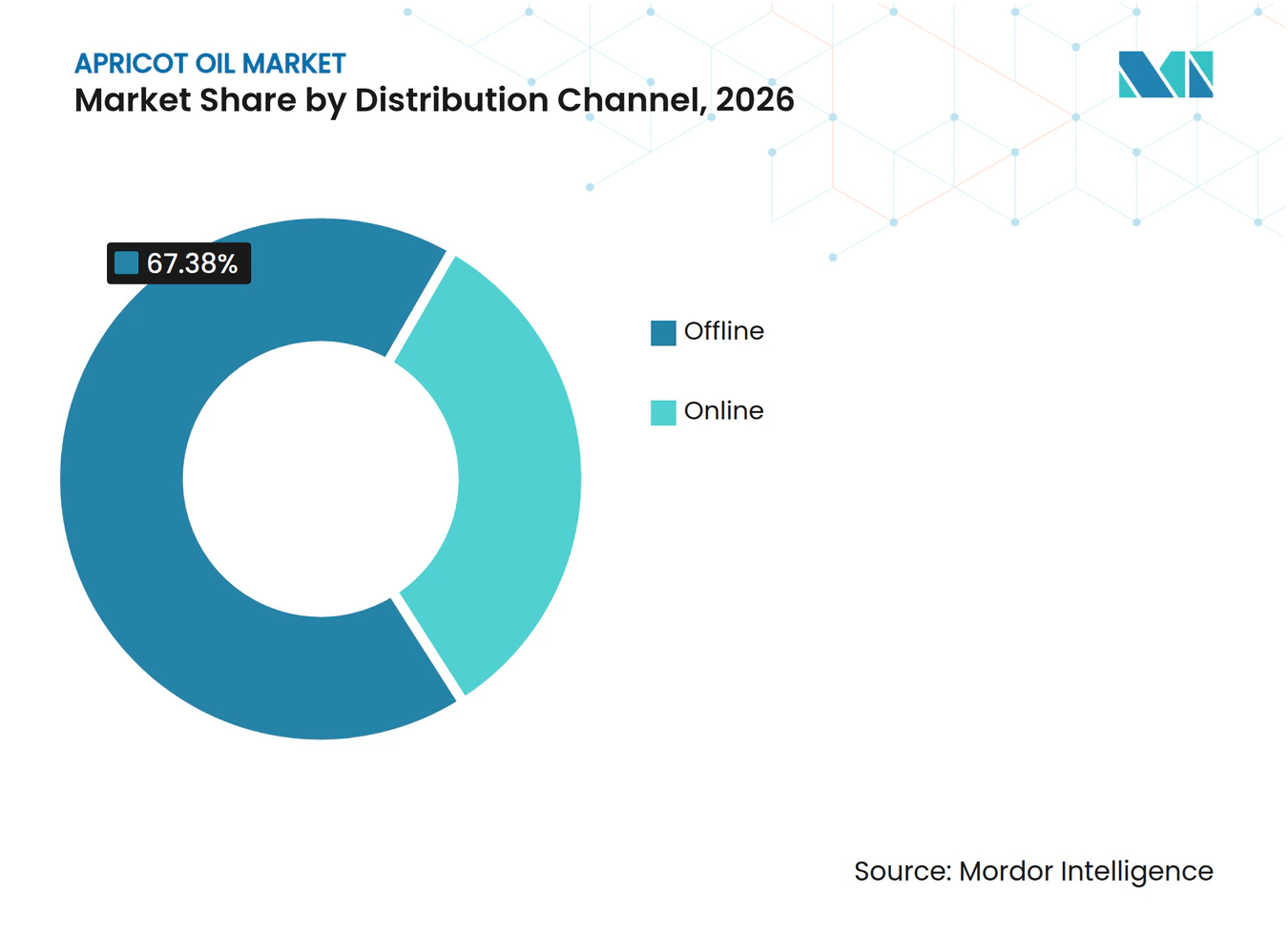
- By distribution channel, offline sales held a 67.38% share of the Apricot Oil Market in 2026, while online sales are forecast to grow at an 8.43% CAGR during 2027-2032.
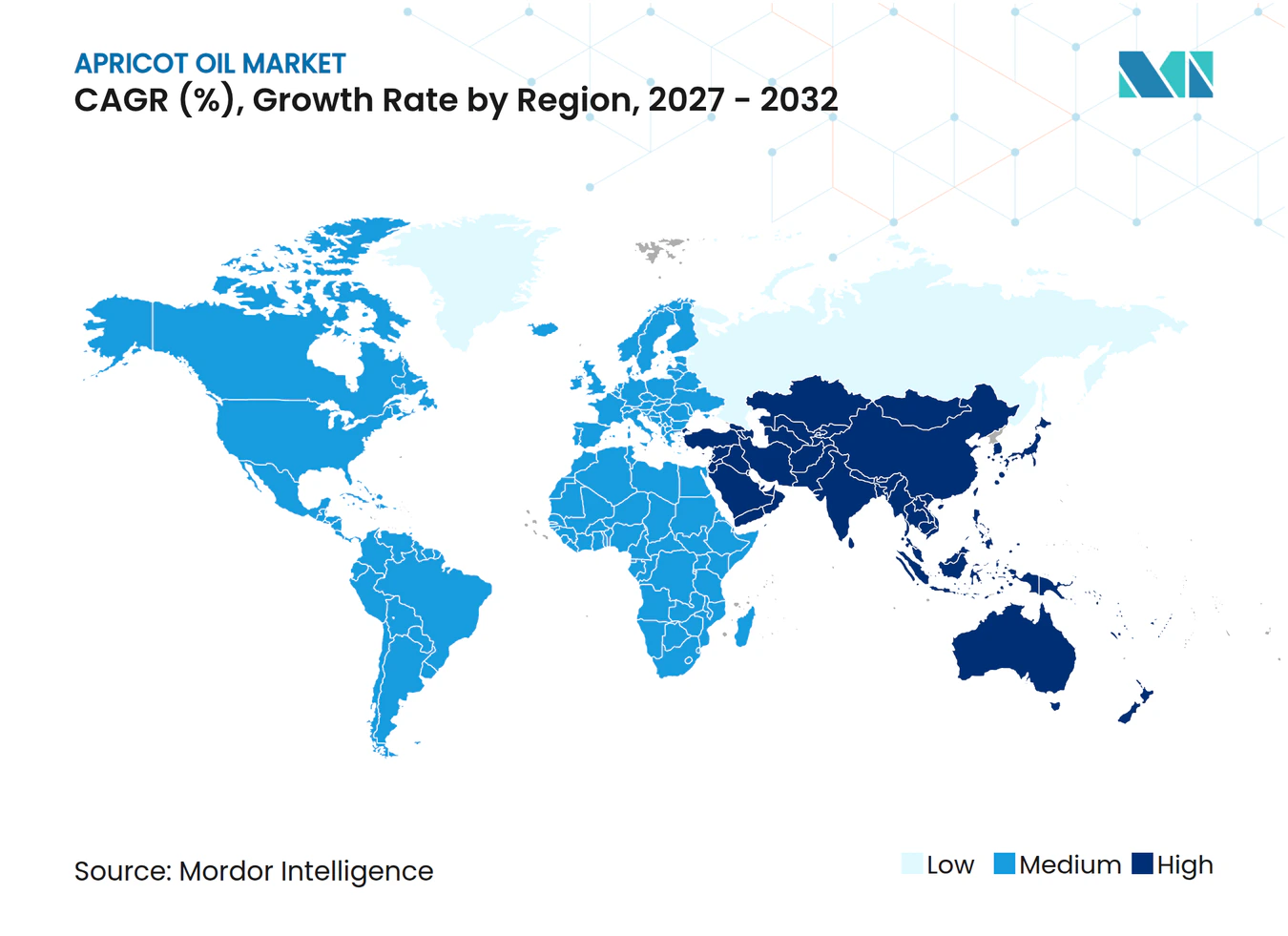
- By geography, Europe held 31.26% of the Apricot Oil Market share in 2026, while Asia-Pacific is forecast to grow at a 6.54% CAGR during 2027-2032.
Note: Market numbers in this report are based on Mordor Intelligence's proprietary estimation framework, which combines nine months of actuals with Q4 projections for base year 2026.
Market Trends and Insights
Drivers Impact Analysis of Apricot Oil Market*
| Driver | (~) % Impact on CAGR Forecast | Geographic Relevance | Impact Timeline |
|---|---|---|---|
| Growing demand for natural and organic personal-care formulations | +1.6% | Global, concentrated in Europe and North America | Short term (≤ 2 years) |
| Increasing consumption of skincare and cosmetic products | +1.1% | Global; especially Asia-Pacific and North America | Short term (≤ 2 years) |
| Rising availability of apricot kernels from fruit-processing activities | +0.8% | Central Asia and European extraction hubs | Medium term (2–4 years) |
| Expanding applications of apricot kernel oil in specialty food formulations | +0.6% | North America, Europe | Medium term (2–4 years) |
| Growing demand from the pharmaceutical and wellness industries | +0.5% | Global | Long term (≥ 4 years) |
| Advancements in apricot kernel oil extraction and recovery technologies | +0.4% | Europe and Asia-Pacific | Long term (≥ 4 years) |
| Source: Mordor Intelligence | |||
Growing Demand for Natural and Organic Personal-Care Formulations
The growing consumer preference for natural and organic personal-care products is encouraging manufacturers to incorporate plant-derived oils into skincare and cosmetic formulations. Increasing attention to ingredient transparency, product quality, and naturally derived alternatives is strengthening demand for botanical ingredients. According to the National Sanitation Foundation (NSF) (2025), 74% of surveyed United States consumers consider organic ingredients important in personal-care products, while 65% want clear ingredient lists to identify potentially harmful ingredients[1]. This shift is encouraging brands to explore naturally derived emollients and specialty carrier oils, supporting the use of apricot oil in skincare, haircare, and other personal-care formulations.
Increasing Consumption of Skincare and Cosmetic Products
The rising consumption of skincare and cosmetic products is expanding demand for functional ingredients used in creams, lotions, facial oils, serums, and other personal-care formulations. Increasing integration of skincare into everyday grooming and wellness routines is encouraging manufacturers to broaden their product offerings and incorporate versatile botanical ingredients. According to the Cosmetics Toiletry and Perfumery Association (CTPA), reporting findings from the Cosmetics Europe Consumer Perception Study (2026), 76% of European consumers use skincare products, while consumers use an average of more than eight cosmetic and personal-care products daily[2]. This sustained product consumption is creating opportunities for specialty oils such as apricot oil, which is valued for its emollient properties and suitability for topical formulations.
Rising Availability of Apricot Kernels from Fruit-Processing Activities
The growing utilization of apricots across food-processing activities is creating opportunities to recover kernels as valuable by-products for oil extraction and other ingredient applications. Processing activities generate apricot stones that can be further utilized to obtain kernels, providing an additional raw-material stream for specialty oil manufacturers. Increasing emphasis on agricultural waste reduction and by-product valorization is encouraging processors to explore more efficient recovery and utilization methods. This integration of fruit processing and kernel extraction supports resource efficiency, creates additional value from existing agricultural output, and strengthens the availability of raw materials for apricot oil production.
Growing Demand from the Pharmaceutical and Wellness Industries
The expanding pharmaceutical and wellness industries are creating additional opportunities for plant-derived ingredients used in health, personal care, and wellness formulations. Growing interest in preventive healthcare, botanical ingredients, and complementary medicine is encouraging manufacturers to explore naturally sourced oils for various product applications. According to the Global Wellness Institute (GWI) (2025), the global wellness economy is projected to grow at an annual rate of 7.6% through 2029, reaching approximately USD 9.8 trillion[3]. Additionally, NITI Aayog (2026) estimates that global spending on medicines will increase at a compound annual growth rate of 5–6% through 2028[4]. These developments are supporting broader opportunities for specialty botanical oils, including apricot oil, across wellness and pharmaceutical-related formulations.
Restraints Impact Analysis of Apricot Oil Market*
| Restraint | (~) % Impact on CAGR Forecast | Geographic Relevance | Impact Timeline |
|---|---|---|---|
| Seasonal and climate-sensitive apricot kernel supply | -0.9% | Türkiye (primary); Europe import markets (Germany, France) | Short term (≤ 2 years) |
| Competition from alternative vegetable and carrier oils | -0.6% | Global | Medium term (2–4 years) |
| Food-safety and cyanogenic-glycoside compliance requirements | -0.5% | Europe, United Kingdom, Australia; global for food-grade oil | Medium term (2–4 years) |
| Oil oxidation susceptibility and batch-to-batch quality variability | -0.4% | Global | Long term (≥ 4 years) |
| Source: Mordor Intelligence | |||
Seasonal and Climate-Sensitive Apricot Kernel Supply
Apricot kernel availability is closely linked to seasonal harvesting cycles and climatic conditions affecting apricot cultivation. Weather-related disruptions, including frost, irregular rainfall, drought, and temperature fluctuations, can influence flowering, fruit development, and overall harvest yields. Since apricot kernels are obtained as by-products of fruit production and processing, fluctuations in apricot harvest volumes can directly affect the availability of raw materials for oil manufacturers. This dependence on seasonal agricultural output creates supply uncertainty, complicates procurement planning, and can lead to fluctuations in raw-material prices. Consequently, manufacturers may face challenges in maintaining consistent sourcing and production schedules, particularly when adverse weather conditions affect major apricot-growing areas.
Competition from Alternative Vegetable and Carrier Oils
The availability of various vegetable and carrier oils creates competitive pressure on apricot oil across personal-care, cosmetic, pharmaceutical, and wellness applications. Manufacturers can choose from a wide range of plant-derived oils based on their formulation requirements, functional properties, sourcing availability, and procurement costs. Established alternatives offer flexibility in product development and can often serve similar purposes in moisturizing, conditioning, and other topical formulations. This wide selection allows manufacturers to substitute ingredients or adjust formulations according to cost and supply considerations, limiting the ability of apricot oil suppliers to secure consistent demand. Consequently, competition from alternative oils can constrain product differentiation and pricing flexibility across the market.
*Our forecasts treat driver/restraint impacts as directional, not additive. The impact forecasts reflect baseline growth, mix effects, and variable interactions.
Apricot Oil Market Segment Analysis
By Nature:
Organic Grade Gaining Speed in a Conventional-Dominant MarketConventional apricot kernel oil holds the largest market share of 78.43% in 2026, supported by its established availability, competitive pricing, and suitability for large-scale industrial applications. Its adoption across personal care, cosmetics, and other ingredient-based formulations is supported by established sourcing and processing networks. Conventional oils also offer manufacturers greater procurement flexibility across different production requirements and product categories. Their suitability for applications that do not specifically require certified organic ingredients further supports their widespread use. Continued demand from established industrial users is expected to maintain the segment's leading position.
Organic apricot kernel oil is the fastest-growing nature segment, and is projected to grow at a CAGR of 7.68% during the forecast period. Its growth is supported by increasing demand for certified natural ingredients, rising preference for sustainable sourcing practices, and the expansion of premium personal-care and cosmetic formulations. Manufacturers are increasingly prioritizing ingredient traceability, certification compliance, and environmentally responsible procurement to align with evolving product standards. Growing adoption of clean-label and organic formulations is further encouraging the use of certified botanical oils. These factors are strengthening demand for organic apricot kernel oil across specialty ingredient applications.


By End Use:
Industrial Dominance Anchored in Cosmetics, Retail the Structural ChallengerIndustrial applications account for the largest share of the apricot oil market, representing 94.63% in 2026. This dominance is supported by established demand from manufacturers using apricot kernel oil in personal care, cosmetics, and other industrial formulations. Its emollient properties and compatibility with various product formulations support its incorporation into skincare, haircare, moisturizing, and topical products. Established procurement networks and consistent industrial consumption further strengthen this segment's position. Continued use of botanical oils across commercial product formulations is expected to sustain industrial applications as the primary end-use category.
Retail end use is the fastest-growing segment and is projected to grow at a CAGR of 6.87% during the forecast period. Its growth is supported by increasing consumer interest in natural skincare ingredients, personal wellness, and do-it-yourself cosmetic formulations. Greater accessibility through online distribution channels is allowing consumers to purchase specialty carrier oils directly for personal use. Rising awareness of ingredient composition and product versatility is further encouraging the adoption of single-ingredient botanical oils. Expanding direct-to-consumer availability and growing interest in home-based skincare and wellness routines are expected to support retail demand for apricot oil.
By Distribution Channel:
Offline Retains the Base, Online Accelerates the FrontierOffline distribution holds the largest share of the apricot oil market, accounting for 67.38% in 2026. Its leading position is supported by established procurement relationships between ingredient suppliers, distributors, and industrial buyers across cosmetics, personal care, and other applications. Offline channels provide access to bulk purchasing, product quality verification, technical assistance, and established supply arrangements. Manufacturers also benefit from direct supplier interactions when evaluating ingredient specifications, consistency, and suitability for different formulations. These factors continue to support the importance of traditional distribution networks, particularly among industrial customers with recurring procurement requirements.
Online distribution is the fastest-growing channel and is projected to grow at a CAGR of 8.43% during the forecast period. Its expansion is supported by increasing digital adoption among consumers and businesses, greater accessibility to specialty ingredients, and the convenience of direct purchasing. E-commerce platforms allow buyers to compare product specifications, sourcing information, certifications, and supplier offerings more efficiently. Growing adoption of digital procurement and direct-to-consumer business models is further improving access to specialty carrier oils. These developments are encouraging suppliers to strengthen their online presence and expand digital sales channels, supporting the growth of online apricot oil distribution.

Geography Analysis
Europe
Europe accounts for 31.26% of the apricot oil market in 2026, supported by established regulatory frameworks, stringent ingredient quality standards, and demand for naturally derived cosmetic ingredients. Regional certification and compliance requirements encourage manufacturers to prioritize ingredient traceability, quality assurance, and responsible sourcing practices. These standards are strengthening the importance of qualified suppliers and established processing capabilities across the regional supply chain. Additionally, investments in natural ingredient research, processing infrastructure, and product innovation are supporting the development of specialty botanical oils. Together, these factors reinforce Europe's position as an established market for apricot oil.
Asia-Pacific
Asia-Pacific is the fastest-growing regional market for apricot oil and is projected to grow at a CAGR of 6.54% from 2027 to 2032. Growth is supported by increasing adoption of online purchasing channels, expanding beauty and personal-care industries, and rising demand for plant-derived ingredients. The region's growing digital retail ecosystem is improving consumer access to specialty oils, while established ingredient suppliers and manufacturers are supporting procurement across commercial and consumer applications. Regulatory frameworks governing cosmetic ingredients and product safety also influence formulation practices and market access across individual countries. These developments, combined with expanding demand for natural personal-care products, are expected to support the region's growth over the forecast period.
North America, South America, and the Middle East and Africa
North America represents an established market for apricot oil, supported by demand for naturally derived ingredients, developed personal-care industries, and established specialty ingredient distribution networks. Growing interest in clean beauty and botanical formulations is encouraging the use of plant-based oils across skincare, haircare, and cosmetic applications. Meanwhile, South America and the Middle East and Africa offer further growth opportunities as personal-care markets expand and consumer awareness of natural ingredients increases. Improvements in retail infrastructure, wider product availability, and the gradual expansion of digital commerce are supporting market access across these regions. Together, these developments are creating opportunities for apricot oil adoption across both established and emerging markets.
Competitive Landscape
Market Concentration
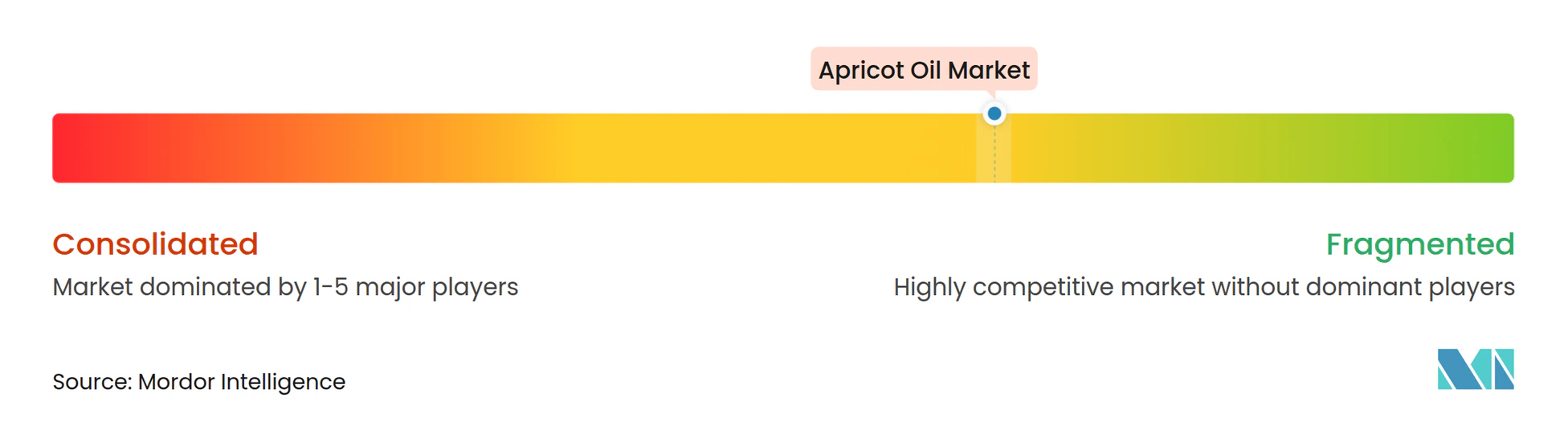
The apricot oil market is moderately fragmented, with competition distributed among specialty oil manufacturers, ingredient suppliers, and distributors rather than concentrated among a single dominant company. Major market participants include NOW Foods, Henry Lamotte Oils GmbH, Givaudan, Gustav Heess GmbH, and Jedwards International, Inc. These companies compete through product quality, sourcing capabilities, processing expertise, distribution networks, and the ability to supply apricot oil for different end-use applications. Their established presence in the broader specialty oils and ingredients industry supports competition across personal care, cosmetics, food, and other applications.
Leading companies are strengthening their competitive positions through investments in processing capabilities, research and development, product quality, and supply-chain infrastructure. Differentiation increasingly depends on ingredient traceability, extraction methods, certification standards, and the ability to meet application-specific requirements. Specialty ingredient distributors are also broadening their natural ingredient portfolios and strengthening technical support for customers. These activities reflect a wider shift toward value-added ingredient supply, where technical expertise and reliable sourcing are becoming important competitive factors alongside product availability and pricing.
Emerging and specialized participants are creating additional competitive pressure through differentiated sourcing models, by-product utilization, and application-focused product development. Companies are developing upcycled ingredient solutions that utilize fruit-processing by-products, while other specialty suppliers are focusing on traceable sourcing and improved processing practices. These approaches provide opportunities to differentiate products through resource efficiency, supply-chain transparency, and sustainability-related attributes. As demand for naturally derived ingredients expands, suppliers with specialized processing capabilities and consistent quality documentation may strengthen their position in the market.
Apricot Oil Industry Leaders
-
NOW Foods
-
Henry Lamotte Oils GmbH
-
Givaudan
-
Gustav Heess GmbH
-
Jedwards International, Inc.
- *Disclaimer: Major Players sorted in no particular order
Apricot Oil Market Companies Covered in this Report
- NOW Foods
- Givaudan
- Jedwards International, Inc.
- Henry Lamotte Oils GmbH
- Gustav Heess GmbH
- AOS Products Pvt. Ltd.
- Mountain Rose Herbs
- Berje Inc.
- AMICOS
- VedaOils
- Plimon
- OLVEA
- SOPHIM
- Azelis
- All Organic Treasures GmbH
- Kern Tec GmbH
- A&A Fratelli Parodi S.p.A.
- Lebermuth
- MakingCosmetics Inc.
- New Directions Aromatics Inc.
- Elemental SRL
- Amphora Aromatics Limited
Recent Industry Developments in Apricot Oil Market
- March 2026: Reliance Retail acquired Himalayan beauty and wellness brand Pahadi Local, along with its business, from Pahadi Goodness Private Limited. The brand's product portfolio includes skincare formulations using Himalayan ingredients such as apricot kernel oil. The acquisition is expected to support the brand's expansion through Reliance Retail's physical stores and digital commerce platforms.
- January 2026: Safic-Alcan expanded its distribution partnership with Givaudan to include the latter's Active Beauty portfolio in Greece. The agreement also marked the launch of Safic-Alcan's Personal Care and Life Sciences division in the country. Givaudan's Active Beauty portfolio includes apricot oil, making the partnership relevant to the distribution of specialty botanical ingredients in the Greek personal-care market.
- June 2025: Yanagiya Honten partnered with Nippon Columbia and the Japanese rock band reGretGirl to introduce a limited-edition version of its Yanagiya Apricot Oil with a specially designed bottle. The product was launched on June 19, 2025, at venues hosting the band's 2025 concert tour. The collaboration combined the company's established plant-derived apricot hair and body oil with a customized consumer-facing product offering. This development demonstrates the use of brand collaborations and limited-edition packaging to extend the reach of apricot oil-based personal-care products.
Global Apricot Oil Market Report Scope
Apricot oil is a plant-derived oil extracted from apricot kernels and used in personal care, cosmetics, food, pharmaceutical, and other applications. The market is segmented by nature into conventional and organic. By end use, the market is categorized into industrial and retail. By distribution channel, it covers online and offline sales. Geographically, the report examines North America, Europe, Asia-Pacific, South America, and the Middle East and Africa. Market forecasts are provided in terms of value in USD and volume in metric tons.
Segmentation Overview
| Conventional |
| Organic |
| Industrial | Cosmetics/Personal Care |
| Food/Beverages | |
| Pharmaceuticals | |
| Other Applications | |
| Retail |
| Online |
| Offline |
| North America | United States |
| Canada | |
| Rest of North America | |
| Europe | Germany |
| United Kingdom | |
| Italy | |
| France | |
| Rest of Europe | |
| Asia-Pacific | China |
| India | |
| Japan | |
| Australia | |
| Rest of Asia-Pacific | |
| South America | |
| Middle East and Africa |
| By Nature | Conventional | |
| Organic | ||
| By End Use | Industrial | Cosmetics/Personal Care |
| Food/Beverages | ||
| Pharmaceuticals | ||
| Other Applications | ||
| Retail | ||
| By Distribution Channel | Online | |
| Offline | ||
| By Geography | North America | United States |
| Canada | ||
| Rest of North America | ||
| Europe | Germany | |
| United Kingdom | ||
| Italy | ||
| France | ||
| Rest of Europe | ||
| Asia-Pacific | China | |
| India | ||
| Japan | ||
| Australia | ||
| Rest of Asia-Pacific | ||
| South America | ||
| Middle East and Africa | ||
Key Questions Answered in the Report
What is the projected growth rate for apricot oil through 2032?
The apricot oil market is forecast to grow at a 5.98% CAGR from 2027 to 2032, reaching USD 347.70 million by 2032.
What is the leading end use for apricot oil?
Industrial applications held 94.63% share in 2026.
Which sales channel is growing the quickest for apricot oil?
Online sales are forecast to grow at an 8.43% CAGR.
Which region has the highest apricot oil demand?
Europe held 31.26% of market share in 2026.