
Antimicrobial Packaging Market Size and Share
Market Overview
| Study Period | 2020 - 2031 |
|---|---|
| Market Size (2026) | USD 13.61 Billion |
| Market Size (2031) | USD 17.38 Billion |
| Growth Rate (2026 - 2031) | 5.01 % |
| Fastest Growing Market | Asia Pacific |
| Largest Market | Asia Pacific |
| Market Concentration | Medium |
Major Players *Disclaimer: Major Players sorted in no particular order Image © Mordor Intelligence. Reuse requires attribution under CC BY 4.0. | |
Antimicrobial Packaging Market Analysis by Mordor Intelligence
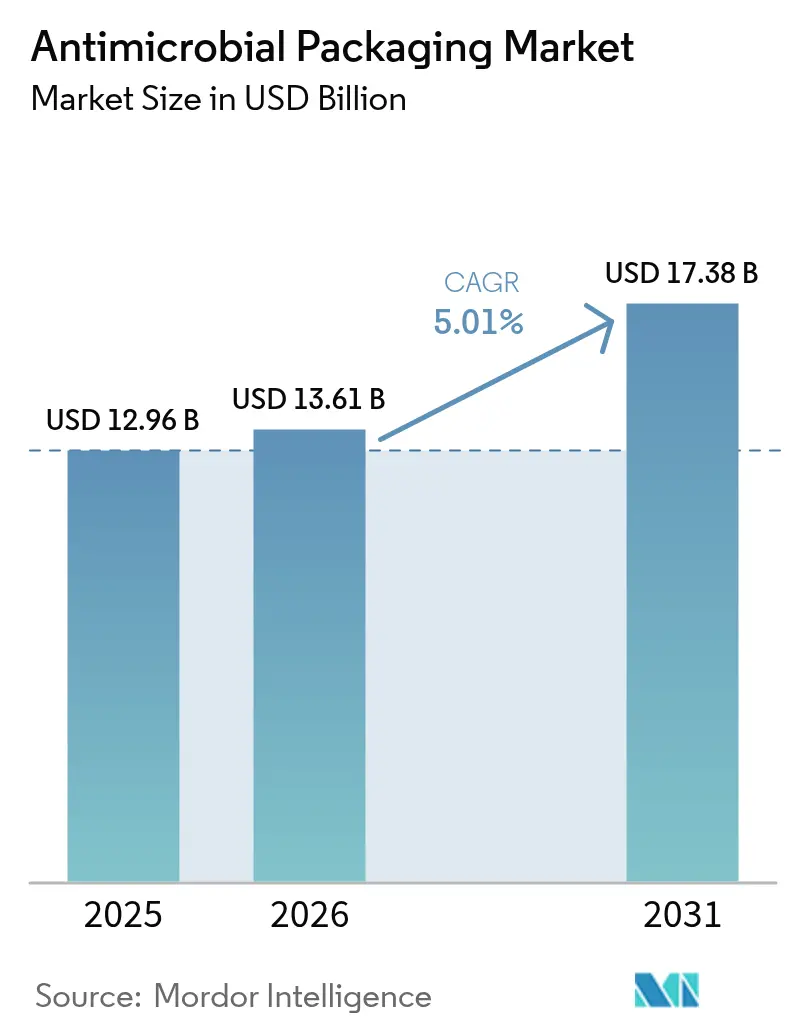
The Antimicrobial Packaging Market size was valued at USD 12.96 billion in 2025 and estimated to grow from USD 13.61 billion in 2026 to reach USD 17.38 billion by 2031, at a CAGR of 5.01% during the forecast period (2026-2031). Demand is propelled by stricter food-contact regulations, the phase-out of PFAS substances, and corporate sustainability mandates that elevate antimicrobial functionality to a mainstream packaging requirement. Regulatory momentum has sparked a pivot toward bio-based antimicrobial agents that balance microbial efficacy with environmental credentials. Asia-Pacific remains the fulcrum of growth, driven by evolving sanitation laws, a booming e-grocery sector, and rapid cold-chain upgrades. Parallel advances in controlled-release nano-silver films, natural compound integration, and smart-sensor pairing are reshaping competitive innovation priorities. As a result, the antimicrobial packaging market continues to diversify across materials, technologies, and end-use sectors.
Key Report Takeaways
- By material, plastics led with 59.74% revenue share in 2025, while biopolymers are set to climb at an 8.05% CAGR through 2031.
- By antimicrobial agent, organic acids held 45.12% of the antimicrobial packaging market share in 2025; bacteriocins and enzymes record the fastest 7.29% CAGR to 2031.
- By technology, active surface coatings commanded 56.11% share of the antimicrobial packaging market size in 2025; controlled-release systems are projected to expand at 6.51% CAGR between 2026-2031.
- By pack type, pouches and bags accounted for 39.88% of the market in 2025, whereas cartons post the highest 8.17% CAGR.
- By end-user, food and beverages captured 45.10% share in 2025, yet healthcare and medical devices advance at a 8.66% CAGR.
- By geography, Asia-Pacific dominated with 40.74% share in 2025 and is forecast to grow fastest at 8.44% CAGR.
Note: Market size and forecast figures in this report are generated using Mordor Intelligence’s proprietary estimation framework, updated with the latest available data and insights as of 2026.
Global Antimicrobial Packaging Market Trends and Insights
Drivers Impact Analysis*
| Driver | (~) % Impact on CAGR Forecast | Geographic Relevance | Impact Timeline |
|---|---|---|---|
| Stringent post-COVID food-safety regulations | +1.2% | Global, with emphasis on North America and EU | Medium term (2-4 years) |
| Acceleration of e-grocery cold-chain investments | +0.8% | Asia-Pacific core, spill-over to North America | Short term (≤ 2 years) |
| Breakthroughs in controlled-release nano-silver films | +0.6% | Global, led by North America and EU research hubs | Long term (≥ 4 years) |
| Inclusion of antimicrobial features in ESG scorecards | +0.4% | North America and EU, expanding to Asia-Pacific | Medium term (2-4 years) |
| Shift to reusable medical-device trays in hospitals | +0.3% | Global, concentrated in developed markets | Short term (≤ 2 years) |
| Adoption of edible, antimicrobial coatings for fresh-produce export | +0.5% | Asia-Pacific export economies, MEA emerging markets | Medium term (2-4 years) |
| Source: Mordor Intelligence | |||
Stringent Post-COVID Food-Safety Regulations
The global reset of food-contact oversight is amplifying uptake of antimicrobial solutions. The United States Human Foods Program now reassesses legacy PFAS notifications, creating an opening for safer antimicrobial alternatives. [1] European agencies simultaneously flag persistent pathogens such as Listeria monocytogenes, compelling processors to adopt packaging that adds an extra microbial barrier. These converging mandates accelerate investment in naturally-derived agents that fulfil both safety and “clean-label” expectations. For suppliers able to document efficacy and recyclability, regulatory tightening translates into clear growth runway within the antimicrobial packaging market.
Acceleration of E-Grocery Cold-Chain Investments
Explosive demand for online groceries places unprecedented stress on temperature-controlled logistics. In Asia-Pacific, thousands of micro-fulfilment warehouses now require packaging that maintains quality over extended last-mile journeys. When refrigeration falters, antimicrobial layers serve as a critical secondary safeguard, reducing spoilage claims. Emerging smart packs pair time-temperature indicators with embedded antimicrobials, giving platforms data-driven control over freshness. As same-day delivery windows shrink, retailers increasingly make antimicrobial functionality a procurement prerequisite, particularly for high-risk perishables. This e-commerce momentum solidifies near-term gains for the antimicrobial packaging market.
Breakthroughs in Controlled-Release Nano-Silver Films
Academic labs have engineered film-forming silver assemblies that deliver zero bacterial adhesion for 30+ days without toxic burst release. [2] While legacy nano-silver raised migration alarms in dry foods, new hierarchical matrices meter release to regulatory-acceptable thresholds. Controlled-release architecture widens use cases from wound-care trays to extended-shelf-life bakery films. Ongoing refinement toward bio-compatibility positions the technology as a long-term growth catalyst for the antimicrobial packaging market.
Inclusion of Antimicrobial Features in ESG Scorecards
Major brand owners now credit antimicrobial packaging in ESG audits for its role in curbing food waste—roughly 30% of global output. Amcor reports 95% of rigid packs are recyclable while simultaneously extending product life through antimicrobial layers. [3] Investors reward demonstrable waste-reduction metrics, making antimicrobial capability a route to improved sustainability rankings. As comparable disclosures proliferate, suppliers that align antimicrobial efficacy with recyclability establish a stronger value proposition throughout the antimicrobial packaging industry.
Restraints Impact Analysis*
| Restraint | (~) % Impact on CAGR Forecast | Geographic Relevance | Impact Timeline |
|---|---|---|---|
| EU biocide regulation (BPR) hurdles for nano-metals | -0.7% | EU, with spillover effects to global markets | Medium term (2-4 years) |
| Price volatility in silver and copper feedstocks | -0.5% | Global, particularly affecting cost-sensitive applications | Short term (≤ 2 years) |
| Consumer push-back on synthetic preservatives in packaging | -0.4% | North America and EU, expanding to Asia-Pacific markets | Medium term (2-4 years) |
| Scale-up challenges for bio-based antimicrobial polymers | -0.3% | Global, concentrated in developed manufacturing hubs | Long term (≥ 4 years) |
| Source: Mordor Intelligence | |||
EU Biocide Regulation (BPR) Hurdles for Nano-Metals
Europe’s Biocidal Products Regulation requires exhaustive dossiers before nano-silver or nano-copper can enter food-contact channels. With no nano-metal yet authorised for direct food or feed applications, innovators face multi-year toxicology programs. Wide-ranging data demands inflate time-to-market, prompting some firms to pivot toward plant-based actives that clear regulatory pathways more swiftly. The deterrent effect narrows near-term growth for metallic solutions inside the antimicrobial packaging market.
Price Volatility in Silver and Copper Feedstocks
Spot prices for silver and copper continue to swing on industrial demand, complicating cost models for antimicrobial masterbatches. Producers buffer volatility through hedging, recycling recovery, and dilution with hybrid organic agents. Nevertheless, thin-margin applications such as fresh-produce wraps remain sensitive to price spikes, slowing adoption. These economics reinforce R&D focus on bio-sourced compounds with more predictable cost curves, subtly tempering CAGR contributions for metal-based formats across the antimicrobial packaging market.
*Our forecasts treat driver/restraint impacts as directional, not additive. The impact forecasts reflect baseline growth, mix effects, and variable interactions.
Segment Analysis
By Material: Biopolymers Drive Sustainability Transition
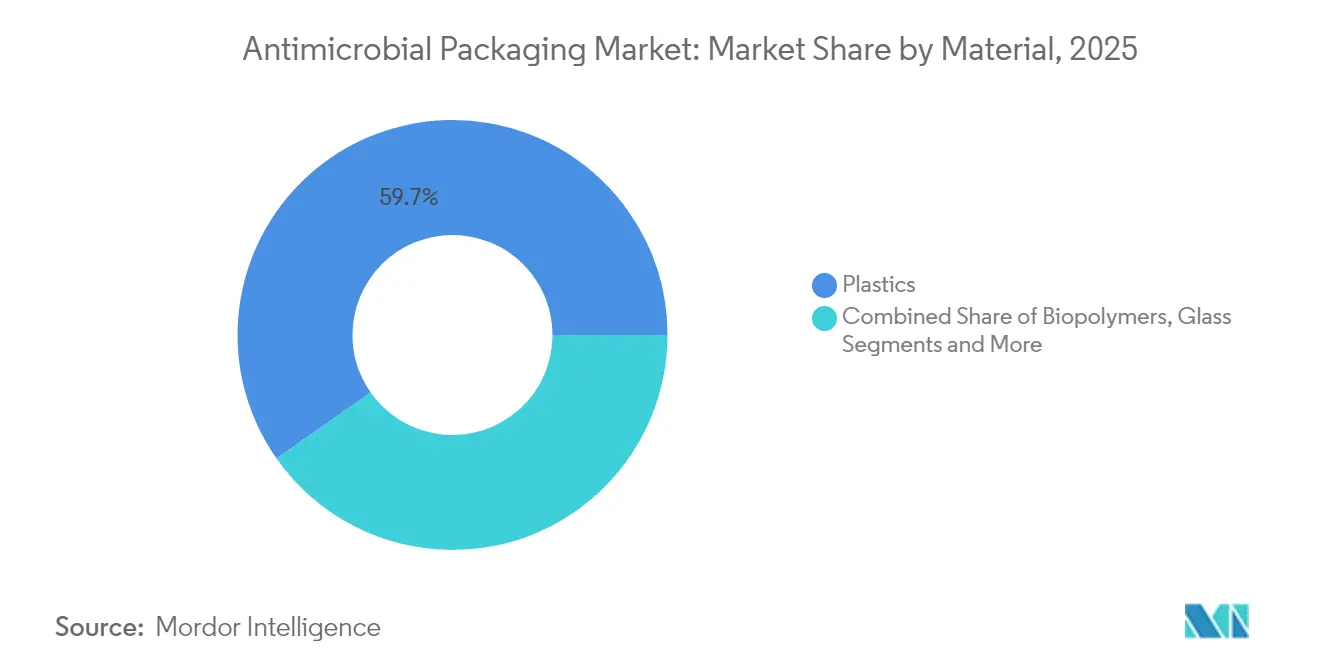
Plastics currently anchor the antimicrobial packaging market size, capturing 59.74% revenue share in 2025 due to scalable extrusion lines and robust barrier performance. Yet policy targets that mandate full recyclability by 2030 propel biopolymers to an 8.05% CAGR, the fastest among materials. Poly-lactic acid and polyhydroxyalkanoate blends enhanced with chitosan or essential oils now match microbial kill rates seen in petrochemical films while supporting compostable end-of-life routes.
Investment is accelerating in closed-loop collection schemes that recover biopolymer offcuts without sacrificing antimicrobial potency. Research also evidences that paper fibres coated with phenolic-rich polysaccharides retain recyclability and deliver broad-spectrum bacterial inhibition. These advances ensure biopolymers will continue eroding plastic share, reshaping supplier portfolios throughout the antimicrobial packaging market.

By Antimicrobial Agent Type: Natural Compounds Gain Momentum
Organic acids command 45.12% of 2025 revenue owing to regulatory familiarity and cost efficiency. However, bacteriocins and enzymes accelerate at 7.29% CAGR, mirroring consumer migration to recognizable, label-friendly additives. Synergistic systems marry bacteriocins with nano-silver, doubling kill efficiency while curbing metal dosage.
Essential oils protected within cyclodextrin cages provide controlled vapor release that suppresses spoilage organisms in high-moisture produce. As biocide scrutiny intensifies, plant-derived agents gain strategic heft, positioning natural actives as pivotal to future differentiation in the antimicrobial packaging market.
By Technology: Controlled-Release Systems Show Promise
Active surface coatings sit atop the technology hierarchy with 56.11% share, benefitting from simple gravure or spray deposition onto existing substrates. Nonetheless, controlled-release platforms advance at 6.51% CAGR as converters incorporate multi-layer films that stagger antimicrobial diffusion. Hierarchical polymer matrices now enable day-long zero-bacterial adhesion without leaching.
Smart sensors paired with release triggers respond to pH or temperature shifts, extending protection only when spoilage risk rises. These functional synergies encourage wider uptake, bolstering the antimicrobial packaging market’s premium tiers.
By Pack Type: Carton Innovation Drives Growth
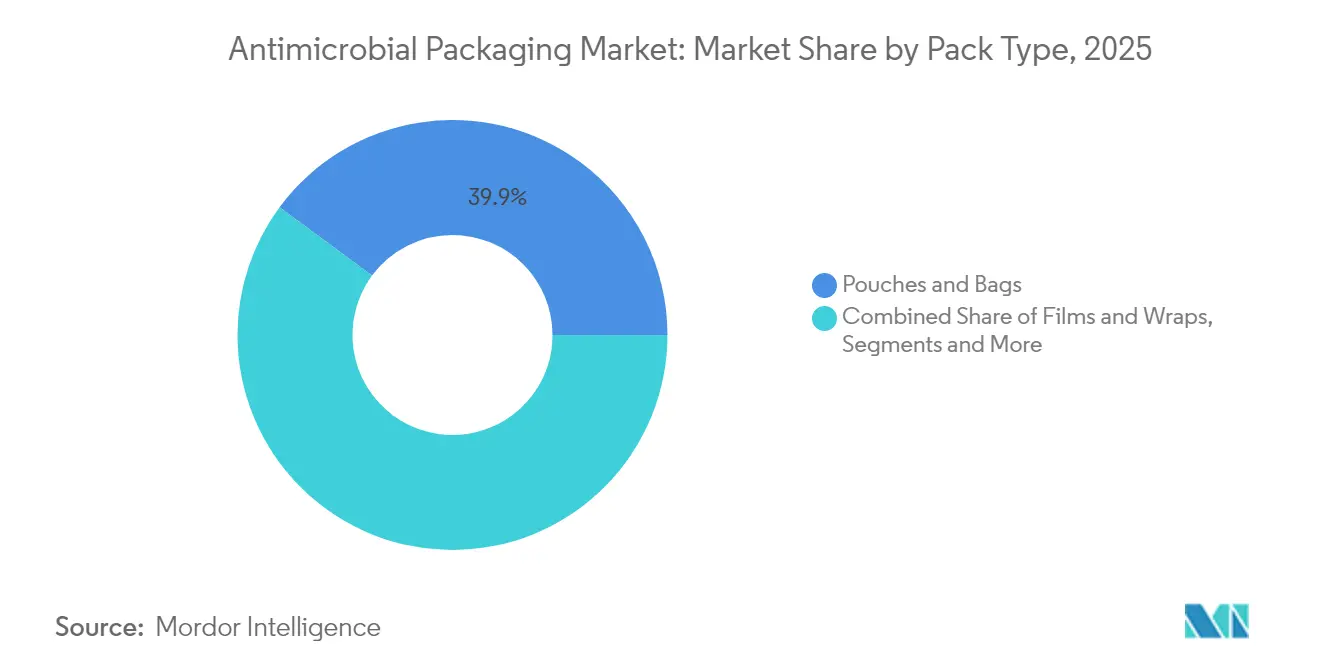
Flexible pouches and bags held 39.88% of 2025 sales, reflecting light-weight economics. Yet cartons climb at 8.17% CAGR, powered by fibre-based formats that incorporate high-barrier antimicrobial coatings while meeting recyclability thresholds. AmFiber Performance Paper illustrates how 80%+ paper content can integrate antimicrobial layers without compromising MRF recovery streams.
Concurrently, antimicrobial shrink films for trays combine oxygen scavenging with microbial kill to safeguard case-ready meat. Continuous innovation across both rigid and flexible formats confirms packaging engineers’ commitment to raising performance across the antimicrobial packaging market.
By End-User Industry: Healthcare Accelerates Adoption
Food and beverages accounted for 45.10% of spending in 2025 as retailers demanded extended shelf life for high-risk proteins and fresh produce. Post-pandemic infection-control protocols propel healthcare packaging to a 8.66% CAGR, the fastest across verticals. SteriTite reusable trays illustrate how long-cycle medical packs rely on antimicrobial aluminium alloys to maintain sterility across autoclave runs.
Single-barrier sterile wraps that cut medical waste while preserving microbial integrity further expand hospital demand. This healthcare momentum diversifies revenue streams, underpinning long-term resilience within the antimicrobial packaging market.
Geography Analysis
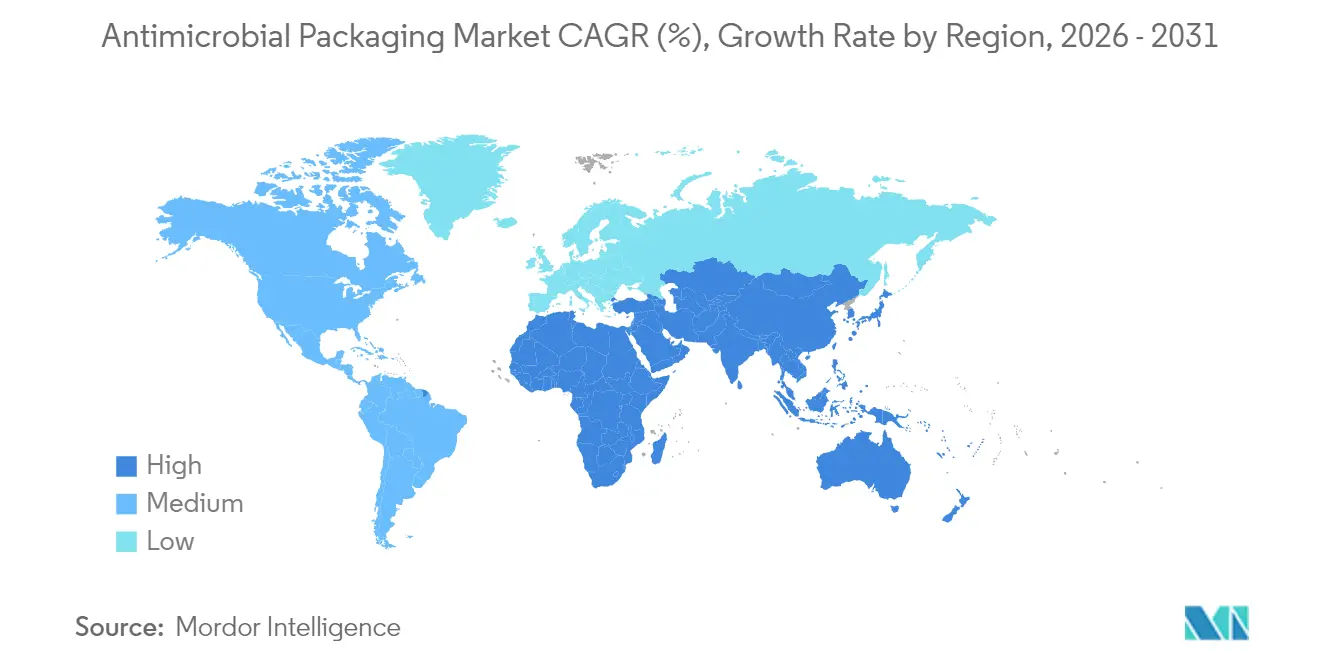
Asia-Pacific tops the global leaderboard, holding 40.74% revenue in 2025 and registering the highest 8.44% CAGR to 2031. China’s Food Safety Law amendments and India’s FSSAI hygiene codes mandate microbiological safeguards that funnel capital toward advanced packs. Japanese converters add smart indicators and controlled-release antimicrobials to premium seafood exports, elevating unit margins. Regional government initiatives to counter antimicrobial resistance further incentivise adoption, reinforcing Asia-Pacific’s pull on the antimicrobial packaging market.
Europe follows, its trajectory shaped by the EU Packaging and Packaging Waste Regulation that forces recyclability and recycled-content compliance. Germany and France spearhead R&D into bio-based actives, whereas Mediterranean exporters deploy antimicrobial cartons to secure shelf life during cross-border produce shipments. While the BPR slows nano-metal roll-outs, it simultaneously accelerates botanical innovation, keeping Europe central to technology leadership.
North America sustains steady gains anchored by FDA oversight and robust healthcare demand. The United States channels grant funding toward PFAS alternatives, indirectly uplifting antimicrobial packaging market size for natural actives. Canadian institutes pilot cellulose-based films infused with enzyme cocktails, targeting seafood supply chains. Mexico, leveraging near-shoring trends, scales antimicrobial pouch production for both domestic brands and US retailers.
Regulatory Landscape
Antimicrobial packaging is shaped by food-contact material (FCM) safety requirements, alongside biocidal and sustainability conditions. In the European Union, Regulation (EC) 1935/2004 sets the FCM framework, while active and intelligent materials must comply with Regulation (EC) 450/2009, including EFSA safety evaluation and listing for substances with an active function. This overlaps with the EU Biocidal Products Regulation (BPR) for antimicrobial claims and substances, where nano-metals have faced particular hurdles due to extensive dossier and authorization requirements.
Sustainability-linked compliance is also tightening. The EU Packaging and Packaging Waste Regulation (EU) 2025/40 entered into force on 11 February 2025, with general application beginning 12 August 2026, which pushes pack designs toward recyclability and waste-reduction targets even when antimicrobial performance is added. For plastics, Commission Regulation (EU) 2026/245 (published February 2026) updates authorized substance lists for plastic FCMs, and Regulation (EU) 2025/351 updates requirements tied to recycled plastics and good manufacturing practices, forcing antimicrobial structures to align with both migration safety and recycled-content or recycling-compatibility expectations. In North America, antimicrobial food-contact substances that function as additives require FDA authorization prior to marketing, while Health Canada regulates food packaging materials under its food safety framework, which reinforces documentation and compliance needs for antimicrobial agents, coatings, and release systems.
Competitive Landscape
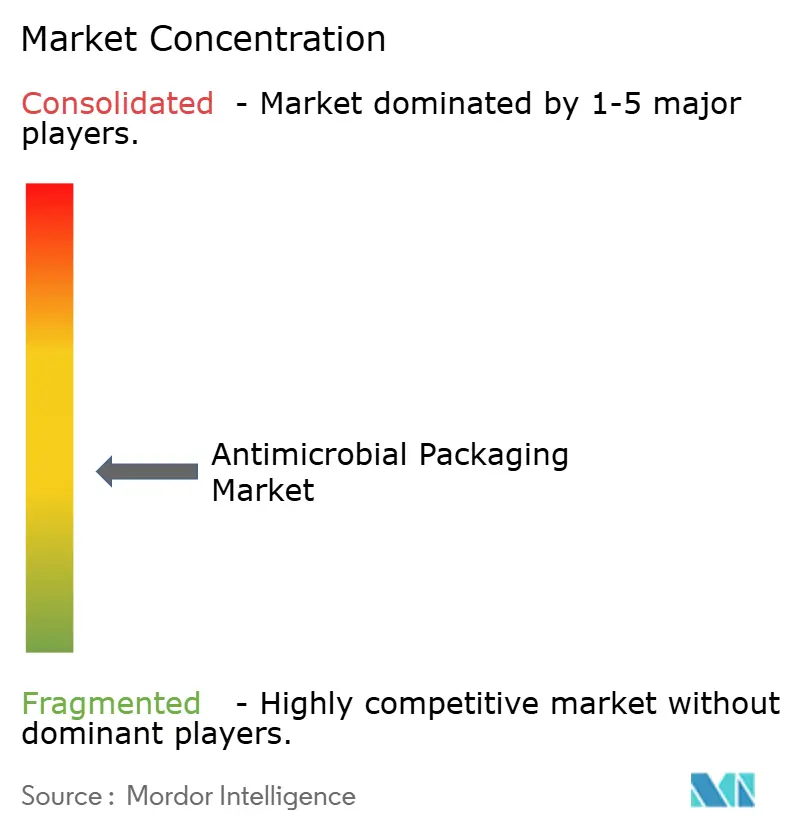
The antimicrobial packaging market remains moderately fragmented. Mega-merger activity, exemplified by Amcor’s all-stock combination with Berry Global, yields a vertically integrated giant poised to extract USD 650 million in synergies by 2028. Simultaneously, niche technology firms such as Microban extend portfolios into PFAS-free water-resistant textiles, broadcasting expertise that can cross-pollinate into food and medical packs.
Strategic focus pivots on proprietary antimicrobial formulations, controlled-release patents, and demonstrable recyclability. Corporate venturing accelerates deal flow; Amcor’s Lift-Off fund backs start-ups like Bloom Biorenewables to secure early access to biobased chemistries. Patent landscapes reveal clustering around enzyme-grafted coatings and nano-porous release reservoirs, areas where first-mover IP can translate into sustainable price premiums. Competitive intensity will hinge on multinationals’ ability to harmonise global regulatory submissions, maintain cost discipline in volatile metals markets, and supply chain-proof biopolymer feedstocks—all critical to consolidating share within the antimicrobial packaging market.
Antimicrobial Packaging Industry Leaders
-
BASF SE
-
Mondi PLC
-
BioCote Limited
-
Dunmore Corporation
-
Avient Corporation
- *Disclaimer: Major Players sorted in no particular order
Market Opportunities and Future Outlook
A key opportunity lies in reformulating antimicrobial solutions away from constrained inorganic actives and toward bio-based and hybrid systems that meet food-contact safety and circularity requirements. Implementation of the Packaging and Packaging Waste Regulation from 12 August 2026 increases the commercial value of antimicrobial performance that does not undermine recyclability, supporting greater interest in fiber-based barrier structures and bio-derived actives (including chitosan, essential oils, organic acids, and bacteriocins/enzymes) for coatings and controlled-release layers. In parallel, regulatory changes referenced in 2026 around silver-based antimicrobial agents, including CLP-linked direction and related downstream restrictions, reinforce whitespace for lower-migration, label-friendly actives and for architectures that deliver efficacy with minimal dosage and clearer compliance pathways.
Near-term whitespace also shows up in retailer and converter validation efforts, particularly in high-waste fresh categories and in formats that are already shifting toward recyclable substrates. In the United Kingdom, Zoono Group reported initial commercial orders for antimicrobial packaging coatings (about NZD 1.2 million) tied to Sharpak Aylesham Limited, connecting antimicrobial coatings to produce-oriented packaging programs where shelf-life extension and waste reduction are direct purchasing criteria. Early-stage scaling is reflected in capacity and trial infrastructure as well: Klura Labs (Cambridge) raised GBP 8 million in July 2026 to expand facilities and retailer trials, supporting a clearer path from lab claims to repeatable manufacturing and qualification. Across technologies, controlled-release systems and smart-pack pairing remain a practical development lane since they address both efficacy duration and migration management, which can improve defensible performance documentation for food and healthcare buyers.
Recent Industry Developments
- June 2026: Mondi introduced re/loop FlowWrap for wet wipes with 35% post-consumer recycled content. The launch aligns wet-wipes flexible packaging with recycled-content and recyclability pressure under the EU Packaging and Packaging Waste Regulation framework, while creating a clearer substrate base for adding antimicrobial coatings in hygiene-focused packs.
- May 2026: BASF and UPM Specialty Materials partnered to develop recyclable fiber-based packaging using UPM barrier papers and BASF Joncryl HPB barrier resins. The collaboration strengthens a route to high-barrier paper structures that can carry antimicrobial functionality without defaulting to hard-to-recycle multilayer plastics.
- August 2025: Mondi ramped up production of FunctionalBarrier Paper Ultimate at its Solec facility in Poland following a EUR 16 million investment. The capacity move supports wider replacement of mixed-material barrier packaging with paper-based alternatives, expanding the addressable base for antimicrobial surface coatings and active layers in fiber-centric packs.
Research Methodology Framework and Report Scope
Market Definition and Coverage
This market covers packaging materials and packaging formats that are intentionally treated or designed with antimicrobial functionality to slow down microbial growth and protect packed products during storage and distribution.
Scope exclusions: We exclude antimicrobial additives sold as standalone raw materials when they are not used in a packaging application, and we also exclude non-packaging surface coatings used on equipment or buildings.
Segmentation Overview
- By Material
- Plastics
- Biopolymers
- Paper and Paperboard
- Glass
- Metals
- By Antimicrobial Agent Type
- Organic Acids
- Bacteriocins and Enzymes
- Silver and Copper Nanoparticles
- Essential Oils and Plant Extracts
- By Technology
- Active Surface Coating
- Controlled-Release Systems
- By Pack Type
- Pouches and Bags
- Films and Wraps
- Trays and Lids
- Carton Packages
- By End-user Industry
- Food and Beverages
- Meat, Poultry and Seafood
- Bakery and Confectionery
- Fruits and Vegetables
- Healthcare and Medical Devices
- Personal Care and Cosmetics
- Animal Feed and Pet Food
- Other End-User Industry
- Food and Beverages
- By Geography
- North America
- United States
- Canada
- Mexico
- Europe
- Germany
- United Kingdom
- France
- Italy
- Spain
- Russia
- Rest of Europe
- Asia-Pacific
- China
- India
- Japan
- South Korea
- Australia and New Zealand
- Rest of Asia-Pacific
- Middle East and Africa
- Middle East
- United Arab Emirates
- Saudi Arabia
- Turkey
- Rest of Middle East
- Africa
- South Africa
- Nigeria
- Egypt
- Rest of Africa
- Middle East
- South America
- Brazil
- Argentina
- Rest of South America
- North America
Data Sources, Market Sizing, and Validation
Desk Research
Desk research was used to build the starting structure of the model and to set realistic boundaries for what qualifies as antimicrobial packaging in real-world supply chains. Public sources were reviewed for packaging demand signals, regulatory direction, and material usage patterns, such as the US FDA food contact framework, the European Commission materials and chemical rules, UN Comtrade trade statistics for packaging materials, and World Bank macro indicators that influence packaged goods consumption.
We also used company annual reports, investor presentations, press releases, and association websites to map product claims, plant footprints, and end use exposure across food, healthcare, and consumer goods. Patent databases were checked to understand which antimicrobial technologies are being commercialized and how quickly substitution is happening, and an import and export shipment-level database was used selectively to sanity-check flows for key packaging substrates where data gaps exist. These desk sources are not exhaustive, and many other public references were used to collect data, validate assumptions, and clarify open questions.
Primary Interviews and Surveys
Primary work focused on confirming what is actually sold as antimicrobial packaging, how pricing is set, and where adoption is real versus still in trials. We spoke with packaging converters, material suppliers, brand owners, and downstream users across major regions so that regional regulation, food safety expectations, and procurement behavior were reflected in the final assumptions.
Distribution of primary research fieldwork respondents
| Company type | Respondent position | Region |
|---|---|---|
| Top tier: 31% | CXOs: 12% | APAC: 52% |
| Mid tier: 49% | Functional/Unit leaders: 36% | EMEA: 29% |
| Smaller Players: 20% | Managers: 52% | Americas: 19% |
Market-Sizing & Forecasting
Our model starts with a top-down build where packaged goods demand, packaging material output and trade movements are used to reconstruct the addressable packaging pool, which is then filtered through antimicrobial adoption rates by end use. To keep the numbers grounded, the totals are corroborated with selective bottom-up checks, including sampled price per unit for antimicrobial formats, channel feedback on typical order sizes, and supplier level volume signals where interviewees could validate ranges.
Key inputs that influence sizing include the share of packaged food and beverages that uses extended shelf life packaging, healthcare and pharma packaging requirements, antimicrobial agent loading and performance claims by format, pricing premiums versus conventional packaging, and regional regulation pressure in food contact and sustainability (which changes what solutions are practical). Forecasts are developed using multivariate regression, where demand for packaged products, regional income and urbanization signals, and adoption curves from interviews are used together, and then scenario analysis is applied for shifts in regulations and material substitution. When bottom-up visibility is weak in smaller countries or niche formats, adoption and pricing are bridged using comparable markets and then rechecked with expert feedback before finalizing.
Data Validation & Update Cycle
Outputs are checked through multiple passes so that the final totals stay consistent with independent indicators like packaging substrate trends, trade direction, and end market consumption. Large variances are flagged, assumptions are revisited, and respondents are re-contacted when a gap cannot be explained by scope or currency timing. Before sign-off, a separate analyst review is completed to confirm that calculations, unit conversions, and regional rollups are consistent.
The report is refreshed annually, and interim updates are triggered when material events occur, such as major regulatory shifts, technology changes that alter pricing premiums, or sharp changes in packaged goods demand. Right before delivery, the model is run again using the latest available public data so clients receive the most current view.
Mordor Intelligence's Antimicrobial Packaging Market Size Compared Against Other Published Estimates
Published market values for antimicrobial packaging can differ even when the topic name looks the same, because teams set different boundaries for what counts as antimicrobial packaging and they do not always align on base year timing. The year used, currency conversion approach, and how pricing premiums are treated can move the number up or down in a noticeable way.
Trade movement signals for key packaging substrates, plus cross-checks with packaged food output and interview-confirmed adoption rates, are the evidence points that keep Mordor Intelligence's estimate tied to a practical demand pool for antimicrobial-enabled packaging rather than broader antimicrobial materials. Other sources may report higher growth by assuming faster premium expansion, or by counting adjacent active packaging features that do not have a clear antimicrobial function, and they may use a different base year that does not match the same market conditions.
Benchmark comparison
| Source | Market Size | Gaps in Research Methodology |
|---|---|---|
| Mordor Intelligence | USD 13.61 B (2026) | |
| Global Consultancy A | USD 14.06 B (2026) | Uses a higher growth framing and tends to apply a broader interpretation of qualifying antimicrobial solutions, which can pull in adjacent active packaging features and lift the addressable value for the same year. |
| Industry Publisher B | USD 11.78 B (2024) | Uses an earlier base year and a different starting market level, and the model emphasis appears to be on reported revenue baselines rather than adoption-led demand reconstruction, which can reduce the size when antimicrobial premiums are not fully captured. |
The table shows that most of the spread comes from scope boundaries and base year selection, followed by how pricing premiums are carried into the current year. By keeping the inputs traceable to packaged goods demand and adoption checks, the estimate stays easy to reproduce and explain during decision making.
Key Questions Answered in the Report
What is the current size of the antimicrobial packaging market?
The market is valued at USD 13.61 billion in 2026 and is projected to reach USD 17.38 billion by 2031 at a 5.01% CAGR.
Which region leads the antimicrobial packaging market?
Asia-Pacific holds 40.74% of global revenue in 2025 and posts the fastest 8.44% CAGR through 2031.
Which material segment is growing fastest?
Biopolymers expand at an 8.05% CAGR as regulations favor recyclable and bio-based substrates.
Why are healthcare applications gaining momentum in antimicrobial packaging?
Post-pandemic infection-control priorities push healthcare packaging to a 8.66% CAGR, the swiftest among end-user industries.