
Andalusite Market Size and Share
Market Overview
| Study Period | 2020 - 2031 |
|---|---|
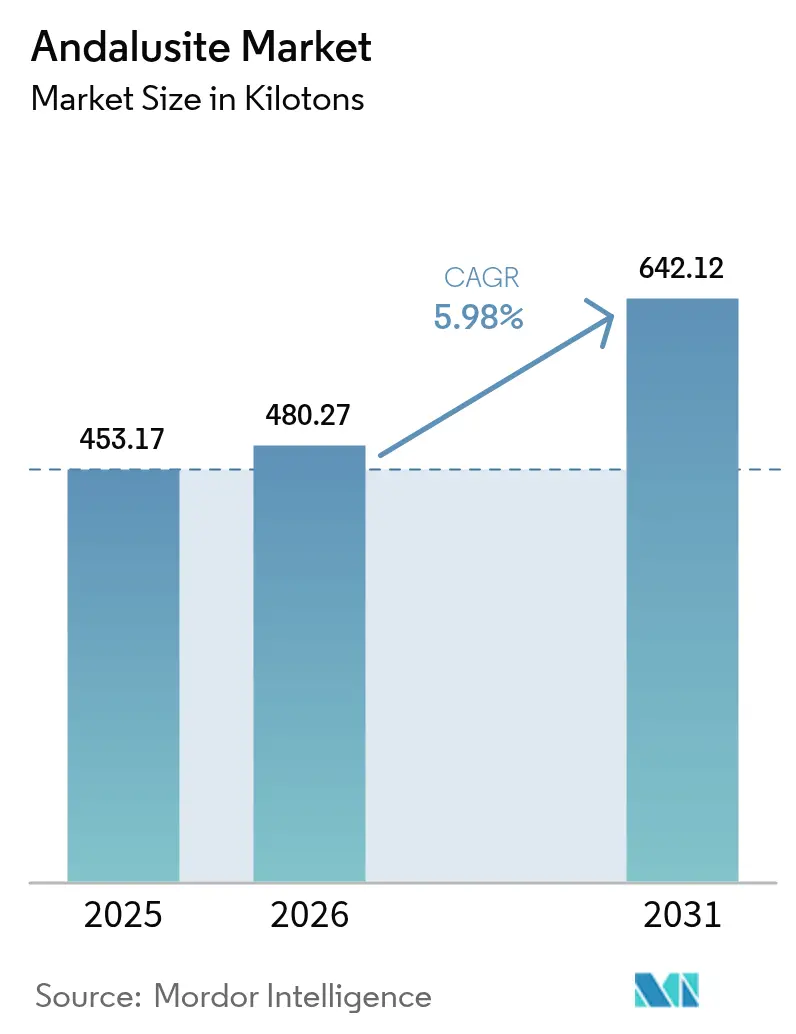
| Market Volume (2026) | 480.27 kilotons |
| Market Volume (2031) | 642.12 kilotons |
| Growth Rate (2026 - 2031) | 5.98 % |
| Fastest Growing Market | Asia Pacific |
| Largest Market | Asia Pacific |
| Market Concentration | Medium |
Major Players *Disclaimer: Major Players sorted in no particular order Image © Mordor Intelligence. Reuse requires attribution under CC BY 4.0. | |
Andalusite Market Analysis by Mordor Intelligence
Andalusite market size in 2026 is estimated at 480.27 kilotons, growing from 2025 value of 453.17 kilotons with 2031 projections showing 642.12 kilotons, growing at 5.98% CAGR over 2026-2031. Rising refractory demand for electric-arc-furnace steelmaking, expanding Southeast Asian foundry capacity, and North American critical-minerals policies are the primary growth catalysts. Supply, however, remains concentrated in South Africa, exposing buyers to risks of grid instability and freight rate volatility. Advanced beneficiation methods are expanding the economically viable resource base, yet new projects are trailing demand momentum, keeping the Andalusite market finely balanced. Growing circular-economy mandates in Europe and the United States add a further layer of complexity, because recycled refractories still require premium virgin Andalusite grades for performance restoration.
Key Report Takeaways
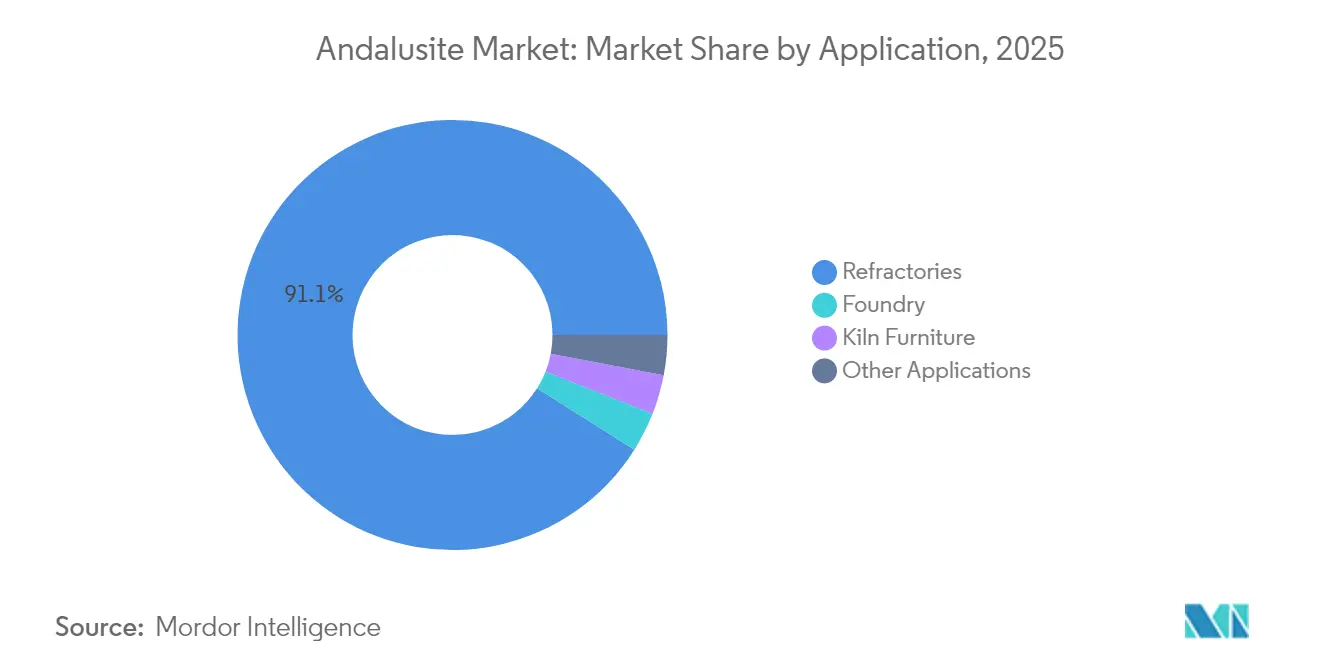
- By application, refractories captured 91.05% of the Andalusite market share in 2025 and are projected to advance at a 7.6% CAGR through 2031.
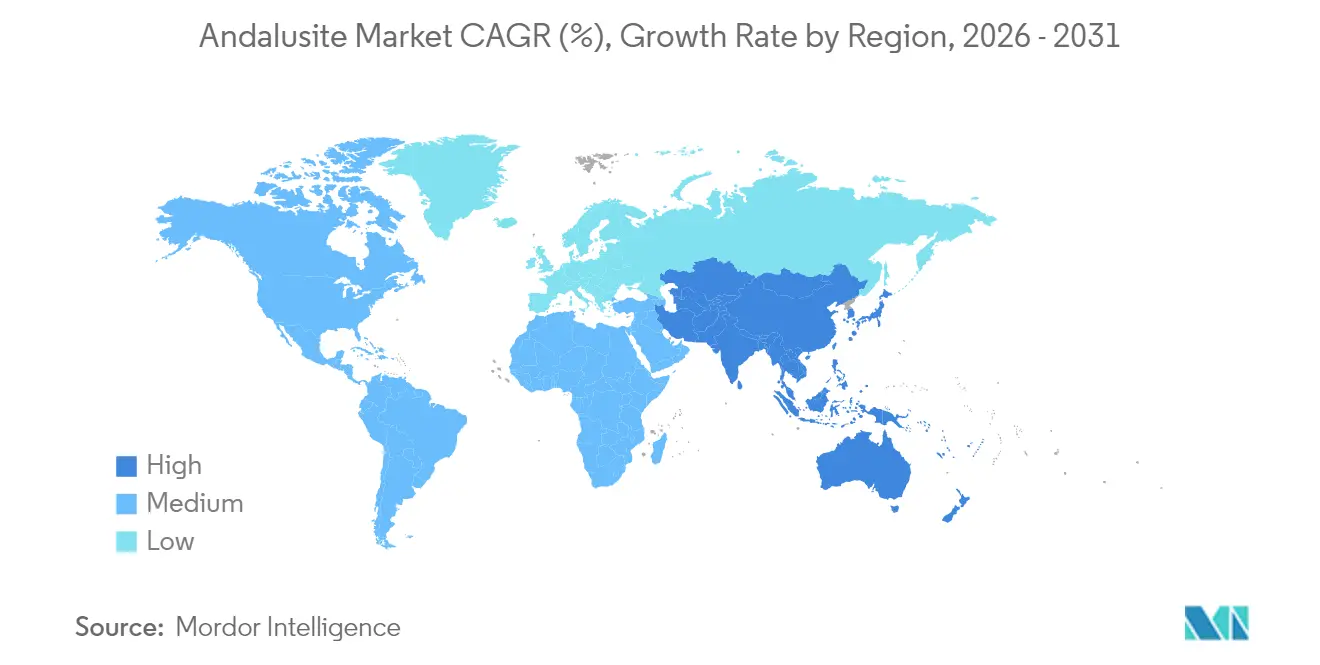
- By geography, the Asia-Pacific region held 46.21% of the Andalusite market share in 2025 and is projected to expand at a 6.21% CAGR through 2031.
Note: Market size and forecast figures in this report are generated using Mordor Intelligence’s proprietary estimation framework, updated with the latest available data and insights as of 2026.
Market Trends and Insights
Drivers Impact Analysis of Andalusite Market*
| Drivers | (~) % Impact on CAGR Forecast | Geographic Relevance | Impact Timeline |
|---|---|---|---|
| Surging refractory demand from electric arc furnace (EAF) steelmaking | +1.8% | Global, with concentration in Asia-Pacific and North America | Medium term (2-4 years) |
| Rapid capacity expansions of South-East Asian foundries | +1.2% | Asia-Pacific core, spill-over to Middle East and Africa | Short term (≤ 2 years) |
| Advanced beneficiation tech lowering production cost/grade threshold | +0.9% | Global, early adoption in North America and Europe | Long term (≥ 4 years) |
| Circular-economy push for recycled refractories in Europe | +0.6% | Europe primary, expanding to North America | Medium term (2-4 years) |
| Supply-chain localisation incentives in United States Critical Minerals policy | +0.4% | North America, indirect effects on global supply chains | Long term (≥ 4 years) |
| Source: Mordor Intelligence | |||
Surging Refractory Demand From Electric Arc Furnace Steelmaking
Global steelmakers are adding electric-arc-furnace capacity because EAF units cut both capital cost and Scope 1 emissions. Carbon-pricing schemes and green-steel premiums further reinforce the shift, while abundant scrap supplies in Indonesia and Vietnam ensure feedstock security. Nippon Steel’s decarbonization outlay through 2030 highlights how low-carbon metallurgy intensifies refractory complexity and increases the demand for high-purity Andalusite[1]Nippon Steel, “Integrated Report 2024,” nipponsteel.com. As electric-arc furnaces operate at temperatures near 1,800 °C, refractory replacement cycles become shorter, thereby amplifying volume growth. The Andalusite market, therefore, benefits directly from each new EAF installation and indirectly from stricter emissions regulation that penalizes less-efficient blast furnaces.
Rapid Capacity Expansions of South-East Asian Foundries
Automotive and electronics supply-chain shifts from China toward Malaysia, Indonesia, and Vietnam are driving a wave of new non-ferrous and ferrous foundries. Each greenfield foundry requires virgin Andalusite for start-up campaigns and high-temperature kiln furniture. Malaysia’s investment incentives promote cluster development, giving suppliers predictable offtake volumes for at least five years. Indonesian industrial parks in Java are securing long-term Andalusite supply agreements to ensure thermal-shock performance and workplace safety compliance. Vietnam benefits from its proximity to Chinese customers, which is facilitated by the absence of the same trade barriers, making it a strategic consumption hub. In aggregate, the rapid build-out compresses regional inventories, magnifying every mining or logistics hiccup in South Africa.
Advanced Beneficiation Technology Lowering Production Cost and Grade Threshold
Process innovations, such as mesofluidic separation, ultrasonic flotation, and machine-learning-driven reagent control, have increased Andalusite recovery rates on lower-grade ores[2]Pacific Northwest National Laboratory, “PNNL technology could help US reduce dependence on foreign critical minerals,” pnnl.gov . Recovery improvements lower the economic cutoff of Al₂O₃, significantly enlarging the resource base. Electro-kinetic mining further unlocks deep, complex formations while shrinking water use and tailings footprints. Western producers are piloting sensor-based sorters that deliver concentrate grades without grinding, preserving crystal integrity valued in premium refractories. The cost curve is therefore flattening, though only producers with sufficient research and development budgets can commercialize these advances. As diffusion widens, incremental tonnage will temper price spikes but not remove supply risk during South African outages.
Circular-Economy Push For Recycled Refractories in Europe
The German National Circular Economy Strategy mandates recycling of industrial materials by 2030, accelerating specialized plants that crush spent bricks and sort phases by X-ray sensor. EU Construction Products Regulation favors natural, low-carbon inputs, tilting demand toward Andalusite over synthetic mullite. Buyers of recycled aggregates still pay a premium for high-purity Andalusite fines to hit quality benchmarks. Consequently, circularity does not cannibalize the Andalusite market; it reallocates demand into cleaner, higher-grade supply channels.
Restraints Impact Analysis of Andalusite Market*
| Restraints | (~) % Impact on CAGR Forecast | Geographic Relevance | Impact Timeline |
|---|---|---|---|
| Grid-instability curtailments at South African mines | -1.4% | Global, with primary impact on Africa and secondary effects worldwide | Short term (≤ 2 years) |
| Substitution threat from synthetic mullite and calcined bauxite | -0.8% | Global, with concentration in cost-sensitive applications | Medium term (2-4 years) |
| Freight-rate volatility on bulk minerals shipping | -0.5% | Global trade routes, particularly affecting Asia-Pacific imports | Short term (≤ 2 years) |
| Source: Mordor Intelligence | |||
Grid-Instability Curtailments at South African Mines
Load-shedding forces andalusite mines to slash power use, resulting in reduced output. Diesel gensets bridge part of the gap but add extra cost, eroding margins on lower-grade product. Supply from Peru and France is insufficient to offset any multi-month disruption. Seasonal demand peaks in Asia-Pacific overlap with South African summer load-shedding, amplifying price volatility and inventory speculation.
Substitution Threat From Synthetic Mullite and Calcined Bauxite
Synthetic mullite and calcined bauxite undercut Andalusite in kiln furniture and low-temperature linings. Almatis is doubling Chinese calcined alumina capacity in early 2026, assuring feedstock for mullite bricks at scale. For applications below 1,500 °C, design engineers prefer materials with tighter particle size control and consistent chemistry. Research into zirconia-mullite and silicon-carbide hybrids is advancing rapidly, promising further inroads. To defend their share, Andalusite suppliers emphasize low porosity, natural crystal morphology, and proven health and safety performance. High-temperature steel ladle linings still rely on Andalusite, yet cost-sensitive customers will pivot if price differentials widen.
*Our forecasts treat driver/restraint impacts as directional, not additive. The impact forecasts reflect baseline growth, mix effects, and variable interactions.
Andalusite Market Segment Analysis
By Application Refractories Dominance and Diversification
Refractories accounted for 91.05% of the Andalusite market size in 2025 and are forecast to expand at a 7.6% CAGR to 2031. Steel ladles, EAF roofs, and tundish linings consume the bulk of volumes, yet waste-to-energy and biomass boilers are emerging growth nodes that also demand high-purity grades. Andalusite’s low thermal expansion and high mullite conversion point deliver superior spalling resistance, extending brick life and lowering furnace downtime. Foundry sands are forming the fastest-growing niche within refractories, driven by capacity additions in Southeast Asia for automotive casting. Advanced beneficiation enables the tailoring of crystal size distribution, resulting in bricks that resist both alkali attack and high thermal gradients. In ceramics, Andalusite additions curb warpage in large sanitary-ware parts, although total volumes remain modest. Jewelry makers source translucent pink Andalusite for gemstone use, capturing premium pricing but negligible tonnage.
Secondary applications, such as filters and spark-plug insulators, are small but technically demanding, favoring Andalusite over cheaper bauxite. Circular-economy legislation in Germany and France is boosting recycled refractory volumes. As decarbonization pushes heavy industry toward higher-efficiency furnaces, the performance envelope tightens, enlarging the addressable Andalusite market. No synthetic mullite currently replicates the exact mixture of alumina, silica, and impurity oxides found in natural Andalusite, giving it a defensible technical moat in ultra-high-temperature service.



Geography Analysis
APAC Andalusite Market
The Asia-Pacific region held 46.21% of the Andalusite market size in 2025 and is projected to grow at a 6.21% CAGR through 2031. China remains the anchor consumer, yet Southeast Asia is the flashpoint where new demand collides with supply risk. Malaysia’s push into electric-vehicle components, Indonesia’s stainless-steel clusters, and Vietnam’s export-oriented foundries are securing multi-year contracts for Andalusite to lock in quality and volume. Japanese and South Korean steelmakers, although mature, are adopting longer off-take terms to hedge against freight volatility and have begun trialing Peruvian Andalusite to diversify their supply lines. India’s refractory industry is expanding, backed by domestic steel capacity approvals.
North America Andalusite Market
North America is pivoting toward self-reliance under the critical minerals policy, stimulating exploration in Arizona and Quebec. Although new mines will not deliver large tonnage before 2028, defense and aerospace users already prefer Andalusite-based domestic refractories to meet content rules. Canada’s modest production and Mexico’s foundry integration within USMCA provide regional supply buffers, but both remain exposed to South African outages. Advanced beneficiation pilot plants in Idaho show promise for converting lower-grade schist into commercial-grade product, potentially shaving imports by mid-decade.
Europe Andalusite Market
Europe’s consumption pattern is shaped by circular economy targets that necessitate recycling by 2030. Germany, France, Italy, and Spain collectively anchor demand, while the United Kingdom shows stable replacement volumes. High energy prices and emissions costs could curb new steel capacity, but waste-to-energy and hydrogen pilot projects compensate, each specifying Andalusite for lining integrity.
MEA and South America Andalusite Market
South America, the Middle East, and Africa are emerging as key consumption arenas. Brazil’s waste-to-energy plants and Peru’s copper smelters require high-grade brick imports, with Andalusite shipped via Atlantic routes, which are less susceptible to fluctuations in Pacific freight. Gulf Cooperation Council countries are investing in desalination and green-hydrogen schemes that operate at extreme temperatures, creating a premium opportunity for Andalusite suppliers willing to stage inventory in local free zones. Africa outside South Africa remains a marginal consumer today, but as regional steel and cement works scale up, local Andalusite availability could shift the demand curve upward.

Regulatory Landscape
Andalusite is traded and declared under HS code 2508.50 in customs systems, which makes tariff and documentation requirements a practical compliance lever for cross-border supply. Alongside trade classification, producers and buyers operate under country mineral laws and permitting regimes, with large producing jurisdictions such as South Africa anchoring compliance to mining and environmental approvals, while import markets apply customs, product declarations, and, where applicable, environmental and social due diligence frameworks used in mineral supply chains (for example, OECD-aligned due diligence expectations for downstream customers).
Operational compliance for mining and processing also ties into emissions and monitoring obligations for mineral processing plants, including particulate-control rules in jurisdictions such as the United States (40 CFR Part 60, Subpart OOO). Public reporting and disclosure for industrial minerals resources is shaped by recognized reporting frameworks, including SAMREC and its industrial minerals guidance (2025), which reinforces qualified-person governance for exploration results and resource and reserve reporting that can influence project financing and offtake negotiations.
Value Chain Analysis
The andalusite value chain starts with exploration and mining in a concentrated set of producing regions (notably South Africa, with additional supply from countries such as France, Peru, and China), followed by beneficiation to reach refractory-grade specifications. Processing typically includes crushing and sizing, magnetic and gravity separation, and flotation stages to reduce impurities and produce high-alumina aluminosilicate concentrates suitable for high-temperature refractory formulations.
Downstream, volumes flow primarily into refractory manufacturers supplying steel (EAF roofs, ladles, tundishes), foundries, and other high-temperature industries, then onward through distributors and direct supply agreements to end users. Key friction points center on energy reliability at mine and processing sites, water management in arid operating environments, and bulk logistics exposure to port and freight disruptions. These constraints have supported a shift toward multi-year offtake structures, tighter quality assurance, and investments in processing efficiency and sensor-based sorting to stabilize grade consistency and reduce delivered-cost volatility.
Competitive Landscape
The Andalusite market is moderately consolidated. Emerging producers in Peru, France, and China focus on niche grades with low iron and alkali impurities. Junior miners in the United States and Australia are leveraging critical minerals grants to develop deposits previously deemed sub-economic. Technology start-ups are licensing ultrasonic flotation and sensor-based sorting to incumbents, tightening quality consistency across the supply base. Downstream, refractory makers sign multi-year supply agreements with take-or-pay clauses to hedge against outage risk, contributing to a stable baseline demand even in slower macroeconomic years. Competitive differentiation is increasingly based on ESG credentials, with customers requesting traceable mining, renewable power sourcing, and cradle-to-gate life-cycle assessments. Substitution pressure from synthetic mullite triggers continuous product innovation. Industry consolidation may continue as large players pursue regional deposits to de-risk single-country exposure.
Andalusite Industry Leaders
Imerys
ARM Andalusite
Andalucita S.A.
LKAB Minerals
RHI Magnesita
- *Disclaimer: Major Players sorted in no particular order

Andalusite Market Companies Covered in this Report
- Andalucita S.A.
- ARM Andalusite
- Henan bontrue New Materials Co., Ltd
- Imerys
- Keyhan Payesh Alvand
- LKAB Minerals
- Resco Products
- RHI Magnesita
- Xinjiang Xinrong Yilong Andalusite Co. Ltd
- Zhengzhou Dongfang Enterprise

Market Opportunities and Future Outlook
Supply diversification and localization remain a clear whitespace because the supply base is concentrated, while refractory consumption continues to build across multiple regions. A concrete opportunity sits in new and prospective non-traditional sources and projects that can reduce single-origin dependence, including India, where large-scale andalusite reserves in Sonbhadra, Uttar Pradesh were reported in June 2026, highlighting a potential new domestic resource anchor for refractory raw materials, subject to mining approvals and infrastructure build-out.
On the demand side, refractories dominate consumption, and the industry-wide shift to more demanding furnace operating profiles (including EAF steelmaking and higher-performance linings) is tightening acceptance windows on impurity levels and crystal integrity. That dynamic raises the value of advanced beneficiation and specialty grades, supporting opportunities for producers and processors that can consistently deliver premium refractory-grade products and for refractory makers that integrate andalusite into lower-maintenance, longer-life lining designs. Circular-economy programs in Europe that expand refractory recycling also create an adjacent pull for high-purity virgin andalusite additions used to restore performance in recycled blends, rather than fully replacing virgin input.
Recent Industry Developments in Andalusite Market
- April 2026: RHI Magnesita released its Q1 2026 trading update and emphasized network optimization and supply chain agility amid softer demand conditions in industrial refractories. The update signaled ongoing operational actions across the footprint that can influence sourcing, inventory strategies, and procurement patterns for refractory raw materials.
- October 2025: Imerys announced an expansion of andalusite production capacity in South Africa to support demand from high-performance refractory applications. The move strengthens supply availability from a core producing hub and underlines producers focus on incremental capacity and reliability improvements at existing operations.
- January 2025: RHI Magnesita completed its acquisition of Resco Group for an enterprise value of USD 410 million, adding US manufacturing scale and access to refractory mineral assets that include pyrophyllite-andalusite in North Carolina. The transaction expanded the companys North American footprint and supported tighter integration between refractory production and raw-material sourcing.


Andalusite Market Report Scope and Research Methodology
Market Definition and Coverage
For this methodology, the market covers the supply and use of andalusite as an industrial mineral that is mined, processed, and consumed for high temperature performance uses, mainly in refractory-linked applications.
Scope exclusions: This sizing excludes the value of finished refractory products and counts only andalusite material volumes consumed.
Segments Covered in This Report
- By Application
- Refractories
- Foundry
- Kiln Furniture
- Other Applications (Ceramics and Jewelry)
- By Geography
- Asia-Pacific
- China
- India
- Japan
- South Korea
- Rest of Asia-Pacific
- North America
- United States
- Canada
- Mexico
- Europe
- Germany
- United Kingdom
- France
- Italy
- Spain
- Rest of Europe
- South America
- Brazil
- Argentina
- Colombia
- Middle-East and Africa
- Saudi Arabia
- South Africa
- Rest of Middle-East and Africa
- Asia-Pacific
Data Sources, Market Sizing, and Validation
Desk Research
Desk research was used to anchor the model with visible supply and demand signals that can be checked year to year. We referred to public sources such as USGS Mineral Commodity Summaries, national geological survey publications, UN Comtrade style trade statistics, and customs and port releases that help indicate flows of andalusite and related minerals.
To connect mineral use with end-market activity, sources such as the World Steel Association for crude steel output, government industrial production indices, and cement industry statistics from industry bodies were reviewed, along with association websites and reputable press. Company annual reports and investor presentations were used to understand capacity changes, announced expansions, and shipment direction, and selective paid subscriptions for company financials and patent databases were used to cross-check timelines and processing routes. The sources named here are illustrative and not exhaustive, and many other public references were also used for collection, validation, and clarification.
Primary Interviews and Surveys
Primary work was used to validate how demand is split across refractories, foundry, kiln furniture, and smaller uses, and to confirm how supply concentration affects delivered availability by region. We spoke with respondents across mining and processing, traders and distributors, and downstream buyers such as refractory makers and large industrial users, with coverage across APAC, EMEA, and the Americas.
These discussions helped fill gaps on typical grade mix sold, import dependence in key countries, and the practical substitution pattern versus bauxite, mullite, and other alumina sources when prices or availability shift.
Distribution of primary research fieldwork respondents
| Company type | Respondent position | Region |
|---|---|---|
| Top tier: 28% | CXOs: 14% | APAC: 48% |
| Mid tier: 54% | Functional/Unit leaders: 28% | EMEA: 32% |
| Smaller Players: 18% | Managers: 58% | Americas: 20% |
Market-Sizing & Forecasting
Sizing was built mainly through a top-down approach where steel, cement, and foundry activity is converted into refractory demand, and then converted again into andalusite consumption using application-level usage factors. When the chain is built step by step and linked to observable indicators, the final market total is reached only at the end.
Inputs used in the model (illustrative) include crude steel production levels and route shifts that change refractory intensity, cement output trends that influence kiln lining demand, foundry activity direction, trade flows of andalusite and related minerals, and observed substitution behavior versus alternative alumina sources. Totals were then corroborated with selective bottom-up approximations such as supplier and trader volume ranges, channel checks on inventory cycles, and sampled price-to-volume sense checks where feasible, which were used to correct country balances that looked inconsistent.
Forecasts were developed using scenario analysis, supported by expert expectations on steel and cement cycles, new capacity additions, and logistics constraints from concentrated supply. Where smaller consuming countries had limited data, proxy factors based on industrial output and import dependence were applied, and then adjusted during primary validation so the time series stayed realistic.
Data Validation & Update Cycle
Outputs were validated through several checks so the results stayed consistent with independent signals. We compared implied consumption against supply availability and trade direction, reviewed year-to-year movement by region for unusual jumps, and checked whether application mix shifts matched what users described.
When variances were large, assumptions were revisited and selected respondents were re-contacted to confirm usage factors or substitution effects. Before sign-off, the model and narrative pass through internal analyst reviews focused on consistency across years and plausibility of drivers. Reports are refreshed annually, with interim updates for material events, and a final pre-delivery review is completed so clients receive the latest updated view.
Mordor Intelligence's Andalusite Market Size Compared Against Other Published Estimates
Published figures for andalusite often do not line up because the unit of measure and the level of the value chain are not always consistent. Some sources describe a value pool, while others describe mineral consumption, and the years used for the starting point can also vary.
The benchmark table shows a 2026 market size expressed as 480.27 kilotons, and in Mordor Intelligence's model the total reflects andalusite material consumption across refractories, foundry, kiln furniture, and other uses, rather than the sales value of downstream refractories or a wider kyanite-group bundle.
Benchmark comparison
| Source | Market Size | Gaps in Research Methodology |
|---|---|---|
| Mordor Intelligence | USD 0.48 M (2026) | |
| Trade Journal A | USD 0.26 B (2024) | Uses value-based reporting with a different base year, and it appears to include a broader refractory materials basket or downstream pricing, which shifts totals away from pure andalusite tonnage consumed. |
| Regional Consultancy B | USD 0.24 B (2025) | Applies blended pricing and demand assumptions without clearly separating re-exports and application-level usage factors, so the implied market moves more with price cycles than with consumption volume. |
The spread is mainly explained by whether the market is counted as mineral volume consumed or as a wider value pool that can include adjacent materials and downstream products. By keeping the build-up tied to industrial activity, trade signals, and application usage factors, the sizing remains repeatable and easier to sanity-check across years.


Key Questions Answered in the Report
What is the projected volume of the Andalusite market by 2031?
The Andalusite market is forecast to reach 642.12 kilotons in 2031, up from 480.27 kilotons in 2026.
Which region leads in Andalusite consumption?
Asia-Pacific commands the largest share at 46.21% and is expanding at a 6.21% CAGR through 2031.
How does electric-arc-furnace steelmaking affect Andalusite demand?
Each new EAF installation requires high-purity Andalusite bricks, which boosts global demand for these materials.
What are the main supply risks in the Andalusite market?
Grid instability in South Africa, freight-rate volatility, and substitution by synthetic mullite pose the greatest near-term challenges.
Are recycled refractories diminishing virgin Andalusite demand?
No, recycled aggregates often need premium Andalusite additions to regain performance, resulting in stable net demand.
Page last updated on:





