
Aluminum Pigment Market Size and Share
Market Overview
| Study Period | 2020 - 2031 |
|---|---|
| Market Size (2026) | USD 757.81 Million |
| Market Size (2031) | USD 918.5 Million |
| Growth Rate (2026 - 2031) | 3.92 % |
| Fastest Growing Market | Asia Pacific |
| Largest Market | Asia Pacific |
| Market Concentration | High |
Major Players *Disclaimer: Major Players sorted in no particular order Image © Mordor Intelligence. Reuse requires attribution under CC BY 4.0. | |
Aluminum Pigment Market Analysis by Mordor Intelligence
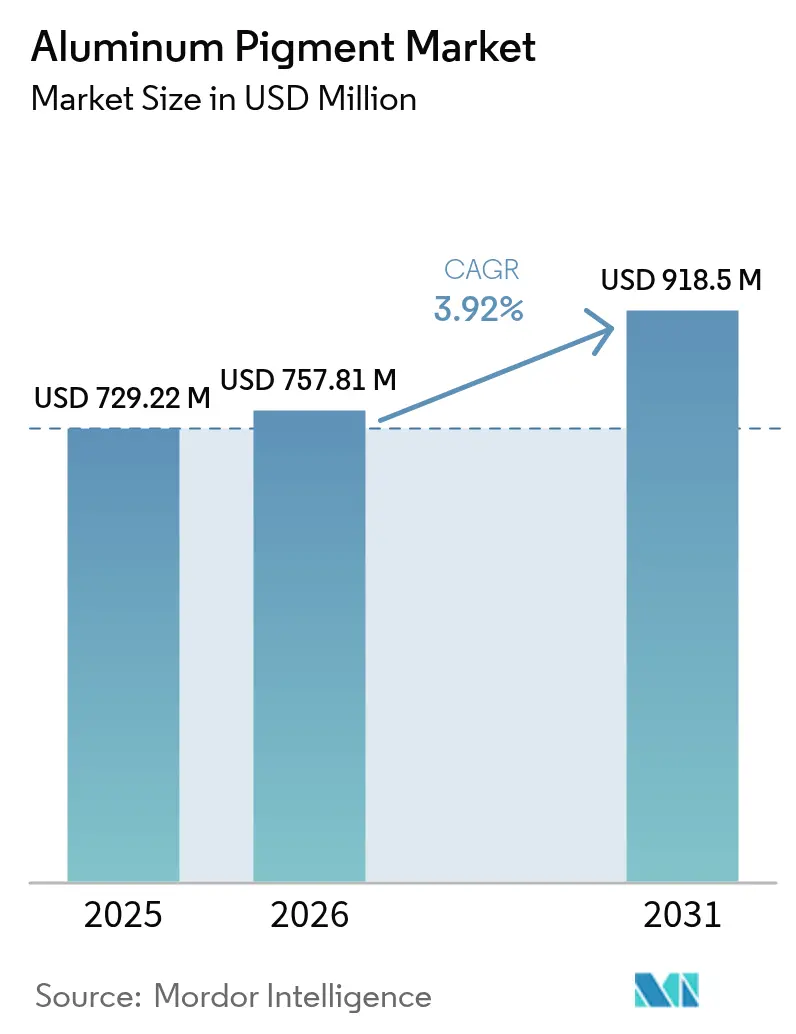
The Aluminum Pigment Market size in 2026 is estimated at USD 757.81 million, growing from 2025 value of USD 729.22 million with 2031 projections showing USD 918.5 million, growing at 3.92% CAGR over 2026-2031. This steady trajectory is shaped by resilient demand for premium metallic automotive finishes, stricter global VOC rules that accelerate adoption of high-performance powder coatings, and expanding use of reflective pigments in cool-roof systems designed to curb urban heat. Larger producers that control upstream aluminum supplies are cushioning the impact of raw-material price swings and meeting the industry’s decarbonization targets with lower-carbon production routes. Meanwhile, sustained research and development spending on encapsulation and radar-transparent technologies is opening high-margin applications in autonomous vehicles and additive manufacturing.
Key Report Takeaways
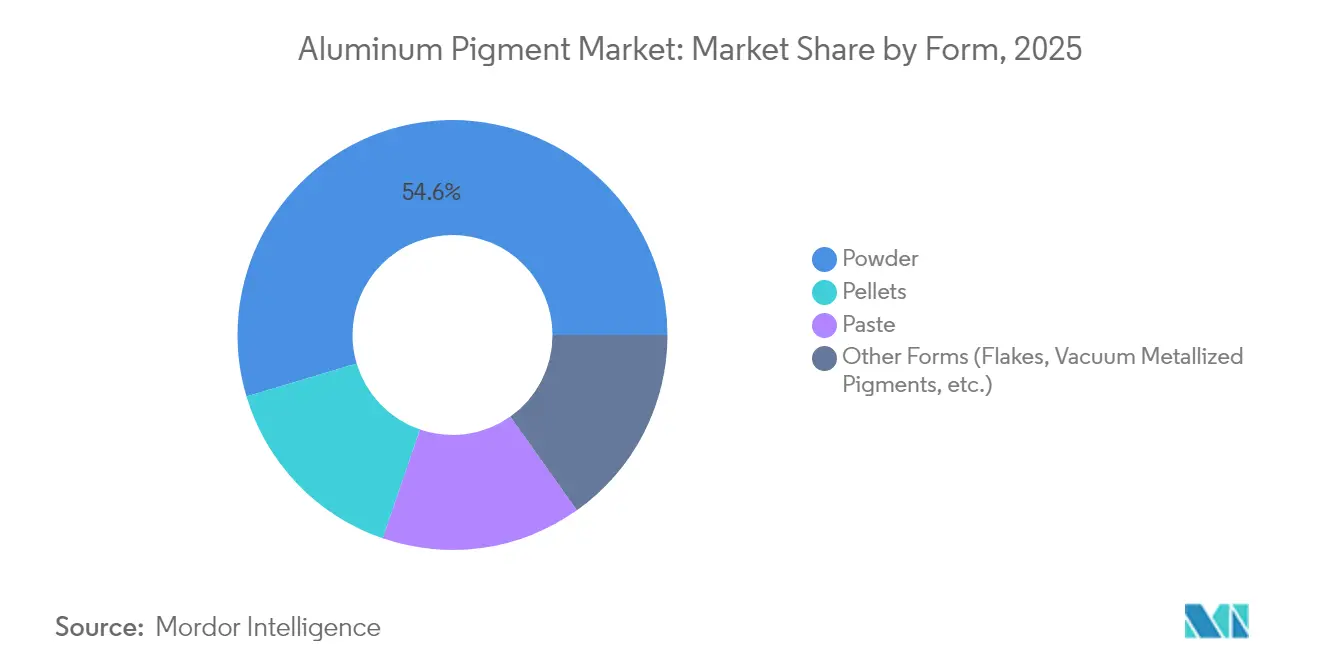
- By form, powder held 54.62% of the aluminum pigment market share in 2025, while other forms recorded the quickest 4.83% CAGR through 2031.
- By coating type, non-leafing accounted for 62.78% of the aluminum pigment market size in 2025, and leafing is advancing at a 4.58% CAGR through 2031.
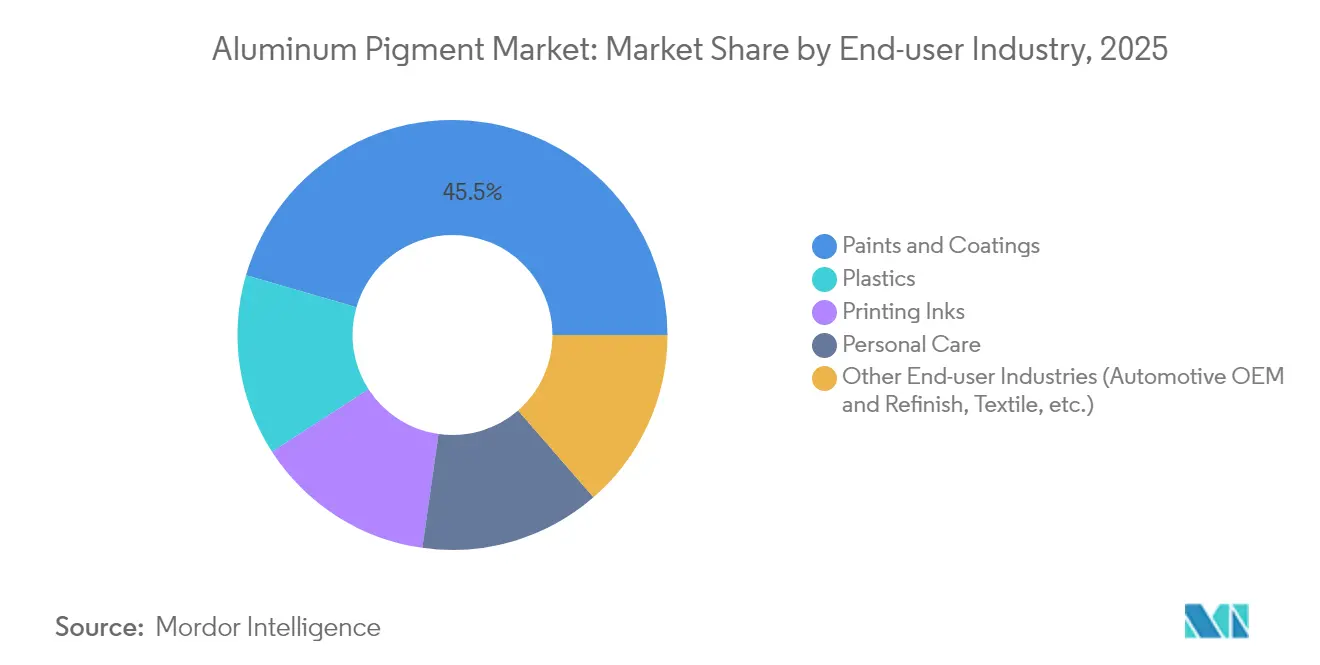
- By end-user industry, Asia-Pacific accounted for 45.52% of the aluminum pigment market size in 2025, and other industries are growing with a CAGR of 4.46%.
- By geography, Asia-Pacific captured 46.35% revenue share in 2025; the region is projected to lead growth at a 4.55% CAGR to 2031.
Note: Market size and forecast figures in this report are generated using Mordor Intelligence’s proprietary estimation framework, updated with the latest available data and insights as of 2026.
Market Trends and Insights
Drivers Impact Analysis of Aluminum Pigment Market*
| Drivers | (~) % Impact on CAGR Forecast | Geographic Relevance | Impact Timeline |
|---|---|---|---|
| Growing demand for metallic automotive finishes | 1.2% | Global, with APAC and North America leading | Medium term (2-4 years) |
| Rising adoption of high-performance powder coatings | 0.9% | Europe and North America core, expanding to APAC | Long term (≥ 4 years) |
| Expansion of personal care and cosmetics with effect pigments | 0.7% | Global, with premium markets in North America and Europe | Medium term (2-4 years) |
| Emerging use of aluminum flakes in additive manufacturing feedstocks | 0.5% | North America and Europe, early adoption in APAC | Long term (≥ 4 years) |
| Reflective cool-roof coatings for urban heat-island mitigation | 0.4% | Global urban centers, particularly hot climate regions | Long term (≥ 4 years) |
| Source: Mordor Intelligence | |||
Growing Demand for Metallic Automotive Finishes
Regulatory limits on solvent emissions and consumer preference for premium styling push automakers toward metallic coatings that incorporate finely milled aluminum flakes. Electric-vehicle OEMs view these pigments as a dual-benefit material: they deliver eye-catching effects and improve thermal reflectivity, which lessens battery heat gain in warm climates. Autonomous-vehicle developers have added performance criteria around LiDAR and radar transparency, prompting suppliers to engineer narrow particle-size cuts that maintain reflectance without signal scatter. Automotive refinish suppliers also rely on aluminum pigments because repair jobs must match OEM shades while curing at temperatures low enough to protect plastic trims. Sector-wide, these requirements channel research and development budgets into tailored encapsulation methods that enhance corrosion resistance in waterborne formulations.
Rising Adoption of High-Performance Powder Coatings
Powder coatings eliminate VOC emissions, cut overspray waste, and offer single-coat coverage, making them the finish of choice for appliances, architecture, and wheels. Aluminum pigments enable bright metallic looks in these systems, but must retain brilliance after a 200 °C bake. Producers now suspend flakes in silica sol-gel or silicone shells to block oxidation, allowing glossy powder lines to pass salt-spray and humidity tests demanded by appliance brands.
Expansion of Personal Care and Cosmetics with Effect Pigments
North American and European beauty labels are moving beyond conventional pearl effects toward colored metallics that shift hues under diverse lighting. The U.S. FDA’s approval of aluminum powder for externally applied cosmetics, including eye-area products, gives formulators predictable safety rules and accelerates launch pipelines[1]. Encapsulation technologies adapted from industrial coatings protect the pigments from moisture and skin oils while preserving shimmer. Brands extend the metallic motif to recyclable aluminum packaging, reinforcing a premium, monomaterial aesthetic and nudging demand for effect pigments in both content and container.
Emerging Use of Aluminum Flakes in Additive Manufacturing Feedstocks
Laser powder bed fusion and binder-jetting methods are migrating from prototypes to serial aerospace and motorsport parts. Certified spherical aluminum powders with tight oxygen limits deliver crack-free prints and weight savings unattainable with cast alloys. Producers such as ECKART obtained DIN EN 9100:2018 approval in 2024 for aerospace-grade atomized powders, underpinning confidence among tier-one suppliers. Blend developers also add low-aspect-ratio flakes into photopolymer and composite filaments to impart electromagnetic shielding or heat-dissipation traits, broadening the aluminum pigment market beyond decorative roles.
Restraints Impact Analysis of Aluminum Pigment Market*
| Restraints | (~) % Impact on CAGR Forecast | Geographic Relevance | Impact Timeline |
|---|---|---|---|
| Stringent EHS regulations on metal powders | -0.8% | Global, with stricter enforcement in Europe and North America | Short term (≤ 2 years) |
| Volatility in primary aluminum prices and supply | -0.6% | Global, with particular impact on cost-sensitive applications | Short term (≤ 2 years) |
| Energy-intensive production processes under decarbonization pressure | -0.5% | Global, with immediate impact in carbon-regulated markets | Medium term (2-4 years) |
| Source: Mordor Intelligence | |||
Stringent EHS regulations on metal powders
Europe’s revised CLP Regulation and the U.S. OSHA dust-combustion rules require upgraded ventilation, inert-gas milling, and ATEX-certified packaging lines. Compliance costs escalate fastest for producers under 5,000 t/y, encouraging mergers that pool capital and engineering know-how. Updated U.S. Subpart RRR limits hydrogen chloride and particulate releases from secondary smelters, affecting pigment plants that tap scrap streams for greener inputs[2]. In turn, the aluminum pigment market experiences a near-term growth drag until upgraded plants come online.
Energy-Intensive Production Processes Under Decarbonization Pressure
Producing 1 ton of primary aluminum still emits around 11 tons of CO₂ in coal-based regions. RMI calculates that the global aluminum chain requires nearly USD 1 trillion in capital by 2050 to hit net-zero. In pigment terms, higher Scope-1 and 2 charges under EU ETS Phase 4 and Canada’s carbon-pricing reforms raise operating costs for smelters that feed flake plants. While hydropower-rich smelters in Canada and Norway gain share, producers reliant on coal power face a medium-term capex burden, subtracting 0.5 percentage points from the growth rate.
*Our forecasts treat driver/restraint impacts as directional, not additive. The impact forecasts reflect baseline growth, mix effects, and variable interactions.
Aluminum Pigment Market Segment Analysis
By Form:
Versatile Powder Steers Market ExpansionPowder held the largest 54.62% aluminum pigment market share in 2025 thanks to its ease of dispersion in automotive and industrial coatings. The aluminum pigment market size for powder formats is projected to grow steadily alongside high-performance powder coatings that cure faster and cut VOCs. In usage terms, low-oil-absorption grades enable thicker film builds without compromise on metallic sparkle, while dust-free granules improve worker safety during electrostatic application.
Other forms, chiefly flakes and vacuum-metallized pigments, represent the quickest 4.83% CAGR through 2031. Flakes mirror visible and near-infrared wavelengths efficiently, making them a staple in cool-roof and façade systems that demand both reflective function and design freedom. Vacuum-metallized pigments, produced by physical vapor deposition, deliver mirror-like brilliance prized in consumer electronics casings. Pellets and pastes remain niche but essential for waterborne or UV-cured formulations that need zero airborne dust.

By Coating Type:
Non-Leafing Dominates while Leafing Gains Specialty GroundNon-leafing pigments accounted for 62.78% of the aluminum pigment market size in 2025 because their surface treatment drives them into the coating matrix, affording abrasion resistance ideal for wheel rims and exterior appliances. Their orientation improves underlying substrates' chemical passivation, extending architectural panels' maintenance cycles.
Leafing grades orient at the surface, producing chrome-like sheen valued in decorative trims. Although smaller in volume, they will post the faster 4.58% CAGR to 2031 as sensor-compatible formulations for autonomous vehicles mature. Low-sparking varieties also find favor in marine topcoats that must balance metallic look with radar invisibility, giving suppliers another entry point to defense markets.
By End-user Industry:
Paints and Coatings Anchor DemandPaints and coatings absorbed 45.52% of revenue in 2025, with automotive OE, refinish, and architectural uses at the helm. Refinish shops, unable to bake panels at 180 °C, depend on readily dispersible aluminum pastes that flash at ambient temperatures yet replicate factory colors. Cool-roof policies add incremental tonnage in the construction sector, while clear-over-base systems in SUVs and pickups boost metallic loadings.
Other industries, led by electric-vehicle battery casings, plastic masterbatches for personal devices, and color-shifting cosmetics, deliver a 4.46% CAGR to 2031. Colored aluminum flakes in mascaras and highlighters satisfy consumer appetite for high-definition sparkle, showing how functional advances translate to lifestyle markets.
Geography Analysis
APAC Aluminum Pigment Market
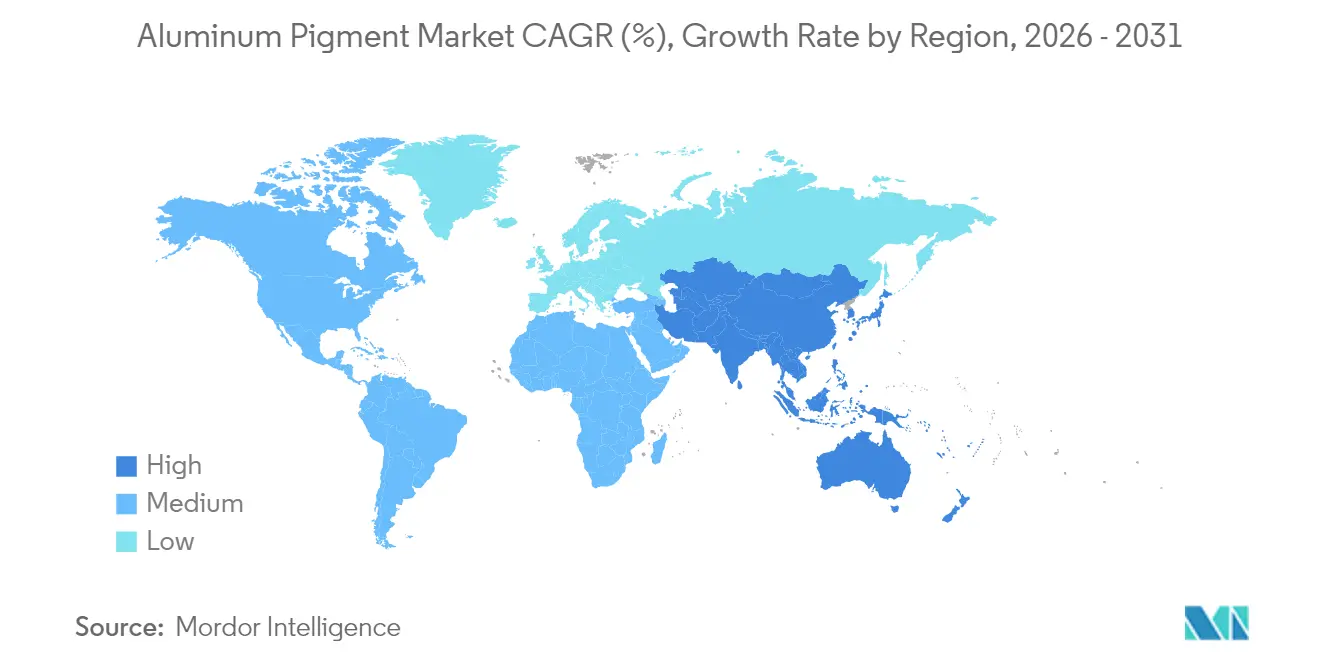
Asia-Pacific controlled 46.35% of 2025 sales and is set to expand at a 4.55% CAGR through 2031. India’s smelting output rose 11% to 4.016 million tons in 2024, underpinning domestic pigment feedstock security. Japan’s auto-grade aluminum demand recovery also supports higher-value pigments for premium brands.
North America and Europe Aluminum Pigment Market
North America benefits from a carbon footprint roughly 50% below the global average, thanks to hydroelectric smelters in Canada and widespread recycling. Europe mirrors this drive, with Hydro partnering with Porsche in 2024 to supply low-carbon aluminum across vehicle lines. These moves stimulate demand for sustainably certified aluminum pigments in luxury branding.
MEA and South America Aluminum Pigment Market
South America, the Middle East, and Africa collectively display emerging demand curves tied to rising infrastructure spending and light-vehicle assembly. GCC construction codes now reference solar-reflective index thresholds, opening doors for NIR-reflective grades. In Brazil and Mexico, pickup and compact-SUV output serves as a pull factor for local pigment blending houses, although currency volatility keeps imports sensitive to metal price shocks.
Mordor Intelligence provides coverage of the aluminum pigment market across other key regional markets. Detailed country-level analysis extends to France incorporating local coverage and market participation, as required.
Regulatory Landscape
Regulatory oversight for aluminum pigments is tightening around chemical safety, worker exposure, and downstream end-use compliance, with Europe and North America setting many of the reference requirements. In the European Union, REACH and related European Chemicals Agency (ECHA) processes continue to drive substance registration, classification, and use-condition scrutiny for metal powders and surface-treated products used in coatings and inks, which increases documentation and testing burdens for suppliers selling into the EU.
In the United States, amendments finalized by the U.S. EPA in December 2024 to the Toxic Substances Control Act (TSCA) new-chemicals review rules reinforce upstream compliance expectations for new or modified pigment chemistries and surface treatments. Trade policy is another material variable for pigment economics and supply planning: metallic aluminum pigments classified under HTS 3212.90.00.10 carry a 3.1% general duty rate as of July 1, 2026, while Section 232 duty regimes for certain aluminum and derivative articles were adjusted again with changes effective in 2025 and 2026, increasing the need for active tariff classification management across pigment and aluminum-input supply chains. For personal care formulations, aluminum powder (CI 77000) remains permitted in the United States under 21 CFR 73.1645 and 21 CFR 73.2645 for externally applied cosmetics, with explicit restrictions such as exclusion from lip products shaping cosmetic-grade effect pigment portfolios.
Value Chain Analysis
The aluminum pigment value chain starts with aluminum feedstock, moving from primary smelting and recycled aluminum collection into atomized aluminum powder production, then into pigment manufacturing steps such as ball-milling/attrition in solvent with lubricants, filtration and solvent recovery, air classification for particle sizing, and surface treatment (for example, wax, resin, or silica-based encapsulation) before conversion into pastes, pellets, or dry powders. Upstream integration into aluminum supply and powder atomization is strategically important because primary aluminum price volatility and decarbonization-linked energy costs feed directly into pigment cost structure and availability.
Downstream, aluminum pigments move through direct supply contracts and distributors to paints and coatings (automotive OEM and refinish, architectural and industrial), printing inks, plastics, and personal care formulators. Performance requirements center on brightness retention, oxidation resistance, and compatibility with waterborne, UV-curable, and powder-coating systems, while EHS and combustible-dust compliance requirements favor larger players with ATEX/OSHA-ready processing and packaging lines. Regional capacity and sourcing patterns are also shifting as suppliers add localized powder and pigment capability, including the Runaya-ECKART joint venture progress in India to support local availability of gas-atomized aluminum powder inputs for high-end effect pigment applications.
Competitive Landscape
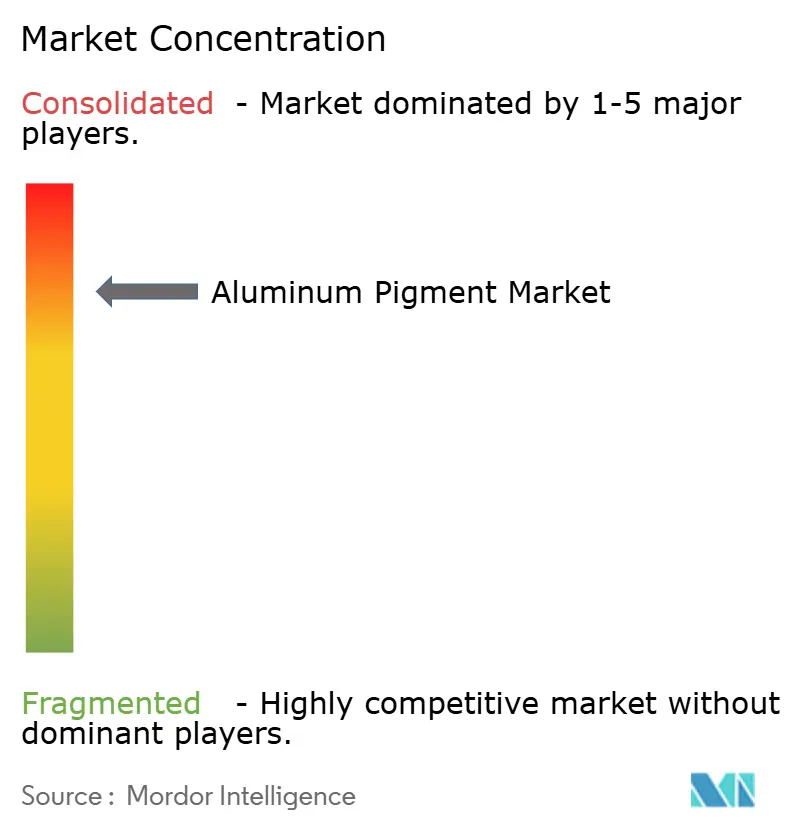
The market is consolidated in nature. Market consolidation quickened in 2024 when ALTANA acquired Silberline, inflating ECKART division sales by 24% to EUR 224 million and widening distribution in North America and Asia. Scale provides leverage for capital-intensive health-and-safety upgrades and greener energy purchases. Competitors with strong backward integration buffer aluminum price swings and secure recycled feed for low-carbon offerings. Technical differentiation centers on surface treatments. Silica sol-gel and silicone encapsulation protect flakes during waterborne curing and alkaline detergents.
Aluminum Pigment Industry Leaders
-
ALTANA
-
DIC CORPORATION -
-
SCHLENK SE
-
TOYO ALUMINIUM K.K.
-
Asahi Kasei Corporation
- *Disclaimer: Major Players sorted in no particular order
Aluminum Pigment Market Companies Covered in this Report
- ALTANA
- Asahi Kasei Corporation
- AVL METAL POWDERS n.v.
- Carlfors Bruk
- DIC CORPORATION
- FX Pigments Pvt. Ltd.
- GEOTECH
- Hefei Sunrise Aluminium Pigments Co.,Ltd�
- Kolortek Co., Ltd.
- Metaflake Ltd
- Nippon Light Metal Co.,Ltd
- SCHLENK SE
- Shan Dong Jie Han Metal Material Co., Ltd
- TOYO ALUMINIUM K.K.
- Zhangqiu metallic pigment co.,ltd.
- ZuXing New Materials Co., Ltd.
Market Opportunities and Future Outlook
White space is opening where customers need metallic appearance without compromising low-VOC and safety targets, which is pushing suppliers toward higher-value surface-treated grades for waterborne and powder-coating systems. As coatings move toward VOC-eliminating powder technologies, demand increases for aluminum pigments that can withstand high bake temperatures while maintaining brilliance, and suppliers with encapsulation and particle engineering capabilities benefit from improved oxidation control and dispersion performance.
Additional opportunity is emerging from localized supply build-outs and expanded domestic powder ecosystems in high-growth regions, particularly Asia-Pacific, which held 46.35% revenue share in 2025. The December 2024 joint venture activity provides an evidence anchor: ECKART and Runaya formed a joint venture tied to a new facility in Orissa, India, aimed at spherical atomized aluminum granules and backed by a memorandum of understanding to manufacture high-quality aluminum pigments, supporting shorter lead times and improved traceability for effect pigment users. Capital-market activity also signals continued investment in aluminum pigment and microfine aluminum powder capabilities, such as Zuxing New Materials opening for A-share subscription in March 2026 with a focus on aluminum pigments and microfine spherical aluminum powders, aligning with higher-spec applications beyond purely decorative coatings.
Recent Industry Developments in Aluminum Pigment Market
- April 2026: Runaya and ECKART (ALTANA) marked the first phase of their joint venture with the launch of an advanced gas-atomized aluminum powder plant in Jharsuguda, India. The added atomized powder capability strengthens local feedstock availability for effect pigments and other high-end aluminum powder applications, helping reduce reliance on imported specialty grades and improving supply continuity for regional formulators.
- July 2025: ALTANA highlighted a high-performance UV-curing printing-ink formulation that uses alcohol-based silver dollar pigments and ultra-thin METALURE effect pigments produced via a specialized PVD process. This development underscores continued product engineering around aluminum-effect pigmentation for high-speed, lower-emission curing systems used in packaging and specialty print applications.
- December 2024: ECKART (ALTANA) and Runaya signed a memorandum of understanding to manufacture high-quality aluminum pigments alongside forming a joint venture to establish a new facility in Orissa, India, for spherical atomized aluminum granules. The program supports localized, potentially more sustainable supply routes for aluminum-based effect pigments serving coatings, solar-related, and other premium applications.
Aluminum Pigment Market Report Scope and Research Methodology
Market Definition and Coverage
For this methodology, the aluminum pigment market covers metallic-effect aluminum pigments sold as powders, pastes, pellets, or similar formats, which are used to create sparkle, opacity, reflectivity, and barrier effects in downstream formulations and finished products.
Scope exclusions: Excludes finished paints, inks, plastics compounds, and coated end products, and counts only the aluminum pigment material value at the point of sale by pigment suppliers.
Segments Covered in This Report
- By Form
- Powder
- Pellets
- Paste
- Other Forms (Flakes, Vacuum Metallized Pigments, etc.)
- By Coating Type
- Leafing
- Non-Leafing
- By End-user Industry
- Paints and Coatings
- Plastics
- Printing Inks
- Personal Care
- Other End-user Industries (Automotive OEM and Refinish, Textile, etc.)
- By Geography
- Asia-Pacific
- China
- Japan
- India
- South Korea
- ASEAN Countries
- Rest of Asia-Pacific
- North America
- United States
- Canada
- Mexico
- Europe
- Germany
- United Kingdom
- France
- Italy
- Spain
- Russia
- NORDIC Countries
- Rest of Europe
- South America
- Brazil
- Argentina
- Rest of South America
- Middle-East and Africa
- Saudi Arabia
- South Africa
- Rest of Middle-East and Africa
- Asia-Pacific
Data Sources, Market Sizing, and Validation
Desk Research
Desk research was used to set the industry boundaries, align units and pricing logic, and map demand signals to the right end uses. We reviewed public sources such as USGS mineral and metals statistics, UN Comtrade trade flows for aluminum-related inputs, US EPA and EU REACH regulatory documentation, and standards bodies and technical papers that discuss metallic pigments and coating performance.
Alongside these, we reviewed company annual reports, investor presentations, product brochures, and reputable press to understand capacity changes, product positioning (leafing versus non-leafing), and typical application mixes. For cross-checking company footprint, patent activity, and major contract signals, we used selective paid database subscriptions where they help confirm timelines and directional trends. These desk sources are illustrative only, and additional public references were also used for data collection, validation, and clarification.
Primary Interviews and Surveys
Primary interviews were used to validate real-world demand drivers and the pricing patterns seen in metallic pigments, especially where published data is thin. We spoke with pigment suppliers, formulators, and downstream users in coatings, inks, plastics, and personal care across APAC, EMEA, and the Americas, and then used follow-up checks to close gaps around utilization, mix shifts, and near-term demand changes.
Distribution of primary research fieldwork respondents
| Company type | Respondent position | Region |
|---|---|---|
| Top tier: 29% | CXOs: 17% | APAC: 49% |
| Mid tier: 53% | Functional/Unit leaders: 34% | EMEA: 33% |
| Smaller Players: 18% | Managers: 49% | Americas: 18% |
Market-Sizing & Forecasting
Sizing started with a top-down build that reconstructs demand from the key consuming pools, mainly coatings, printing inks, plastics, and personal care, and then converts those pools into aluminum pigment value using penetration assumptions and typical dosage ranges. Once those totals were formed, they were checked and adjusted using selective bottom-up approximations like sampled supplier revenues, channel feedback, and price per kilogram ranges applied to estimated volumes.
Inputs that mattered in the model included the split between leafing and non-leafing use, shifts toward water-based and powder coating systems, automotive and industrial coatings output trends, packaging and printing activity, and regional mix changes (with APAC being a key volume driver). When direct volume indicators were missing, we used structured gap-handling by anchoring to comparable application consumption patterns and then stress-testing with interview feedback.
For forecasting, scenario analysis was used around end-use growth and price movement, and then the preferred path was selected based on what practitioners expect for formulation shifts, replacement cycles, and regulatory direction. The final forecast was reviewed for internal consistency so that volumes, average selling prices, and mix changes move in a realistic way year to year.
Data Validation & Update Cycle
Model outputs were compared against independent signals such as trade trends for relevant inputs, reported capacity changes, and downstream production indicators, and then variances were investigated before conclusions were signed off. Where results looked out of line with field feedback, assumptions were revisited and respondents were re-contacted to confirm whether the issue came from scope, timing, or pricing.
Each report goes through multi-step analyst reviews to catch anomalies in units, currency conversion, and regional splits. Updates use an annual refresh cycle, with interim updates when material events occur that can change near-term demand or supply. Before delivery, we run a final pass to reflect the latest public developments and the most recent verification checks.
Mordor Intelligence's Aluminum Pigment Market Estimate Compared With Other Published Estimates
It is normal to see different market sizes for aluminum pigment because studies do not always count the same material scope, sales point in the value chain, or regional coverage, and they may also lock assumptions at different times. Currency timing, whether figures are reported as producer revenue versus broader formulated product value, and how leafing and non-leafing mixes are treated can all change the number.
By tracking application-level demand pools, refreshing mix and pricing inputs with field checks, and then validating anomaly bands, Mordor Intelligence keeps the estimate tied to aluminum pigment material revenue rather than finished coatings or inks, which is a common source of spread in published totals.
Benchmark comparison
| Source | Market Size | Gaps in Research Methodology |
|---|---|---|
| Mordor Intelligence | USD 0.76 B (2026) | |
| Global Consultancy A | USD 0.55 B (2024) | Uses an earlier base year and can understate value if pricing is held flat through the period, and if scope is limited to select coating uses rather than the full mix across inks, plastics, and personal care. |
| Industry Publisher B | USD 0.62 B (2025) | Often reflects a broader metallic pigment basket or a different sell-through point, where distributor markups or adjacent effect pigments may be blended, which shifts the market boundary away from pure aluminum pigment supplier revenue. |
The comparison shows that most gaps come from what is counted, and when it is counted, more than from math differences. When the boundary is kept at aluminum pigment material sales, and key variables like end-use output, formulation shifts, and ASP progression are updated in a repeatable way, the result is easier to reconcile with real demand signals and to re-check over time.
Key Questions Answered in the Report
What is the current size of the aluminum pigment market?
The aluminum pigment market size is USD 757.81 million in 2026 and is expected to reach USD 918.5 million by 2031.
Which region leads the aluminum pigment market?
Asia-Pacific holds the largest regional position with a 46.35% share in 2025 and is projected to grow at 4.55% CAGR through 2031.
Why are aluminum pigments important in electric vehicles?
They provide metallic aesthetics while reflecting heat, helping to keep battery packs cooler and improving vehicle efficiency.
How do environmental regulations affect aluminum pigment producers?
Strict VOC and dust-combustion rules force upgrades to encapsulation technology and plant safety systems, raising capital requirements and driving consolidation.
What is driving demand for aluminum pigments in building materials?
Urban heat-island regulations encourage reflective cool-roof coatings that use near-infrared-reflective aluminum pigments to reduce cooling loads.