
Aircraft Nacelle Systems Market Size and Share
Market Overview
| Study Period | 2020 - 2031 |
|---|---|
| Market Size (2026) | USD 6.01 Billion |
| Market Size (2031) | USD 7.74 Billion |
| Growth Rate (2026 - 2031) | 5.21 % |
| Fastest Growing Market | Asia Pacific |
| Largest Market | North America |
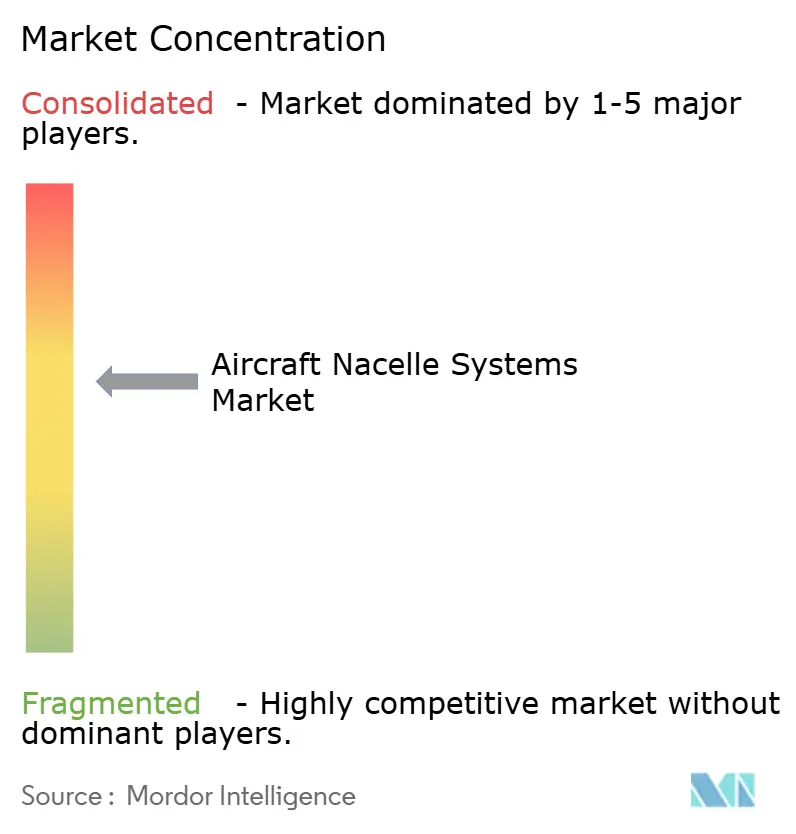
| Market Concentration | Medium |
Major Players *Disclaimer: Major Players sorted in no particular order Image © Mordor Intelligence. Reuse requires attribution under CC BY 4.0. | |
Aircraft Nacelle Systems Market Analysis by Mordor Intelligence
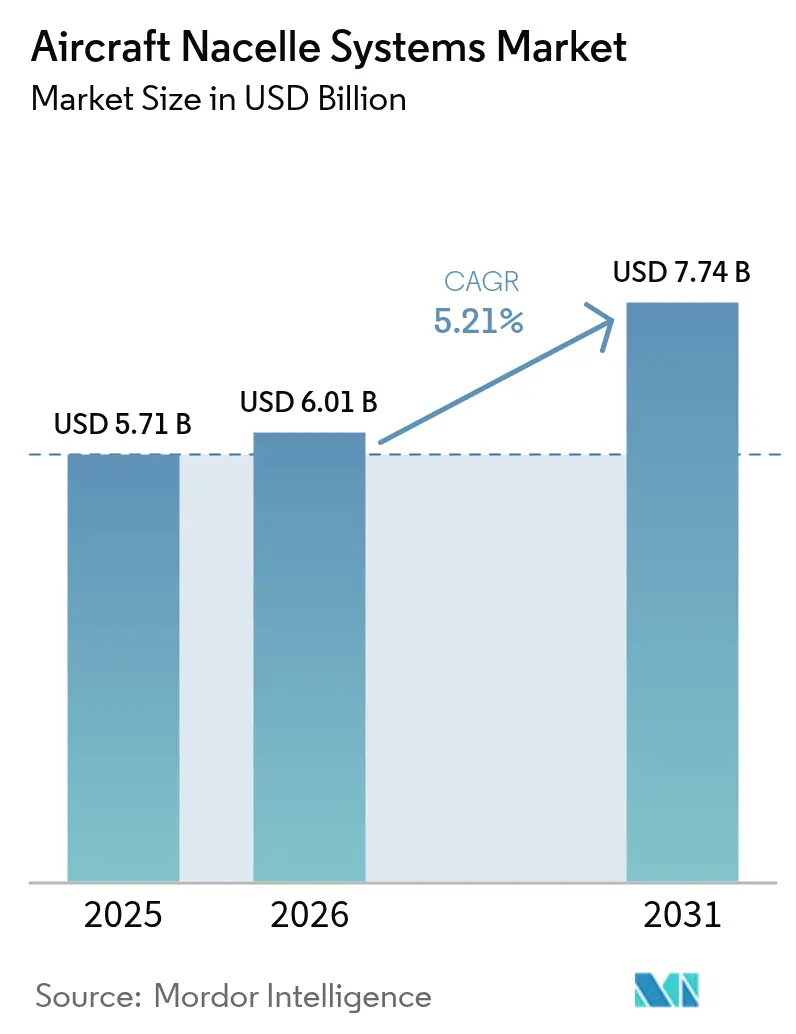
The aircraft nacelle systems market size is expected to grow from USD 5.71 billion in 2025 to USD 6.01 billion in 2026 and is forecast to reach USD 7.74 billion by 2031 at 5.21% CAGR over 2026-2031. Robust backlogs at Airbus and Boeing, rising single-aisle output targets, and airlines’ continued shift toward high-bypass engines underpin the growth trajectory. Ongoing certification of new B737 MAX and A320neo family variants, plus sustained retirements of legacy fleets, will keep demand for advanced nacelles firmly positive despite intermittent supply-chain constraints. Growing preference for service-based contracts such as nacelle-as-a-service and digital health-monitoring upgrades widens the aftermarket’s strategic relevance.
Key Report Takeaways
- By component, thrust reversers led with 31.12% of the aircraft nacelle systems market share in 2025; inlet cowls are projected to expand at a 5.64% CAGR through 2031.
- By aircraft type, commercial aviation held 57.30% revenue share in 2025, while general aviation is set to post the fastest 5.78% CAGR to 2031.
- By engine type, turbofan platforms captured 78.10% of the aircraft nacelle systems market size in 2025 and are advancing at a 5.86% CAGR into 2031.
- By end user, OEMs commanded 75.70% of the aircraft nacelle systems market size in 2025, whereas the aftermarket segment is forecasted to rise at a 5.39% CAGR to 2031.
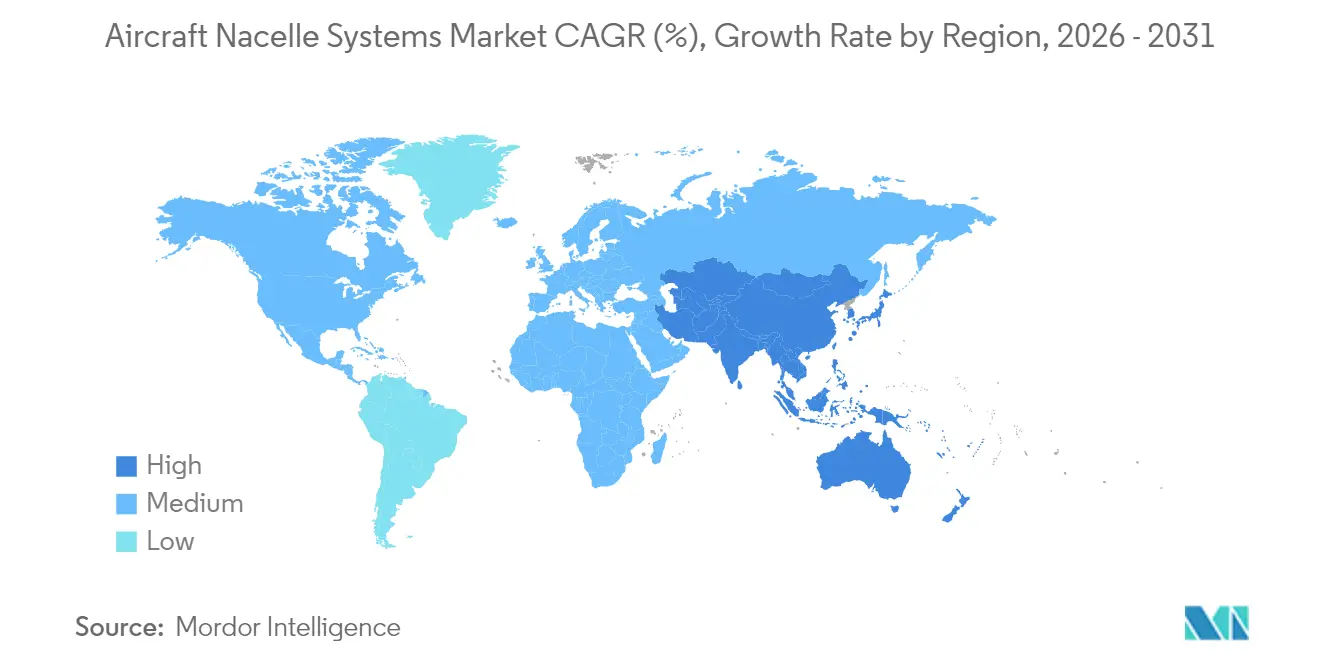
- By geography, North America accounted for a 38.30% share in 2025, yet Asia-Pacific is projected to log the quickest 5.62% CAGR over the forecast window.
Note: Market size and forecast figures in this report are generated using Mordor Intelligence’s proprietary estimation framework, updated with the latest available data and insights as of 2026.
Market Trends and Insights
Drivers Impact Analysis of Aircraft Nacelle Systems Market*
| Driver | (~) % Impact on CAGR Forecast | Geographic Relevance | Impact Timeline |
|---|---|---|---|
| Growing emphasis on fuel-efficient and next-generation aircraft | +0.8% | North America and Europe with global fleet adoption | Medium term (2-4 years) |
| Ongoing fleet modernization and rising single-aisle aircraft backlog | +1.0% | Asia-Pacific and North America | Medium term (2-4 years) |
| Ramp-up in production rates by Airbus and Boeing | +1.1% | North America and Europe manufacturing hubs | Short term (≤2 years) |
| Stricter airport noise regulations driving acoustic nacelle integration | +0.7% | Europe and North America, expanding to Asia-Pacific | Long term (≥4 years) |
| Adoption of nacelle-as-a-service subscription and maintenance models | +0.5% | Early uptake in North America and Europe | Medium term (2-4 years) |
| Advancements in nacelle designs supporting boundary-layer ingestion propulsion | +0.4% | North America and Europe R&D centers | Long term (≥4 years) |
| Source: Mordor Intelligence | |||
Growing Emphasis on Fuel-Efficient and Next-Generation Aircraft
Airlines’ immediate focus on cutting fuel burn translates into nacelle designs that handle larger fan diameters, higher bypass ratios, and 15–20% lower specific fuel consumption for engines such as CFM LEAP-1A and LEAP-1B.[1]Sean Broderick, “Boeing Lays Out 737 Production-Ramp Path,” Aviation Week, aviationweek.com Weight penalties are countered through broader use of resin-infused carbon-fiber barrels that trim 20 to 25 kg per ship-set without compromising stiffness. Acoustic liners now integrate micro-perforated face-sheets and graded honeycomb cores to curb tonal noise peaks by up to 3 dB, ensuring Chapter 14 compliance on the A320neo and B737 MAX families. Sustained demand is evidenced by Boeing’s plan to surpass 50 B737 MAX units per month after 2H 2026, locking in five-year visibility for nacelle suppliers. Fuel-efficiency mandates extend to military tanker and transport upgrades, adding incremental volume beyond commercial fleets.
Ongoing Fleet Modernization and Rising Single-Aisle Backlog
Backlog pressures remain acute, as Airbus counted 8,754 open orders by mid-2025—82% concentrated in the A220/A320 lines—translating to more than eight years of forward production at current build rates.[2]ePlane AI, “Airbus Outlook 2025,” eplaneai.com Each A320neo ship-set requires roughly USD 1 million worth of nacelle hardware, giving suppliers high-volume recurring revenue once ramp-ups stabilize. Asia-Pacific airlines, notably IndiGo, are securing purchase rights for up to 100 A350 jets, signaling that widebody replacement is also gathering pace. Deferred deliveries owing to engine shortages widen the delta between orders and production, making slots on high-volume programs strategically valuable.
Ramp-Up in Production Rates by Airbus and Boeing
The FAA’s May 2025 authorization for Boeing to raise B737 MAX output to 42 jets monthly created an instant step-change in nacelle procurement, with each monthly uptick adding demand for 84 thrust-reverser halves, 84 fan cowls, and 84 inlet lips. Airbus, meanwhile, is working toward 75 A320-family aircraft per month by 2027 after pushing back the 2026 target because of supply tightness. Even a two-month slip in Boeing’s five-jet-per-increment ramp schedule can pull as much as USD 120 million in nacelle revenue forward or backward per quarter, underscoring how tightly linked suppliers are to OEM cadence.
Stricter Airport Noise Regulations
European hubs such as Heathrow and Amsterdam-Schiphol attach landing-fee surcharges of up to 15% on aircraft that fail to meet local decibel caps, nudging airlines toward nacelles with advanced chevron nozzles and triple-layer acoustic liners. Suppliers respond by integrating metamaterial liners that shrink nacelle length by 6–8 cm while keeping attenuation stable, freeing space for wing-to-body fairing redesigns. Investment costs average USD 7–10 million per new acoustic option, but pay back within four years through higher ship-set pricing and better aftermarket margins.
Restraints Impact Analysis of Aircraft Nacelle Systems Market*
| Restraint | (~) % Impact on CAGR Forecast | Geographic Relevance | Impact Timeline |
|---|---|---|---|
| High capital investment and tooling costs for system manufacturing | -0.4% | Global, hitting small and mid-tier suppliers hardest | Short term (≤2 years) |
| Stringent FAA and EASA certification and regulatory compliance cycles | -0.5% | North America and Europe | Medium term (2-4 years) |
| Bottlenecks in the supply of aerospace-grade composite resins | -0.3% | North America and Europe | Short term (≤2 years) |
| Competitive threat from emerging podded electric propulsion systems | -0.2% | Europe and North America R&D nodes | Long term (≥4 years) |
| Source: Mordor Intelligence | |||
High Capital Investment and Tooling Costs
Fabricating a next-generation thrust-reverser cascade tool set exceeds USD 12 million, while autoclave lines sized for A320neo fan cowls can cost another USD 25 million. Hexcel’s 2024 capex of USD 87 million mainly financed resin-injection machines and in-house NDI systems, yet payback horizons stretch 5–7 years because ship-set pricing remains under OEM cost-down pressure.[3]Hexcel Corporation, “2024 Full-Year Results,” hexcel.com Smaller tier-2 shops often finance through sale-leasebacks that raise effective borrowing costs by 150–200 basis points. As OEMs demand dual-sourcing to buffer supply shocks, some suppliers must duplicate capacity on separate continents, doubling upfront spend without guaranteed volumes.
Stringent FAA and EASA Certification Requirements
Boeing’s B737 MAX 7 nacelle ice-shape re-test campaign extended program approval by 14 months, highlighting how even minor design tweaks can restart validation loops. Suppliers must generate more than 8,000 pages of compliance data for a typical thrust reverser, including cyber-resilience assessments for digital valve actuators. Dual-authority sign-offs obligate up to 40 witnessed ground tests, costing USD 50,000 to 70,000 in instrumentation and crew. Any service history incident, however minor, can trigger Special Conditions that retroactively affect in-service fleets, adding retrofit costs.
*Our forecasts treat driver/restraint impacts as directional, not additive. The impact forecasts reflect baseline growth, mix effects, and variable interactions.
Aircraft Nacelle Systems Market Segment Analysis
By Component:
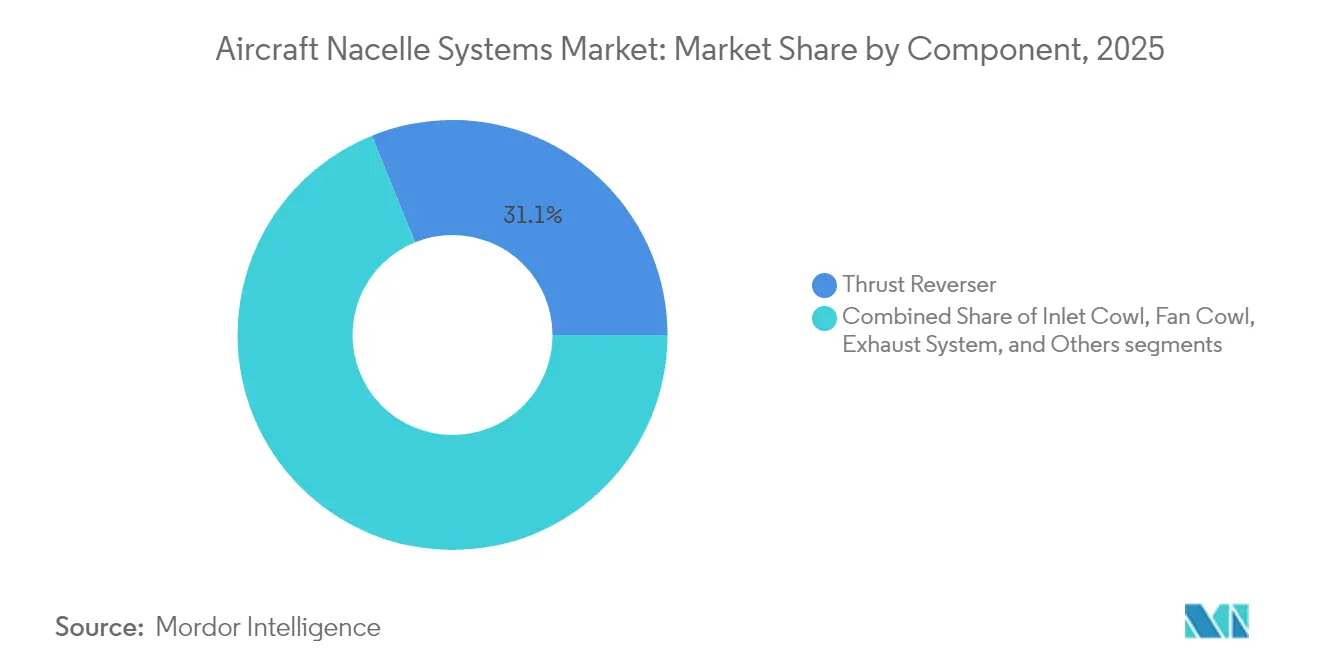
Complexity Keeps Thrust Reversers DominantThrust reversers held 31.12% of the aircraft nacelle systems market in 2025, buoyed by their safety-critical role and integration with engine-control logic. Although smaller in value, inlet cowls are on track for the fastest 5.64% CAGR through 2031 as carriers reward suppliers that can marry variable-geometry lips with low-noise liners. Suppliers that streamline removable acoustic panels and additive-manufactured lips stand to grow share, especially on re-engined narrowbodies expected to dominate deliveries this decade.
Fan cowls and exhaust systems still command steady demand that shadows airframe production, yet they face less aggressive redesign cycles than inlet cowls. Composite hot zones and metallic flow paths continue to converge, targeting reduced maintenance while defending margins in a cost-pressured environment. The emergence of boundary-layer ingestion further heightens inlet design complexity, steering supplier investment into lightweight, structurally stiff inlet ducts capable of managing distorted in-flow fields without inducing flutter.



By Aircraft Type:
Commercial Aviation Drives Volume, General Aviation Outpaces GrowthCommercial programs delivered the bulk of revenue in 2025, accounting for 57.30% of the aircraft nacelle systems market. Narrowbodies, led by the A320neo and B737 MAX, sustain unmatched build-rates and thus the lion’s share of nacelle shipments. Meanwhile, general aviation is expected to clock a 5.78% CAGR, supported by fresh business jet introductions and early eVTOL prototypes that leverage scaled-down nacelle technologies. The aircraft nacelle systems market size for the business jet niche is predicted to climb alongside Gulfstream G700 and Bombardier Global 7500 roll-outs.
Widebody nacelles have the greatest per-unit value, with Airbus striving to increase A350 output to 12 aircraft per month by 2028. Regional jets and military transports supply steady, albeit lower-volume demand that diversifies supplier revenue and smooths commercial cycle volatility.
By Engine Type:
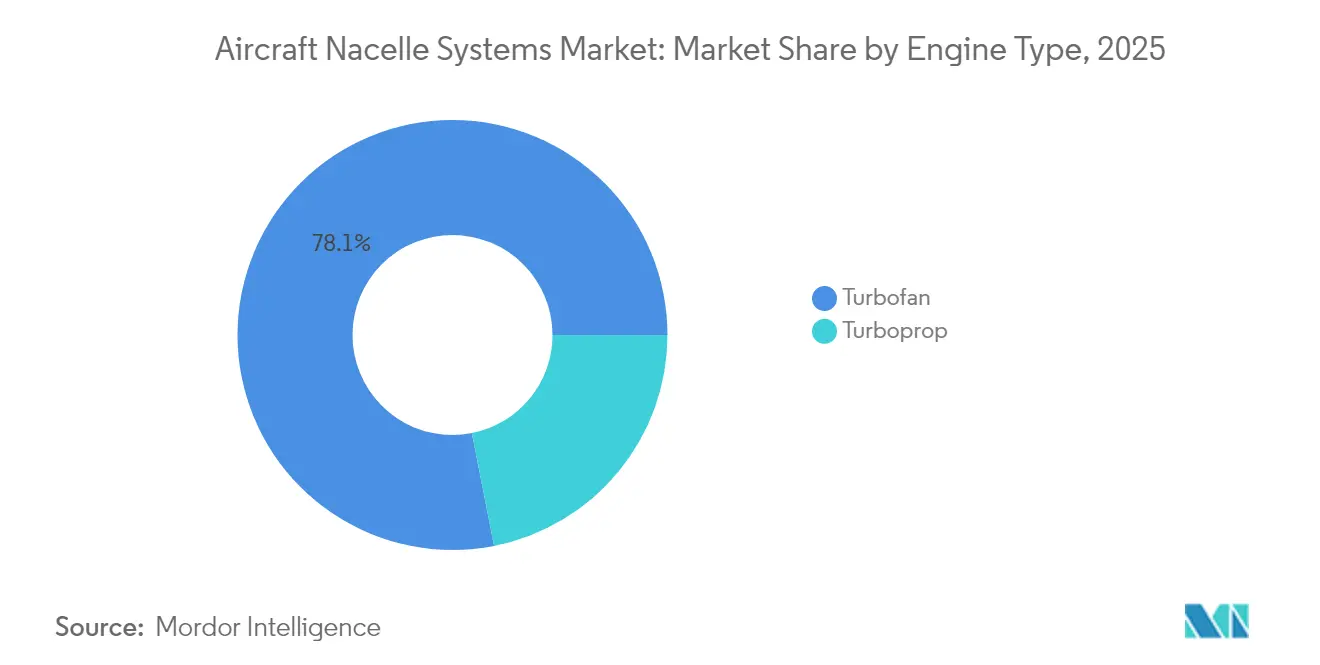
Turbofan Supremacy ContinuesTurbofan programs captured 78.10% of revenue in 2025 and are pegged to expand at a 5.86% CAGR, reflecting sustained preference for high-bypass typologies in commercial and defense fleets. The aircraft nacelle systems market size tied to turbofans is projected to rise with LEAP, GTF, and Trent deliveries.
Key design themes include composite fan-door barrels, integrated anti-icing systems, and real-time structural health sensors. Despite a smaller volume, turboprops remain relevant for regional and special-mission aircraft where short-field performance prevails.
By End User:
OEM Contracts Dominate, Aftermarket Scales FasterOEM deliveries produced 75.70% of 2025 revenue, yet the aftermarket’s 5.39% CAGR will gradually enlarge its slice as operators seek cost-predictable service loops. Airlines increasingly sign power-by-the-hour‐styled agreements that bundle nacelle spares, on-wing support, and predictive analytics dashboards. Safran’s multi-site MRO expansion in Singapore and Dubai is emblematic of how incumbents fortify global reach.
Geography Analysis
North America Aircraft Nacelle Systems Market
North America controlled 38.30% of 2025 revenue due to Boeing’s production rebound and dense aftermarket networks. FAA clearance in May 2025 for 42 units per month, B737 MAX output immediately lifted the nacelle order flow. Spirit AeroSystems’ Pearl 10X nacelle contract and Collins Aerospace’s blended wing body partnership with JetZero reflect the region’s innovation weight.
APAC Aircraft Nacelle Systems Market
Asia-Pacific is predicted to pace the field with a 5.62% CAGR through 2031 as China, India, and Southeast Asia scale fleets and localize aerostructure work. IndiGo’s purchase rights for up to 100 A350s underline the region’s widebody appetite. Safran’s tie-up with Hindustan Aeronautics Limited to manufacture LEAP parts in India shows established suppliers embedding within emerging supply chains.
Europe Aircraft Nacelle Systems Market
Europe remains a pillar supplier hub anchored by Airbus and top-tier vendors like Safran and GKN. Clean-Aviation-funded hybrid-electric prototypes keep continental R&D centered on low-drag, low-noise nacelles. Airbus’ target of 75 A320-family jets a month by 2027 underwrites volume stability. Regulatory rigor from EASA, particularly on acoustics, steers global design baselines.

Regulatory Landscape
Certification and continued airworthiness for nacelle systems are governed primarily by the FAA and EASA through transport-airplane and engine frameworks, which shape design, test, and documentation requirements for thrust reversers, inlets, and fire protection features. In June 2026, the FAA published a notice of proposed rulemaking to modernize transport airplane and propulsion certification standards and advance harmonization with EASA CS-25, reinforcing the market weight of dual-authority alignment for globally delivered A320neo and B737 MAX nacelle shipsets.
On the engine side, EASA updated its CS-E framework with ED Decision 2025/003/R (CS-E Amendment 8) in April 2025, including alternate endurance testing provisions for turbofan engines and additional substantiation requirements relevant to nacelle-engine integration. The convergence workstream also runs through the Certification Authorities for Transport Airplanes (CATA) program involving FAA, EASA, ANAC, and TCCA, including a worklist item (EASA-002) focused on harmonizing fire protection requirements for the 2D Nacelle under CS/FAR 25.867. In parallel, the FAA continued to issue targeted directives affecting propulsion-system safety substantiation, including a March 2026 Airworthiness Directive emphasizing documentation of engine system safety fault rates under 14 CFR 33.5, which can cascade into nacelle-related compliance artifacts and retrofit activity.
Value Chain Analysis
The aircraft nacelle systems value chain begins with material and sub-tier supply of carbon-fiber feedstock, aerospace-grade resin systems, and titanium alloys, then moves into specialized processing such as composite layup or infusion, machining, and non-destructive inspection. Tier suppliers produce acoustic liners, actuators, hinges, latches, anti-ice elements, and thrust-reverser subassemblies, feeding Tier-1 nacelle integrators that hold design authority, systems integration, qualification testing, and delivery to airframe and engine programs. OEM production cadence, particularly for A320neo and B737 MAX, drives short-cycle demand for high-rate shipsets, while certification evidence packages and configuration control extend the cost and lead times for even minor design changes.
Downstream, distribution and support shift toward the aftermarket through MRO networks that manage scheduled inspections, repairs, and tooling availability, increasingly under service-based contracts and digital monitoring. Regional MRO localization is a lever for the value chain, and the June 2026 joint venture agreement between Safran Aircraft Engines and SIA Engineering Company to establish a CFM LEAP engine shop in Singapore for LEAP-1A and LEAP-1B maintenance supports the wider installed-base support ecosystem that nacelle providers rely on. Program-specific collaborations can also reshape work across tiers, such as Deutsche Aircraft and NORDAM working on nacelles for the D328eco, which can create new qualification, tooling, and supplier-approval requirements.
Competitive Landscape
Competition is moderate, shaped by deep-rooted OEM alliances and certification prowess. Safran, Collins Aerospace, and Leonardo S.p.A. collectively oversee a substantive share, leveraging vertically integrated composites, thrust reverser patents, and worldwide MRO footprints. Safran’s EUR 1 billion (USD 1.17 billion) LEAP MRO rollout boosts aftermarket stickiness, while Collins’ JetZero project positions it for boundary-layer ingestion configurations.
White-space opens around electrified propulsion and blended-wing airframes where conventional nacelles may morph or vanish. Through its Raytheon Technologies subsidiary, RTX is co-developing nacelles for JetZero’s blended-wing demonstrator, aiming to preserve thermal management know-how in disruptive architectures. Hexcel’s new HexPly M51 prepreg promises lighter, more rigid hot-section panels.[4]Hexcel Corporation, “Launch of HexPly M51,” hexcel.com
Barriers to entry stay high: multi-year certification, soaring tooling capex, and tight supplier approval loops deter newcomers. However, regional composite houses in India and China could gain share in cost-sensitive sub-assemblies once local regulatory pathways mature.
Aircraft Nacelle Systems Industry Leaders
Leonardo S.p.A.
GKN Aerospace Services Limited (Melrose Industries plc)
Collins Aerospace (RTX Corporation)
Safran SA
Spirit AeroSystems, Inc.
- *Disclaimer: Major Players sorted in no particular order
Aircraft Nacelle Systems Market Companies Covered in this Report
- Safran SA
- Collins Aerospace (RTX Corporation)
- Spirit AeroSystems, Inc.
- GKN Aerospace Services Limited (Melrose Industries plc)
- Leonardo S.p.A.
- The NORDAM Group LLC
- Barnes Group Inc.
- FACC AG
- Triumph Group, Inc.
- Singapore Technologies Engineering Ltd.
- AAR CORP.
- Ducommun Incorporated

Market Opportunities and Future Outlook
White space is opening around high-rate narrowbody shipsets and the industrial capabilities needed to sustain output without compromising compliance and on-wing reliability, particularly for thrust reversers and acoustic nacelle features under tighter airport noise regimes. June 2026 progress provides a clear anchor: Safran Nacelles delivered its 5,000th Airbus A320neo nacelle from its Colomiers facility, and it communicated a move toward higher annual production capacity, supporting demand for automated composite fabrication, inspection throughput, and fast-turn spares provisioning. Aftermarket tooling access is also becoming a differentiator; the April 2026 renewal of an exclusive license agreement between Dedienne Aerospace and Collins Aerospace for the sale, maintenance, calibration, and leasing of nacelle tooling supporting a fleet of more than 20,000 aircraft points to sustained investment in tool availability, standardization, and global support coverage.
Technology transition in propulsion architectures is also creating adjacent opportunities for nacelle redesign, materials, and actuation. Safran Aircraft Engines began construction of an 8 m-diameter test cell at Villaroche in March 2026 to support system-level testing of a full-scale open-fan front module, with ground tests scheduled for early 2027, which increases demand for next-generation inlet and acoustic solutions linked to ultra-high bypass and open-rotor integration. Materials choices are shifting toward practical manufacturing pathways as well; in January 2026, a consortium including Airbus demonstrated repurposing a thermoplastic A380 engine pylon cowl into a smaller A320neo pylon cowl, supporting opportunities in circular composite supply chains and repairable thermoplastic structures for nacelle applications. Electric and simplified maintenance concepts are gaining traction in defense programs too, with Bell Textron reporting in April 2026 that its V-22 Osprey Nacelle Improvement Program reduced maintenance time by 75% and improved readiness by 10% based on 10,000 flight hours, pointing to retrofit kits and maintainability-focused nacelle upgrades beyond commercial aircraft.
Recent Industry Developments in Aircraft Nacelle Systems Market
- July 2026: Collins Aerospace opened an Engineering Center of Excellence in Wolverhampton, UK, to advance electric thrust reverser actuation systems (elecTRAS) used in nacelles. The investment concentrates engineering resources around electrified nacelle functions and supports industrialization of electric actuation architectures that reduce hydraulic complexity on newer aircraft.
- June 2026: Safran Nacelles delivered its 5,000th nacelle for the Airbus A320neo program, produced at its Colomiers facility. The milestone highlights sustained shipset volume on the highest-rate single-aisle line and reinforces the need for resilient composite manufacturing and supply continuity across nacelle subassemblies.
- December 2025: AAR and AFI KLM E&M commenced operations of their joint venture, xCelle Asia, in Chonburi, Thailand, providing nacelle maintenance, repair, and overhaul services. Starting operations adds regional MRO capacity in Asia, improving turnaround times for operators and strengthening the competitive position of providers with localized aftermarket networks.


Aircraft Nacelle Systems Market Report Scope and Research Methodology
Market Definition and Coverage
This market counts the revenue generated from aircraft nacelle systems supplied for aircraft engines, covering the nacelle structure and the main functional sub-systems that manage airflow, noise, and engine integration across civil and defense aviation.
Scope exclusions: We exclude the engine core itself, standalone engine components that are not sold as part of the nacelle system, and unrelated airframe structures outside the engine installation area.
Segments Covered in This Report
- By Component
- Inlet Cowl
- Fan Cowl
- Thrust Reverser
- Exhaust System
- Others
- By Aircraft Type
- Commercial Aviation
- Narrowbody Aircraft
- Widebody Aircraft
- Regional Jets
- Military Aviation
- Combat Aircraft
- Transport Aircraft
- Special Mission Aircraft
- Others
- General Aviation
- Business Jets
- Others
- Commercial Aviation
- By Engine Type
- Turbofan
- Turboprop
- By End User
- Original Equipment Manufacturer (OEM)
- Aftermarket
- By Geography
- North America
- United States
- Canada
- Mexico
- Europe
- United Kingdom
- France
- Germany
- Italy
- Spain
- Rest of Europe
- Asia-Pacific
- China
- India
- Japan
- South Korea
- Australia
- Rest of Asia-Pacific
- South America
- Brazil
- Rest of South America
- Middle East and Africa
- Middle East
- United Arab Emirates
- Saudi Arabia
- Rest of Middle East
- Africa
- South Africa
- Rest of Africa
- Middle East
- North America
Data Sources, Market Sizing, and Validation
Desk Research
Desk research was used to establish the fact base and boundaries before the model was built. We referenced public aviation production and delivery statistics, fleet and traffic indicators, and regulatory or safety releases to understand which aircraft are being built, operated, and maintained, and what that implies for nacelle demand.
Typical inputs came from sources such as FAA and EASA publications, ICAO and IATA air transport statistics, U.S. Bureau of Transportation Statistics data series, and customs and trade statistics where nacelle-related parts can be tracked at a high level. Company annual reports, investor presentations, and audited financial statements were also reviewed to understand program exposure and aftermarket mix, and then a paid subscription for company financials and news was used selectively to cross-check timelines and supply chain events. The desk sources listed here are illustrative and not exhaustive, and additional public sources were also used for data collection, validation, and clarification.
Primary Interviews and Surveys
Primary interviews were used to validate what is counted as a nacelle system sale, and when that revenue is recognized between OEM fitment and aftermarket activity. We spoke with a mix of supply chain participants, aftermarket service stakeholders, and aviation domain experts across APAC, EMEA, and the Americas, which helped us pressure-test pricing logic, program ramp timing, and realistic retrofit and maintenance rates.
Distribution of primary research fieldwork respondents
| Company type | Respondent position | Region |
|---|---|---|
| Top tier: 36% | CXOs: 14% | APAC: 37% |
| Mid tier: 46% | Functional/Unit leaders: 34% | EMEA: 36% |
| Smaller Players: 18% | Managers: 52% | Americas: 27% |
Market-Sizing & Forecasting
The market was sized using a top-down and bottom-up approach, where aircraft production and in-service fleet activity are translated into nacelle system demand, then value is reconstructed through representative pricing ranges by aircraft and engine family. Totals are checked with selective bottom-up approximations, including supplier revenue sampling, program-level channel checks, and a sanity check of implied nacelle content per delivered aircraft, before the figures are adjusted.
Key inputs used in the model include aircraft delivery and backlog direction, the mix shift between narrowbody and widebody builds, turbofan versus turboprop installation trends, the split between OEM line-fit and aftermarket demand, and observed pricing movements for nacelle assemblies and major modules like thrust reversers and inlet or fan cowls. Where the data trail is thinner, such as smaller fleets or less-disclosed aftermarket contracts, we apply conservative penetration rates and then align them with expert feedback.
For forecasting, we used scenario analysis supported by regression-style checks between fleet growth indicators and nacelle replacement or overhaul intensity, followed by expert validation on rate ramps and supply constraints. This keeps the outlook repeatable while reflecting how quickly build rates and shop-visit patterns can change year to year.
Data Validation & Update Cycle
Outputs are validated through several checks so the final numbers do not rely on a single assumption. We compare modeled totals against independent signals such as aircraft deliveries, fleet utilization changes, and the implied aftermarket share, then investigate variances that fall outside expected ranges.
A multi-step internal review is done before sign-off, and re-contact is triggered when a major program rate change, certification event, or supply disruption could shift the sizing inputs. The report is refreshed annually, with interim updates for material events, and then a final pre-delivery pass is completed so clients receive the latest updated view.
Mordor Intelligence's Aircraft Nacelle Systems Market Size Measured Against Other Published Estimates
Published market sizes for aircraft nacelle systems can vary even when the topic label looks the same, because different studies do not always count the same revenue points and timing. The spread usually comes from what is included as a nacelle system sale, how OEM fitment is treated versus aftermarket, and which aircraft and engine types are counted in the addressable pool.
The benchmark table shows a clear range across sources, and in Mordor Intelligence's model the 2026 starting point aligns with the defined forecast window and counts nacelle system value tied to aircraft applications and engine types, rather than mixing adjacent engine or broader airframe content into the same total. Differences also come from how pricing is progressed (flat versus program-linked escalation), how currency conversion timing is handled for multi-region supply chains, and whether assumptions are re-validated when production rates or retrofit activity shift.
Benchmark comparison
| Source | Market Size | Gaps in Research Methodology |
|---|---|---|
| Mordor Intelligence | USD 6.01 B (2026) | |
| Industry Research Publisher A | USD 9.00 B (2024) | Uses a 2024 base year and a different time window, which can move the starting value depending on how aircraft deliveries and in-service activity were normalized for that year. The total can also rise if additional nacelle-adjacent content is included alongside complete nacelle assemblies. |
| Industry Research Publisher B | USD 6.61 B (2024) | Anchors on 2024 with a shorter outlook, which changes sensitivity to build-rate ramps and aftermarket cycles compared with a later start year. Limited detail on whether OEM fitment and aftermarket revenue are separated cleanly can also shift the total. |
Taken together, the comparison indicates that scope edges and time anchors explain most of the gap, not just arithmetic differences. By linking the totals back to aircraft output, fleet activity, and realistic pricing ranges, we can show the steps clearly and update inputs when new aviation signals emerge.


Key Questions Answered in the Report
What is the forecast value of the aircraft nacelle systems market by 2031?
The aircraft nacelle systems market is projected to reach USD 7.74 billion by 2031.
Which geographic region is poised for the fastest nacelle growth?
Asia-Pacific is expected to post a 5.62% CAGR through 2031.
Which component currently leads revenue?
Thrust reversers held 31.12% share in 2025.
Why are inlet cowls the fastest growing component?
Airlines seek fuel economy and lower noise, prompting advanced inlet designs to grow at 5.64% CAGR.
How significant is the aftermarket compared with OEM sales?
OEMs still generate 75.70% of 2025 revenue, but aftermarket contracts are expanding faster at 5.39% CAGR.
What is the primary restraint hindering new entrants?
High tooling investment exceeding USD 50 million and lengthy certification timelines create steep entry barriers.
Page last updated on:


 Your data is secure and never sold or shared.


