Market Overview
| Study Period | 2019 - 2031 |
|---|---|
| Market Size (2026) | USD 2.21 Billion |
| Market Size (2031) | USD 3.27 Billion |
| Growth Rate (2026 - 2031) | 8.12 % |
| Fastest Growing Market | Asia-Pacific |
| Largest Market | North America |
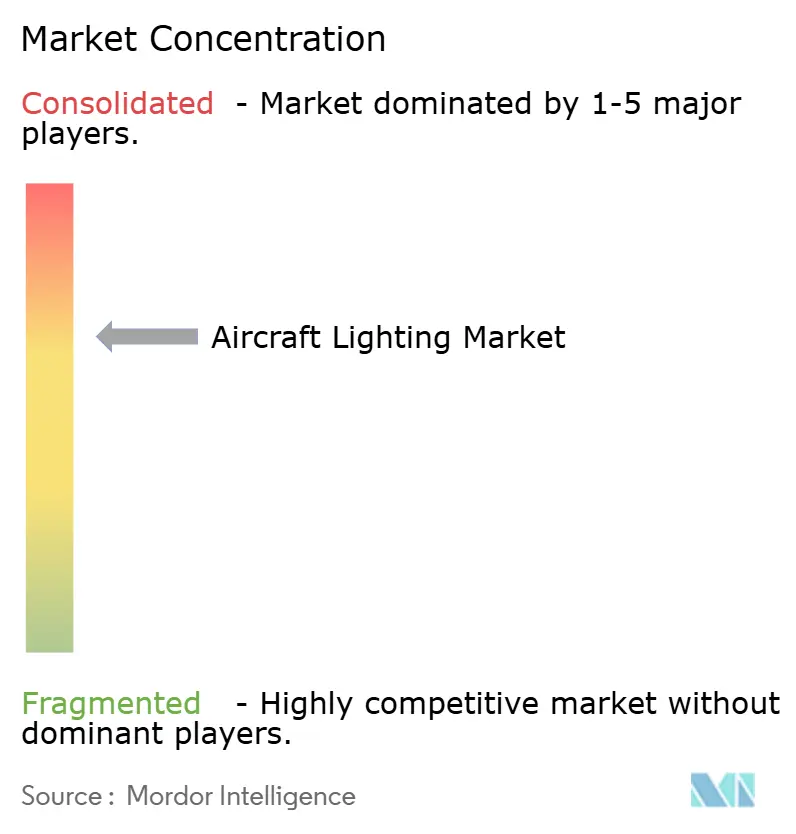
| Market Concentration | Medium |
Major Players *Disclaimer: Major Players sorted in no particular order Image © Mordor Intelligence. Reuse requires attribution under CC BY 4.0. | |
Aircraft Lighting Market Analysis by Mordor Intelligence
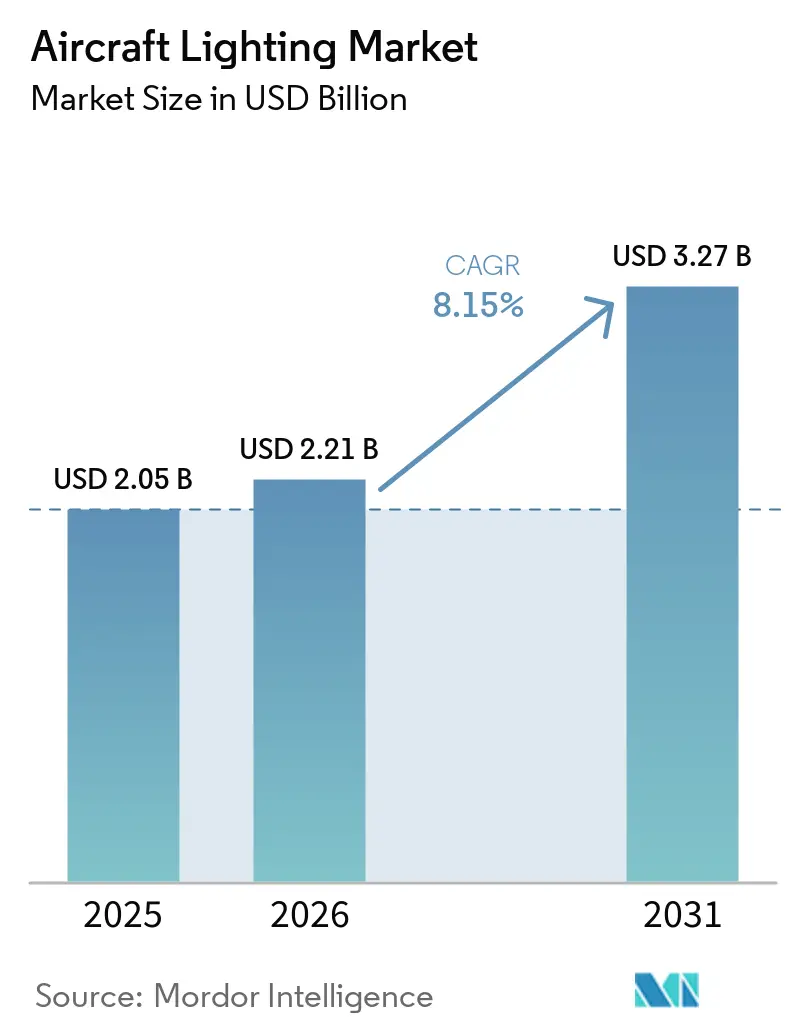
The aircraft lighting market size was valued at USD 2.05 billion in 2025, and is forecast to grow from USD 2.21 billion in 2026 to USD 3.27 billion by 2031 at a 8.12% CAGR during the forecast period (2026-2031). Commercial OEM deliveries, military aircraft procurement, and cabin retrofit work support demand for certified lighting systems. Airbus delivered 793 commercial aircraft in 2025, and its 2026 delivery plans support continued linefit demand across new aircraft programs. Airlines are also updating cabin interiors, which places lighting alongside seating, displays, and other equipment during scheduled maintenance visits. Suppliers with established certification capabilities can benefit, as approvals, testing, and aircraft integration create lengthy qualification cycles. Connected cabin systems could also make lighting networks more valuable by supporting maintenance, monitoring, and software-led cabin functions.
Key Report Takeaways
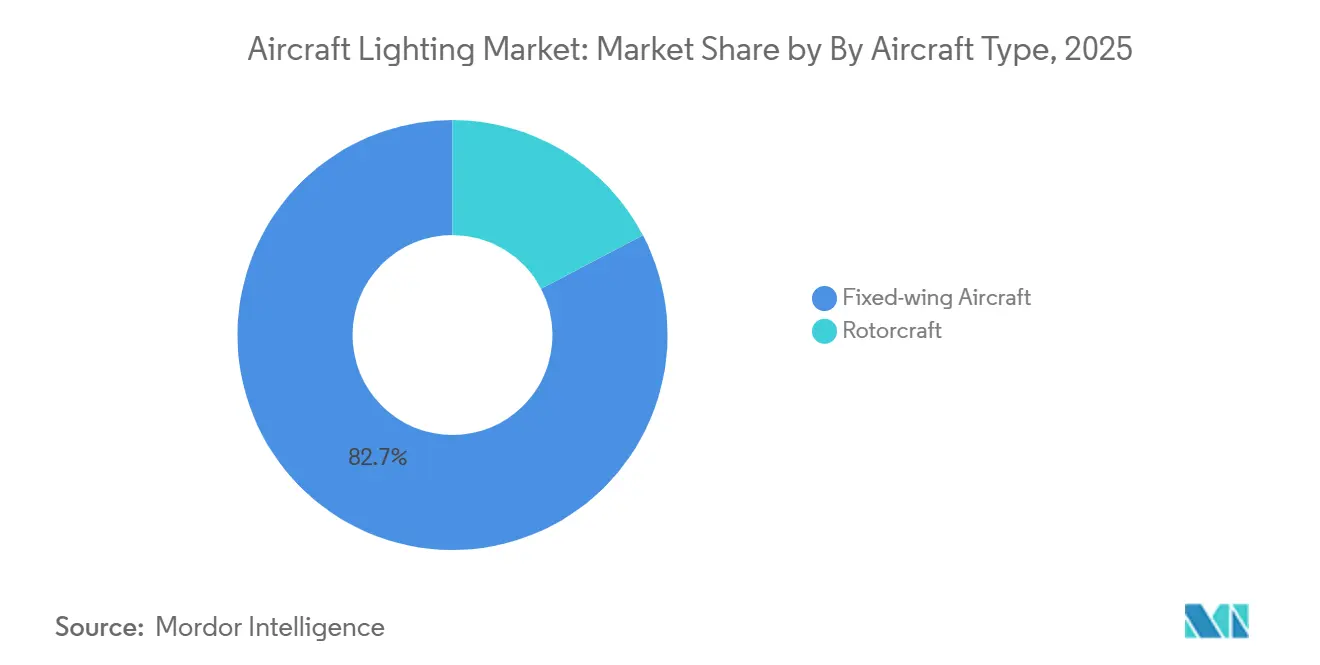
- By aircraft type, fixed-wing aircraft held 82.67% of the aircraft lighting market share in 2025, while rotorcraft is forecast to grow at a 9.69% CAGR through 2031.
- By light type, interior lights accounted for 45.27% of the aircraft lighting market share in 2025, while cockpit lights are forecast to expand at an 11.49% CAGR through 2031.
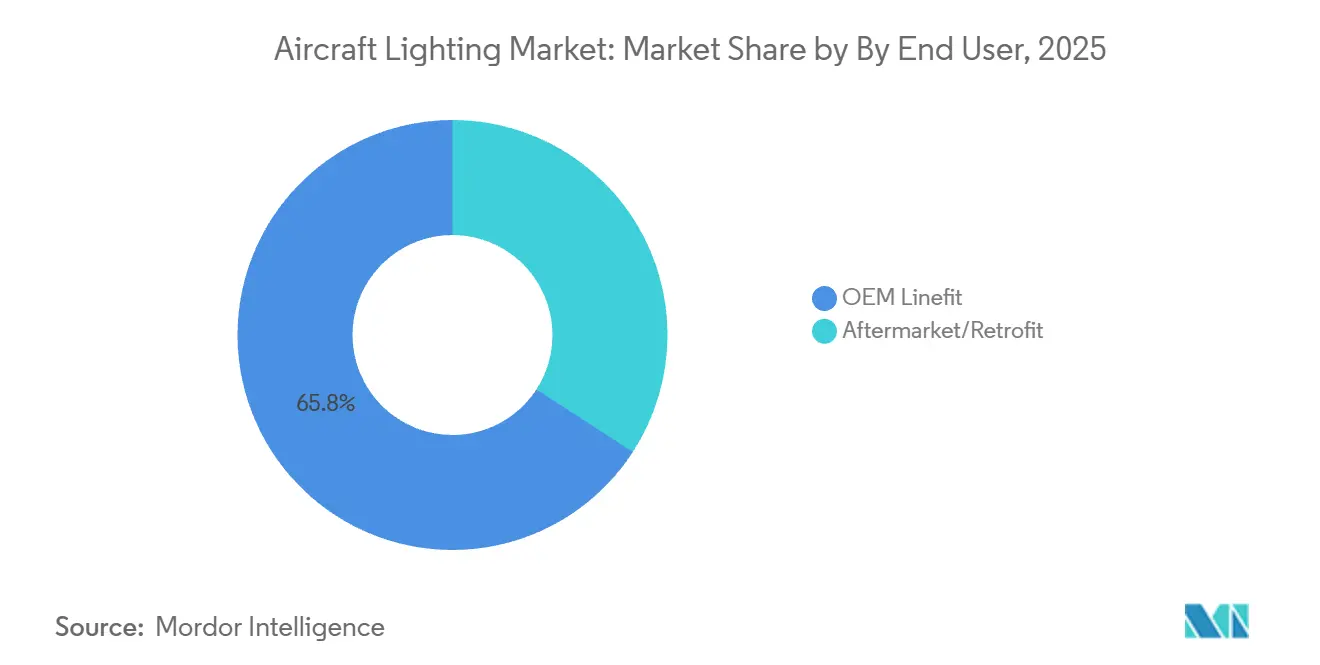
- By end user, OEM linefit held 65.84% of revenue in 2025, while aftermarket/retrofit channels are forecast to grow at a 10.29% CAGR through 2031.
- By technology, LED technology held 51.38% of revenue in 2025, while other emerging lighting technologies are forecast to grow at a 12.95% CAGR through 2031.
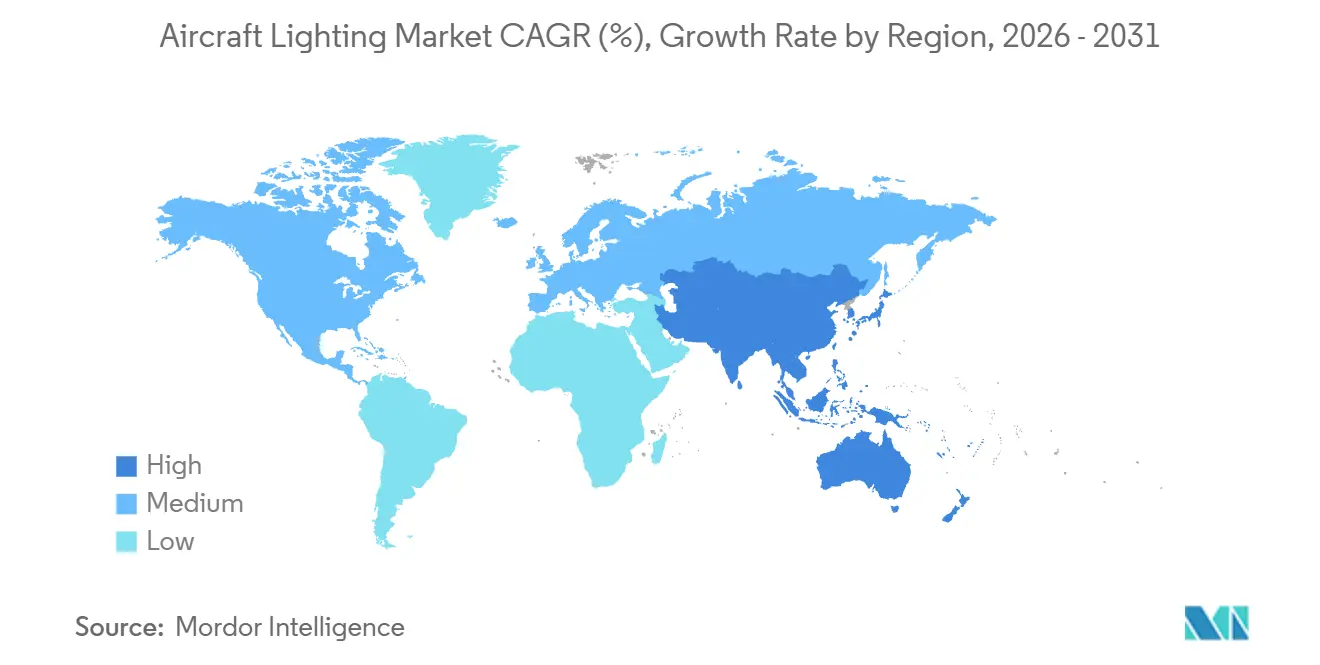
- By region, North America accounted for 40.89% of 2025 revenue, while Asia-Pacific is forecast to grow at a 10.28% CAGR through 2031.
Note: Market size and forecast figures in this report are generated using Mordor Intelligence’s proprietary estimation framework, updated with the latest available data and insights as of 2026.
Market Trends and Insights
Drivers Impact Analysis of Aircraft Lighting Market*
| Driver | (~) % Impact on CAGR Forecast | Geographic Relevance | Impact Timeline |
|---|---|---|---|
| Growth in aircraft deliveries and fleet expansion | +2.10% | Global, led by North America and Asia-Pacific | Short term (≤ 2 years) |
| LED adoption for lower power consumption and maintenance | +1.80% | Global, with early gains in North America and Europe | Medium term (2-4 years) |
| Aircraft cabin modernization and retrofit programs | +1.50% | Global, concentrated in North America, Europe, and the Middle East | Medium term (2-4 years) |
| Passenger-experience differentiation through dynamic lighting | +1.00% | Global, led by premium long-haul operators in Europe, Asia-Pacific, and the Middle East | Long term (≥ 4 years) |
| Plug-and-play certified retrofit kits reducing aircraft downtime | +0.70% | North America, Europe, and Asia-Pacific MRO hubs | Short term (≤ 2 years) |
| IoT-enabled smart lights enabling predictive maintenance | +0.60% | Global, with faster adoption in Asia-Pacific and North America | Long term (≥ 4 years) |
| Source: Mordor Intelligence | |||
Growth in Aircraft Deliveries and Fleet Expansion
Aircraft delivery volumes directly support the aircraft lighting market, as each new aircraft requires certified interior, exterior, cockpit, and emergency lighting before entering service. Airbus delivered 793 commercial aircraft in 2025, a 4% increase from the prior year, and targets 870 deliveries in 2026.[1] These deliveries create linefit demand for lighting suppliers that have positions on commercial aircraft programs. The large installed order backlog also gives suppliers visibility beyond short production cycles, even though each aircraft program has its own approved configuration. Military procurement adds another source of demand, as combat, tanker, and transport aircraft require platform-specific lighting. The US Air Force FY2026 budget covers aircraft procurement and modernization programs that require specialized systems, including night-vision-compatible lighting.
LED Adoption for Lower Power Consumption and Maintenance
LED adoption continues to reshape the aircraft lighting market because airlines seek lower electrical load and fewer component replacements. SAE ARP6253A, revised in 2025, sets requirements for LED aircraft applications across electrical interfaces, thermal management, and electromagnetic compatibility. The FAA is also converting more than 900 Medium Intensity Approach Lighting Systems to LED technology, with work beginning in early 2024 and a transition expected to take 6-8 years.[2] Certified LED reading lights can exceed 100,000 hours of mean time between failures, use up to 50% less power, and reduce weight by up to 36.50 kg on widebody aircraft. Longer service life reduces routine replacements, but the technology creates inspection and compliance work when wiring, controls, or interfaces require attention. The FAA's 2026 directive on B777 LED sidewall wire bundles illustrates how maintenance needs can follow a fleetwide lighting upgrade.
Aircraft Cabin Modernization and Retrofit Programs
Cabin refurbishment supports the aircraft lighting market, as lighting modules are often installed alongside new seats, displays, and cabin finishes. Emirates' USD 5 billion program covers 219 aircraft, and 100 refurbishments were completed by mid-2026. Air India completed the first phase of its legacy cabin retrofit on 27 A320neo aircraft by October 2025, bringing its upgraded A320 fleet to 104 aircraft. LED cabin kits can be supplied under FAA Supplemental Type Certificates and generally need less structural work than wider cabin modifications. This allows operators to include lighting upgrades during planned maintenance visits with limited additional downtime. AAR acquired Aircraft Reconfig Technologies in April 2026, increasing engineering and certification capacity for aircraft reconfiguration.
Passenger Experience Differentiation Through Dynamic Lighting
Dynamic cabin systems create a further path for the aircraft lighting market as long-haul carriers seek ways to differentiate the passenger experience. Collins Aerospace's Hypergamut system uses software-defined controls to manage sleep cycles and adjust color temperature without replacing the installed hardware. Diehl Aviation presented its Flex Light system in 2026 for cabin lighting arrangements that can adapt to cabin geometry and passenger needs. Scientific research indicates that spectral light near 480 nm can affect circadian pathways, which supports the case for lighting programs that align with destination time zones. Connected interiors can also identify maintenance issues through real-time cabin monitoring, making lighting networks part of a wider service offering. These capabilities favor suppliers that can provide qualified hardware, software controls, and integration support over the life of the cabin.
Restraints Impact Analysis of Aircraft Lighting Market*
| Restraint | (~) % Impact on CAGR Forecast | Geographic Relevance | Impact Timeline |
|---|---|---|---|
| High certification and integration costs | -1.20% | Global, most acute in North America and Europe | Medium term (2-4 years) |
| Aircraft weight, power, and thermal-management constraints | -0.80% | Global | Medium term (2-4 years) |
| Cybersecurity and electromagnetic-compatibility validation for connected lighting | -0.60% | North America and Europe, with spillover to Asia-Pacific | Long term (≥ 4 years) |
| Capital reallocation toward IFEC/connectivity over lighting | -0.50% | Global, led by long-haul carriers | Medium term (2-4 years) |
| Source: Mordor Intelligence | |||
High Certification, Integration, and Aircraft Constraints
Certification costs can limit adoption in the aircraft lighting market, particularly for connected products and aircraft-specific retrofit programs. EASA Amendment 25/29, effective in August 2024, extended airworthiness security requirements to new large aircraft and major changes. Suppliers may need to complete validation across several authorities, which can lengthen documentation and approval work. Fire testing, electrical integration, thermal management, weight limits, and available aircraft power all add design constraints for a new lighting installation. Smaller specialists often need third-party test facilities, which adds cost and scheduling risk. Operators can face higher prices for certified retrofit kits, while spending priorities may favor in-flight entertainment and connectivity projects over lighting upgrades.
Cybersecurity and Electromagnetic-Compatibility Validation for Connected Lighting
Connected lighting faces a separate restraint because networked cabin equipment requires cybersecurity and electromagnetic compatibility validation. EASA CS 25.1319 requires airworthiness security processes for relevant aircraft systems, including threat analysis and risk assessment work. Research presented at the 2025 Digital Avionics Systems Conference identified risks where vulnerabilities in cabin systems could cross network boundaries. Digital control buses and power-line communications must also meet RTCA DO-160 electromagnetic-compatibility requirements when installed near sensitive avionics. These obligations can add 12-18 months to development schedules for connected lighting products. The burden is most immediate in North America and Europe, where the updated regulatory frameworks are applied first, before influencing requirements in the Asia-Pacific.
*Our forecasts treat driver/restraint impacts as directional, not additive. The impact forecasts reflect baseline growth, mix effects, and variable interactions.
Aircraft Lighting Market Segment Analysis
By Aircraft Type:
Rotorcraft Upgrades Accelerate Within a Fixed-Wing-Led MarketFixed-wing aircraft held 82.67% of revenue in 2025, supported by commercial narrowbody production and high-value military transport programs. Airbus delivered 793 commercial aircraft in 2025 and ended the year with an order backlog of 8,754 aircraft. New narrowbody aircraft use multi-zone LED systems that must meet the environmental qualification requirements of SAE ARP5873B and RTCA DO-160. Military fixed-wing platforms, including the F-35A, F-15EX, and KC-46A, require premium lighting packages to increase revenue per aircraft. These programs keep fixed-wing aircraft as the main source of OEM linefit demand in the aircraft lighting market.
Rotorcraft is forecast to grow at a 9.69% CAGR from 2026 to 2031. Military rotary-wing modernization, offshore energy operations, and advanced air mobility platforms support this growth. NATO member states are adopting night-vision-compatible cockpit illumination and formation-lighting upgrades on helicopters, which can bring retrofit work forward from normal replacement cycles. Offshore operators of the Airbus H175 and Leonardo AW189 face airworthiness requirements for maritime exterior lighting intensity and failure-mode performance. EASA's Special Condition for Small VTOL aircraft established lighting certification criteria for eVTOL aircraft, creating an additional procurement category for rotary-adjacent aircraft.

By Light Type:
Interior Lighting Leads as Cockpit Demand AcceleratesInterior lighting accounted for 45.27% of revenue in 2025 because it covers passenger cabins, galleys, lavatories, reading lights, service areas, emergency lighting, and ambient systems. Passenger cabin lighting is highly valued by airlines, as they install programmable LED systems that support color tuning and cabin branding. Emergency and exit lighting needs rigorous qualification and traceability because it is safety-critical equipment. Galley and lavatory lights may require more frequent replacement due to exposure to heat and moisture. These operating conditions make reliability and service support important selection factors.
Cockpit lights are forecast to grow at an 11.49% CAGR through 2031, the fastest rate among light types in the aircraft lighting market. Avionics upgrades and wider use of night-vision-compatible lighting support this demand in military and para-public aircraft. Exterior systems must meet FAA and EASA color and intensity requirements, maintaining replacement demand as operators convert older systems to LED technology. Mood lighting is increasingly selected against measurable chromaticity and thermal performance requirements, a change that broadens the technical basis for supplier evaluation.
By End User:
OEM Linefit Leads While Retrofit Channels Grow FasterOEM linefit accounted for 65.84% of the aircraft lighting market in 2025, reflecting direct supply agreements with airframe manufacturers. Programs such as the A320neo, A321XLR, and B737 MAX provide predictable production volumes for selected suppliers. These commitments support investment in tooling, qualification, and manufacturing capacity. Suppliers with entry-into-service positions gain an advantage when airlines later need approved replacement parts. The link between linefit and approved parts helps preserve supplier continuity across the fleet life cycle.
Aftermarket/retrofit demand is projected to grow at a 10.29% CAGR through 2031, making it the fastest-growing end-user channel in the aircraft lighting market. Airlines are updating older cabins and can use pre-certified LED kits with limited aircraft downtime. Astronics acquired Envoy Aerospace in July 2025 for USD 8 million to expand its FAA certification capabilities for aircraft modification and connectivity products. China's 4,574 registered aircraft and the rise in its average fleet age from 7 years to 10 years support mid-life replacement demand. Certification capacity affects how quickly retrofit products can enter service. This makes engineering approvals an important part of aftermarket competition.
By Technology:
LED Is Established While Emerging Systems Gain GroundLED technology accounted for 51.38% of the aircraft lighting market in 2025 and remains the leading technology due to its lower power consumption, reduced weight, and lower maintenance needs. Certified LED reading lights can provide more than 100,000 hours of mean time between failures and use up to 50% less power. SAE guidance on reading lights, LED aircraft applications, and replacement programs provides suppliers with a defined qualification route. Conventional incandescent, halogen, and fluorescent products are becoming less relevant as operators carry out LED conversions. The FAA's LED program signals the wider movement toward the technology. The aircraft lighting market continues to shift away from conventional products as these installations become more common.
Other emerging lighting technologies are projected to grow at a 12.95% CAGR through 2031, the fastest rate in the aircraft lighting market. The category includes OLED panels, fiber-optic illumination, and full-spectrum tunable systems. SCHOTT states that its HelioFlex fiber-optic platform is 30% lighter than equivalent LED solutions and can power up to 30 light points from 1 LED source. SCHOTT and Jetlite formed a partnership in April 2026 to develop a modular lighting platform that combines aviation-qualified optics with chronobiology-based controls. Diehl Aviation's eDecor technology shows how dynamic cabin surfaces can extend the practical scope of illumination systems. These products may more closely link lighting choices to cabin design and passenger comfort.
Geography Analysis
North America accounted for 40.89% of the aircraft lighting market in 2025, supported by Boeing production, dense MRO activity, and US military procurement. The United States has more than 200,000 registered general aviation aircraft, which supports replacement demand for cockpit and exterior LED equipment. Boeing increased its cleared B737 MAX output rate from 42 to 47 aircraft per month in 2026, adding linefit volume for narrowbody suppliers. The FAA had completed more than 28 MALS conversions by May 2025 and is targeting over 900 systems for LED transition.
Europe is the second-largest regional market, supported by Airbus production sites in Toulouse and Hamburg. The aircraft lighting market benefits from the region's network of qualified suppliers, integrators, and MRO operators. EASA requirements for photometric performance and airworthiness security raise approval costs while protecting suppliers with established testing resources. France and Germany lead regional activity due to their ties to the Airbus supply chain. European low-cost carriers standardize LED configurations across narrow fleets to limit spares complexity and support repeat replacement work.
Asia-Pacific is forecast to grow at a 10.28% CAGR through 2031, making it the fastest-growing geography within the aircraft lighting market. Airbus forecasts that the region will require 19,120 new passenger aircraft by 2045, driven by growth in its middle-income population. China Eastern Airlines ordered 101 Airbus aircraft in March 2026, while AirAsia ordered 150 A220-300 aircraft. China's rising fleet age creates retrofit demand alongside new deliveries.[3] Embraer's commercial programs in Brazil support South America, while the Middle East is important because Emirates is investing USD 5 billion to refurbish 219 aircraft.
Competitive Landscape
The aircraft lighting market is moderately concentrated among Collins Aerospace, Safran SA, Diehl Aviation, Honeywell Aerospace Inc., and Astronics Corporation. These companies hold long-running positions on major commercial and military aircraft programs. They supply interior, exterior, cockpit, mood, and night-vision-compatible systems, and their FAA and EASA qualification experience creates barriers for suppliers seeking linefit access. Specialists, including SCHOTT AG, Bruce Aerospace, Beadlight, Madelec Aero, Aveo Engineering, Prizm Aircraft Lighting, Heads Up Technologies, and S.E.L.A. Lighting Systems, focus on narrower technical and service niches.
The aircraft lighting industry uses early OEM program selection as a central competitive strategy because linefit positions can lead to aftermarket supply opportunities. Astronics acquired Envoy Aerospace in July 2025 and Bühler Motor Aviation in October 2025, adding certification capacity and adjacent cabin-system capabilities. SCHOTT and Jetlite partnered in April 2026 to develop a certified modular LED strip platform for seats, suites, and galleys. The aircraft lighting market, therefore, rewards suppliers that combine qualified products, certification capacity, and related cabin expertise.
Smaller suppliers compete through quick certification, simple installation, and applications where larger OEMs may be less flexible. Aveo Engineering and Heads Up Technologies address retrofit demand with approved LED exterior and cockpit upgrade packages for aging aircraft. Diehl Aviation presented Flex Light and a scalable LED upgrade solution at MRO Americas 2026, while Collins Aerospace entered service with its Hypergamut variable-spectrum cabin platform. Connected products may prompt partnerships because cybersecurity engineering adds to the skills required to enter the aircraft lighting market.
Aircraft Lighting Industry Leaders
-
Collins Aerospace (RTX Corporation)
-
Honeywell Aerospace Inc.
-
Diehl Stiftung & Co. KG
-
Astronics Corporation
-
Safran S.A.
- *Disclaimer: Major Players sorted in no particular order
Aircraft Lighting Market Companies Covered in this Report
- Collins Aerospace (RTX Corporation)
- Safran S.A.
- Diehl Stiftung & Co. KG
- Astronics Corporation
- SCHOTT AG
- Honeywell Aerospace Inc.
- Luminator Technology Group
- Bruce Aerospace Inc. (TransDigm Group)
- Cobalt Aerospace Group Limited
- S.E.L.A. Lighting Systems
- Soderberg Manufacturing Company, Inc.
- Prizm Aircraft Lighting
- Madelec Aero SAS
- Beadlight Limited
- Aveo Engineering Group, s.r.o.
- Heads Up Technologies, Inc.
Recent Industry Developments in Aircraft Lighting Market
- March 2026: Diehl Aviation announced its participation in Aircraft Interiors Expo (AIX) 2026 in Hamburg, showcasing integrated cabin solutions covering interior components, lighting, and connected onboard systems. The company highlighted solutions to improve operational reliability while reducing aircraft weight and system complexity, in line with evolving airline and OEM requirements.
- April 2025: Satair and Collins Aerospace extended their cabin interior parts distribution agreement by four years, covering Collins' oxygen systems, Goodrich lighting solutions, and beverage makers for Airbus, Boeing, and other aircraft platforms. The agreement strengthens aftermarket distribution capabilities for cabin and external lighting products, including landing, navigation, emergency, anti-collision, taxi, wing, and logo lights.
Global Aircraft Lighting Market Report Scope
The aircraft lighting market encompasses the design, development, manufacturing, integration, and aftermarket supply of lighting systems and components for commercial aircraft, business jets, general aviation aircraft, military aircraft, and helicopters. It evaluates LED and conventional lighting technologies, including their applications in new aircraft and existing fleet modernization, considering energy efficiency, weight, reliability, maintenance, system integration, and passenger experience.
The aircraft lighting market is segmented by aircraft type, light type, end user, technology, and geography. By aircraft type, the market is segmented into fixed-wing aircraft and rotorcraft. By light type, the market is segmented into interior lights, exterior lights, and cockpit lights. By end user, the market is segmented into OEM linefit, and aftermarket/retrofit. By technology, the market is segmented into LED, conventional lighting, and other emerging lighting. The report also covers market sizes and forecasts for the aircraft lighting market in major countries across the regions. For each segment, the market size is provided in terms of value (USD).
Segmentation Overview
By Aircraft Type
| Fixed-Wing Aircraft | Commercial Aircraft |
| Business Jets and General Aviation Aircraft | |
| Military Aircraft | |
| Rotorcraft |
By Light Type
| Interior Lights | Passenger Cabin Lighting |
| Galley and Lavatory Lighting | |
| Reading and Service Lighting | |
| Emergency and Exit Lighting | |
| Mood and Ambient Lighting | |
| Other Interior Lighting | |
| Exterior Lights | Navigation and Position Lights |
| Anti-Collision Lights | |
| Landing and Taxi Lights | |
| Other Exterior Lighting | |
| Cockpit Lights |
By End User
| OEM Linefit |
| Aftermarket/Retrofit |
By Technology
| LED |
| Conventional Lighting |
| Other Emerging Lighting |
By Geography
| North America | United States | |
| Canada | ||
| Mexico | ||
| Europe | United Kingdom | |
| France | ||
| Germany | ||
| Italy | ||
| Rest of Europe | ||
| Asia-Pacific | China | |
| India | ||
| Japan | ||
| South Korea | ||
| Rest of Asia-Pacific | ||
| South America | Brazil | |
| Rest of South America | ||
| Middle East and Africa | Middle East | Saudi Arabia |
| United Arab Emirates | ||
| Qatar | ||
| Rest of Middle East | ||
| Africa | South Africa | |
| Rest of Africa | ||
| By Aircraft Type | Fixed-Wing Aircraft | Commercial Aircraft | |
| Business Jets and General Aviation Aircraft | |||
| Military Aircraft | |||
| Rotorcraft | |||
| By Light Type | Interior Lights | Passenger Cabin Lighting | |
| Galley and Lavatory Lighting | |||
| Reading and Service Lighting | |||
| Emergency and Exit Lighting | |||
| Mood and Ambient Lighting | |||
| Other Interior Lighting | |||
| Exterior Lights | Navigation and Position Lights | ||
| Anti-Collision Lights | |||
| Landing and Taxi Lights | |||
| Other Exterior Lighting | |||
| Cockpit Lights | |||
| By End User | OEM Linefit | ||
| Aftermarket/Retrofit | |||
| By Technology | LED | ||
| Conventional Lighting | |||
| Other Emerging Lighting | |||
| By Geography | North America | United States | |
| Canada | |||
| Mexico | |||
| Europe | United Kingdom | ||
| France | |||
| Germany | |||
| Italy | |||
| Rest of Europe | |||
| Asia-Pacific | China | ||
| India | |||
| Japan | |||
| South Korea | |||
| Rest of Asia-Pacific | |||
| South America | Brazil | ||
| Rest of South America | |||
| Middle East and Africa | Middle East | Saudi Arabia | |
| United Arab Emirates | |||
| Qatar | |||
| Rest of Middle East | |||
| Africa | South Africa | ||
| Rest of Africa | |||
Market Definition
- Product Type - The interior lights of aircraft which provide illumination for instruments, cabins, and other sections that are occupied by passengers are included in this study.
- Aircraft Type - All the passenger aircraft such as narrowbody and widebody which are single-aisle and twin-aisle are included in this study.
- Cabin Class - Business and First Class, economy and premium economy are classes of air travel provided by the airlines that offer various services to the passengers.
| Keyword | Definition |
|---|---|
| Gross domestic product (GDP) | Gross domestic product (GDP) is a monetary measure of the market value of all the final goods and services produced in a specific time period by countries. |
| Original Equipment Manufacturer (OEM) | An original equipment manufacturer (OEM) traditionally is defined as a company whose goods are used as components in the products of another company, which then sells the finished item to users. |
| High Dynamic Range (HDR) | Dynamic range describes the ratio between the brightest and darkest parts of an image. HDR is used to capture a greater dynamic range than SDR. |
| Federal Aviation Administration (FAA) | The division of the Department of Transportation is concerned with aviation. It operates Air Traffic Control and regulates everything from aircraft manufacturing to pilot training to airport operations in the United States. |
| European Aviation Safety Agency (EASA) | The European Aviation Safety Agency is a European Union agency established in 2002 with the task of overseeing civil aviation safety and regulation. |
| 4K Display | 4K resolution refers to a horizontal display resolution of approximately 4,000 pixels. |
| Organic Light Emitting Diode (OLED) | It is the light-emitting diode (LED) in which the emissive electroluminescent layer is a film of organic compound that emits light in response to an electric current. |
| Mean Time Between Failures (MTBF) | The mean time between failures is the predicted elapsed time between inherent failures of a mechanical or electronic system, during normal system operation. |
| (Low-Cost Carrier (LCCs) | It is an airline that is operated with an especially high emphasis on minimizing operating costs and without some of the traditional services and amenities provided in the fare |
| Electronically Dimmable Windows (EDW) | It is a type of window that blocks up to 99.96% of all visible light and provide full opacity, integrated into the window cassette of the sidewall panel. |
Research Methodology
Mordor Intelligence follows a four-step methodology in all our reports.
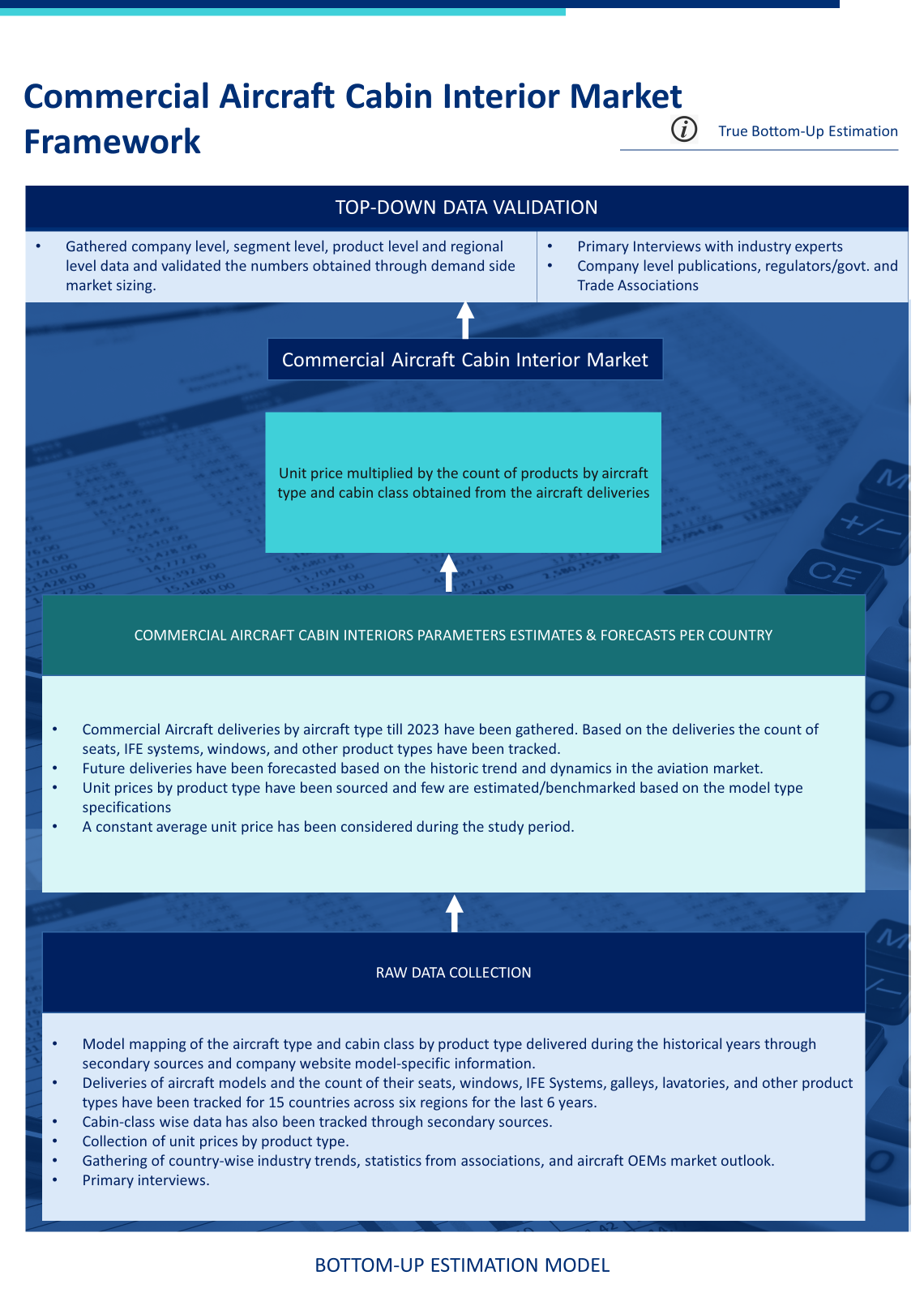
- Step 1: Identify Key Variables: In order to build a robust forecasting methodology, the variables and factors identified in Step-1 are tested against available historical market numbers. Through an iterative process, the variables required for market forecast are set and the model is built on the basis of these variables.
- Step 2: Build a Market Model: Market-size estimations for the historical and forecast years have been provided in revenue terms. For sales conversion to volume, the average selling price (ASP) is kept constant throughout the forecast period for each country, and inflation is not a part of the pricing.
- Step 3: Validate and Finalize: In this important step, all market numbers, variables and analyst calls are validated through an extensive network of primary research experts from the market studied. The respondents are selected across levels and functions to generate a holistic picture of the market studied.
- Step 4: Research Outputs: Syndicated Reports, Custom Consulting Assignments, Databases & Subscription Platforms