
Aircraft Galley Market Size and Share
Market Overview
| Study Period | 2020 - 2031 |
|---|---|
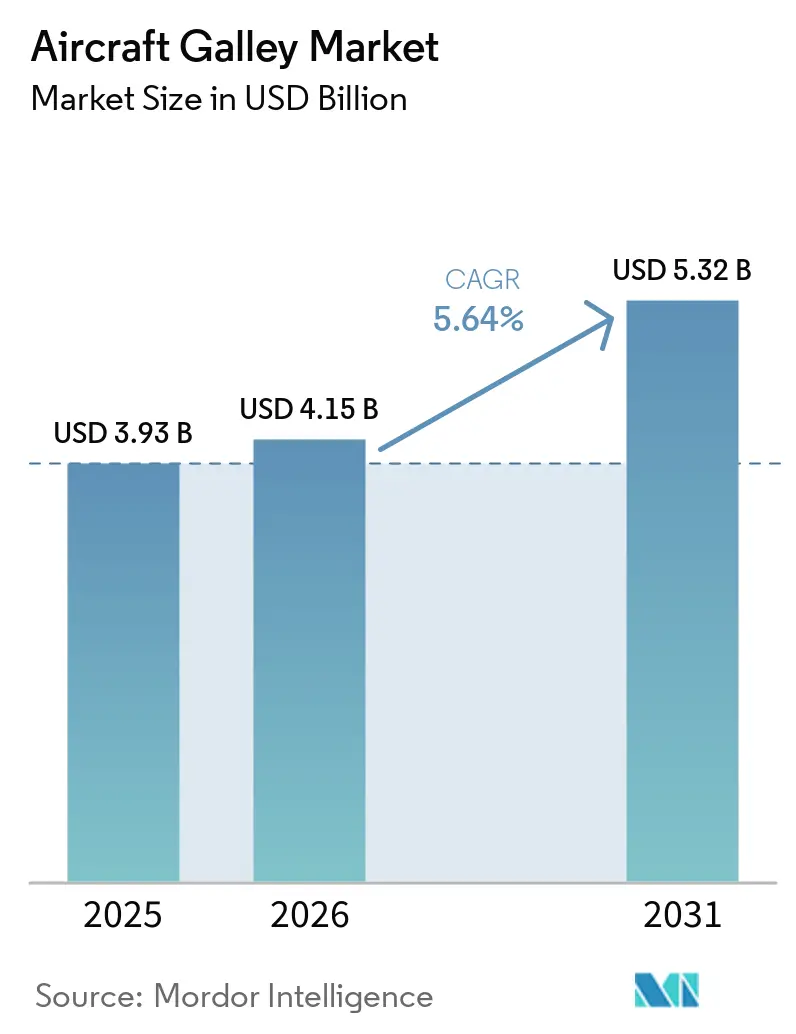
| Market Size (2026) | USD 4.15 Billion |
| Market Size (2031) | USD 5.32 Billion |
| Growth Rate (2026 - 2031) | 5.64 % |
| Fastest Growing Market | Asia Pacific |
| Largest Market | North America |
| Market Concentration | Medium |
Major Players *Disclaimer: Major Players sorted in no particular order Image © Mordor Intelligence. Reuse requires attribution under CC BY 4.0. | |
Aircraft Galley Market Analysis by Mordor Intelligence
Aircraft galley market size in 2026 is estimated at USD 4.15 billion, growing from 2025 value of USD 3.93 billion with 2031 projections showing USD 5.32 billion, growing at 5.64% CAGR over 2026-2031. Airlines channel post-pandemic cash flows into cabin modernization, with weight-saving composite monuments, connected inserts, and end-of-life retrofits forming the pillars of near-term demand. A sustained narrowbody backlog, electrification roadmaps that favor power-efficient appliances, and premium-class differentiation on new widebody programs all reinforce a stable replacement cycle. Makers that provide integrated digital platforms are winning long-term service contracts, while supply-chain stress around aerospace-grade composites is nudging OEMs toward vertical integration strategies. Sustainability pressures—from fuel-burn reduction to mandated waste segregation—remain the dominant design lens shaping the aircraft galley equipment market.
Key Report Takeaways
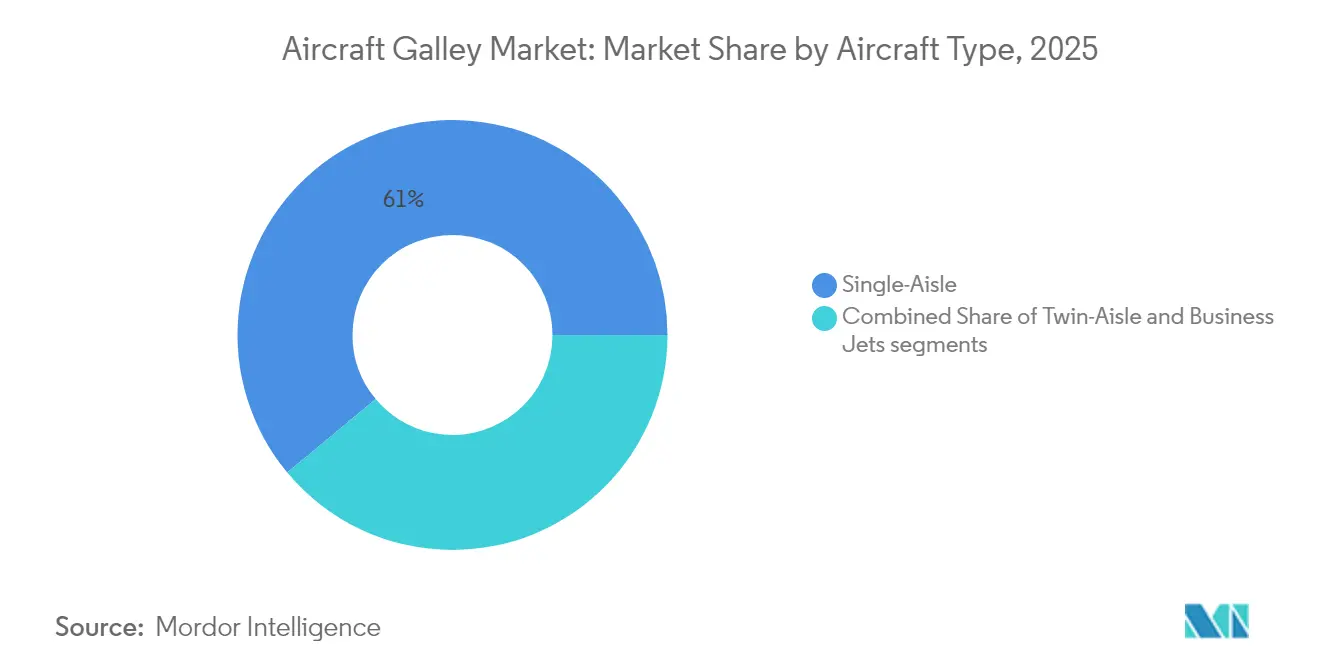
- By aircraft type, single-aisle platforms led with 61.05% revenue share in 2025, while twin-aisle programs are poised to log a 6.13% CAGR through 2031.
- By galley insert type, electric inserts commanded a 67.40% share in 2025; the segment is advancing at a 6.58% CAGR to 2031, outpacing non-electric alternatives.
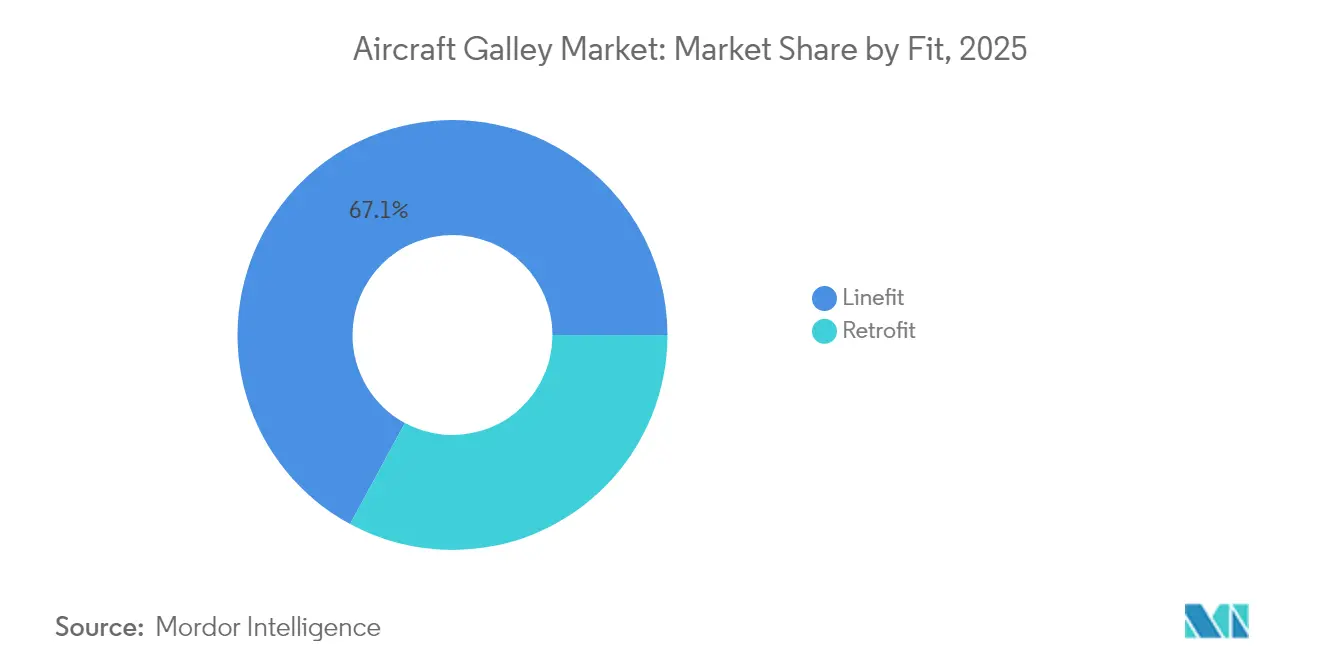
- By fit, linefit installations captured 67.10% of 2025 deliveries, whereas retrofit activity is projected to deliver a 6.05% CAGR over the forecast window.
- By material, aluminum retained 43.30% of 2025 revenue, yet composites and thermoplastics are projected to post a 6.67% CAGR through 2031.
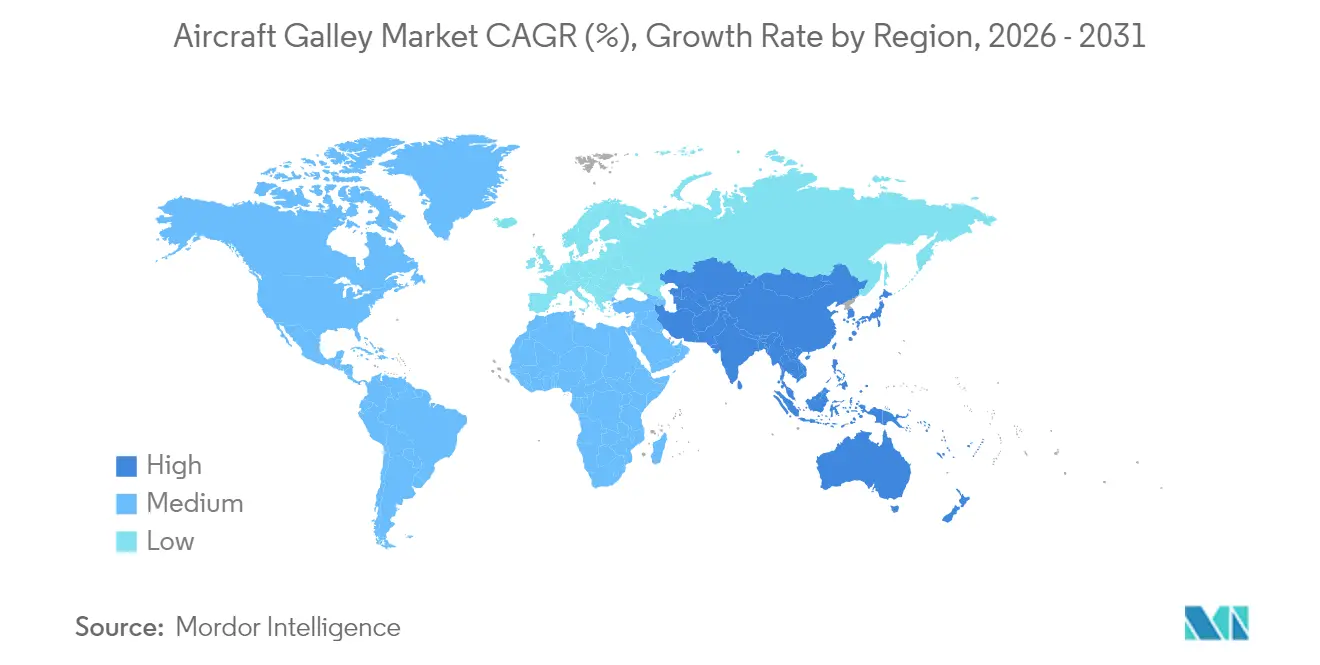
- By geography, North America topped the 2025 revenue table with a 31.30% share, while Asia-Pacific is forecasted to be the fastest-growing region at a 6.18% CAGR.
Note: Market size and forecast figures in this report are generated using Mordor Intelligence’s proprietary estimation framework, updated with the latest available data and insights as of 2026.
Market Trends and Insights
Drivers Impact Analysis of Aircraft Galley Market*
| Driver | (~) % Impact on CAGR Forecast | Geographic Relevance | Impact Timeline |
|---|---|---|---|
| Shift toward lightweight composite and thermoplastic galley structures | +1.2% | Global; early adopters in North America and EU | Medium term (2-4 years) |
| Rising demand for smart galley inserts in new single-aisle aircraft programs | +1.5% | Global; led by North America and Asia-Pacific | Short term (≤ 2 years) |
| Widebody fleet renewals driving adoption of premium-class service galleys | +0.9% | North America, Europe, Middle East | Medium term (2-4 years) |
| Growth in airline ancillary revenue models supporting self-service galley modules | +1.1% | Global; focus on North America and Europe | Short term (≤ 2 years) |
| Regulatory pressure to implement cabin waste segregation solutions | +0.6% | Global, with EU leading implementation | Long term (≥ 4 years) |
| Electrification roadmaps driving the need for load-shedding compatible galley appliances | +0.7% | Global, aligned with OEM electrification timelines | Medium term (2-4 years) |
| Source: Mordor Intelligence | |||
Shift Toward Lightweight Composite and Thermoplastic Galley Structures
Cabin monuments fabricated from carbon-fiber reinforced plastics and advanced thermoplastics trim 20–30% off legacy aluminum ship-sets, cutting airline fuel burn on every cycle.[1] Operating-cost relief dovetails with environmental targets as carriers chase fleet-wide CO2 reductions. Premium cabin operators also prize composites for their design flexibility, enabling integrated branding, bionic partitions, and sculpted self-service counters that amplify passenger touch-points. Fire-safety testing, higher raw material outlays, and limited autoclave capacity temper adoption. However, OEM roadmaps now bundle lighter galleys as the default, signaling an irreversible shift in the aircraft galley equipment market.
Rising Demand for Smart Galley Inserts in New Single-Aisle Aircraft Programs
The latest generation of ovens, chillers, and beverage makers embeds IoT sensors that stream performance data to cabin and ground portals. Collins Aerospace’s connected galley suite links to an AI assistant that alerts crews to inventory gaps and optimizes service sequencing, reducing unscheduled maintenance events by up to 15%. Airbus’s Skywise environment further stitches these appliances into a cabinwide data fabric, giving operators predictive insights and shortening turn times.[2] Airlines deploying such smart galleys unlock higher ancillary sales while lowering lifetime support costs—an advantage set to accelerate fleet-wide digital retrofits.
Widebody Fleet Renewals Driving Adoption of Premium-Class Service Galleys
As passenger yield pivots to the front of the cabin, long-haul carriers specify mezzanine-style pantries, espresso stations, and chef-grade ovens that lift culinary standards. Custom monuments integrate chilled carts, induction cooking, and plated-meal staging shelves, enabling restaurant-quality service on 12-hour sectors. Upscale materials add 30–40% to unit cost, translating into more substantial brand equity and higher business class load factors. With B777-9 and A350-1000 deliveries cresting, the aircraft galley market is seeing an uptick in bespoke premium galleys configured to maximize galley-to-seat ratios without compromising crew workflow.
Growth in Airline Ancillary Revenue Models Supporting Self-Service Galley Modules
Digital ordering applications and cashless payment nodes are driving a redesign of galley space into retail alcoves stocked with pre-packed meals, merchandised snacks, and wellness products. Airlines report double-digit uplifts in average basket size when passengers browse and collect items during free cabin movement phases. Monetization success hinges on secure storage, rapid-cool mini-fridges, and NFC-enabled dispensers, pushing suppliers to bundle hardware with inventory tracking software. As ancillary revenue share rises above 15% of total airline turnover, demand for mixed-use galleys that combine catering, retail, and waste-segregation functions gains momentum across the aircraft galley equipment market.
Restraints Impact Analysis of Aircraft Galley Market*
| Restraint | (~) % Impact on CAGR Forecast | Geographic Relevance | Impact Timeline |
|---|---|---|---|
| Long certification timelines for innovative galley monument designs | -0.8% | Global; FAA vs EASA variances | Long term (≥ 4 years) |
| High raw material costs for aerospace-grade composites | -0.5% | Global; supply concentration in North America | Short term (≤ 2 years) |
| Supply chain concentration among a small number of Tier-1 galley manufacturers | -0.6% | Global, with critical dependencies in North America and Europe | Medium term (2-4 years) |
| Deferral of retrofit programs due to airline cash flow volatility | -0.4% | Global, with higher impact in emerging markets and low-cost carriers | Short term (≤ 2 years) |
| Source: Mordor Intelligence | |||
Long Certification Timelines for Innovative Galley Monument Designs
Galley structures must clear rigorous flammability, decompression, and evacuation-path testing governed by ICAO cabin safety protocols.[3] Novel composite partitions or integrated lighting layouts often extend certification loops to 30 months, tying up capital and delaying entry into service. The process advantages incumbents with deep regulatory expertise, creating a barrier for start-ups offering disruptive concepts. Airlines weigh these risks when scheduling retrofit downtime, slowing the cadence of next-gen galley roll-outs.
High Raw Material Costs for Aerospace-Grade Composites
Advanced carbon fabrics and phenolic resin systems attract 15–20% premiums over aluminum sheet. Supply is concentrated among a handful of qualified US and European mills, exposing programs to price spikes and lead-time instability. While long-term fuel-burn savings frequently justify the up-front spend, airlines facing tight capex cycles may defer retrofits, dampening near-term orders in the aircraft galley equipment market.
*Our forecasts treat driver/restraint impacts as directional, not additive. The impact forecasts reflect baseline growth, mix effects, and variable interactions.
Aircraft Galley Market Segment Analysis
By Aircraft Type:
Single-Aisle Backlog Underpins VolumeThe aircraft galley market size attributed to single-aisle platforms accounted for 61.05% of 2025 revenue. B737 MAX and A320neo output keeps assembly lines buzzing, anchoring a 4.49% CAGR through 2031. Compact monument footprints, modular inserts, and lightweight carts dominate specifications as airlines optimize turnaround times on high-cycle routes. The aircraft galley equipment market share for twin-aisles remains smaller today. Still, it is expanding at a 6.13% CAGR due to the deliveries of the B787-9, A350-900, and B777-9, which feature premium-service galleys with larger chilled volumes and digital diagnostics. Business jet demand is a niche yet lucrative market, with bespoke veneers, induction cooktops, and barista modules generating higher margins per ship-set.
Second-generation narrowbody cabins are increasingly featuring self-service pantries adjacent to forward galleys, creating new aftermarket potential. On long-haul quad-crew missions, operators prioritize ergonomic layouts that shorten service cycles and reduce fatigue. VIP airframers translate lessons from commercial programs into high-touch materials—marble-look surfaces, electrochromic dispensers—that later filter back into linefit catalogues, driving continuous innovation in the aircraft galley equipment market.

By Galley Insert Type:
Electrification AcceleratesElectric inserts represented 67.40% of global shipments in 2025, reflecting airlines’ tilt toward power-efficient ovens, espresso machines, and chillers that integrate with cabin–power distribution systems. This cohort is tracking a 6.58% CAGR, dwarfing mechanically driven or propane-based equipment still used by select legacy fleets. Electric architectures enable real-time energy monitoring and intelligent load shedding, ensuring system resilience during peak usage. As OEMs pursue more-electric aircraft concepts, certified insert suppliers position connected appliances as standard, strengthening the aircraft galley equipment market share of electric solutions.
Mechanical inserts persist where retrofit budgets are constrained or cabin-power upgrades would extend downtime. Still, rising spare-parts costs and regulatory carbon targets are tilting total-cost-of-ownership math toward electrified replacements. Leasing companies now bundle digital inserts into return-condition clauses, further normalizing the transition and supporting sustained growth across the aircraft galley equipment market.
By Fit:
Retrofit Momentum BuildsLinefit accounted for 67.10% of installations in 2025, leveraging factory integration and streamlined certification pathways. Yet retrofit programs are mounting the fastest climb—6.05% CAGR—as carriers extend aircraft economic lives while refreshing cabin appeal. Quick-turn modified monuments, plug-and-play connected inserts, and pre-certified composite doors enable overnight installation, lowering aircraft-on-ground exposure. The aircraft galley equipment market size for retrofits is rising with global narrowbody lease extensions and widebody premium refresh cycles.
Regulatory triggers also lift retrofit spending. New waste-segregation mandates compel operators to add sealed biohazard units and recycling bins, while cybersecurity guidelines for connected appliances require upgraded firewalls and data-bus protectors. Supplier-financed retrofit kits help smaller carriers bridge capital gaps, ensuring broad diffusion of next-gen galley technologies through 2031.
By Material:
Composites Gain Strategic GroundAluminum retained 43.30% of 2025 shipments thanks to its favorable cost-to-strength ratio and established supply chains. Even so, composite and thermoplastic assemblies are posting a forecast 6.67% CAGR, underpinned by airline fuel-burn targets and ESG scorecards. Novel resin systems achieve low-temperature cure cycles, reducing energy use during manufacturing while improving part recyclability. These gains amplify the aircraft galley equipment market’s appeal to carriers publishing sustainability reports.
Combining aluminum frames with composite door skins, hybrid stacks offer a transition path that balances cost and weight. In parallel, flame-retardant thermoplastics pass updated heat-release standards, opening fresh design territory for curved surfaces and integrated lighting recesses. Material innovations continue to reshape competitive dynamics in the aircraft galley equipment market.
Geography Analysis
North America Aircraft Galley Market
North America led the 2025 revenue table at 31.30%, buoyed by large cabin-upgrade budgets and proximity to Boeing’s final assembly lines. The region’s early adoption of innovative galley ecosystems and stringent FAA oversight favors suppliers with deep retrofit credentials.
APAC Aircraft Galley Market
Asia-Pacific, however, is charting the fastest 6.18% CAGR as rising middle-class travel stimulates fleet additions and local MRO hubs proliferate. Chinese airframers partner with global insert vendors to localize supply, broadening the regional aircraft galley equipment market size.
EMEA Aircraft Galley Market
Europe maintains a technology leadership posture, anchoring R&D into low-carbon materials and circular-economy cabin solutions aligned with EASA roadmaps. Middle East carriers fuel premium-galley demand as they chase super-connector status on intercontinental trunk routes, while Africa’s nascent fleets adopt lightweight monuments to offset high fuel costs. These dynamics ensure a geographically diversified growth pattern for the aircraft galley equipment market.
Regulatory Landscape
In the United States, galley interiors and installed equipment are regulated under airworthiness frameworks that govern flammability and heat-release performance, including 14 CFR 25.853 and related provisions under 14 CFR 121.312 and 14 CFR 125.113 for certain operations. Certification and continued-airworthiness considerations shape material choices and component qualification for galley constructions.
In Europe, EASA certification routes combine CS-25 and CS-26 with ETSO for galley inserts and containers (ETSO-C184 and ETSO-C175, aligned to SAE AS8057 and AS8056). Environmental qualification uses RTCA DO-160G test methods for airborne equipment, and AD 2026-0017 for ATA 25 equipment and furnishings highlights operator inspection and corrective-action expectations to maintain continued airworthiness.
Value Chain Analysis
The galley value chain starts with regulated raw materials and subcomponents (aluminum, composite/thermoplastic panels, latches, harnessing, and thermal and electrical parts), then moves into fabrication of monuments and modules, integration of inserts (ovens, chillers, coffee and beverage makers), and the final production of carts and containers. Major cabin integrators and galley specialists such as Safran Cabin, Collins Aerospace (RTX), Diehl Aviation, Bucher Leichtbau, and JAMCO coordinate design, certification evidence, and ship-set production for Airbus and Boeing programs.
Downstream, OEM final-assembly lines and completion centers install galleys, while airline and third-party MRO networks drive retrofit demand through cabin refresh checks and end-of-lease cycles. The chain is sensitive to production variability and cabin-system bottlenecks, and modular architectures alongside closer OEM-Tier-1-MRO collaboration can reduce rework and shorten turnaround for both new-builds and retrofits.
Competitive Landscape
The aircraft galley market is moderately concentrated: Safran SA, Collins Aerospace (RTX Corporation), Bucher Leichtbau AG, Diehl Stiftung & Co. KG, and JAMCO Corporation jointly control the majority of global revenue. Scale affords these firms robust certification track records and integrated service networks. JAMCO’s strength in widebody monuments delivers competitive insulation in long-haul programs, while Safran leverages vertical integration to de-risk composite material supply. Collins Aerospace differentiates through its galley.ai software layer, securing aftermarket royalties and deepening operator lock-in.
Second-tier suppliers such as Diehl Aviation and Iacobucci HF Aerospace carve out a share via niche product excellence—coffee brewers, chillers, and connectivity nodes that bolt into larger OEM ecosystems. Strategic alliances are forming around cybersecurity and data analytics modules, foreshadowing a service-centric revenue remix in the aircraft galley equipment market. Private-equity entries signal confidence in expanding retrofit volumes and digital-service annuities, although high certification hurdles continue to deter green-field disruptors.
Aircraft Galley Industry Leaders
-
Collins Aerospace (RTX Corporation)
-
Bucher Leichtbau AG
-
JAMCO Corporation
-
Diehl Stiftung & Co. KG
-
Safran SA
- *Disclaimer: Major Players sorted in no particular order

Aircraft Galley Market Companies Covered in this Report
- Safran SA
- Collins Aerospace (RTX Corporation)
- Bucher Leichtbau AG
- JAMCO Corporation
- Diehl Stiftung & Co. KG
- Aerolux Ltd.
- AVIC Cabin Systems Limited
- Korita Aviation (Direct Aviation)
- EnCore Corporate, Inc. (The Boeing Company)
- Egret Aviation Co., Ltd.
- Miller Fabrication & Welding, Inc.
- Dynamo Aviation, Inc.
Market Opportunities and Future Outlook
Connected galley architectures are showing up as a white-space opportunity. The galley.ai concept from Collins Aerospace has been recognized with a 2025 Crystal Cabin Award, and sensor-driven monitoring of galley parameters creates room to package hardware, software, and services into certified offerings that support maintenance planning and crew workflows.
Lightweighting and material substitution also support weight reductions and greater standardization across programs. Diehl Aviation has highlighted expanded use of continuous fiber-reinforced thermoplastics and additive manufacturing for cabin brackets, pointing to more scalable lightweight cabin hardware. Airbus reports a 40 percent reduction in missing parts versus the start of 2025, which supports opportunities tied to dual sourcing, standardized ship-set options, and expanded certified repair capacity for both new aircraft and aging fleets.
Recent Industry Developments in Aircraft Galley Market
- April 2026: Bucher Leichtbau AG was selected as a Source For Equipment (SFE) galley and stowage supplier for the Airbus A320 family. The award strengthens Bucher Leichtbau's position on the high-volume single-aisle platform and supports broader linefit and retrofit activity as airlines standardize cabin architectures. This contract signals continued demand for modular galley architectures across major OEM programs.
- September 2025: AMETEK Ameron expanded its aircraft galley equipment repair facility to add aircraft faucet assembly capabilities. The expansion broadens MRO depth for galley-related assemblies and helps operators and lessors reduce turnaround time and support costs during cabin refresh and heavy-check windows.
- October 2024: AJW Group and Collins Aerospace advanced their three-year Specific Business Arrangement for comprehensive repairs of galley inserts. The arrangement broadens repair throughput for high-wear powered inserts, supporting fleets that are extending in-service life while managing parts availability and reliability targets.
Aircraft Galley Market Report Scope and Research Methodology
Market Definition and Coverage
The aircraft galley market, for this methodology, covers revenue generated from complete galley monuments and major galley insert modules installed in aircraft cabins, including line-fit and approved retrofit installations, across commercial and business aviation.
Scope exclusions: We exclude loose catering consumables and airline food service operations because they are not part of galley hardware value.
Segments Covered in This Report
- By Aircraft Type
- Single-Aisle
- Twin-Aisle
- Business Jets
- By Galley Insert Type
- Electric Inserts
- Non-Electric Inserts
- By Fit
- Linefit
- Retrofit
- By Material
- Aluminum
- Composites and Thermoplastics
- Others
- By Geography
- North America
- United States
- Canada
- Mexico
- Europe
- United Kingdom
- France
- Germany
- Spain
- Rest of Europe
- Asia-Pacific
- China
- India
- Japan
- South Korea
- Rest of Asia-Pacific
- South America
- Brazil
- Rest of South America
- Middle East and Africa
- Middle East
- United Arab Emirates
- Saudi Arabia
- Rest of Middle East
- Africa
- South Africa
- Rest of Africa
- Middle East
- North America
Data Sources, Market Sizing, and Validation
Desk Research
Desk research started with public aviation delivery and fleet signals, because galley demand moves with aircraft production cycles and cabin reconfiguration timing. We referenced sources such as FAA and EASA airworthiness and certification publications, ICAO and IATA air transport statistics, aircraft delivery and backlog disclosures from airframe makers, and aerospace trade association releases.
To translate these signals into a market model, we also reviewed company filings and investor presentations from cabin-interior suppliers, along with credible aviation press coverage on retrofit programs, cabin densification, and lightweight material shifts. Patent databases were selectively used to understand innovation intensity in galley inserts (for example, ovens, chillers, and water and waste units) and to sanity-check which sub-systems are actively being redesigned. These desk sources are illustrative and not exhaustive, and many other public references were used for data collection, validation, and clarification.
Primary Interviews and Surveys
Primary work focused on validating what gets counted as a galley sale, how line-fit versus retrofit is booked, and how pricing shifts with aircraft type and material choice. Interviews targeted a mix of OEM-facing suppliers, retrofit and MRO-linked stakeholders, and airline or lessor-side technical teams across APAC, EMEA, and the Americas, then differences were reconciled through follow-up checks so assumptions stayed realistic.
Distribution of primary research fieldwork respondents
| Company type | Respondent position | Region |
|---|---|---|
| Top tier: 32% | CXOs: 13% | APAC: 48% |
| Mid tier: 51% | Functional/Unit leaders: 27% | EMEA: 34% |
| Smaller Players: 17% | Managers: 60% | Americas: 18% |
Market-Sizing & Forecasting
Sizing was built using a top-down model where aircraft production and delivery schedules are reconstructed by aircraft family, then translated into expected galley shipsets using typical galley positions and configuration norms by single-aisle, twin-aisle, and business jets. After the demand pool was set, average selling prices were applied using ranges informed by material mix (aluminum versus composites and thermoplastics), insert type (electric versus non-electric), and the fit cycle (line-fit versus retrofit).
To keep totals grounded, we corroborated the outputs with selective bottom-up checks, such as supplier revenue splits disclosed for cabin-interior lines, sampled shipset pricing discussions from interviews, and channel checks on retrofit kit intensity during heavy maintenance cycles. Where company disclosures were not detailed enough, gaps were handled with conservative ranges and then narrowed through additional expert feedback.
Forecasting used scenario analysis supported by a simple multivariate regression on passenger traffic recovery, aircraft deliveries, and retrofit intensity indicators, then adjusted based on what industry respondents expect for supply constraints and cabin refresh cycles. This reduced the risk of assuming a single straight-line growth path when input variables were moving at different speeds.
Data Validation & Update Cycle
Validation was done through multiple steps, starting with internal cross-checks between the demand pool, pricing logic, and implied unit volumes per aircraft type. Outliers were flagged when the model suggested unrealistic shipset counts, sudden ASP jumps, or region shares that did not align with known delivery patterns, and those items were reworked after additional desk checks and targeted re-contacts.
Before sign-off, a second analyst review is completed to test whether assumptions remain consistent across segments and years, and whether any input sources contradict each other. The report is refreshed annually, and interim updates are made when material events occur (for example, major delivery delays, sharp changes in fleet utilization, or regulatory-driven cabin modifications). Prior to delivery, a final pass is performed so clients receive the most current view available.
Mordor Intelligence's Aircraft Galley Market Size Compared With Other Published Estimates
Published market sizes for aircraft galleys often vary because the counted scope is not always the same, and the timing of aircraft delivery assumptions can differ by a year or two. Differences also come from how retrofit revenue is treated, how galley inserts are bundled versus priced separately, and which currency conversion timing is applied.
The main gap comes from whether retrofit insert replacements are included, where Mordor Intelligence counts line-fit galley installations in new-generation aircraft deliveries and keeps standalone retrofit of individual inserts outside the total. This can pull the number away from estimates that mix both streams.
Benchmark comparison
| Source | Market Size | Gaps in Research Methodology |
|---|---|---|
| Mordor Intelligence | USD 4.15 B (2026) | |
| Trade Publisher A | USD 2.61 B (2024) | Uses an earlier base year and appears to include a broader aftermarket and retrofit pool, so totals can be lower on timing but wider on scope versus a line-fit focused count. |
| Industry Study B | USD 3.70 B (2024) | States a 2024 valuation but does not clearly separate full galley monuments from insert-only replacements, which can shift the value depending on whether shipsets or component-only spend is being tallied. |
Taken together, the spread in published values is mostly explained by timing and what is treated as a galley sale, rather than a disagreement on the direction of demand. By keeping assumptions traceable to deliveries, typical shipset content, and realistic pricing ranges, the estimate stays easier to reproduce and to update when aircraft programs or cabin refresh cycles change.
Key Questions Answered in the Report
How large is the aircraft galley market in 2026?
The aircraft galley market size is USD 4.15 billion in 2026.
What is the forecast CAGR for aircraft galley market through 2031?
The market is projected to expand to USD 5.32 billion and register a 5.64% CAGR between 2026 and 2031.
Which aircraft type dominates demand for galley equipment?
Single-aisle platforms account for 61.05% of 2025 revenue, making them the largest demand driver.
Why are electric galley inserts gaining popularity?
Electric inserts provide energy monitoring, load-shedding compatibility, and digital diagnostics, supporting airline sustainability and maintenance goals.
Which region is expected to grow fastest?
Asia-Pacific is the fastest-growing region, forecasted to post a 6.18% CAGR through 2031.