
Aircraft Cameras Market Size and Share
Market Overview
| Study Period | 2020 - 2031 |
|---|---|
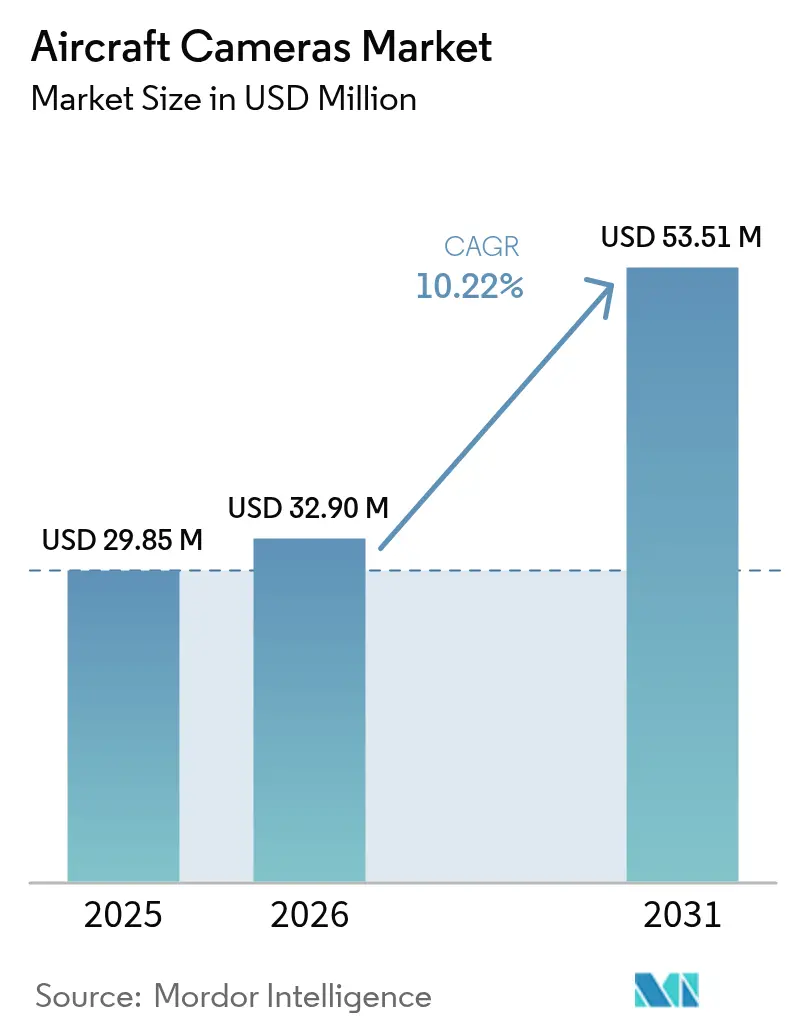
| Market Size (2026) | USD 32.9 Million |
| Market Size (2031) | USD 53.51 Million |
| Growth Rate (2026 - 2031) | 10.22 % |
| Fastest Growing Market | Asia Pacific |
| Largest Market | North America |
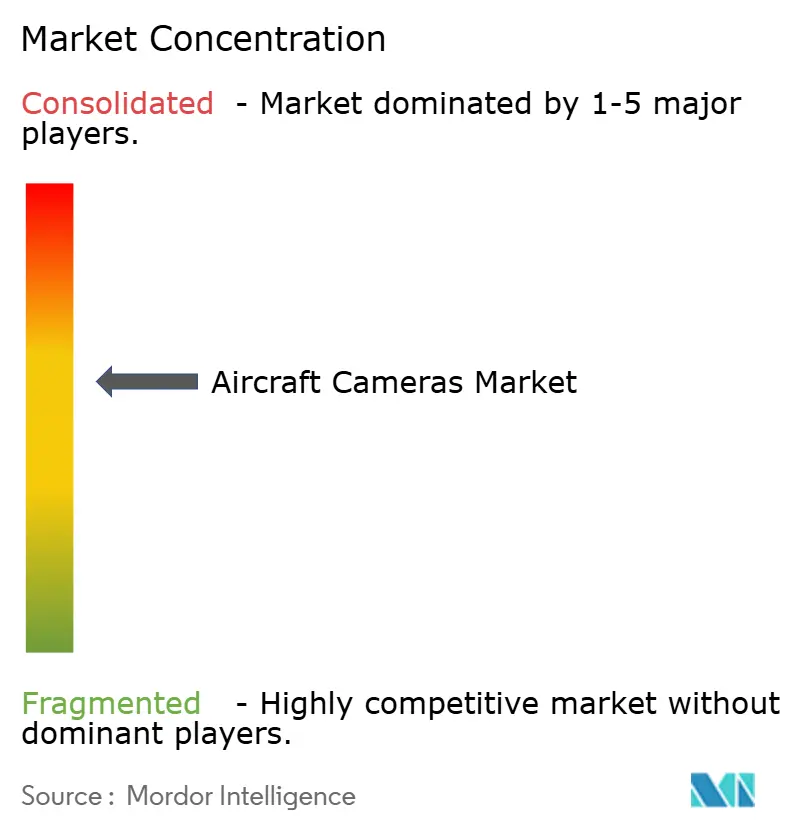
| Market Concentration | Medium |
Major Players *Disclaimer: Major Players sorted in no particular order Image © Mordor Intelligence. Reuse requires attribution under CC BY 4.0. | |
Aircraft Cameras Market Analysis by Mordor Intelligence
The aircraft cameras market size is expected to grow from USD 29.85 million in 2025 to USD 32.9 million in 2026 and is forecast to reach USD 53.51 million by 2031 at 10.22% CAGR over 2026-2031. Heightened regulatory pressure for cockpit-video recorders, escalating retrofit activity for 4K cabin-surveillance systems, and the rapid mainstreaming of unmanned and eVTOL platforms collectively underpin this trajectory. Demand also benefits from airlines’ preference for modular plug-and-play upgrades that avoid long ground times, while OEM linefit programs bake advanced imaging into next-generation airframes. In parallel, defense procurement, exemplified by the US Army’s HADES initiative, creates a robust pipeline for multisensor ISR solutions that rely on ruggedized, high-fidelity optics. Competitive intensity rises as traditional avionics majors compete with niche vision-tech firms that bring AI-enabled edge processing to predictive maintenance and autonomous flight applications.
Key Report Takeaways
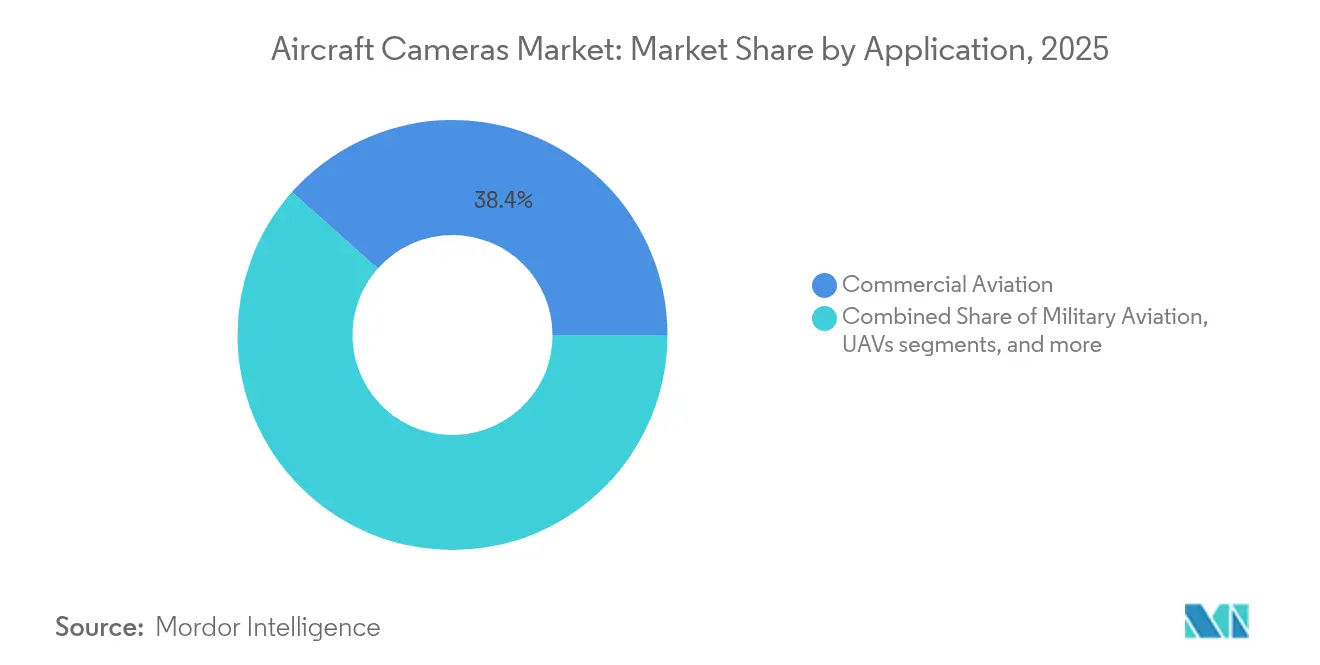
- By application, commercial aviation led with 38.42% revenue share in 2025, while unmanned aerial vehicles (UAVs) are projected to expand at a 12.08% CAGR to 2031.
- By camera installation, external systems commanded 56.75% of the aircraft cameras market share in 2025 and are advancing at an 11.03% CAGR through 2031.
- By camera type, multispectral/hyperspectral units accounted for 36.88% of the aircraft cameras market size in 2025; AI-enabled smart cameras represent the fastest-growing type with an 11.52% CAGR to 2031.
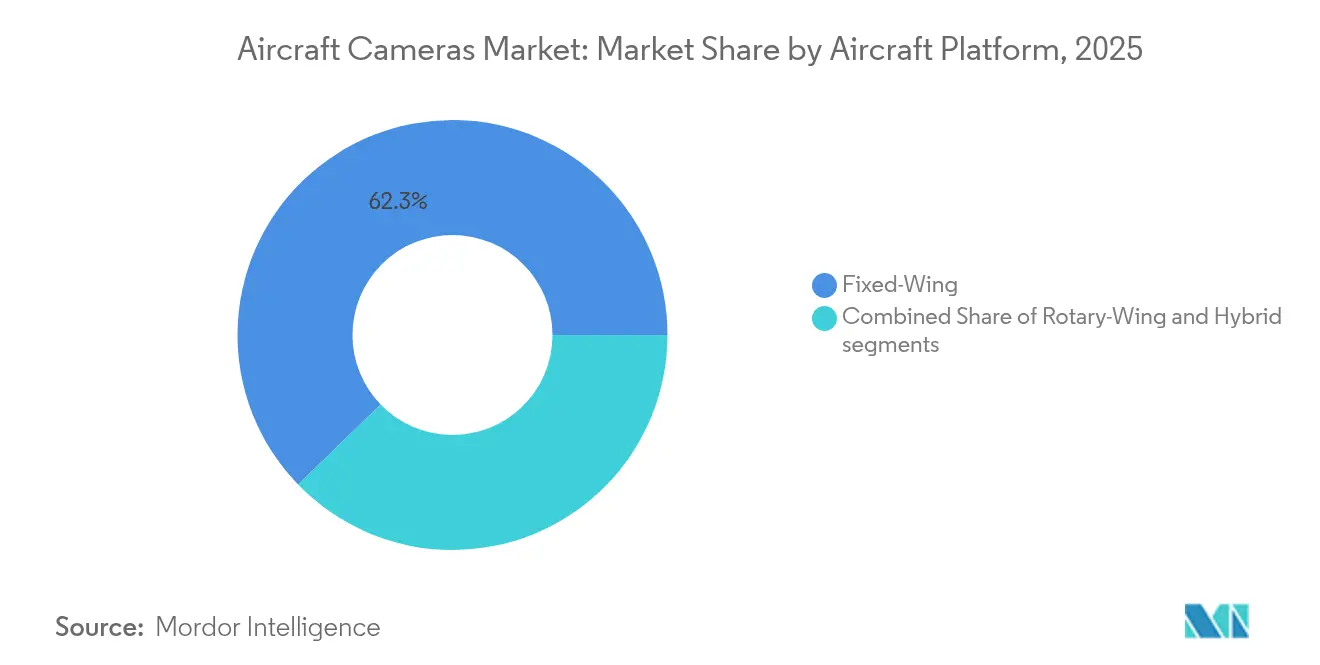
- By aircraft platform, fixed-wing aircraft held a 62.25% market share in 2025, whereas hybrid eVTOL concepts are poised to achieve the highest 10.34% CAGR during the forecast horizon.
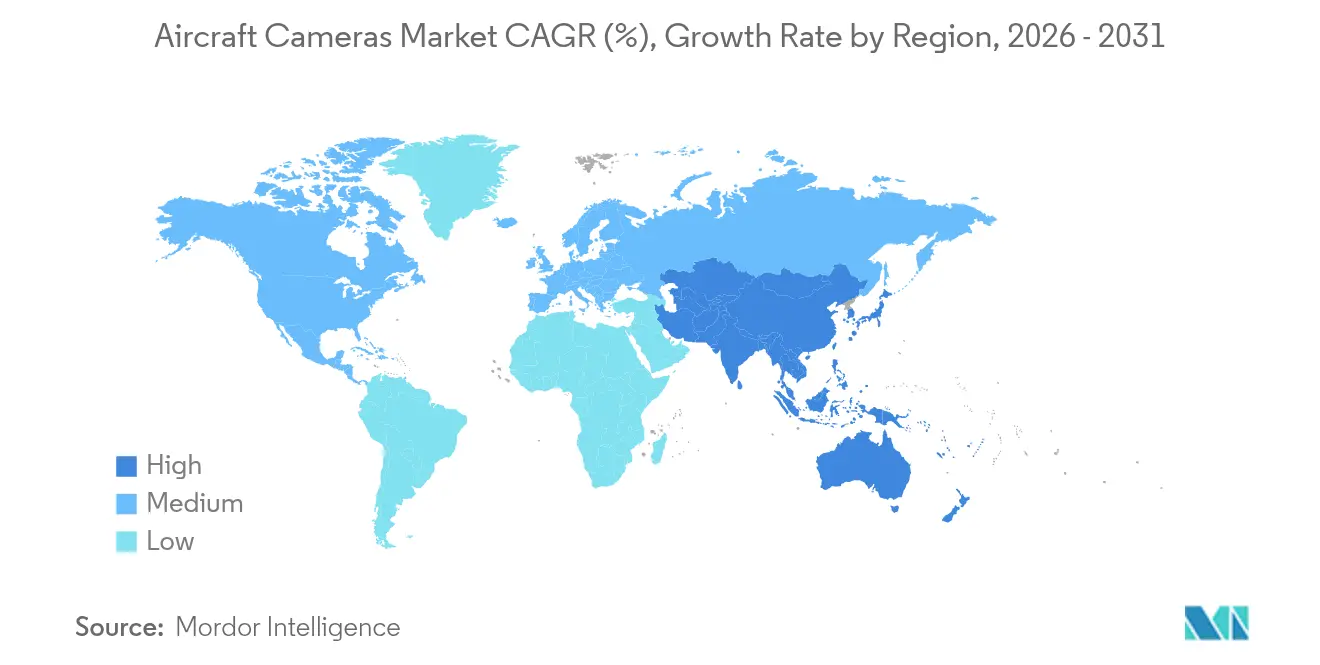
- By region, North America led with a 37.95% market share in 2025, while the Asia-Pacific region is set to post the fastest growth, with a 10.31% CAGR from 2026 to 2031.
Note: Market size and forecast figures in this report are generated using Mordor Intelligence’s proprietary estimation framework, updated with the latest available data and insights as of 2026.
Market Trends and Insights
Drivers Impact Analysis of Aircraft Cameras Market*
| Driver | (~) % Impact on CAGR Forecast | Geographic Relevance | Impact Timeline |
|---|---|---|---|
| Rising retrofit demand for 4K cabin-surveillance upgrades | +2.10% | North America, Europe, Global fleets | Medium term (2-4 years) |
| AI-assisted predictive-maintenance cameras for digital-twin programs | +1.80% | North America, Europe, Asia-Pacific | Long term (≥4 years) |
| Mandatory EASA/FAA cockpit-video recorders from 2028 | +1.60% | Global | Medium term (2-4 years) |
| Growth in unmanned and eVTOL platforms needing SWaP-optimized imaging | +1.40% | North America, Asia-Pacific | Short term (≤2 years) |
| Thermal/IR camera integration for wildfire monitoring operations | +0.90% | North America, Australia, Mediterranean Europe | Short term (≤2 years) |
| Demand for 360° taxi-aid systems on next-gen widebody aircraft | +0.70% | Global hub airports | Long term (≥4 years) |
| Source: Mordor Intelligence | |||
Rising Retrofit Demand for 4K Cabin-Surveillance Upgrades
Airlines are accelerating the modernization of in-cabin video infrastructure as safety guidelines become stricter and insurers seek more granular incident evidence. Air Canada’s A320 and A321 upgrade program highlights the pivot toward high-resolution cameras that deliver facial-recognition-ready imagery and integrate seamlessly with existing cabin-management systems.[1] Short installation windows favor modular, plug-and-play designs, enabling carriers to refresh surveillance capability during overnight checks instead of extended heavy-maintenance visits. The 4K baseline has quickly become the de facto procurement specification, positioning vendors with scalable, open-architecture solutions to capture retrofit budgets. As regulators consider broader mandates for behavioral analytics functions, suppliers who validate AI algorithms under DO-178C will likely enjoy an early-mover advantage in the aircraft cameras market.
AI-Assisted Predictive-Maintenance Cameras for Digital-Twin Programs
To feed digital-twin ecosystems, OEMs and tier-one integrators increasingly embed vision sensors inside wings, engines, and airframes. Lockheed Martin’s AAIR platform uses computer vision to detect microcracks and paint degradation, trimming unscheduled maintenance by up to 15% while extending component life cycles.[2] Real-time video analytics processed at the edge eliminate latency, enabling operators to optimize maintenance schedules and maintain high fleet availability. Demand for ruggedized, low-latency cameras that support standardized data interfaces is growing faster than legacy inspection borescopes. Vendors who certify edge-AI modules under avionics safety standards gain a compelling foothold, particularly as airlines converge their digital engineering and MRO budgets.
Mandatory EASA/FAA Cockpit-Video Recorders from 2028
Regulatory momentum toward 25-hour cockpit video retention will trigger a sizable wave of compliance-driven procurement. The US National Transportation Safety Board’s post-accident recommendations have galvanized both FAA and EASA rulemaking, targeting entry into force in 2028.[3] Approximately 6,000 active commercial jets fall under the scope of retrofit, creating a multi-year order backlog for certified suppliers. Incumbent avionics houses with DO-160-qualified hardware and cyber-secure data-management suites are best positioned. Nevertheless, privacy objections from pilot unions in North America and Europe remain a key variable that could stretch certification timelines or dilute technical specifications, moderating the upside for some aircraft cameras market participants.
Growth in Unmanned and eVTOL Platforms Needing SWaP-Optimized Imaging
The rapid expansion of drone logistics, defense ISR, and urban air mobility (UAM) ecosystems is generating new demand for size-, weight-, and power-constrained (SWaP-constrained) optics. The US government’s policy to prioritize domestic drone supply chains gives local camera manufacturers preferred-vendor status. Concurrently, breakthroughs in metalens technology produce optics thinner than a human hair without compromising optical quality, perfectly aligning with the payload envelopes of small air vehicles. As regulators expand beyond-visual-line-of-sight (BVLOS) corridors, detect-and-avoid camera assemblies become a mandatory kit, providing a lucrative niche for vendors that can merge optical fidelity with ultralow power draw.
Restraints Impact Analysis of Aircraft Cameras Market*
| Restraint | (~) % Impact on CAGR Forecast | Geographic Relevance | Impact Timeline |
|---|---|---|---|
| High DO-178/DO-254 certification costs for new camera hardware | -1.20% | Global, hits smaller vendors hardest | Long term (≥4 years) |
| Pilot-union privacy push-back on cockpit video | -0.80% | North America, Europe | Medium term (2-4 years) |
| Export-control restrictions on dual-use EO/IR sensors | -0.60% | US-China trade lanes | Short term (≤2 years) |
| Persistent semiconductor supply-chain volatility | -0.50% | Global, Asia-Pacific fabs | Short term (≤2 years) |
| Source: Mordor Intelligence | |||
High DO-178/DO-254 Certification Costs for New Camera Hardware
End-to-end certification at DO-178C Level A often exceeds USD 2 million per product line and can consume up to 24 months, effectively locking out many startups.[4] The burden includes exhaustive documentation, software verification, and environmental qualification that only deep-capital incumbents can shoulder. As a result, breakthrough optical concepts take longer to reach commercial airframes, and competitive pricing pressure is muted. This dynamic reinforces the position of tier-one avionics suppliers, further concentrating the aircraft cameras market around a handful of players.
Pilot-Union Privacy Push-Back on Cockpit Video
European and North American pilot associations argue that audio and flight-data recorders provide adequate insight into incidents, warning that continuous video may be misused for disciplinary action. Negotiations have introduced carve-outs such as limited data retention or encryption keys controlled by third-party safety boards, potentially scaling back system complexity and unit pricing. Nonetheless, any protracted labor dispute could stall airline retrofit schedules, dampening near-term revenue cycles for cockpit-camera vendors.
*Our forecasts treat driver/restraint impacts as directional, not additive. The impact forecasts reflect baseline growth, mix effects, and variable interactions.
Aircraft Cameras Market Segment Analysis
By Application:
UAVs Drive Next-Generation Imaging DemandUAVs are forecasted to register a 12.08% CAGR as militaries and civil operators expand their missions, ranging from border surveillance to parcel delivery. The aircraft cameras market size allocated to UAV payloads is projected to reach USD 9.05 billion by 2031, underpinned by the US Army’s HADES deep-sensing program and similar initiatives in Asia. Despite maturing growth, commercial aviation remains the revenue anchor with a 38.42% share in 2025, thanks to mandatory safety retrofits and widebody linefit commitments. Military aviation continues to procure high-dynamic-range EO/IR turrets for manned ISR platforms. At the same time, business and general aviation operators adopt lightweight interior cameras that feed real-time engine health data into cloud analytics.
UAV adoption shifts the optical design roadmap toward ultralight, low-power assemblies that can survive harsh vibration profiles and high-altitude temperature swings. Suppliers incorporating FPGA-based onboard processing reduce datalink bandwidth, a critical constraint for beyond-line-of-sight (BLOS) missions. Airlines prioritize 4K cabin clarity in manned segments to support facial analytics and in-flight service optimization. Special-mission operators, notably search and rescue (SAR) and medical evacuation (Medevac), pursue dual-sensor packages that combine long-wave IR with visible zoom for all-hours operations, sustaining stable demand even during commercial down cycles.

By Camera Installation Type:
External Systems Strengthen Market LeadershipExternal installations captured 56.75% of the aircraft cameras market share in 2025, buoyed by airline appetite for 360° taxi-aid suites and military demand for gimbal-mounted ISR turrets. Growth through 2031 is projected at 11.03% CAGR, raising external-camera revenues to an estimated USD 32.15 million. While smaller in number, internal cameras are increasingly integrated into predictive maintenance architectures, allowing for automatic visual inspections of landing gear bays and avionics racks during overnight turns.
External housings enable broader fields of view and simplify certification, as they avoid electromagnetic compatibility issues within pressurized cabins. Retrofit opportunities abound because camera pods can be attached to existing hard points without requiring primary structural reinforcement. Conversely, internal installations face cabin-layout constraints and stricter flammability standards. Market participants, therefore, bundle interior sensors with health-monitoring subscriptions, monetizing data rather than unit sales alone.
By Type:
Multispectral Dominance, AI-Smart Cameras AccelerateMultispectral and hyperspectral cameras accounted for 36.88% of the 2025 revenue pool, favored by defense and environmental-monitoring operators that require band-specific analytics. The aircraft cameras market size for this category is expected to surpass USD 19.43 million by 2031 as programs such as Germany’s PEGASUS SIGINT aircraft adopt wideband sensor suites. AI-enabled smart cameras, featuring embedded GPUs and neural accelerators, are growing at the fastest rate, with a 11.52% CAGR, and carving out a share from traditional electro-optical models.
The transition to software-defined architectures enables operators to upgrade capabilities via firmware, prolonging asset life cycles and reducing the total cost of ownership. Infrared sensors maintain a strong foothold in nighttime SAR and military targeting, while 360-degree panoramic units migrate from high-end biz jets to mainstream narrowbodies as pricing falls. Suppliers investing in open-standards middleware enjoy interoperability advantages that resonate with cost-conscious airlines.
By Aircraft Platform:
Fixed-Wing Fleet Drives Volume, Hybrids Fuel Incremental GrowthFixed-wing aircraft held a 62.25% share in 2025, reflecting the vast installed commercial fleet and ongoing surveillance conversions of business jets into ISR roles. Rotary-wing demand centers on airborne law enforcement and offshore energy, where stabilized turrets enable overwater search tasks. Hybrid platforms, encompassing tiltrotors and eVTOL craft, are projected to generate the steepest 10.34% CAGR as urban mobility projects finalize certification pathways.
Fixed-wing linefit packages are increasingly integrating nose-mounted volumetric sensors that support taxi-aid, runway-incursion alerts, and predictive maintenance imaging. eVTOL developers specify distributed camera arrays that serve as both detect-and-avoid systems and passenger-experience enhancers, such as panoramic cabin views. This multi-use philosophy boosts attachment rates beyond legacy crew-only installations, enriching the aircraft camera market opportunity per airframe.
By Sales Channel:
Retrofit Momentum Outpaces Linefit GrowthOEM linefit retained 57.40% share in 2025 but is projected to cede relative ground as retrofit CAGRs hit 12.02% through 2031. Delivery delays for new aircraft push airlines to modernize existing jets, accelerating purchase orders for modular interior and exterior vision kits. MRO providers leverage camera maintenance as a new revenue stream, bundling periodic lens cleaning and software update services into hourly cost programs.
Incoming cockpit-video mandates and insurance-related cabin-surveillance requirements catalyze retrofit efforts. Vendors offering drop-in replacements compatible with legacy flight-data buses capture spend without necessitating costly rewiring of the avionics bay. Over time, predictive maintenance subscriptions may eclipse hardware margins, mirroring the software-as-a-service (SaaS) playbooks prevalent in ground-vehicle telematics.
Geography Analysis
North America Aircraft Cameras Market
North America accounted for 37.95% of 2025 revenue, anchored by US defense ISR budgets and a sizable commercial fleet undergoing safety retrofits. The US Army’s HADES contract pipeline alone could absorb nearly USD 1 billion in sensor purchases over the next decade. Canada’s investment in WESCAM MX-20 systems for P-8A maritime patrol aircraft underscores continued regional appetite for high-end EO/IR payloads. Mexico contributes a moderate but rising demand tied to cross-border security surveillance and low-cost carrier fleet expansions.
APAC Aircraft Cameras Market
The Asia-Pacific region represents the fastest-growing geography, with a 10.31% CAGR outlook. China’s proliferation of indigenous drones spurs the development of local camera manufacturing clusters, despite export-control frictions. India, Japan, and South Korea channel defense offsets into sensor technology transfer, gradually building domestic competence. Commercial carriers from Indonesia to Australia accelerate in-cabin safety upgrades in response to tightening ICAO audit requirements.
Europe Aircraft Cameras Market
Europe maintains steady momentum, leveraging programs such as Germany’s EUR 1.2 billion (USD 1.41 billion) PEGASUS SIGINT fleet and the UK runway-incursion prevention mandates. The French and Italian defense ministries tender multi-sensor turret purchases to modernize their rotary-wing fleets, while regional airlines prioritize 360° taxi-aid kits to reduce ground-damage costs at congested airports. Eastern European demand lags due to budget constraints, and sanctions limit Russian access to Western camera technology, prompting the substitution of lower-spectral-resolution domestic optics.
Regulatory Landscape
Airborne camera hardware and installations are governed by airworthiness certification frameworks that distinguish minor alterations from major changes requiring approved data and, in many cases, an STC for integrated surveillance and recording systems. For cockpit image recorder functionality, EASA has published ETSO-C176a, aligned to EUROCAE ED-112A minimum performance standards, while the FAA and EASA also shape how imaging is used for operational credit in Enhanced Flight Vision Systems (EFVS) through guidance and application materials.
Across civil and defense aircraft, qualification and compliance depend on established standards and authorities, including RTCA DO-160G environmental qualification (referenced in FAA AC 21-16G) and Technical Airworthiness Clearance processes under the Technical Airworthiness Authority for military-registered aircraft in Canada. This approach elevates traceability, configuration control, and approved installation and maintenance data as gating items for suppliers, and it increases program risk and cost as camera functions shift from non-critical monitoring to safety-relevant vision (for example, EFVS-related integrations and future autonomy-oriented use cases).
Value Chain Analysis
The value chain runs from image-sensor and optics supply (visible, IR, and multispectral) to ruggedized electronics (processing, memory, and power conditioning), mechanical housings and mounts, and system-level integration into certified aircraft environments. Qualification and certification activities, including RTCA DO-160 environmental testing and platform-specific airworthiness approvals, are a central value-added step. In practice, camera OEMs, avionics integrators, airframers, and MROs often coordinate to package hardware, software, and documentation into linefit or retrofit kits.
Downstream, distribution and demand aggregation are influenced by aircraft OEM linefit programs, defense primes, and retrofit and MRO channels that bundle installation, spares, and software updates. The supply chain remains sensitive to availability of certified components, including sensors, connectors, and other avionics-grade electronics. Industry reporting in May 2026 pointing to sensors and electrical components as a major share of hard-to-find parts supports strategies such as vertical integration, dual-sourcing, and modular designs that reduce redesign and recertification cycles when components change.
Competitive Landscape
Market concentration is moderate, with the top five suppliers accounting for a significant global revenue share. Collins Aerospace, Thales, and L3Harris leverage long-term supplier-furnished equipment contracts and deep certification pedigrees to secure repeat linefit awards. Teledyne's acquisition spree integrates sensor fabs with system-level integration, enabling end-to-end vertical control that appeals to defense primes. Honeywell and Curtiss-Wright emphasize edge-computing gateways that fuse multiple camera feeds, differentiating themselves on the depth of data analytics rather than relying solely on optics.
Specialized challengers, such as Trakka Systems and KID-Systeme, target high-growth niches, SAR and cabin Wi-Fi camera networks, offering lighter form factors and rapid product refresh cycles. Software-defined architectures lower airlines' switching costs, allowing smaller vendors to penetrate legacy fleets via retrofit channels.
Strategic collaboration defines recent activity: L3Harris combined imaging payloads with Air Tractor's rugged airframes to win the US Special Operations Armed Overwatch award. HENSOLDT partners with Lufthansa Technik to integrate PEGASUS sensor suites, minimizing certification risk through early alignment with civil MRO experts. These alliances illustrate how domain knowledge and integration bandwidth now rival pure optical performance as determinants of contract success.
Aircraft Cameras Industry Leaders
-
Collins Aerospace (RTX Corporation)
-
Teledyne Technologies Incorporated
-
Leonardo S.p.A.
-
HENSOLDT AG
-
LATECOERE S.A
- *Disclaimer: Major Players sorted in no particular order
Aircraft Cameras Market Companies Covered in this Report
- Teledyne Technologies Incorporated
- Collins Aerospace (RTX Corporation)
- Thales Group
- Leonardo S.p.A.
- KID-Systeme GmbH
- LATECOERE S.A
- Cabin Avionics Limited
- Elbit Systems Ltd.
- L3Harris Technologies, Inc.
- Parker-Meggitt Corporation
- HENSOLDT AG
- Trakka Systems
- Curtiss-Wright Corporation
- Honeywell International Inc.
- Aerial View Systems Inc. (NEP Group)
Market Opportunities and Future Outlook
Compliance-driven and mission-driven upgrades are creating a clear gap for certified, privacy-aware recording and higher-resolution imaging across both manned and unmanned platforms. The cockpit video retention push referenced in the report context, with FAA and EASA rulemaking targeting 2028, concentrates demand around recorders and camera systems that can meet minimum performance standards and withstand certification scrutiny. At the same time, airline retrofit behavior cited in the report, such as Air Canada’s A320 and A321 in-cabin upgrades, favors modular 4K architectures that reduce downtime and integrate with existing cabin management systems.
Technology shifts are also expanding the addressable opportunity for advanced sensing, fusion, and edge processing. In April 2026, Raytheon demonstrated an event-based MWIR camera under DARPA-funded work, highlighting movement toward low-latency sensing for fast-moving targets and bandwidth-constrained platforms. In June 2026, Boeing completed a first phase of KC-46A RVS 2.0 flight testing focused on ruggedized 4K vision, pointing to modernization of safety-critical external vision chains. Together, these programs support demand for multispectral, software-upgradable camera payloads that can be integrated as pods, distributed arrays, or embedded inspection sensors across fixed-wing fleets, rotorcraft, and SWaP-constrained UAV and hybrid platforms.
Recent Industry Developments in Aircraft Cameras Market
- July 2026: Leonardo DRS secured a blanket purchase agreement to supply more than 50,000 Tenum Orbit thermal imaging cameras. The high-volume award signals scaled demand for SWaP-optimized EO/IR sensors across unmanned and multi-domain platforms, strengthening production-run economics and accelerating fielding timelines for integrators.
- November 2025: Collins Aerospace (RTX) was selected by the U.S. Air Force for a USD 197.2 million contract for MS-110 reconnaissance pods providing long-range wide-area multispectral imaging. The award reinforces procurement momentum for podded external imaging systems and supports sustained demand for certified multispectral camera subsystems and integration services.
- September 2024: Teledyne FLIR Defense announced an agreement worth up to USD 20.8 million to deliver Star SAFIRE 380-HLD multispectral imaging systems to the Japan Maritime Self-Defense Force for SH-60L helicopters. The program expands installed base in Asia-Pacific rotary-wing fleets and underlines the role of exportable EO/IR solutions in maritime surveillance and SAR modernization.
Aircraft Cameras Market Report Scope and Research Methodology
Market Definition and Coverage
For this study, the aircraft cameras market is defined as cameras and related onboard imaging units installed on aircraft to support safety monitoring, situational awareness, operational visibility, and mission imaging, across new builds and retrofits. The market is measured in revenue terms, captured in USD.
Scope exclusions: We exclude non-aircraft platforms and do not count broader video surveillance systems when the camera value cannot be isolated from recorders, analytics, or full-kit bundles.
Segments Covered in This Report
- By Application
- Commercial Aviation
- Military Aviation
- Business and General Aviation
- Unmanned Aerial Vehicles (UAVs)
- Special Mission Aircraft (ISR, SAR, Medevac)
- By Camera Installation Type
- Internal Cameras
- External Cameras
- By Type
- Electro-Optical (Visible)
- Infrared (LWIR and MWIR)
- Night-Vision/Low-Light
- Multispectral/Hyperspectral
- 360-Degree and Panoramic
- AI-Enabled Smart Cameras
- By Aircraft Platform
- Fixed-Wing
- Rotary-Wing
- Hybrid
- By Sales Channel
- OEM Linefit
- Retrofit/Aftermarket/MRO
- By Geography
- North America
- United States
- Canada
- Mexico
- Europe
- United Kingdom
- France
- Germany
- Russia
- Rest of Europe
- Asia-Pacific
- China
- India
- Japan
- South Korea
- Rest of Asia-Pacific
- South America
- Brazil
- Rest of South America
- Middle East and Africa
- Middle East
- Saudi Arabia
- United Arab Emirates
- Rest of Middle East
- Africa
- South Africa
- Rest of Africa
- Middle East
- North America
Data Sources, Market Sizing, and Validation
Desk Research
Desk research was used to anchor the model to real aircraft activity and procurement signals, and then to frame where cameras get fitted by platform and use case. We relied on public aviation and defense references such as FAA aircraft registry and airworthiness documentation, EASA publications, ICAO statistical datasets, IATA traffic indicators, and defense budget and procurement releases from sources such as the US DoD.
To translate that activity into a camera demand pool, we also reviewed sources such as aircraft safety and investigation publications (for example, NTSB updates), OEM and supplier annual reports, investor presentations, patent databases for imaging and sensing trends, and reputable aviation press for production rates and retrofit programs. For trade directionality, we used customs and trade statistics where product codes were meaningful, supported by a paid subscription focused on company financials and another on shipment-level import and export data. The sources named here are illustrative only, and many other public documents and datasets were also consulted for data collection, validation, and clarification.
Primary Interviews and Surveys
Primary work focused on validating where cameras are actually being installed (cockpit, cabin, external, and mission pods) and how pricing moves by resolution, sensor type, and certification requirements. We spoke with a mix of aircraft camera suppliers, integrators, MRO-focused retrofit channels, and end-user and procurement-side experts across the Americas, EMEA, and APAC so gaps from desk research could be closed and assumptions could be cross-checked.
Distribution of primary research fieldwork respondents
| Company type | Respondent position | Region |
|---|---|---|
| Top tier: 30% | CXOs: 13% | APAC: 42% |
| Mid tier: 53% | Functional/Unit leaders: 38% | EMEA: 32% |
| Smaller Players: 17% | Managers: 49% | Americas: 26% |
Market-Sizing & Forecasting
Sizing was built using a top-down and bottom-up approach, where aircraft production, fleet size, and retrofit intensity were first translated into likely camera install volumes, which were then valued using realistic average selling prices by camera category. The top-down view used aviation activity indicators to reconstruct demand, including aircraft deliveries by platform, active fleet and utilization trends, retrofit and mandated safety adoption timing, and the typical number of cameras per aircraft for internal and external use.
To keep the totals practical, we corroborated the model with selective bottom-up checks, such as sampling representative supplier revenue exposure, channel checks with retrofit and MRO participants, and quick volume times ASP calculations by platform. Key variables used in the model (illustrative) included the mix of internal versus external installations, shifts toward higher resolution and EO/IR configurations, defense ISR and special mission demand, the share of linefit versus aftermarket, and regional production and fleet growth patterns.
For forecasting, scenario analysis was used with a base case that aligns to expected aircraft build rates and retrofit schedules, followed by expert-led adjustments for timing risks (certification lead times, supply constraints, and procurement cycle delays). Where bottom-up visibility was weak for smaller retrofit programs, we applied conservative penetration ranges and then re-tested the output against fleet-level camera count logic so that gaps did not inflate the market.
Data Validation & Update Cycle
Validation was handled through triangulation across independent signals, where model outputs were compared against fleet and delivery metrics, procurement activity, and the observed pace of camera upgrades in the field. When a segment result moved outside expected ranges, we re-checked the input drivers, revisited the ASP ladder, and then re-contacted selected interviewees if the variance could not be explained cleanly.
Before sign-off, the work goes through stepwise analyst reviews, including regional consistency checks and cross-segment roll-up tests so that totals reconcile back to the market definition. Reports are refreshed annually, with interim updates when a material event shifts aircraft output, retrofit requirements, or pricing. Right before delivery, we perform a final refresh pass so the client receives the latest view available at that time.
Mordor Intelligence's Aircraft Cameras Market Sizing Compared With Other Published Estimates
Published market sizes for aircraft cameras often differ because the year used for currency conversion, the timing of price updates, and the handling of bundled kits can move the final number up or down. Differences also show up when the assumed pace of retrofits is set using broad aviation narratives instead of checks tied to aircraft deliveries, active fleet mix, and upgrade timing.
In several publications, the biggest swing comes from treating complete safety or surveillance suites as cameras, and then applying ASP uplifts that are not refreshed when the sensor mix shifts between visible, IR, and multi-camera installations. By refreshing exchange rates and ASP ladders on a consistent cut-off date and then re-checking the result against install-rate and linefit-versus-retrofit signals, Mordor Intelligence keeps the camera-only total aligned to what is actually being purchased and fitted.
Benchmark comparison
| Source | Market Size | Gaps in Research Methodology |
|---|---|---|
| Mordor Intelligence | USD 0.03 B (2025) | |
| Trade Journal A | USD 0.60 B (2025) | This estimate appears to cover flight safety camera systems as a wider category, which can pull in recorders, integration, and broader surveillance scope beyond camera units, and it may use a different currency timing for the base year. |
| Regional Consultancy B | USD 2.06 B (2025) | The value looks closer to an aircraft camera system definition that likely includes multiple components and services across platforms, and the implied ASP and content-per-aircraft assumptions are not clearly tied back to install counts or retrofit penetration constraints. |
The comparison shows that scope boundaries and refresh timing explain most of the spread, especially around whether kits and services are included with camera units. When camera-only revenue is kept separate and the price curve is linked to observable platform mix and retrofit cadence, the result stays easier to replicate and audit across years.
Key Questions Answered in the Report
How large is the aircraft cameras market in 2026?
The market is valued at USD 32.9 million in 2026 and is projected to grow to USD 53.51 million by 2031.
Which application segment is expanding the fastest?
Unmanned aerial vehicles (UAVs) lead growth with a forecasted 12.08% CAGR through 2031.
What region offers the strongest demand outlook?
Asia-Pacific shows the highest regional CAGR at 10.31% owing to drone expansion and fleet modernization.
Why are airlines retrofitting 4K cabin cameras?
Tighter safety protocols and insurance requirements are pushing carriers to adopt high-resolution systems that enable facial recognition and behavioral analytics.
How will new cockpit-video mandates affect suppliers?
The EASA/FAA mandate starting 2028 is expected to trigger a multi-year retrofit wave across about 6,000 aircraft, benefiting vendors with certified, privacy-compliant solutions.