
AI In Social Media Market Size and Share
Market Overview
| Study Period | 2020 - 2031 |
|---|---|
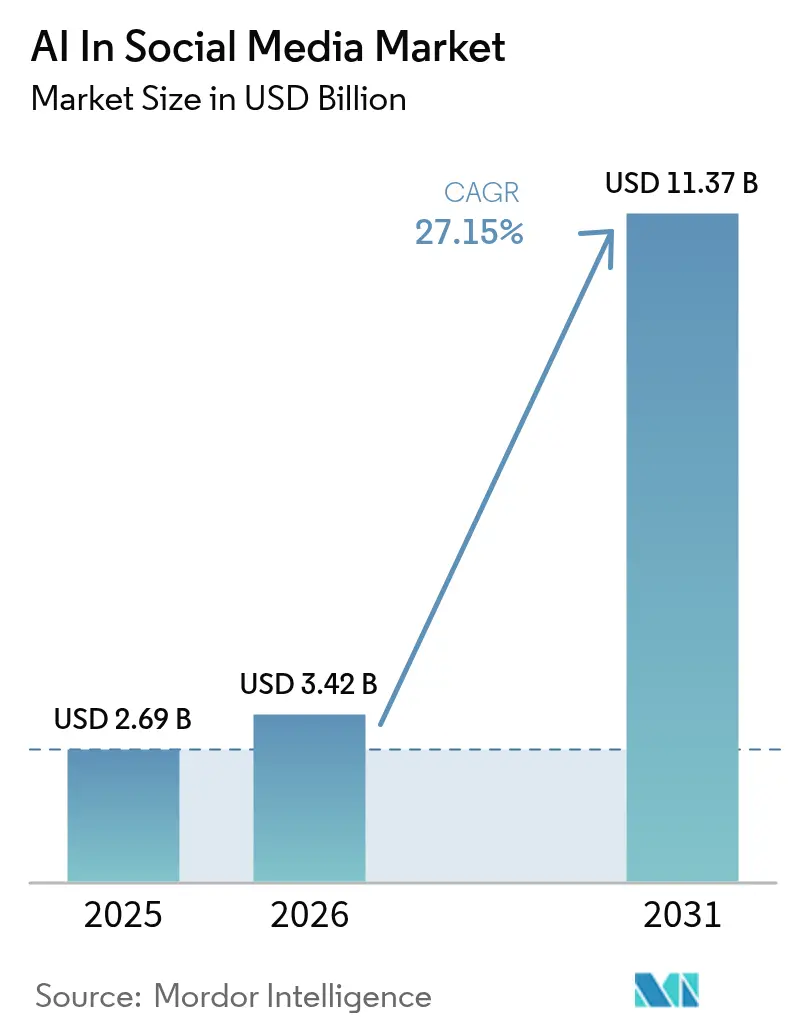
| Market Size (2026) | USD 3.42 Billion |
| Market Size (2031) | USD 11.37 Billion |
| Growth Rate (2026 - 2031) | 27.15 % |
| Fastest Growing Market | Asia-Pacific |
| Largest Market | North America |
| Market Concentration | Medium |
Major Players *Disclaimer: Major Players sorted in no particular order Image © Mordor Intelligence. Reuse requires attribution under CC BY 4.0. | |
AI In Social Media Market Analysis by Mordor Intelligence
The AI in social media market size is expected to grow from USD 2.69 billion in 2025 to USD 3.42 billion in 2026 and is forecast to reach USD 11.37 billion by 2031 at 27.15% CAGR over 2026-2031. Rising use of foundation-model APIs is lowering infrastructure hurdles, so even small platforms integrate advanced personalization. Machine learning and deep learning engines presently steer most recommendation, detection, and moderation tasks, while natural language processing (NLP) is scaling fastest as conversational tools spread across networks. Asia Pacific posts the quickest regional expansion at a 30.84% CAGR, propelled by large public and private generative-AI funding, whereas North America retains leadership with a 38.2% revenue share on the back of Meta’s USD 14.3 billion AI outlays. Demand is also bolstered by mobile-first usage, social-commerce conversions, and synthetic influencers that cut production costs yet raise authenticity concerns.
Key Report Takeaways
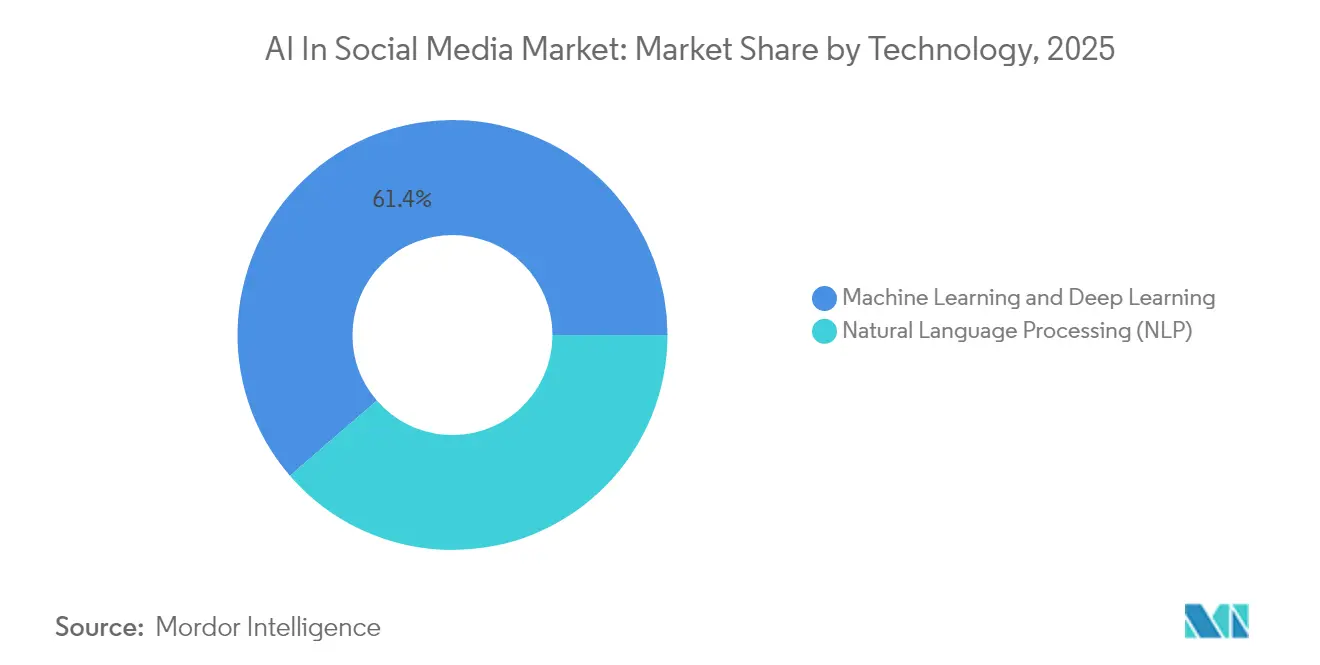
- By technology: Machine learning and deep learning held 61.35% of AI in social media market share in 2025; NLP is set to expand at a 29.10% CAGR to 2031.
- By application: Sales and marketing led with 47.85% revenue share in 2025; image and video recognition is projected to advance at a 27.95% CAGR through 2031.
- By service: Managed services accounted for 56.90% share of the AI in social media market size in 2025; professional services post the highest forecast CAGR at 28.90% until 2031.
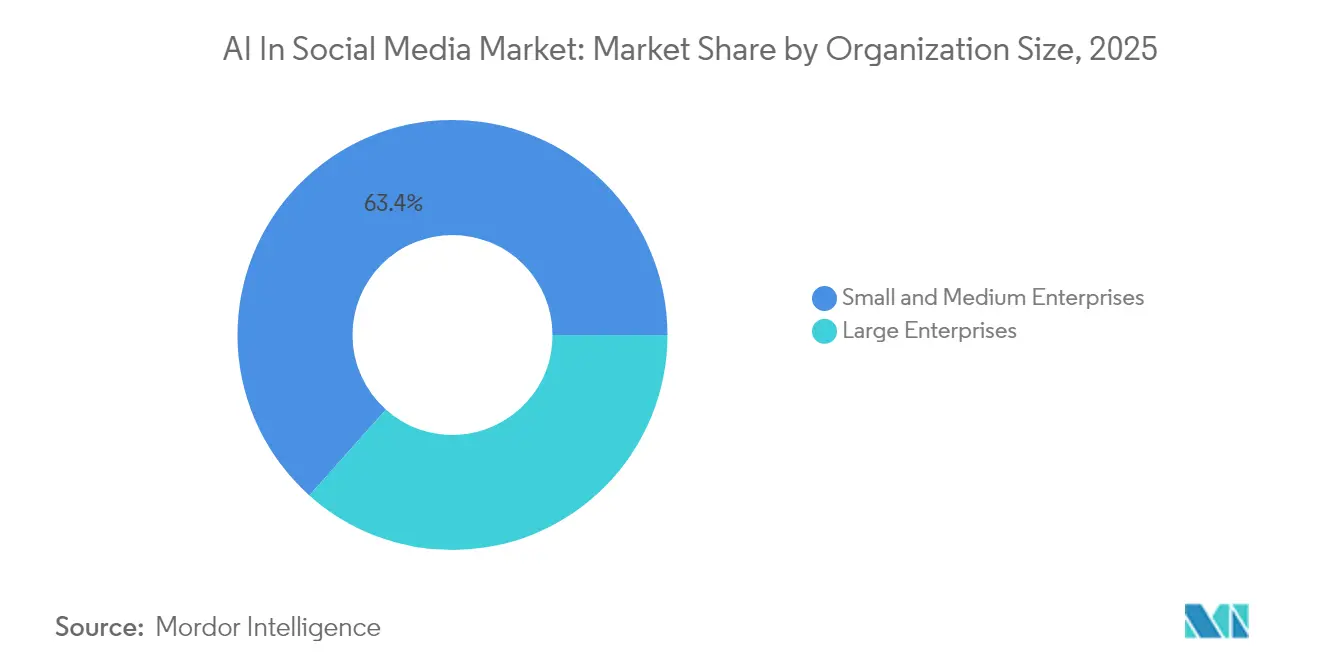
- By organization size: Small and medium enterprises captured 63.40% share in 2025 and will grow at a 28.65% CAGR.
- By end-user industry: Retail dominated with 29.05% share in 2025, while e-commerce is expected to rise at a 28.70% CAGR to 2031.
- By Geography, North America controlled 37.75% of 2025 revenue; Asia Pacific exhibits the fastest 29.75% CAGR outlook.
Note: Market size and forecast figures in this report are generated using Mordor Intelligence’s proprietary estimation framework, updated with the latest available data and insights as of 2026.
Global AI In Social Media Market Trends and Insights
Drivers Impact Analysis*
| Driver | (~) % Impact on CAGR Forecast | Geographic Relevance | Impact Timeline |
|---|---|---|---|
| Integration of AI for hyper-targeted social-media advertising | +8.2% | Global; strongest in North America and Asia Pacific | Medium term (2-4 years) |
| Mobile-first rise in time spent on social platforms | +6.5% | Global; led by Asia Pacific emerging markets | Short term (≤ 2 years) |
| AI-powered social-commerce engines boosting conversion | +7.1% | Global; concentrated in e-commerce-heavy regions | Medium term (2-4 years) |
| Foundation-model APIs lowering entry barriers for in-feed generative content | +4.8% | Global; high SME benefit | Long term (≥ 4 years) |
| On-device inference unlocking privacy-preserving personalization | +3.2% | EU, North America | Long term (≥ 4 years) |
| Synthetic-influencer adoption amplifying brand reach at lower cost | +2.7% | Global; fashion and beauty focus | Medium term (2-4 years) |
| Source: Mordor Intelligence | |||
Integration of AI for Hyper-Targeted Social Media Advertising
Generative engines now refine audience segmentation in the AI in social media market, letting advertisers tailor copy, imagery, and call-to-action wording on the fly. Meta reports a 40% spending uplift when campaigns deploy AI-driven recommendations, confirming the revenue upside.[1] IBM Institute, “AI Advertising Benchmarks,” IBM, ibm.com TikTok pilots virtual sales hosts that both entertain and guide checkout, raising engagement and in-stream purchase rates. Gen-Z users welcome these bespoke feeds, yet 88% also seek tighter AI governance, illustrating the privacy-effectiveness tension. Networks must therefore blend performance objectives with transparent consent flows as regulatory drafts take shape.
Mobile-First Rise in Time Spent on Social Platforms
Smartphones account for most daily sessions, so developers shift inference workloads onto devices where possible. Edge processing cuts latency, trims cloud fees, and enables contextual prompts, such as location-aware recommendations. The EDPS notes that on-device execution aligns with strict data localization rules across Europe.[2]European Data Protection Supervisor, “Edge AI and Data Protection,” edps.europa.eu Research on arXiv finds handheld models still risk stereotype leakage, spurring investment in differential-privacy techniques. Vendors also experiment with mixed architectures that send only partial vectors to the cloud, balancing speed and compliance.
AI-Powered Social-Commerce Engines Boosting Conversion
Conversational funnels delivered by AI chatbots propel conversion ratios, especially for SMEs that lack large support teams. Fashion retailer 6thStreet captured 5-8 × return on ad spend via WhatsApp campaigns that reached 97% of its customer file. Always-on agents combine product discovery, upselling, and order status in one thread, lifting basket sizes. Retailers also embed dynamic pricing scripts that respond to inventory signals, while maintaining human-override dashboards to avoid algorithmic over-discounting.
Foundation-Model APIs Lowering Entry Barriers for In-Feed Generative Content
Affordable endpoints from providers such as Anthropic let start-ups compose captions, translate posts, or build synthetic characters without heavy GPUs. The USD 100 million Anthology Fund widens this access, issuing credits to early-stage teams. However, abundant AI text and images blur authenticity lines, prompting platforms to invest in watermarking and provenance tags. Clear disclosure labels already appear on Meta and YouTube, and policy drafts suggest mandatory flagging of AI-generated political messaging.
Restraints Impact Analysis*
| Restraint | (~) % Impact on CAGR Forecast | Geographic Relevance | Impact Timeline |
|---|---|---|---|
| Scarcity of AI talent for social-graph optimization | -4.2% | Global; acute in emerging markets | Medium term (2-4 years) |
| Limited AI budgets among SMEs in emerging economies | -3.8% | Asia Pacific, Latin America, Africa | Short term (≤ 2 years) |
| Heightened regulatory scrutiny on user-generated data pipelines | -5.1% | EU, North America; expanding globally | Long term (≥ 4 years) |
| Model hallucination risks eroding brand trust | -2.9% | Global; premium brands sensitive | Medium term (2-4 years) |
| Source: Mordor Intelligence | |||
Scarcity of AI Talent for Social-Graph Optimization
Graph neural networks powering friend suggestions and feed ranking demand niche expertise. Meta has offered signing bonuses up to USD 100 million to attract staff, intensifying the squeeze. Emerging-market firms struggle most, so many outsource model tuning or adopt auto-ML pipelines, which can reduce quality in edge cases. University partnerships and open-curriculum platforms aim to widen the talent pool, yet hiring lags growth projections over the next three years.
Limited AI Budgets Among SMEs in Emerging Economies
Although SMEs dominate adoption overall, counterparts in lower-income regions face bandwidth costs, modest cloud credits, and currency volatility. Local telcos now run subsidy programs bundling compute credits with advertising inventory, easing entry barriers. Venture funds also condition seed checks on demonstrable AI roadmaps, pushing founders to adopt early. Still, cash constraints can delay mid-project pivots, making feature completeness uneven across geographies.
*Our forecasts treat driver/restraint impacts as directional, not additive. The impact forecasts reflect baseline growth, mix effects, and variable interactions.
Segment Analysis
By Technology: Machine Learning Dominance Meets NLP Acceleration
Machine learning and deep learning engines held 61.35% of AI in social media market share in 2025, underlining their critical role in ranking feeds and spotting policy violations.The AI in social media market keeps scaling these models to manage video formats and emerging multimodal posts. Historic datasets stretching back to 2020 show steady accuracy improvements as transformers replaced older CNN-RNN hybrids.
Natural language processing is advancing even faster, posting a 29.10% CAGR for 2026-2031 on the back of chat assistants and automatic copywriting. LLMs, now outperforming rule-based filters by 73% in toxicity detection, expand safety layers while adding brand-tone control. The AI in social media market size for NLP-driven tools is poised to widen as low-resource language packs reach commercial viability. Concurrently, computer vision stacks integrate with audio-text encoders, paving paths for unified content understanding.



By Application: Sales and Marketing Leadership Challenged by Visual Recognition Growth
Sales and marketing dominated 2025 with 47.85% of revenue, riding AI ad-optimization that lifted return on spend for early adopters. That slice equates to the largest portion of the AI in social media market size and will retain precedence through subscription-based creative suites. Predictive lead-scoring and budget pacing algorithms automate once manual spreadsheets, freeing marketers to focus on narrative arcs instead of bid toggles.
Image and video recognition, forecast to grow at 27.95% CAGR, benefits from user migration to short-form clips. The AI in social media market leverages real-time scene labeling, product tagging, and AR overlays that spur impulse buys. Deepfake detectors now accompany these pipelines to maintain authenticity gates. Paired with emerging video-to-text captioning, platforms streamline accessibility compliance while improving search discoverability.
By Service: Professional Services Surge Reflects Customization Demand
Managed services retained 56.90% share of the AI in social media market size in 2025 because many brands still outsource moderation and audience-strategy upkeep. Providers bundle cost-predictable subscriptions, hardware, and SLAs, suiting organizations that require turnkey compliance.
Yet professional services, expanding at 28.90% CAGR, signal mounting need for bespoke pipelines that mirror each platform’s community DNA. Consulting practices craft proprietary embeddings, re-train sentiment models on domain jargon, and link outputs to CRM triggers. As the AI in social media industry matures, buyers seek advisory roadmaps that weave in ethics audits, bias mitigation, and ROI dashboards rather than generic plugins.
By Organization Size: SME Dominance Drives Democratic AI Adoption
Small and medium enterprises captured 63.40% of 2025 revenue, and their 28.65% CAGR underscores agility advantages. Founders lean on self-service ad APIs, low-code bot builders, and freemium analytics that slash go-to-market cycles. The AI in social media market supports these firms with tiered pricing and knowledge hubs that level the technical playing field.
Large enterprises continue to invest in holistic platforms connecting marketing, service, and HR data lakes. Their deployments shape the upper-end of AI in social media market size metrics, yet decision pathways often extend proofs of concept across multi-team committees. Integration depth yields cross-functional insights but slows iteration, giving nimble SMEs space to experiment with emerging generative formats.
By End-User Industry: Retail Leadership Faces E-Commerce Disruption
Retail commanded 29.05% of 2025 spending, embracing virtual try-ons and automated listicle ads that mimic influencer storytelling. Sephora’s rebuild illustrates how the AI in social media market powers omni-channel engagement, coupling store beacons with personalized feeds.
E-commerce players show the quickest 28.70% CAGR by weaving checkout natively into chat threads. Social-commerce toolkits embed stock checks and order payout directly inside platforms, shrinking conversion funnels. BFSI firms deploy fraud-alert messaging bots, media houses automate highlight reels, and education pilots adaptive discussion rooms. Each vertical tailors AI prompts to lexicon, regulation, and audience expectations, reflecting the breadth of the AI in social media industry.
Geography Analysis
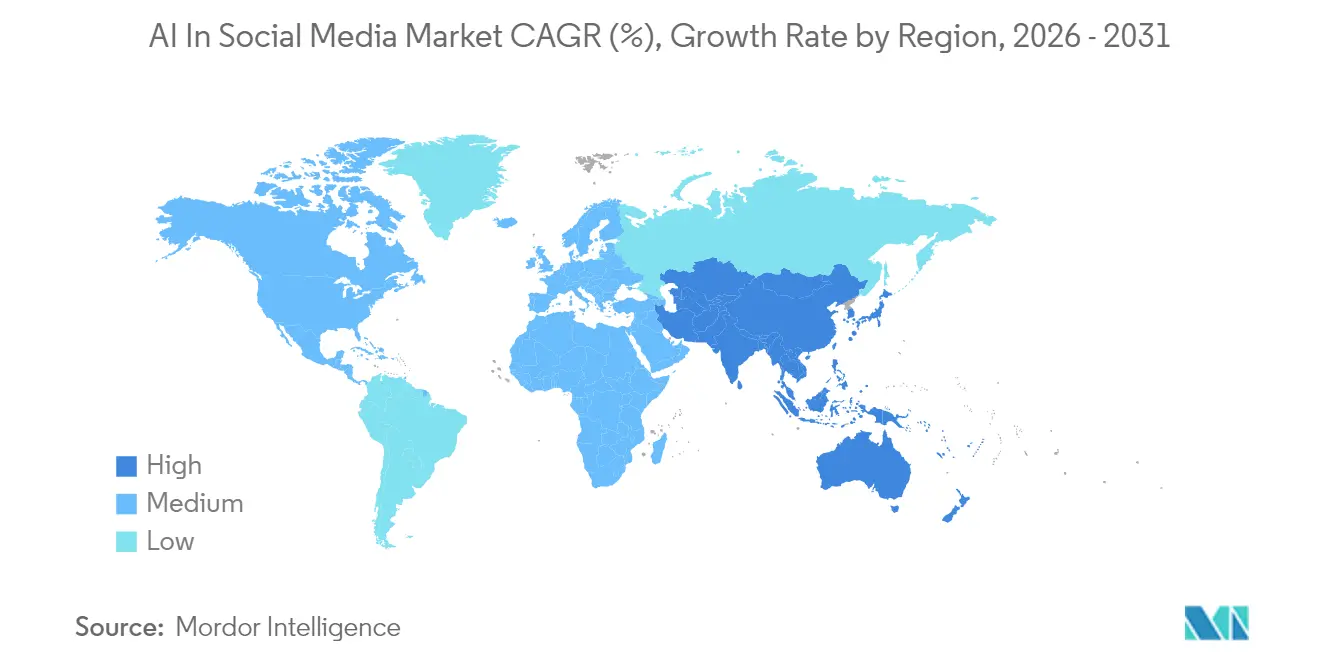
North America held 37.75% revenue in 2025, driven by Meta, Alphabet, Microsoft, and a dense start-up pipeline around Silicon Valley. The region’s cloud incumbents anchor foundational model training, and its venture ecosystem funds content-tech verticals that expand the AI in social media market. Government grants focus on trustworthy AI, encouraging bias audits and transparency APIs that complement federal privacy proposals.
Asia Pacific is the fastest-advancing territory with a 29.75% CAGR through 2031. China’s USD 2.1 billion in generative-AI funding, India’s thriving developer base, and Korea’s 5G coverage combine to scale user adoption beyond 1 billion social-media accounts. The AI in social media market share grows as local networks integrate multilingual LLMs tuned to Hindi, Bahasa, and Thai dialects, capturing cohorts under-served by Western platforms.
Europe navigates stricter oversight, but privacy-led design spurs on-device research. The AI in social media market size reflects slower headline growth yet higher spend per user because enterprises pay premiums for compliant toolkits. The Middle East and Africa witness rising mobile uptake; telco-bundled data and fintech wallets fuel content creation across Swahili, Arabic, and Hausa. Latin America integrates social-commerce plug-ins, aligning influencer culture with cross-border payments to unlock fresh opportunities.

Regulatory Landscape
Regulation affecting AI use in social media is tightening around transparency, child safety, and deceptive AI claims across major markets. In the EU, the EU AI Act (Regulation (EU) 2024/1689) sets a harmonized, risk-based framework with transparency duties for AI-generated content, shaping how platforms label synthetic media and document model behavior when operating in the EU market.
In 2026, the United States and the United Kingdom advanced distinct approaches that increase compliance complexity for global platforms. In March 2026, the White House released a national AI legislative framework aimed at federal-level alignment, while in July 2026 the US Federal Trade Commission issued a policy statement on applying Section 5 of the FTC Act to AI marketing claims. This step heightens scrutiny of deceptive representations about AI-enabled moderation, targeting, or safety. In the UK, DSIT engagement with Ofcom elevated enforcement priorities around youth protections, including restrictions tied to minors use cases (notably chatbot and safety controls). That shift is pushing platforms toward stricter age-gating, content controls, and auditable safeguards in product design.
Value Chain Analysis
The value chain spans upstream compute and foundation-model providers, data acquisition and labeling, model development and safety tooling, and downstream deployment into social platforms and enterprise social-media stacks. Hyperscale cloud and foundation-model APIs reduce infrastructure barriers for platforms and SMEs, while specialized vendors supply moderation pipelines, drift and hallucination monitoring, and provenance signaling. These components link model outputs to policy enforcement and advertiser requirements.
Downstream, platforms operationalize AI across recommendation, ad-optimization, social commerce, and automated moderation systems. They then distribute capabilities through self-serve APIs and managed and professional services. Regulatory actions are increasingly part of the chain constraints as well. In July 2026, the European Commission issued preliminary findings under the Digital Services Act focused on engagement-oriented design and recommender behaviors (including infinite scroll, autoplay, and related algorithmic features) for Meta properties. The findings reinforce that governance, documentation, and feature-level controls now affect product iteration cycles, vendor selection, and the demand for compliance-ready monitoring and transparency layers.
Competitive Landscape
The AI in social media market features moderate concentration. Meta multiplies Llama checkpoints and fuses teams under its new Superintelligence Labs to quicken product cycles. Google’s YouTube scales RLHF-tuned recommenders while broadening cloud alliances that embed enterprise agents into collaboration suites. Microsoft hosts xAI’s Grok 3 on Azure, courting creators who want frictionless deployment.
Vertical differentiation gains prominence. ByteDance iterates computer-vision loops optimizing TikTok’s For You feed, whereas Amazon Web Services cultivates a generative-AI partner cohort to pump specialized add-ons into Marketplace. New entrants like Bluesky pilot decentralized identity models that challenge closed-garden incumbents.
Responsible-AI tooling becomes a battleground; WhyLabs sells monitoring dashboards spotting drift and hallucinations in under a minute. Vendors publicize safety metrics, aiming to pre-empt regulators and reassure advertisers. Partnerships, open-source drops, and equity stakes in specialized start-ups define collaboration patterns as firms balance speed, control, and governance.
AI In Social Media Industry Leaders
Microsoft Corporation
Google LLC
Amazon Web Services, Inc
Adobe Systems Incorporated
Meta
- *Disclaimer: Major Players sorted in no particular order


Market Opportunities and Future Outlook
Opportunities concentrate in compliance-grade generative content, proactive moderation, and creator-led AI experiences that can be deployed without large in-house ML teams. Meta’s creator tooling offers a clear signal: AI Studio (released to the US market in July 2024) enabled creation and sharing of custom AI characters across Instagram, Messenger, and WhatsApp, and in July 2026 Meta announced Muse Image and Muse Video to extend AI-driven content creation. These updates support broader market opening for third-party professional services, safety layers such as watermarking, labeling, and provenance tags, and managed operations that help brands and platforms run generative campaigns while keeping disclosure and trust in place.
Regulatory activity also creates room for vendors that package policy controls into product workflows. Canada introduced Bill C-34 (Safe Social Media Act) in June 2026 with duties spanning labeling synthetic material and restricting impersonation, while India introduced a May 2026 IT Rules Amendment that includes an active moderation mandate for AI-integrated social platforms. Alongside the EU’s focus on algorithmic transparency and age-appropriate design, demand is shifting toward toolchains that unify content labeling, audit trails, human-in-the-loop escalation, and reporting dashboards across ads, feeds, chatbots, and commerce experiences.
Recent Industry Developments
- July 2026: Meta announced Muse Image and Muse Video to expand AI-driven content generation for social creative workflows, positioning the models for integration into Meta advertising and Instagram creation surfaces. The release strengthens in-platform generative creation while increasing the need for provenance, labeling, and safety controls around synthetic media.
- July 2026: Google began applying a "created or edited with AI" label to ads generated by its AI tools across Search, Discover, and YouTube via My Ad Center. The change operationalizes AI disclosure at scale in paid social and video inventory, influencing advertiser workflows and setting a higher baseline for transparency features across competing platforms.
- June 2024: Meta started testing user-created AI chatbots on Instagram, extending conversational AI from platform-owned assistants to creator-built agents. This broadened the route to AI-driven customer engagement and commerce while increasing moderation and impersonation risks that vendors and platforms must manage through tighter guardrails.


Research Methodology Framework and Report Scope
Market Definition and Coverage
This market tracks revenue from AI software and related services that are used to run, optimize, and secure social media activities, including content decisions, audience targeting, and automated interactions.
Scope exclusions: We exclude non-AI social media tools and generic IT services that are not directly tied to AI-enabled social media outcomes.
Segmentation Overview
- By Technology
- Machine Learning and Deep Learning
- Natural Language Processing (NLP)
- By Application
- Customer Experience Management
- Sales and Marketing
- Image and Video Recognition
- Predictive Risk Assessment
- Other Applications
- By Service
- Managed Service
- Professional Service
- By Organization Size
- Small and Medium Enterprises
- Large Enterprises
- By End-User Industry
- Retail
- E-commerce
- Banking, Financial Services and Insurance (BFSI)
- Media and Advertising
- Education
- Other Industries
- By Geography
- North America
- United States
- Canada
- Mexico
- South America
- Brazil
- Argentina
- Rest of South America
- Europe
- United Kingdom
- Germany
- France
- Spain
- Russia
- Rest of Europe
- Asia Pacific
- China
- Japan
- India
- South Korea
- Australia and New Zealand
- Rest of Asia Pacific
- Middle East and Africa
- Middle East
- Saudi Arabia
- UAE
- Turkey
- Rest of Middle East
- Africa
- South Africa
- Nigeria
- Rest of Africa
- Middle East
- North America
Data Sources, Market Sizing, and Validation
Desk Research
Desk work started with public data that helps explain the size of the demand pool and the pace of AI adoption in social channels. Sources used for this step included U.S. Census Bureau digital economy statistics, OECD digital indicators, ITU connectivity metrics, World Bank macro series, and regulatory publications from bodies such as the FTC and the European Commission on digital advertising and platform governance.
We also reviewed company filings and earnings call transcripts, investor decks, engineering blogs, and reputable press to map use cases like personalization, moderation, social listening, and conversational tools, and to understand how monetization is discussed. A paid subscription for company financials and intelligence was used selectively to normalize revenue splits, and a patent database was referenced to sanity-check technology direction. The sources listed here are illustrative, and many other public documents were reviewed to collect, validate, and clarify inputs.
Primary Interviews and Surveys
Primary work focused on validating what is actually purchased and deployed for AI in social media, and how budgets move between managed services and professional services, including the way teams describe NLP, machine learning, and related toolsets. We spoke with a balanced mix of platform-side teams, marketing and CX owners, and solution delivery specialists across major geographies, then used those inputs to tighten assumptions on adoption, pricing movement, and near-term demand softness or spikes.
Distribution of primary research fieldwork respondents
| Company type | Respondent position | Region |
|---|---|---|
| Top tier: 28% | CXOs: 21% | APAC: 51% |
| Mid tier: 51% | Functional/Unit leaders: 34% | EMEA: 29% |
| Smaller Players: 21% | Managers: 45% | Americas: 20% |
Market-Sizing & Forecasting
Sizing was built using a top-down approach, where we reconstructed the spend pool by linking social media operational and marketing use cases to measurable adoption signals, then allocating that spend into AI-specific workflows. To keep totals realistic, we corroborated results with selective bottom-up approximations, such as sampled vendor revenue disclosures, channel checks on common packaging, and modeled ASP times estimated volume for AI features.
Key inputs included the mix shift toward NLP-led automation, the share of social operations using AI for moderation and brand safety, the penetration of AI-driven content optimization in paid and organic programs, managed versus professional services split, and regional differences in AI policy and data handling that affect rollout speed. For the forecast, scenario analysis was used so growth could be flexed based on expert views on AI feature attach rates, pricing progression, and the speed of platform and enterprise adoption. When direct revenue splits were not available, gaps were handled through proxy ratios from comparable software categories, followed by re-checks with interview feedback and public disclosures.
Data Validation & Update Cycle
Outputs were checked against independent signals such as digital ad spend direction, reported AI feature adoption in social workflows, and the pace of enterprise software budget changes, and any large variance was investigated. When an outlier appeared, we revisited assumptions behind volume, pricing, and regional weighting, and re-contacted experts if the reason could not be explained through public evidence.
Before sign-off, the model goes through a multi-step internal review so logic, units, and conversions stay consistent across regions and years. Reports are refreshed annually, and interim updates are made when material events occur, such as policy changes, major pricing shifts, or step-change platform feature launches. Right before delivery, a fresh validation pass is completed so clients receive the latest updated view.
Mordor Intelligence's Social Media AI Market Size Compared Against Other Published Estimates
Published market sizes for AI in social media often vary because each publisher uses different scope rules, year timing, and pricing logic, and those choices flow into the final figure. In our checks, the biggest differences came from what is counted as AI revenue versus adjacent analytics or general marketing software, and from how service revenue is treated.
Some estimates bundle a wider set of platform monetization and downstream advertising activity into the market total. In Mordor Intelligence, the value is counted only for AI-specific solutions and services tied to defined social media applications, and adjacent non-AI tools are kept out even if they are used by the same teams.
Benchmark comparison
| Source | Market Size | Gaps in Research Methodology |
|---|---|---|
| Mordor Intelligence | USD 3.42 B (2026) | |
| Global Research Publisher A | USD 3.49 B (2026) | Uses a provider revenue framing that can pull in a broader set of AI-enabled platform tooling, and the definition leans on supplier-side reporting where AI feature allocation is not always separated consistently. |
| Industry Research Firm B | USD 3.09 B (2025) | Different base year and timing of currency conversion can shift the total, and the scope description is less explicit on which AI-enabled social workflows are counted versus adjacent social analytics and generic marketing suites. |
Looking across the table, most of the spread can be traced to scope width and year alignment, then to how AI-only revenue is separated from nearby software categories. By anchoring the model on observable adoption signals and pressure-testing pricing and service mix with interviews, the final value remains traceable to steps that can be repeated year after year.


Key Questions Answered in the Report
What is the current size of the AI in social media market?
The AI in social media market stands at USD 3.42 billion in 2026 and is projected to hit USD 11.37 billion by 2031.
Which region is expanding fastest in AI-driven social media?
Asia Pacific records the highest growth with a 29.75% CAGR, thanks to substantial generative-AI investments and mobile-first engagement.
Which technology segment leads the market today?
Machine learning and deep learning hold 61.35% of revenue, powering recommendations, moderation, and ranking systems.
Why are SMEs major adopters of AI on social platforms?
SMEs control 63.40% of 2025 spending because low-code APIs and pay-as-you-go models let them implement AI without heavy infrastructure.
What is driving the surge in AI-based social-commerce conversions?
Chatbots and conversational funnels can deliver 5-8 × return on ad spend by offering personalized, real-time purchase assistance within messaging apps.
How are regulations influencing market growth?
Frameworks like the EU AI Act impose high-risk classifications and heavy fines for non-compliance, compelling platforms to invest in transparency, data lineage, and on-device processing.
Page last updated on:


 Your data is secure and never sold or shared.


