
Aerospace Carbon Fiber Market Size and Share
Market Overview
| Study Period | 2020 - 2031 |
|---|---|
| Market Size (2026) | USD 2.62 Billion |
| Market Size (2031) | USD 3.69 Billion |
| Growth Rate (2026 - 2031) | 7.06 % |
| Fastest Growing Market | Asia Pacific |
| Largest Market | Asia Pacific |
| Market Concentration | Medium |
Major Players *Disclaimer: Major Players sorted in no particular order Image © Mordor Intelligence. Reuse requires attribution under CC BY 4.0. | |
Aerospace Carbon Fiber Market Analysis by Mordor Intelligence
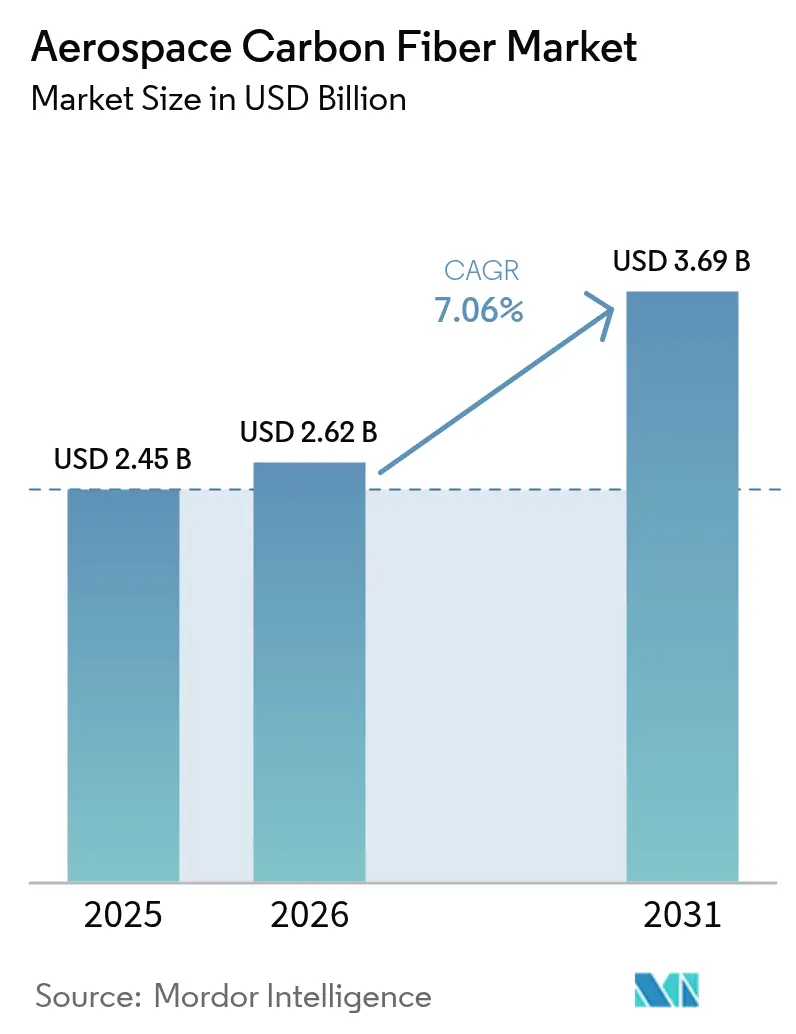
The Aerospace Carbon Fiber Market size market size in 2026 is estimated at USD 2.62 billion, growing from 2025 value of USD 2.45 billion with 2031 projections showing USD 3.69 billion, growing at 7.06% CAGR over 2026-2031.
The rapid adoption of modern manufacturing technologies, such as additive manufacturing, and the development and induction of new aircraft models are likely to remain the key growth drivers for the market. Additionally, the need for manufacturing low-weight, fuel-efficient aircraft that reduce emissions is anticipated to drive the market's growth prospects. Advancements in the application base of additive manufacturing techniques in the aviation sector are envisioned to affect the market in the future.
Note: Market size and forecast figures in this report are generated using Mordor Intelligence’s proprietary estimation framework, updated with the latest available data and insights as of 2026.
Global Aerospace Carbon Fiber Market Trends and Insights
The Commercial Fixed-wing Aircraft Segment is Expected to Dominate the Market During the Forecast Period
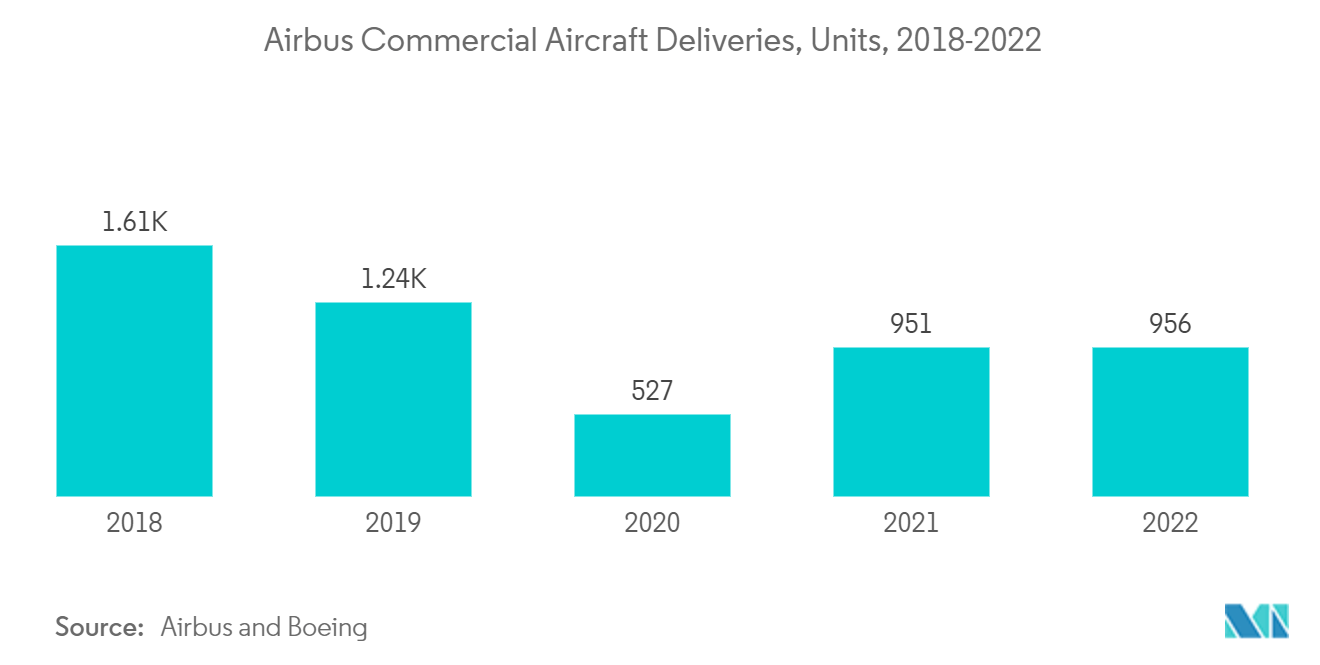
Weight is the most important parameter considered at every phase in the design and development of an aircraft. The low overall weight of an aircraft can result in less fuel consumption. Most commercial airlines operate at low-profit margins, and hence, prefer aircraft that are fuel efficient. The growing demand for lightweight materials to increase fuel efficiency and the growth of commercial aircraft with high composites composition such as B787 and A350WXB.
Airlines are constantly searching for new avenues to explore and enhance their revenue stream. This includes launching services on new routes for catering to untapped market potentials. c. Based on certain predicted outcomes such as revenue and profitability, airlines decide on the type of aircraft to be used and the frequency of operations on a new route. For instance, a total of 3,500 routes were launched globally by several operators in 2022. The launch of new routes bolsters the entire aviation infrastructure in the region. Besides initiating procurement and retrofitting of aircraft fleets, it also encourages increased participation of regional component manufacturers in the scheduled and unscheduled maintenance carried over an aircraft. New routes are likely to be served only by fleet expansion, driving the demand for new generation commercial aircraft and thereby driving the commercial fixed-wing aircraft segment of the market during the forecast period.


The Asia-Pacific Market is Expected to Witness the Highest Growth During the Forecast Period
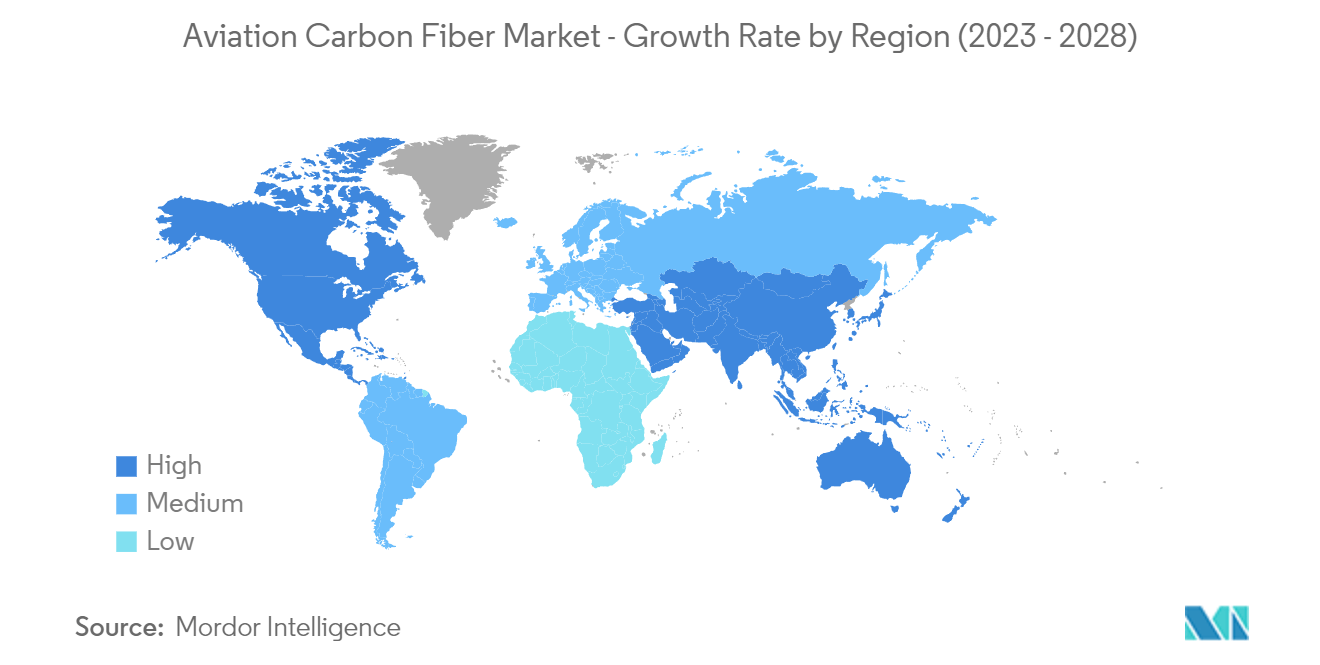
Asia-Pacific is expected to witness the highest CAGR during the forecast period. The increasing number of aircraft orders and deliveries in the region, due to the increasing demand for newer generation aircraft, is currently driving the growth of the market in the region. Also, several of the material suppliers are based in this region and supply raw materials for part manufacturers and aircraft OEMs. Air passenger traffic in the Asia-Pacific region is growing at a rapid pace, which has forced the airlines operating across Asia to increase their fleet size. This will result in airlines procuring new aircraft in the coming years, which is likely to generate demand for carbon fiber since the majority of the newer generation aircraft structures are made using carbon fiber composites.

Competitive Landscape
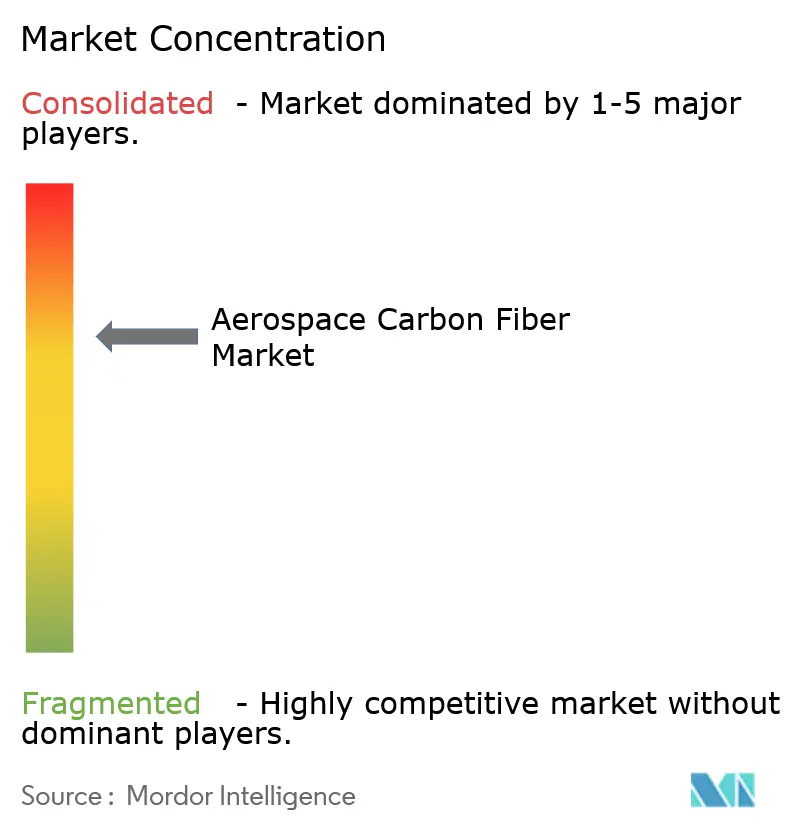
The aerosapce carbon fiber market is highly consolidated. The top players account for the majority of the market share. The market demand is higher and is expected to increase further in the future. Solvay S.A., Toray Industries, Inc., DuPont de Numours, Inc., TEIJIN LIMITED, and SGL Carbon SE are a few of the market leaders, both in terms of production capacity and revenue. Companies are investing significantly to develop advanced carbon fiber materials, which can overcome the challenges associated with the materials available today. Companies are also collaborating with research institutions to work on advanced materials that can shape the future of materials used by the aviation industry.
Aerospace Carbon Fiber Industry Leaders
SGL Carbon SE
TEIJIN LIMITED
Toray Industries, Inc.
Solvay S.A.
DuPont de Numours, Inc.
- *Disclaimer: Major Players sorted in no particular order

Market Opportunities and Future Outlook
A key opportunity area is supply security and qualification-ready material systems as airframe and engine programs consume more composite content. In January 2026, Syensqo and Toray Composite Materials America initiated a five-year global supply agreement covering high-strength and intermediate-modulus carbon fibers for aerospace applications. The agreement reflects how long-term contracting is being used to stabilize availability, lead times, and certification continuity for OEMs and Tier suppliers.
Another opportunity is expanding regionally diversified fiber capacity and adding additional sources for both high-performance and large-tow grades, which can change procurement strategies across commercial, defense, and space end uses. In March 2026, Toray Carbon Fibers Europe started up a new production facility in South-West France, increasing annual capacity for T300 and high-modulus fibers from 5,000 to 6,000 tonnes. In China, Sinopec Shanghai Petrochemical commenced Phase I commercial operation of a 30,000-ton/year large-tow project in May 2026, and CNBM launched high-performance production lines in Jiangsu in June 2026 that included capability for 1,000 tonnes/year of T1100-grade fiber for aerospace applications. Alongside virgin fiber, reclaimed aerospace-grade carbon fiber is moving into structured procurement for selected use cases, supported by developments such as Nandina REM and Odyssey Space executing an exclusive procurement directive in July 2026.
Recent Industry Developments
- June 2026: CNBM launched high-performance production lines in Jiangsu that included capacity for 1,000 tonnes/year of T1100-grade carbon fiber for aerospace applications. The move expands domestic high-performance carbon fiber capacity and can affect qualification and sourcing dynamics for aerospace programs.
- April 2026: Toray Composite Materials America entered into a long-term carbon fiber supply agreement with Syensqo for aerospace applications. The arrangement formalizes multi-year sourcing for high-strength and intermediate-modulus fibers, supporting continuity for qualified composite systems. It also aligned suppliers as OEMs and Tier suppliers manage allocation risk for aerospace-grade fiber.
- February 2026: Toray Composite Materials America achieved NCAMP qualification for its 3960 prepreg system incorporating TORAYCA T1100 carbon fiber for primary structural aircraft materials. NCAMP qualification can shorten adoption cycles by providing shared material allowables used across programs, reducing repetitive testing burden.


Research Methodology Framework and Report Scope
Market Definition and Coverage
For this study, the market covers carbon fiber material demand sold into aerospace manufacturing, where the fiber is used to make lightweight, high-strength composite parts for aircraft and rotorcraft across major regions.
Scope exclusions: We exclude carbon fiber used mainly in non-aerospace end uses such as wind energy, automotive, sporting goods, and general industrial applications.
Segmentation Overview
- Application
- Commercial Fixed-wing Aircraft
- Military Fixed-wing Aircraft
- Rotorcraft
- Geography
- North America
- United States
- Canada
- Europe
- United Kingdom
- France
- Germany
- Italy
- Rest of Europe
- Asia-Pacific
- China
- India
- Japan
- Rest of Asia-Pacific
- Latin America
- Mexico
- Brazil
- Rest of Latin America
- Middle-East and Africa
- Saudi Arabia
- United Arab Emirates
- South Africa
- Rest of Middle-East and Africa
- North America
Data Sources, Market Sizing, and Validation
Desk Research
Desk research was used to build the base structure of the model and to lock in a consistent definition of what counts as aerospace carbon fiber. We reviewed public sources such as FAA aircraft delivery and fleet indicators, EASA airworthiness and safety publications, ICAO air traffic datasets, and trade and customs statistics (for example, UN Comtrade) that help explain production and cross-border movement of carbon fiber and related inputs.
We also used sources like company annual reports, investor presentations, earnings call transcripts, and reputable aerospace and composites association websites to understand capacity additions, qualification timelines, and typical usage of carbon fiber in aircraft structures. In a few places, paid subscriptions for company financials and news were used to cross-check timelines and announced expansions, and patent databases helped validate technology direction without relying on private data. These sources are illustrative, and many other public references were also used for data collection, validation, and clarification.
Primary Interviews and Surveys
Primary work focused on interviews and structured surveys with people involved in carbon fiber supply, composite part manufacturing, and aerospace procurement and engineering. To reduce single-point bias, inputs were collected across major regions and then used to test assumptions such as aerospace-grade qualification cycles, average carbon fiber usage per aircraft platform, and price movement expectations that are later applied in the model.
Distribution of primary research fieldwork respondents
| Company type | Respondent position | Region |
|---|---|---|
| Top tier: 31% | CXOs: 12% | APAC: 47% |
| Mid tier: 47% | Functional/Unit leaders: 31% | EMEA: 34% |
| Smaller Players: 22% | Managers: 57% | Americas: 19% |
Market-Sizing & Forecasting
Sizing starts with a top-down build that reconstructs the demand pool from aircraft production and delivery trends, followed by program-level material intensity assumptions for carbon fiber in primary structures and other qualifying components. Once the demand pool is shaped, pricing is applied using a practical view of aerospace-grade carbon fiber ASPs, adjusted for mix shifts between commercial fixed-wing, military fixed-wing, and rotorcraft demand.
To keep the numbers realistic, we corroborate totals using selective bottom-up checks, including supplier and processor revenue checks, sampled price per kilogram times estimated volume, and channel feedback on allocation tightness. Key inputs used in the model include aircraft build rate plans, composite content per aircraft family, scrap and yield loss factors during layup and conversion, qualification and recertification timing, and inflation and currency assumptions that affect realized prices. Forecasting is run using scenario analysis, where the base case is anchored to expected aircraft production ramps and then stress tested for delivery delays, defense budget timing, and raw material cost swings. These assumptions are reviewed with expert feedback before finalizing.
Data Validation & Update Cycle
Outputs are validated through cross-checks against independent signals such as aircraft deliveries, public capacity announcements, trade flow direction, and observed pricing commentary in public disclosures. When a sharp variance appears, the assumptions are revisited, a second analyst reviews the logic, and follow-up calls are triggered to confirm whether the change is real or a data timing issue.
The report is refreshed annually, and interim updates are made when material events occur, such as major aircraft program rate revisions, supply disruptions, or large capacity expansions. Before publication, a final pass is completed so clients receive an updated view that reflects the latest public releases and revalidated assumptions.
Mordor Intelligence's Aerospace Carbon Fiber Market Size Compared With Other Published Estimates
Published market sizes for aerospace carbon fiber do not always match because the term can be interpreted in different ways, and the underlying demand drivers are not consistent across studies. Differences usually come from what is counted as aerospace, the time window used for pricing, and whether the model follows aircraft build rates or broader composites consumption.
The table shows a wide spread in the 2025 to 2026 market value, and in Mordor Intelligence's model the sizing is tied to aerospace end use by application (commercial fixed-wing, military fixed-wing, and rotorcraft) and is not expanded into adjacent non-aerospace uses that sometimes get bundled in. Another common gap is the way ASPs are advanced, where some estimates use faster price inflation or a higher mix of premium grades without checking against public aircraft program ramp timing. Refresh cadence can also move the number because delivery delays and supplier allocation changes quickly affect near-term volume assumptions.
Benchmark comparison
| Source | Market Size | Gaps in Research Methodology |
|---|---|---|
| Mordor Intelligence | USD 2.62 B (2026) | |
| Global Consultancy A | USD 5.39 B (2025) | Uses a broader application map that appears to include non-aerospace blades within the same study scope, and it extends forecasts with a higher growth window to 2034, which can lift implied near term sizing through mix and pricing assumptions. |
| Industry Publisher B | USD 2.40 B (2025) | Uses a different base year and a longer horizon to 2035, and the value looks driven by generalized growth rates with limited evidence of aircraft program level volume checks and near term delivery timing adjustments. |
Taken together, the differences are mostly explained by scope boundaries, year selection, and how volume and ASP are linked to aircraft production reality. Our approach keeps the estimate traceable to clear demand indicators and repeatable steps, which helps users understand what is included and why the final value lands where it does.


Key Questions Answered in the Report
What is the current Aerospace Carbon Fiber Market size?
The Aerospace Carbon Fiber Market is projected to register a CAGR of 7.06% during the forecast period (2026-2031)
Who are the key players in Aerospace Carbon Fiber Market?
SGL Carbon SE, TEIJIN LIMITED, Toray Industries, Inc., Solvay S.A. and DuPont de Numours, Inc. are the major companies operating in the Aerospace Carbon Fiber Market.
Which is the fastest growing region in Aerospace Carbon Fiber Market?
Asia Pacific is estimated to grow at the highest CAGR over the forecast period (2026-2031).
Which region has the biggest share in Aerospace Carbon Fiber Market?
In 2025, the Asia Pacific accounts for the largest market share in Aerospace Carbon Fiber Market.
What years does this Aerospace Carbon Fiber Market cover?
The report covers the Aerospace Carbon Fiber Market historical market size for years: 2019, 2020, 2021, 2022, 2023 and 2024. The report also forecasts the Aerospace Carbon Fiber Market size for years: 2026, 2027, 2028, 2029, 2030 and 2031.
Page last updated on:


 Your data is secure and never sold or shared.


