
Aerosol Bag On Valve Packaging Market Size and Share
Market Overview
| Study Period | 2019 - 2030 |
|---|---|
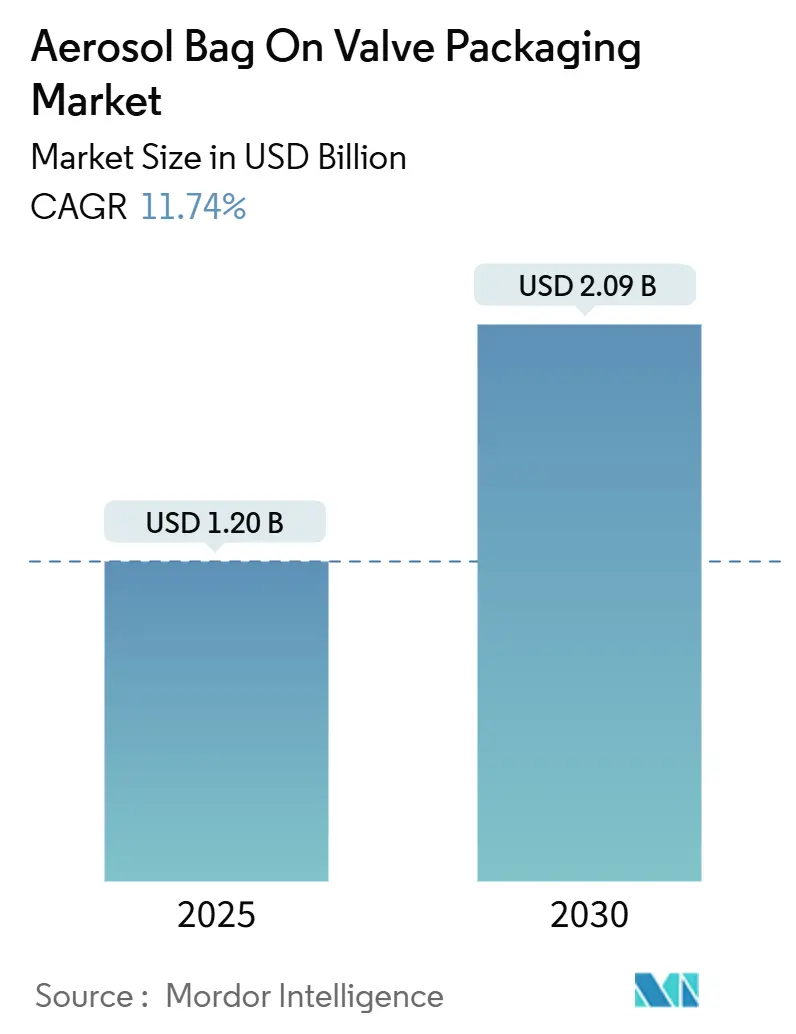
| Market Size (2025) | USD 1.20 Billion |
| Market Size (2030) | USD 2.09 Billion |
| Growth Rate (2025 - 2030) | 11.74 % |
| Fastest Growing Market | Asia Pacific |
| Largest Market | Europe |
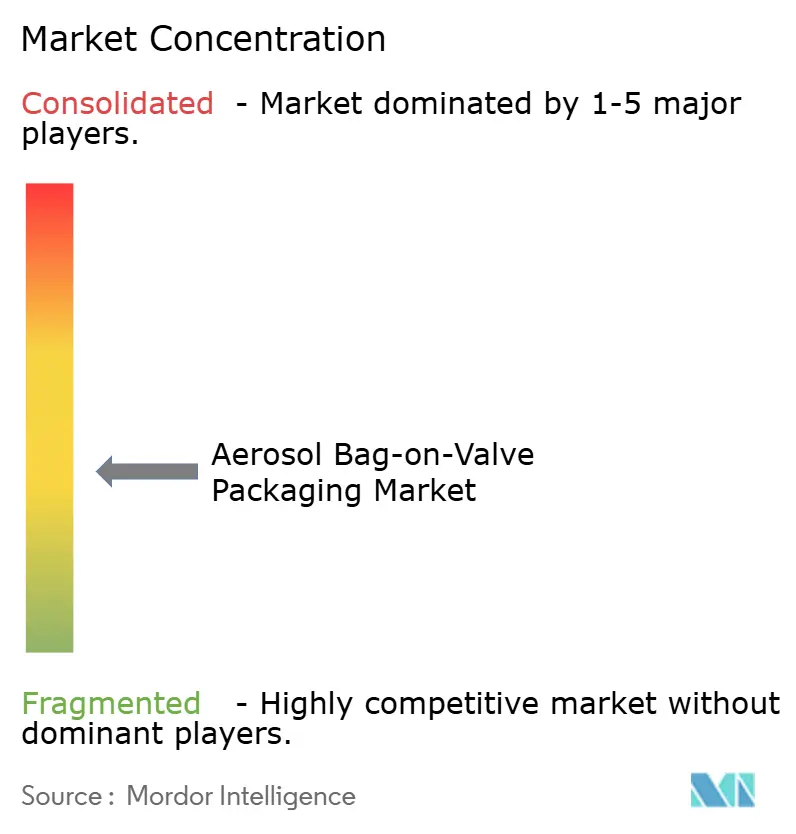
| Market Concentration | Medium |
Major Players *Disclaimer: Major Players sorted in no particular order Image © Mordor Intelligence. Reuse requires attribution under CC BY 4.0. | |
Aerosol Bag On Valve Packaging Market Analysis by Mordor Intelligence
The aerosol bag-on-valve packaging market size reached USD 1.2 billion in 2025 and is forecast to expand to USD 2.09 billion by 2030 at an 11.74% CAGR. Momentum stems from the format’s product-propellant separation, which preserves sensitive formulations, eliminates preservatives, and reduces volatile organic compound emissions. Demand acceleration is underpinned by regulatory pressure on hydrocarbon propellants, brand sustainability goals, and contract filling scale-ups that lower per-unit costs. Competitive rivalry centers on actuator innovation, aluminum recyclability, and modular valve designs that broaden the technology’s viscosity range. Rising aluminum availability in Asia and expedited regulatory pathways for innovative drug-delivery systems shape near-term investment priorities.
Key Report Takeaways
- By product type, the aerosol bag-on-valve market for one-inch valves captured 44.41% of the market share in 2024.
- By application, the aerosol bag-on-valve market for pharmaceutical sprays is expected to advance at a 14.51% CAGR through 2030.
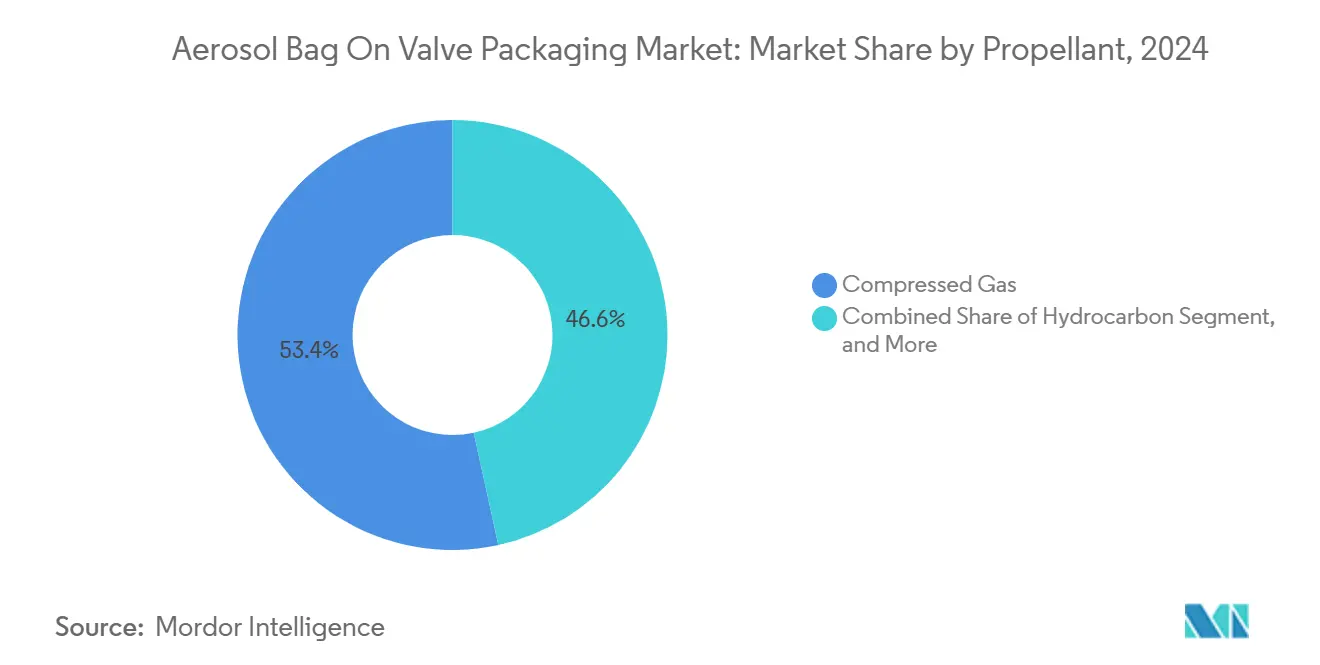
- By propellant, the aerosol bag-on-valve market for compressed gases held 53.41% of the market share in 2024.
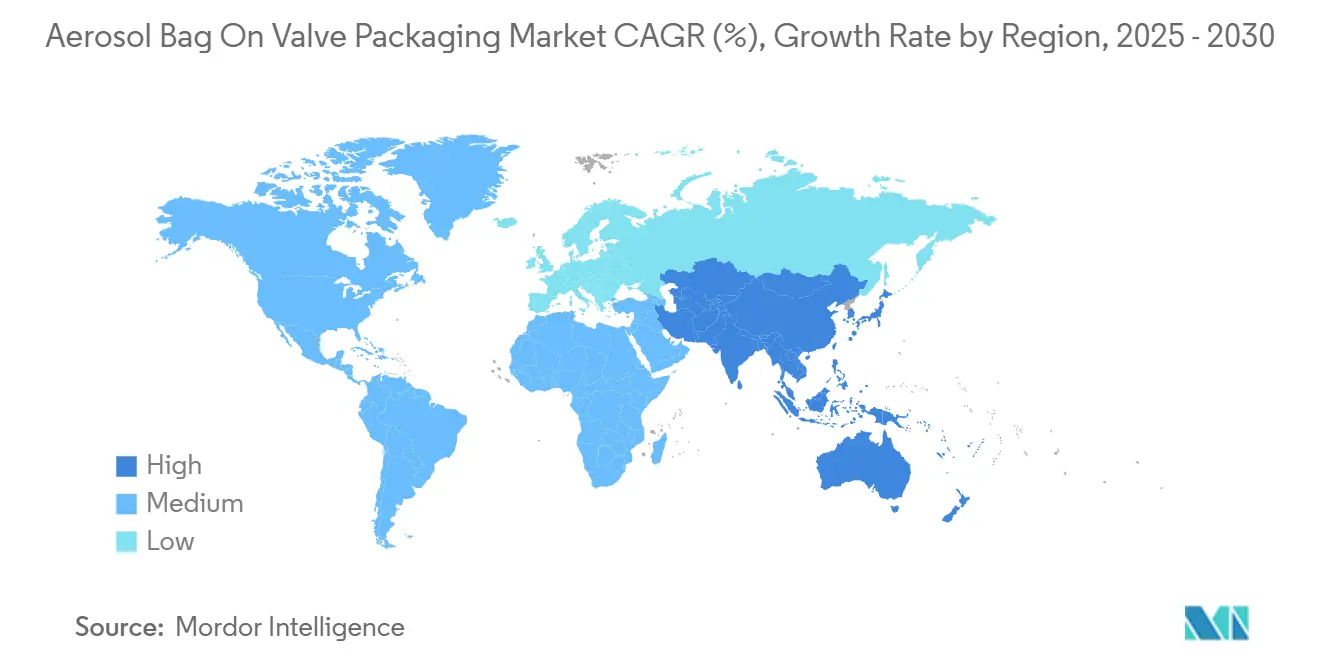
- By geography, the aerosol bag-on-valve market in Asia-Pacific is projected to expand at a 13.1% CAGR through 2030.
Note: Market size and forecast figures in this report are generated using Mordor Intelligence’s proprietary estimation framework, updated with the latest available data and insights as of January 2026.
Market Trends and Insights
Drivers Impact Analysis of Aerosol Bag On Valve Packaging Market*
| Driver | (~) % Impact on CAGR Forecast | Geographic Relevance | Impact Timeline |
|---|---|---|---|
| Increasing demand for preservative-free and eco-friendly aerosol delivery | +2.8% | Global, with strongest adoption in North America and Europe | Medium term (2-4 years) |
| Regulatory tailwinds on VOC and propellant safety | +2.1% | Europe and North America core, expanding to APAC | Long term (≥ 4 years) |
| Rising adoption in topical pharmaceutical sprays | +3.2% | Global, with accelerated uptake in developed markets | Short term (≤ 2 years) |
| Growth of premium personal care formats in APAC | +1.9% | APAC core, spill-over to MEA | Medium term (2-4 years) |
| Rapid scale-up of contract filling capacity in Europe | +1.1% | Europe, with secondary benefits to North America | Short term (≤ 2 years) |
| Brand shift to aluminum-based recyclability messaging | +0.7% | Global, with early gains in Europe, North America | Long term (≥ 4 years) |
| Source: Mordor Intelligence | |||
Increasing Demand for Preservative-Free and Eco-Friendly Aerosol Delivery
Bag-on-valve isolates the product from the propellant, enabling gamma-sterilized, preservative-free formulas that meet stringent dermatology requirements. Pharmaceutical and premium beauty brands capitalize on the clean-label narrative in Europe and North America, where consumers scrutinize ingredient lists.[1]Bag-on-Valve Services AB, “Putting Your Product Into Superior Bag-on-Valve Aerosol Technology,” bagonvalve.com Compressed air and nitrogen propellants pose zero flammability risk and have a negligible global warming potential, aligning with evolving environmental standards. The proposition resonates with health-conscious buyers who perceive a reduced risk of contamination and improved product purity. Brand owners highlight the 360-degree dispensing feature to reinforce convenience and on-the-go usability.
Regulatory Tailwinds on VOC and Propellant Safety
European F-gas legislation and California Air Resources Board rules limit VOC content and favor non-flammable propellants, making compressed gases the default option. FDA’s Emerging Technology Program further accelerates pharmaceutical adoption by offering early engagement and streamlined review for innovative container-closure systems. These frameworks raise compliance costs for conventional aerosols and tilt capital expenditures toward bag-on-valve filling lines. Contract fillers respond by upgrading capacity and promoting aluminum cans certified under the Aluminium Stewardship Initiative.
Rising Adoption in Topical Pharmaceutical Sprays
Dermatology and wound-care therapies rely on precise dosing and sterility, criteria that bag-on-valve meets through uniform spray patterns and sealed multilayer pouches.[2]International Journal of Pharmaceutics, “Canister Valve and Actuator Deposition in Metered Dose Inhalers Formulated with Low-GWP Propellants,” osti.gov Manufacturers transitioning from hydrofluoroalkane propellants are adopting low-GWP gases, such as HFO-1234ze, enabled by the technology’s pressure-flexible design. Clinical studies have reported improved bioavailability and reduced systemic exposure compared to pump formats, thereby strengthening physician acceptance. Higher unit cost is offset by premium pricing and regulatory compliance advantages, driving robust uptake in prescription and over-the-counter products.
Growth of Premium Personal Care Formats in Asia-Pacific
Urban consumers in China, South Korea, and Japan favor innovative packaging that complements fast-paced lifestyles. Bag-on-valve delivers continuous 360-degree sprays for dry shampoo, sun protection, and setting mists, enhancing perceived luxury. Regional contract fillers add dedicated lines, leveraging proximity to aluminum sources and lower labor costs. Multinational brands localize production to avoid import tariffs and tailor formulations to humid climates, reinforcing the technology’s regional momentum.
Restraints Impact Analysis of Aerosol Bag On Valve Packaging Market*
| Restraint | (~) % Impact on CAGR Forecast | Geographic Relevance | Impact Timeline |
|---|---|---|---|
| Higher unit cost versus conventional aerosol valves | -1.8% | Global, with strongest impact in price-sensitive markets | Medium term (2-4 years) |
| Limited compatibility with high-viscosity formulations | -1.2% | Global, particularly affecting industrial and technical applications | Long term (≥ 4 years) |
| Supply chain concentration in valve components | -0.9% | Global, with heightened risk in APAC and Europe | Short term (≤ 2 years) |
| Slower regulatory approvals for medical applications in U.S. | -0.6% | North America, with secondary effects on global pharmaceutical segment | Medium term (2-4 years) |
| Source: Mordor Intelligence | |||
Higher Unit Cost Versus Conventional Aerosol Valves
The multilayer pouch, precision valve, and specialized filling lines create a 15-25% price premium that suppresses penetration in mass-market personal care and household categories. Private-label players with thin margins hesitate to absorb the premium, while contract fillers face longer changeovers that erode equipment utilization. Scale economies are improving as demand climbs, yet the differential still deters first-time adopters in emerging economies where purchasing power is lower.[3]Bag-on-Valve Services AB, “FAQ,” bagonvalve.com
Limited Compatibility with High-Viscosity Formulations
Flow through narrow valve stems becomes inconsistent when viscosity exceeds threshold ranges, limiting use in thick creams, gels, and industrial coatings. Workarounds such as oversized orifices, agitator beads, or staged-pressure designs add complexity and cost. Consequently, industrial lubricants and high-build coatings continue to rely on conventional aerosol systems that handle paste-like products more reliably. R&D initiatives targeting reinforced pouch films and adaptive valve geometries are ongoing, but commercial rollout remains several years away.
*Our forecasts treat driver/restraint impacts as directional, not additive. The impact forecasts reflect baseline growth, mix effects, and variable interactions.
Aerosol Bag On Valve Packaging Market Segment Analysis
By Product Type:
Modular Designs Broaden AdoptionThe aerosol bag-on-valve market size for one-inch formats remained dominant, with a 44.41% share in 2024. Modular three-piece systems, however, are projected to outpace with a 13.81% CAGR as brand owners demand flexibility for varying viscosities and fill volumes. Component vendors standardize gasket materials and stem lengths, allowing fillers to swap propellants without retooling entire lines. The shift enhances capital efficiency and reduces minimum order quantities, enabling smaller brands to enter the market. Actuator innovation, exemplified by the Lindal Group’s FlipStraw, introduces user-friendly lock-out features and enhanced spray control, setting new benchmarks for convenience and product safety.
Product type diversification also fuels supply-chain localization. Asian manufacturers produce aluminum cans at scale, European suppliers dominate valve precision machining, and North American fillers integrate automated inspection systems. Harmonized specifications across regions lower qualification barriers and boost cross-border sourcing resilience.




By Application:
Pharmaceuticals Propel High-Value GrowthPersonal care retained the lion’s share, but the pharmaceutical segment is the undisputed growth engine. Manufacturers prioritize bag-on-valve packaging for wound cleansers, dermatology sprays, and nascent inhalation therapies because the sealed pouch maintains sterility and prevents oxidation of sensitive actives. The aerosol bag-on-valve market share for personal care remains anchored by dry shampoos and body sprays, while home care lines such as surface disinfectants leverage the propellant’s non-flammable profile to claim safety advantages. Food-grade variants penetrate cooking spray and whipped cream niches where oxygen exclusion prolongs shelf life.
Clinical guidelines released in 2024 outline container-closure criteria, favoring uniform spray performance throughout the canister's life. Companies that invested early in propellant switch testing now enjoy a first-mover advantage, especially as regulators push for lower global-warming-potential propellants. This regulatory head start shields pharmaceutical adopters from the rapid reformulation cycles faced by personal care brands.
By Propellant:
Compressed Gas Secures LeadershipCompressed air and nitrogen secured a commanding 53.41% share of the aerosol bag-on-valve market size in 2024, owing to zero flammability and near-zero VOC emissions. Growth continues at 12.59% CAGR as governments tighten hydrocarbon rules. Hydrocarbons, such as propane or butane, persist in niche segments that require rapid evaporation but face mounting safety labeling costs. Specialized blends, such as HFA-152a or HFO-1234ze, fulfill pharmaceutical aerosol pressure profiles while achieving a lower global warming potential. Purity standards for medical propellants drive vertical integration, with gas suppliers partnering directly with contract fillers to guarantee traceability.
Propellant choice affects canister pressure and hence valve design. Manufacturers optimize spring constants and stem diameters to strike a balance between evacuation efficiency and hand-spray comfort. Compressed gas systems deliver nearly complete evacuation, reducing product waste and strengthening sustainability credentials featured in brand marketing.
Geography Analysis
Europe Aerosol Bag on Valve Packaging Market
Europe’s 32.91% slice of global revenue reflects a mature contract-filling ecosystem, early F-gas restrictions, and government-backed aluminum recycling targets that resonate with bag-on-valve sustainability messaging. Germany and France serve as hubs for pharmaceuticals and personal care, while the United Kingdom champions collection infrastructure through the Aerosol Recycling Initiative. The harmonized regulatory regime gives European fillers a head start in process validation and GMP compliance.
APAC Aerosol Bag on Valve Packaging Market
The Asia-Pacific region, growing at a 13.1% CAGR, benefits from China’s scale in aluminum can manufacturing and the rising affluence of its middle class, which fuels demand for premium personal care products. Contract fillers in Shanghai, Seoul, and Osaka install bag-on-valve-dedicated lines to serve both global multinationals and emerging local indie brands. Japan and South Korea apply stringent quality standards that mirror EMA expectations, facilitating the smooth transfer of pharmaceutical technology. Southeast Asian countries attract investment due to their competitive labor costs and tariff-free access to regional blocs.
North America, LATAM and MEA Aerosol Bag on Valve Packaging Market
North America leverages a sophisticated pharmaceutical sector and the FDA’s proactive stance on emerging technologies to maintain momentum in adoption. Cross-border supply chains with Canada and Mexico enhance resilience and cater to seasonal demand spikes for sunscreens and insect repellents. Latin America, the Middle East, and Africa record lower but rising volumes as multinational brands introduce eco-friendly lines tailored to climate conditions and local purchasing power, albeit at moderated growth due to infrastructure and cost challenges.

Competitive Landscape
The market remains moderately fragmented. AptarGroup, Lindal Group, and Ball Corporation anchor the top tier with global manufacturing footprints and extensive patent coverage. These leaders invest in lightweight actuators, recyclable certifications, and integrated dosing indicators to differentiate themselves. Mid-tier specialists focus on region-specific niches, such as pharmaceutical canister sterilization in Japan or halal-certified personal care fillers in Indonesia. Competition intensifies around sustainability, driving transparent life-cycle assessments and aluminum alloys with lower carbon footprints, exemplified by Ball’s ReAl series.
Strategic collaborations shape the landscape. Valve makers partner with contract fillers to offer turnkey solutions, reducing barriers for brands switching from conventional aerosols. Material suppliers co-develop multilayer pouch films that withstand aggressive solvents and gamma sterilization. Regulatory expertise, especially in dossier preparation for container-closure system filings, becomes a pivotal differentiator, raising the entry bar for newcomers lacking compliance infrastructure.
Aerosol Bag On Valve Packaging Industry Leaders
AptarGroup Inc.
Lindal Group Holding GmbH
Coster Tecnologie Speciali S.p.A.
Summit Packaging Systems Inc.
Precision Valve Corporation
- *Disclaimer: Major Players sorted in no particular order
Aerosol Bag On Valve Packaging Market Companies Covered in this Report
- AptarGroup Inc.
- Lindal Group Holding GmbH
- Coster Tecnologie Speciali S.p.A.
- Summit Packaging Systems Inc.
- Precision Valve Corporation
- KOH-I-NOOR Mlada Vozice a.s.
- TOYO AEROSOL INDUSTRY CO. LTD.
- Exal Corporation
- BOV Solutions Inc.
- Shanghai Sunhome Industrial Co. Ltd.
- Shanghai Rite Industry Co. Ltd.
- Guangzhou Zhongpin Aerosol Valves Co. Ltd.
- Jinxing Aerosol Valve Manufacturing Co. Ltd.
- Newman Green Inc.
- TUBEX GmbH
- Alltub Group
- Ball Corporation (Aerosol Packaging division)
- Ardagh Metal Packaging S.A.
- Crown Holdings Inc.
- CCL Industries Inc. (Avery BOV)
- Daizo Corporation
- Mitani Valve Co. Ltd.
- Weener Plastics Group BV
- Tecnocap Group
- MAROLEX M.P. Sp. z o.o.

Recent Industry Developments in Aerosol Bag On Valve Packaging Market
- January 2025: Aptar Beauty unveiled the NeoAir actuator integrating an 18% lighter spring for lower force dispersion and full metal-free pathways.
- November 2024: Lindal Group inaugurated a USD 25 million high-precision valve plant in Hamburg, targeting pharmaceutical demand spikes.
- October 2024: Ball Corporation achieved Aluminium Stewardship Initiative Chain of Custody certification for its Czech can factory, expanding sustainable sourcing reach.
- September 2024: FDA released its Innovative Manufacturing Technologies Strategy, granting fast-track status to four bag-on-valve drug products.


Global Aerosol Bag On Valve Packaging Market Report Scope
| One-inch BOV |
| Three-piece BOV |
| Other Product Types |
| Personal Care |
| Pharmaceutical |
| Home Care |
| Food and Beverage |
| Industrial and Technical |
| Other Applications |
| Compressed Gas |
| Hydrocarbon |
| Other Propellants |
| North America | United States | |
| Canada | ||
| Mexico | ||
| South America | Brazil | |
| Argentina | ||
| Rest of South America | ||
| Europe | Germany | |
| United Kingdom | ||
| France | ||
| Italy | ||
| Spain | ||
| Russia | ||
| Rest of Europe | ||
| Asia-Pacific | China | |
| Japan | ||
| India | ||
| South Korea | ||
| South-East Asia | ||
| Rest of Asia-Pacific | ||
| Middle East and Africa | Middle East | Saudi Arabia |
| United Arab Emirates | ||
| Turkey | ||
| Rest of Middle East | ||
| Africa | South Africa | |
| Nigeria | ||
| Rest of Africa | ||
| By Product Type | One-inch BOV | ||
| Three-piece BOV | |||
| Other Product Types | |||
| By Application | Personal Care | ||
| Pharmaceutical | |||
| Home Care | |||
| Food and Beverage | |||
| Industrial and Technical | |||
| Other Applications | |||
| By Propellant | Compressed Gas | ||
| Hydrocarbon | |||
| Other Propellants | |||
| By Geography | North America | United States | |
| Canada | |||
| Mexico | |||
| South America | Brazil | ||
| Argentina | |||
| Rest of South America | |||
| Europe | Germany | ||
| United Kingdom | |||
| France | |||
| Italy | |||
| Spain | |||
| Russia | |||
| Rest of Europe | |||
| Asia-Pacific | China | ||
| Japan | |||
| India | |||
| South Korea | |||
| South-East Asia | |||
| Rest of Asia-Pacific | |||
| Middle East and Africa | Middle East | Saudi Arabia | |
| United Arab Emirates | |||
| Turkey | |||
| Rest of Middle East | |||
| Africa | South Africa | ||
| Nigeria | |||
| Rest of Africa | |||


Key Questions Answered in the Report
How big is the aerosol bag-on-valve packaging market in 2025?
It reached USD 1.2 billion and is projected to climb to USD 2.09 billion by 2030.
What CAGR is expected for bag-on-valve aerosol packaging?
The market is forecast to grow at 11.74% annually between 2025 and 2030.
Which application is the fastest growing?
Pharmaceutical sprays are advancing at a 14.51% CAGR through 2030.
Why are compressed gases preferred as propellants?
They are non-flammable, meet VOC limits, and hold 63.41% share with a 12.59% growth pace.
Which region is expanding fastest?
Asia-Pacific leads with a projected 13.1% CAGR, backed by aluminum supply and rising disposable income.
Page last updated on:





