
3D Smart Camera Market Size and Share
Market Overview
| Study Period | 2020 - 2031 |
|---|---|
| Market Size (2026) | USD 7.17 Billion |
| Market Size (2031) | USD 15.79 Billion |
| Growth Rate (2026 - 2031) | 17.10 % |
| Fastest Growing Market | Asia |
| Largest Market | Asia-Pacific |
| Market Concentration | Medium |
Major Players *Disclaimer: Major Players sorted in no particular order Image © Mordor Intelligence. Reuse requires attribution under CC BY 4.0. | |
3D Smart Camera Market Analysis by Mordor Intelligence
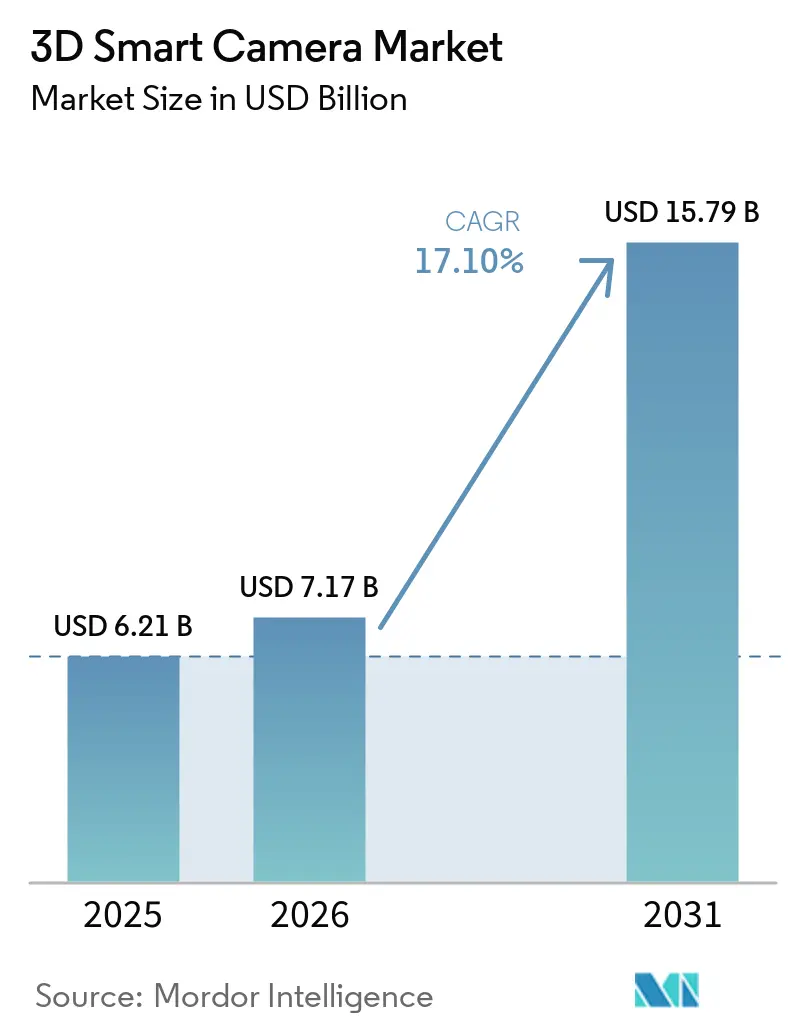
The 3D Smart Camera Market size was valued at USD 6.21 billion in 2025 and estimated to expand from USD 7.17 billion in 2026 to reach USD 15.79 billion by 2031, at a CAGR of 17.10% during the forecast period (2026-2031). Demand is supported by depth-aware vision in robotics, vehicle cabins, and precision inspection. Industrial automation creates recurring requirements for robotic guidance, bin picking, and flexible production. Automotive rules are making camera-based driver monitoring a standard vehicle requirement in Europe. Suppliers are also moving beyond hardware by combining cameras with AI tools, cloud management, and integration support. Price pressure from lower-cost Chinese suppliers is increasing competition in standard industrial applications, while specialized systems retain value in demanding work environments.
Key Report Takeaways
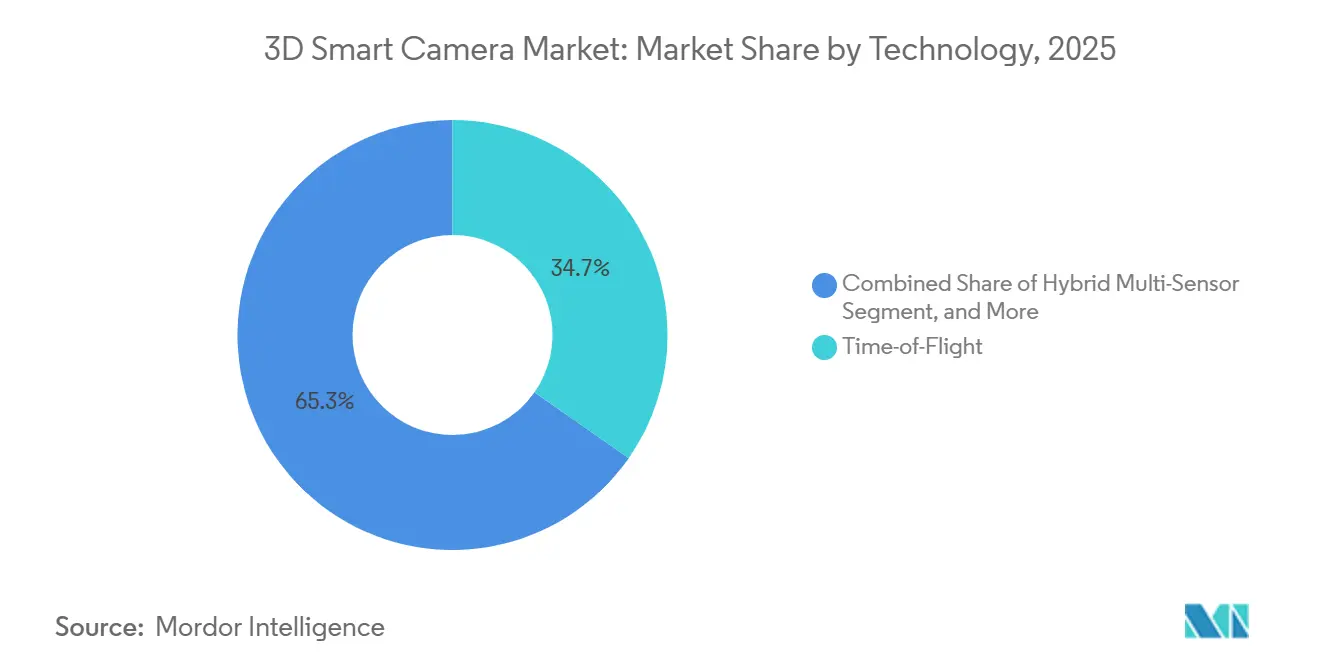
- By technology, Time-of-Flight held 34.71% of the 3D Smart Camera Market share in 2025, while Hybrid Multi-Sensor configurations are projected to expand at a 20.87% CAGR through 2031.
- By resolution, the below-16 MP segment held 52.63% of the 3D Smart Camera Market share in 2025, while the above-16 MP segment is projected to expand at a 20.69% CAGR through 2031.
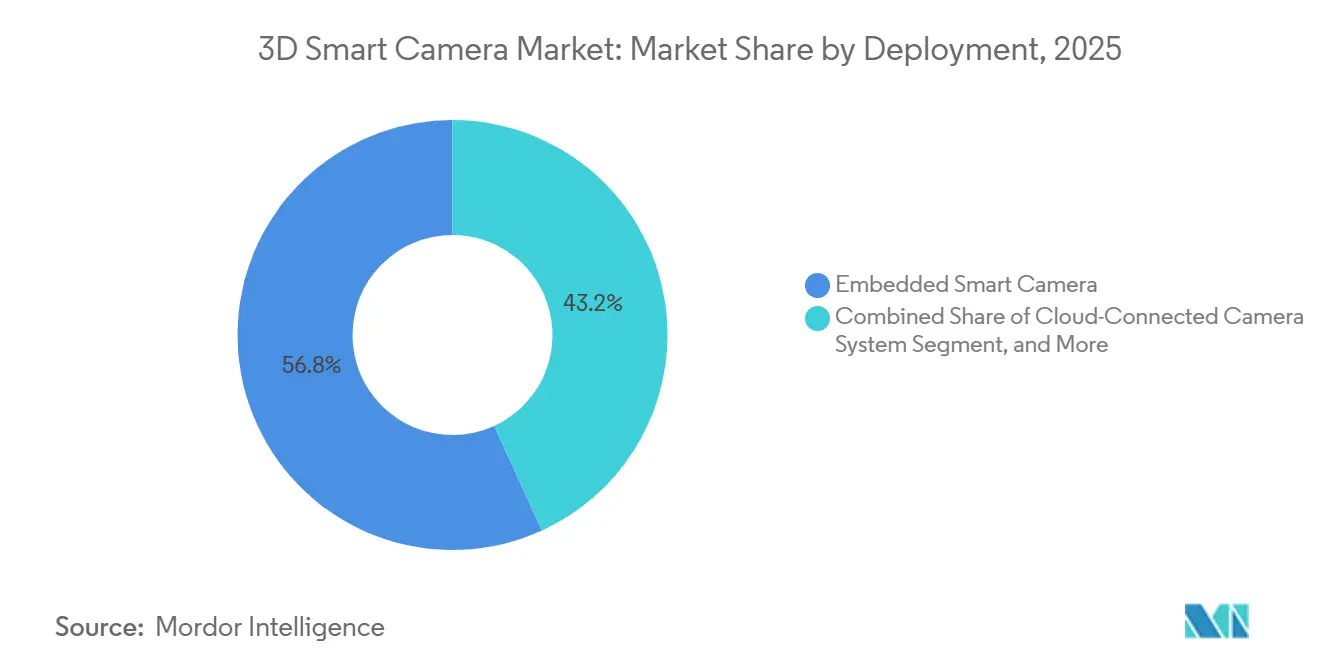
- By deployment, Embedded Smart Cameras held 56.84% share in 2025, while Cloud-Connected Camera Systems are projected to expand at a 19.51% CAGR through 2031.
- By application, Robotics and Automation held 24.93% share in 2025, while Driver and Occupant Monitoring is projected to expand at a 20.79% CAGR through 2031.
- By end-user industry, Industrial Manufacturing held 27.86% share in 2025, while Automotive is projected to expand at a 19.85% CAGR through 2031.
- By geography, Asia-Pacific held 38.57% share in 2025 and is projected to expand at a 21.47% CAGR through 2031.
Note: Market size and forecast figures in this report are generated using Mordor Intelligence’s proprietary estimation framework, updated with the latest available data and insights as of January 2026.
Global 3D Smart Camera Market Trends and Insights
Drivers Impact Analysis*
| Driver | (~) % Impact on CAGR Forecast | Geographic Relevance | Impact Timeline |
|---|---|---|---|
| Industrial Automation and Robotic Vision Expansion | +4.2% | Global, with strongest concentration in Asia-Pacific and Europe | Short term (≤ 2 years) |
| ADAS and In-Cabin Monitoring Adoption | +3.1% | Global, especially the European Union and North America | Medium term (2-4 years) |
| Edge AI for Real-Time Autonomous Perception | +2.6% | Global, with early scaling in North America and Asia-Pacific | Medium term (2-4 years) |
| 3D Inspection and Quality Assurance Demand | +1.9% | Global, led by precision manufacturing in Asia-Pacific | Short term (≤ 2 years) |
| Depth Sensing in Smartphones and Tablets | +1.4% | Asia-Pacific and North America | Long term (≥ 4 years) |
| Standardized 3D Vision Interfaces for Retrofits | +0.9% | North America and Europe | Medium term (2-4 years) |
| Source: Mordor Intelligence | |||
Expansion of Industrial Automation and Robotic Vision
The International Federation of Robotics recorded 542,000 industrial robot installations worldwide in 2024, the fourth consecutive year above 500,000 units. Asia accounted for 74% of those installations, with China accounting for 295,000 units. The federation expects installations to reach 575,000 in 2025 and exceed 700,000 by 2028. Each robot arm, collaborative workspace, and bin-picking station needs reliable depth perception to operate in the presence of changing objects and layouts. This expanding installed base also supports replacement demand as older vision systems are upgraded with embedded AI cameras. The 3D Smart Camera Market, therefore, benefits from both new automation projects and modernization of existing lines.
Growth of ADAS and In-Cabin Monitoring Systems
For the 3D Smart Camera Market, the European Union General Safety Regulation requires Driver Drowsiness and Attention Warning systems on new vehicles from July 2024. Camera-based Advanced Driver Distraction Warning is required across new vehicles from July 2026.[1]European Commission, “Regulation (EU) 2019/2144 on Type-Approval Requirements for Motor Vehicles,” EUR-Lex These requirements increase demand for in-cabin imaging modules capable of detecting distraction and drowsiness. In March 2026, Mobileye secured a driver-monitoring production program with a U.S. automaker, using a single EyeQ6L chip for driver and occupant monitoring, with production planned for 2027. Vehicle makers are moving from single-purpose warnings toward systems that assess driver status, passenger position, and child-seat presence. This shift raises camera content per vehicle and broadens opportunities for suppliers serving major vehicle programs.[2]Mobileye, “Mobileye Secures Major DMS Production Program with Leading U.S. Automaker,” Business Wire
Edge AI Enables Real-Time Autonomous Perception
In the 3D Smart Camera Market, on-device AI reduces the need to send raw point cloud data to external servers or computers. Cognex introduced the In-Sight 6900 Vision Controller in April 2026 with NVIDIA Jetson technology and up to 157 TOPS of AI processing. The controller supports transformer-based classification with 10 to 20 training images and does not require an external PC. In May 2026, Cognex introduced the In-Sight 3900 with Qualcomm Dragonwing platforms, up to 25 MP resolution, and inspection speeds up to 4 times those of the prior generation. Faster local processing supports high-speed production lines where low latency and stable response are important. It also makes advanced vision systems more accessible to smaller manufacturers that lack dedicated data-science teams.
Increasing Demand for 3D Inspection and Quality Assurance
For the 3D Smart Camera Market, EV battery, semiconductor, and medical-device production require inspection methods capable of detecting height variations and surface defects. ISO 13485 and IATF 16949 requirements add to the need for dependable quality controls in regulated manufacturing. LMI Technologies launched the Gocator 6300 Series in March 2025 for inspection of semiconductor, EV battery, and consumer electronics. The series provides X-profile data intervals below 2.1 microns and Z-repeatability of 0.15 microns. FARO CREAFORM launched the MetraSCAN BLACK2 in August 2026 for shop-floor measurement, with acceptance testing based on ISO 10360 and VDI/VDE 2634 Part 3. Tighter inspection specifications favor higher-value 3D systems where 2D images cannot provide sufficient surface information.
Restraints Impact Analysis*
| Restraint | (~) % Impact on CAGR Forecast | Geographic Relevance | Impact Timeline |
|---|---|---|---|
| Camera, Software, and Integration Costs | -2.8% | Global, most acute in South America and the Middle East and Africa | Medium term (2-4 years) |
| Limited Availability of Skilled 3D Vision Engineers | -1.5% | Global, particularly South America, the Middle East and Africa, and Southeast Asia | Medium term (2-4 years) |
| Calibration Drift in High-Throughput Environments | -0.9% | Global, with high exposure in automotive and electronics lines | Long term (≥ 4 years) |
| Fragmented Point-Cloud Data and AI Standards | -0.6% | Global | Long term (≥ 4 years) |
| Source: Mordor Intelligence | |||
High Camera, Software, and System Integration Costs
In the 3D Smart Camera Market, a full deployment includes sensor hardware, edge-AI software, calibration tools, and systems-integration labor. These combined costs can exceed the capital budgets of smaller manufacturers in cost-sensitive locations. Software subscriptions also introduce recurring operating costs to procurement processes built around hardware purchases. Full configurations with mounting, wiring, labor, and software commonly cost USD 20,000 to USD 50,000 per station. IEC 62443 cybersecurity requirements and ISO 13849 machine-safety requirements can increase integration work and professional-service fees. Healthcare, aerospace, and defense users may therefore take longer to approve projects because compliance work affects the expected payback period.
Limited Availability of Skilled 3D Vision Engineers
The 3D Smart Camera Market requires deployment teams with expertise in optics, point cloud processing, and AI model training. These skills have traditionally been developed in separate engineering disciplines. The shortage is acute in Southeast Asia, South Asia, and parts of South America, where demand for automation is rising faster than training capacity. Troubleshooting structured-light interference and calibration drift also requires practical experience that basic online training consistently fails to provide. The limited talent pool increases systems-integrator day rates and raises the total cost of ownership. It can delay adoption among smaller manufacturers without specialized engineering teams.
*Our forecasts treat driver/restraint impacts as directional, not additive. The impact forecasts reflect baseline growth, mix effects, and variable interactions.
Segment Analysis
By Technology: Time-of-Flight Supports Volume While Hybrid Sensing Expands in Robotics
Time-of-Flight held 34.71% of the 3D Smart Camera Market share in 2025. Its full-field depth capture and tolerance for ambient-light variation support industrial automation, access control, and in-cabin monitoring. LIPS Corporation's LIPSedge T235 uses Samsung's ISOCELL VIZION 63D indirect ToF sensor. The platform extends measurement range beyond 10 meters while maintaining sub-1% depth accuracy. This performance supports large logistics areas and wide-field surveillance uses that previously required more costly LiDAR systems.
Hybrid Multi-Sensor systems are projected to expand at a 20.87% CAGR through 2031. They combine 2 or more depth-sensing methods to support near-field manipulation and mid-range obstacle detection. Structured light remains important for detailed metrology in electronics and automotive body parts. Stereo vision is widely used in warehouse navigation and bin picking. SICK's Visionary AI-Assist combines a stereoscopic 3D camera with on-sensor AI for autonomous mobile robot collision avoidance. The 3D Smart Camera Market is likely to see differentiation through sensor fusion and adaptive sensing rather than a single modality.



By Resolution: Below 8 MP Leads Volume While Above 16 MP Gains From Precision Needs
The 8 MP band held 52.63% of the 3D Smart Camera Market share in 2025. Robotic guidance, logistics dimensioning, bin picking, and access control often do not need higher pixel counts. These uses place more value on frame rate, depth accuracy, and edge-compute throughput. Fast global shutters also fit standard industrial use cases. The 8-16 MP tier addresses intermediate inspection work and can absorb demand as manufacturing specifications become stricter.
The above 16 MP segment is projected to expand at a 20.69% CAGR through 2031. Semiconductor wafer inspection, EV battery analysis, and electronics assembly require detailed defect detection. In these settings, spatial resolution directly affects the ability to identify micron-scale anomalies. LMI's Gocator 6300 offers X-profile intervals below 2.1 microns, while a Gocator 2600 variant provides 4,200 points per profile across wide fields. Battery manufacturers are also extending high-resolution requirements from cell inspection into logistics packaging lines. This broadens demand beyond specialized quality-control stations.
By Deployment: Embedded Cameras Lead While Cloud Connectivity Changes Factory Analytics
The 3D Smart Camera Market relied on Embedded Smart Cameras for 56.84% share in 2025. Their self-contained architecture avoids external PC dependency and supports dependable response on continuously operating production lines. LMI's Gocator 2D Smart Cameras use NVIDIA Jetson Orin NX and GoPxL IIoT software at up to 84 fps. Cognex's In-Sight 3900 provides edge inference at up to 25 MP. PC-based systems remain relevant for unusually complex work, including multi-angle wafer metrology and large-volume computed-tomography workflows.[3]Cognex Corporation, “Cognex Launches In-Sight Vision Controller Powered by NVIDIA,” PR Newswire
Cloud-Connected Camera Systems are projected to expand at a 19.51% CAGR through 2031. Manufacturers use this architecture for cross-site analytics, central AI model governance, and predictive-maintenance workflows. Cognex OneVision supports centralized training and deployment to camera nodes across multiple plants. This model can reduce retraining work without interrupting production. Cloud access is increasingly sold as a software subscription alongside embedded hardware. That approach changes the 3D Smart Camera Market from a one-time equipment sale toward recurring software revenue.[4]Cognex Corporation, “Cognex Launches Highest Performance Embedded AI Vision System Powered by Qualcomm,” PR Newswire
By Application: Robotics and Automation Lead While Driver Monitoring Accelerates
In the 3D Smart Camera Market, Robotics and Automation held 24.93% share in 2025. Industrial robots, autonomous mobile robots, and collaborative workspaces require depth-aware perception to handle a variety of objects safely. The global installed base reached 4,664,000 industrial robots in 2024, an increase of 9%. This installed base supports ongoing upgrades as robot programs handle more variable workpieces. Orbbec cameras were integrated with Teradyne Robotics' UR AI Trainer at Automate 2026 to collect data for AI and visual-language-action model training.
Driver and Occupant Monitoring in the 3D Smart Camera Market is projected to expand at a 20.79% CAGR through 2031. The July 2026 European requirement for direct, camera-based driver-distraction warnings supports this demand. Quality inspection, scanning and modeling, augmented and virtual reality, access control, medical imaging, and additive manufacturing diversify the application base. Medical use is developing as surgical robotics adopts depth sensing for instrument tracking. Standalone mixed-reality headsets also use 3D cameras for inside-out tracking. Consumer and enterprise spatial-computing products, therefore, add another route to camera demand.

By End-User Industry: Industrial Manufacturing Leads While Automotive Expands Fastest
Industrial Manufacturing held 27.86% share in 2025. Its use cases include automotive body lines, electronics assembly, metal fabrication, food and beverage packaging, and medical-device production. The 3D Smart Camera Market serves this varied customer base with systems for robotic guidance and inspection. Hikrobot reported FY2025 revenue exceeding CNY 6.45 billion (USD 943 million) and introduced more than 35 products in April 2026. Its RoboCast structured-light camera delivers VDI/VDE accuracy of 0.03 mm at 300 mm in a 700 g design, reflecting the move toward production-floor sensing for eye-in-hand robotics.
The automotive industry is projected to expand at a 19.85% CAGR through 2031. Exterior ADAS and interior monitoring requirements are the main sources of demand. Tobii and STMicroelectronics entered mass production for a premium European vehicle maker with a combined driver and occupant monitoring system. The system uses Tobii attention-computing algorithms and STMicroelectronics' 5.1 MP VD1940 hybrid RGB-infrared sensor. Logistics and warehousing are advancing with autonomous mobile robots, while healthcare is using depth sensing in robotic surgery and patient monitoring. Other end users include consumer electronics, aerospace and defense, security, media, construction, real estate, and agriculture.
Geography Analysis
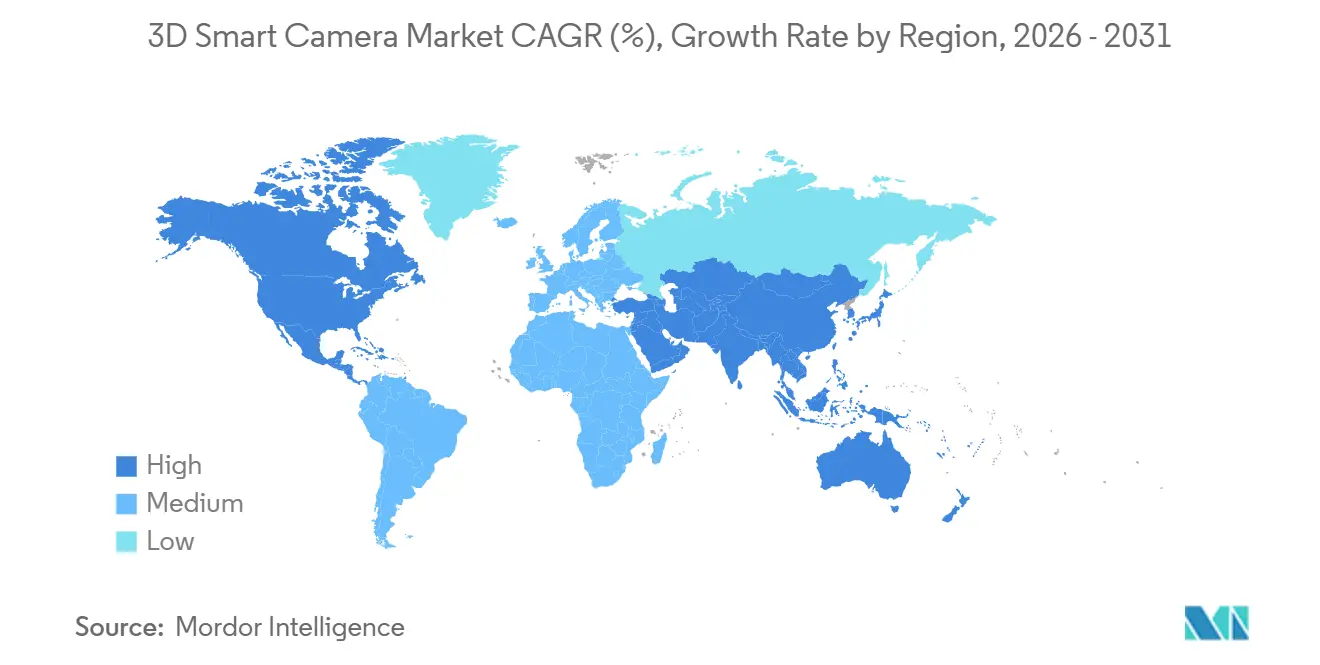
Asia-Pacific held 38.57% of the 3D Smart Camera Market share in 2025 and is projected to expand at a 21.47% CAGR through 2031. China installed 295,000 industrial robots in 2024, equal to 54% of global installations. This was the highest annual deployment total for a single country. China is the largest concentration of demand for manufacturing and logistics cameras. Hikrobot and Vzense Technology are also expanding beyond China into ASEAN supplier networks.
In Japan, the 3D Smart Camera Market is supported by automotive and precision-electronics purchases of structured-light and ToF systems. South Korean semiconductor and display fabs require profiling sensors capable of sub-micron measurement. India's electronics and automotive manufacturing corridor is emerging as a fast-developing national opportunity, supported by production-linked incentive programs. North America holds the second-largest regional share, with demand concentrated in automotive manufacturing, semiconductor fabrication, logistics automation, and defense. The United States remains the central regional demand hub, with activity in Michigan, Tennessee, Texas, and Arizona.
Mobileye's March 2026 U.S. production program points to broader adoption of in-cabin sensing through the forecast period. Canada's AI and computer-vision institutions support early adopters in Ontario, while Mexico's Tier 1 suppliers are adopting systems aligned with North American vehicle programs. Europe is the third-largest regional market, led by Germany, the United Kingdom, France, Italy, and Spain. European safety rules make driver monitoring a baseline compliance requirement, while SICK and Basler remain established industrial vision suppliers. South America, the Middle East, and Africa are emerging markets where automotive assembly, food processing, smart-city projects, and security infrastructure drive targeted demand.

Competitive Landscape
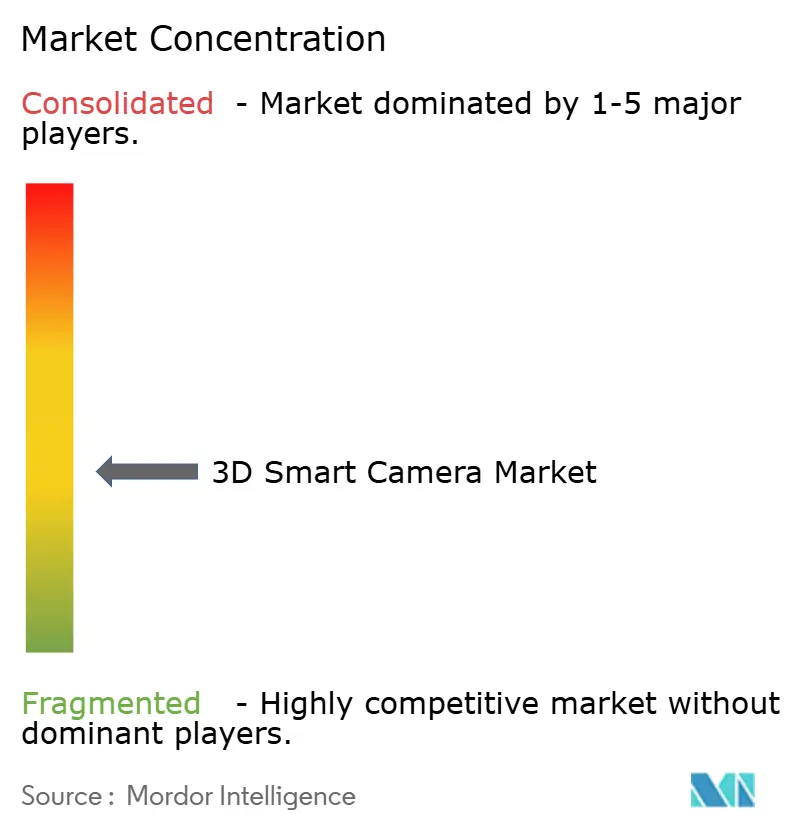
The 3D Smart Camera Market is moderately fragmented because no supplier leads in all technologies, applications, and regions. Cognex Corporation, SICK AG, and LMI Technologies compete by leveraging software ecosystems, global service reach, and industrial compliance capabilities, which can make system changes costly for established customers. Hikrobot and Orbbec compete strongly in Asia-Pacific with lower-cost structured-light and stereo cameras. Their products use NVIDIA Jetson AI platforms and place pressure on prices in standard industrial applications. Incumbents must either reduce entry-level prices or focus on specialized systems.
Basler introduced the Stereo mini in July 2026, expanding its offering in the 3D Smart Camera Market with a compact 3D stereo system for robotics, autonomous mobile robots, automated guided vehicles, and warehouse-drone navigation, which connects to its pylon SDK ecosystem. Cognex OneVision and LMI GoPxL IIoT software show how leading suppliers are combining hardware with AI training, cloud connectivity, and multi-site management. This helps suppliers offset pressure on hardware prices with recurring software subscriptions. Agricultural robotics, construction monitoring, and healthcare robotics remain early-stage areas with limited established supplier positions.
Advantech and StereoLabs expanded their collaboration in July 2026 to validate ZED X GMSL stereo cameras with NVIDIA Jetson Thor-powered robotics platforms. The joint approach offers 3D Smart Camera Market equipment makers a production-ready vision and compute package without custom hardware work. SICK is scheduled to present Ranger NextGen 3D profiling cameras and an updated NOVA platform at Vision 2026 in Stuttgart in October 2026. Patent activity in ToF pixel architecture and multi-sensor calibration has increased during 2024-2026 among Japanese, South Korean, and Chinese organizations. These technical areas are likely to shape the next generation of product differentiation.
3D Smart Camera Industry Leaders
Orbbec Inc
Stereolabs Inc.
Zivid AS
Cognex Corporation
Basler AG
- *Disclaimer: Major Players sorted in no particular order

Recent Industry Developments
- August 2026: FARO CREAFORM launched MetraSCAN BLACK2, a portable metrology-grade optical 3D scanner with acceptance testing based on ISO 10360 and VDI/VDE 2634 Part 3, targeting shop-floor quality control teams that require simultaneous scanning and probing workflows. The launch addresses manufacturers in automotive and aerospace who cannot accommodate fixed coordinate measurement machines during active production shifts.
- July 2026: Basler AG introduced the Stereo mini, a compact, lightweight 3D stereo camera system available in 50 mm and 95 mm baseline configurations, supporting USB 3.0, GigE, and future GMSL interfaces and integrating with Basler's pylon SDK. The system is designed for robotics, AMR, AGV, and warehouse drone navigation, extending factory-calibrated, cost-effective 3D vision to system integrators that previously relied on costlier depth-sensing hardware.
- July 2026: Advantech and StereoLabs announced an expanded collaboration, with Advantech's AFE/ASR-series robotics platforms powered by NVIDIA Jetson Thor, AGX Orin, and Orin NX providing validated support for StereoLabs' ZED X GMSL stereo cameras. The joint solution targets physical-AI and agentic robotics developers requiring a production-ready, co-certified vision-and-compute stack without custom hardware integration.
- June 2026: Cognex Corporation launched the In-Sight 3900 Vision System, powered by Qualcomm Dragonwing platforms, delivering inspection speeds up to 4 times faster than previous-generation Cognex systems and supporting up to 25 MP resolution at the edge. The system integrates with Cognex's OneVision cloud-to-edge AI ecosystem, enabling centralized model training at the corporate level and distributed deployment to production-floor camera nodes across global manufacturing networks.


Global 3D Smart Camera Market Report Scope
3D Smart Cameras are advanced, self-contained vision systems that integrate high-resolution image sensors with depth-sensing technologies and onboard processing capabilities to capture and analyze spatial and volumetric data in real time, enabling precise 3D scanning, robotic guidance, automated inspection, and complex metrology tasks without relying on external processing hardware.
The 3D Smart Camera Market Report is Segmented by Technology (Time-of-Flight, Stereo Vision, Structured Light, and Hybrid Multi-Sensor), Resolution (Less Than 8 MP, 8–16 MP, and Above 16 MP), Deployment (Embedded Smart Camera, PC-Based Camera System, and Cloud-Connected Camera System), Application (3D Scanning and Modeling, Robotics and Automation, Quality Inspection and Metrology, Augmented Reality and Virtual Reality, Driver and Occupant Monitoring, Access Control and Surveillance, Medical and Diagnostic Imaging, 3D Printing and Additive Manufacturing, and Other Applications), End-User Industry (Consumer Electronics, Automotive, Industrial Manufacturing, Logistics and Warehousing, Healthcare and Life Sciences, Aerospace and Defense, Security and Surveillance, Media and Entertainment, Construction and Real Estate, Agriculture, and Other End-User Industries), and Geography (North America, South America, Europe, Asia-Pacific, Middle East and Africa). The Market Forecasts are Provided in Terms of Value (USD).
| Time-of-Flight |
| Stereo Vision |
| Structured Light |
| Hybrid Multi-Sensor |
| Less Than 8 MP |
| 8-16 MP |
| Above 16 MP |
| Embedded Smart Camera |
| PC-Based Camera System |
| Cloud-Connected Camera System |
| 3D Scanning and Modeling |
| Robotics and Automation |
| Quality Inspection and Metrology |
| Augmented Reality and Virtual Reality |
| Driver and Occupant Monitoring |
| Access Control and Surveillance |
| Medical and Diagnostic Imaging |
| 3D Printing and Additive Manufacturing |
| Other Applications |
| Consumer Electronics |
| Automotive |
| Industrial Manufacturing |
| Logistics and Warehousing |
| Healthcare and Life Sciences |
| Security and Surveillance |
| Construction and Real Estate |
| Agriculture |
| Other End-User Industries |
| North America | United States | |
| Canada | ||
| Mexico | ||
| South America | Brazil | |
| Argentina | ||
| Rest of South America | ||
| Europe | Germany | |
| United Kingdom | ||
| France | ||
| Italy | ||
| Spain | ||
| Rest of Europe | ||
| Asia-Pacific | China | |
| Japan | ||
| India | ||
| South Korea | ||
| Rest of Asia-Pacific | ||
| Middle East and Africa | Middle East | Saudi Arabia |
| United Arab Emirates | ||
| Turkey | ||
| Rest of the Middle East | ||
| Africa | South Africa | |
| Nigeria | ||
| Rest of Africa | ||
| By Technology | Time-of-Flight | ||
| Stereo Vision | |||
| Structured Light | |||
| Hybrid Multi-Sensor | |||
| By Resolution | Less Than 8 MP | ||
| 8-16 MP | |||
| Above 16 MP | |||
| By Deployment | Embedded Smart Camera | ||
| PC-Based Camera System | |||
| Cloud-Connected Camera System | |||
| By Application | 3D Scanning and Modeling | ||
| Robotics and Automation | |||
| Quality Inspection and Metrology | |||
| Augmented Reality and Virtual Reality | |||
| Driver and Occupant Monitoring | |||
| Access Control and Surveillance | |||
| Medical and Diagnostic Imaging | |||
| 3D Printing and Additive Manufacturing | |||
| Other Applications | |||
| By End-User Industry | Consumer Electronics | ||
| Automotive | |||
| Industrial Manufacturing | |||
| Logistics and Warehousing | |||
| Healthcare and Life Sciences | |||
| Security and Surveillance | |||
| Construction and Real Estate | |||
| Agriculture | |||
| Other End-User Industries | |||
| By Geography | North America | United States | |
| Canada | |||
| Mexico | |||
| South America | Brazil | ||
| Argentina | |||
| Rest of South America | |||
| Europe | Germany | ||
| United Kingdom | |||
| France | |||
| Italy | |||
| Spain | |||
| Rest of Europe | |||
| Asia-Pacific | China | ||
| Japan | |||
| India | |||
| South Korea | |||
| Rest of Asia-Pacific | |||
| Middle East and Africa | Middle East | Saudi Arabia | |
| United Arab Emirates | |||
| Turkey | |||
| Rest of the Middle East | |||
| Africa | South Africa | ||
| Nigeria | |||
| Rest of Africa | |||


Key Questions Answered in the Report
What is the size of the 3D Smart Camera Market?
The 3D Smart Camera Market was valued at USD 6.21 billion in 2025, is estimated at USD 7.17 billion in 2026, and is projected to reach USD 15.79 billion by 2031.
What CAGR is forecast for 3D smart cameras through 2031?
The market is projected to expand at a 17.10% CAGR between 2026 and 2031.
Which 3D smart camera technology held the largest share?
Time-of-Flight led technology demand with 34.71% share in 2025, supported by industrial automation and in-cabin monitoring.
What application is expected to expand fastest through 2031?
Driver and Occupant Monitoring is projected to expand at a 20.79% CAGR, supported by European vehicle safety requirements.
Why are manufacturers adopting 3D smart cameras?
Manufacturers use them for robotic guidance, detailed quality inspection, logistics automation, and centralized AI model management.
Which region offers the strongest outlook for 3D smart cameras?
Asia-Pacific held 38.57% share in 2025 and is projected to expand at a 21.47% CAGR through 2031.
Page last updated on:


 Your data is secure and never sold or shared.


