
Ruggedized Industrial Smart Camera Market Size and Share
Market Overview
| Study Period | 2020 - 2031 |
|---|---|
| Market Size (2026) | USD 1.17 Billion |
| Market Size (2031) | USD 1.77 Billion |
| Growth Rate (2026 - 2031) | 8.63 % |
| Fastest Growing Market | Middle East and Africa |
| Largest Market | Asia-Pacific |
| Market Concentration | Medium |
Major Players *Disclaimer: Major Players sorted in no particular order Image © Mordor Intelligence. Reuse requires attribution under CC BY 4.0. | |
Ruggedized Industrial Smart Camera Market Analysis by Mordor Intelligence
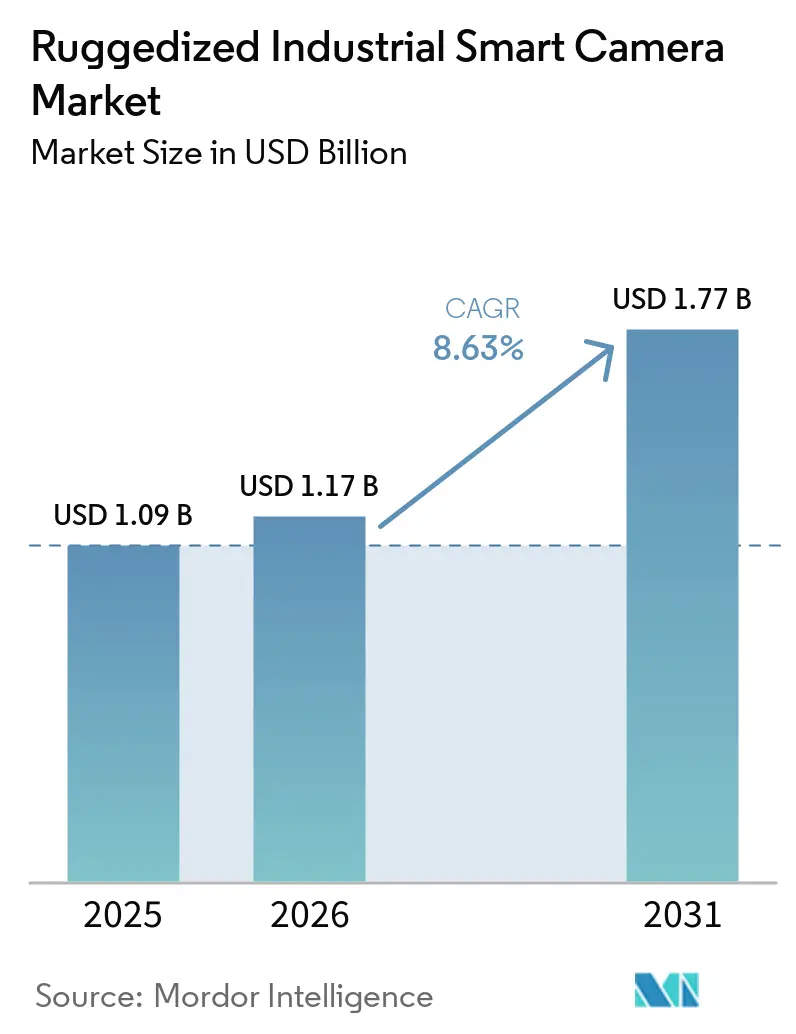
The Ruggedized Industrial Smart Camera Market size is projected to expand from USD 1.09 billion in 2025 to USD 1.17 billion in 2026, and to USD 1.77 billion by 2031, registering an CAGR of 8.63% between 2026 and 2031. Factory automation is increasing the demand for inspection systems that can operate reliably in the presence of dust, coolant, vibration, and washdown equipment. Buyers are placing more weight on embedded software, model deployment, and the ability to extend systems across several plants. Edge processing supports this shift by enabling decisions to be made without sending production images outside the facility. This favors suppliers that combine durable hardware with usable software and application support. It also leaves room for suppliers that can meet hazardous-area requirements while adding onboard AI capability.
Key Report Takeaways
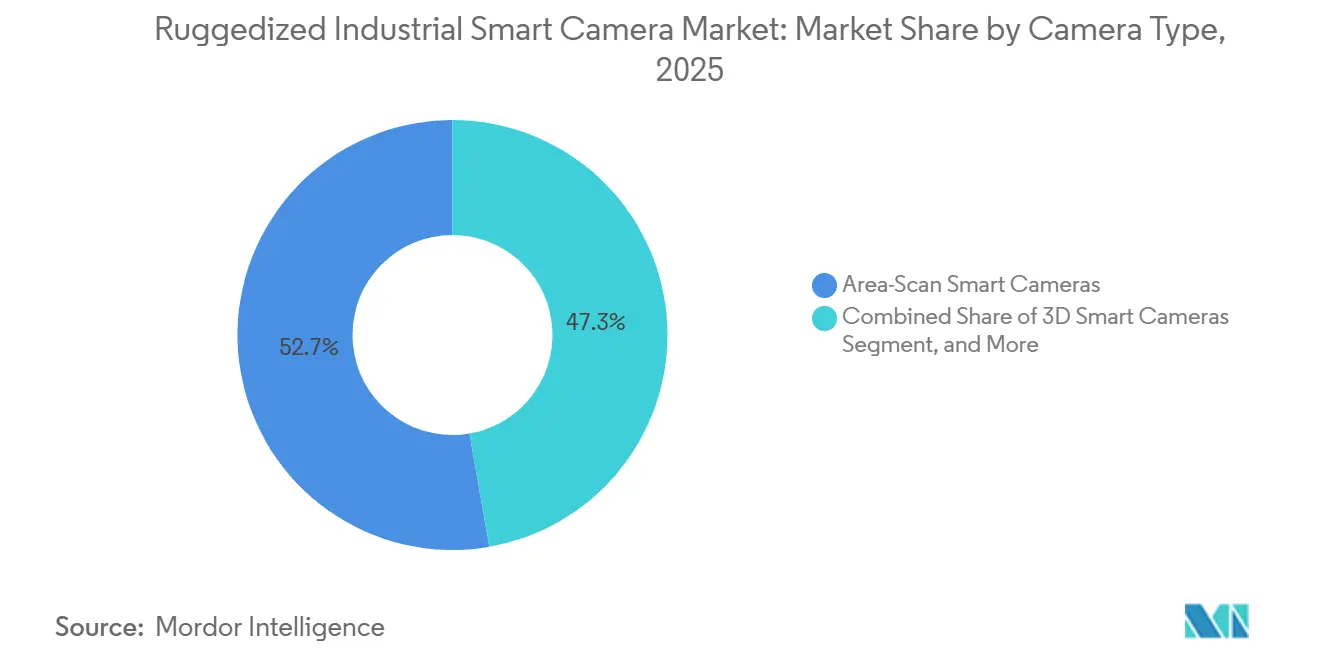
- By camera type, area-scan smart cameras held 52.73% share in 2025, while 3D smart cameras are projected to expand at an 11.23% CAGR through 2031.
- By ruggedization and environmental protection, IP67-IP68 cameras accounted for 38.61% of the Ruggedized Industrial Smart Camera Market share in 2025, while explosion-protected and hazardous-location cameras are projected to expand at a 10.81% CAGR through 2031.
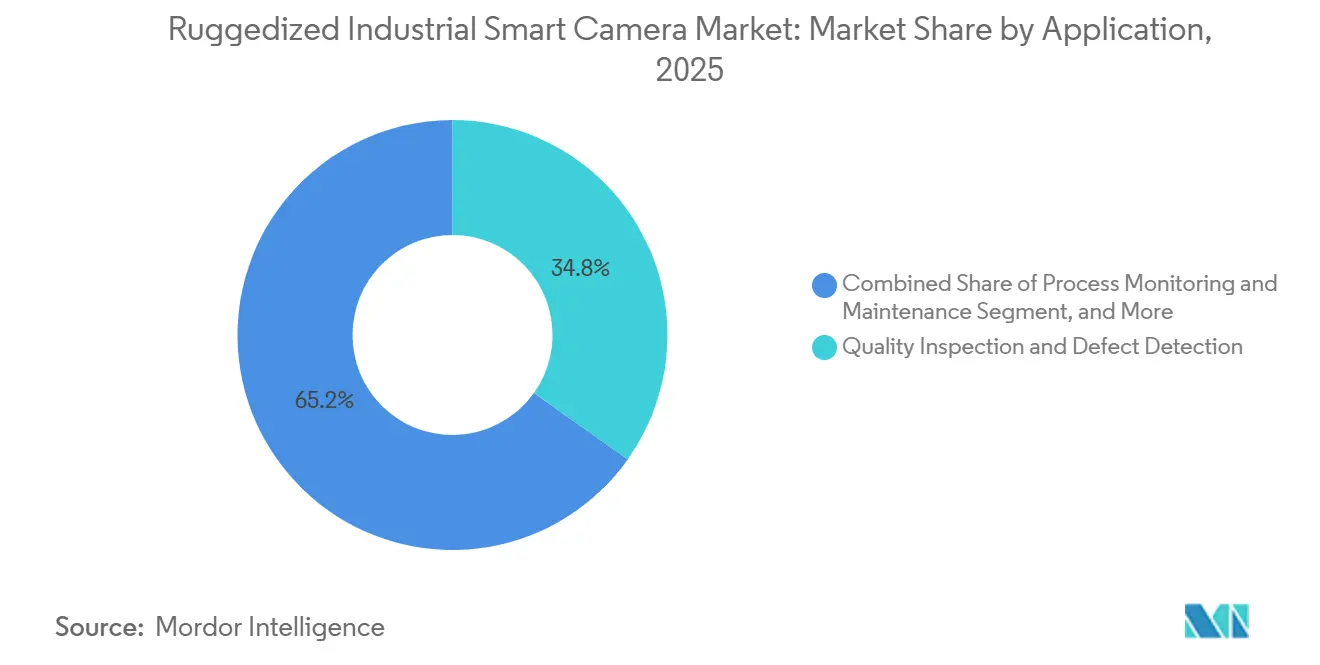
- By application, quality inspection and defect detection accounted for 34.83% of the market in 2025, while process monitoring and predictive maintenance are projected to expand at a 10.37% CAGR through 2031.
- By end-user industry, automotive and electric vehicles held 23.91% of the market in 2025, while metals, mining, energy, and heavy machinery are projected to expand at a 10.13% CAGR through 2031.
- By geography, Asia-Pacific held 42.87% of the market in 2025, while Middle East and Africa are projected to expand at a 10.71% CAGR through 2031.
Note: Market size and forecast figures in this report are generated using Mordor Intelligence’s proprietary estimation framework, updated with the latest available data and insights as of January 2026.
Global Ruggedized Industrial Smart Camera Market Trends and Insights
Drivers Impact Analysis*
| Driver | (~) % Impact on CAGR Forecast | Geographic Relevance | Impact Timeline |
|---|---|---|---|
| High-Resolution, Low-Latency Machine Vision Demand | +2.5% | Global | Short term (≤ 2 years) |
| Longer Camera-to-Host Distances in Distributed Inspection | +2.0% | Asia-Pacific and North America | Medium term (2-4 years) |
| Electromagnetic Interference Immunity in Harsh Environments | +1.6% | Europe and North America | Short term (≤ 2 years) |
| Ethernet Component Availability and Bandwidth Scaling | +1.3% | Global, with early gains in North America and Asia-Pacific | Medium term (2-4 years) |
| Fiber Retrofit of Installed CoaXPress Camera Bases | +0.9% | North America and Europe | Short term (≤ 2 years) |
| Optical Data Forwarding for Multi-Stage TDI Inspection | +0.7% | Asia-Pacific semiconductor fabs and European printing and packaging | Long term (≥ 4 years) |
| Source: Mordor Intelligence | |||
Edge AI Inference for Low-Latency Inspection
Factory automation provides the broadest demand base for the Ruggedized Industrial Smart Camera Market. Deployments are moving from single-pilot stations to inspection systems used across multiple lines and facilities, including established plants that require equipment compatible with existing controls. AI vision can identify micro-scratches, alignment errors, and color variation that fixed-rule systems may not classify reliably. A 2026 Association for Advancing Automation survey found that 41% of manufacturers ranked AI vision as their leading emerging automation priority.[1] The survey linked this priority to quality control, lower scrap, and the ability to retrofit existing lines. Older plants also expose cameras to coolant splash, metal dust, and vibration, making rugged housings necessary for commissioning rather than an optional upgrade.
Edge AI Inference for Low-Latency Inspection
Edge AI is changing the Ruggedized Industrial Smart Camera Market by moving value beyond the camera itself. On-device processing avoids delays that can interrupt high-throughput manufacturing tasks and supports decisions at the point of inspection. It can also keep production images within the plant, reducing exposure to external data transfer. Cognex launched the In-Sight 6900 Vision Controller in April 2026, featuring up to 157 TOPS of AI performance powered by NVIDIA Jetson technology. The controller supports parallel models and production timing measured in microseconds without an external PC. A 2026 peer-reviewed study reported that YOLOv10n on a Jetson Nano achieved 25 frames per second for industrial conveyor tracking.[2]
High-Speed Quality Control in Electronics and Battery Manufacturing
Industrial Smart Camera Market. Weld seams, electrode coatings, and cell-stacking geometry can be difficult for human inspectors to assess during active production. Ford reported that its Mobile AI Vision System completed 150 million inspections at North American facilities and flagged 400,000 issues missed by human inspectors. Ford installed 40 systems at Michigan sites in 2026 for the Expedition launch, using 6 times the AI-powered inspection tools used for the prior model year. General Motors developed BVSeal to locate microscopic weld-crack leaks in EV battery trays before downstream assembly. Continuous high-speed imaging inside IP67 housings can create thermal stress, which makes heat management an important product consideration.
Washdown, Dust, and Vibration Requirements in Harsh Production Areas
Environmental protection is a basic buying requirement that shapes the Ruggedized Industrial Smart Camera Market in food, beverage, pharmaceutical, and chemical facilities. The difference between IP67 and IP69K determines whether a camera can remain in place during sanitation cycles. IP67 supports dust protection and temporary immersion, while IP69K is designed for high-pressure steam washdown at temperatures up to 80°C. A camera that does not meet the washdown requirement may need to be removed and reinstalled after each cleaning cycle. Atlas Copco's ROBOcam, released in 2026, was designed for robot-mounted EV battery inspection with integrated LED lighting and protection against aerosol contamination and coolant splash. In mining, cement, and forging settings, vibration performance under IEC 60068 can be more important than ingress protection, although suppliers rarely publish detailed vibration data.
Restraints Impact Analysis*
| Restraint | (~) % Impact on CAGR Forecast | Geographic Relevance | Impact Timeline |
|---|---|---|---|
| High Total Cost of Ownership for Certified Rugged Systems | -1.8% | Global, most acute in Middle East and Africa and South America | Long term (≥ 4 years) |
| Integration and Application-Engineering Complexity | -1.3% | Global, most severe in emerging automation markets | Medium term (2-4 years) |
| Shortage of Machine-Vision Skills for Edge-AI Deployment | -0.8% | Global, highest pressure in Asia-Pacific and Middle East and Africa | Medium term (2-4 years) |
| Cybersecurity Exposure Across Connected Camera Fleets | -0.4% | Global | Long term (≥ 4 years) |
| Source: Mordor Intelligence | |||
High Total Cost of Ownership for Certified Rugged Systems
Environmental protection is a basic requirement for purchasing that shapes the Ruggedized Industrial Smart Camera Market in food, beverage, pharmaceutical, and chemical facilities. The difference between IP67 and IP69K determines whether a camera can remain in place during sanitation cycles. IP67 supports dust protection and temporary immersion, while IP69K is designed for high-pressure steam washdown at temperatures up to 80°C. A camera that does not meet the washdown requirement may need to be removed and reinstalled after each cleaning cycle. Atlas Copco's ROBOcam, released in 2026, was designed for robot-mounted EV battery inspection with integrated LED lighting and protection against aerosol contamination and coolant splash. In mining, cement, and forging settings, vibration performance under IEC 60068 can be more important than ingress protection, although suppliers rarely publish detailed vibration data.[3]
Integration and Application-Engineering Complexity
The Ruggedized Industrial Smart Camera Market also faces practical integration barriers inside active plants. Cameras must communicate with PLCs through EtherNet/IP or PROFINET and coordinate with encoders, robots, and reject systems, often within narrow production windows. Incorrect lighting, placement, or timing may only become visible after production starts and scrap exposure is already present. Cognex stated in May 2026 that OneVision customers moved from single-line work to multisite deployment in days rather than months. This result depends on centralized model development and deployment processes that many plant teams do not yet have. Adding stations can also introduce timing and model-management work that requires specialized vision engineering skills.
*Our forecasts treat driver/restraint impacts as directional, not additive. The impact forecasts reflect baseline growth, mix effects, and variable interactions.
Segment Analysis
By Camera Type: Area-Scan Cameras Lead Volume and 3D Vision Expands Fastest
Area-scan smart cameras held a 52.73% share in 2025, reflecting their broad use in planar defect detection, barcode reading, and fixed-station dimensional checks. Established vision libraries and PLC integration methods support their use in rugged production cells. Line-scan cameras address moving metal coils, film, PCB panels, and battery electrode coatings, reducing motion blur. They provide full-width inspection at line speeds beyond standard area-scan capacity.
3D smart cameras are projected to expand at an 11.23% CAGR from 2026 to 2031, because depth data supports weld checks, bin picking, robot guidance, and complex-part measurement. This capability broadens the use of the Ruggedized Industrial Smart Camera Market beyond fixed inspection cells. Basler AG and Orbbec announced a March 2026 partnership to bring the Basler Stereo mini 3D camera to AMR navigation, obstacle detection, and logistics. LMI Technologies introduced Gocator 2D Smart Cameras in January 2026 with edge-native AI and GigE Vision integration. These releases show that 2D and 3D camera categories are converging in buyer decisions.[4]

By Ruggedization and Environmental Protection: IP67-IP68 Leads and Hazardous-Area Cameras Accelerate
IP67-IP68 cameras accounted for 38.61% of the market in 2025 and serve food, beverage, pharmaceutical, electronics, and automotive facilities. IP67 requires dust-tight construction and temporary immersion tolerance, making it suitable for washdown without high-pressure steam. IP65-IP66 cameras suit logistics and metal fabrication sites exposed to dust and cutting-fluid mist. Protection ratings help buyers match a camera enclosure to plant conditions.
Explosion-protected and hazardous-location cameras are projected to expand at a 10.81% CAGR from 2026 to 2031. This tier is a rapidly advancing part of the Ruggedized Industrial Smart Camera Market. Oil, gas, chemical, mining, and grain facilities require IECEx and ATEX compliance, while IEC 60079-1 and Directive 2014/34/EU define key requirements. Hanwha Vision reported a 57% size reduction for its TNO-C8083E while retaining IECEx, ATEX, KCs, and JPEx certifications. IP69K also supports dairy, brewery, and ready-to-eat food sites that use high-pressure steam cleaning at temperatures up to 80°C.
By Application: Quality Inspection Leads and Predictive Maintenance Accelerates
Quality inspection and defect detection accounted for 34.83% of the Ruggedized Industrial Smart Camera Market size in 2025. It spans semiconductor die-bond checks, food-tray fill-level verification, and other manufacturing tasks. Models trained on acceptable parts can identify unfamiliar defects, which helps low-volume and high-mix production. Code reading also supports traceability requirements, including those of the U.S. Drug Supply Chain Security Act, which entered full enforcement in November 2024.
Process monitoring and predictive maintenance are projected to expand at a 10.37% CAGR from 2026 to 2031 by identifying drift before it creates scrap or downtime. This use case is broadening the Ruggedized Industrial Smart Camera Market from defect checks toward continuous equipment observation. InspecSafe-V1 covered 5 inspection settings using data from 41 wheeled and rail-mounted robots at 2,239 valid sites. Its industrial settings included petrochemical plants, power facilities, sintering equipment, and coal conveyors. SICK's PLB520 supports adaptive bin picking using structured-light 3D vision and AI object detection.
By End-User Industry: Automotive and EV Manufacturing Leads and Heavy Industry Accelerates
Automotive and electric vehicles accounted for 23.91% of the market in 2025 because automated assembly and EV battery packs require frequent checks. These requirements make the sector an established customer base for the Ruggedized Industrial Smart Camera Market. Electronics, semiconductors, and batteries are the second-largest cluster, using high-resolution systems for wafer, die placement, and coating inspection. Food and beverage plants use IP67-IP69K systems for fill-level, label, and cap-torque checks. Pharmaceuticals, chemicals, and medical devices use code-reading systems to support traceability requirements.
Metals, mining, energy, and heavy machinery are projected to expand at a 10.13% CAGR from 2026 to 2031, supported by certified equipment, inspection robots, and infrastructure modernization in the Ruggedized Industrial Smart Camera Market. Steel systems can identify more than 200 surface defect types at 900 meters per minute, while manual inspection identifies defects at a rate of 45-65% during a typical shift. Mariana Minerals deployed a Spot robot with thermal imaging, acoustic sensors, and a 30x optical zoom PTZ camera at Copper One in July 2026. Outdoor systems also have earlier-stage applications in agriculture, ports, bridges, and pipeline monitoring.
Geography Analysis
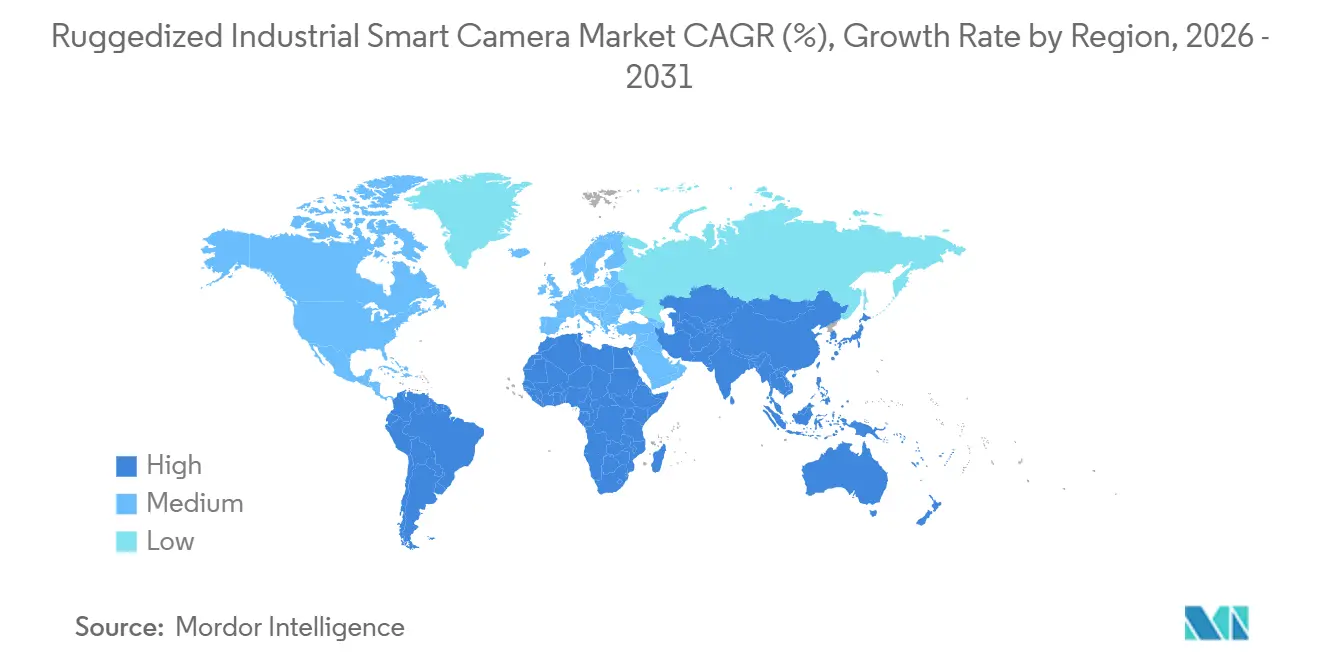
Asia-Pacific held 42.87% of the Ruggedized Industrial Smart Camera Market share in 2025, and the regional production base makes Asia-Pacific central to the Ruggedized Industrial Smart Camera Market. China, Japan, South Korea, and India support demand through electronics, semiconductor, and EV production. Japan's Ministry of Economy, Trade and Industry incentives and China's Ministry of Industry and Information Technology standards support compatible inspection systems. South Korean display, memory-chip, and semiconductor supply chains require high-speed line-scan and area-scan cameras. India adds demand through pharmaceutical exports, electronics automation, and high-humidity production environments.
North America and Europe represented the second-largest combined regional position in the Ruggedized Industrial Smart Camera Market. Brownfield automotive and heavy-machinery plants create North American retrofit demand for protected camera systems. The Association for Advancing Automation identified 37.4% of the region's AI-vision opportunity in legacy facilities. Europe combines manufacturing demand with a supplier base including Basler AG, SICK AG, and IDS Imaging Development Systems GmbH. The EU Machinery Regulation 2023/1230 applies from January 2027 and is expected to support vision-integrated safety verification.
Middle East and Africa are projected to expand at a 10.71% CAGR from 2026 to 2031. Gulf petrochemical facilities require explosion-protected equipment, while Saudi Vision 2030 and UAE Industry 4.0 support automation investment. Africa has early demand from pharmaceutical manufacturing, food inspection, and solar-module production. South America is the smallest of the 5 geographic markets, with Brazil supported by automotive supply and food processing.
Competitive Landscape
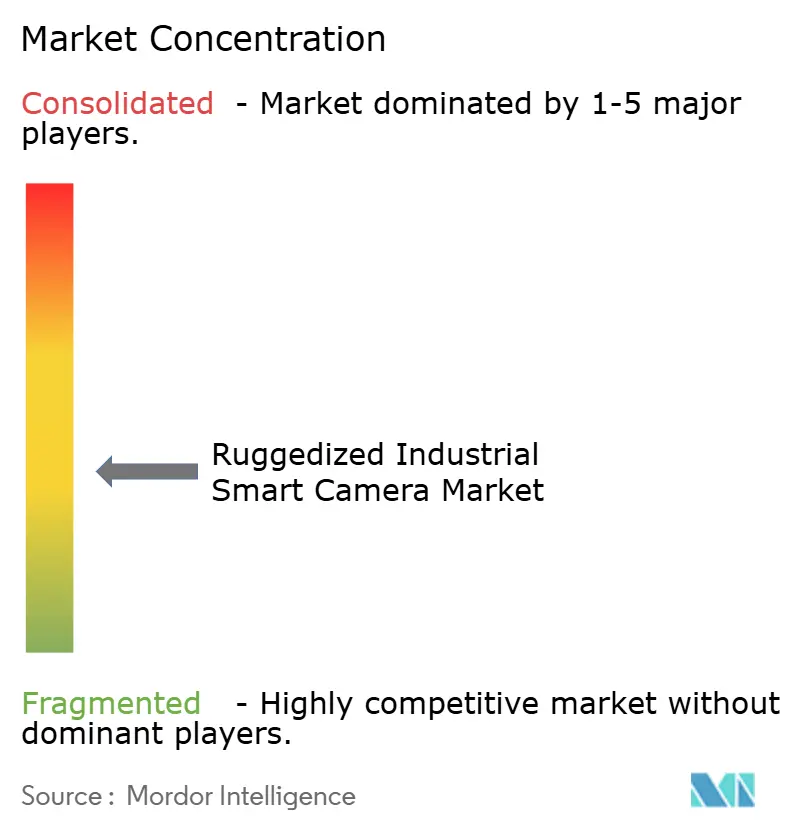
The Ruggedized Industrial Smart Camera Market is moderately fragmented in the premium tier, where Cognex Corporation, Keyence Corporation, and SICK AG combine durable hardware, proprietary software, and application support. SICK's Nova AI platform combines 3D CMOS profiling, anomaly detection, and configurable deployment licenses. Cognex launched the IP67-rated, 25 megapixel In-Sight 3900 in May 2026, with processing that supports speeds up to 4x faster than the prior generation. Cognex also made OneVision generally available in May 2026 after a June 2025 beta involving more than 100 enterprise customers.
Midtier European companies use partnerships to extend their technology reach in the Ruggedized Industrial Smart Camera Market. Basler and Advantech announced an alliance in April 2026 for GMSL-based multi-camera vision and robotics, using Basler ace 2 GMSL cameras and NVIDIA Jetson-powered controllers. Basler and Orbbec also announced a March 2026 3D technology partnership for factory and logistics automation. Patent EP4474782B1 describes hyperspectral material classification at distances up to 20 meters in dark and dusty conditions. The concept is suited to mining and mineral processing.
Hikrobot competes in the mid-market with IP67-rated CT Series cameras and multispectral capability, adding price pressure in the Ruggedized Industrial Smart Camera Market across Asia-Pacific and emerging markets. Hikrobot introduced third-generation CT Series cameras in May 2025, featuring IP67 protection, thermal control, and Mini, Base, Pro, and Max variants. Hazardous-location cameras with embedded AI inference remain an opening because IEC 60079 validation raises the technical barrier. Panasonic began global licensing of its AI Platform for Visual Inspection in March 2026, widening competition beyond traditional machine-vision suppliers.
Ruggedized Industrial Smart Camera Industry Leaders
-
Cognex Corporation
-
Keyence Corporation
-
Omron Corporation
-
Basler AG
-
Teledyne Technologies Incorporated
- *Disclaimer: Major Players sorted in no particular order
Recent Industry Developments
- September 2026: Basler AG announced its participation at VISION 2026, October 6-8, Stuttgart, previewing the Basler ace 2 10GigE camera, 29 mm x 29 mm compact form factor with PoE and RDMA support, a vision simulation capability for generating synthetic AI training data without physical hardware, and an agentic vision engineering concept combining simulation and coding agents, positioning Basler as a full-line vision solutions provider extending beyond camera hardware.
- August 2026: General Motors deployed BVSeal, an automated EV battery inspection system combining gas-imaging cameras, FANUC CRX cobots, and an Advantech GPU-based IoT edge computer, to detect and pinpoint microscopic weld-crack leaks in EV battery trays during production, enabling repair or rejection before downstream assembly and replacing inspection methods that could identify leaks but not their precise location.
- July 2026: Mariana Minerals deployed Boston Dynamics' Spot robot at its Copper One facility near Moab, Utah, equipping the quadruped with thermal imaging, acoustic sensors, and a 30x optical zoom PTZ camera to automate multi-mile walk-downs of copper production infrastructure that previously required personnel to traverse hazardous zones, directly replacing manual inspection routines.
- July 2026: Hikrobot India launched at Automation Expo 2026, Mumbai, July 22-25, its infrared LWIR cameras for thermal-based defect detection and the CT Series industrial area-scan cameras with liquid lens, marking a commercial expansion of Hikrobot's ruggedized machine vision portfolio into the Indian manufacturing market.
Global Ruggedized Industrial Smart Camera Market Report Scope
Ruggedized Industrial Smart Cameras are durable, self-contained vision systems designed to withstand harsh industrial environments characterized by extreme temperatures, moisture, dust, vibration, and hazardous conditions, while delivering reliable real-time image processing and decision-making capabilities for automated quality control and operational monitoring.
The Ruggedized Industrial Smart Camera Market Report is Segmented by Camera Type (Area-Scan Smart Cameras, Line-Scan Smart Cameras, and 3D Smart Cameras), Ruggedization and Environmental Protection (IP65–IP66 Cameras, IP67–IP68 Cameras, IP69/IP69K Cameras, and Explosion-Protected and Hazardous-Location Cameras), Application (Quality Inspection and Defect Detection, Identification, OCR, OCV, and Code Reading, Robot Guidance and Pick-and-Place, Process Monitoring and Predictive Maintenance, and Logistics, Sorting, and Asset Tracking), End-User Industry (Automotive and Electric Vehicles, Electronics, Semiconductors, and Batteries, Food, Beverage, and Consumer Packaged Goods, Pharmaceuticals, Chemicals, and Medical Devices, Logistics, Warehousing, and E-Commerce, Metals, Mining, Energy, and Heavy Machinery, Agriculture, Marine, and Infrastructure, and Other End-User Industries), and Geography (North America, South America, Europe, Asia-Pacific, Middle East and Africa). The Market Forecasts are Provided in Terms of Value (USD).
| Area-Scan Smart Cameras |
| Line-Scan Smart Cameras |
| 3D Smart Cameras |
| IP65-IP66 Cameras |
| IP67-IP68 Cameras |
| IP69/IP69K Cameras |
| Explosion-Protected and Hazardous-Location Cameras |
| Quality Inspection and Defect Detection |
| Identification, OCR, OCV, and Code Reading |
| Robot Guidance and Pick-and-Place |
| Process Monitoring and Predictive Maintenance |
| Logistics, Sorting, and Asset Tracking |
| Automotive and Electric Vehicles |
| Electronics, Semiconductors, and Batteries |
| Food, Beverage, and Consumer Packaged Goods |
| Pharmaceuticals, Chemicals, and Medical Devices |
| Logistics, Warehousing, and E-Commerce |
| Metals, Mining, Energy, and Heavy Machinery |
| Agriculture, Marine, and Infrastructure |
| Other End-User Industries |
| North America | United States | |
| Canada | ||
| Mexico | ||
| South America | Brazil | |
| Argentina | ||
| Rest of South America | ||
| Europe | Germany | |
| United Kingdom | ||
| France | ||
| Italy | ||
| Spain | ||
| Rest of Europe | ||
| Asia-Pacific | China | |
| Japan | ||
| India | ||
| South Korea | ||
| Rest of Asia-Pacific | ||
| Middle East and Africa | Middle East | Saudi Arabia |
| United Arab Emirates | ||
| Turkey | ||
| Rest of the Middle East | ||
| Africa | South Africa | |
| Nigeria | ||
| Rest of Africa | ||
| By Camera Type | Area-Scan Smart Cameras | ||
| Line-Scan Smart Cameras | |||
| 3D Smart Cameras | |||
| By Ruggedization / Environmental Protection | IP65-IP66 Cameras | ||
| IP67-IP68 Cameras | |||
| IP69/IP69K Cameras | |||
| Explosion-Protected and Hazardous-Location Cameras | |||
| By Application | Quality Inspection and Defect Detection | ||
| Identification, OCR, OCV, and Code Reading | |||
| Robot Guidance and Pick-and-Place | |||
| Process Monitoring and Predictive Maintenance | |||
| Logistics, Sorting, and Asset Tracking | |||
| By End-User Industry | Automotive and Electric Vehicles | ||
| Electronics, Semiconductors, and Batteries | |||
| Food, Beverage, and Consumer Packaged Goods | |||
| Pharmaceuticals, Chemicals, and Medical Devices | |||
| Logistics, Warehousing, and E-Commerce | |||
| Metals, Mining, Energy, and Heavy Machinery | |||
| Agriculture, Marine, and Infrastructure | |||
| Other End-User Industries | |||
| By Geography | North America | United States | |
| Canada | |||
| Mexico | |||
| South America | Brazil | ||
| Argentina | |||
| Rest of South America | |||
| Europe | Germany | ||
| United Kingdom | |||
| France | |||
| Italy | |||
| Spain | |||
| Rest of Europe | |||
| Asia-Pacific | China | ||
| Japan | |||
| India | |||
| South Korea | |||
| Rest of Asia-Pacific | |||
| Middle East and Africa | Middle East | Saudi Arabia | |
| United Arab Emirates | |||
| Turkey | |||
| Rest of the Middle East | |||
| Africa | South Africa | ||
| Nigeria | |||
| Rest of Africa | |||
Key Questions Answered in the Report
What is the Ruggedized Industrial Smart Camera Market size?
The Ruggedized Industrial Smart Camera Market is USD 1.17 billion in 2026 and is projected to reach USD 1.77 billion by 2031 at an 8.63% CAGR.
What is driving demand for ruggedized industrial smart cameras?
Factory automation, edge AI, battery production, and the need for systems that withstand dust, washdown, and vibration are supporting demand.
Which camera type leads the Ruggedized Industrial Smart Camera Market?
Area-scan smart cameras led with 52.73% share in 2025, while 3D smart cameras are projected to expand at an 11.23% CAGR through 2031.
Which application is expanding fastest?
Process monitoring and predictive maintenance are projected to expand at a 10.37% CAGR from 2026 to 2031.
Which end-user sector has the largest share?
Automotive and electric vehicles held 23.91% share in 2025 because production lines require frequent inspection and quality verification.
Which region leads global demand?
Asia-Pacific held 42.87% share in 2025, while Middle East and Africa are projected to expand at a 10.71% CAGR through 2031.