
Structured Light Projector Market Size and Share
Market Overview
| Study Period | 2020 - 2031 |
|---|---|
| Market Size (2026) | USD 0.96 Billion |
| Market Size (2031) | USD 1.53 Billion |
| Growth Rate (2026 - 2031) | 9.77 % |
| Fastest Growing Market | Asia-Pacific |
| Largest Market | Asia-Pacific |
| Market Concentration | Low |
Major Players *Disclaimer: Major Players sorted in no particular order Image © Mordor Intelligence. Reuse requires attribution under CC BY 4.0. | |
Structured Light Projector Market Analysis by Mordor Intelligence
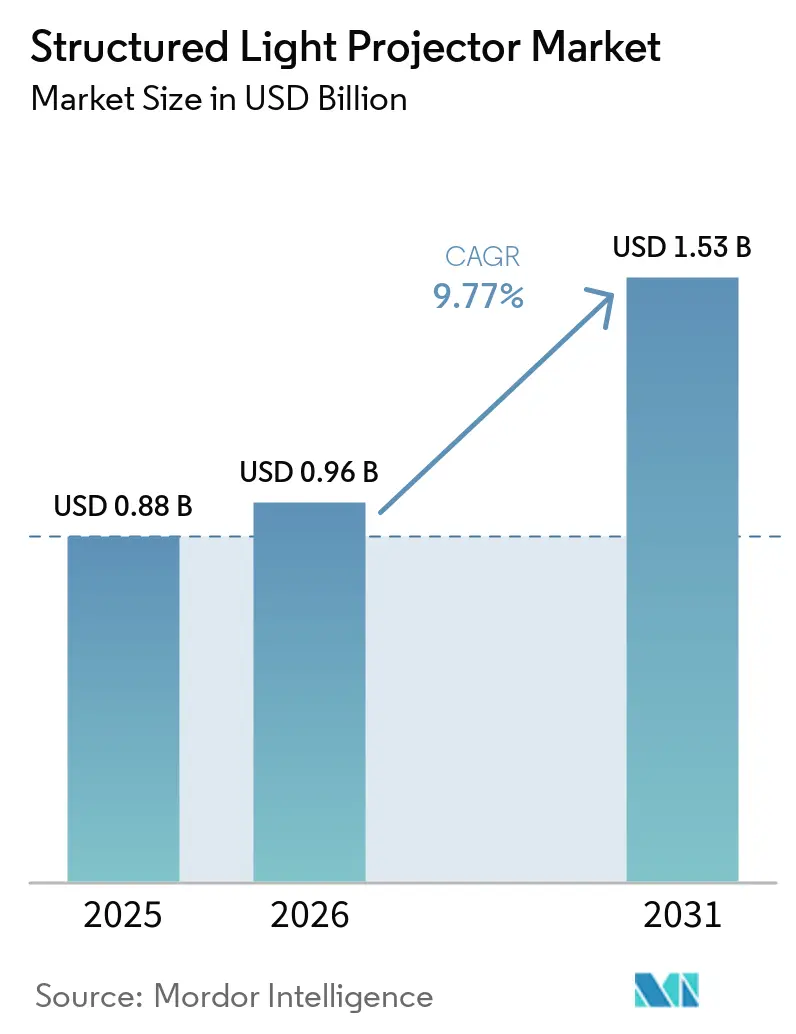
The Structured Light Projector Market size was USD 0.88 billion in 2025, USD 0.96 billion in 2026, and is forecast to reach USD 1.53 billion by 2031, expanding at a CAGR of 9.77% over 2026-2031. The Structured Light Projector Market is supported by factory automation, collaborative robotics, biometric access devices, EV battery plants, and semiconductor production, where users increasingly need reliable 3D information for inspection, guidance, authentication, and process monitoring. Its short-range accuracy and sub-millimeter resolution support inspection tasks where passive stereo and time-of-flight systems may face hardware trade-offs, particularly when surface conditions, working distance, speed, and available installation space all affect measurement performance. Demand is also shifting toward compact, low-power projectors that process depth data on-device, which suits both industrial equipment and consumer hardware and can reduce reliance on separate computing hardware during deployment. Competition in the Structured Light Projector Market is widening among 3D vision specialists, optics developers, and automation suppliers, putting pressure on selling-price premiums while expanding the range of applications.
Key Report Takeaways
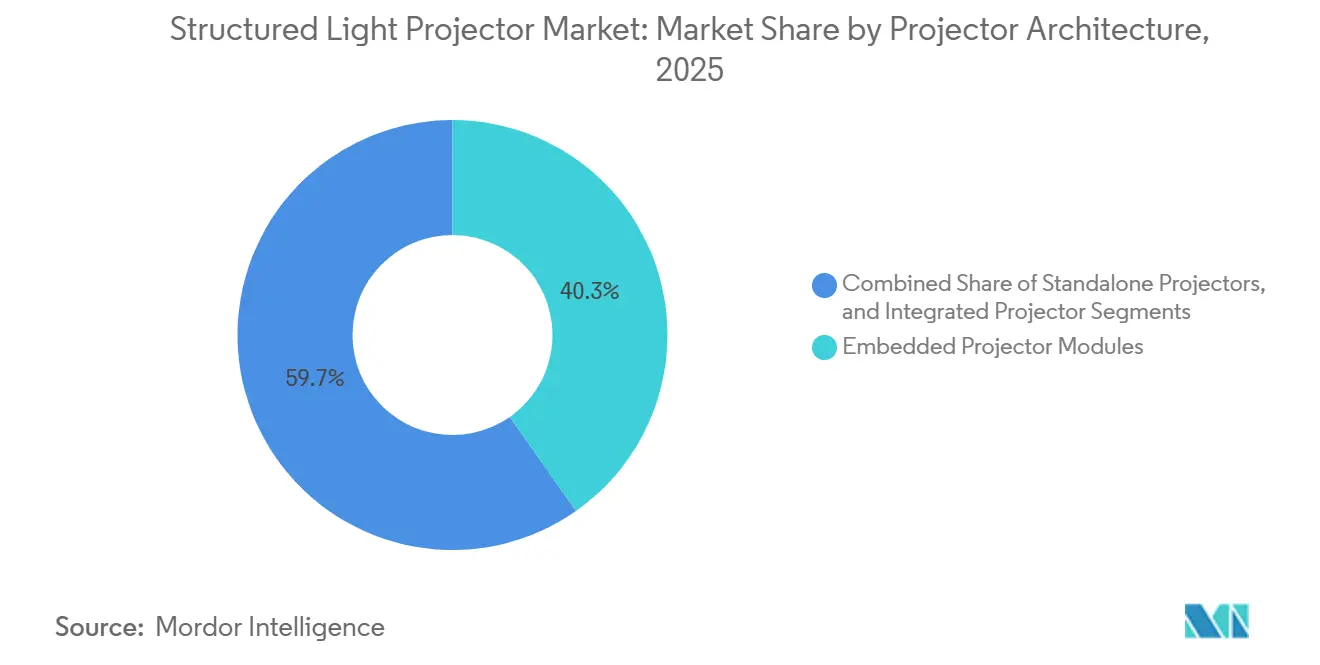
- By projector architecture, embedded projector modules held 40.27% Structured Light Projector Market revenue share in 2025 and are projected to expand at an 11.73% CAGR through 2031.
- By light source technology, laser diode-based systems accounted for 44.83% revenue share in 2025, while VCSEL-based systems are projected to expand at a 12.27% CAGR through 2031.
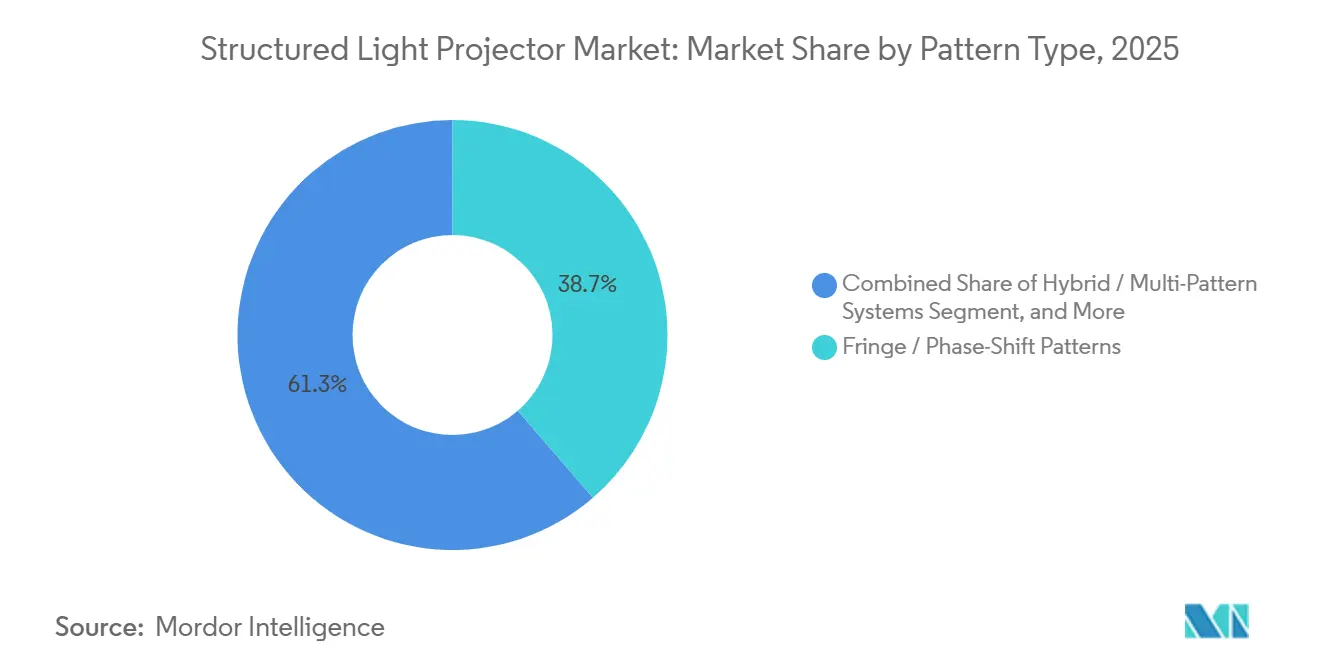
- By pattern type, fringe and phase-shift patterns held 38.67% Structured Light Projector Market revenue share in 2025, while hybrid and multi-pattern systems are projected to expand at a 12.83% CAGR through 2031.
- By end user, electronics and semiconductor applications accounted for 26.47% revenue share in 2025, while consumer electronics are projected to expand at a 12.67% CAGR through 2031.
- By geography, Asia-Pacific accounted for 39.27% of the Structured Light Projector Market revenue share in 2025 and is projected to expand at an 11.47% CAGR through 2031.
Note: Market size and forecast figures in this report are generated using Mordor Intelligence’s proprietary estimation framework, updated with the latest available data and insights as of January 2026.
Market Trends and Insights
Drivers Impact Analysis of Structured Light Projector Market*
| Driver | (~) % Impact on CAGR Forecast | Geographic Relevance | Impact Timeline |
|---|---|---|---|
| Industrial Automation and Inline 3D Inspection | +2.8% | Global, with concentration in China, Germany, South Korea, and Japan | Short term (≤ 2 years) |
| Robotics Depth Data for Occluded Workspaces | +2.1% | North America, Asia-Pacific core markets, and Europe | Short term (≤ 2 years) |
| Smartphone and Consumer Device Face Authentication | +1.8% | Asia-Pacific, North America, and Europe | Short term (≤ 2 years) |
| EV Battery and Semiconductor Manufacturing Expansion | +1.5% | China, South Korea, Germany, and the United States | Medium term (2-4 years) |
| Privacy-Preserving On-Device Depth Processing | +0.9% | Global, with early adoption in Europe and North America | Medium term (2-4 years) |
| Speckle-Reduced Optics and Pattern Reliability | +0.6% | Global | Long term (≥ 4 years) |
| Source: Mordor Intelligence | |||
Industrial Automation and Inline 3D Inspection Adoption
Mixed-model assembly lines need fast geometric verification without slowing conveyor-based operations. This requirement supports demand for Structured Light Projectors because contact metrology cannot provide the same inspection cadence or offer a noncontact, full-field measurement method at each production stage. An IEEE-published 2025 framework showed that 3D structured-light profiling and edge analytics can monitor coating uniformity, calendering integrity, electrode alignment, and weld quality in a continuous lithium-ion battery workflow.[1]IEEE International Conference on Control, Mechatronics and Automation, “Integration of Vision Based Inspection and Edge Computing for High-Throughput Lithium Ion Battery Production,” IEEE ICCMA The data stream from an installed sensor can support process control and final quality checks, giving production teams a clearer record of where deviations first appear. That broader role can make the equipment part of a production machine rather than a separate inspection station.
Robotics Requiring Dense Depth Data in Occluded Workspaces
Robotic bin picking and collaborative robot guidance require reliable depth information in cluttered work areas. Structured light can provide dense point clouds and per-pixel depth confidence for partially hidden or dark objects, which helps a robot distinguish the selected item from adjacent components. Photoneo introduced MotionCam-3D Color Blue in May 2025, featuring real-time, parallel structured-light scanning for objects moving at up to 144 km/h.[2]Photoneo, “Photoneo Launches MotionCam-3D Color Blue,” Photoneo The company reported a reduction of up to 2 seconds per bin-picking event and stated that 97% of automotive and logistics items could be picked without presorting. These requirements are shifting supplier selection in the Structured Light Projector Market toward throughput, reconstructed-point confidence, and onboard computing capability.
Smartphone and Consumer Device Face Authentication
Front-facing structured-light modules enable higher-assurance facial authentication in phones and access-control equipment. Security policy upgrades and digital identification requirements can drive adoption into device tiers that previously relied on 2D face unlock, adding consumer-volume opportunities to the Structured Light Projector Market. STMicroelectronics and Metalenz signed a license agreement in July 2025 to scale up production of metasurface optics on a 300 mm semiconductor platform.[3]Metalenz, “STMicroelectronics and Metalenz Sign a New License Agreement to Accelerate Metasurface Optics Adoption,” Metalenz The companies stated that STMicroelectronics had shipped more than 140 million metasurface optics and FlightSense modules since 2022. SwitchBot Lock Vision Pro uses a 940 nm infrared dot projector with more than 20,000 infrared dots and on-device 3D liveness detection, showing the use of this technology beyond smartphones.
EV Battery and Semiconductor Manufacturing Expansion
New battery plants and semiconductor fabs create equipment demand linked to production capacity. These applications use noncontact measurement for tasks that require consistent geometric inspection, including coating, alignment, surface, and weld checks that are difficult to complete with 2D cameras alone. A 2026 study developed a YOLO-based defect-detection model for lithium-ion battery cells using structured light imaging.[4]T. Jiang et al., “YOLO-SLB: Appearance Defect Detection Model of Lithium Battery Cell Oriented to Structured Light Imaging,” Optics Express Engineering The study addressed aluminum-plastic film surfaces, where conventional illumination can produce inconsistent images. Suppliers serving the Structured Light Projector Market must also consider the cost implications of specialized optical metrology equipment classification for cross-border deployments.
Restraints Impact Analysis of Structured Light Projector Market*
| Restraint | (~) % Impact on CAGR Forecast | Geographic Relevance | Impact Timeline |
|---|---|---|---|
| Calibration Drift from Thermal and Mechanical Stress | -1.2% | Global, most acute in industrial deployments across Asia-Pacific and Europe | Short term (≤ 2 years) |
| Reflective, Transparent, and Low-Texture Surface Limits | -0.9% | Global | Medium term (2-4 years) |
| Eye-Safety and Laser-Classification Compliance Burden | -0.7% | Europe, North America, and Asia-Pacific | Medium term (2-4 years) |
| Integration Cost and Limited 3D Vision Talent | -0.5% | Global, with stronger effects in South America, Southeast Asia, and the Middle East and Africa | Long term (≥ 4 years) |
| Source: Mordor Intelligence | |||
Calibration Drift from Thermal and Mechanical Stress
Thermal and mechanical conditions can affect the calibration of projector-camera systems in operating environments. This can make industrial deployment more demanding than controlled laboratory use and delay the wider adoption of the Structured Light Projector Market in factories with changing temperatures. Software compensation can reduce the effect, but it requires calibration information and real-time thermal sensing in the projector. Those features increase hardware costs and are uncommon in entry-level systems. Service requirements can therefore create added cost and liability for integrators operating in variable conditions.
Reflective, Transparent, and Low-Texture Surface Limitations
Polished metals, glass, transparent plastics, and low-reflectance composites can produce unreliable fringe patterns. Systems may need multi-exposure HDR capture or wavelength-switching hardware to improve depth maps, which can add complexity for Structured Light Projector Market customers. A 2025 study reported that a clustered adaptive exposure method reduced measurement error by 25.4% on high-dynamic-range objects. The added computation and acquisition time can conflict with cycle-time targets in high-throughput lines. Blue laser systems from Photoneo and LMI Technologies address part of this challenge, but their higher source cost limits adoption in price-sensitive applications.
*Our forecasts treat driver/restraint impacts as directional, not additive. The impact forecasts reflect baseline growth, mix effects, and variable interactions.
Structured Light Projector Market Segment Analysis
By Projector Architecture:
Embedded Modules Lead Share and ExpansionEmbedded projector modules held 40.27% of the Structured Light Projector Market share in 2025 and are projected to expand at an 11.73% CAGR through 2031. This combination of leading share and expansion reflects a shift from discrete assemblies to board-level integration, in which suppliers can design the optical, electronic, and mechanical elements for a single intended host system. Smartphone OEMs, robotics builders, and consumer device makers can apply familiar component-cost disciplines to module procurement while also reducing the effort required to align a separate projector with cameras and processing hardware. Smaller modules also fit equipment where weight and installation space are limited, and they simplify product design for handheld equipment, robotic arms, compact access devices, and fixed automation stations.
Orbbec presented a DLP structured light camera at Automate 2026 with 0.07 mm VDI/VDE accuracy and 0.05 mm Z-repeatability at 0.5 m. The compact design was intended for robotic-arm integration. Standalone projectors remain relevant for large-volume scanning and aerospace metrology. Integrated projector-camera systems continue to serve fixed-station quality control. Metasurface optics can consolidate several conventional optical functions into a flatter component, which supports module miniaturization across the Structured Light Projector Industry.



By Light Source Technology:
VCSEL Systems Expand FasterLaser diode-based systems accounted for 44.83% of revenue in 2025 because they offer mature designs and high optical power density. VCSEL-based systems are projected to expand at a 12.27% CAGR through 2031, the highest rate among light source technologies in the Structured Light Projector Market. Multi-junction VCSEL arrays can increase optical power while mitigating thermal rollover, which has historically limited their use in higher-performance systems. This capability is relevant to automotive cabin monitoring and longer-range robotic guidance, where a stable source can support consistent depth performance through normal operating cycles.
Infineon released VCSEL arrays with integrated heat-spreading layers in March 2025 to enable higher sustained optical output at stable operating temperatures. LED-based sources continue to serve lower-cost and short-range tasks, including food inspection and logistics height measurement. Their expansion is more limited as precision requirements increase across the Structured Light Projector Market. Superluminescent diode systems remain a small premium category for speckle-suppressed metrology and biological imaging. In these applications, reduced speckle is a technical requirement rather than an optional feature.
By Pattern Type:
Fringe Patterns Support Precision WorkFringe and phase-shift patterns accounted for 38.67% of revenue in 2025. Their use for measuring flatness, waviness, and weld profile demonstrates strong surface reconstruction accuracy, especially where customers need detailed information across the entire surface rather than at a limited set of points. A 2025 review found that phase-shifting profilometry remained a reference approach for measurements from submicrometer to millimeter ranges. Learning-based phase unwrapping is being extended to dynamic scenes and nonideal surfaces.
Hybrid and multi-pattern systems are projected to expand at a 12.83% CAGR through 2031. Flexible automation cells can use a single unit for localization, assembly guidance, and final inspection, allowing operators to match the projected pattern to the task rather than installing separate instruments. Research in 2025 demonstrated deep-learning-accelerated fringe projection profilometry at 100,000 frames per second. This work addresses the historical trade-off between speed and resolution in fringe projection and supports a broader set of moving inspection tasks. Binary-coded, dot, random-dot, and line-pattern systems remain useful in measurement, facial authentication, and profile-gauging applications across the Structured Light Projector Market.
By End User:
Electronics and Semiconductor Applications LeadElectronics and semiconductor applications accounted for 26.47% revenue share in 2025. These users require noncontact 3D measurement for wafer shape, printed circuit board inspection, and display flatness verification, where repeatable results help teams identify defects before later production stages. Display and memory production in South Korea, advanced logic fabrication in Taiwan, and outsourced semiconductor assembly in China support demand for high-resolution optical metrology. The Structured Light Projector Market serves these settings where a full-field 3D map is important to the inspection process and where the cost of missed defects can exceed the cost of measurement equipment.
Consumer electronics are projected to expand at a 12.67% CAGR through 2031, the fastest rate among end-user groups. Facial authentication is extending from premium phones to mid-range devices, smart locks, and access panels. trinamiX and NIL Technology announced a January 2025 collaboration on a compact 2-in-1 dot-flood projector for high-security face authentication. Automotive uses include panel-gap measurement and battery-pack inspection. Aerospace, defense, healthcare, research, and general manufacturing also use structured light equipment for specialized quality and research workflows.
Geography Analysis
APAC Structured Light Projector Market
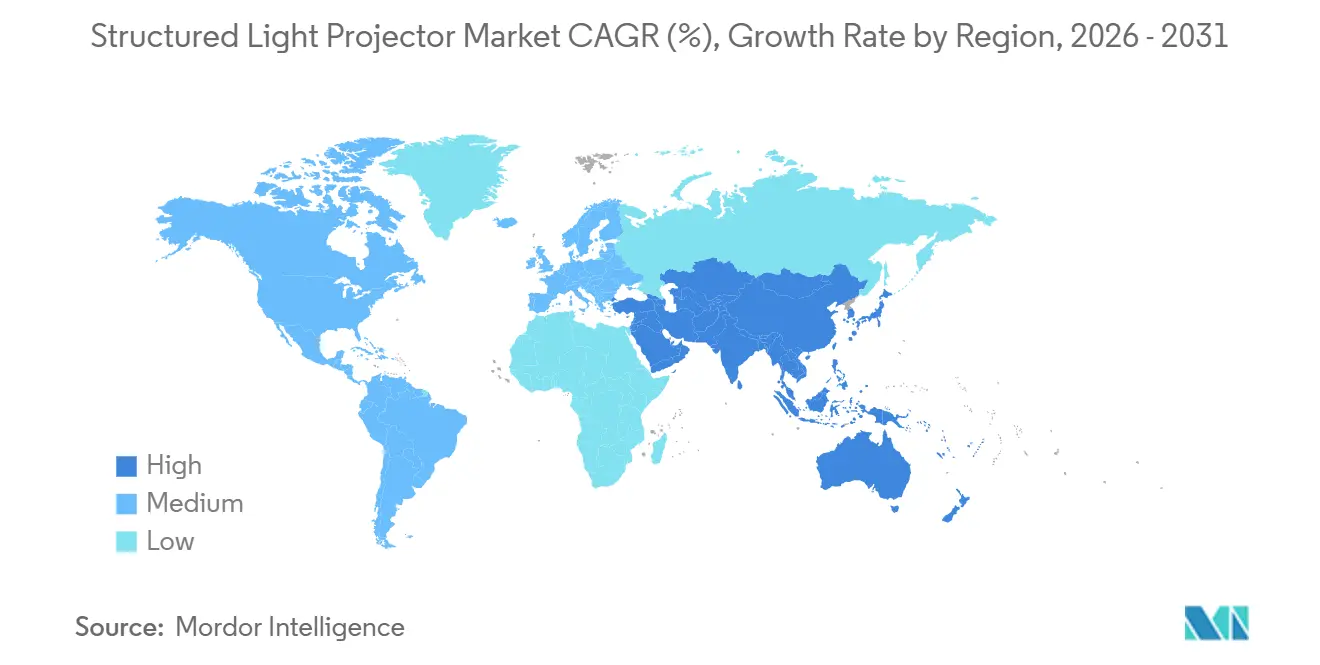
Asia-Pacific held 39.27% of the Structured Light Projector Market share in 2025 and is projected to expand at an 11.47% CAGR through 2031. The region combines the largest consumption base with a major production base for projector technology, which gives system suppliers access to large electronics, automotive, and automation customer groups. China’s electronics assembly and EV battery manufacturing support demand for industrial inspection. South Korean display and memory production requires high-specification wafer and panel measurement. Japan’s precision robotics ecosystem supports the use of embedded projectors in assembly guidance and remains an important driver of demand for the Structured Light Projector Market.
North America, Europe and APAC Structured Light Projector Market
Taiwan’s advanced logic fabrication supports the demand for optical metrology in process control. India is emerging as an electronics manufacturing hub as global OEMs ' investment increases. North America has demand from automotive automation, domestic semiconductor construction, and 3D vision-guided logistics systems, which broadens the Structured Light Projector Market customer base. Face authentication remains important in North American premium smartphones with high-security biometric requirements. Europe is supported by German precision engineering and automotive metrology, where VDI/VDE 2634 and ISO/IEC 17025 requirements favor accuracy-certified systems.
MEA and South America Structured Light Projector Market
FARO CREAFORM introduced HandySCAN 3D MAX EVO and MAX EVO Elite models in July 2026 for large-part aerospace and automotive work. The company stated that the Elite model achieved a volumetric accuracy of 0.075 mm + 0.010 mm/m after validation against the VDI/VDE 2634 standards. South America, the Middle East, and Africa have smaller revenue bases but include aerospace, smart factory, automotive, and mining applications. Limited availability of 3D vision integration skills remains a common constraint across these regions.

Competitive Landscape
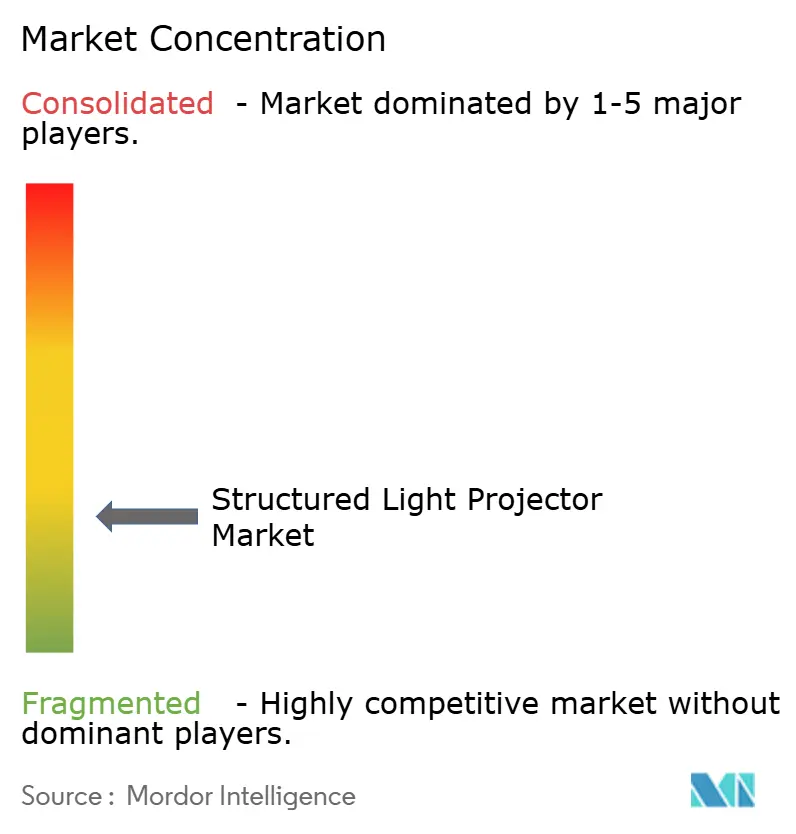
The Structured Light Projector Market is fragmented, and no supplier holds a majority across all applications. Cognex Corporation, FARO Technologies, FARO CREAFORM, Hexagon AB, and ZEISS Industrial Quality Solutions have established positions in industrial precision work, supported by installed systems, product portfolios, and calibration-certified equipment. Their installed bases and calibration-certified products are important in applications with strict measurement requirements. The competitive field combines established metrology providers with smaller optics and 3D vision companies, and suppliers often compete on application knowledge, integration support, accuracy, and the ability to fit equipment into existing production processes.
Established firms are adding workflow software and AI-assisted inspection as customers consider lower-cost embedded alternatives. Newer suppliers are emphasizing compact modules, on-device processing, and partnerships with robotics companies for new automation projects. Cognex launched the In-Sight 3900 in May 2026 on the Qualcomm Dragonwing platform for embedded AI inspection. Cognex also introduced the NVIDIA Jetson-powered In-Sight 6900 Vision Controller in April 2026 for configurable machine vision applications. These releases bring hardware, processing, and inspection software together in a single offering.
Hexagon debuted the wireless HYPERSCAN SR 3D scanner at IMTS 2026 for portable measurement work in flexible manufacturing cells. Metalenz reported more than 150 patent applications and issued patents covering single-element dot-pattern projectors and polarization-based face recognition in August 2025. That intellectual property position can require other suppliers to license, design around, or acquire relevant optical technologies, particularly when customers require smaller modules that integrate pattern projection and sensing functions within tightly constrained device designs. Laser safety compliance under IEC 60825-1 is also becoming a differentiator for products intended for outdoor or longer-range use, because suppliers must balance optical output, thermal management, safety controls, documentation, product testing, and the time needed to complete certification before a customer deployment. These technical and commercial requirements support a competitive environment in the Structured Light Projector Market where system capability, optical design, and implementation support can matter as much as the price of a projector or camera component.
Structured Light Projector Industry Leaders
Wintech Digital Systems Technology Corp.
Keynote Photonics Inc.
Osela Inc.
Visitech International Ltd.
EFFILUX SAS
- *Disclaimer: Major Players sorted in no particular order
Structured Light Projector Market Companies Covered in this Report
- Wintech Digital Systems Technology Corp.
- Keynote Photonics Inc.
- Osela Inc.
- EFFILUX SAS
- RODER Vision GmbH
- Visitech International Ltd.
- Mantis Vision Ltd.
- Orbbec Inc.
- LMI Technologies Inc.
- Basler AG
- Cognex Corporation
- FARO Technologies, Inc.
- ZEISS Industrial Quality Solutions
- Hexagon AB
- GOM GmbH
- ATOS SE
- Photoneo s.r.o.
- MetraSCAN 3D Technologies Inc.
- MagikEye Inc.
- Metalenz, Inc.

Recent Industry Developments in Structured Light Projector Market
- September 2026: Hexagon AB debuted HYPERSCAN SR, a fully wireless optical tracking 3D scanner, at IMTS 2026 in Chicago, completing its HYPERSCAN portfolio with an untethered entry-level model suited for on-site and supplier inspection workflows. The wireless capability addresses a long-standing deployment friction point in flexible manufacturing environments.
- August 2026: Orbbec launched its Physis series robotics vision cameras and Robot-Free Data Collection Hardware Platform at the 2026 World Robot Conference in Beijing. The Physis 257g Human-IPD RGB stereo camera features a 63 mm stereo baseline, dual real-time 1920 x 1200 @ 60 fps color streams, and depth accuracy of 1.6% at 2 m, targeting physical AI training data collection and humanoid robot perception.
- July 2026: FARO CREAFORM announced the HandySCAN 3D MAX EVO and MAX EVO Elite portable structured light scanners, with the Elite model achieving volumetric accuracy of 0.075 mm + 0.010 mm/m, validated in ISO/IEC 17025-accredited laboratories against VDI/VDE 2634 standards, targeting large-part aerospace and automotive metrology.
- May 2026: Cognex Corporation launched the In-Sight 3900 Vision System, powered by the Qualcomm Dragonwing platform, delivering embedded AI-driven inspection at the edge without external compute dependencies. OneVision, Cognex’s cloud-to-edge AI vision platform, simultaneously reached general availability, enabling customers such as Schneider Electric to deploy AI inspection models globally with reported yield doubling and reduction in false rejects.


Global Structured Light Projector Market Report Scope
Structured Light Projectors are optical devices that project precise, known light patterns onto objects to enable 3D shape reconstruction and high-accuracy spatial measurement, serving as critical components in machine vision systems for industrial inspection, robotic guidance, and biometric recognition.
The Structured Light Projector Market Report is Segmented by Projector Architecture (Standalone Projectors, Embedded Projector Modules, and Integrated Projector-Camera Systems), Light Source Technology (LED-Based, Laser Diode-Based, VCSEL-Based, and Superluminescent Diode-Based), Pattern Type (Fringe / Phase-Shift Patterns, Binary-Coded Patterns, Dot / Random-Dot Patterns, Line / Multi-Line / Cross Patterns, and Hybrid / Multi-Pattern Systems), End-User (Electronics and Semiconductor, Automotive, Aerospace and Defense, Healthcare and Life Sciences, General Manufacturing and Machine Builders, Research Institutes and Universities, Consumer Electronics, and Other End-Users), and Geography (North America, South America, Europe, Asia-Pacific, Middle East, Africa). The Market Forecasts are Provided in Terms of Value (USD).
| Standalone Projectors |
| Embedded Projector Modules |
| Integrated Projector-Camera Systems |
| LED-Based |
| Laser Diode-Based |
| VCSEL-Based |
| Superluminescent Diode-Based |
| Fringe / Phase-Shift Patterns |
| Binary-Coded Patterns |
| Dot / Random-Dot Patterns |
| Line / Multi-Line / Cross Patterns |
| Hybrid / Multi-Pattern Systems |
| Electronics and Semiconductor |
| Automotive |
| Aerospace and Defense |
| Healthcare and Life Sciences |
| General Manufacturing and Machine Builders |
| Research Institutes and Universities |
| Consumer Electronics |
| Other End-Users |
| North America | United States |
| Canada | |
| Mexico | |
| South America | Brazil |
| Argentina | |
| Rest of South America | |
| Europe | Germany |
| United Kingdom | |
| France | |
| Italy | |
| Spain | |
| Rest of Europe | |
| Asia-Pacific | China |
| Japan | |
| India | |
| South Korea | |
| Rest of Asia-Pacific | |
| Middle East | United Arab Emirates |
| Saudi Arabia | |
| Rest of Middle East | |
| Africa | South Africa |
| Rest of Africa |
| By Projector Architecture | Standalone Projectors | |
| Embedded Projector Modules | ||
| Integrated Projector-Camera Systems | ||
| By Light Source Technology | LED-Based | |
| Laser Diode-Based | ||
| VCSEL-Based | ||
| Superluminescent Diode-Based | ||
| By Pattern Type | Fringe / Phase-Shift Patterns | |
| Binary-Coded Patterns | ||
| Dot / Random-Dot Patterns | ||
| Line / Multi-Line / Cross Patterns | ||
| Hybrid / Multi-Pattern Systems | ||
| By End-User | Electronics and Semiconductor | |
| Automotive | ||
| Aerospace and Defense | ||
| Healthcare and Life Sciences | ||
| General Manufacturing and Machine Builders | ||
| Research Institutes and Universities | ||
| Consumer Electronics | ||
| Other End-Users | ||
| By Geography | North America | United States |
| Canada | ||
| Mexico | ||
| South America | Brazil | |
| Argentina | ||
| Rest of South America | ||
| Europe | Germany | |
| United Kingdom | ||
| France | ||
| Italy | ||
| Spain | ||
| Rest of Europe | ||
| Asia-Pacific | China | |
| Japan | ||
| India | ||
| South Korea | ||
| Rest of Asia-Pacific | ||
| Middle East | United Arab Emirates | |
| Saudi Arabia | ||
| Rest of Middle East | ||
| Africa | South Africa | |
| Rest of Africa | ||


Key Questions Answered in the Report
What is the Structured Light Projector Market size?
The Structured Light Projector Market size was USD 0.96 billion in 2026 and is forecast to reach USD 1.53 billion by 2031 at a 9.77% CAGR.
What is driving demand for structured light projectors?
Factory automation, robotic bin picking, face authentication, EV battery inspection, and semiconductor metrology are supporting demand.
Which projector architecture leads revenue?
Embedded projector modules held 40.27% revenue share in 2025 and are projected to expand at an 11.73% CAGR through 2031.
Which region leads Structured Light Projector Adoption?
Asia-Pacific held 39.27% revenue share in 2025 and is projected to expand at an 11.47% CAGR through 2031.
Why are VCSEL-based projectors gaining traction?
VCSEL systems are projected to expand at a 12.27% CAGR because array designs can provide higher optical power with controlled thermal performance.
What limits deployment in industrial settings?
Thermal calibration drift, difficult reflective or transparent surfaces, laser-safety compliance, and limited integration talent can slow deployment.
Page last updated on:





