
Deep Learning Smart Camera Market Size and Share
Market Overview
| Study Period | 2020 - 2031 |
|---|---|
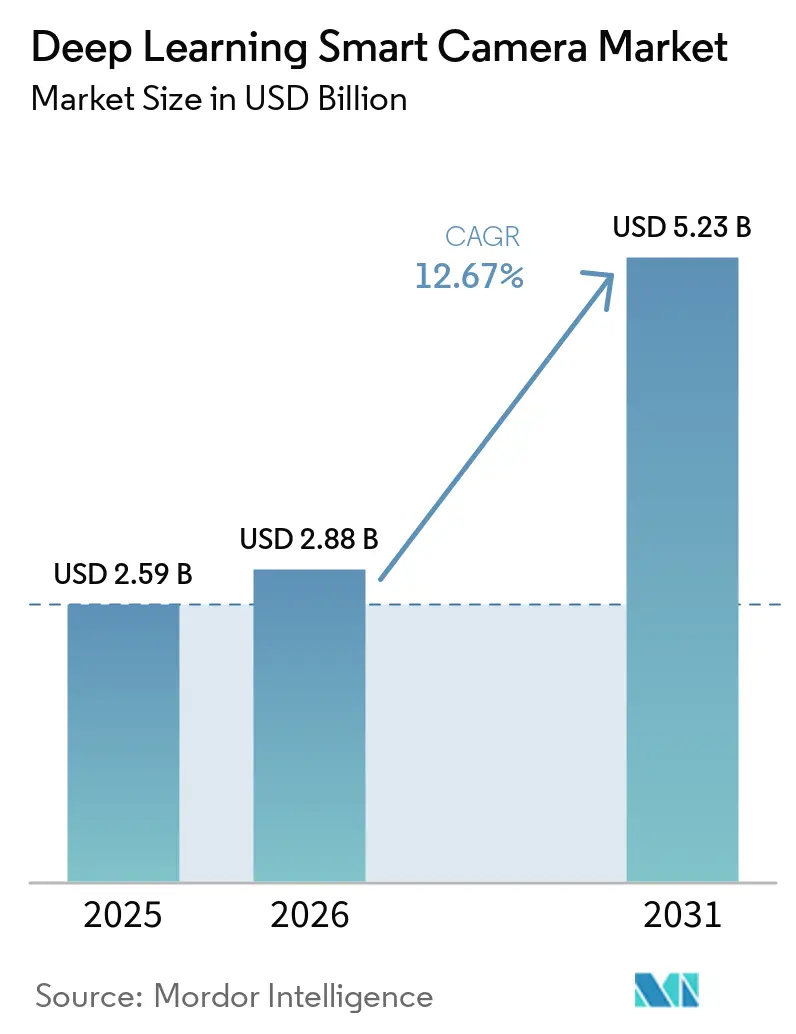
| Market Size (2026) | USD 2.88 Billion |
| Market Size (2031) | USD 5.23 Billion |
| Growth Rate (2026 - 2031) | 12.67 % |
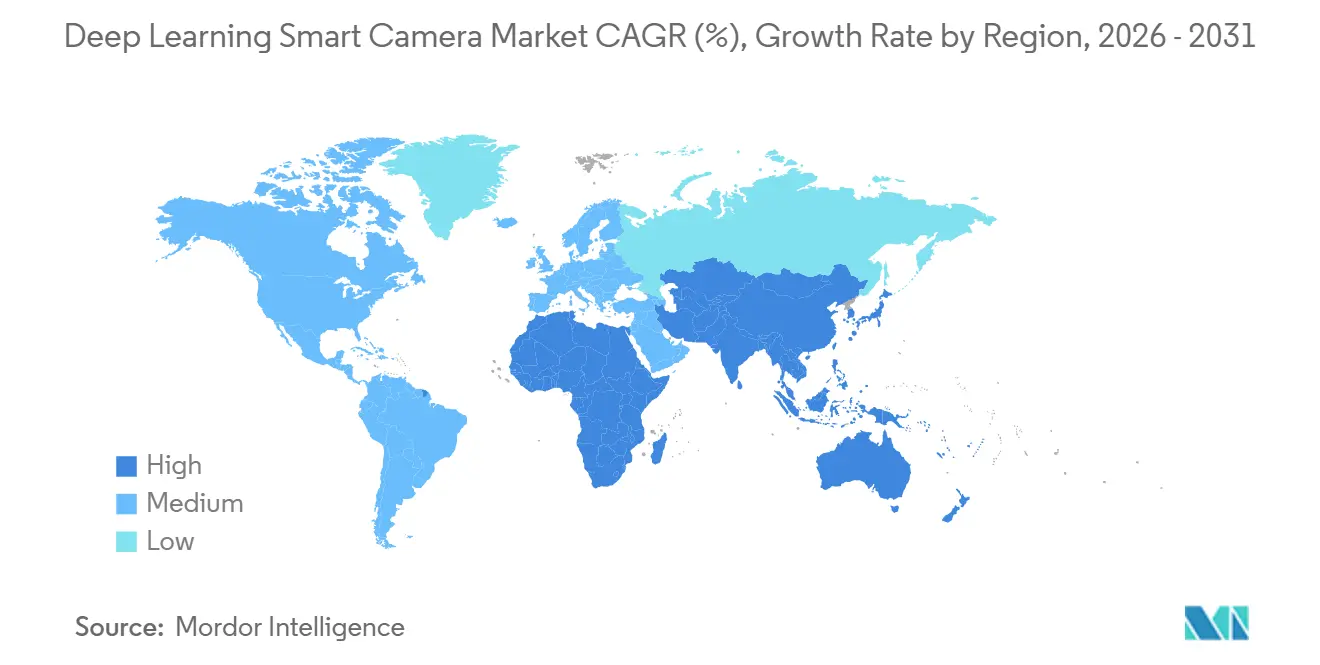
| Fastest Growing Market | Asia-Pacific |
| Largest Market | Asia-Pacific |
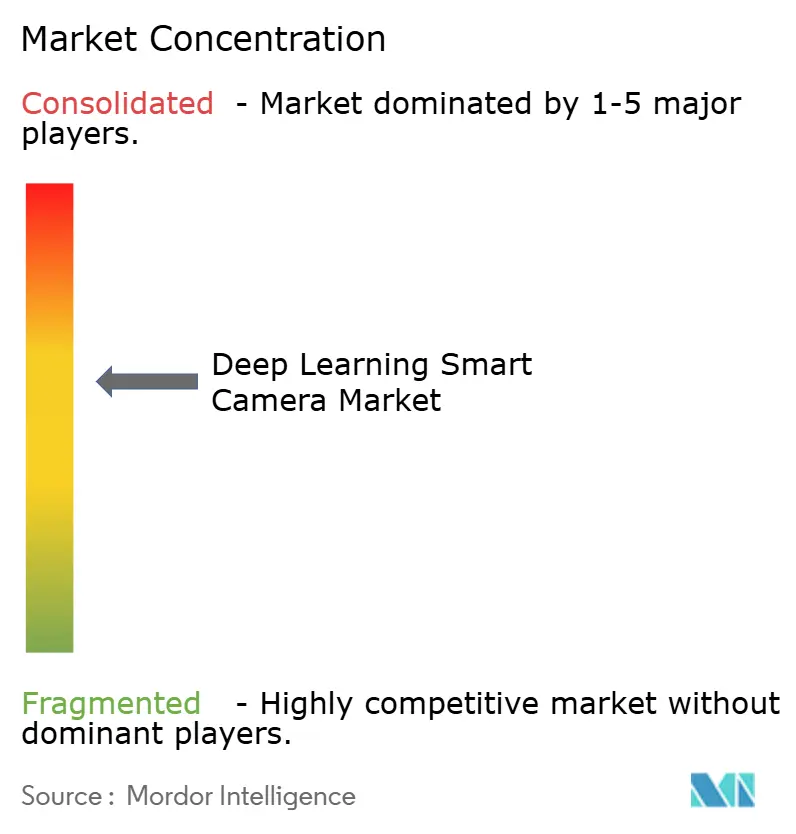
| Market Concentration | Medium |
Major Players *Disclaimer: Major Players sorted in no particular order Image © Mordor Intelligence. Reuse requires attribution under CC BY 4.0. | |
Deep Learning Smart Camera Market Analysis by Mordor Intelligence
The Deep Learning Smart Camera Market size was valued at USD 2.59 billion in 2025 and estimated to expand from USD 2.88 billion in 2026 to reach USD 5.23 billion by 2031, at a CAGR of 12.67% during the forecast period (2026-2031). The Deep Learning Smart Camera Market is moving from rule-based inspection to cameras that process images at the point of capture. Lower-power neural processing units are making advanced inspection practical without a separate PC. Industrial automation, autonomous mobility, and urban video infrastructure remain the main sources of demand. Vendors are placing more value on software tools, model libraries, and updates that can work across camera fleets. Security, privacy rules, and model governance will influence which suppliers can support larger deployments.
Key Report Takeaways
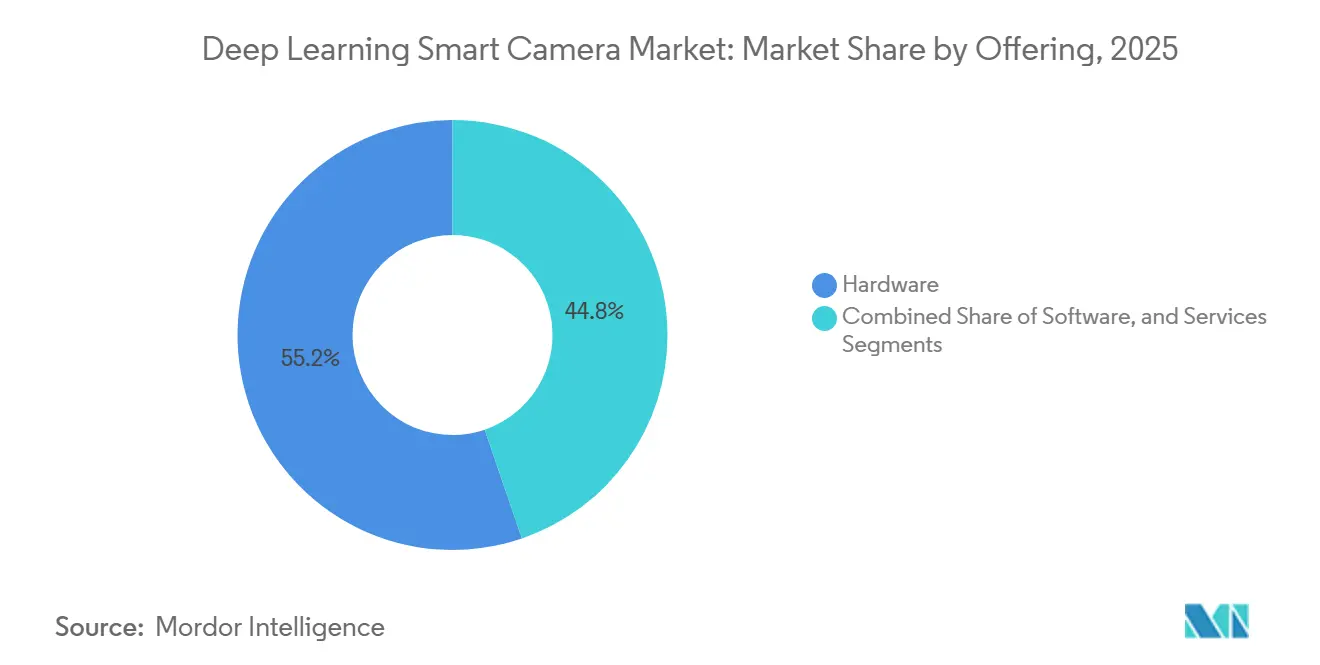
- By offering, hardware held 55.23% of the Deep Learning Smart Camera Market share in 2025, while software is projected to expand at a 15.23% CAGR through 2031.
- By product architecture, Smart Camera Systems accounted for 38.17% of the Deep Learning Smart Camera Market share in 2025, while AI Vision Platforms and APIs are expected to expand at a 15.17% CAGR through 2031.
- By imaging modality, 2D Vision Systems held 52.14% share in 2025, while Hyperspectral and Multispectral Imaging is projected to expand at a 15.36% CAGR through 2031.
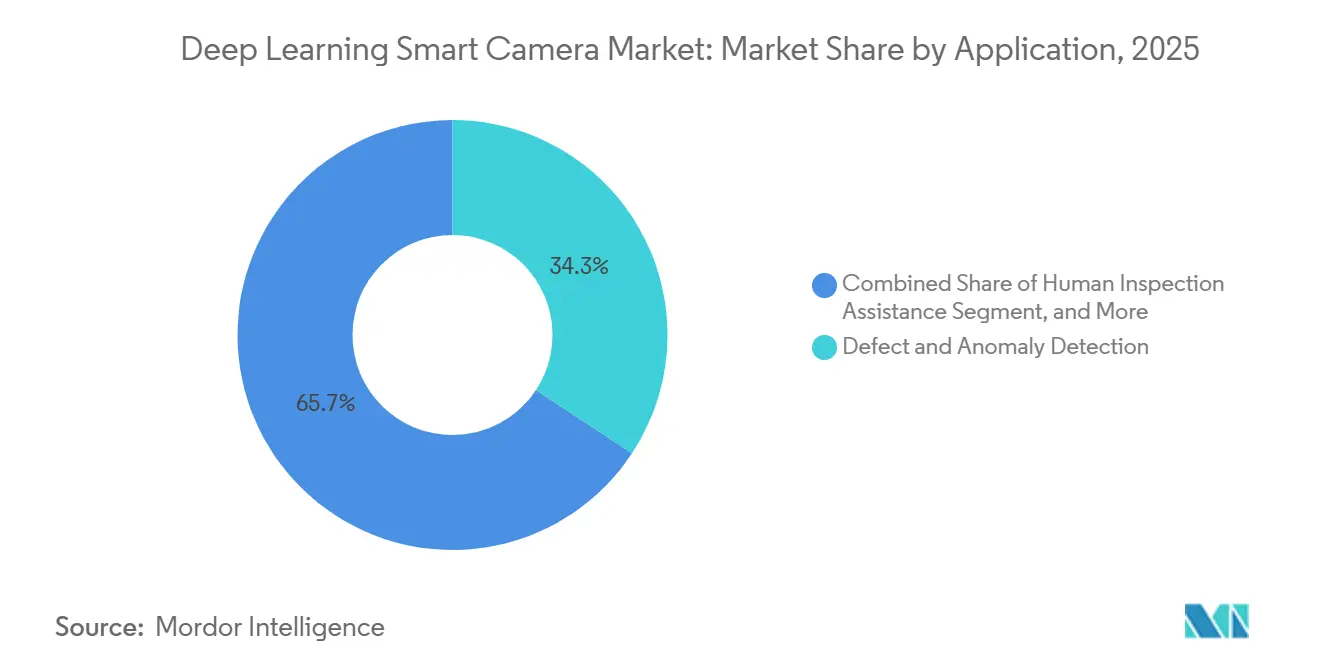
- By application, Defect and Anomaly Detection accounted for 34.26% share in 2025, while Human Inspection Assistance and Decision Support are projected to expand at a 14.24% CAGR through 2031.
- By end-user industry, Electronics and Semiconductors held 25.37% share in 2025, while Logistics and E-Commerce is expected to expand at a 14.42% CAGR through 2031.
- By geography, Asia-Pacific held 32.18% share in 2025 and is projected to expand at a 15.18% CAGR through 2031.
Note: Market size and forecast figures in this report are generated using Mordor Intelligence’s proprietary estimation framework, updated with the latest available data and insights as of January 2026.
Global Deep Learning Smart Camera Market Trends and Insights
Drivers Impact Analysis*
| Driver | (~) % Impact on CAGR Forecast | Geographic Relevance | Impact Timeline |
|---|---|---|---|
| Edge AI Inference Reducing Cloud Bandwidth and Latency | +3.2% | Global, with the strongest concentration in Asia-Pacific and North America | Short term (≤ 2 years) |
| ADAS and Autonomous Driving Camera Content Increasing | +2.4% | Global, with core gains in China, Europe, and the United States | Medium term (2-4 years) |
| Industry 4.0 Quality Control Automation | +2.1% | Global, strongest in electronics hubs across China, South Korea, Japan, Taiwan, and Germany | Short term (≤ 2 years) |
| Smart City and Public Safety Video Modernization | +1.6% | Asia-Pacific, with spillover to the Middle East, Europe, and South America | Medium term (2-4 years) |
| Privacy Preserving On-Device Learning for Regulated Deployments | +1.0% | Europe, North America, and regulated Asia-Pacific markets | Medium term (2-4 years) |
| Vision Language Models Expanding Camera Use Cases | +0.7% | North America and Europe in early adoption, with rapid scaling in Asia-Pacific | Long term (≥ 4 years) |
| Source: Mordor Intelligence | |||
Edge AI Inference Reducing Cloud Bandwidth and Latency
Edge processing is making inline vision inspection more practical because decisions can occur close to the production line. A 2026 systematic review found that cloud communication delays can allow equipment to move several centimeters before an inspection decision is made. That delay makes local processing more suitable for quality-control tasks that require immediate action and repeatable response times. The review also described edge-optimized models that use quantization, pruning, and compact hybrid designs to support sub-millisecond inference. These approaches send decision metadata rather than raw video, which reduces network demand and can simplify the handling of high-volume visual data. Cognex introduced the In-Sight 6900 Vision Controller in April 2026 with NVIDIA Jetson processing up to 157 TOPS, demonstrating that more complex models can run without external PCs. The Deep Learning Smart Camera Market benefits when camera capability can be added without a separate distributed computing setup.[1]Springer, “A Systematic Review of Deep Learning Based Machine Vision for Quality Control in Industry 4.0,” Discover Mechanical Engineering, link.springer.com.
ADAS and Autonomous Driving Camera Content Increasing
Driver-assistance systems are adding more camera functions for forward, surround-view, and driver-monitoring tasks. Each added function increases demand for higher-resolution sensors and local AI processing, particularly in vehicle systems that need timely visual information. Aptiv stated that its next-generation ADAS smart camera entered mass production in September 2026 for a Chinese automaker’s European vehicle program. The camera uses an 8MP sensor, a 120° field of view, and an automotive-grade system-on-chip. Aptiv reported that its single-chip design reduces hardware size and power consumption by 20%.[2]Aptiv PLC, “Aptiv’s Next-Generation ADAS Smart Camera Enters Mass Production in Global Vehicle Program of Leading Chinese Automaker,” Aptiv Investor Relations, aptiv.com. This consolidation can lower the integration burden while preserving the processing capacity needed for advanced functions. Automotive validation requirements also pose a barrier for suppliers without functional safety expertise.
Industry 4.0 Quality Control Automation
Manufacturers are adopting AI vision where inspection errors create direct yield and rework costs. A 2026 review of machine-learning vision for robotic inspection reported accuracy above 95% in many factory applications, with selected controlled settings reaching 98-100%.[3]National Center for Biotechnology Information, “Machine Learning-Powered Vision for Robotic Inspection in Manufacturing,” PubMed Central, pmc.ncbi.nlm.nih.gov. The same body of research showed that many implementations remain at the prototype or pilot stage. This leaves a pipeline of validated systems that still need to be integrated into production operations, including the workflows required to act on each camera decision. Hitachi announced in February 2025 a technique for identifying sub-10nm semiconductor defects from SEM images. Such requirements favor cameras, optics, and algorithms that can work at higher precision. Quality requirements in pharmaceutical, food, and industrial production also make automated records and repeatable decisions more important. The Deep Learning Smart Camera Market is supported by this need for inspection that can be documented and repeated at line speed.[4]Hitachi Ltd., “Development of Technology to Detect Sub-10nm Micro Defects in Semiconductor Manufacturing,” PRTimes, prtimes.jp.
Smart City and Public Safety Video Modernization
Cities are replacing older CCTV systems with AI-enabled cameras that identify events for operator review. This approach can reduce the need for continuous screen monitoring while allowing teams to focus on alerts that need a response. Videonetics stated that its platform connected 15,000 IP cameras across 28 districts in Andhra Pradesh by July 2026. The deployment covered public safety and smart mobility applications. Large public programs require cameras to perform several visual tasks within a single stream. These requirements support progress in edge computing and model compression that can also be used in industrial settings. The Deep Learning Smart Camera Market, therefore, benefits from demand beyond factory inspection.
Restraints Impact Analysis*
| Restraint | (~) % Impact on CAGR Forecast | Geographic Relevance | Impact Timeline |
|---|---|---|---|
| High Implementation Cost and Specialist Engineering Requirements | -2.0% | Global, most acute in small and medium-sized manufacturing businesses across South Asia, South America, and Southern Europe | Short term (≤ 2 years) |
| Privacy Regulation and Facial Recognition Restrictions | -1.5% | Europe, North America, and selected Asia-Pacific markets | Medium term (2-4 years) |
| Model Drift from Changing Camera Scenes and Long-Tail Events | -0.8% | Global, with higher exposure in high-mix manufacturing and outdoor deployments | Long term (≥ 4 years) |
| Cybersecurity Exposure Across Camera Fleets and AI Supply Chains | -1.0% | Global, with greater exposure in public safety and critical infrastructure | Medium term (2-4 years) |
| Source: Mordor Intelligence | |||
High Implementation Cost and Specialist Engineering Requirements
Cost and integration work remain important limits on broader deployment, especially for smaller manufacturers. A 2026 review found that systems integration can represent 30-50% of an AI vision project’s total spending. The review also noted a median lag of 3 years between academic publication and industrial deployment for mature methods. High-mix production adds an extra burden because each product may require separate training data and model updates, increasing the need for specialist support. UnitX introduced DeteX in June 2026 as a camera intended for deployment in 1 minute without vision engineering experience. Cognex also made OneVision generally available in May 2026 to support centralized development and deployment across sites. The Deep Learning Smart Camera Market depends on tools that reduce this initial implementation burden.
Privacy Regulation and Facial Recognition Restrictions
Biometric AI rules can delay camera purchases in public safety, retail, and security settings. The EU AI Act has restricted certain real-time remote biometric identification practices in publicly accessible spaces since February 2025. Vendors with multifunction camera platforms must control whether prohibited uses can be activated. This adds product-governance work and can lengthen procurement reviews, particularly for deployments that process personal visual data. The regulation also favors on-device methods that limit the movement of personal data. Those designs can support data residency needs and reduce exposure associated with centralized video processing. The Deep Learning Smart Camera Market must therefore balance broader analytical capabilities with tighter controls over how those capabilities are used.
*Our forecasts treat driver/restraint impacts as directional, not additive. The impact forecasts reflect baseline growth, mix effects, and variable interactions.
Segment Analysis
By Offering: Software Layer Accelerates as Hardware Matures
Hardware held 55.23% share in 2025. Sensors, neural processors, optics, and ruggedized housings remain the largest initial purchase items. Industrial buyers need camera systems that withstand production conditions and integrate with existing equipment. Automotive buyers also require components that meet demanding safety and reliability requirements. These needs keep hardware central to procurement decisions. Aptiv’s 2026 single-chip ADAS camera design reduced hardware size and power consumption by 20%. That design shows how suppliers are improving capability while reducing the physical burden of installation. Camera suppliers must still balance image quality, compute capacity, power use, and enclosure durability. Hardware revenue should remain important in the Deep Learning Smart Camera Market even as component costs change. The Deep Learning Smart Camera industry continues to depend on reliable embedded computing and imaging components.
Software is projected to expand at a 15.23% CAGR from 2026 to 2031. Model libraries, over-the-air updates, and development environments are increasing software’s role in each deployment. These tools allow a camera fleet to improve without replacing each physical device. Cognex made OneVision generally available in May 2026 after more than 100 customers took part in its beta program. The platform supports centralized model development and cloud-to-edge deployment. This approach can reduce separate engineering effort at each factory location. Services remain the smallest offering but support training, integration, and model retraining. Pilot projects moving into production should increase demand for those services. Higher software use per camera can gradually narrow the difference between hardware and software revenue. This shift is important for suppliers in the Deep Learning Smart Camera Market seeking recurring revenue.



By Product Architecture: Smart Camera Systems Lead While AI Platforms Reshape the Stack
Smart Camera Systems held 38.17% share in 2025. These products combine the sensor, processor, optics, and communications into a single unit. The integrated format reduces installation complexity for many production lines. It also reduces the need for dedicated computing hardware for standard inspection tasks. Automotive assembly, PCB inspection, and food sorting have established use cases for this format. Embedded Vision Systems support designs that need tailored integration within larger equipment. PC-Based Vision Systems remain relevant where resolution, frame rate, or thermal needs exceed compact camera limits. Aerospace measurement and semiconductor inspection can require that added capacity. The installed base gives Smart Camera Systems a durable position within the Deep Learning Smart Camera Market. The Deep Learning Smart Camera Market supports several architectures because production environments have different technical requirements.
AI Vision Platforms and APIs are expected to expand at a 15.17% CAGR from 2026 to 2031. They allow manufacturers to manage different models across multi-vendor camera fleets through one software layer. This can improve consistency when an organization uses cameras across many sites. Hikrobot introduced its VM Algorithm Platform 5.0 in 2025 with vision foundation models and edge-learning tools across its smart camera lineup. This model reduces dependence on separate hardware configurations for each task. It also gives suppliers a means to update functions without redesigning the camera platform. Functional-safety requirements affect platform selection in automotive and aerospace environments. Suppliers need to document the reliability of decisions that trigger equipment actions. Auditable confidence scores can make these platforms more suitable for higher-value applications. The Deep Learning Smart Camera Market will reward systems that combine flexibility with traceable decisions.
By Imaging Modality: 2D Vision Anchors Revenue While Spectral Modalities Extend Use Cases
2D Vision Systems accounted for 52.14% share in 2025. Their lower cost and familiar workflows support extensive use in industrial inspection. A 2026 review found that CNN-based 2D systems remained the most commonly deployed approach across the studies examined. Production teams also have more experience using 2D tools for defect classification. The approach is well-suited to tasks with stable lighting and visible surface characteristics. 3D systems serve robotic guidance, bin picking, and dimensional checks. Line-scan systems are well-suited to continuous web inspection applications. Area-scan systems support analysis of fixed parts. Infrared and near-infrared cameras can identify surface temperature patterns and subsurface issues that RGB images cannot show. The wide range of modalities allows users to select a system based on the inspection problem rather than a single camera format.
Hyperspectral and Multispectral Imaging is projected to expand at a 15.36% CAGR from 2026 to 2031. These methods can distinguish material characteristics that standard RGB imaging cannot separate. The capability is relevant to pharmaceutical contamination screening, battery cell grading, and food adulteration detection. A 2026 study reported a coefficient of determination of 0.99 when hyperspectral reflectance data were combined with RGB texture features for moisture monitoring in food processing. The result supported the value of combining complementary imaging inputs. Spectral methods can move some quality checks closer to the production line. X-Ray systems remain useful where objects or packaging are opaque. Multimodal systems can extend inspection into more complex production environments. Cost reductions in detectors should support wider use of these technologies. These modalities are extending the Deep Learning Smart Camera Market into applications where conventional imaging has limited value.
By Application: Defect Detection Leads While Human Inspection Assistance Expands
Defect and Anomaly Detection accounted for 34.26% of the Deep Learning Smart Camera Market size in 2025. Manufacturers use these systems where visual errors directly affect yield, rework, and product reliability. Electronics, semiconductor, and automotive lines create sustained demand for this application. The business case is strongest where a missed defect can affect many downstream units. Toshiba announced a one-shot optical technology in February 2025 to detect nanoscale defects on semiconductor wafer surfaces from a single image. The work demonstrates the continuing need for higher resolution and faster inspection. Assembly and presence verification remain high-volume uses of camera systems. Measurement, dimensional verification, and traceability checks also use the same installed equipment base. Process monitoring enables continuous observation when discrete inspection is insufficient. Defect detection, therefore, remains a core application in the Deep Learning Smart Camera Market across multiple manufacturing settings.
Human Inspection Assistance and Decision Support is projected to expand at a 14.24% CAGR from 2026 to 2031. This application uses camera outputs to give operators descriptions, confidence scores, and recommended actions. It goes beyond a simple pass-or-fail result. The intended role is to make visual findings easier for operators to review and act on. MaViLa, reported in the Journal of Manufacturing Systems in 2025, evaluated vision-language methods in smart-manufacturing settings. Such models can convert visual observations into structured reports for manufacturing systems. The approach can help operators review complex defects more consistently. It also makes image data more useful in workflows that still need human judgment. Adoption will depend on dependable model performance and clear operating controls. Suppliers that simplify this review process can address plants that are not ready for fully autonomous inspection.
By End-User Industry: Electronics Leads While Logistics Demand Surges
Electronics and Semiconductors held 25.37% share in 2025. Display, PCB, and semiconductor fabrication lines require precise inspection because small defects can affect yield. These environments also require cameras to support high throughput without compromising detection performance. Hitachi announced a machine-learning method in February 2025 for detecting sub-10nm semiconductor defects using SEM images. This need supports demand for capable cameras, optics, and inference processing. Automotive and electric vehicle production also requires inspection for vehicle components, battery cells, and paint quality. Pharmaceutical and medical-device manufacturing have strict validation needs. Food, beverage, packaging, and printing applications use vision for quality and traceability. Aerospace, metals, machinery, and plastics exhibit more varied surfaces and rarer defect conditions. These industries require suppliers to adapt their equipment and models to different line conditions.
Logistics and E-Commerce are projected to expand at a 14.42% CAGR from 2026 to 2031. Warehousing, returns processing, and robotic bin picking are driving demand for inspection in less-structured settings. This differs from fixed conveyor systems designed for predictable factory lines. Interact Analysis projected machine-vision spending in logistics to increase from USD 494 million in 2025 to USD 898 million in 2030. The segment’s needs include sortation, item identification, and automated handling. Cameras must process a wider variety of packaging, product shapes, and item conditions in these facilities. Solar and renewable-energy equipment also present an emerging use case. Electroluminescence and UV fluorescence imaging can help detect cracks in photovoltaic cells. The Deep Learning Smart Camera industry is therefore serving both established manufacturing and newer automated operations. This broader base of applications can reduce the Deep Learning Smart Camera Market's reliance on any single production sector.
Geography Analysis
Asia-Pacific held 32.18% share in 2025 and is projected to expand at a 15.18% CAGR through 2031. China supports demand through semiconductor investment, new-energy vehicle output, and smart-city programs. Japan contributes precision-manufacturing, robotics, and semiconductor-inspection expertise. South Korea adds demand from display and memory-chip fabrication. India is emerging as a manufacturing-capacity destination, and Hikrobot presented new machine-vision products in Mumbai in July 2026.
North America held the second-largest regional position in 2025. ADAS development, defense-related vision programs, and e-commerce logistics automation support demand in the region. Cognex introduced the NVIDIA Jetson-powered In-Sight 6900 in April 2026 and the Qualcomm-powered In-Sight 3900 in May 2026. Europe remains important because of Germany’s machine-tool base and inspection requirements in aerospace and pharmaceuticals. The EU AI Act affects procurement and product design for camera uses involving biometric data.
South America has early-stage but meaningful smart-city camera programs. San Isidro in Argentina replaced its analog CCTV network with 2,600 high-definition AI cameras in August 2026 through a USD 13 million investment. Gulf Cooperation Council countries are investing in smart-city infrastructure, while Sub-Saharan Africa remains largely at a proof-of-concept stage. Cybersecurity requirements are becoming more important for Deep Learning Smart Camera Market suppliers serving military and civilian programs across these regions.

Competitive Landscape
The Deep Learning Smart Camera Market is moderately consolidated among premium hardware and software suppliers. Cognex, KEYENCE, Basler, and Teledyne DALSA are established suppliers in the higher-value tier. Competition is more fragmented in AI software platforms, edge-AI startups, and regional Asian suppliers. Premium vendors are building connected development environments to create switching costs beyond the camera itself. Cognex’s OneVision platform supports centralized model development and multi-site deployment.
Suppliers are using different approaches to defend or build their position. Cognex introduced the In-Sight 6900 in April 2026 with NVIDIA Jetson processing for high-resolution AI models. It followed with the Qualcomm Dragonwing-powered In-Sight 3900 in May 2026. Advantech and Basler announced a partnership in April 2026 for a GMSL-based vision and robotics platform that uses Basler cameras and NVIDIA Jetson-enabled controllers. Hardware-agnostic software providers such as Landing AI and MVTec focus on enterprise deployments across mixed camera fleets.
UnitX represents a rapid-deployment approach for mid-market buyers. Its DeteX camera combines segmentation, classification, OCR, and dimensional measurement in one device. Low-cost, no-code products address the shortage of in-house vision engineering among smaller manufacturers. The Deep Learning Smart Camera Market remains competitive across integrated systems and software-led platforms.
Deep Learning Smart Camera Industry Leaders
Hangzhou Hikvision Digital Technology Co., Ltd.
Dahua Technology Co., Ltd.
Axis Communications AB
Hanwha Vision Co., Ltd.
Teledyne FLIR LLC
- *Disclaimer: Major Players sorted in no particular order

Recent Industry Developments
- September 2026: Aptiv PLC announced that its next-generation ADAS smart camera entered mass production for a leading Chinese NEV manufacturer's European-market vehicle program, featuring an 8MP/120° field-of-view sensor built on a Chinese automotive-grade SoC with Wind River Kaiwu RTOS and designed to meet Euro NCAP 2026 five-star safety requirements. The single-SoC architecture reduces hardware size and power consumption each by 20%, lowering system BOM cost.
- August 2026: Changhong AI and Digital Product R&D Center launched a proprietary full-chain industrial intelligent detection system leveraging deep learning and industrial visual foundation models with a "pre-training plus fine-tuning" architecture. The system achieves micron-level detection precision across incoming material inspection, assembly, warehousing, and factory safety scenarios, and is described as capable of rapid adaptation across multiple industries and production lines without separate per-line engineering.
- July 2026: Hikrobot India introduced the Hikpad Autonomous Mobile Robot and three new machine vision products, CI Series Infrared LWIR cameras, CT Series Industrial Area Scan Cameras, and MV-ID800 Series Smart Code Readers, at Automation Expo in Mumbai from July 22-25, 2026, marking a significant expansion of the company's smart manufacturing portfolio in India.
- June 2026: UnitX launched DeteX, an 8-megapixel, 30 fps AI smart camera designed to deploy in 1 minute without vision engineering expertise, offering AI segmentation, multi-class classification, OCR, and dimensional measurement in a single device. UnitX states the camera is trusted to inspect over USD 15 billion in products annually across 190+ manufacturing facilities worldwide. DeteX was debuted at Automate 2026 in Chicago.


Global Deep Learning Smart Camera Market Report Scope
Deep Learning Smart Cameras are advanced vision systems that integrate high-performance image sensors with embedded artificial intelligence processors, enabling real-time execution of complex deep learning algorithms for automated defect detection, classification, and decision-making directly at the edge without relying on external computing infrastructure.
The Deep Learning Smart Camera Market Report is Segmented by Offering (Hardware, Software, and Services), Product Architecture (Smart Camera Systems, Embedded Vision Systems, PC-Based Vision Systems, and AI Vision Platforms and APIs), Imaging Modality (2D Vision Systems, 3D Vision Systems, Line-Scan Imaging, Area-Scan Imaging, Infrared and Near-Infrared Imaging, Hyperspectral and Multispectral Imaging, and X-Ray and Multimodal Vision Systems), Application (Defect and Anomaly Detection, Assembly and Presence Verification, Measurement and Dimensional Verification, Identification, Label and Traceability Verification, Surface Classification and Grading, Process Monitoring and WIP Inspection, Human Inspection Assistance and Decision Support, and Other Applications), End-User Industry (Electronics and Semiconductors, Automotive and Electric Vehicles, Pharmaceuticals and Medical Devices, Food and Beverage, Packaging and Printing, Metals, Machinery and Industrial Equipment, Glass, Rubber and Plastics, Aerospace and Defense, Solar Panels and Renewable Energy Equipment, Logistics and E-Commerce, and Other End-User Industries), and Geography (North America, South America, Europe, Asia-Pacific, Middle East and Africa). The Market Forecasts are Provided in Terms of Value (USD).
| Hardware |
| Software |
| Services |
| Smart Camera Systems |
| Embedded Vision Systems |
| PC-Based Vision Systems |
| AI Vision Platforms and APIs |
| 2D Vision Systems |
| 3D Vision Systems |
| Infrared and Near-Infrared Imaging |
| Hyperspectral and Multispectral Imaging |
| X-Ray and Multimodal Vision Systems |
| Defect and Anomaly Detection |
| Assembly and Presence Verification |
| Measurement and Dimensional Verification |
| Identification, Label and Traceability Verification |
| Human Inspection Assistance and Decision Support |
| Other Applications |
| Electronics and Semiconductors |
| Automotive and Electric Vehicles |
| Pharmaceuticals and Medical Devices |
| Food and Beverage |
| Packaging and Printing |
| Logistics and E-Commerce |
| Other End-User Industries |
| North America | United States | |
| Canada | ||
| Mexico | ||
| South America | Brazil | |
| Argentina | ||
| Rest of South America | ||
| Europe | Germany | |
| United Kingdom | ||
| France | ||
| Italy | ||
| Spain | ||
| Rest of Europe | ||
| Asia-Pacific | China | |
| Japan | ||
| India | ||
| South Korea | ||
| Rest of Asia-Pacific | ||
| Middle East and Africa | Middle East | Saudi Arabia |
| United Arab Emirates | ||
| Turkey | ||
| Rest of the Middle East | ||
| Africa | South Africa | |
| Nigeria | ||
| Rest of Africa | ||
| By Offering | Hardware | ||
| Software | |||
| Services | |||
| By Product Architecture | Smart Camera Systems | ||
| Embedded Vision Systems | |||
| PC-Based Vision Systems | |||
| AI Vision Platforms and APIs | |||
| By Imaging Modality | 2D Vision Systems | ||
| 3D Vision Systems | |||
| Infrared and Near-Infrared Imaging | |||
| Hyperspectral and Multispectral Imaging | |||
| X-Ray and Multimodal Vision Systems | |||
| By Application | Defect and Anomaly Detection | ||
| Assembly and Presence Verification | |||
| Measurement and Dimensional Verification | |||
| Identification, Label and Traceability Verification | |||
| Human Inspection Assistance and Decision Support | |||
| Other Applications | |||
| By End-User Industry | Electronics and Semiconductors | ||
| Automotive and Electric Vehicles | |||
| Pharmaceuticals and Medical Devices | |||
| Food and Beverage | |||
| Packaging and Printing | |||
| Logistics and E-Commerce | |||
| Other End-User Industries | |||
| By Geography | North America | United States | |
| Canada | |||
| Mexico | |||
| South America | Brazil | ||
| Argentina | |||
| Rest of South America | |||
| Europe | Germany | ||
| United Kingdom | |||
| France | |||
| Italy | |||
| Spain | |||
| Rest of Europe | |||
| Asia-Pacific | China | ||
| Japan | |||
| India | |||
| South Korea | |||
| Rest of Asia-Pacific | |||
| Middle East and Africa | Middle East | Saudi Arabia | |
| United Arab Emirates | |||
| Turkey | |||
| Rest of the Middle East | |||
| Africa | South Africa | ||
| Nigeria | |||
| Rest of Africa | |||


Key Questions Answered in the Report
What is the Deep Learning Smart Camera Market size?
The Deep Learning Smart Camera Market is estimated at USD 2.88 billion in 2026 and is forecast to reach USD 5.23 billion by 2031 at a 12.67% CAGR.
Which offering leads demand for deep learning smart cameras?
Hardware led with 55.23% share in 2025 because sensors, processors, optics, and enclosures remain major procurement items.
Which imaging modality has the largest share?
2D Vision Systems held 52.14% share in 2025, supported by familiar workflows and lower processing complexity.
Which application is largest for these systems?
Defect and Anomaly Detection held 34.26% share in 2025, reflecting its importance in yield-sensitive manufacturing.
Which end-user sector is expanding fastest?
Logistics and E-Commerce is projected to expand at a 14.42% CAGR through 2031 because of automated sorting, returns processing, and robotic picking.
Which region is expected to lead expansion?
Asia-Pacific held 32.18% share in 2025 and is projected to expand at a 15.18% CAGR through 2031.
Page last updated on:


 Your data is secure and never sold or shared.


