
3D Robot Guidance Systems Market Size and Share
Market Overview
| Study Period | 2020 - 2031 |
|---|---|
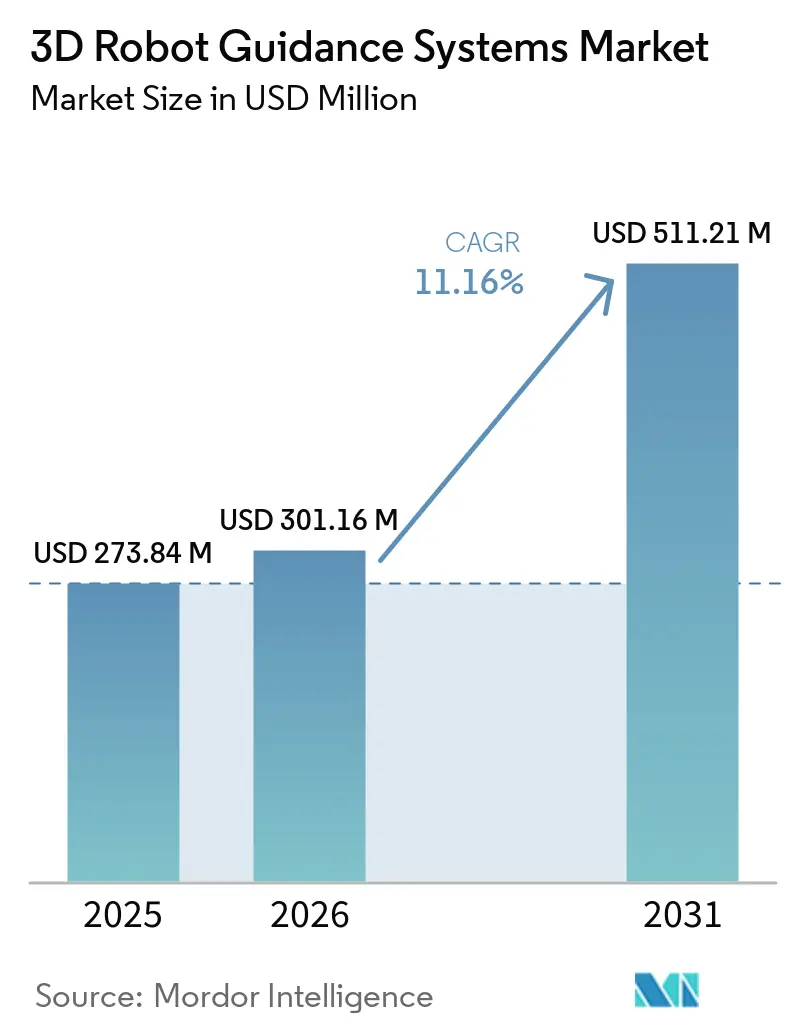
| Market Size (2026) | USD 301.16 Million |
| Market Size (2031) | USD 511.21 Million |
| Growth Rate (2026 - 2031) | 11.16 % |
| Fastest Growing Market | Middle East and Africa |
| Largest Market | Asia-Pacific |
| Market Concentration | Medium |
Major Players *Disclaimer: Major Players sorted in no particular order Image © Mordor Intelligence. Reuse requires attribution under CC BY 4.0. | |
3D Robot Guidance Systems Market Analysis by Mordor Intelligence
The 3D robot guidance systems market size is projected to expand from USD 273.84 million in 2025 and USD 304.41 million in 2026 to USD 511.21 million by 2031, registering a CAGR of 11.16% between 2026 to 2031. The 3D robot guidance systems market is benefiting from sustained demand for automation in tasks that still depend on manual handling and judgment. It supports automation of random-orientation bin picking, fixture-free high-mix assembly, and machine tending for irregular parts. These applications extend automation into workflows that fixed programming could not address. Suppliers are therefore focusing on software that can work across different robot and camera platforms. High integration costs and unreliable sensing on reflective, transparent, or contaminated surfaces remain important limits on wider adoption.
Key Report Takeaways
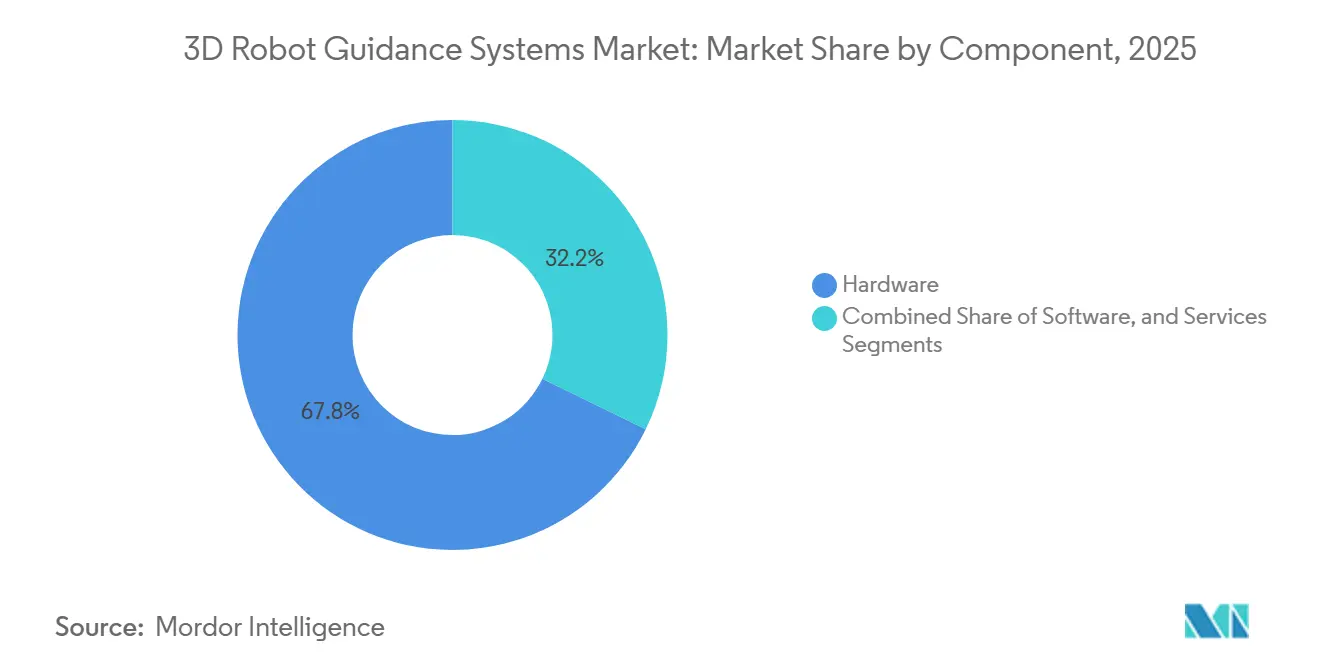
- By component, hardware held 67.78% share of the 3D robot guidance systems market in 2025, while software is projected to expand at a 12.98% CAGR through 2031.
- By 3D vision technology, stereo vision held 32.45% revenue share in 2025, while time-of-flight is expected to expand at a 12.41% CAGR through 2031.
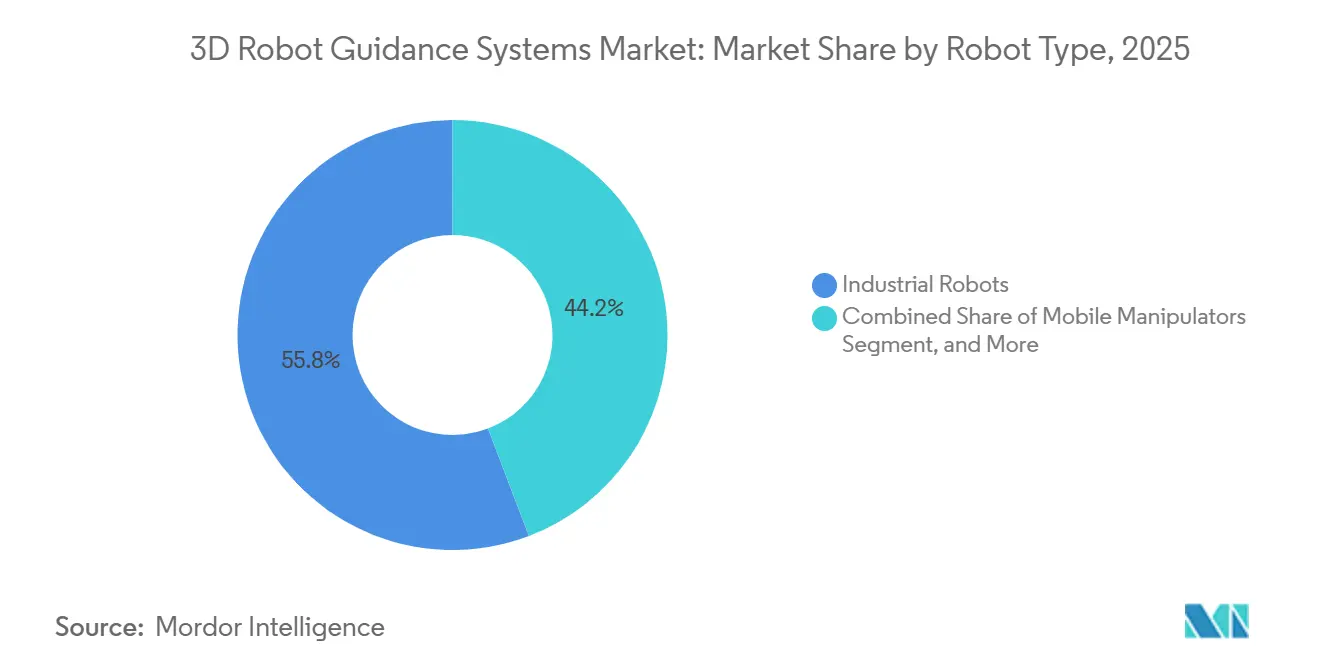
- By robot type, industrial robots accounted for 55.78% share of the 3D robot guidance systems market in 2025, while mobile manipulators are projected to expand at a 12.97% CAGR through 2031.
- By guidance function, object localization and pose estimation held 25.89% share in 2025, while bin picking guidance is expected to expand at a 12.78% CAGR through 2031.
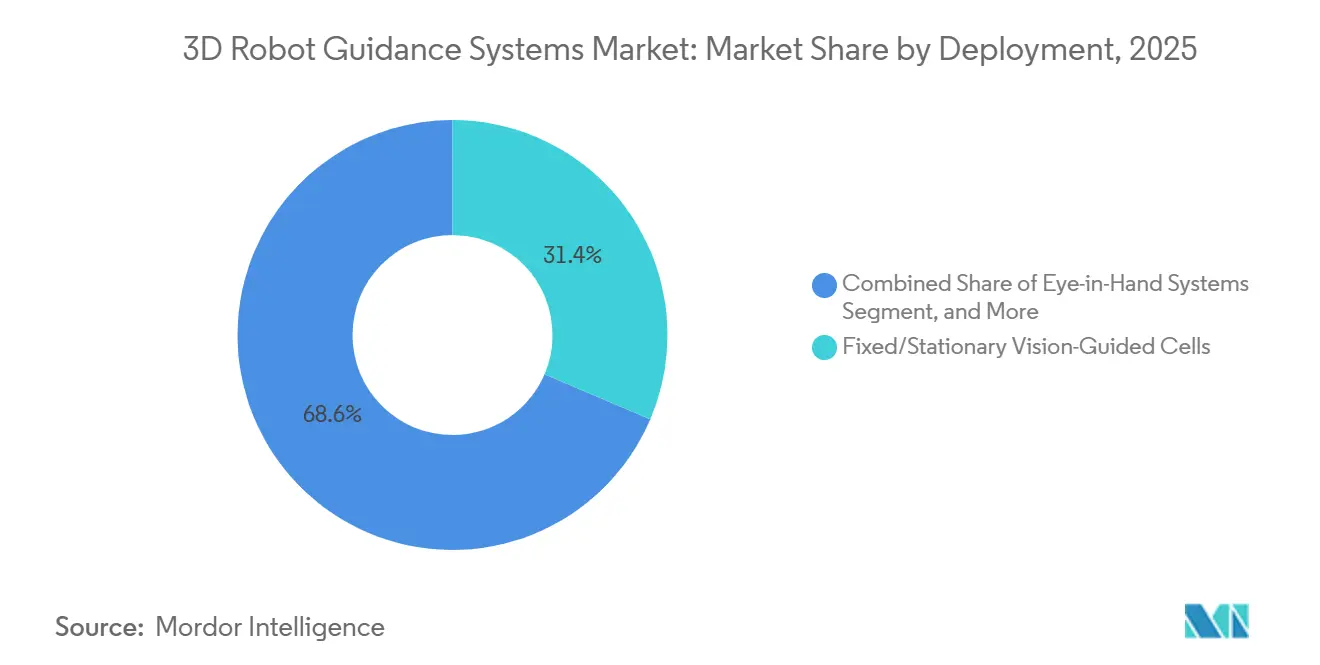
- By deployment, fixed and stationary vision-guided cells accounted for 31.41% share in 2025, while mobile and on-robot guidance systems are projected to expand at a 12.11% CAGR through 2031.
- By end-user industry, automotive and automotive components held 31.21% share in 2025, while logistics and warehousing is expected to expand at a 12.65% CAGR through 2031.
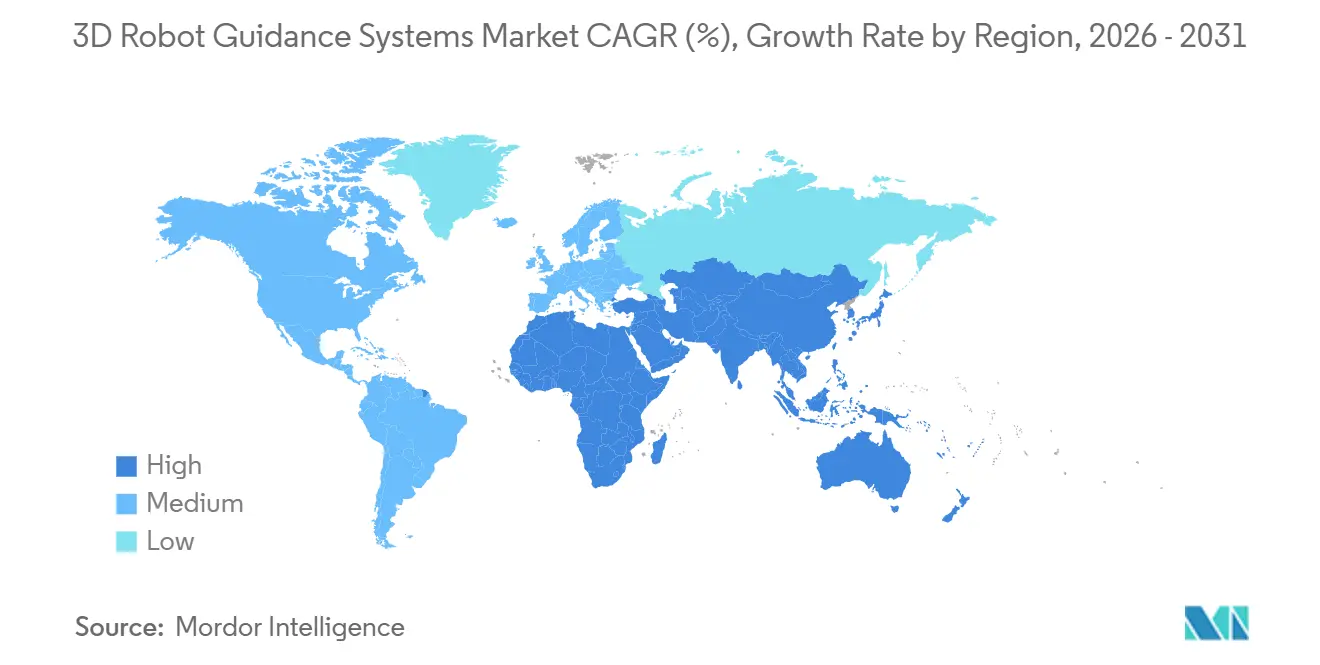
- By geography, Asia-Pacific held 40.12% share of the 3D robot guidance systems market in 2025, while Middle East and Africa is projected to expand at a 12.54% CAGR through 2031.
Note: Market size and forecast figures in this report are generated using Mordor Intelligence’s proprietary estimation framework, updated with the latest available data and insights as of January 2026.
Global 3D Robot Guidance Systems Market Trends and Insights
Drivers Impact Analysis*
| Driver | (~) % Impact on CAGR Forecast | Geographic Relevance | Impact Timeline |
|---|---|---|---|
| Manufacturing Labor Shortages and Rising Labor Costs | +3.1% | Global | Short term (≤ 2 years) |
| Higher 3D Perception Accuracy and AI Grasp Planning | +2.5% | Global, with early concentration in North America and Asia-Pacific | Medium term (2-4 years) |
| Flexible Automation for High-Mix Production | +1.9% | North America and Europe | Medium term (2-4 years) |
| Expansion of E-Commerce Fulfillment Automation | +1.6% | Asia-Pacific and North America, with spillover to Europe | Short term (≤ 2 years) |
| Safer Handling of Heavy, Sharp, and Contaminated Parts | +0.8% | Global, with early gains in automotive and pharmaceutical clusters | Medium term (2-4 years) |
| Synthetic-Data Training Reducing New-Part Commissioning Time | +0.6% | North America, Europe, and Asia-Pacific core | Long term (≥ 4 years) |
| Source: Mordor Intelligence | |||
Manufacturing Labor Shortages and Rising Labor Costs
Labor availability and labor costs continue to encourage manufacturers to invest in automated handling. The International Federation of Robotics recorded 542,000 industrial robot installations worldwide in 2024. Asia accounted for 74% of those new installations, confirming the scale of the installed robot base that can use guidance upgrades.[1] Staffing pressure is especially relevant for bin picking, machine tending, and assembly insertion, where human dexterity has historically been difficult to replace. The 3D robot guidance systems market gives integrators a means to automate these variable tasks without relying on fixed fixtures. This widens the set of production processes that can justify robot investment.
Higher 3D Perception Accuracy and AI Grasp Planning
Improved perception and grasp planning are reducing the need for highly structured production settings. ABB launched OmniCore EyeMotion in September 2025 as a hardware-agnostic vision software toolbox that can reduce commissioning time by up to 90% and cycle time by up to 50% in relevant configurations.[2] ABB and NVIDIA announced RobotStudio HyperReality in March 2026 to integrate NVIDIA Omniverse libraries into ABB simulation workflows. FANUC also announced work with NVIDIA technologies for simulation, virtual commissioning, and edge deployment across its robot portfolio. ZeroGrasp research presented at CVPR 2025 showed how 3D reconstruction and grasp-pose prediction can be combined for novel objects using synthetic training data. KUKA introduced its Automation Management Platform in March 2026 to connect rule-based automation with AI-supported operations.
Flexible Automation for High-Mix Production
High-mix, low-volume production has remained difficult for rigid automation because product changes require frequent adjustment. Festo introduced GripperAI in May 2026 for mixed-product robotic handling without custom programming or template loading between stock-keeping units.[3] Cognex states that modern vision systems can learn new parts and guide robots or inspection processes in high-mix settings. This reduces the dependence on lengthy reprogramming during product changeovers. The 3D robot guidance systems market can therefore reach smaller manufacturers that could not justify fixed automation for short runs. It also adds demand from applications that sit alongside established high-volume automotive and electronics lines.
Expansion of E-Commerce Fulfillment Automation
E-commerce fulfillment requires systems that can manage varied stock keeping units under continuous throughput pressure. Vention launched Rapid Operator AI in March 2026 for deep bin picking of randomly oriented parts in dense clutter. Brightpick introduced Gridpicker in March 2026, combining AI-powered mobile manipulators with high-density grid fulfillment. Geek+ launched RoboShuttle V5 in March 2026 with an integrated robot-arm picking station for tote-to-person workflows. These releases show a move from individual automation cells toward connected picking workflows. Vendors that combine perception, software, and automation equipment are better positioned than suppliers offering only stand-alone sensors.
Restraints Impact Analysis*
| Restraint | (~) % Impact on CAGR Forecast | Geographic Relevance | Impact Timeline |
|---|---|---|---|
| High Upfront Integration and Commissioning Costs | -1.5% | Global, most acute in emerging markets and among mid-sized manufacturers | Short term (≤ 2 years) |
| Occlusion, Reflectivity, and Part-Surface Variability | -1.0% | Global, with concentration in automotive, heavy machinery, and pharmaceutical industries | Medium term (2-4 years) |
| Sparse Edge-Case Data for Rare Part Poses | -0.7% | Global | Medium term (2-4 years) |
| Supplier Qualification and Cybersecurity Friction in Connected Cells | -0.5% | North America and Europe, where compliance factors are most stringent | Medium term (2-4 years) |
| Source: Mordor Intelligence | |||
High Upfront Integration and Commissioning Costs
Integration and commissioning costs remain a near-term barrier for 3D robot guidance systems. Viroteq states that a standard 3D vision-guided bin-picking cell can require 10-14 weeks of commissioning for random tangled-bin configurations. Gripper selection, lighting adjustment, manufacturing execution system integration, and supervised ramp-up can all extend the process. Long payback periods are more difficult for small and mid-sized manufacturers to absorb. Commissioning time can act as a practical limit on the 3D robot guidance systems market because economically marginal buyers delay projects. Automated configuration, simulation-first workflows, and robot-agnostic deployment can help suppliers reduce this barrier.
Occlusion, Reflectivity, and Part-Surface Variability
Surface conditions can prevent 3D sensors from delivering stable pose estimates. A 2025 study on reflective workpieces found that standard depth sensing can produce unstable predictions on specular surfaces and may need iterative refinement. Mech-Mind identifies brake discs, bearing sleeves, and inertia rings as difficult imaging targets because of stacking, nesting, partial occlusion, and reflective surfaces. These conditions are common in automotive, medical, and heavy-industry processes where automation value is high. ISO 10218-1:2025 and ISO 10218-2:2025 added updated requirements for industrial robots, applications, and robot cells. Integrators may need multi-exposure imaging, polarized lighting, or other sensing approaches alongside compliant safety architecture.
*Our forecasts treat driver/restraint impacts as directional, not additive. The impact forecasts reflect baseline growth, mix effects, and variable interactions.
Segment Analysis
By Component: Software Revenue Is Rewiring the Value Chain
Hardware held 67.78% share of the 3D robot guidance systems market in 2025. Cameras, structured-light projectors, and compute units remain the physical base of a guidance cell. The segment benefits from the capital-intensive nature of initial installations. Customers also continue to prefer qualified sensing equipment from established suppliers. Hardware demand supports vendors' access to broader automation deployments even as software becomes more capable.
Software is projected to expand at a 12.98% CAGR through 2031. AI-native platforms separate the intelligence layer from proprietary sensing equipment and support recurring software or outcome-linked revenue. Services remain important because integration, maintenance, retraining, and support increase as installed fleets expand. ABB's OmniCore EyeMotion works with third-party cameras, which illustrates the move toward hardware-agnostic software. Cognex launched the In-Sight 3900 Vision System in May 2026 with edge AI processing and OneVision connectivity.

By 3D Vision Technology: ToF Miniaturization Reshapes Eye-in-Hand Configurations
Stereo vision held 32.45% of the 3D robot guidance systems market in 2025. Its position reflects accessible costs, broad hardware compatibility, and a long record in industrial robot cells. System integrators are familiar with stereo calibration processes and mature toolchains support its use. Structured-light 3D vision also remains relevant where stationary applications need sub-millimeter accuracy. Laser triangulation and 3D laser scanning address specialized metrology-grade requirements.
Time-of-flight is projected to expand at a 12.41% CAGR through 2031. Smaller sensors and lower costs make real-time depth mapping more practical in end-effector-mounted systems. STMicroelectronics announced volume production of its VL53L9CX direct time-of-flight 3D LiDAR for availability from July 2026. IDS Imaging launched the Nion industrial time-of-flight camera in April 2026 for logistics and robotics use. High frame rates and reduced dependence on ambient light support eye-in-hand use and align with mobile manipulator demand.
By Robot Type: Industrial Robots Retain Scale, Mobile Manipulators Signal the Next Frontier
Industrial robots accounted for 55.78% share of the 3D robot guidance systems market in 2025. Stationary robot cells remain central to automotive and electronics manufacturing, where applications require short cycle times and repeatable handling. The global installed base gives manufacturers a large pool of systems that can receive vision upgrades. The International Federation of Robotics recorded 542,000 industrial robot installations in 2024. Collaborative robots also support medium and high payload handling where robots operate close to people.
Mobile manipulators are projected to expand at a 12.97% CAGR through 2031. They move 3D guidance beyond fixed cells and into aisles and changing work areas. Brightpick's Gridpicker uses AI-powered mobile manipulators in a grid-storage environment. Such systems map surrounding areas while completing manipulation tasks and need closer coordination of navigation, perception, and grasp planning. This increases the value of tightly integrated guidance software and sensing equipment.
By Guidance Function: Bin Picking Growth Reflects Demand for Flexible Handling
Object localization and pose estimation held 25.89% share in 2025. It is a required step for many other robot guidance functions. Pick-and-place guidance supports high-volume material movement. Machine tending guidance serves process-stable applications in heavy manufacturing. Assembly and insertion guidance is gaining interest for connector insertion and subassembly work in automotive final assembly.
Bin picking guidance is projected to expand at a 12.78% CAGR through 2031. It automates a difficult form of manual handling in manufacturing and logistics. Vention stated that Rapid Operator AI can support deep bin picking for opaque, translucent, and transparent materials . The 3D robot guidance systems market benefits as bin picking shifts from a specialized integration project toward a more repeatable deployment. Suppliers are widening robot-brand compatibility so end users can add guidance to mixed fleets without replacing installed robots.
By Deployment: Fixed Cells Lead, Mobile Configurations Change Coverage Economics
Fixed and stationary vision-guided cells held 31.41% share in 2025. Automotive body shops, electronics surface-mount lines, and food and beverage packaging applications support this installed base. These settings generally operate within defined work envelopes. Eye-to-hand systems suit high-throughput work, while eye-in-hand systems provide flexibility for multi-step assembly. The design choice depends on payload limits, motion requirements, and cable management.
Mobile and on-robot guidance systems are projected to expand at a 12.11% CAGR through 2031. Their progress follows wider deployment of mobile manipulators and flexible automation. ISO 10218-2:2025 addresses industrial robot applications and robot cells, including integration and commissioning requirements. KUKA's iiQKA.AI Vision integrates vision functions in the robot controller for bin picking, assembly, quality control, and depalletizing. Controller-level integration can reduce brownfield deployment effort and make mobile coverage more practical.
By End-User Industry: Automotive Anchors Demand, Logistics Accelerates
Automotive and automotive components held 31.21% of the 3D robot guidance systems market in 2025. Dense robot populations support demand in welding, component assembly, and engine-line machine tending. Electric vehicle production adds requirements for battery pack assembly, motor winding, and lightweight material handling. These tasks can involve part shapes that fixed programming cannot address without 3D guidance. Electronics, semiconductors, food and beverage, machinery, and industrial equipment also require precision, safety, and repeatability.
Logistics and warehousing is projected to expand at a 12.65% CAGR through 2031. E-commerce infrastructure and efforts to reduce per-pick labor needs support this direction. Pharmaceutical and healthcare applications require specific sensor materials, enclosures, and validation records, which can favor turnkey systems. Food processing and chemical handling also benefit where robots handle contaminated or sharp materials. The 3D robot guidance systems industry serves both established manufacturing lines and variable fulfillment operations.
Geography Analysis
Asia-Pacific held 40.12% share of the 3D robot guidance systems market in 2025. The region has the highest concentration of industrial robot installations. Asia accounted for 74% of global new robot deployments in 2024. China, Japan, South Korea, and ASEAN countries support regional volume. South Korea's robot density reached 1,012 units per 10,000 manufacturing workers, which supports a deep installed base for guidance upgrades.
India is an important acceleration location for the 3D robot guidance systems market. Tamil Nadu's automotive corridor and expanding electronics zones support adoption beyond basic material handling. Vietnam, Thailand, and Malaysia are adding greenfield manufacturing capacity where facilities can specify 3D guidance at the design stage. China continues to direct investment toward smart-factory applications, including battery manufacturing and consumer electronics assembly.
North America and Europe remain major demand centers in the 3D robot guidance systems market after Asia-Pacific. Automotive and aerospace applications support their demand, while reshoring supports current-generation automation installations. Germany retains extensive knowledge in machine tending and precision assembly through companies such as KUKA, SICK, and Roboception. Middle East and Africa is projected to expand at a 12.54% CAGR through 2031 as industrialization and logistics infrastructure investment increase. South America remains at an earlier stage, with Brazil's automotive sector acting as its main demand base.
Competitive Landscape
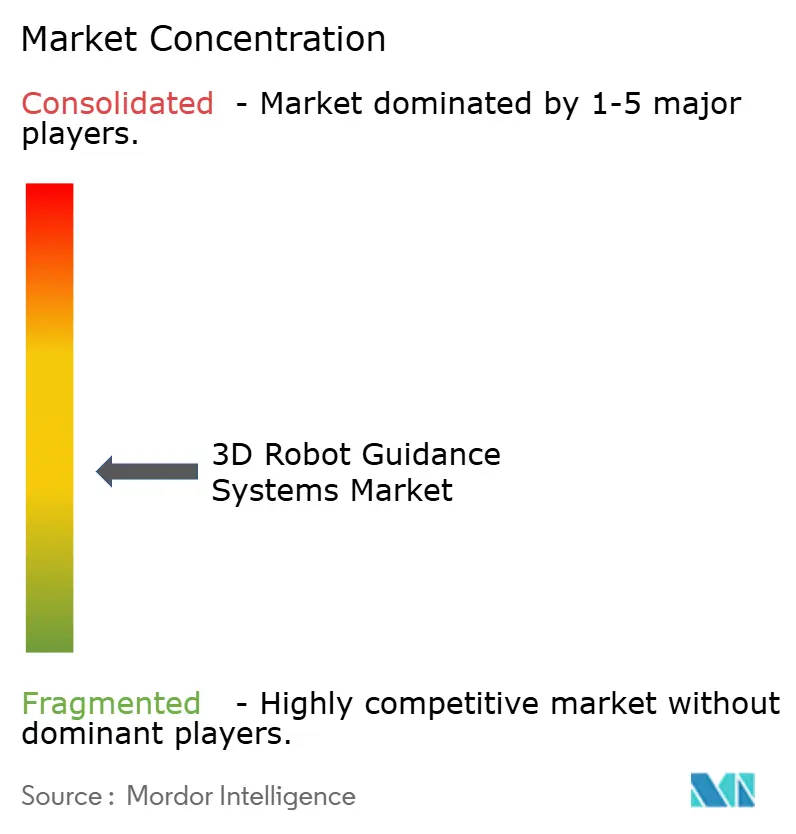
The 3D robot guidance systems market has a moderately fragmented supplier structure. ABB, FANUC, Siemens, KUKA, and Yaskawa compete through integrated automation platforms and robot-native vision tools. Mech-Mind, Photoneo, Pick-it, Roboception, and Apera AI compete through specialized perception and robot-agnostic systems. Photorealistic simulation and synthetic-data workflows are becoming common areas of product development. ABB, FANUC, and KUKA have each announced work involving NVIDIA simulation or AI technologies.
Mech-Mind demonstrated transparent-object picking, sheet-metal machine tending, and conveyor tracking at Automate 2026 as it sought design wins in North America and Europe. Cognex launched the In-Sight 6900 Vision Controller in April 2026 for complex inspection and robot guidance workloads. Its OneVision ecosystem supports centralized model development and deployment across production sites. These moves address the need for common software environments across cameras and robot fleets.
SICK has extended its positioning toward mobile robot localization with Triton Floor-LOC. ISO 10218:2025 increases the importance of safety and cybersecurity validation for robot-cell suppliers. Smaller specialists such as Apera AI and Solomon Technology compete through application-specific performance. Zebra Technologies is relevant through Photoneo, while Stäubli is most relevant when the scope includes robot platforms that integrate third-party guidance systems.
3D Robot Guidance Systems Industry Leaders
-
FANUC Corporation
-
ABB Ltd.
-
KUKA AG
-
Yaskawa Electric Corporation
-
Cognex Corporation
- *Disclaimer: Major Players sorted in no particular order
Recent Industry Developments
- July 2026: Robo.ai and Abu Dhabi-based Eleven International Holdings established Alif Holding, a joint venture AI industrial technology group to deploy robotics, computer vision, digital twin, and industrial AI platforms across UAE, GCC, and global markets, with a four-phase roadmap progressing from technology acquisition to local UAE manufacturing.
- June 2026: STMicroelectronics began mass production of the VL53L9CX, the world's highest-resolution direct time-of-flight 3D LiDAR module with 2,268 zones and a 5 cm to 9 m range at up to 100 fps, designed for robotics, industrial automation, and AR/VR applications, with global customer shipments commencing in July 2026.
- June 2026: Mech-Mind Robotics participated at Automate 2026, unveiling its Mech-Station InstaPick robotic loading and unloading station and the Mech-Station InstaDepal depalletizing station, alongside live demonstrations of transparent-object picking, sheet-metal machine tending, and dynamic conveyor-tracking guidance.
- May 2026: Cognex Corporation launched the In-Sight 3900 Vision System on May 5, powered by Qualcomm Dragonwing platforms, delivering embedded AI processing at the edge for demanding inspection and guidance applications, and the system integrates with OneVision for centralized model development and cross-site AI deployment.
Global 3D Robot Guidance Systems Market Report Scope
The 3D Robot Guidance Systems Market refers to the industry focused on hardware, software, sensors, cameras, and vision-based technologies that enable robots to perceive, identify, locate, and interact with objects in three-dimensional space with high precision and autonomy.
The 3D Robot Guidance Systems Market Report is Segmented by Component (Hardware, Software, and Services), by 3D Vision Technology (Stereo Vision, Structured-Light 3D Vision, Time-of-Flight (ToF), Laser Triangulation/3D Laser Scanning, and Other 3D Vision Technologies), by Robot Type (Industrial Robots, Collaborative Robots (Cobots), Mobile Manipulators, and Other Robots), by Guidance Function (Object Localization and Pose Estimation, Pick and Place Guidance, Bin Picking Guidance, Machine Tending Guidance, Assembly and Insertion Guidance, and Other Guidance Functions), by Deployment (Fixed/Stationary Vision-Guided Cells, Eye-in-Hand Systems, Eye-to-Hand Systems, and Mobile/On-Robot Guidance Systems), by End-User Industry (Automotive and Automotive Components, Electronics and Semiconductors, Machinery and Industrial Equipment, Logistics and Warehousing, Food and Beverage, Pharmaceutical and Healthcare, and Other End-User Industries), and by Geography (North America, South America, Europe, Asia-Pacific, and Middle East and Africa). The Market Forecasts are Provided in Terms of Value (USD).
| Hardware |
| Software |
| Services |
| Stereo Vision |
| Structured-Light 3D Vision |
| Time-of-Flight (ToF) |
| Laser Triangulation/3D Laser Scanning |
| Other 3D Vision Technologies |
| Industrial Robots |
| Collaborative Robots (Cobots) |
| Mobile Manipulators |
| Other Robots |
| Object Localization and Pose Estimation |
| Pick and Place Guidance |
| Bin Picking Guidance |
| Machine Tending Guidance |
| Assembly and Insertion Guidance |
| Other Guidance Functions |
| Fixed/Stationary Vision-Guided Cells |
| Eye-in-Hand Systems |
| Eye-to-Hand Systems |
| Mobile/On-Robot Guidance Systems |
| Automotive and Automotive Components |
| Electronics and Semiconductors |
| Machinery and Industrial Equipment |
| Logistics and Warehousing |
| Food and Beverage |
| Pharmaceutical and Healthcare |
| Other End-User Industries |
| North America | United States | |
| Canada | ||
| Mexico | ||
| South America | Brazil | |
| Argentina | ||
| Rest of South America | ||
| Europe | Germany | |
| United Kingdom | ||
| France | ||
| Italy | ||
| Spain | ||
| Rest of Europe | ||
| Asia-Pacific | China | |
| Japan | ||
| India | ||
| South Korea | ||
| ASEAN | ||
| Rest of Asia-Pacific | ||
| Middle East and Africa | Middle East | Saudi Arabia |
| United Arab Emirates | ||
| Rest of the Middle East | ||
| Africa | Egypt | |
| South Africa | ||
| Rest of Africa | ||
| By Component | Hardware | ||
| Software | |||
| Services | |||
| By 3D Vision Technology | Stereo Vision | ||
| Structured-Light 3D Vision | |||
| Time-of-Flight (ToF) | |||
| Laser Triangulation/3D Laser Scanning | |||
| Other 3D Vision Technologies | |||
| By Robot Type | Industrial Robots | ||
| Collaborative Robots (Cobots) | |||
| Mobile Manipulators | |||
| Other Robots | |||
| By Guidance Function | Object Localization and Pose Estimation | ||
| Pick and Place Guidance | |||
| Bin Picking Guidance | |||
| Machine Tending Guidance | |||
| Assembly and Insertion Guidance | |||
| Other Guidance Functions | |||
| By Deployment | Fixed/Stationary Vision-Guided Cells | ||
| Eye-in-Hand Systems | |||
| Eye-to-Hand Systems | |||
| Mobile/On-Robot Guidance Systems | |||
| By End-User Industries | Automotive and Automotive Components | ||
| Electronics and Semiconductors | |||
| Machinery and Industrial Equipment | |||
| Logistics and Warehousing | |||
| Food and Beverage | |||
| Pharmaceutical and Healthcare | |||
| Other End-User Industries | |||
| By Geography | North America | United States | |
| Canada | |||
| Mexico | |||
| South America | Brazil | ||
| Argentina | |||
| Rest of South America | |||
| Europe | Germany | ||
| United Kingdom | |||
| France | |||
| Italy | |||
| Spain | |||
| Rest of Europe | |||
| Asia-Pacific | China | ||
| Japan | |||
| India | |||
| South Korea | |||
| ASEAN | |||
| Rest of Asia-Pacific | |||
| Middle East and Africa | Middle East | Saudi Arabia | |
| United Arab Emirates | |||
| Rest of the Middle East | |||
| Africa | Egypt | ||
| South Africa | |||
| Rest of Africa | |||
Key Questions Answered in the Report
What is the size of the 3D Robot Guidance Systems sector?
The sector is projected to increase from USD 304.41 million in 2026 to USD 511.21 million by 2031 at an 11.16% CAGR.
What is driving adoption of 3D Robot Guidance Systems?
Manufacturers are using these systems to automate variable tasks such as bin picking, machine tending, and high-mix assembly where fixed programming has limits.
Which component leads 3D Robot Guidance Systems demand?
Hardware held 67.78% share in 2025 because cameras, projectors, and compute units are required for each guidance cell.
Which robot type is expected to expand fastest?
Mobile manipulators are projected to expand at a 12.97% CAGR through 2031 as guidance moves into dynamic fulfillment and aisle-level operations.
Which end-user application is expanding fastest?
Logistics and warehousing is expected to expand at a 12.65% CAGR through 2031, supported by e-commerce fulfillment requirements.
Which region leads demand for 3D Robot Guidance Systems?
Asia-Pacific held 40.12% share in 2025, supported by the region's concentration of industrial robot installations.