
Vision-Based Robot Safety Systems Market Size and Share
Market Overview
| Study Period | 2020 - 2031 |
|---|---|
| Market Size (2026) | USD 306.40 Million |
| Market Size (2031) | USD 598.51 Million |
| Growth Rate (2026 - 2031) | 14.33 % |
| Fastest Growing Market | Middle East and Africa |
| Largest Market | Asia |
| Market Concentration | Medium |
Major Players *Disclaimer: Major Players sorted in no particular order Image © Mordor Intelligence. Reuse requires attribution under CC BY 4.0. | |
Vision-Based Robot Safety Systems Market Analysis by Mordor Intelligence
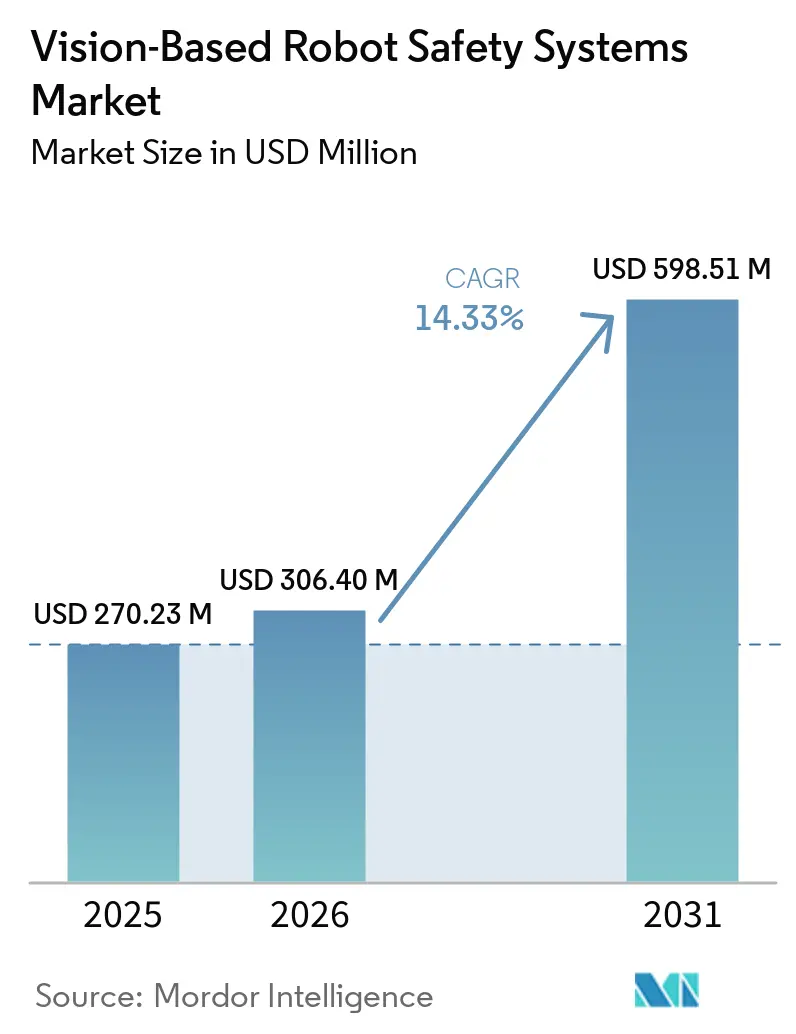
The Vision-Based Robot Safety Systems Market size is expected to expand from USD 270.23 million in 2025 to USD 306.40 million in 2026, and is forecast to reach USD 598.51 million by 2031, at a 14.33% CAGR over 2026-2031. Demand follows continued industrial robot installations and the movement of robots into shared work areas. The International Federation of Robotics reported 542,000 industrial robots installed globally in 2024, while the operating stock reached 4.664 million units, 9% higher than in 2023. Buyers increasingly need systems that identify people and hazards around collaborative and mobile robots without fixed barriers. Suppliers are combining certified sensing hardware, local processing, and safety software to meet this requirement. Compliance with ISO 10218:2025 is also making verifiable safety functions a central purchasing requirement for the Vision-Based Robot Safety Systems Market.
Key Report Takeaways
- By safety function, Human Presence Detection held 27.71% of the Vision-Based Robot Safety Systems Market share in 2025, while Safe Navigation and Path Monitoring is projected to expand at an 18.23% CAGR through 2031.
- By vision technology, 3D Stereo Vision held 28.93% of the Vision-Based Robot Safety Systems Market share in 2025, while AI and Deep-Learning Vision is projected to expand at a 21.78% CAGR through 2031.
- By robot type, Industrial Robots accounted for 47.76% of the Vision-Based Robot Safety Systems Market size in 2025, while Industrial Mobile Manipulators is projected to expand at a 19.65% CAGR through 2031.
- By end-user industry, Automotive and Mobility held 26.41% of the Vision-Based Robot Safety Systems Market share in 2025, while Logistics and Warehousing is projected to expand at a 17.67% CAGR through 2031.
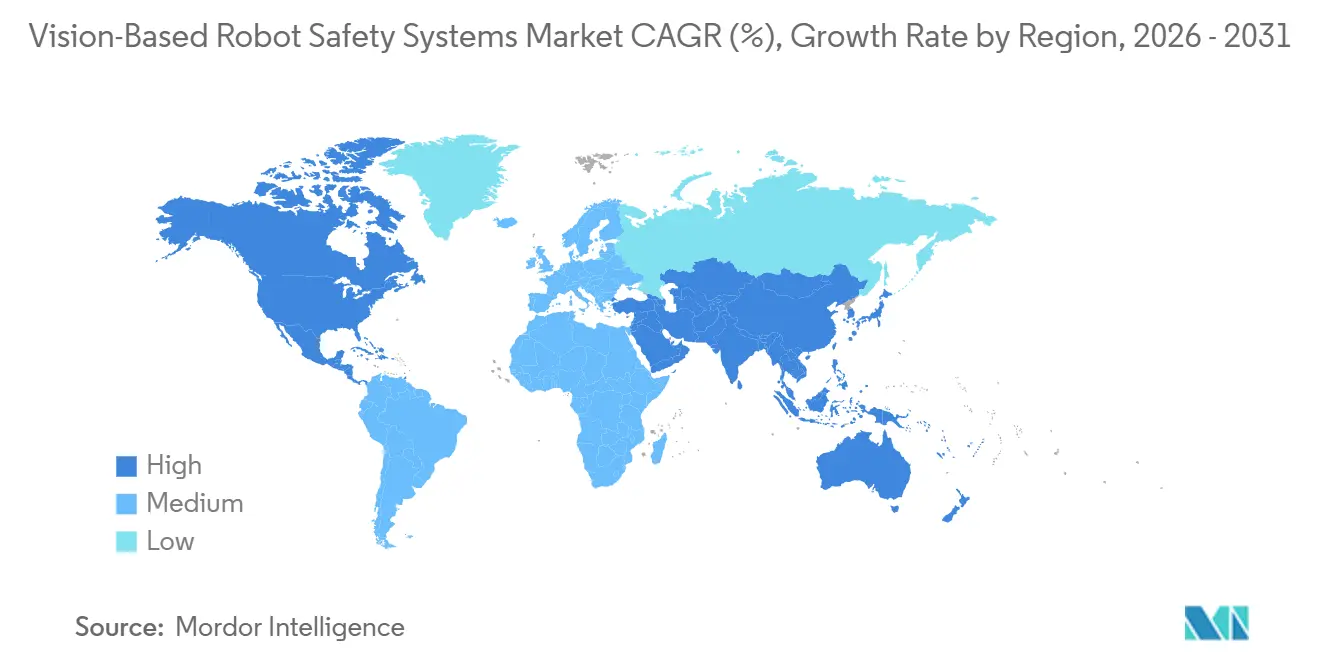
- By geography, Asia-Pacific held 37.41% of the Vision-Based Robot Safety Systems Market share in 2025, while Middle East and Africa is projected to expand at a 15.56% CAGR through 2031.
Note: Market size and forecast figures in this report are generated using Mordor Intelligence’s proprietary estimation framework, updated with the latest available data and insights as of January 2026.
Market Trends and Insights
Drivers Impact Analysis of Vision-Based Robot Safety Systems Market*
| Driver | (~) % Impact on CAGR Forecast | Geographic Relevance | Impact Timeline |
|---|---|---|---|
| Integration of AI, Edge Computing, and 3D Perception | +2.5% | Global, with rapid adoption in China, Germany, and the United States | Medium term (2-4 years) |
| Expansion of Collaborative Robot Workcells | +2.3% | Global, concentrated in East Asia, Germany, and U.S. automotive clusters | Short term (≤ 2 years) |
| Growth of Autonomous Mobile Robots in Warehouses | +2.0% | Global, with early intensity in North American and Asia-Pacific e-commerce hubs | Short term (≤ 2 years) |
| Stricter Functional Safety and Machine Safety Requirements | +1.5% | European Union, North America, and Japan, with effects in South Korea and Australia | Medium term (2-4 years) |
| Brownfield Retrofit Demand for Vision-Based Protection | +0.9% | Asia-Pacific, Europe, and North American legacy manufacturing corridors | Medium term (2-4 years) |
| Safety Data Integration With Industrial Automation Platforms | +0.6% | North American and European Union Industry 4.0 adopters, with emerging adoption in Asia-Pacific | Long term (≥ 4 years) |
| Source: Mordor Intelligence | |||
Integration of AI, Edge Computing, and 3D Perception Reshapes Safety Architecture
Edge-based AI vision is moving from quality inspection into the safety layer when fixed protective zones cannot account for changing human and robot paths. A 2025 IEEE study reported 92.3% detection precision and 88.5% mean average precision from a system combining LiDAR, RGB, and thermal inputs at 28 to 35 frames per second. Cognex launched the In-Sight 3900 in May 2026 with Qualcomm Dragonwing processing and up to 4× faster processing than its predecessor.[1]Cognex Corporation, “Cognex Launches In-Sight Vision Controller Powered by NVIDIA,” Cognex Corporation, prnewswire.com It also launched the NVIDIA Jetson-powered In-Sight 6900 controller in April 2026 for demanding local workloads. The Vision-Based Robot Safety Systems Market, therefore, favors suppliers that reduce latency while maintaining documented, certified system behavior. Model updates still require safety validation before deployment, which makes update management as important as processing performance.
Expansion of Collaborative Robot Workcells Multiplies Contact-Zone Exposure
Collaborative robots create several small and changing protective zones instead of one fixed cell perimeter. The global operating stock of industrial robots reached 4.664 million units in 2024, supporting wider use of robots in constrained production settings. SICK and Universal Robots developed the End-of-Arm Safeguard, which creates a moving protective field around the tool rather than increasing the workcell footprint.[2]SICK AG, “SICK End-of-Arm Safeguard Receives RBR50 Recognition for Advancing Safer Human-Robot Collaboration,” SICK Connect, sickconnect.com Smaller, more varied workcells increase the cost of validating each installation. This supports demand in the Vision-Based Robot Safety Systems Market for pre-certified modules that require less custom engineering. It also gives suppliers with proven integration packages a clearer route into smaller factories.
Growth of Autonomous Mobile Robots in Warehouses Creates Perpetual Safety Perimeter Demand
Autonomous mobile robots and automated guided vehicles need continuous awareness when they move through pedestrian corridors. A 2026 Scientific Reports study found that a system combining VSLAM and optical flow improved obstacle avoidance for indoor logistics robots in changing environments.[3]Scientific Reports, “Visual Obstacle Avoidance Technology of VSLAM Indoor Intelligent Logistics Robot Combining Optical Flow and Feature Extraction,” Scientific Reports, nature.com Alstef Group introduced an autonomous intelligent vehicle with an AI-based safety perception bubble at MODEX 2026. The system classifies pedestrians, carts, and pallets to select a suitable speed response. Large fleets also need safety information that can be coordinated across vehicles. That requirement expands the Vision-Based Robot Safety Systems Market from individual sensing products toward connected fleet safety architectures.
Stricter Functional Safety and Machine Safety Requirements Raise the Certification Floor
ISO 10218-1:2025 and ISO 10218-2:2025 were published in April 2025 and replaced the 2011 editions. The updated standards incorporated most of the collaborative robot requirements previously covered by ISO/TS 15066. Primary safety functions must demonstrate defined performance levels or safety integrity levels under the relevant safety framework. Speed and Separation Monitoring requires safety-rated presence detection and documented validation of stopping performance. High detection accuracy alone does not make a conventional camera suitable for a certified safety role. These requirements support the Vision-Based Robot Safety Systems Market position of established suppliers with third-party-certified products, while making entry more difficult for newer AI products.
Restraints Impact Analysis of Vision-Based Robot Safety Systems Market*
| Restraint | (~) % Impact on CAGR Forecast | Geographic Relevance | Impact Timeline |
|---|---|---|---|
| High Functional Safety Validation and Certification Costs | -1.5% | Global, most acute in the European Union, United States, and Japan | Medium term (2-4 years) |
| Integration Complexity Across Legacy Robot Controllers and Safety PLCs | -1.2% | Asia-Pacific legacy manufacturing, Southern and Eastern Europe, and mid-tier manufacturers in the Americas | Medium term (2-4 years) |
| Performance Degradation Under Low-Light, Occlusion, and Contamination Conditions | -0.8% | Global, especially food and beverage, automotive body shops, and foundries | Short term (≤ 2 years) |
| Limited Availability of Safety-Validated Industrial AI Training Data | -0.7% | Global, especially pharmaceutical and semiconductor applications | Long term (≥ 4 years) |
| Source: Mordor Intelligence | |||
High Functional Safety Validation and Certification Costs Compress Integrator Margins
Functional safety certification for a new vision-based product can take 12 to 18 months and cost more than USD 500,000 when hardware and software require joint certification. This expense is difficult for small and mid-sized integrators to absorb. Pilz released its TÜV-certified SEC2 Safety Ethernet Connection function block for safety communication across heterogeneous systems. The product supports ISO 13849 Performance Level e and IEC 61508 Safety Integrity Level 3 requirements. Some users may instead place uncertified AI vision in a monitoring role, leaving compliance uncertain. The cost and duration of certification can therefore limit the commercial pace of the Vision-Based Robot Safety Systems Market, even where the underlying technology is mature.
Integration Complexity Across Legacy Robot Controllers and Safety PLCs Slows Brownfield Adoption
Many installed industrial robots use proprietary controllers from before the advent of common safety communication standards such as PROFIsafe and FSoE. This makes the addition of vision-based protection dependent on site-specific integration work. FANUC had shipped more than 1,000 robots for physical-AI brownfield retrofit applications by May 2026, showing the commercial demand for upgrades. Safety-rated camera data often must pass through certified safety PLCs before a robot receives a stop command. Older PLCs may not process high-resolution image metadata without affecting cycle times. Standardized interfaces and pre-wired safety modules can reduce this burden and help the Vision-Based Robot Safety Systems Market address the installed base.
*Our forecasts treat driver/restraint impacts as directional, not additive. The impact forecasts reflect baseline growth, mix effects, and variable interactions.
Vision-Based Robot Safety Systems Market Segment Analysis
By Safety Function:
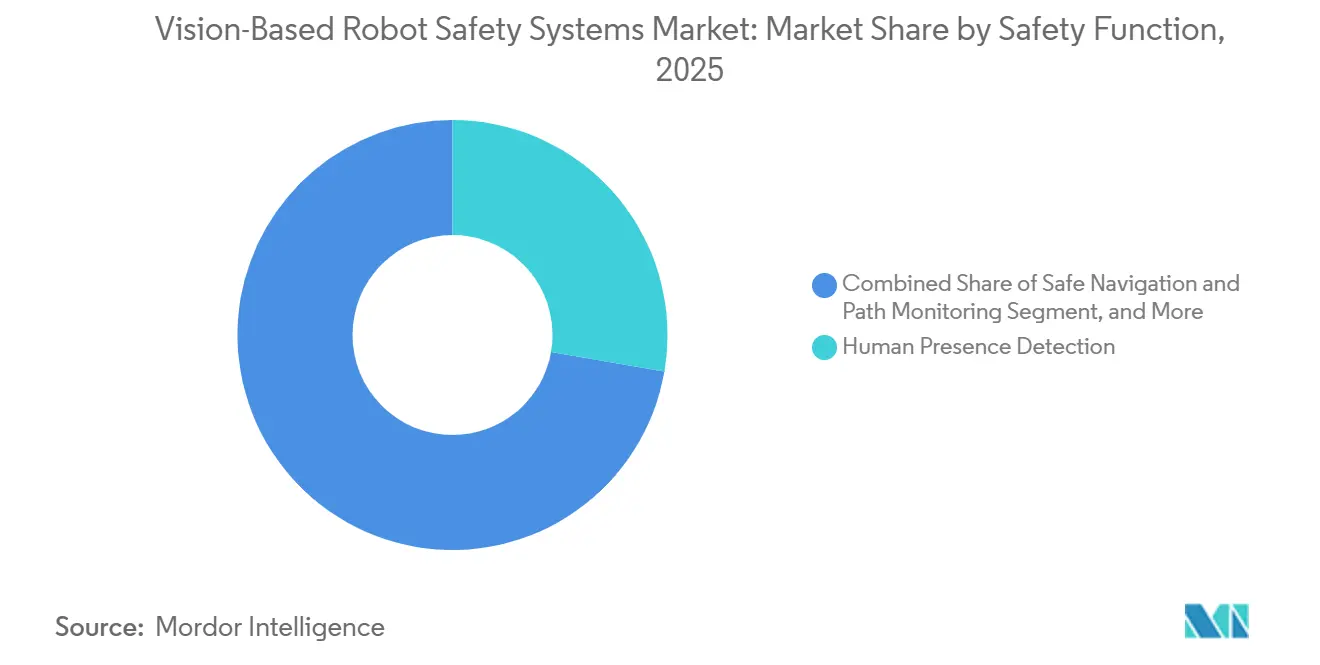
Presence Detection Provides the Base While Navigation Grows FastestHuman Presence Detection held the largest share at 27.71% in 2025, making it a core part of demand for Vision-Based Robot Safety Systems in shared workspaces. Reliable detection is necessary before other protective functions can respond appropriately to changing worker positions and intended robot motion. Speed and Separation Monitoring, safety zone detection, and collision detection are commonly combined in layered safety designs across complex facilities. These functions address different risks around collaborative equipment, fixed industrial robots, and mobile platforms operating near workers.
Safe Navigation and Path Monitoring is forecast to expand at an 18.23% CAGR through 2031. Its growth reflects mobile platforms operating through open floors where zones cannot be fully pre-mapped or reliably separated from pedestrian routes. A 2025 Frontiers in Robotics and AI study reported 88% obstacle avoidance success with sub-150-millisecond latency for an edge-deployed logistics robot. Other functions include heat mapping, load detection, and posture analysis. These functions have gained relevance in pharmaceutical production and aerospace assembly, where ergonomic compliance may be reviewed during safety and process audits. The Vision-Based Robot Safety Systems Market can therefore extend beyond hazard detection to more specialized workplace controls that support site-specific operating procedures.



By Vision Technology:
Stereo Vision Leads While AI Perception Advances Fastest3D Stereo Vision accounted for 28.93% of the Vision-Based Robot Safety Systems Market share in 2025. Its position reflects dependable depth information, deterministic geometric output, and long integration experience in automotive body-in-white and heavy-component assembly cells. Structured-light 3D vision and time-of-flight sensors also address applications that need accurate depth measurement in varying working distances. SICK launched the safeVisionary2 in April 2026 as a safety-certified 3D time-of-flight sensor with configurable three-dimensional protective fields.
AI and Deep-Learning Vision is forecast to expand at a 21.78% CAGR through 2031. It can classify objects by type, distinguishing a pedestrian from a stationary cart instead of simply measuring movement or distance from the sensing device. A 2025 Applied Sciences review identified multimodal sensor fusion and explainable AI as active research areas in collaborative robotics. Explainability can help address concerns about predictable behavior during safety validation and subsequent system audits. Two-dimensional safety vision remains useful in controlled and cost-sensitive settings. Its relative position is under pressure as three-dimensional alternatives become more accessible for machine-tool guarding applications requiring depth-aware protective fields.
By Robot Type:
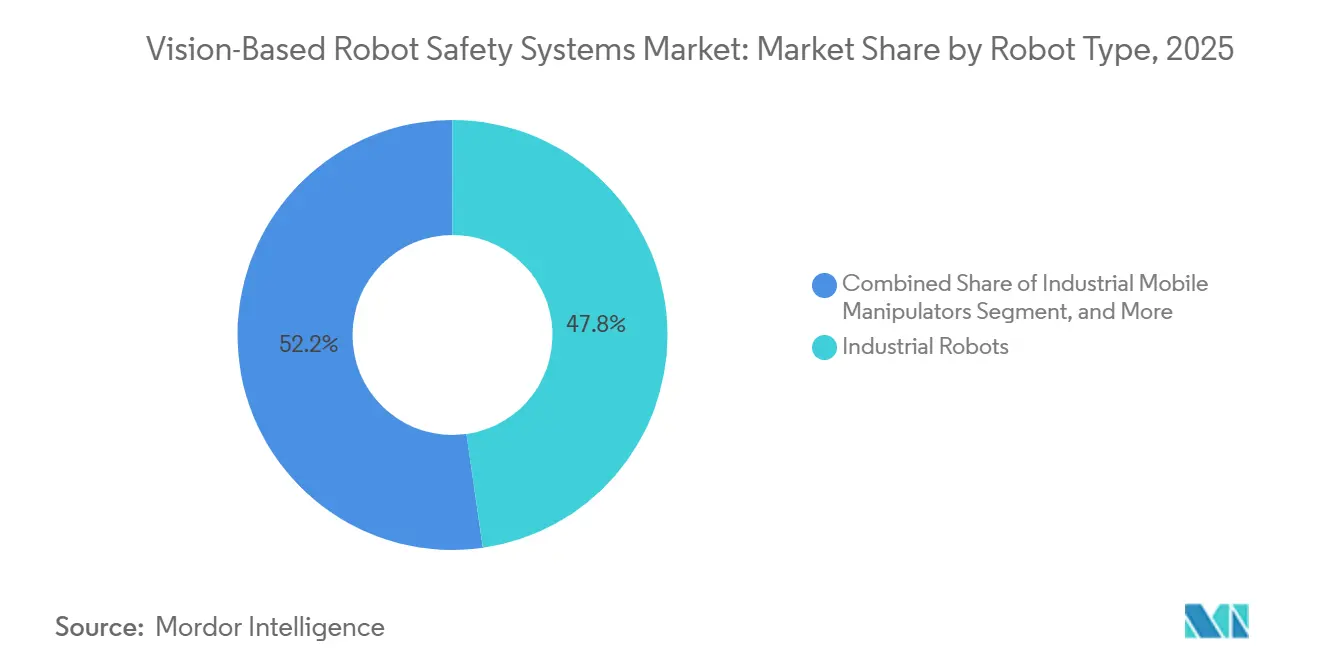
Industrial Robots Anchor Revenue While Mobile Manipulators AccelerateIndustrial Robots accounted for 47.76% of the Vision-Based Robot Safety Systems Market size in 2025. The segment rests on the large installed base and continued retrofits of existing cells, particularly where older safeguards need updated detection capabilities. The global stock of industrial robots exceeded 4.664 million operating units in 2024. ISO 10218:2025 compliance also requires support for upgrades to monitoring and protective functions.
Industrial Mobile Manipulators are forecast to expand at a 19.65% CAGR through 2031. These systems combine a mobile base with an articulated arm and must manage both navigation and close-proximity manipulation within the same working cycle. Aptiv announced in June 2026 that Robust.AI selected Aptiv PULSE AI and ML sensor fusion for its Gen 3 Carter collaborative mobile robot. The system targets ISO 13849 Performance Level d certification. Mobile robots, including AMRs and AGVs, also require upgrades as fleet counts rise in fulfillment centers and shared logistics corridors. This shifts safety from a per-unit purchase to a fleet-infrastructure decision within the Vision-Based Robot Safety Systems Market.
By End-User Industry:
Automotive Leads Demand While Logistics Expands QuicklyAutomotive and Mobility accounted for 26.41% of the Vision-Based Robot Safety Systems Market share in 2025. High robot density and strict worker protection requirements sustain its use of vision-based monitoring in mixed assembly environments. Automotive accounted for more than 45% of industrial robot installations in India during 2024 and more than 47% in Canada. Mixed assembly lines can use vision systems as an alternative to full cage guarding when people need regular access to the production area.
Logistics and warehousing are forecast to expand at a 17.67% CAGR through 2031. E-commerce fulfillment requires larger mobile robot fleets, coordinated safety controls, and dependable perception where workers, inventory, and equipment continually change position. OMRON introduced the B5T HVC-P2 human detection module for cleanroom environments in March 2026. The module was designed to identify workers whose protective suits affect conventional body-shape recognition. Pharmaceutical, medical device, and food applications also require designs that manage washdown conditions, contamination, and lens fouling. Aerospace and defense use collaborative robots for composite assembly, where human proximity cannot be avoided.
Geography Analysis
APAC Vision-Based Robot Safety Systems Market
Asia-Pacific held 37.41% of the Vision-Based Robot Safety Systems Market share in 2025. China installed 295,000 industrial robots in 2024, representing 54% of global deployments, while domestic manufacturers accounted for 57% of the Chinese market. Japan operated a stock of 450,500 units in 2024, up 3% from the prior year, and South Korea maintained annual installations near 31,000 units since 2019. India installed a record 9,100 industrial robots in 2024, with automotive accounting for 45% of those deployments. Growing deployments and alignment with ISO 10218 provisions support demand for internationally certified safety platforms across the region.[4]International Federation of Robotics, “IFR: Industrial Robot Deployments Have Doubled in 10 Years,” The Robot Report, therobotreport.com
North America and Europe Vision-Based Robot Safety Systems Market
North America and Europe were the second- and third-largest geographic blocs in 2025. Germany installed 26,982 robots in 2024, accounting for 32% of European installations, despite an 8% decline from the prior year. The European Union Machinery Regulation 2023/1230 tightens requirements for autonomous and AI-enabled machinery, creating upgrade needs in automotive and machine-tool facilities. North America installed 50,100 robots in 2024, and the United States accounted for 34,200 units, or 68% of the regional total. Network isolation and software integrity requirements also encourage the replacement of older safety installations that were not designed to meet current cybersecurity expectations.
The Americas and MEA Vision-Based Robot Safety Systems Market
The Middle East and Africa are forecast to expand at a 15.56% CAGR through 2031, the fastest regional rate in the Vision-Based Robot Safety Systems Market. Saudi Vision 2030 and the United Arab Emirates National Industry Strategy support manufacturing capacity, logistics hubs, warehouse automation, and purpose-built mobile robot operations. Greenfield facilities can specify safety systems during design rather than adding them later, supporting greater system value when AMR operations are planned from the start. South America remains smaller, with Brazil and Argentina holding most regional installations, while Mexico installed 5,600 robots in 2024 despite a 4% annual decline.

Competitive Landscape
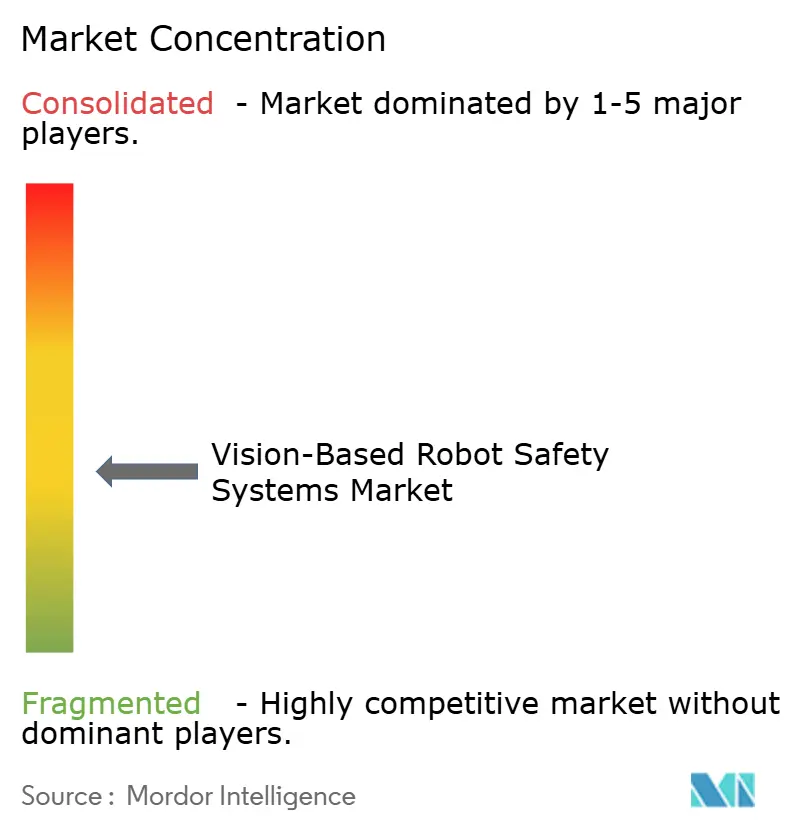
The Vision-Based Robot Safety Systems Market has a moderated fragmented supplier base led by SICK AG, KEYENCE Corporation, Pilz GmbH, Cognex Corporation, and OMRON Corporation. These companies hold strong positions in certified sensors and safety electronics, while FANUC, KUKA, Universal Robots, and Yaskawa increasingly embed safety vision in their products. Competition centers on systems that combine reliable perception, certified stop functions, and practical integration into existing automation environments. Buyers also assess software update controls, support for safety documentation, and the availability of proven interfaces with established robot controllers.
Cognex used two 2026 launches to expand its local AI processing capabilities with the Qualcomm-based In-Sight 3900 and the NVIDIA Jetson-based In-Sight 6900. SICK and Universal Robots jointly developed the End-of-Arm Safeguard for a protective field that moves with the robot tool. Pilz filed a 2025 U.S. patent application covering radar-sensor-based safeguarding for automated machine danger zones. These moves show a shift toward local AI, mobile protection, and sensing approaches that combine multiple modalities.
No supplier in the supplied material is identified as controlling fleet-level safety orchestration across heterogeneous robots. This leaves room for software that combines real-time safety data from multiple platforms and supports ISO 13849 compliance documentation. The need is strongest where AMR fleets operate alongside fixed robots, conventional conveyors, and workers within the same facility. Suppliers that can certify fused perception systems may gain an advantage over providers of separate sensor products. The Vision-Based Robot Safety Systems Market remains competitive because certification expertise, integration capability, software control, and product performance must work together.
Vision-Based Robot Safety Systems Industry Leaders
SICK AG
KEYENCE CORPORATION
OMRON Corporation
Rockwell Automation, Inc.
Cognex Corporation
- *Disclaimer: Major Players sorted in no particular order
Vision-Based Robot Safety Systems Market Companies Covered in this Report
- Balluff GmbH
- Banner Engineering Corp.
- Basler AG
- Cognex Corporation
- DENSO CORPORATION
- FANUC CORPORATION
- Hans TURCK GmbH & Co. KG
- Hokuyo Automatic Co., Ltd.
- IDEC Corporation
- ifm electronic GmbH
- KEYENCE CORPORATION
- KUKA AG
- Leuze electronic GmbH + Co. KG
- OMRON Corporation
- Panasonic Holdings Corporation
- Pepperl+Fuchs SE
- Pilz GmbH & Co. KG
- Rockwell Automation, Inc.
- SICK AG
- Schneider Electric SE
- Teledyne Technologies Incorporated
- Universal Robots A/S
- Yaskawa Electric Corporation

Recent Industry Developments in Vision-Based Robot Safety Systems Market
- July 2026: SICK AG's End-of-Arm Safeguard (EOAS), co-developed with Universal Robots, received the 2026 RBR50 Robotics Innovation Award, marking the first certified end-of-arm safety sensor that dynamically moves with the robot tool to prevent collisions without increasing cell footprint.
- June 2026: Aptiv PLC announced that Robust.AI selected Aptiv PULSE AI and ML sensor fusion for the Gen 3 Carter collaborative mobile robot, establishing the foundation for ISO 13849 PL(d) certification across relevant industrial safety use cases.
- May 2026: Cognex Corporation launched the In-Sight 3900 Vision System, powered by Qualcomm Dragonwing and delivering up to 4× faster AI edge inspection than prior-generation systems, with resolution up to 25 megapixels and PC-free operation for production-line deployment.
- May 2026: FANUC confirmed it has shipped over 1,000 robots for physical-AI brownfield retrofit applications since debuting the system at the IREX show in December 2025, demonstrating commercial-scale traction for vision-enabled AI upgrades to existing installed-base robots.


Global Vision-Based Robot Safety Systems Market Report Scope
Vision-Based Robot Safety Systems are advanced perception technologies that use optical sensors and real-time image processing to monitor robotic workspaces, enabling non-contact risk assessment, dynamic safety zone management, and safe human-robot collaboration in compliance with international functional safety standards.
The Vision-Based Robot Safety Systems Market Report is Segmented by Safety Function (Human Presence Detection, Speed and Separation Monitoring (SSM), Safety Zone / Intrusion Detection, Collision / Proximity Detection, Safe Navigation and Path Monitoring, and Other Safety Functions), Vision Technology (2D Safety Vision, 3D Stereo Vision, Structured-Light 3D Vision, Time-of-Flight (ToF), AI / Deep-Learning Vision, and Other Vision Technologies), Robot Type (Industrial Robots, Collaborative Robots (Cobots), Mobile Robots (AMRs/AGVs), Industrial Mobile Manipulators, and Other Robot Types), End-User Industry (Automotive and Mobility, Electronics and Semiconductors, General Manufacturing, Food and Beverage, Pharmaceutical and Medical Devices, Logistics and Warehousing, Aerospace and Defense, and Other End-User Industries), and Geography (North America, South America, Europe, Asia-Pacific, Middle East and Africa). The Market Forecasts are Provided in Terms of Value (USD).
| Human Presence Detection |
| Speed and Separation Monitoring (SSM) |
| Safety Zone / Intrusion Detection |
| Collision / Proximity Detection |
| Safe Navigation and Path Monitoring |
| Other Safety Functions |
| 2D Safety Vision |
| 3D Stereo Vision |
| Structured-Light 3D Vision |
| Time-of-Flight (ToF) |
| AI / Deep-Learning Vision |
| Other Vision Technologies |
| Industrial Robots |
| Collaborative Robots (Cobots) |
| Mobile Robots (AMRs/AGVs) |
| Industrial Mobile Manipulators |
| Other Robot Types |
| Automotive and Mobility |
| Electronics and Semiconductors |
| General Manufacturing |
| Food and Beverage |
| Pharmaceutical and Medical Devices |
| Logistics and Warehousing |
| Aerospace and Defense |
| Other End-User Industries |
| North America | United States | |
| Canada | ||
| Mexico | ||
| South America | Brazil | |
| Argentina | ||
| Rest of South America | ||
| Europe | Germany | |
| United Kingdom | ||
| France | ||
| Italy | ||
| Spain | ||
| Rest of Europe | ||
| Asia-Pacific | China | |
| Japan | ||
| India | ||
| South Korea | ||
| Rest of Asia-Pacific | ||
| Middle East and Africa | Middle East | Saudi Arabia |
| United Arab Emirates | ||
| Turkey | ||
| Rest of the Middle East | ||
| Africa | South Africa | |
| Nigeria | ||
| Rest of Africa | ||
| By Safety Function | Human Presence Detection | ||
| Speed and Separation Monitoring (SSM) | |||
| Safety Zone / Intrusion Detection | |||
| Collision / Proximity Detection | |||
| Safe Navigation and Path Monitoring | |||
| Other Safety Functions | |||
| By Vision Technology | 2D Safety Vision | ||
| 3D Stereo Vision | |||
| Structured-Light 3D Vision | |||
| Time-of-Flight (ToF) | |||
| AI / Deep-Learning Vision | |||
| Other Vision Technologies | |||
| By Robot Type | Industrial Robots | ||
| Collaborative Robots (Cobots) | |||
| Mobile Robots (AMRs/AGVs) | |||
| Industrial Mobile Manipulators | |||
| Other Robot Types | |||
| By End-User Industry | Automotive and Mobility | ||
| Electronics and Semiconductors | |||
| General Manufacturing | |||
| Food and Beverage | |||
| Pharmaceutical and Medical Devices | |||
| Logistics and Warehousing | |||
| Aerospace and Defense | |||
| Other End-User Industries | |||
| By Geography | North America | United States | |
| Canada | |||
| Mexico | |||
| South America | Brazil | ||
| Argentina | |||
| Rest of South America | |||
| Europe | Germany | ||
| United Kingdom | |||
| France | |||
| Italy | |||
| Spain | |||
| Rest of Europe | |||
| Asia-Pacific | China | ||
| Japan | |||
| India | |||
| South Korea | |||
| Rest of Asia-Pacific | |||
| Middle East and Africa | Middle East | Saudi Arabia | |
| United Arab Emirates | |||
| Turkey | |||
| Rest of the Middle East | |||
| Africa | South Africa | ||
| Nigeria | |||
| Rest of Africa | |||


Key Questions Answered in the Report
What is the Vision-Based Robot Safety Systems Market size?
The market size is USD 306.40 million in 2026 and is forecast to reach USD 598.51 million by 2031, at a 14.33% CAGR.
What is driving adoption of vision-based robot safety systems?
Collaborative workcells, mobile robot fleets, edge AI, three-dimensional perception, and tighter functional safety rules support demand.
Which safety function led demand in 2025?
Human Presence Detection led with a 27.71% share in 2025 because it is fundamental to shared human-robot workspaces.
Which vision technology is growing fastest through 2031?
AI and Deep-Learning Vision is forecast to expand at a 21.78% CAGR through 2031.
Which region held the largest share in 2025?
Asia-Pacific held 37.41% in 2025, supported by high robot installations in China, Japan, South Korea, and India.
Which end-user application is growing fastest?
Logistics and Warehousing is projected to expand at a 17.67% CAGR through 2031 as fulfillment centers expand mobile robot fleets.
Page last updated on:





