
Industrial Robot Intelligence Software Market Size and Share
Market Overview
| Study Period | 2020 - 2031 |
|---|---|
| Market Size (2026) | USD 2.04 Billion |
| Market Size (2031) | USD 3.26 Billion |
| Growth Rate (2026 - 2031) | 9.83% CAGR |
| Fastest Growing Market | Middle East |
| Largest Market | Asia-Pacific |
| Market Concentration | Medium |
Major Players *Disclaimer: Major Players sorted in no particular order Image © Mordor Intelligence. Reuse requires attribution under CC BY 4.0. | |
Industrial Robot Intelligence Software Market Analysis by Mordor Intelligence
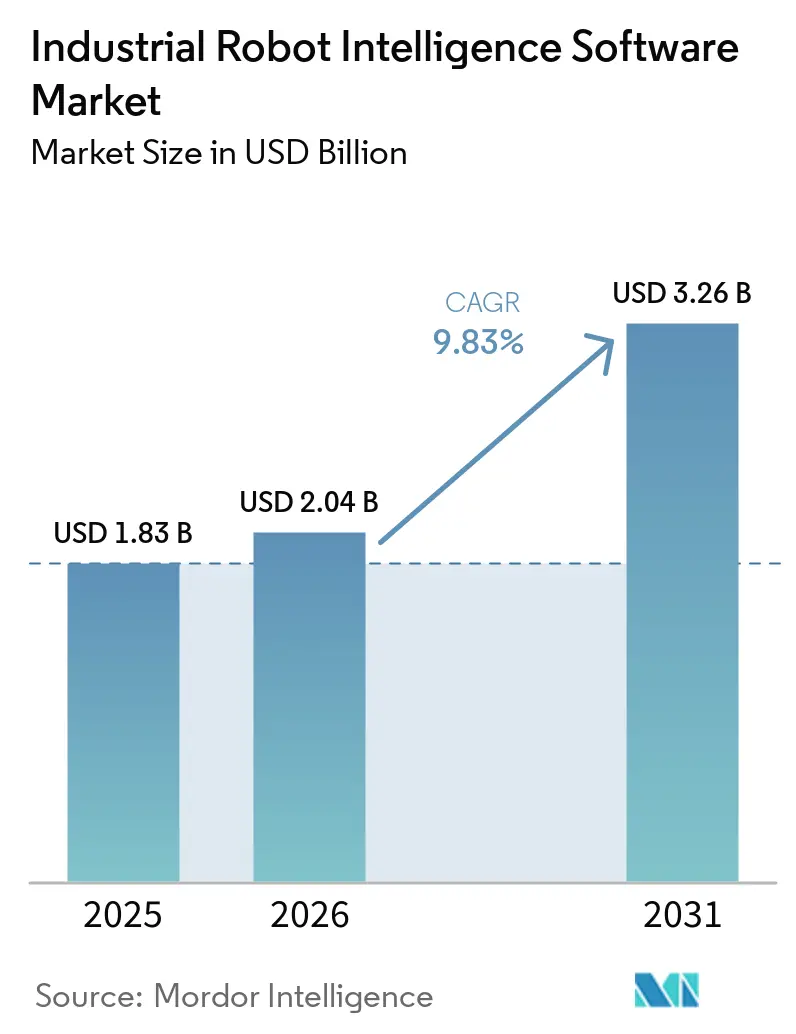
The industrial robot intelligence software market size is projected to expand from USD 1.83 billion in 2025 and USD 2.04 billion in 2026 to USD 3.26 billion by 2031, registering a CAGR of 9.83% between 2026 to 2031. Growth reflects broader adoption of AI in robot execution and a manufacturing shift toward automation-led operations. Manufacturers are assigning greater value to software that programs, validates, monitors, and improves robot cells through their operating lives. Demand is also moving beyond new installations because installed robot fleets need upgrades for vision, simulation, and connected operations. Suppliers are responding with platforms that combine simulation, programming, and AI tools, while specialist vendors focus on multi-brand retrofits. Cybersecurity reviews and reliable transfer from simulated to physical environments remain central purchase considerations for the industrial robot intelligence software market.
Key Report Takeaways
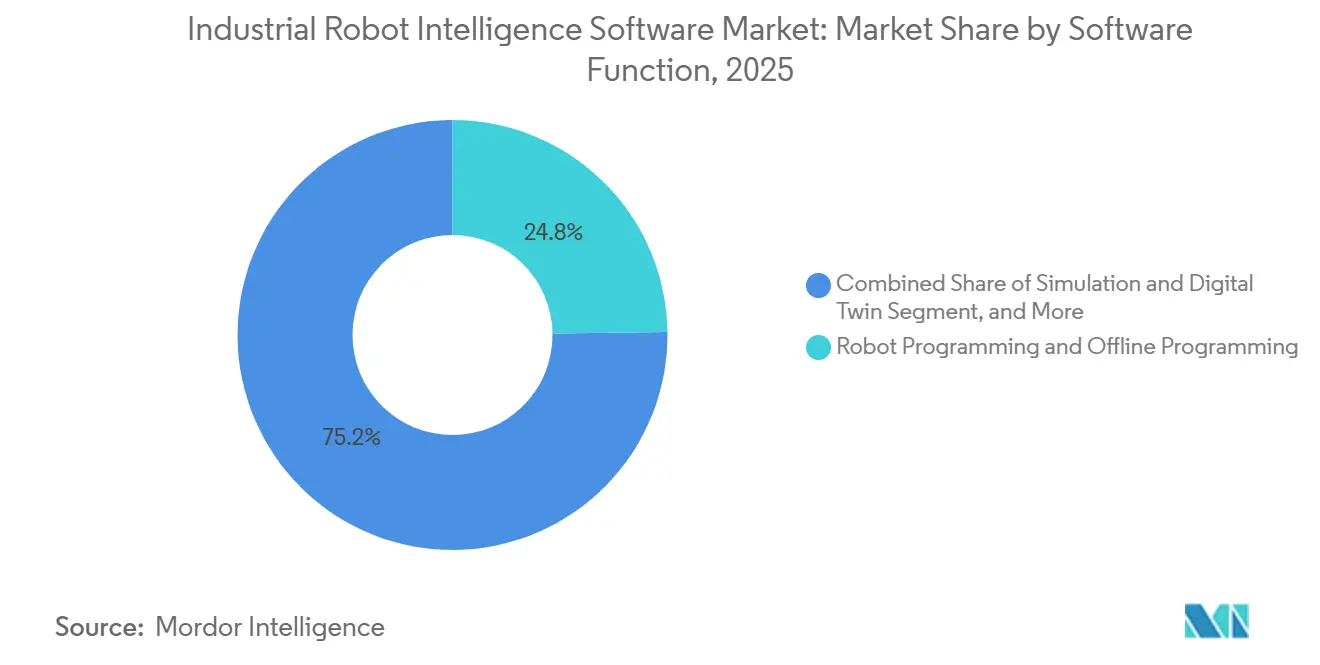
- By software function, Robot Programming and Offline Programming held 24.78% of the industrial robot intelligence software market share in 2025, while Perception and Vision Guidance is projected to expand at a 12.16% CAGR through 2031.
- By deployment model, On-Premises deployment accounted for 60.59% of the industrial robot intelligence software market size in 2025, while Cloud-Based deployment is projected to expand at a 13.02% CAGR through 2031.
- By application, Material Handling and Packaging held 20.07% of the industrial robot intelligence software market share in 2025, while Quality Inspection and Metrology is projected to expand at a 12.02% CAGR through 2031.
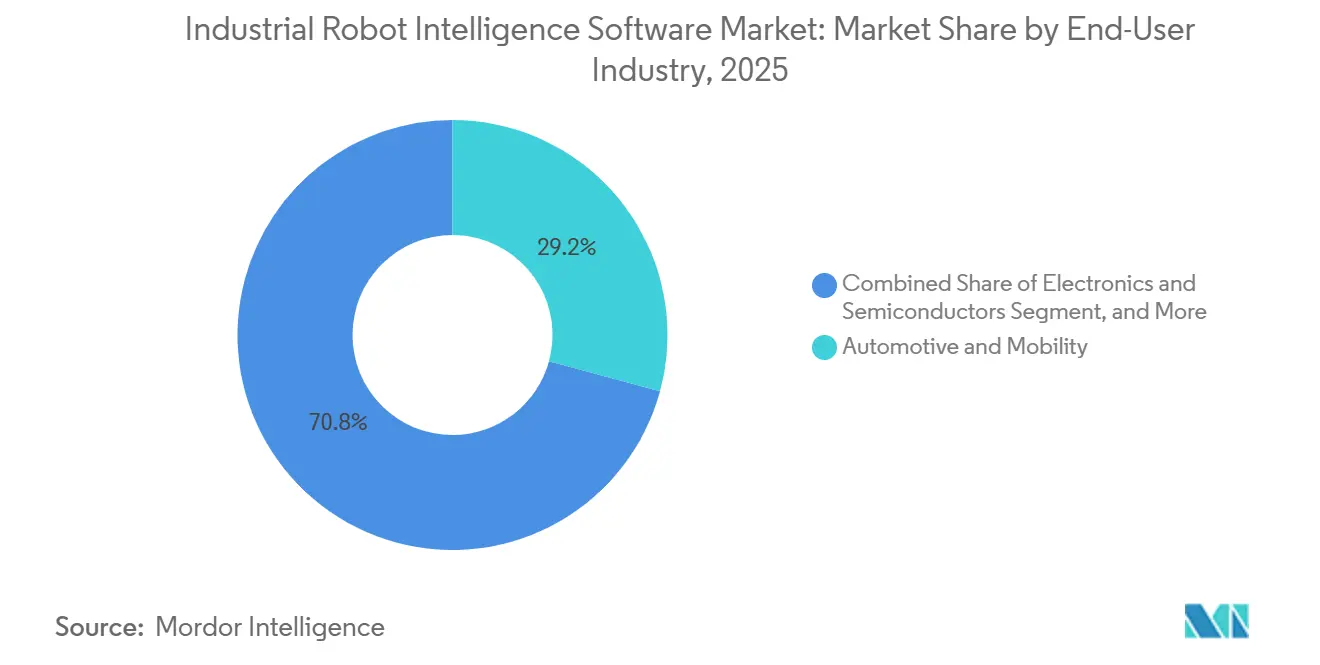
- By end-user industry, Automotive and Mobility held 29.21% share in 2025, while Electronics and Semiconductors is projected to expand at an 11.27% CAGR through 2031.
- By enterprise size, Large Enterprises held 77.86% share in 2025, while Small and Medium-Sized Enterprises are projected to expand at a 13.74% CAGR through 2031.
- By geography, Asia-Pacific held 48.62% share in 2025, while the Middle East is projected to expand at a 13.06% CAGR through 2031.
Note: Market size and forecast figures in this report are generated using Mordor Intelligence’s proprietary estimation framework, updated with the latest available data and insights as of January 2026.
Global Industrial Robot Intelligence Software Market Trends and Insights
Drivers Impact Analysis*
| DRIVER | (~) % IMPACT ON CAGR FORECAST | GEOGRAPHIC RELEVANCE | IMPACT TIMELINE |
|---|---|---|---|
| AI-Enabled Adaptive Robot Execution | +3.0% | Global, with highest intensity in North America, China, Germany, and Japan | Medium term (2-4 years) |
| Factory Labor Scarcity and Reshoring Economics | +2.0% | North America and Western Europe, with spillover to South Korea and Australia | Short term (≤ 2 years) |
| Digital Twins and Virtual Commissioning Requirements | +1.5% | Global, led by automotive and semiconductor clusters in Germany, Japan, South Korea, and the United States | Medium term (2-4 years) |
| Low-Code Programming for High-Mix Production | +1.2% | Global, with early gains in SME-dense regions such as Europe, Southeast Asia, and Mexico | Short term (≤ 2 years) |
| CAD-Trained Perception for Fixture-Light Automation | +0.8% | Global, concentrated in high-mix electronics and automotive assembly locations | Medium term (2-4 years) |
| Synthetic Data and Sim-to-Real Training Pipelines | +0.6% | Global, with cloud-compute advantages in North America and East Asia | Long term (≥ 4 years) |
| Source: Mordor Intelligence | |||
AI-Enabled Adaptive Robot Execution
Foundation models for physical AI are changing the economics of industrial robotics. Manufacturers can train broad policies and adapt them to individual cells, rather than programming every action separately. This approach can lower the software effort for applications that previously required extensive custom work. FANUC deepened its ROBOGUIDE integration with NVIDIA Isaac Sim in May 2026 so simulation and physical robots use the same control algorithms, addressing trajectory differences between the two settings. ABB planned RobotStudio HyperReality for release in the second half of 2026, using NVIDIA Omniverse to support a claimed 99% correlation between virtual and physical robot behavior. A 2026 Nature Communications study found that combining precision perception with language-model reasoning improved results on complex, fault-tolerant manufacturing tasks.[1]Weilin Lu et al., “Hybrid Reasoning for Perception, Explanation, and Autonomous Action in Manufacturing,” Nature Communications, nature.com These developments support continued spending on the industrial robot intelligence software market as hardware costs decline and software capabilities expand.
Factory Labor Scarcity and Reshoring Economics
Labor shortages are making automation decisions less dependent on short-term capital cycles. Manufacturing employers need systems that can perform tasks with less reliance on scarce specialist labor. The International Federation of Robotics reported that U.S. robot installations rose 11% to 38,000 units in 2025, the third strongest result on record. The Federal Reserve Bank of San Francisco found that firms facing trade-policy uncertainty increased their use of industrial robots, linking policy risk with automation activity.[2]Federal Reserve Bank of San Francisco, “Will Trade Uncertainty Boost Automation?” FRBSF Economic Letter, frbsf.org This creates demand for software upgrades in existing fleets as well as new robot projects. AI-guided execution becomes more relevant where manufacturers must sustain output while controlling labor and relocation costs. The industrial robot intelligence software market, therefore, benefits when reshoring programs require flexible, repeatable production methods.
Digital Twins and Virtual Commissioning Requirements
Virtual commissioning is becoming more important as production lines must start faster and accommodate more product variants. Digital twins enable engineers to test programming, robot movement, and safety conditions before physical equipment is placed on the line. PIA Automation applied digital twin technology and virtual commissioning to a BMW E-Drive line with 78 processing stations, 27 robotic cells, and 46 industrial robots. A 2025 study in the International Journal of Advanced Manufacturing Technology reported energy reductions of 74.79% for a pick-and-place task and 36.06% for a welding task using a self-learning digital-twin framework. ABB stated that RobotStudio HyperReality can reduce commissioning time by up to 80%. This places simulation software in more automation proposals, particularly where physical prototyping and delayed ramp-up create material costs. The industrial robot intelligence software market gains from recurring work around virtual models, process updates, and model retraining.
Low-Code Programming for High-Mix Production
High-mix production has been difficult to automate because programming effort can exceed the operational benefit. Low-code and no-code tools reduce this burden and enable more operators to create or modify robot tasks. Inbolt introduced Robot Programming at Automate 2026, allowing engineers to generate executable robot motion from a CAD model in under 5 minutes on existing fleets. Panasonic Connect introduced Robo Sync in 2025 with visual programming designed for users without coding expertise. KUKA also integrated iiQWorks.Copilot with iiQWorks.Sim to support robot-cell design and validation through natural-language prompts. These tools extend software access to process operators and smaller manufacturers that depend on integrators. They also create new opportunities in large plants, where frequent product changes require faster program updates. The industrial robot intelligence software market can therefore expand through both additional users and wider use within established robot fleets.
Restraints Impact Analysis*
| RESTRAINT | (~) % IMPACT ON CAGR FORECAST | GEOGRAPHIC RELEVANCE | IMPACT TIMELINE |
|---|---|---|---|
| High Integration and Validation Cost | -1.8% | Global, with greatest pressure in SME-dense locations and emerging economies with limited integrator networks | Short term (≤ 2 years) |
| Cybersecurity and Functional-Safety Exposure | -1.2% | Global, with the strongest regulatory pressure in North America and Europe | Medium term (2-4 years) |
| Sim-to-Real Transfer Risk in Variable Cells | -0.7% | Global, especially in multi-supplier, high-variability automotive and electronics settings | Medium term (2-4 years) |
| Scarcity of Safety-Certified Robotics Software Talent | -0.5% | Global, with heightened pressure in North America and Europe | Long term (≥ 4 years) |
| Source: Mordor Intelligence | |||
High Integration and Validation Cost
Deploying intelligence software in established factories requires coordination with programmable logic controllers, safety controls, vision systems, and manufacturing execution systems. This work can cost more than the software license in complex, multi-supplier cells. ABB’s estimate of up to 80% lower commissioning time for RobotStudio HyperReality indicates the scale of existing commissioning effort, though a new software stack still requires upfront investment. Researchers at the University of Southern Denmark found that reconfiguration and programming were the leading barriers to robot adoption in small-batch European manufacturing settings.[3]University of Southern Denmark, “A Modular Software Framework for Cost Effective Deployment of Robots in Manufacturing SMEs,” University of Southern Denmark Research Portal, sdu.dk Validation can lengthen projects where multiple brands, safety interlocks, and legacy systems are involved. Pre-certified modules and common integration layers can reduce the burden, but they do not eliminate the need for site-specific testing. This slows adoption in the industrial robot intelligence software market among organizations with smaller budgets or limited integrator support.
Cybersecurity and Functional-Safety Exposure
Connected robot cells add cybersecurity requirements to automation projects. Security assessments must address access controls, operating systems, networks, and the potential effect of an incident on physical operations. Kaspersky ICS CERT reported that 19.6% of industrial control system computers were attacked in the first quarter of 2026. KUKA achieved IEC 62443-4-2 Security Level 2 certification for a robot system in July 2026, while also meeting the requirements of EN ISO 10218-1:2025 and Regulation (EU) 2024/2847. Such requirements increasingly affect supplier qualification and purchasing schedules. Regulated users may delay software upgrades while completing security and safety reviews. The industrial robot intelligence software market faces a timing challenge because more connected capabilities can increase the validation required before deployment.
*Our forecasts treat driver/restraint impacts as directional, not additive. The impact forecasts reflect baseline growth, mix effects, and variable interactions.
Segment Analysis
By Software Function: Vision Intelligence Expands Beyond Programming Leadership
Robot Programming and Offline Programming accounted for 24.78% of the industrial robot intelligence software market in 2025, making it the largest software-function category. Its position reflects long-running investment in OEM programming environments and the large installed base of teach-pendant workflows. ABB RobotStudio, FANUC ROBOGUIDE, and KUKA iiQWorks support planning, programming, and validation tasks that remain essential in production cells. Perception and Vision Guidance is projected to expand at a 12.16% CAGR through 2031, the fastest rate among software functions. AI-native vision tools can locate parts from CAD reference frames without dedicated fixtures. That capability reduces setup work for lower-volume applications and supports a wider set of production conditions. A 2025 study reported a mean average precision of 98.40% for a detection model trained on synthetic data on real industrial inspection images.[4]Springer Nature, “Investigation of the Impact of Synthetic Training Data in the Industrial Application of Terminal Strip Object Detection,” Machine Vision and Applications, springer.com The result shows how CAD models and physics-based image generation can reduce the data-collection effort for industrial perception.
Simulation and Digital Twin software link programming and perception, allowing engineers to validate vision-guided tasks in a virtual environment. FANUC and NVIDIA strengthened their integration in May 2026 to address differences between simulated and physical robot behavior. Motion Planning and control are also gaining value in applications where multiple robots must coordinate their movements and avoid collisions in shared workspaces. Realtime Robotics addresses this requirement with motion-planning software that operates above controller firmware. Predictive Maintenance and Diagnostics, along with Data Management and Analytics, expand as manufacturers use robot telemetry as a production input. KUKA’s iiQWorks.Copilot combines AI assistance with simulation workflows. This brings programming, simulation, and AI support closer together in a single workflow. The industrial robot intelligence software market is consequently shifting from separate functional tools toward more integrated engineering platforms.



By Deployment Model: Cloud Services Grow While On-Premises Systems Remain Essential
On-Premises deployment accounted for 60.59% of the market in 2025. This lead reflects the need for local control in motion-sensitive production operations. Closed-loop servo control operates at cycle times below 4 milliseconds and cannot depend on cloud round-trip latency. Automotive, aerospace, and defense supply chains also apply strict data-control requirements to production software. These factors keep execution-layer functions close to the robot controller. On-premises environments continue to support the high reliability needed for safety-critical operations. They also allow manufacturers to manage local validation and plant-specific configurations. This structural role limits the speed at which cloud services can replace locally deployed control software.
Cloud-Based deployment is projected to expand at a 13.02% CAGR through 2031. The model supports large-scale AI training, synthetic-data generation, and collaboration across locations. NVIDIA OSMO supports orchestration of Isaac Sim workflows across distributed compute environments. ABB’s RobotStudio HyperReality can export parameterized robot stations to NVIDIA Omniverse for cloud-based model training before hardware commissioning. Robotics-as-a-Service contracts combine hardware, software, connectivity, and maintenance into recurring operating expenses. Workr has used cloud-trained physical AI with ABB robots to serve smaller manufacturers. Hybrid architectures combine local execution with cloud-based updates and fleet analytics. This approach gives multi-site manufacturers centralized intelligence management without compromising real-time performance at the cell level.
By Application: Quality Inspection Gains Momentum Alongside Material Handling
Material Handling and Packaging held 20.07% of the industrial robot intelligence software market size in 2025. Warehouse, distribution, and end-of-line packaging operations have high robot density and relatively standardized programming requirements. These conditions sustain demand for path planning, workflow coordination, and fleet management tools. Quality Inspection and Metrology is projected to expand at a 12.02% CAGR through 2031. Electronics and automotive producers need tighter defect control as products and assemblies become more complex. A Nature Communications study published in 2026 demonstrated a manufacturing framework that joined convolutional neural network perception with language-model reasoning. This approach supports adaptive assessment in changing production environments. The industrial robot intelligence software market is therefore moving toward more continuous inspection within the production process.
Inbolt has deployed CAD-based perception tools at Ford, GM, Stellantis, and Toyota plants, indicating the use of robot vision in automotive production settings.[5]Inbolt, “Inbolt Launches Vision-Enabled Robot Programming, Closing the Loop from CAD to Factory Floor,” Inbolt, inbolt.com These systems can shift inspection from post-process sampling toward in-process checks at production speed. Assembly and Joining also benefit from learned motion capabilities. FANUC demonstrated CRX cobots trained with NVIDIA Isaac GR00T N for flexible cloth folding in May 2026. Welding and Surface Treatment, and Machine Tending and Processing, retain demand as production processes become more specialized. Picking, Kitting, and Order Fulfillment, Intralogistics and Mobile Manipulation, and Hazardous-Environment Operations represent further application areas. Vendors including Fizyr, Brain Corporation, and Realtime Robotics serve environments where fixed paths and structured layouts have been insufficient. The industrial robot intelligence software market gains application breadth as perception and adaptive control improve reliability in those settings.
By End-User Industry: Electronics and Semiconductors Narrow the Gap With Automotive
Automotive and Mobility held 29.21% of the market in 2025. Electrification programs require detailed programming for battery-module assembly and e-drive manufacturing. These processes demand more precise motion and inspection than conventional powertrain production. PIA Automation’s BMW E-Drive project included 46 robots, digital-twin commissioning, and multi-variant production without retooling. General Manufacturing, Food and Beverage, Pharmaceuticals, and Medical Devices provide a stable base of demand. The International Federation of Robotics reported a 30% increase in U.S. food-sector robot installations in 2025. Pharmaceutical and medical-device users also require documented validation, which supports recurring demand for software services. The industrial robot intelligence software market benefits as each of these sectors applies software to meet different production and compliance needs.
The electronics and semiconductors industry is projected to expand at an 11.27% CAGR through 2031, the fastest rate among end-user categories. Semiconductor fabrication requires high precision in inspection and component placement. Hiwin Technologies reported that its robotics revenue share doubled in the first quarter of 2026 due to demand for semiconductor automation. TSMC, Samsung, and Intel had committed more than USD 400 billion to new fabrication facilities through 2030, requiring software capable of sub-millimeter inspection and nanometer-precision placement. This raises demand for simulation, vision, and tightly controlled motion systems. Logistics and Warehousing are also gaining relevance through mobile manipulation platforms. Metals and Machinery, and Aerospace and Defense, adopt at different rates based on process variability and validation needs. The industrial robot intelligence software market is exposed to these verticals through specialized workflows rather than a single standard software configuration.
By Enterprise Size: Small and Medium-Sized Enterprises Gain Access Through Flexible Models
Large Enterprises held 77.86% of the market in 2025. Their larger robot fleets allow them to absorb integration costs, validation timelines, and specialist talent needs. ABB stated that more than 60,000 robotics engineers use RobotStudio worldwide. Large organizations also account for much of the demand for digital twins and simulation, since virtual-factory models require meaningful engineering resources. Their multi-line facilities can justify modeling work that smaller plants may not be able to fund. Large enterprises are therefore important customers for full-featured platforms, long-term licenses, and digital-twin services. They also influence software requirements through procurement standards, cybersecurity reviews, and global support needs.
Small and Medium-Sized Enterprises are projected to expand at a 13.74% CAGR through 2031. Robotics-as-a-Service arrangements reduce capital commitments, while no-code platforms broaden the group of employees who can configure robot tasks. AI vision can also replace some fixture-based setups with camera-based localization. The OECD found in 2025 that the robotics-adoption gap between large and smaller businesses narrows when cloud-based and modular software reduces skill and infrastructure barriers. ABB and Workr have worked on synthetic-data-trained physical AI for small and medium-sized manufacturers. Vendors that combine software, training data, and remote support in subscriptions are better aligned with this customer group. The industrial robot intelligence software market can reach more smaller manufacturers when implementation relies less on perpetual licenses and specialist integrators.
Geography Analysis
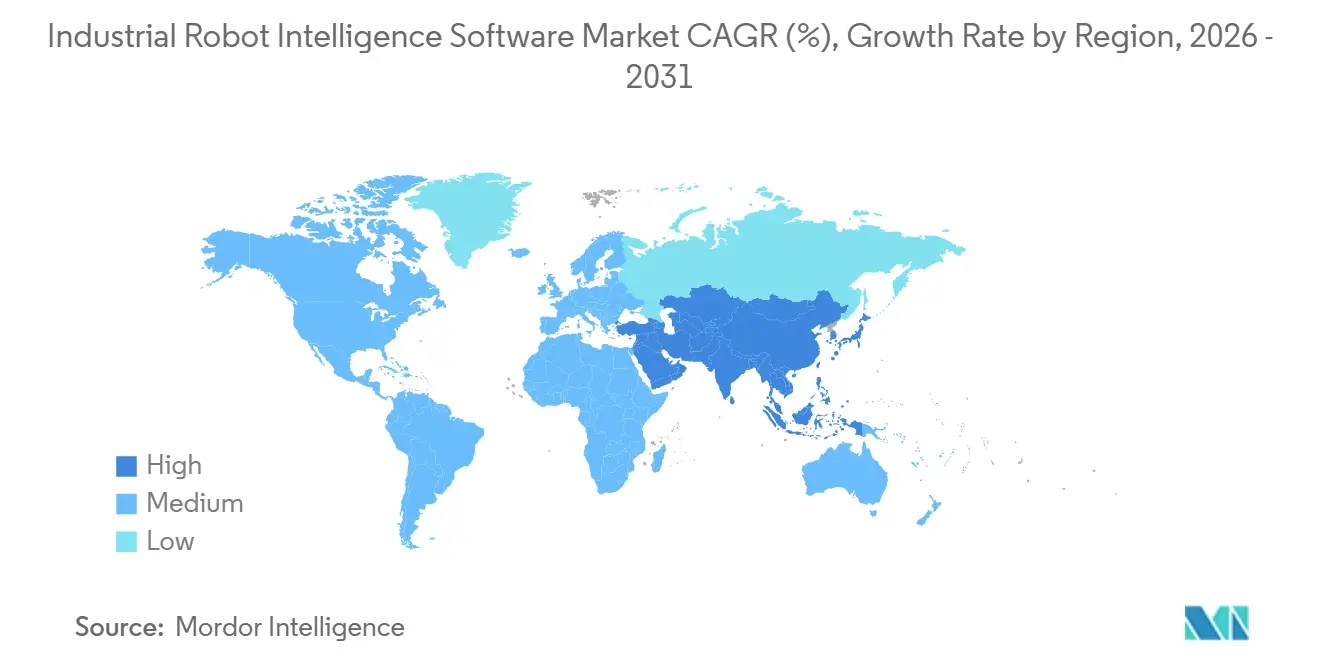
Asia-Pacific held 48.62% of the market in 2025. China installed 295,000 industrial robots in 2024, accounting for 54% of global annual installations, and had an operational stock of 2,027,200 units, creating ongoing demand for programming, AI upgrades, and connected operations. Samsung announced KRW 19 trillion (USD 13.77 billion) for humanoid robot mass production and AI-centered manufacturing in Gumi in July 2026, while Hyundai Wia announced KRW 400 billion (USD 289.9 million) for robotics investments, including stakes in AI and software startups. Config raised a USD 27 million seed round in May 2026 for robot-foundation-model data collection and a cloud-based robot-as-a-service platform. Japan and South Korea have large installed bases of robots that require periodic software upgrades, while India and Australia offer faster-growing opportunities for newer software stacks.
North America and Europe together provide the next largest combined contribution to the industrial robot intelligence software market. The United States installed 38,000 robots in 2025, an 11% increase from the prior year, with food-sector automation, reshoring programs, and AI infrastructure contributing to demand. NVIDIA’s Isaac ecosystem supports simulation, synthetic-data generation, and edge deployment for developers and manufacturers. Western Europe recorded a robot density of 267 units per 10,000 manufacturing employees in 2024, with Germany, Switzerland, the Netherlands, and Italy leading regional adoption. European customers place particular weight on virtual commissioning, safety standards, and cybersecurity requirements, while South America remains an emerging area centered on automotive assembly and programming tools.
The Middle East is projected to expand at 13.06% CAGR through 2031, the fastest geographic rate in the industrial robot intelligence software market. Saudi Vision 2030 and the United Arab Emirates Operation 300bn connect robotics deployment with wider diversification plans. ADNOC deployed a heavy-duty autonomous operator robot at Taweelah in 2026, with full operation targeted by year-end.[6]WAM, “ADNOC Deploys Industry-First Heavy-Duty Robot to Strengthen Safety, Reliability,” Emirates News Agency, wam.ae Lianhe Sowell International Group signed a USD 132.5 million financing framework in October 2025 for an AI-powered robot manufacturing and research base in the United Arab Emirates, while Micropolis AI Robotics signed a USD 1.2 million deployment agreement with EMSTEEL in May 2026 for 4 autonomous logistics robots. These activities show commercial deployments emerging alongside state-backed pilots, while Africa remains the smallest geographic segment, with early demand in South Africa and Nigeria focused on extractives, logistics, and food processing.

Competitive Landscape
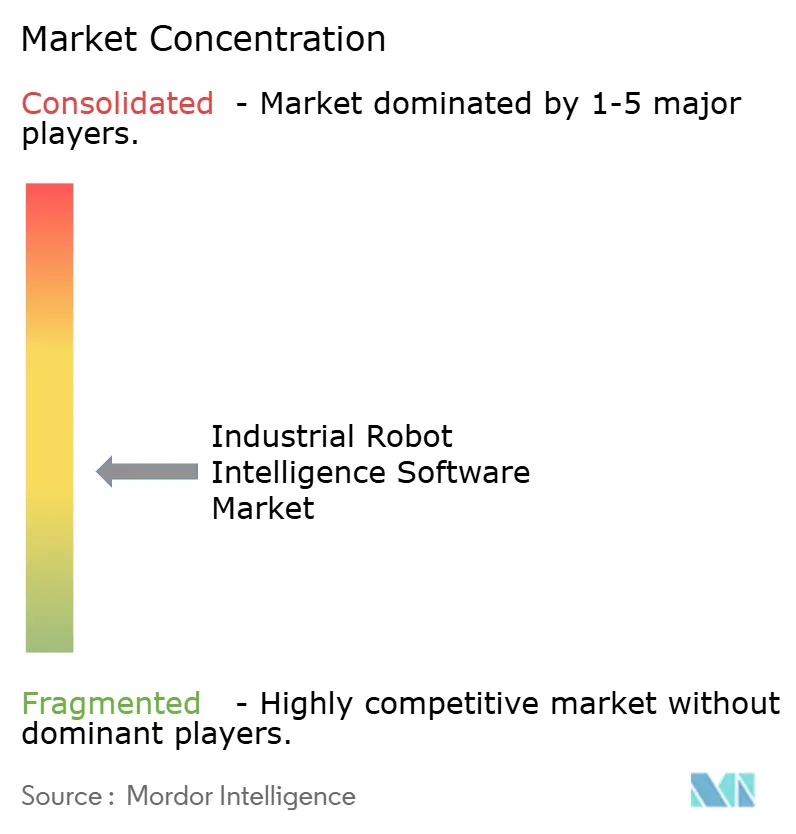
The industrial robot intelligence software market is moderately fragmented, comprising competitive groups that are increasingly overlapping. Robotics original equipment manufacturers, including ABB, FANUC, KUKA, Yaskawa, Mitsubishi Electric, and Universal Robots, package intelligence software with proprietary hardware and build recurring revenue through subscriptions, simulation upgrades, and digital-twin services. Pure-play suppliers, including Inbolt SAS, Fizyr B.V., Augmentus Pte. Ltd., Palladyne AI Corp., Realtime Robotics, and Brain Corporation, address multi-brand and multi-cell settings where an OEM-native platform may not provide a common layer. NVIDIA supports both groups through its Isaac simulation and AI development platform. KUKA introduced its Automation Management Platform at NVIDIA GTC 2026, while ABB’s RobotStudio HyperReality brings AI-oriented simulation into an established robot engineering environment.
Competition increasingly centers on simulation-to-real workflows that reduce project risk and shorten commissioning. Dassault Systèmes DELMIA, PTC, and Siemens Digital Industries Software compete at the enterprise factory-simulation layer, while Inbolt’s CAD-to-production workflow and Realtime Robotics’ motion-planning software address the gap between factory models and robot servo control. Inbolt launched vision-enabled programming for existing robot fleets in June 2026, and its dynamic in-hand bin-picking demonstration was nominated for an Automate 2026 Innovation Award. This shows how software-only vendors can compete in vision and programming without manufacturing robot hardware. The industrial robot intelligence software market remains open to suppliers that can show reliable interoperability and measurable deployment outcomes.
Cloud infrastructure affects model-training costs and the speed of software updates. Microsoft contributed to KUKA’s iiQWorks.Copilot, while cloud platforms support the compute needs of several specialist vendors. Smaller suppliers can move quickly with pre-trained perception models, several robot-brand integrations, and subscription pricing, while OEM software teams retain advantages from installed hardware bases, controller access, and service networks. Cybersecurity certification, safety validation, and integration depth will remain important in supplier selection, leaving space for specialist vendors alongside leading OEM platforms.
Industrial Robot Intelligence Software Industry Leaders
ABB Ltd.
FANUC Corporation
Siemens AG
NVIDIA Corporation
Yaskawa Electric Corporation
- *Disclaimer: Major Players sorted in no particular order

Recent Industry Developments
- August 2026: PIA Automation announces a contract to build a BMW E-Drive assembly line comprising 78 processing stations, 27 robotic cells, and 46 industrial robots, applying digital twin technology and virtual commissioning throughout for multi-variant e-drive production without retooling. Commissioning of the final sections is scheduled for 2027.
- July 2026: Hyundai Wia announces KRW 400 billion (USD 282.62 million) in mid-to-long-term robotics business investment, including equity stakes in AI and software startups and development of mobile picking robots for manufacturing and logistics. The amount represents 1.6 times Hyundai Wia's robot-related sales of KRW 250 billion in 2025.
- July 2026: KUKA launches the LBR iisy collaborative robot on its iiQKA.OS2 unified operating system, providing entry into KUKA's simulation, virtual commissioning, and AI vision ecosystem. In the same month, KUKA achieves IEC 62443-4-2 Security Level 2 certification for a robot system and meets the EN ISO 10218-1:2025 and Regulation (EU) 2024/2847 Cyber Resilience requirements.
- May 2026: FANUC deepens its NVIDIA Isaac Sim and ROBOGUIDE integration, enabling both systems to share the same robot control algorithms and eliminating sim-to-real trajectory discrepancy. FANUC also demonstrates imitation learning with NVIDIA Isaac GR00T N on CRX cobots for flexible cloth folding and upgrades its human-avoidance AI robot with NVIDIA Jetson Thor, improving AI compute performance by more than 7.5x.


Global Industrial Robot Intelligence Software Market Report Scope
The industrial robot intelligence software market includes software solutions that enhance the capabilities of industrial robots through machine vision, motion planning, autonomous decision-making, predictive maintenance, and adaptive learning. These solutions help robots execute complex tasks with improved precision, flexibility, and efficiency across industries such as manufacturing, automotive, electronics, food processing, and warehousing.
The Industrial Robot Intelligence Software Market Report is Segmented by Software Function (Robot Programming and Offline Programming, Perception and Vision Guidance, Simulation and Digital Twin, Motion Planning and Control, and Other Software Functions), Deployment Model (On-Premises, Cloud-Based, and Hybrid), Application (Material Handling and Packaging, Assembly and Joining, Welding and Surface Treatment, Quality Inspection and Metrology, Machine Tending and Processing, and Other Applications), End-User Industry (Automotive and Mobility, Electronics and Semiconductors, General Manufacturing, Food and Beverage, Pharmaceuticals and Medical Devices, Other End-User Industries), Enterprise Size (Large Enterprises, and Small and Medium-Sized Enterprises) and Geography (North America, South America, Europe, Asia-Pacific, Middle East, and Africa). The Market Forecasts are Provided in Terms of Value (USD).
| Robot Programming and Offline Programming |
| Perception and Vision Guidance |
| Simulation and Digital Twin |
| Motion Planning and Control |
| Other Software Functions (Predictive Maintenance and Diagnostics, Data Management and Analytics) |
| On-Premises |
| Cloud-Based |
| Hybrid |
| Material Handling and Packaging |
| Assembly and Joining |
| Welding and Surface Treatment |
| Quality Inspection and Metrology |
| Machine Tending and Processing |
| Other Applications (Picking, Kitting, and Order Fulfillment, Intralogistics and Mobile Manipulation, Hazardous-Environment Operations) |
| Automotive and Mobility |
| Electronics and Semiconductors |
| General Manufacturing |
| Food and Beverage |
| Pharmaceuticals and Medical Devices |
| Other End-User Industries (Metals and Machinery, Logistics and Warehousing, Aerospace and Defense) |
| Large Enterprises |
| Small and Medium-Sized Enterprises |
| North America | United States |
| Canada | |
| Mexico | |
| South America | Brazil |
| Argentina | |
| Rest of South America | |
| Europe | Germany |
| Italy | |
| France | |
| United Kingdom | |
| Russia | |
| Rest of Europe | |
| Asia-Pacific | China |
| Japan | |
| South Korea | |
| India | |
| Australia | |
| Rest of Asia-Pacific | |
| Middle East | Saudi Arabia |
| United Arab Emirates | |
| Turkey | |
| Rest of Middle East | |
| Africa | South Africa |
| Nigeria | |
| Rest of Africa |
| By Software Function | Robot Programming and Offline Programming | |
| Perception and Vision Guidance | ||
| Simulation and Digital Twin | ||
| Motion Planning and Control | ||
| Other Software Functions (Predictive Maintenance and Diagnostics, Data Management and Analytics) | ||
| By Deployment Model | On-Premises | |
| Cloud-Based | ||
| Hybrid | ||
| By Application | Material Handling and Packaging | |
| Assembly and Joining | ||
| Welding and Surface Treatment | ||
| Quality Inspection and Metrology | ||
| Machine Tending and Processing | ||
| Other Applications (Picking, Kitting, and Order Fulfillment, Intralogistics and Mobile Manipulation, Hazardous-Environment Operations) | ||
| By End-User Industry | Automotive and Mobility | |
| Electronics and Semiconductors | ||
| General Manufacturing | ||
| Food and Beverage | ||
| Pharmaceuticals and Medical Devices | ||
| Other End-User Industries (Metals and Machinery, Logistics and Warehousing, Aerospace and Defense) | ||
| By Enterprise Size | Large Enterprises | |
| Small and Medium-Sized Enterprises | ||
| By Geography | North America | United States |
| Canada | ||
| Mexico | ||
| South America | Brazil | |
| Argentina | ||
| Rest of South America | ||
| Europe | Germany | |
| Italy | ||
| France | ||
| United Kingdom | ||
| Russia | ||
| Rest of Europe | ||
| Asia-Pacific | China | |
| Japan | ||
| South Korea | ||
| India | ||
| Australia | ||
| Rest of Asia-Pacific | ||
| Middle East | Saudi Arabia | |
| United Arab Emirates | ||
| Turkey | ||
| Rest of Middle East | ||
| Africa | South Africa | |
| Nigeria | ||
| Rest of Africa | ||


Key Questions Answered in the Report
What is the size of the industrial robot intelligence software market?
The industrial robot intelligence software market was estimated at USD 2.04 billion in 2026 and is forecast to reach USD 3.26 billion by 2031 at a 9.83% CAGR.
Which software function leads the sector?
Robot Programming and Offline Programming led with 24.78% share in 2025, while Perception and Vision Guidance is forecast to grow fastest at a 12.16% CAGR.
Why is cloud deployment expanding faster than on-premises systems?
Cloud-Based deployment is projected to grow at a 13.02% CAGR because it supports AI training, synthetic data, and subscription models, while local systems remain important for real-time execution.
Which application is growing fastest?
Quality Inspection and Metrology is projected to expand at a 12.02% CAGR through 2031 as manufacturers need adaptive, high-precision inspection.
Which customer group has the strongest growth outlook?
Small and Medium-Sized Enterprises are projected to grow at a 13.74% CAGR as no-code tools and Robotics-as-a-Service reduce entry barriers.
Which region has the highest growth forecast?
The Middle East is projected to grow at a 13.06% CAGR through 2031, supported by diversification programs and new commercial robotics deployments.
Page last updated on:






