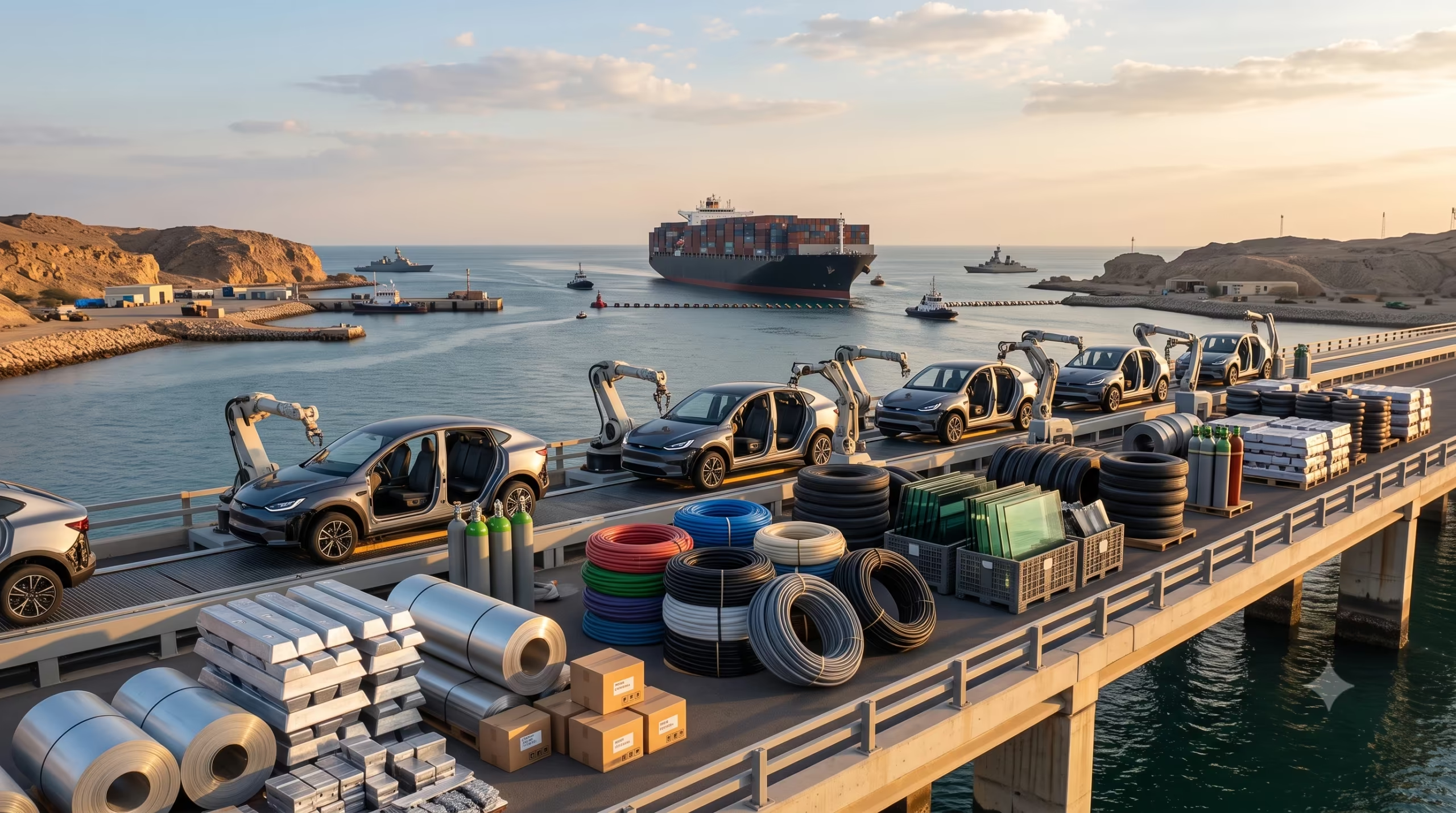
Seven Materials, One Chokepoint
As of this writing (July 15, 2026), Strait traffic is reduced again following a blockade reimposed on July 13–14, after operating at partial volume since a June 17 interim accord. The structural exposure mapped in this brief does not depend on which way that resolves next.
The Bill of Materials Was Always a Geopolitical Document
Build a car. Start with steel and aluminum for the body and chassis. Add naphtha-derived plastics for the interior and bumpers. Layer in synthetic rubber from the butadiene chain for tires and seals. Fill the windscreen with glass made in energy-intensive furnaces. Then add the 1,400 to 3,000 semiconductors that run the engine management, infotainment, safety, and power electronics systems. You now have a vehicle. You also have a supply chain that, at nearly every stage, depends on Gulf energy, Gulf materials, or Gulf-routed industrial gases.
Toyota CEO Koji Sato, who also chairs the Japan Automobile Manufacturers Association, stated explicitly in March 2026 that Japan's carmakers rely on the Middle East for aluminum, naphtha, and export sales. The confirmation was notable for its directness. The dependence had always existed. It simply hadn't been stress-tested at this severity before.
Japan imports roughly 90% of its crude oil, with a substantial share transiting the Strait. Toyota, Honda, and Nissan face direct exposure to energy price shocks, compressing margins at every link of their supply chains. The result is visible: Toyota has widened planned overseas production reductions three times since March, with the latest revision reaching approximately 100,000 vehicles through February 2027, up from an initial 38,000. The company cited softening demand in the Middle East and Asia alongside rising fuel prices curbing appetite for petrol vehicles, and the ICE RAV4 and Avalon carry the brunt of that demand-side cut.
The same revision also trims the bZ3X and bZ7, EV models built for the Chinese market, but it would be a mistake to read those cuts as proof that materials scarcity is already constraining EV production. Toyota's own reporting attributes the bZ3X and bZ7 reductions to intensifying competition from Chinese EV and hybrid brands, not to Hormuz-driven material costs. That distinction matters for the rest of this brief: the EV materials exposure mapped below is a forward-looking risk, not one that has shown up in a headline production cut yet. Forward risk is still risk, helium buffers are explicitly time-limited and aluminum content gaps are still widening, and the case study later in this brief shows a Tier 1 supplier already restructuring around that exposure before it forces a production decision, not after.
"The disruption hits both the cost base and physical availability of raw materials and components. For automakers, this is not a single-material problem. It is a system-level shock."
Tang Jin, Senior Researcher, Mizuho Bank, April 2026From Aluminum to Semiconductors: Seven Materials Hit at Once
The full value chain cascade, raw material exposure by automotive category.
| Material | Gulf Dependency | Status | Automotive Impact | Exposure |
|---|---|---|---|---|
| Energy | Japan: 90% crude oil via Hormuz | Energy costs surging; plant costs up | Cost inflation at every plant in Japan, Korea, India | C |
| Aluminum | GCC: ~9% global smelting; Japan: ~30% imports from ME | LME up ~17%; premiums to USD 350/t, Q2 2026 | EV weight reduction now a cost liability | C |
| Plastics/Naphtha | 70% of Japan's naphtha from ME | Naphtha shortage; PE/PP up 30% | Interior, seals, trim, bumpers cost-impacted | C |
| Helium | Qatar: 30–33% global supply; S. Korea 64.7% dependent | 5.2M m³/month removed; fabs weathered Q2, buffer finite | Semiconductor fab risk rising; EV battery mfg under watch | C |
| Semiconductors | TSMC/Samsung dependent on Qatar helium | Q2 fabs report no significant impact; tail risk rising | Vehicle production risk from Q4 2026 if buffer depletes | H |
| Rubber/Tires | Butadiene from naphtha chain | Synthetic rubber prices surging | Fleet cost inflation; EV tire costs up | H |
| Glass | Energy-intensive; LNG/oil dependent | Furnace costs up; margins compressed | Windscreen and glazing costs rise across models | M |
| C = Critical · H = High · M = Medium. Sources: S&P Global; Automotive News; AlCircle; MarketScreener; Mordor Intelligence | ||||
The cascade is unusual because it hits every major material category at once. Previous automotive supply chain disruptions were component-specific: the 2011 Japan earthquake hit certain electronic components, COVID-19 hit semiconductors, the 2024 Red Sea crisis hit global automotive logistics costs. The Hormuz closure of 2026 hits energy, metals, polymers, industrial gases, and semiconductors simultaneously. Every one of them traces back to the same 33-kilometer chokepoint. Daniel Harrison, Senior Automotive Analyst at Ultima Media, was among the first to name the full scope of it in April, and the pattern he flagged has only broadened since. What this brief adds to that picture is what happens next at the supplier level, and what one Tier 1 manufacturer actually did about it.
Aluminum is the most immediately visible shock. Japanese automakers source roughly 30% of aluminum imports from the Middle East. LME aluminum prices rose approximately 17% since hostilities began, briefly exceeding USD 3,700 per tonne in 2026, a four-year high. Japanese buyer premiums over LME surged from USD 195 per tonne to USD 350 to 353 per tonne for Q2 2026. Gulf aluminum producers collectively account for approximately 9% of global smelting capacity, and the Strait is their only maritime exit route.
Helium is the sleeper risk, not because it has already caused production halts, but because the mitigants are depletable. Qatar produced approximately 30 to 33% of global helium as a byproduct of LNG processing. The Ras Laffan shutdown removed roughly 5.2 million cubic meters a month from global supply. Through Q2 2026, the major fabs weathered the shortage better than early forecasts predicted. TSMC reported no significant impact; Infineon and STMicroelectronics said production was unaffected. The reasons are structural, large chipmakers maintain 80 to 90% helium recycling rates, hold long-term supply contracts with diversified providers, and can access US strategic storage reserves. Moody's noted that semiconductor firms can outbid most helium users because the gas represents just 0.5 to 1% of production costs.
But resilience is not immunity. The mitigants, recycling capacity, stored reserves, US supply redirection, all assume the disruption is temporary. QatarEnergy's own assessment puts the Ras Laffan repair timeline at three to five years. Interim accords have come and gone faster than that repair timeline, more than once, and each one has narrowed rather than removed the underlying exposure. If the current accord follows the same pattern, the fabs managing today will be rationing by mid-2027. The risk is not a sudden halt. It is a slow squeeze on the most advanced nodes, exactly the ones EV power electronics and ADAS systems require.
The Exposure Is Not Uniform
Japan is the most vulnerable major automotive economy: 90% oil dependency on the Gulf, 30% of aluminum imports from the Middle East, and a tier-2 supplier base with limited diversification lead time. South Korea's position is comparable, 70% of crude oil from the Gulf and 64.7% of helium imports from Qatar. But the picture differs sharply elsewhere. US automakers source aluminum primarily from domestic smelters and Canada, and Bloomberg Intelligence assessed they face no near-term shortage risk. European OEMs sit in the middle, less Gulf-dependent on aluminum but exposed through naphtha-derived plastics and the EU's 40% helium sourcing from Qatar. China, the largest vehicle market and fastest-growing EV exporter, faces the steepest energy cost inflation, 84% of Hormuz crude flows to Asia, but has offset some aluminum supply through domestic smelter ramp-ups and Indonesian imports. The strategic response required depends entirely on where in this exposure map an OEM sits.
"Aluminum earned its place in EV manufacturing because nothing else moves heat away from a battery pack as efficiently at that weight. That's the number planners need before they chase a substitute, not just is there another material, but does it perform at the same temperature range without adding mass back somewhere else."
Sai Phani Kumar, Senior Research Manager (Automotive, Aerospace & Defense), Mordor IntelligenceThe EV Transition Paradox: Why the EV Battery Supply Chain Requires the Most Vulnerable Inputs
Here is what makes the Strait of Hormuz crisis particularly disruptive for automotive strategy: the shift to electric vehicles was supposed to reduce energy dependency by moving from oil to electricity. In practice, EVs require more aluminum per vehicle than their combustion equivalents, for weight reduction and thermal management, more advanced semiconductors, for battery management, power electronics, and ADAS, more specialist resins and polymers, for battery housings and thermal interface materials, and more helium in the fabrication of the advanced chips that run them. The technology designed to reduce energy dependency has created a deeper dependency on energy-intensive and Hormuz-routed materials.
The EV powertrain segment currently stands at USD 259.92 billion in 2026, growing at 21.48% CAGR to USD 687.64 billion by 2031. Asia-Pacific holds 57.66% of that segment. The automotive power electronics segment, which is entirely dependent on advanced semiconductor fabrication, stands at USD 5.75 billion in 2026, growing to USD 9.76 billion by 2031 at 11.18% CAGR. Both forecasts were built on a stable helium supply, stable aluminum pricing, and an open Strait. All three assumptions need revisiting.
The semiconductor impact has been contained through Q2 2026 by inventory buffers and recycling, but analysts at Fitch Ratings flag it as a rising tail risk if disruption persists, particularly for the advanced-node chips that EV battery management, power electronics, and ADAS systems depend on. The EV Battery Pack segment, with Asia-Pacific accounting for 62.39% of revenue in 2025, faces compounding pressure from both aluminum cost inflation and semiconductor supply constraints.
When Aluminum Became the Constraint, Not Just the Cost
A Tier 1 supplier facing an aluminum allocation gap on its battery housing line came to Mordor Intelligence with one question: substitute, or secure more supply. We modeled both. On the supply side, realistic primary aluminum availability at the client's tier fell short of projected 2027 EV-driven demand by a meaningful margin. On the substitution side, we tested alternatives against the actual performance requirement of each application, not a generic "lighter and cheaper" comparison.
The answer split the difference. The battery housing's thermal conductivity requirement ruled out steel and made magnesium impractical on cost and manufacturing grounds, aluminum stayed. Structural brackets and trim, roughly a third of total tonnage, had no such requirement and moved to high-strength steel within ten weeks. Net effect, full aluminum allocation preserved for the housing, and enough demand pulled off the aluminum line to close the supply gap without a price war for scarce metal.
The Non-Obvious Conclusion: The Chip and Helium Shortage Gave Combustion Vehicles a Reprieve
The dominant planning assumption in automotive procurement for the past five years has been an accelerating transition away from internal combustion vehicles toward EVs, with the pace set by regulation and battery cost deflation. That assumption remains structurally intact at the policy level. It is being tested at the material level in 2026.
EV production requires more of the exact materials that are now most constrained: aluminum, advanced semiconductors, and helium-dependent chips. ICE vehicles, by contrast, contain fewer advanced semiconductors and no helium-dependent EUV-fabricated chips. The short-to-medium-term material disruption therefore disproportionately impacts EV production and costs relative to conventional vehicles, at least in principle. In practice, the clearest evidence for this so far isn't a headline production cut, Toyota's own EV cuts trace to Chinese competition, not materials, it's the kind of restructuring the Tier 1 supplier in this brief's case study had to do quietly, months before any OEM would confirm a materials-driven delay in public.
The non-obvious conclusion is that ICE vehicles, widely written off as the declining product, have temporarily become the easier-to-produce product. This does not reverse the EV transition. It delays some model launches, inflates EV bill-of-materials costs, and may shift a portion of near-term demand back toward hybrid or even conventional powertrains in markets where EV availability or cost parity has deteriorated. Planners who assumed the ICE-to-EV curve was one-directional should account for this temporary but real reversal in the 2026 to 2028 production mix, and should expect to see it first in supplier-level restructuring, not in OEM press releases.
| Segment | 2026 Value | Forecast | CAGR | Strategic Note |
|---|---|---|---|---|
| Global Automotive | USD 2.75T (2025) | USD 3.26T (2030) | 3.46% | EV + digital cockpit transition |
| EV Powertrain | USD 259.92B | USD 687.64B (2031) | 21.48% | Asia-Pacific 57.66% |
| Auto Power Electronics | USD 5.75B | USD 9.76B (2031) | 11.18% | SiC/GaN; helium-dependent fab |
| EV Battery Pack | APAC 62.39% | 9.12% CAGR, EU (2031) | Fastest | 600–800V architecture |
| Electric Vehicle | USD 744.85B | USD 1.30T (2031) | 11.68% | Asia-Pacific 52.73% |
| Source: Mordor Intelligence | ||||
Market Signal: The Supply-Demand Paradox in Real Time
The Hormuz crisis is producing a contradiction that automotive planners will need to manage through 2028. EV demand is accelerating in the markets most exposed to the disruption, while EV supply is constrained by the very materials the disruption has cut off.
The demand signal is unambiguous. In Europe, battery-electric car registrations surged 51% year-on-year in March 2026, reaching 344,064 units across the EU, EFTA, and UK, a record 21.8% market share. April held at 255,296 units, a 38% year-on-year increase. Fuel price volatility and new models priced around EUR 25,000 are converting buyers in real time.
India tells a similar story. Electric passenger vehicle registrations jumped from approximately 13,700 units in February 2026 to 22,500 in March, 23,500 in April, and 26,700 in May, a 75% year-on-year increase even as overall passenger vehicle sales declined. EV penetration in India crossed 5.8% in April, overtaking the US (5.1%) for the first time.
But the supply side tells the opposite story. European-manufactured EVs averaged 283 kg of aluminum content in 2022, compared with 169 kg for ICE equivalents, a gap projected to widen to 310 kg by 2026. Every EV battery pack, power electronics module, and ADAS system requires the advanced semiconductors now at risk from helium supply constraints. The vehicles consumers increasingly want are the vehicles most exposed to the materials shortage.
The strategic implication: OEMs face a production allocation problem, not a demand problem. The manufacturers that can secure aluminum, helium-dependent chips, and battery-grade materials will capture a demand wave. Those that can't will cede share, and the gap between the two groups is widening with each month of disruption.
Strategic Synthesis: The Supply Chain Disruption No One Planned For
A car is not just an assembly of components. It is a bundle of energy-intensive materials, each with a supply geography, a transit dependency, and a price repricing in real time. That single insight is the through-line of this crisis.
The global automotive sector, at USD 2.75 trillion, is experiencing simultaneous cost inflation and physical constraints across more material categories than during any previous supply disruption. The EV transition, already the most capital-intensive product change in automotive history, is now being executed against a backdrop of constrained aluminum, constrained semiconductors, and constrained helium, three of the four most critical inputs for the next generation of vehicles.
The organizations that manage this best are the ones that treat the vehicle bill of materials as a strategic document, not a procurement spreadsheet. Every line in that BOM has an energy origin, a transit route, and a geopolitical risk. Most automotive companies are only discovering this now. The ones that mapped it early are managing a crisis. The ones that didn't are inside one.
A ceasefire does not resolve the structural exposure. Interim accords in this conflict have followed a consistent shape: a negotiated window opens, limited Strait passage resumes, and within weeks an incident, a strike, a boarding, a contested transit claim, breaks the accord before its own term expires. Each cycle has looked different in its specifics, but the shape has held, and technical talks in Doha now run alongside renewed strikes rather than instead of them.
The terms under negotiation reveal the deeper risk regardless of whether the shooting resumes: Iran is seeking permanent international recognition of its authority over the Strait, including eventual transit fees, a structural change to global shipping economics, not a temporary disruption. Even under the most optimistic resolution timeline, Goldman Sachs estimates damaged Gulf aluminum smelting capacity will not fully restart until mid-2027, and helium supply from Ras Laffan faces a three-to-five-year repair horizon according to QatarEnergy's own assessment. The bill of materials remains a geopolitical document whether or not any single ceasefire holds.
One Origin Shock, Four Fractures
This brief maps the automotive angle. The same Gulf disruption is simultaneously restructuring global LNG and energy infrastructure investment, driving a fertilizer and food security crisis, and cutting off the naphtha and LPG feedstock behind global petrochemical and polymer production. It's the same origin shock, read through four different desks, energy, agriculture, chemicals, and automotive, and no single-sector publication covering any one of them can show you the other three.
For any organization that touches more than one of these verticals, an automotive group with chemicals or energy exposure, an investor spanning materials and mobility, a government weighing industrial and food policy together, pricing chokepoint risk once, at the Strait level, is more efficient and more accurate than re-discovering the same exposure four separate times, one sector at a time.
Five Decisions for Automotive OEMs, Tier 1 Suppliers, and Investors
Each one has a lead time longer than the current crisis will last.
The Next Layer of Intelligence
The questions that matter over the next 18 months are specific: which Tier 2 and Tier 3 suppliers carry Gulf-origin helium dependencies, how much semiconductor inventory buffer remains before EV production is affected, and what the actual recovery timeline for aluminum and naphtha supply looks like when rerouting adds 100 days to delivery. Our automotive coverage spans 60-plus reports updated continuously with primary data, from automotive value chain analysis that surfaces risk three tiers removed from the OEM, to commodity price trend tracking that separates a temporary spike from a structural repricing, to competitive benchmarking that shows which manufacturers are absorbing the hit and which are gaining ground.
Want deeper insights on how the Hormuz materials cascade is repricing bills of materials, reshaping powertrain mix decisions, and exposing aluminum and semiconductor dependencies? Explore our latest Global Automotive and EV Powertrain research reports.