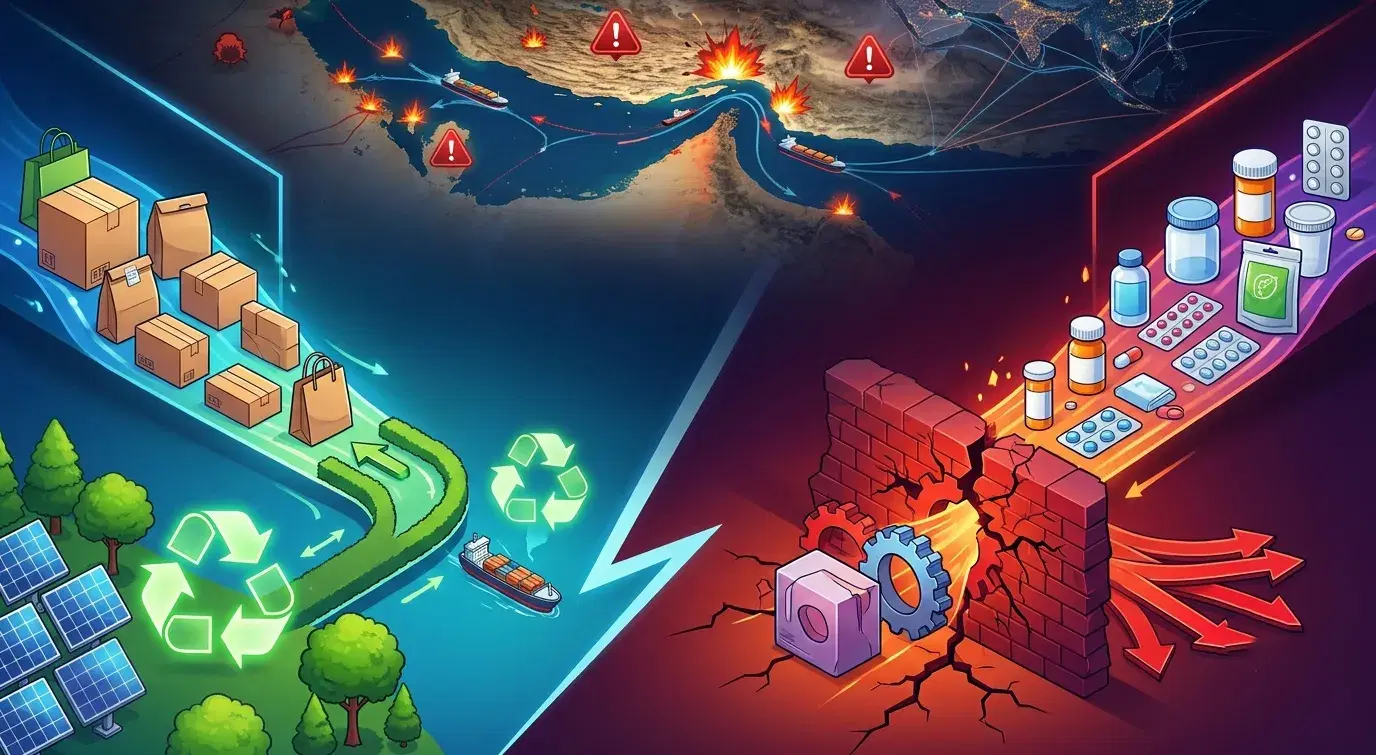
When the cost shock and the physical shortage hit at once, and the backup materials cannot do the job in the applications that matter most, that is a double bind. This brief maps which half of your portfolio can escape it and which half cannot.
The Ceasefire Has Not Held, as of 16 July 2026
On June 19 the US and Iran signed a memorandum initiating a 60-day ceasefire; by late June, Hapag-Lloyd, Maersk, and CMA CGM had begun moving vessels through a narrow Omani-side corridor. That recovery did not hold. On July 7 the tankers Al Rekayyat and Wedyan were struck inside the Strait, and Washington revoked Iran's oil-sale authorization and struck Iranian military targets. On July 13–14 the US reinstated a full blockade of Iranian ports, and maritime trackers again recorded stalled and dark transits, with daily traffic well below the roughly 100–110 pre-war baseline.
What this changes: the reopened corridor never reached the sustained volumes needed to prioritize bulk petrochemical feedstock. Full restoration of the PE, PP, and PVC feedstock chain is now further out than June estimates assumed, and repair work stalls each time strikes resume.
What this does not change: the structural exposure the crisis revealed. Every vulnerability mapped below existed before February 28 and will exist after the Strait fully reopens. The double bind was the stress test. The question now is what you do with the results.
Plastic Packaging Is the Last Stop in the Strait of Hormuz Crisis
The decision-useful point is not that resin got expensive. It is that visibility across most packaging supply chains stopped at the converter, so when the shock arrived, buyers could not tell which of their inputs traced back to a Gulf cracker and which did not. That is a feedstock-origin blind spot, and it is the difference between managing this crisis and discovering it.
The physical route is straightforward. Naphtha moves through the Strait, into crackers, into ethylene and propylene, and then into the PE and PP resins behind every film, tray, pouch, cap, closure, and blister pack made in Asia and Europe. Packaging Europe's April 2026 analysis confirmed more than 80% of Middle East polyethylene export capacity depends on Hormuz transit, with the region exporting nearly three-quarters of its PE production. When the Strait closed, parts of the chain did not just get more expensive. They stopped working. PE and PP climbed to four-year highs, up more than 30% since late February. LDPE spot in Europe doubled, exceeding Russia-Ukraine-crisis levels. US PE contract prices rose nearly 20% in March alone. Plastic goods in Taiwan surged as much as 40%.
One partial offset is emerging: US ethane-based PE, which is not Hormuz-dependent, spiked in March as domestic producers anticipated demand. But new capacity does not arrive at scale until late 2026 at the earliest, and US supply alone cannot replace the Gulf's export volume. It narrows the gap. It does not close it.
The stability of plastic as a basic industrial material has been shaken. The disruption will move quickly through supply chains.
- Chen Ping-Kuo, Professor, Ritsumeikan Asia Pacific University, Fortune, May 2026Why This Resin Shortage Is Different, and Where Substitution Actually Fails
Every previous resin spike kept one safety valve open: supply was available if you paid enough. The double bind removes that valve in specific critical categories, and it does so through two distinct mechanisms that most coverage blurs together. The first is allocation: PP inventories were already at 35 days before the closure, below the 38-to-42-day norm, so physical shortage on top of a depleted buffer became an allocation problem no budget can solve. In South Korea, 71% of surveyed plastics companies received notices of resin reductions or suspensions, and LG Chem shut its No. 2 naphtha cracker at Yeosu. The German Association of Plastics Processors found 99% of packaging manufacturers faced supplier price increases, but only a fraction could pass them through.
The second mechanism is substitution failure, and this is where the analysis has to get specific instead of hopeful. Paper and fiber work in secondary packaging and e-commerce mailers. They do not work, without significant barrier-technology investment, in high-barrier food packaging, pharmaceutical blister packs, IV bags, or syringes. Fortune's May reporting confirmed PP and PVC shortages were directly limiting syringe, IV bag, and sterile packaging availability across Asian healthcare. When a packaging crisis reaches hospital procurement, the stakes move from commercial to clinical.
The Substitution-Decision Grid: Which Half of the Portfolio Can Escape the Bind
The exposure chart above shows where resin risk concentrates. The grid below is the decision layer Mordor Intelligence adds to it: for each application category, whether a substitute exists now, how far off barrier technology is, and therefore what the correct move actually is. This is the synthesis no single trade-press source assembles, and it is what turns a price story into a procurement plan.
The Uncomfortable Half of the Double Bind
The consensus story is that this crisis accelerates the sustainable packaging transition. That is true for the top two rows above and false for the bottom three. For high-barrier food, pharmaceutical blister, and sterile medical formats, substitution fails on validation and barrier performance, not on cost, so there is no sustainable hedge to qualify. For that volume the correct response is not qualifying alternatives; it is securing virgin resin allocation and building a contingency plan before the next disruption. Any brief that tells you sustainability is the answer for the whole portfolio is selling you the comfortable half.
Continue the Analysis
Flexible plastic packaging sits at the center of today's resin allocation challenge. Explore the full market outlook, demand by end-use, competitive landscape, and forecasts through 2031.
Explore the Flexible Plastic Packaging Market Report →What Happens Next: Packaging Procurement Along the Chain
If you are a brand owner, you are now absorbing the costs your converters cannot pass on. The 99% German finding is the critical data point. The shortage compresses converter margins and flows upstream through contract renegotiation, cost-recovery clauses, and allocation that favours the highest-volume customers. If you did not model resin escalation into H2 2026 and FY2027, you are exposed on both margin and availability.
Medical and pharmaceutical packaging faces its own crisis within this one. PVC and PP are the primary resins for syringes, IV bags, blister packs, and sterile materials, and pharmaceutical packaging is now competing for the same constrained grades as food packaging. The healthcare and pharmaceutical segment is the fastest-growing end-use in flexible plastic packaging, growing at a CAGR of 6.05% from 2026–2031, demand that was already accelerating into this constraint before the Strait closed.
One healthcare converter's response to this exact constraint shows what disciplined crisis management looks like, and why the decisions being made now will outlast the disruption.
In early March 2026, a mid-sized healthcare packaging converter supplying sterile trays, syringe components, and flexible medical pouches across Japan, South Korea, and Taiwan faced the defining problem of this crisis: resin was not merely more expensive, it was intermittently unavailable. Its legacy model of price indexes and quarterly contracts failed when PP and PVC moved from cost pressure into allocation risk.
Rather than substituting blindly, the converter segmented its portfolio into three tiers. Critical sterile-contact applications were protected, because validation risk was too high. Secondary and tertiary packaging moved into accelerated trials for paper and fiber. Non-sterile flexible formats were redesigned around downgauging, mono-material structures, and resin grades with lower Gulf-origin exposure.
Within six weeks, the company replaced generic resin surcharges with a resin-exposure map by application, grade, supplier origin, and substitution feasibility. Customers received three choices: secure allocation at a premium, approve alternative formats, or accept longer delivery windows. The most important shift was financial: sustainable packaging moved from an ESG initiative to a supply-security investment, judged on whether it could keep customers supplied when virgin resin could not be reliably procured.
The Reframe: Sustainable Packaging Is a Supply Argument, but Only for Half the Portfolio
Sustainable packaging has received its most powerful commercial argument, and it is important to scope it honestly. For secondary and e-commerce formats, brands that were evaluating alternatives as ESG compliance are now evaluating them as resin-supply hedges, and finance and supply-chain leaders, not sustainability teams, are driving the switch. At Interpack 2026, converters testing fiber-based alternatives accelerated full-scale transitions. The sustainable packaging segment was already USD 325.94 billion in 2026 at a 7.29% CAGR. The regulatory tailwind compounds it: the EU's PPWR pushes on compliance while the crisis pushes on supply.
There is a real irony worth naming: rising virgin resin prices are doing what years of sustainability policy could not, making recycled content cost-competitive. The virgin-to-recycled PE spread has narrowed or reversed in several grades since March, improving the economics of chemical recycling.
The conventional narrative, of consumer demand and regulation pushing brands toward alternatives over a 10-to-15-year horizon, is still true in principle and now wrong on timing for the substitutable half of the portfolio. The double bind compresses that transition into a 2-to-3-year window of forced qualification, not because goals changed, but because Gulf-origin virgin PE and PP are no longer reliably available at viable prices. For the non-substitutable half, as the grid shows, there is no compression to capture, only allocation to secure.
Where Substitution Stops
High-barrier pharmaceutical packaging follows a different set of rules. Explore the market dynamics shaping one of packaging's most supply-constrained segments.
Explore the Pharmaceutical Packaging Market Report →Strategic Synthesis: The Flexible Plastic Packaging Repricing
The double bind split packaging supply chains into two groups: those that had diversified resin sources and invested in alternatives, and those that had not. The first group managed the crisis. The second group was the crisis. The June 19 ceasefire has not erased that separation; its collapse has sharpened it, because each round of strikes keeps facilities from being repaired and pushes petrochemical normalization further behind crude and LNG than June estimates assumed.
The scale is the point. Global packaging is USD 1.22 trillion in 2026, and the flexible plastic portion, the most directly exposed, is USD 280 billion. That is the supply chain being repriced by a 33-kilometer chokepoint. But the sharper synthesis is the split this brief has mapped: the sustainable transition belongs on the risk register for the substitutable half of that volume, and virgin-resin allocation security belongs on it for the half that has no green hedge. Boards briefed on sustainable packaging as a cost center should be briefed on it as a supply-security investment for one half of the portfolio, and on allocation risk for the other.
The question is not whether this exposure applies to your supply chain. It does. The question is whether you have mapped which half of it can escape the bind, and which half you must simply secure.
Five decisions with lead times measured in months. The ceasefire's failure to hold has narrowed the window to act, not widened it.
The Next Layer of Intelligence
The double bind exposed a gap most procurement teams did not know they had: visibility stopped at the converter. The resin behind the film, the cracker behind the resin, and the feedstock route behind the cracker were invisible until they broke. Aggregate price feeds and quarterly supplier reviews cannot answer the questions that now decide competitive position: which resin grades face physical shortage versus price-only impact, where US ethane-based PE can realistically substitute for Gulf-origin grades, how fast alternatives clear qualification, and what recovery path Middle East polymer exports actually follow.
Mordor Intelligence's Value and Supply Chain Analysis maps feedstock flows from crude origin through cracker, converter, and end-use application, quantifying where risk concentrates across tier-1 to tier-3 suppliers. Its Strategic Sourcing and Category Intelligence delivers the cost-structure and grade-level pricing visibility to act on what the mapping reveals across PE, PP, PVC, and PET.
The double bind was a stress test, and it returned a clear result. This is no longer a question of whether packaging is exposed to the Strait of Hormuz; it plainly is. It is a question of knowing, SKU by SKU, which part of your portfolio has a fundable path to fiber and recycled content, and which part has no substitute and must be secured on allocation. The organizations that leave that mapping until the next disruption will spend the next one discovering exposure again. The organizations that do it now will spend the next one acting on it. That is the entire difference the double bind revealed, and it is the difference worth acting on before the corridor status changes again.
Want deeper insights on how resin shortages are splitting packaging portfolios between the formats that can substitute and those that cannot? Explore our latest Flexible Plastic Packaging and Sustainable Packaging research reports.