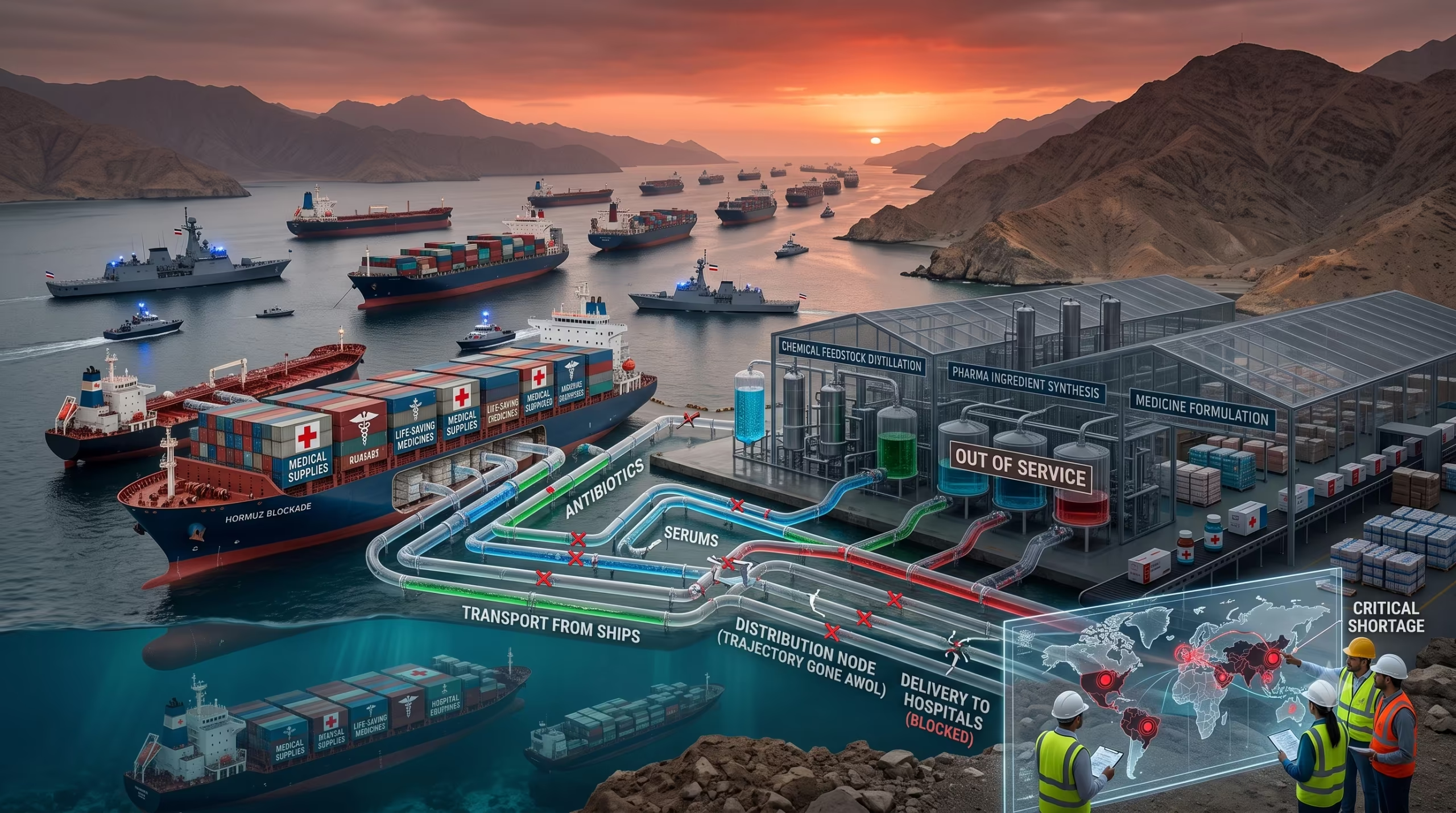
The 2026 Strait of Hormuz crisis disrupted the petrochemical inputs on which medicines depend - the solvents and intermediates that build APIs, and the PVC, PP, and PE that form IV bags, syringe barrels, and blister packs. That dependency was documented and public. What broke was not primarily supply; it was visibility. Most pharmaceutical and hospital procurement teams could trace costs to a Tier 1 supplier and no further, so when propylene and PVC repriced after Gulf energy flows were hit, they could not tell which of their inputs ran back to a Gulf-linked feedstock, or whether a delayed shipment was a logistics bottleneck or a feedstock shortage, the gap that turned a shipping disruption into a full Hormuz pharmaceutical supply disruption for procurement teams.
The disruption moved on two tracks that demand different responses. The cost track was fast and hedgeable: Indian paracetamol API roughly doubled in weeks, Pharmexcil sought emergency government allocation of propylene, methanol, and butane, and CDMOs on thin margins idled facilities. The physical-availability track was slower but more dangerous, because it hit categories that cannot be substituted or delayed: NHS England warned certain single-use medical supplies could run out within days, and South Korea opened a national probe into syringe hoarding. A cost spike on a hedgeable API is a margin problem; a physical shortage of a sterile single-use device a patient needs today is a clinical one. Which track an input sits on - and whether it can be substituted or can wait - is the decision that matters.
This brief maps that two-track exposure by substitutability and clinical tolerance, generalizes the feedstock-visibility method from a live Mordor Intelligence engagement into a repeatable approach, and right-sizes the role of AI: as the scalable early-warning layer over that visibility, not as a supply fix. It closes with five decisions whose lead times are longer than any single ceasefire.
The Blind Spot Was Visibility, Not Supply
Every pharmaceutical executive knows their API supplier. Most know their Tier 1 packaging converter. Very few, before February 2026, had traced either relationship back through the petrochemical chain to a dependence on Gulf-routed crude and its derivatives. The Hormuz closure made that gap visible in the most uncomfortable way - through medicine shortages, hospital alerts, and health-minister statements - but the information had been sitting in annual reports and public polymer supply maps the whole time.
Petrochemical dependency in pharmaceuticals is not confined to one input category , it runs the length of the chain, from synthesis to packaging to delivery. Paracetamol, ibuprofen, and metformin are made using petrochemical-derived raw materials; the solvents that dissolve APIs, the intermediates assembled into active molecules, and the polymers that form IV bags, syringe barrels, blister foils, and bottle caps all trace to the same feedstocks that move through the Strait. India - the pharmacy of the world - routes roughly 40% of its crude imports through Hormuz, and the United States fills 47% of its generic prescriptions from India. The arithmetic is simple and uncomfortable: a Strait disruption is a disruption to the raw-material cost base of most of the world’s generic medicines, including in countries that never import a molecule from the Gulf.
The organizations that had mapped these dependencies had time to react. Those that had not discovered them through shortages. That difference- foresight versus surprise- is the entire subject of this brief, and it is a visibility problem before it is a supply problem.
Two Tracks, and the One That Cannot Wait
The disruption moves along two tracks at once. The first is cost. The second is physical availability - and the second is more dangerous, because it lands on categories that cannot be substituted or delayed.
On the cost track the impact was rapid. Pharmexcil sought emergency government allocation of propylene, methanol, ammonia, and butane in April 2026 as inventories fell; feedstock affecting ibuprofen and metformin was placed under monitoring; and Pharmexcil’s chairman warned that persistence past end-April could impose USD 500–750 million in losses on India’s sector over at least six months. Paracetamol API roughly doubled within weeks and thiocolchicoside rose about 100%. CDMOs, on thinner margins than branded manufacturers, absorbed the sharpest compression, and several Indian API and intermediate producers idled facilities as input costs made production uneconomic. Painful - but largely a margin and hedging problem, and one that can be managed with inventory and contract tools.
On the physical-availability track the consequences are clinical. QatarEnergy's force majeure on PE, PP, and PVC directly constrained the polymers in IV bags, syringe barrels, and blister packs; Fortune reported PP and PVC shortages limiting syringe, IV-bag, and sterile-packaging availability across Asian healthcare supply. South Korea opened a nationwide syringe-hoarding probe on April 20, 2026, after distributors created artificial bottlenecks. And NHS England’s Chief Executive warned in late March that certain supplies could run out within days, naming syringes, gloves, and IV bags. You cannot hedge a sterile single-use device the way you hedge an API, and a patient in theatre cannot wait for the next shipment.
Definition. Productivity gain refers to the overall percentage improvement in pharmaceutical supply chain performance attributable to AI-enabled planning, visibility, automation, and decision-making, measured against a comparable non-AI baseline.
Methodology. Estimated by synthesizing published evidence from peer-reviewed case studies, vendor-disclosed outcomes, an academic capstone study, and stakeholder perspectives, across demand and planning effectiveness, inventory and working-capital efficiency, service resilience and disruption management, decision-making and workforce productivity, and operational and compliance efficiency. The conservative, baseline, and optimistic cases represent outcome ranges weighted by the strength and consistency of reported results, adjusted for implementation maturity, data quality, integration depth, and organizational readiness. All data points carry source-tier and confidence ratings.
Pharmaceutical Feedstock Visibility in Practice
The two engagements below are the same method applied at two points in the chain - a manufacturer and a hospital network. Both start where invoices stop, at Tier 1, and trace inputs down to feedstock origin and Gulf exposure.
An 18-facility hospital network across South and Southeast Asia faced rising costs and longer lead times on IV bags, surgical drapes, and single-use syringes. Procurement initially blamed shipping - but the inputs traced to PVC and PP feedstocks tied to Gulf supply, and the team had no way to tell a logistics bottleneck from a feedstock shortage, so it could not decide whether to wait, substitute, or stockpile.
Assessed vulnerabilities across the 25 most critical consumable categories, traced PVC and PP consumables to regional producers and their Gulf feedstock ties, and found over 60% flowing through a single procurement corridor. Cost sensitivities showed which categories needed immediate buffers and which needed long-term diversification.
A tiered consumable-criticality framework, alternative-supplier qualification underway for five high-risk categories, and feedstock price indices added to quarterly procurement reviews - replacing lagging invoice signals with leading indicators. The distinction from Case 1: here the binding constraint is clinical, not margin, so the response led with buffer stock, not price hedging.
Strategic Synthesis: The Dependency Outlasts the Ceasefire
The ceasefire has not held and the dependency has not moved. The mid-June framework promised pre-war shipping within 30 days; it broke down through the July 7 tanker strikes on the Al Rekayyat and Wedyan, and the US reinstated its port blockade on July 13–14. But the shipping headline is almost beside the point for pharma. With 6–18 month lead times from feedstock to finished medicine, the benzene, propylene, and freight-rate spikes of March onward are already embedded in purchase orders, inventory positions, and contract renegotiations that will play out into 2027 whether the Strait settles on the original timeline or a longer one. India underlined the persistence by repeatedly renewing zero customs duty on 40 critical petrochemical imports - polypropylene, PVC, methanol, phenol - because the pressure keeps not resolving.
The hidden dependency is no longer hidden. Medicines are not insulated from commodity disruption; they are downstream of it. The USD 506 billion global pharma manufacturing base is repricing across every petrochemical-linked category, and the exposure is not uniform: generic manufacturers are most exposed on API cost, hospital procurement on device and packaging availability, cold-chain operators on biologics transit. The organizations that manage this best will be the ones that mapped their feedstock exposure before the crisis made it urgent - and treated visibility tooling as the early-warning layer over that map, not as a substitute for holding the right buffers.
Five decisions for pharma supply-chain leaders, hospital procurement, and healthcare investors. Most must start now to matter in six months.
The Next Layer of Intelligence
The Hormuz crisis did not create pharma’s petrochemical dependency; it exposed it - and procurement teams that never had to think about crude routes are now fielding questions about API feedstock origins and polymer availability. Mordor Intelligence’s team closes that gap through primary research: sourcing-manager and API-manufacturer interviews across the countries a supply chain touches, combined with scenario modeling, supplier due diligence, and technology scouting that separates AI platforms that deliver from those still finding their footing. Behind it: 550-plus analysts and a network of 250,000-plus domain specialists across 90-plus countries - the reach that gets a straight answer from a converter in South Korea or a distributor in Bangladesh within days.