Philippines Pet Food Market Size and Share
Market Overview
| Study Period | 2017 - 2030 |
|---|---|
| Base Year For Estimation | 2024 |
| Forecast Data Period | 2025 - 2030 |
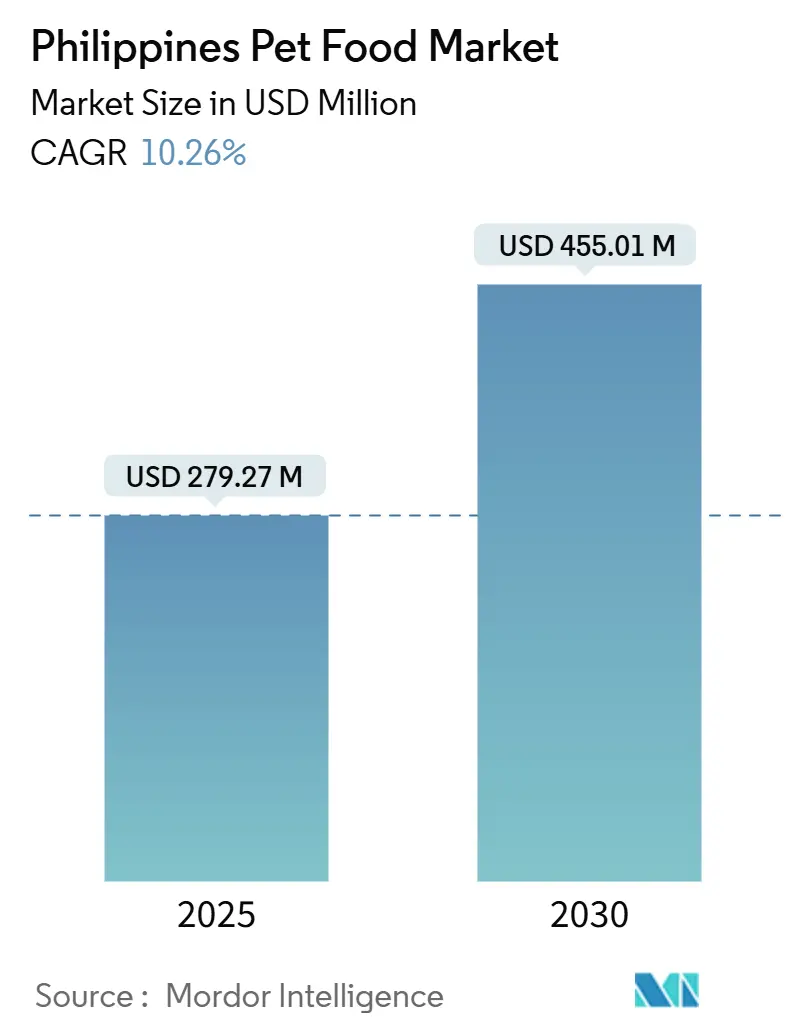
| Market Size (2025) | USD 279.27 Million |
| Market Size (2030) | USD 455.01 Million |
| Growth Rate (2025 - 2030) | 10.26% CAGR |
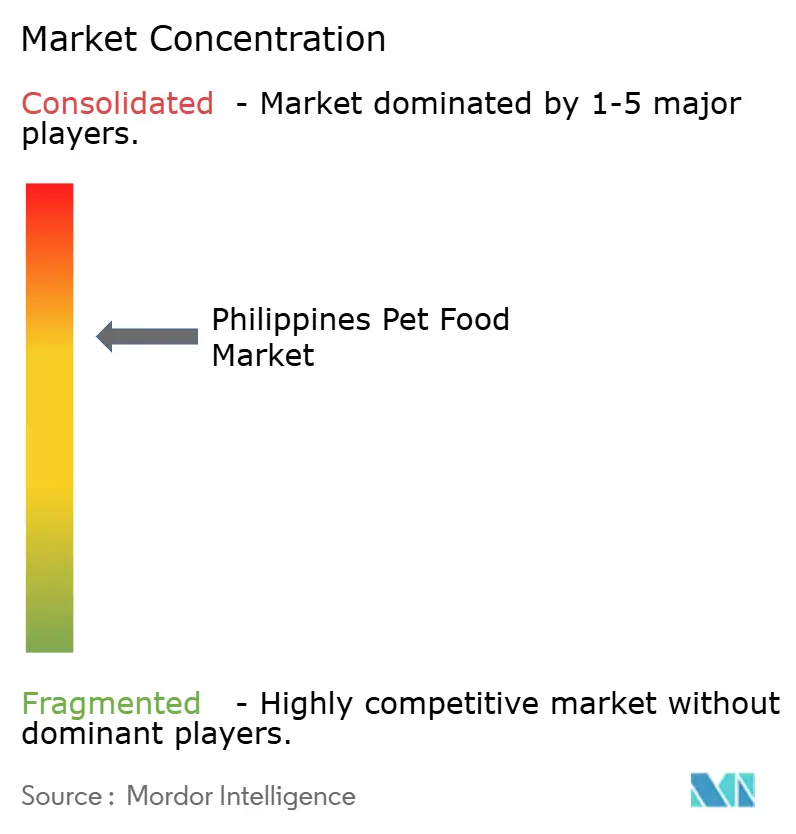
| Market Concentration | Medium |
Major Players
*Disclaimer: Major Players sorted in no particular order Image © Mordor Intelligence. Reuse requires attribution under CC BY 4.0. |
|
Philippines Pet Food Market Analysis by Mordor Intelligence
The Philippines pet food market size stood at USD 279.27 million in 2025 and is forecast to reach USD 455.01 million in 2030, advancing at a 10.26% CAGR through 2030. The growing humanization of pets, rapid adoption of e-commerce, and a shift by livestock feed manufacturers toward pet nutrition underpin this rise. Urban households boost premium demand through functional diets, while rural owners shift from table scraps to economy dry food as local manufacturing improves affordability. Multinational brands are leveraging nationwide retail modernization, as well as peso volatility, lengthy Bureau of Animal Industry clearances, and counterfeit products, which temper near-term gains. Competitive dynamics remain fluid as domestic feed players capture price-sensitive segments and global majors deepen investments to protect share within the Philippines' pet food market.
Key Report Takeaways
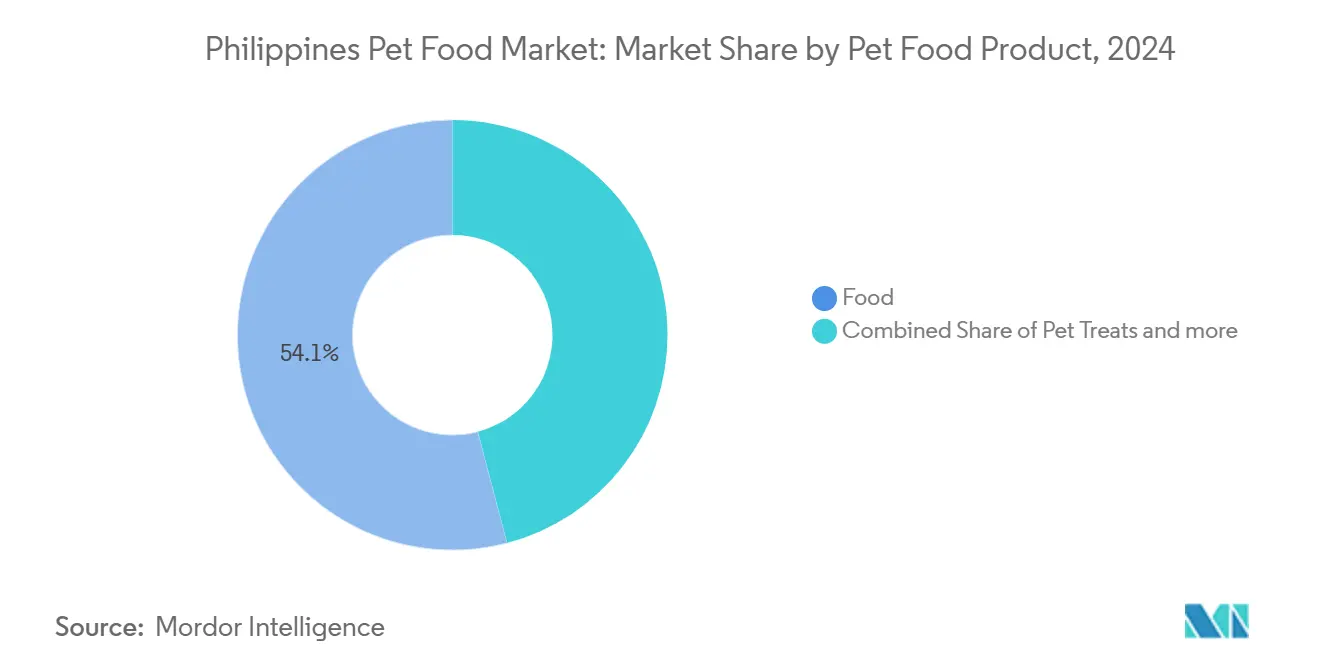
- By product category, food accounted for 54.1% of the Philippines' pet food market share in 2024, while the food segment led growth at a 12.4% CAGR through 2030.
- By pet type, dogs accounted for 60.9% of the Philippines' pet food market size in 2024, and are projected to expand at a 12.2% CAGR through 2030.
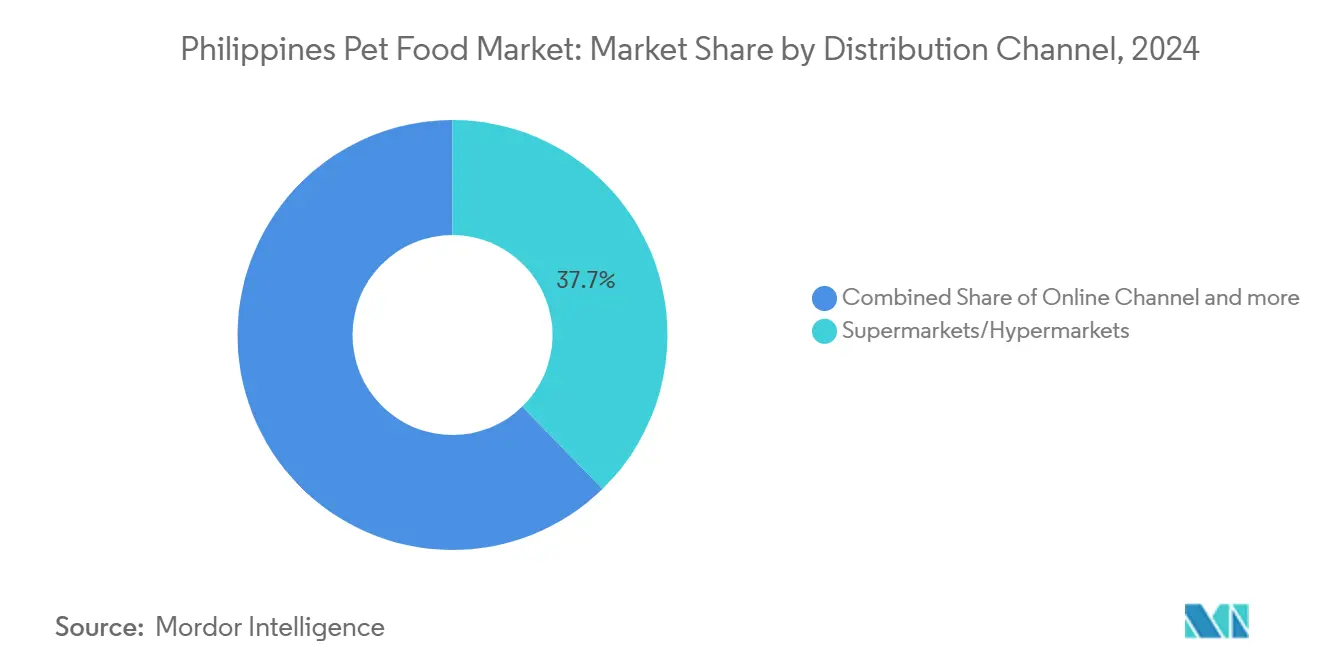
- By distribution channel, supermarkets and hypermarkets led with a 37.7% revenue share in 2024, and online channel are projected to record the highest CAGR at 12.3% through 2030.
Philippines Pet Food Market Trends and Insights
Drivers Impact Analysis
| Driver | (~) % Impact on CAGR Forecast | Geographic Relevance | Impact Timeline |
|---|---|---|---|
| Rising pet humanization and premium-nutrition spend | +2.8% | Metro Manila, Cebu, Davao | Medium term (2-4 years) |
| Expansion of modern retail and e-commerce | +2.1% | Tier 1 and Tier 2 cities nationwide | Short term (≤ 2 years) |
| Growing dog and cat population | +1.9% | Nationwide, strongest in suburbs | Long term (≥ 4 years) |
| Feed-millers converting idle capacity into pet-food lines | +1.4% | Central Luzon and Mindanao | Medium term (2-4 years) |
| Surge in veterinary tele-health and pet insurance | +1.2% | Urban centers | Medium term (2-4 years) |
| Duty-free and warehouse-club bulk-pack availability | +0.8% | Metro Manila and secondary cities | Short term (≤ 2 years) |
| Source: Mordor Intelligence | |||
Rising Pet Humanization and Premium-Nutrition Spend
Filipino pet owners are increasingly treating animals as family members, with Mars' Global Pet Parent Study revealing that Shih Tzu dogs (29% preference) and Persian cats (43% preference) dominate breed choices, reflecting a preference for companion animals rather than those with utility purposes [1]Source: Manila Standard, “Mars unveils world’s largest pet parent study,” manilastandard.net. The humanization trend drives demand for functional ingredients, including probiotics, omega-3 fatty acids, and specialized veterinary diets, particularly as 61% of dog owners cite stress relief as a primary benefit of owning a pet. The shift creates opportunities for premium positioning, though price sensitivity remains acute, with annual dog food costs averaging USD 340.59, the second-lowest in Asia after Vietnam.
Expansion Of Modern Retail and E-Commerce
The expansion of modern retail formats has fundamentally altered pet food accessibility, with Robinsons Retail Holdings accelerating pet retail store openings in 2025 while enhancing merchandise assortment and introducing grooming services to drive category growth. Warehouse clubs, such as Landers Superstore, are expanding from 12 to 17 stores by 2024, with long-term plans for 7 annual openings through 2027. This expansion introduces bulk-pack purchasing, which reduces per-unit costs for price-sensitive consumers. Channel proliferation benefits both premium brands seeking differentiated positioning and economy brands requiring broad market access, although regulatory compliance becomes increasingly complex across multiple touchpoints.
Growing Dog and Cat Population
Pet population dynamics underpin sustained market expansion, with the total number of pets growing from 56.3 million in 2020 to 65.9 million by 2024 [2]Source: Agriculture and Agri-Food Canada, “Sector Trend Analysis – Pet food in the Philippines,” agriculture.canada.ca . Dog-owning households increased from 9.74 million to 11.66 million (2020-2024), while cat households grew from 1.72 million to 2.04 million (2020-2024), reflecting urbanization trends favoring smaller pets in condominium living. Mars' WeR4HappyTails adoption platform and Global Adoption Weekend activities aim to increase shelter adoption rates, potentially expanding the addressable market beyond traditional pet purchases. Population growth is concentrated in suburban developments, where pet ownership correlates with rising disposable incomes, creating geographic pockets of premium demand despite overall price sensitivity.
Feed-Millers Converting Idle Capacity into Pet-Food Lines
Traditional livestock feed manufacturers are pivoting to pet food production as African swine fever and avian influenza reduce demand for hog and poultry feed, creating a uniquely Filipino market dynamic absent in neighboring Asian countries. Universal Robina Corporation plans a PHP 300-400 million (USD 5.10-6.80 million) animal feed mill in Mindanao, with TopBreed positioning itself as a market leader in the dog food segment, while San Miguel Foods expands its economy pet food lines, leveraging its existing feed infrastructure. Local production reduces foreign exchange exposure and supply chain vulnerabilities, though quality control and brand building remain challenges for feed millers transitioning from B2B to consumer markets.
Restraints Impact Analysis
| Restraint | (~) % Impact on CAGR Forecast | Geographic Relevance | Impact Timeline |
|---|---|---|---|
| High price sensitivity and table-scrap feeding | -2.4% | Rural zones and low-income urban areas | Long term (≥ 4 years) |
| Import-dependence and FX / logistics volatility | -1.8% | Nationwide | Short term (≤ 2 years) |
| Lengthy Bureau of Animal Industry product registration | -1.1% | Nationwide | Medium term (2-4 years) |
| Counterfeit and gray-market products eroding trust | -0.9% | Urban e-commerce channels | Short term (≤ 2 years) |
| Source: Mordor Intelligence | |||
High Price Sensitivity and Table-Scrap Feeding
Persistent price sensitivity constrains market premiumization, despite growing pet humanization, with over 50% of animals still being fed table scraps and leftovers, which limits commercial pet food penetration[3]Source: International Monetary Fund, “Philippines: 2024 Article IV Consultation,” elibrary.imf.org . Consumer segmentation reveals four distinct types: utilitarians treating pets as working animals, pragmatic spoilers providing basic care, companions seeking emotional bonds, and humanizers offering full family treatment including insurance and healthcare. The predominance of utilitarian and pragmatic segments limits willingness to pay premium prices, though rising disposable incomes and approaching upper-middle-income status create gradual premiumization opportunities in urban markets.
Import-Dependence and FX / Logistics Volatility
Heavy reliance on imports for 80% of retail pet food creates structural vulnerability to peso depreciation and global supply chain disruptions that materialized during 2022-2024, forcing consumers to switch to local alternatives. Thailand's dominance as the Philippines' largest pet food supplier (USD 100.5 million in 2023) creates a concentration risk, while Red Sea shipping disruptions and Panama Canal constraints increase freight costs and lead to delivery delays. The International Monetary Fund identifies exchange rate volatility as a key risk factor for import-dependent sectors, with pet food manufacturers facing margin compression when they are unable to pass through currency-driven cost increases to price-sensitive consumers.
Segment Analysis
By Pet Food Product: Premium Treats Drive Category Innovation
Food products dominate the market with a 54.1% market share in 2024, and emerge as the fastest-growing segment at a 12.4% CAGR (2030), driven by premiumization trends and impulse purchasing behavior that makes treats less price-sensitive than staple nutrition. Dry Pet Food maintains the largest subsegment share, benefiting from its shelf stability and cost efficiency, while Wet Pet Food captures a significant share of the category, as Filipino consumers recognize the hydration benefits for cats in tropical climates.
This segment's prominence is primarily driven by the essential role of specialized and balanced nutritional diets in maintaining pet health, with dry pet foods being the major type consumed due to their convenience, longer shelf life, and cost-effectiveness. The segment's strong position is further reinforced by the growing awareness among pet owners regarding pet nutrition, increasing premiumization trends, and pet parents treating their pets as family members. The availability of various brands and products, coupled with the convenience of feeding, has made food products the preferred choice among pet owners in the Philippines.
Note: Segment shares of all individual segments available upon report purchase
By Pets: Dogs Maintain Dominance Amid Urbanization
Dogs command a 60.9% market share in 2024, reflecting cultural preferences and household penetration that exceed those of other pet types. Dogs emerge as the fastest-growing segment at a 12.2% CAGR through 2030, driven by urbanization and condominium living trends. Dog food exhibits mature growth, supported by established feeding habits and higher per-pet consumption volumes, while medium-sized dogs and Shih Tzu breeds (with a 29% preference) drive specific nutritional requirements.
The segment's dominance is further strengthened by the increasing demand for premium and high-quality dog food brands Philippines, driven by growing awareness among pet owners. The food products and pet treats categories are particularly strong within this segment, reflecting the evolving preferences of pet owners towards higher-quality nutrition for their dogs.
By Distribution Channel: E-commerce Disrupts Traditional Retail
Supermarkets and Hypermarkets are projected to maintain a 37.7% distribution share in 2024, leveraging their broad geographic coverage and impulse purchasing opportunities. Major chains, such as SM Supermarket, Puregold, Robinsons Supermarket, and Rustan's Supermarket, have established dedicated pet food sections offering a comprehensive range of products across various price points. These retailers leverage their extensive nationwide presence and strong relationships with suppliers to offer competitive pricing and regular promotional discounts. Supermarkets have been successful in carrying both mass-market and premium brands, catering to diverse consumer preferences and budget considerations.
Online Channel emerge as the fastest-growing segment, with a 12.3% CAGR through 2030. E-commerce platforms are attracting pet owners through competitive pricing strategies, extensive product selections, and the convenience of doorstep delivery. The channel's growth is further supported by the Philippine government's initiatives to promote e-commerce adoption among small and medium enterprises. Online retailers are leveraging subscription models for regular pet food deliveries, enhancing customer retention and providing additional value through personalized recommendations and detailed product information.
Note: Segment shares of all individual segments available upon report purchase
Geography Analysis
The Philippines' pet food market is experiencing concentrated growth in urban centers, while expanding into secondary cities through modern retail penetration and increased e-commerce accessibility. Metro Manila dominates the market share in 2024, accounting for approximately 35% of national consumption, driven by the highest pet ownership rates, higher disposable income levels, and a higher density of retail infrastructure, including warehouse clubs, specialty stores, and veterinary services that support the adoption of premium products.
Central Luzon emerges as a strategic production hub, with feed manufacturers such as Universal Robina Corporation, San Miguel Foods, and Pilmico establishing pet food capabilities alongside their traditional livestock feed operations. This creates supply chain efficiencies and cost advantages for domestic brands. Mindanao exhibits strong growth potential, driven by agricultural prosperity and San Miguel Corporation's massive poultry expansion, which involves creating 12 mega-plants with an annual capacity of 960 million birds, generating abundant by-product streams for pet food ingredient supply.
Visayas demonstrates balanced growth across urban centers like Iloilo and Bacolod, supported by improving logistics connectivity and retail modernization, while rural areas throughout the archipelago show gradual commercial pet food adoption as disposable incomes rise and traditional table-scrap feeding practices evolve. Regional variations in pet ownership patterns create segmentation opportunities, with urban areas favoring cats for apartment living while rural regions maintain dog preferences for security and utility functions, requiring differentiated product positioning and distribution strategies across geographic markets.
Competitive Landscape
Large multinational corporations with established global presence and diverse product portfolios dominate the Philippines' pet food market. These companies, Mars, Incorporated, Nestle (Purina), Colgate-Palmolive Company (Hill's Pet Nutrition, Inc.), General Mills Inc., and Charoen Pokphand Group, are leveraging their extensive research capabilities, established brand recognition, and robust distribution networks to maintain their market positions. The market structure shows a medium level of consolidation, with the top players accounting for a significant portion of the market share, making it challenging for smaller players to compete effectively. The presence of local players is limited, with most operating in specific niches or serving as distributors for international brands.
The market has witnessed several strategic acquisitions and partnerships, particularly by global players looking to strengthen their position in the region. These consolidation activities have primarily focused on acquiring companies with complementary product portfolios or strong regional presence. Companies are also forming strategic alliances with local distributors and retailers to expand their market reach and gain a deeper understanding of local consumer preferences. The high barriers to entry, including significant capital requirements and stringent regulatory standards, have contributed to maintaining the market's consolidated nature.
Technology adoption focuses on e-commerce platform optimization and supply chain digitization rather than product innovation. Aboitiz Foods' merger of Pilmico and Gold Coin creates a major regional agribusiness player with 29 facilities across 8 countries and pet food brands Maxime, Tommy, and Woofy, demonstrating consolidation trends among domestic manufacturers. Regulatory compliance under Bureau of Animal Industry oversight creates barriers to entry that favor established players with proper licensing, while counterfeit product proliferation on e-commerce platforms threatens brand integrity and consumer trust across all market participants.
Philippines Pet Food Industry Leaders
-
Mars, Incorporated
-
Nestle (Purina)
-
Colgate-Palmolive Company (Hill's Pet Nutrition, Inc.)
-
General Mills Inc.
-
Charoen Pokphand Group.
- *Disclaimer: Major Players sorted in no particular order
Recent Industry Developments
- July 2023: Hill's Pet Nutrition introduced its new MSC (Marine Stewardship Council) certified pollock and insect protein products for pets with sensitive stomachs and skin lines. They contain vitamins, omega-3 fatty acids, and antioxidants.
- May 2023: Nestle Purina launched new cat treats under the Friskies "Friskies Playfuls - treats" brand. These treats are round in shape and are available in chicken and liver and salmon and shrimp flavors for adult cats.
- April 2023: Mars Incorporated opened its first pet food research and development center in Asia-Pacific. This new facility, called the APAC pet center, will support the company's product development.
Philippines Pet Food Market Report Scope
Food, Pet Nutraceuticals/Supplements, Pet Treats, Pet Veterinary Diets are covered as segments by Pet Food Product. Cats, Dogs are covered as segments by Pets. Convenience Stores, Online Channel, Specialty Stores, Supermarkets/Hypermarkets are covered as segments by Distribution Channel.| Food | By Sub Product | Dry Pet Food | By Sub Dry Pet Food | Kibbles |
| Other Dry Pet Food | ||||
| Wet Pet Food | ||||
| Pet Nutraceuticals/Supplements | By Sub Product | Milk Bioactives | ||
| Omega-3 Fatty Acids | ||||
| Probiotics | ||||
| Proteins and Peptides | ||||
| Vitamins and Minerals | ||||
| Other Nutraceuticals | ||||
| Pet Treats | By Sub Product | Crunchy Treats | ||
| Dental Treats | ||||
| Freeze-dried and Jerky Treats | ||||
| Soft & Chewy Treats | ||||
| Other Treats | ||||
| Pet Veterinary Diets | By Sub Product | Diabetes | ||
| Digestive Sensitivity | ||||
| Oral Care Diets | ||||
| Renal | ||||
| Urinary tract disease | ||||
| Obesity Diets | ||||
| Derma Diets | ||||
| Other Veterinary Diets |
| Cats |
| Dogs |
| Other Pets |
| Convenience Stores |
| Online Channel |
| Specialty Stores |
| Supermarkets/Hypermarkets |
| Other Channels |
| Pet Food Product | Food | By Sub Product | Dry Pet Food | By Sub Dry Pet Food | Kibbles |
| Other Dry Pet Food | |||||
| Wet Pet Food | |||||
| Pet Nutraceuticals/Supplements | By Sub Product | Milk Bioactives | |||
| Omega-3 Fatty Acids | |||||
| Probiotics | |||||
| Proteins and Peptides | |||||
| Vitamins and Minerals | |||||
| Other Nutraceuticals | |||||
| Pet Treats | By Sub Product | Crunchy Treats | |||
| Dental Treats | |||||
| Freeze-dried and Jerky Treats | |||||
| Soft & Chewy Treats | |||||
| Other Treats | |||||
| Pet Veterinary Diets | By Sub Product | Diabetes | |||
| Digestive Sensitivity | |||||
| Oral Care Diets | |||||
| Renal | |||||
| Urinary tract disease | |||||
| Obesity Diets | |||||
| Derma Diets | |||||
| Other Veterinary Diets | |||||
| Pets | Cats | ||||
| Dogs | |||||
| Other Pets | |||||
| Distribution Channel | Convenience Stores | ||||
| Online Channel | |||||
| Specialty Stores | |||||
| Supermarkets/Hypermarkets | |||||
| Other Channels | |||||
Market Definition
- FUNCTIONS - Pet foods are usually intended to provide complete and balanced nutrition to the pet but are primarily used as functional products. The scope includes the food and supplements consumed by pets including veterinary diets. Supplements/nutraceuticals that are directly supplied to pets are considered within the scope.
- RESELLERS - Companies engaged in reselling of pet food without value addition have been excluded from the market scope, in order to avoid double counting.
- END CONSUMERS - Pet owners are considered to be the end-consumers in the market studied.
- DISTRIBUTION CHANNELS - Supermarkets/hypermarkets, specialty stores, convenience stores, online channels and other channels are considered within the scope. The stores which are exclusively providing pet related basic and custom products are considered within the scope of specialty stores.
| Keyword | Definition |
|---|---|
| Pet Food | The scope of pet food includes the food that is eatable by pets including food, treats, veterinary diets, and nutraceuticals/supplements. |
| Food | Food is animal feed intended for consumption by pets. It is formulated to provide essential nutrients and meet the dietary needs of various types of pets, including dogs, cats, and other animals. These are generally segmented into dry and wet pet foods. |
| Dry Pet Food | Dry pet foods may be extruded/baked (kibbles) or flaked. They have a lower moisture content, typically around 12-20%. |
| Wet Pet Food | Wet pet food, also known as canned pet food or moist pet food, generally has a higher moisture content compared to dry pet food, often ranging from 70-80%. |
| Kibbles | Kibbles are dry, processed pet food in small, bite-sized pieces or pellets. They are specifically formulated to provide balanced nutrition for various domestic animals, such as dogs, cats, and other animals. |
| Treats | Pet Treats are special food items or rewards given to pets, to show affection, and encourage good behavior. They are especially used during training. Pet treats are made from various combinations of meat or meat-derived materials with other ingredients. |
| Dental Treats | Pet dental treats are specialized treats that are formulated to promote good oral hygiene in pets. |
| Crunchy Treats | It is a type of pet treat that has a firm and crispy texture which can be a good source of nutrition for pets. |
| Soft and chewy treats | Soft and Chewy pet treats are a type of pet food product that is formulated to be easy to chewy and digest. They are usually made from soft and pliable ingredients, such as meat, poultry, or vegetables, that have been blended and formed into bite-sized pieces or strips. |
| Freeze-dried & Jerky Treats | Freeze-dried and jerky treats are snacks given to pets, that are prepared through a special preservation process, without damaging the nutritional content, resulting in long-lasting, nutrient-rich treats. |
| Urinary Tract Disease Diets | These are commercial diets that are specifically formulated to promote urinary health and reduce the risk of urinary tract infections and other urinary problems. |
| Renal Diets | These are specialized pet foods formulated to support the health of pets with kidney disease or renal insufficiency. |
| Digestive Sensitivity Diets | Digestive-sensitive diets are specially formulated to meet the nutritional needs of pets with digestive issues such as food intolerances, allergies, and sensitivities. These diets are designed to be easily digestible and to reduce the symptoms of digestive problems in pets. |
| Oral Care Diets | Oral care diets for pets are specially formulated diets produced to promote oral health and hygiene in pets. |
| Grain-Free Pet Food | Pet food that does not contain common grains like wheat, corn, or soy. Grain-free diets are often preferred by pet owners seeking alternative options or if their pets have specific dietary sensitivities. |
| Premium Pet Food | High-quality pet food formulated with superior ingredients often offers additional nutritional benefits compared to standard pet food. |
| Natural Pet Food | Pet food made from natural ingredients, with minimal processing and without artificial preservatives. |
| Organic Pet Food | Pet food is produced using organic ingredients, free from synthetic pesticides, hormones, and genetically modified organisms (GMOs). |
| Extrusion | A manufacturing process used to produce dry pet food, where ingredients are cooked, mixed, and shaped under high pressure and temperature. |
| Other Pets | Other pets include birds, fish, rabbits, hamsters, ferrets, and reptiles. |
| Palatability | The taste, texture, and aroma of pet food influence its appeal and acceptance by pets. |
| Complete and Balanced Pet Food | Pet food that provides all essential nutrients in appropriate proportions to meet the nutritional needs of pets without additional supplementation. |
| Preservatives | These are the substances that are added to pet food to extend its shelf life and prevent spoilage. |
| Nutraceuticals | Food products that offer health benefits beyond basic nutrition, often contain bioactive compounds with potential therapeutic effects. |
| Probiotics | Live beneficial bacteria that promote a healthy balance of gut flora, supporting digestive health and immune function in pets. |
| Antioxidants | Compounds that help neutralize harmful free radicals in the body, promoting cellular health and supporting the immune system in pets. |
| Shelf-Life | The duration of which pet food remains safe and nutritionally viable for consumption after its production date. |
| Prescription diet | Specialized pet food formulated to address specific medical conditions under veterinary supervision. |
| Allergen | A substance that can cause allergic reactions in some pets, leading to food allergies or sensitivities. |
| Canned food | Wet pet food that is packed in cans and contains higher moisture content than dry food. |
| Limited ingredient diet (LID) | Pet food formulated with a reduced number of ingredients to minimize potential allergens. |
| Guaranteed Analysis | The minimum or maximum levels of certain nutrients present in pet food. |
| Weight management | Pet food designed to help pets maintain a healthy weight or support weight loss efforts. |
| Other Nutraceuticals | It includes prebiotics, antioxidants, digestive fiber, enzymes, essential oils and herbs. |
| Other Veterinary Diets | It includes weight management diets, skin and coat health, cardiac care, and joint care. |
| Other Treats | It includes rawhides, mineral blocks, lickables, and catnips. |
| Other Dry Foods | It includes cereal flakes, mixers, meal toppers, freeze-dried foods, and air-dried foods. |
| Other Animals | It includes birds, fish, reptiles, and small animals (rabbits, ferrets, hamsters). |
| Other Distribution Channels | It includes veterinary clinics, local unregulated stores, and feed and farm stores. |
| Proteins and Peptides | Proteins are large molecules composed of basic units called amino acids which help in the growth and development of pets. Peptides are the short string of 2 to 50 amino acids. |
| Omega-3 fatty acids | Omega-3 fatty acids are essential polyunsaturated fats that play a crucial role in the overall health and well-being of Pets |
| Vitamins | Vitamins are the essential organic compounds that are essential for vital physiological functioning. |
| Minerals | Minerals are naturally occurring inorganic substances that are essential for various physiological functions in pets. |
| CKD | Chronic Kidney Disease |
| DHA | Docosahexaenoic Acid |
| EPA | Eicosapentaenoic Acid |
| ALA | Alpha-linolenic Acid |
| BHA | Butylated Hydroxyanisol |
| BHT | Butylated Hydroxytoluene |
| FLUTD | Feline Lower Urinary Tract Disease |
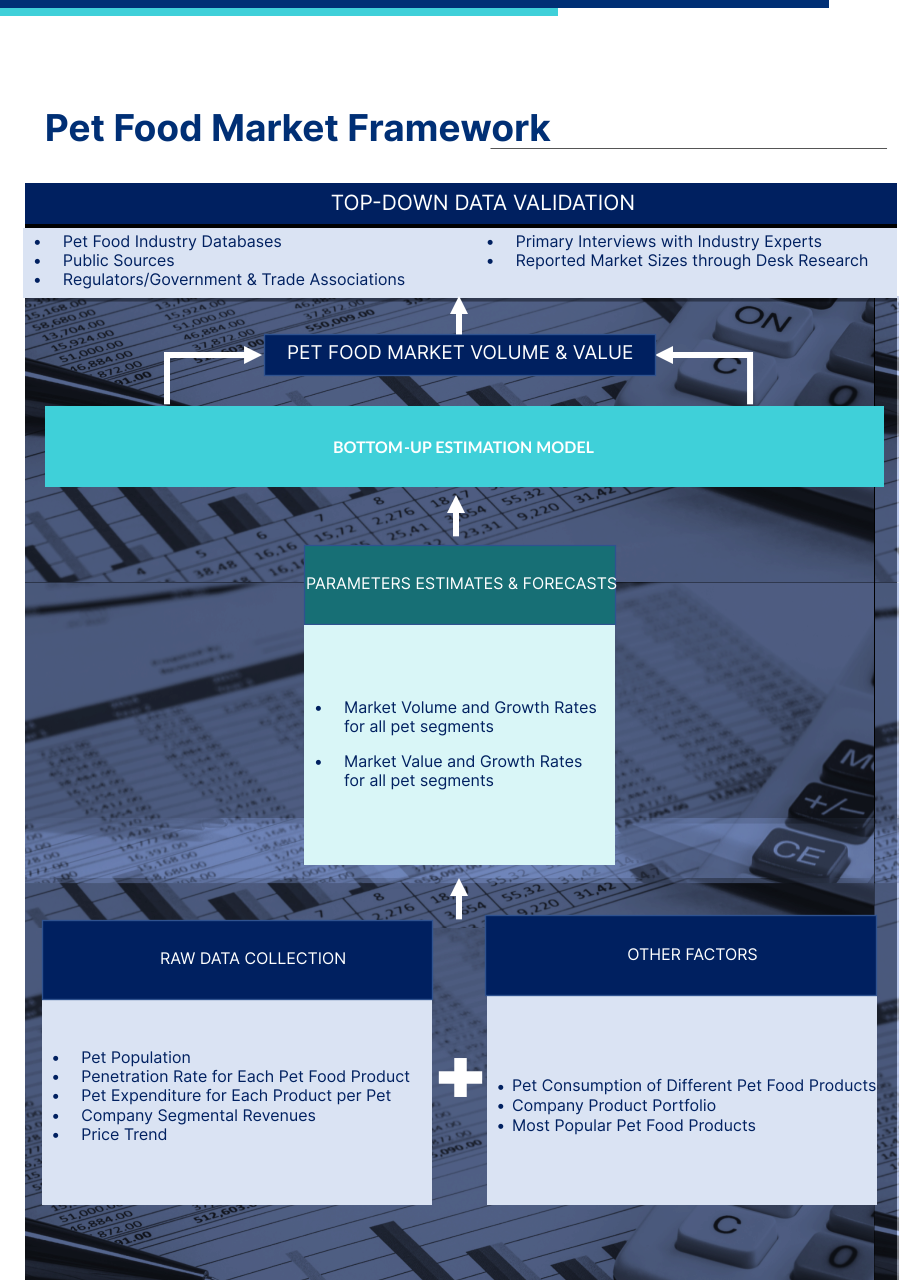
Research Methodology
Mordor Intelligence follows a four-step methodology in all our reports.
- Step-1: IDENTIFY KEY VARIABLES: In order to build a robust forecasting methodology, the variables and factors identified in Step-1 are tested against available historical market numbers. Through an iterative process, the variables required for market forecast are set and the model is built on the basis of these variables.
- Step-2: Build a Market Model: Market-size estimations for the forecast years are in nominal terms. Inflation is not a part of the pricing, and the average selling price (ASP) is kept constant throughout the forecast period.
- Step-3: Validate and Finalize: In this important step, all market numbers, variables and analyst calls are validated through an extensive network of primary research experts from the market studied. The respondents are selected across levels and functions to generate a holistic picture of the market studied.
- Step-4: Research Outputs: Syndicated Reports, Custom Consulting Assignments, Databases & Subscription Platforms