
India Medical Devices Market Size and Share
India Medical Devices Market Analysis by Mordor Intelligence
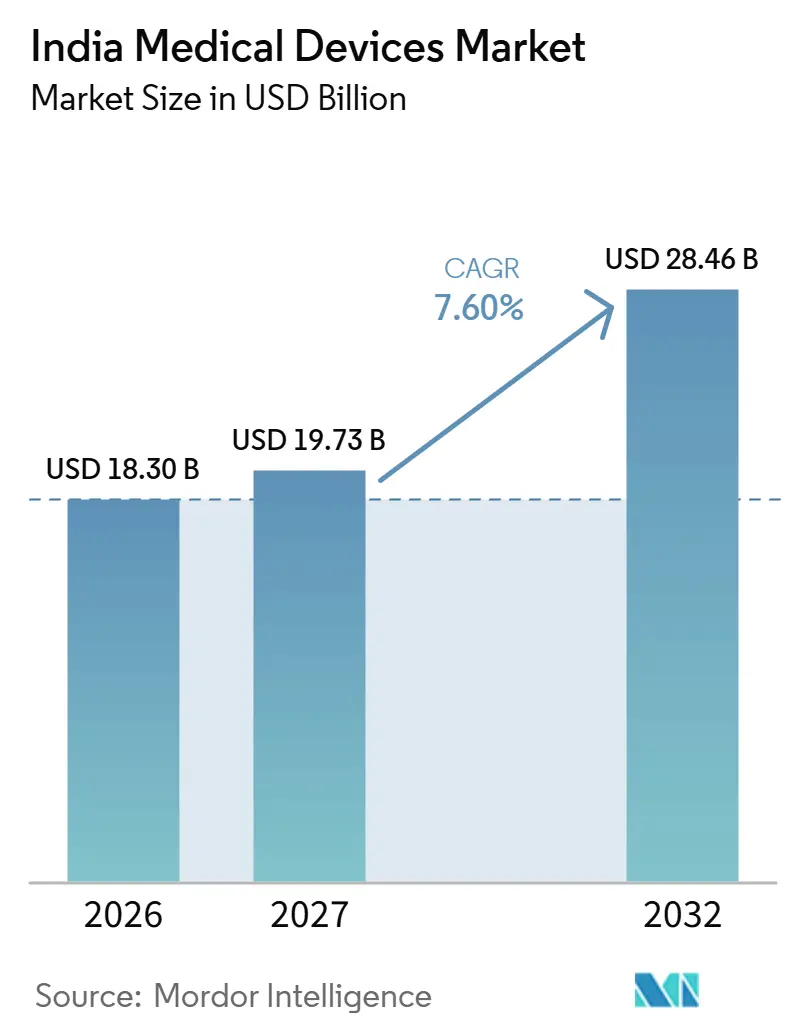
The India medical devices market size is expected to increase from USD 18.3 billion in 2026 to USD 19.73 billion in 2027 and reach USD 28.46 billion by 2032, growing at a CAGR of 7.6% over 2027-2032.
Demand in India is supported by continuing chronic-disease management and a care footprint spanning hospitals and neighborhood primary-care facilities. That combination creates equipment opportunities in cardiac treatment and in clinical assessment closer to the patient. Manufacturing incentives support local production and differentiated clinical systems address treatment needs, while regulatory delays and incomplete procedure coverage constrain access. Production incentives and the primary-care footprint outweigh those access constraints in the growth outlook, favoring suppliers serving both hospital cardiac treatment and neighborhood assessment.
Key Report Takeaways
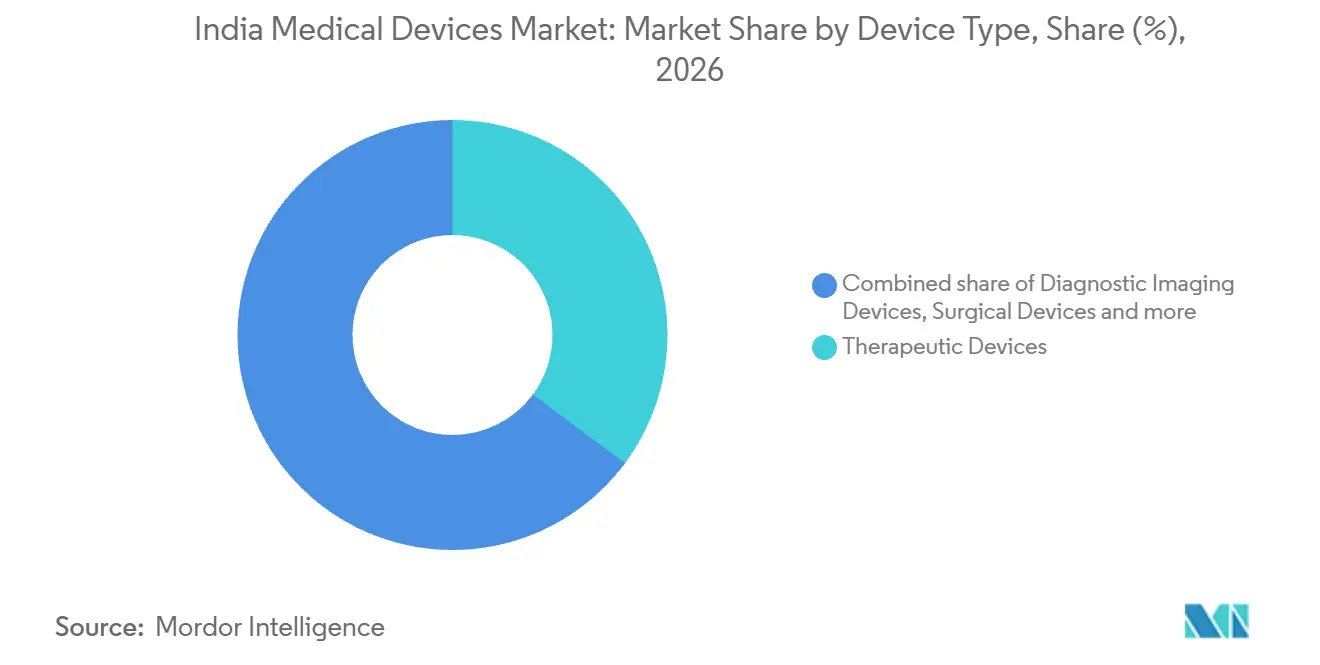
- By device type, therapeutic devices led with a 35.16% India medical devices market share in 2026, while monitoring devices are forecast to grow fastest at an 8.32% CAGR over 2027-2032.
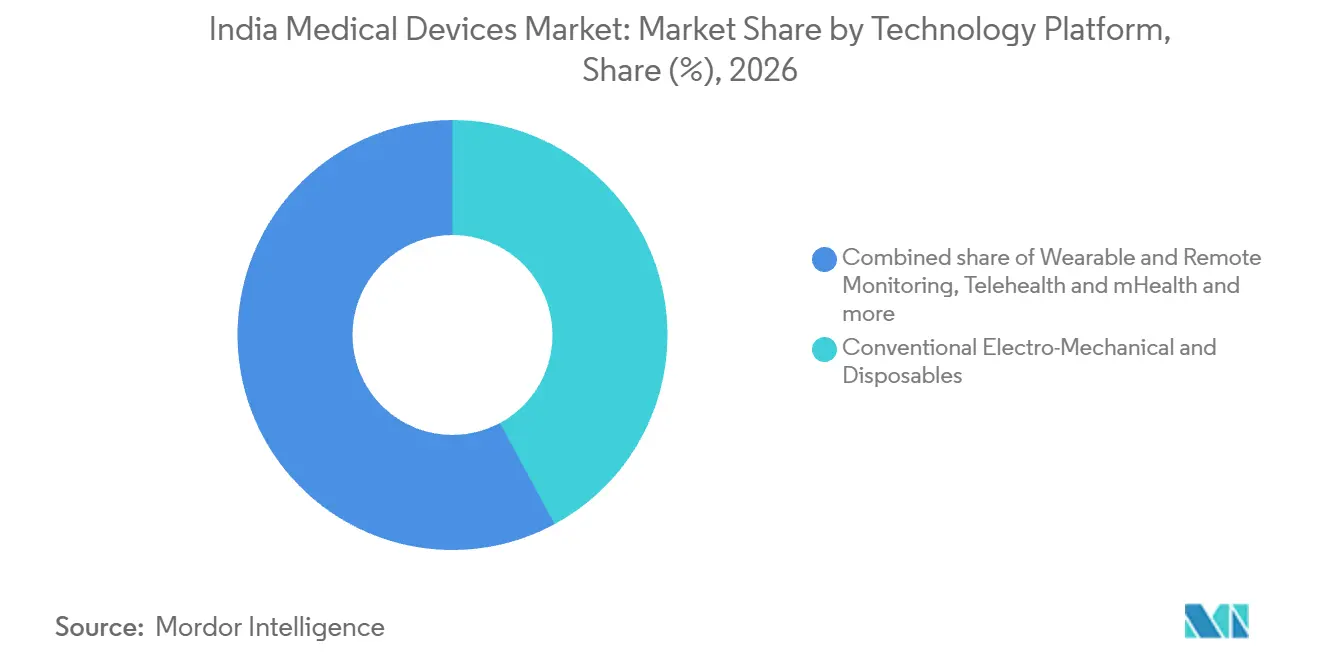
- Conventional electro-mechanical devices and disposables led technology platforms with a 42.12% share of the India medical devices market size in 2026, whereas the augmented and virtual reality segment is forecast to grow fastest at an 8.55% CAGR over 2027-2032.
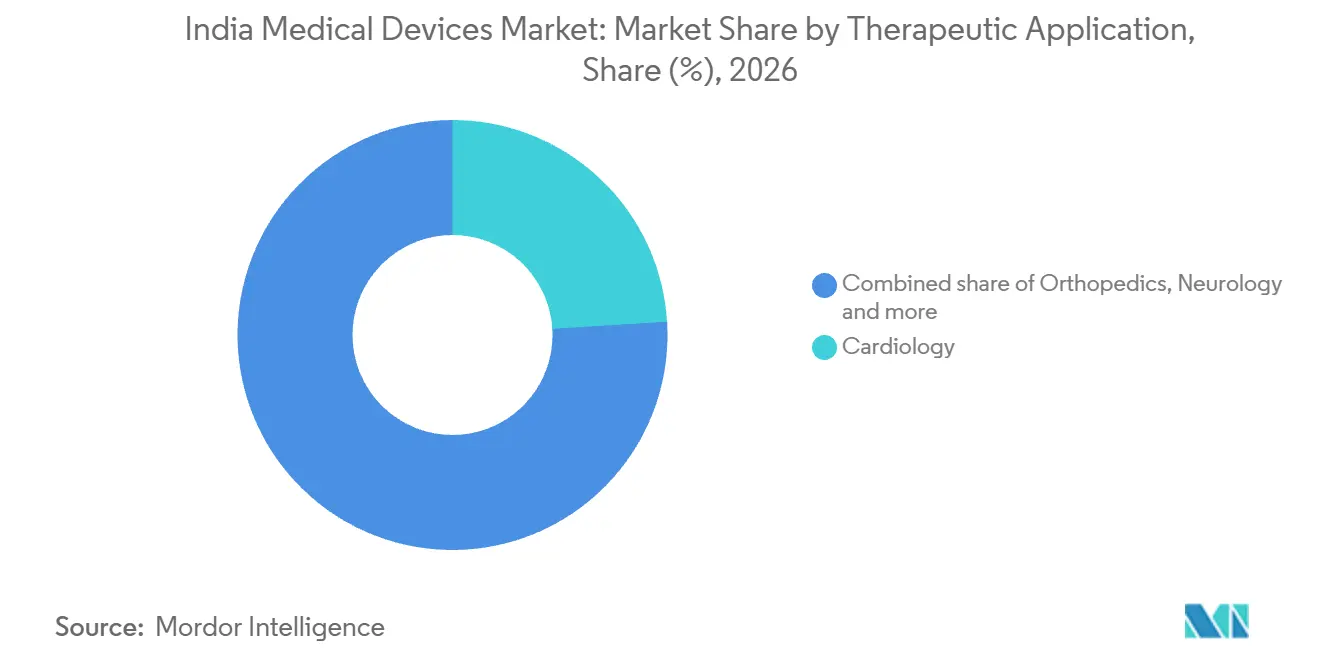
- Among therapeutic applications, cardiology led with 24.01% of device revenue in 2026, and neurology is forecast to grow fastest at a 9% CAGR over 2027-2032.
- The end-user mix was led by hospitals with 65.13% of device revenue in 2026, with clinics forecast to grow fastest at a 9.2% CAGR over 2027-2032.
Note: Market numbers in this report are based on Mordor Intelligence's proprietary estimation framework, which combines nine months of actuals with Q4 projections for base year 2026.
India Medical Devices Market Trends and Insights
Drivers Impact Analysis*
| Driver | (~) % Impact on CAGR Forecast | Geographic Relevance | Impact Timeline |
|---|---|---|---|
| Escalating Burden of Non-Communicable Diseases | +3% | Nationwide | Long term (≥ 4 years) |
| Government Incentives for Domestic Manufacturing | +2% | Nationwide | Medium term (2-4 years) |
| Expansion of Healthcare Infrastructure and Insurance Coverage | +2.25% | Nationwide | Medium term (2-4 years) |
| Digital Health Transformation and Telemedicine Adoption | +1.75% | Nationwide | Medium term (2-4 years) |
| Rising Medical Tourism and Demand for High-End Procedures | +0.75% | Nationwide | Medium term (2-4 years) |
| Increasing Penetration of Affordable Point-of-Care Diagnostics | +0.5% | Tribal-dominated areas in affected states | Short term (≤ 2 years) |
| Source: Mordor Intelligence | |||
Escalating Burden of Non-Communicable Diseases
Care for noncommunicable diseases creates an equipment requirement that continues after the first screening encounter. By February 2026, India's National Programme for Prevention and Control of Non-Communicable Diseases reported 55.72 million hypertension cases on treatment.[1] The program also reported 33.93 million diabetes cases on treatment at that point. Its 2023-2030 operational guidelines call for follow-up and monthly drug refills at sub-centers, establishing a continuing local-care pathway. The guideline's local follow-up pathway broadens the relevance of NCD devices beyond hospital departments to teams managing treated cases at sub-centers.
Government Incentives for Domestic Manufacturing
Sales-linked manufacturing incentives can improve the economics of supplying eligible devices from Indian production facilities. The Department of Pharmaceuticals' production-linked incentive scheme provides a 5% incentive on incremental sales of eligible India-manufactured medical devices for 5 years. In September 2026, the department reported that production had commenced for 57 unique devices, including MRI machines, CT scanners, and heart valves. This supported range includes high-end devices that were earlier predominantly imported. Because these categories were earlier predominantly imported, production under the scheme shifts part of the supply base for MRI machines, CT scanners, and heart valves toward Indian facilities.
Expansion of Healthcare Infrastructure and Insurance Coverage
Insurance-backed treatment and neighborhood care infrastructure create complementary routes for expanding the use of medical equipment. Ayushman Bharat Pradhan Mantri Jan Arogya Yojana (AB-PMJAY) had more than 38,466 public and private hospitals empaneled across India as of August 12, 2026.[2] The program had covered a cumulative 126.9 million hospitalizations by June 30, 2026, demonstrating substantial use of its treatment network. More than 186,000 Ayushman Arogya Mandirs were also functional on August 12, 2026, providing neighborhood primary healthcare. Covered admissions connect insurance support to delivered hospital care, while functional primary-care centers establish a separate setting for assessment.
Digital Health Transformation and Telemedicine Adoption
Telemedicine can create an equipment opportunity where diagnostic information helps clinicians assess patients remotely. The Centre for Development of Advanced Computing described implemented diagnostic-device integration for eSanjeevani in its FY2024-25 report. The service operated through over 123,332 spokes and 15,757 hubs during that fiscal year. By September 15, 2026, it had recorded a cumulative 500.1 million teleconsultations across all 36 Indian states and union territories. Device integration connects the equipment opportunity to the clinical information exchanged during remote assessment, giving it a function beyond the consultation link itself.
Restraints Impact Analysis*
| Restraint | (~) % Impact on CAGR Forecast | Geographic Relevance | Impact Timeline |
|---|---|---|---|
| Stringent Regulatory and Compliance Requirements | -1% | Nationwide | Medium term (2-4 years) |
| Price Controls and Reimbursement Limitations | -0.75% | Nationwide | Long term (≥ 4 years) |
| Supply-Chain Dependence on Imported Components | -0.5% | Nationwide | Long term (≥ 4 years) |
| Fragmented After-Sales Service and Maintenance Ecosystem | -0.5% | Nationwide | Medium term (2-4 years) |
| Source: Mordor Intelligence | |||
Stringent Regulatory and Compliance Requirements
Regulatory timelines and compliance expenses make authorization a commercial constraint for device suppliers. In its report presented on August 7, 2026, the parliamentary health committee said it had been given to understand that regulatory delays, administrative redundancies, and high compliance burdens inflated device costs.[3] It linked the higher final cost of medical devices to weaker healthcare access. Administrative duplication therefore matters alongside review time, because both enter the cost of bringing devices to care providers. Suppliers carry authorization time and compliance expense before a device can earn revenue from authorized sales.
Price Controls and Reimbursement Limitations
Price controls and incomplete reimbursement can constrain access from opposite sides of a device transaction. In its 2026 report, the Rajya Sabha Committee on Petitions said medicine-oriented price controls had reduced margins and, in some cases, prompted high-end device withdrawals in India. The report also recorded the view of a medical institute (SKIMS) that AB-PMJAY coverage for cardiac catheterization had fallen from 100% to 50%, leaving substantial patient expenses. Product withdrawal narrows the choices available to treating teams, making margin pressure relevant to clinical access. In the SKIMS account, patient payment for catheterization limits the usefulness of access to the device alone.
*Our forecasts treat driver/restraint impacts as directional, not additive. The impact forecasts reflect baseline growth, mix effects, and variable interactions.
Segment Analysis
By Device Type: Therapeutic Production and Monitoring Investment
Therapeutic devices accounted for a 35.16% share of the India medical devices market size in 2026. By July 2026, Meril Life Sciences' Gujarat project under the medical-device production-linked incentive scheme had been commissioned for heart valves, stents, and balloon catheters for percutaneous transluminal coronary angioplasty (PTCA). The commissioned Gujarat project adds domestic production capacity for those therapeutic devices.
Monitoring devices are forecast to be the fastest-growing segment, with an 8.32% CAGR over 2027-2032. In a July 24, 2026, update, the Department of Pharmaceuticals reported actual investment of INR 100.3 million (USD 1.04 million) in BPL Medical Technologies' Karnataka TS 3 project, covering 5 product lines including patient monitoring. The other lines were anesthesia workstations, automated external defibrillators, ECG equipment, and stress-test systems. Patient monitoring sits within this wider domestic equipment investment, connecting its development opportunity to a project spanning several clinical functions.

By Technology Platform: Disposable Scale and Clinical Visualization
Conventional electro-mechanical devices and disposables represented a 42.12% India medical devices market share in 2026. Poly Medicure Ltd. reported distributing its products to more than 8,000 private and government hospitals and nursing homes across India in FY2025. The company also reported 21.57% FY2025 growth in manufactured-product revenue across domestic and export markets, with intravenous cannulas, prefilled syringes, and blood bags among its products. That institutional reach makes distribution capability a competitive asset across several manufactured-product categories.
Augmented / virtual reality (AR / VR) is forecast to be the fastest-growing segment, with an 8.55% CAGR over 2027-2032. KIMS-SUNSHINE Hospitals announced an AR-enabled outpatient service with SKIA at its Begumpet hospital in Hyderabad in 2025. Its platform converted CT and MRI data into interactive 3D visualizations supporting patient education, surgical planning, and consultation. The added clinical function comes after scan acquisition, when CT and MRI data become tools for explaining and planning treatment.
By Therapeutic Application: Cardiac Infrastructure and Neurology Adoption
Cardiology was the largest segment, accounting for 24.01% of device revenue in 2026. Safdarjung Hospital in New Delhi has 4 cardiac catheterization laboratories, including one operating 24 hours for emergency primary angioplasty. Its dedicated biplane electrophysiology laboratory supports complex cardiac rhythm management. The department's equipment consequently serves different clinical requirements, including emergency intervention and specialized rhythm care within a single cardiac service. Because one of the 4 laboratories runs around the clock for emergency primary angioplasty, equipment uptime there is a continuity requirement for heart-attack care.
Neurology is forecast to be the fastest-growing segment, with a 9% CAGR over 2027-2032. Apollo Hospitals Chennai performed adaptive deep brain stimulation for Parkinson's disease on March 2, 2026, in what it described as India's first clinical activation. Orthopedics has a distinct inpatient workload, with Lok Nayak Hospital in New Delhi recording 3,874 orthopedic inpatients in 2025. Apollo Chennai's movement-disorder neurology and functional neurosurgery expertise links the stimulation system to a specialized treatment service, making clinical capability central to replicating that use.
By End-User: Hospital Capacity and Multispecialty Clinics
Hospitals were the largest segment, accounting for 65.13% of device revenue in 2026. As of March 31, 2026, Apollo Hospitals Enterprise Limited had capacity for 10,970 beds across 78 hospitals in India and overseas. An inpatient network of that scale creates an equipment requirement across treatment and patient assessment, giving suppliers several clinical functions to serve within institutional care.
Clinics are forecast to be the fastest-growing segment, with a 9.2% CAGR over 2027-2032. Apollo Clinic inaugurated a facility in Tiruppur, Tamil Nadu, on July 27, 2026, expanding its network in the state. The clinic offers general medicine, obstetrics and gynecology, pediatrics, and dermatology consultations alongside laboratory testing and X-ray services. Consultations across several specialties make laboratory testing and X-ray support shared functions within this outpatient setting.
Regulatory Framework and Outlook
The comparison of selected jurisdictions assesses India's national framework and Maharashtra's delegated state administration from a device manufacturer's perspective. The national rules allocate imports and Class C/D manufacturing to the central authority, while state authorities oversee Class A/B manufacturing and sales across all device classes. Specified Class A non-sterile, non-measuring devices are exempt from licensing when their manufacturer or importer obtains a Central Drugs Standard Control Organization (CDSCO) registration number. An August 2026 amendment also added quality management system wording to the applicable registration provisions.
Regulatory Table
| Decision factor | India | Maharashtra |
|---|---|---|
| Primary authority | Central Licensing Authority | Maharashtra Food and Drugs Administration |
| Key instruments or direction | Medical Devices Rules, 2017 and 2026 amendments | State administration under the Medical Devices Rules, 2017 |
| Commercial effect | Central import and Class C/D manufacturing oversight; specified Class A non-sterile, non-measuring registration route | Class A/B manufacturing oversight and sales enforcement across all device classes |
| Current policy attractiveness | Medium | Medium |
| Future direction of policy attractiveness | Easing | Easing |
| Source: Mordor Intelligence | ||
India's Medium rating reflects central oversight of imports and Class C/D manufacturing, while Maharashtra's Medium rating reflects its Class A/B manufacturing remit and sales enforcement across all device classes. A June 2026 draft supports the Easing outlook, proposing state Class B license-grant cuts from 140 to 115 days, including Maharashtra, and central Class C/D cuts from 105 to 90 days. An August 2026 amendment also removed the separate loan license for sterilization outsourced to a facility holding a valid Medical Devices Rules license. Manufacturers outsourcing sterilization receive a 6-month transition to implement the new labeling requirement, so the removal of the separate loan license takes effect without an immediate relabeling deadline.
Value Chain Stages
The value chain compares revenue from making devices with earnings from maintaining and upgrading installed equipment. In January 2026, Wipro GE Healthcare introduced SIGNA Prime Elite, an MR imaging system made at its Indian manufacturing facility, placing production at the start of that commercial lifecycle. VMMC & Safdarjung Hospital reported medical-equipment procurement for April through June 2026. After equipment enters service, Philips India's maintenance, upgrade, and implementation offerings provide a separate basis for earning from installed devices.
Value Chain Analysis Table
| Primary activity | Key participants | Value capture | Bottleneck | Resilience response |
|---|---|---|---|---|
| Device manufacturing | Device producers such as Wipro GE Healthcare and Poly Medicure Ltd. | Device-sales revenue | Scaling output while maintaining consistency | Qualify production processes before increasing output |
| Distribution to healthcare facilities | Manufacturers with distribution networks such as Poly Medicure Ltd. | Product-sales revenue through distribution channels | Reaching dispersed institutional customers | Match regional distribution coverage to customer locations |
| Equipment maintenance and upgrades | Equipment-service providers such as Koninklijke Philips N.V. | Maintenance, upgrade and implementation fees | Sustaining the usefulness of installed equipment | Combine planned maintenance with targeted upgrades |
| Source: Mordor Intelligence | ||||
Manufacturing and distribution contribute to initial device-sales revenue, while maintenance and upgrades create fee opportunities after installation. Each additional hardware sale concerns another device, whereas service fees can arise repeatedly from work on equipment already supplied. Distribution coverage and service capability therefore address different constraints, reaching care facilities before sale and sustaining equipment usefulness afterward.
Competitive Landscape
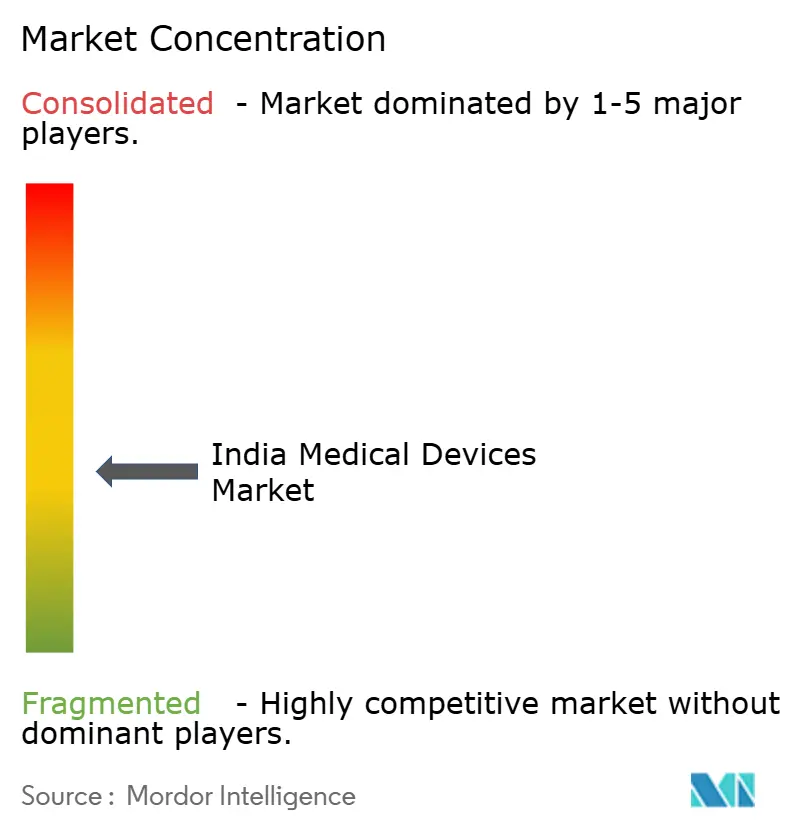
Competition is moderately fragmented across clinical functions, with suppliers differentiating through specialized products and their ability to serve Indian care providers. Abbott Laboratories launched its AVEIR dual-chamber leadless pacemaker system in India on October 6, 2025, describing it as the world's first such system. GE HealthCare participates in MRI, while Koninklijke Philips N.V.'s patient-monitoring offering spans hospital and remote devices. Medtronic Plc participates in surgical energy devices, and Siemens Healthineers supplies angiography systems. These offerings make competition category-specific, with leadless pacing, MRI, patient monitoring, surgical energy, and angiography serving distinct clinical requirements.
By July 2026, Siemens Healthineers had started manufacturing its ARTIS one Edition X angiography platform in Bengaluru, establishing a domestic production route for that equipment. Medtronic announced the India launch of 2 Valleylab FT10 surgical energy generators for hospitals on September 30, 2025. Medtronic's move concerns the surgical products offered to hospitals, while Siemens's move concerns the production footprint behind an imaging platform. Angiography rivals therefore face an offering differentiated by manufacturing location as well as its clinical application.
Competitive development in arrhythmia treatment connects new equipment with the specialist service that uses it. Medtronic announced the June 14, 2026, India launch of PulseSelect, a pulsed field ablation system designed to treat atrial fibrillation. Kauvery Hospital Chennai's June 15, 2026, program launch included PulseSelect at Alwarpet and Biosense Webster's Varipulse at Vadapalani. Visiting US electrophysiology experts collaborated with Kauvery's team to initiate the program and support first procedures. The use of different systems across Kauvery's 2 sites places competition within individual specialist programs, beyond national product availability.
India Medical Devices Industry Leaders
-
Abbott Laboratories
-
GE HealthCare
-
Koninklijke Philips N.V.
-
Medtronic Plc
-
Siemens Healthineers
- *Disclaimer: Major Players sorted in no particular order
Key Opportunities for Market Participants
The opportunities compare affordable diagnostic supply for public screening with development routes for priority diagnostic and assistive devices. The National Sickle Cell Anaemia Elimination Mission recorded more than 72.4 million screenings among people aged 0 to 40 in tribal-dominated areas of 17 states through July 16, 2026. State health departments used public tendering and price negotiation to procure sickle-cell point-of-care test kits for less than USD 1.21 per test, establishing a concrete unit-price benchmark for that program. The Indian Council of Medical Research's (ICMR) October 2026 calls provide a separate development enabler for priority diagnostic and assistive devices.
Market Opportunities Table
| Opportunity | Why now | Buyer / lead segment | Recommended play | Main barrier | Likely beneficiaries |
|---|---|---|---|---|---|
| Point-of-care devices for TB differentiation | Priority technology in ICMR's 2026 development call | Prospective diagnostic-testing providers | Co-develop within an eligible mixed-risk technology portfolio | Demonstrating clinically useful diagnostic differentiation | Eligible diagnostic-device research teams |
| Point-of-care oral-cancer assessment | Intraoral-scanner application in the priority call | Prospective oral-care providers | Link scanner development with clinical-validation planning | Clinical validation for the intended oral-cancer use | Eligible medical-device and diagnostic development teams |
| Assistive devices for mobility and accessibility | ICMR's 2026 assistive-technology translation call | Rehabilitation teams and assistive-device users | Co-design with users and caregivers within an indicative technology portfolio | Usability, human-factors evaluation and manufacturing translation | Eligible multidisciplinary institutional teams |
| Source: Mordor Intelligence | |||||
Priority-device proposals must come from regular faculty investigators at engineering or technological institutions among the top 25 in the NIRF 2025 Overall Category and cover at least 8 to 10 technologies. Full proposals for both ICMR calls are due November 13, 2026, at 17:00 IST, with development using existing infrastructure and specifically justified upgrades potentially permitted for priority-device projects. The calls fund institution-led development and assessment rather than purchases of finished devices. State-run sickle-cell screening is therefore the nearest-term supplier opening, but the demonstrated tender-price benchmark limits the price a test-kit offer can sustain.
Recent Industry Developments
- Jun 2026: Medtronic Plc announced the India launch of its PulseSelect pulsed field ablation system for atrial fibrillation on June 14.
- May 2026: Align Technology, Inc. announced plans to open a medical-device manufacturing facility in Hyderabad in 2027.
Research Methodology Framework and Report Scope
Market Definition and Coverage
India medical devices market measures annual spending on regulated medical devices and device software sold for use in India. The value covers device sales across product types, technology platforms, therapeutic applications and end-user settings.
Scope exclusions: Standalone telehealth or mHealth services and general-purpose health applications, repair and other after-sales services, separately sold replacement parts and unregulated accessories, raw materials and upstream components, and medical device sales for use outside India are excluded.
Segmentation Overview
- By Device Type
- Diagnostic Imaging Devices
- Therapeutic Devices
- Surgical Devices
- Monitoring Devices
- In-Vitro Diagnostics (IVD)
- Assistive & Mobility Aids
- Dental Devices
- Other Devices
- By Technology Platform
- Conventional Electro-Mechanical & Disposables
- Wearable & Remote Monitoring
- Telehealth & mHealth
- Robotic Surgery
- 3D Printing
- Augmented / Virtual Reality (AR / VR)
- Nanotechnology
- Other Technology Platforms
- By Therapeutic Application
- Cardiology
- Orthopedics
- Neurology
- Ophthalmology
- General Surgery
- Other Therapeutic Applications
- By End-User
- Hospitals
- Clinics
- Home-Care Settings
- Other End-Users
Data Sources, Market Sizing, and Validation
Desk Research
Public sources such as the Central Drugs Standard Control Organisation's Medical Device and Diagnostics overview, the Department of Pharmaceuticals' policy page, the Press Information Bureau's Department of Pharmaceuticals release and the Economic Survey establish regulatory coverage, local supply conditions and independent market signals. The Central Drugs Standard Control Organisation defines the regulated device perimeter, the policy page describes national medical-device policy and support programs, the release reports Directorate General of Commercial Intelligence and Statistics trade values, and the Economic Survey summarizes India's medical-device export reach and manufacturing development.
Company annual reports and filings, investor materials, procurement notices and reputable Indian business press can add company-specific product, investment and purchasing context, then cross-check market movements and clarify conflicting source definitions. These named sources are illustrative and not exhaustive, and further sources inform collection, validation and clarification.
Primary Interviews and Surveys
Interviews and structured surveys would cover Indian device manufacturers, importers, distributors, hospital and clinic procurement staff, biomedical engineering teams, and product or regulatory leaders. Their input would test secondary estimates of product mix, purchasing routes, price movement and facility demand, while focused follow-up would resolve conflicting classifications or missing value and volume observations. Analysts would triangulate responses against public records and channel evidence before carrying unresolved gaps into explicit ranges or scenarios.
Distribution of primary research fieldwork respondents
| Company type | Respondent position | Region |
|---|---|---|
| Top tier: 30% | CXOs: 20% | |
| Mid tier: 45% | Functional/Unit leaders: 35% | |
| Smaller Players: 25% | Managers: 45% |
Market-Sizing & Forecasting
The analyst first estimates annual India device sales from the demand and supply evidence, then checks the total against sampled product and channel estimates. The market is sized in USD value for medical-device sales in India and segmented across device types, technology platforms, therapeutic applications and end-user settings. Inputs include chronic-disease caseloads and procedure activity to indicate clinical need, hospital and clinic capacity and procurement to indicate purchasing ability, domestic production and import flows to measure available supply, and product launch or localization activity to assess changes in the mix while observed selling prices help distinguish value growth from changes in unit demand. Public company filings, government records, provider procurement material and channel checks support segment shares across those categories, with interviews testing whether the evidence reflects actual purchasing and use. Experts in hospital procurement and biomedical engineering would test whether demand, capacity, supply and price variables reflect observed purchasing conditions and plausible changes over the forecast period. For the forecast, multivariate regression can relate the historical market series to these demand, capacity, supply and price indicators, while scenario analysis tests different paths for infrastructure investment, localization and product adoption. Selective bottom-up checks multiply sampled average selling prices by supported units or placements and compare those results with the top-down total. Where unit counts or prices are missing, analysts use ranges from comparable products and channel input, document the uncertainty, and reconcile the resulting difference before carrying a value forward.
Data Validation & Update Cycle
Analysts triangulate the market total and segment shares against independent trade, production, procurement, filing and facility signals, then investigate anomalies and material variances by checking units, timing, classification and source coverage. A second review checks calculations, source traceability and consistency between segment totals and the India market boundary, with senior review before sign-off, and analysts re-contact respondents when a material conflict or unclear definition could change an estimate. The evidence is refreshed annually, updated between cycles when a material policy, supply or demand event changes the outlook, and checked again in a fresh pre-delivery review.
Mordor Intelligence's India Medical Devices Market Size Compared With Other Published Estimates
Published estimates can differ in the transactions and products they count and the inputs used to model demand. India medical devices market measures annual spending on regulated medical devices and device software sold for use in India.
Key Gap Drivers include the study's defined coverage and market-specific modeling choices. For the forecast, multivariate regression can relate the historical market series to these demand, capacity, supply and price indicators, while scenario analysis tests different paths for infrastructure investment, localization and product adoption.
Benchmark comparison
| Source | Market Size | Gaps in Research Methodology |
|---|---|---|
| Mordor Intelligence | USD 19.73 B (2027) | |
| Global Consultancy A | USD 15.91 B (2024) | At its 2024 base, this estimate is 19.4% below this report's 2027 value of USD 19.73 B, 3 years later. The earlier measurement year places the reported value before the comparison year, consistent with the source's forecast of continued market growth. |
| Regional Consultancy B | USD 15.2 B (2025) | At its 2025 base, this estimate is 23.0% below this report's 2027 value of USD 19.73 B, 2 years later. The earlier measurement year places the reported value before the comparison year, consistent with the source's forecast of faster growth through 2032. |
Mordor Intelligence's analysts triangulate the market total and segment shares against independent trade, production, procurement, filing and facility signals, then investigate anomalies and material variances by checking units, timing, classification and source coverage.
Key Questions Answered in the Report
What is the India medical devices market size and growth outlook?
Size is expected to reach USD 19.73 billion in 2027 and USD 28.46 billion by 2032, with a 7.6% CAGR over 2027-2032.
What is driving medical-device demand in India?
Chronic-disease management and wider healthcare access support demand. The domestic manufacturing incentive provides 5% on incremental sales of eligible India-manufactured devices for 5 years.
Which medical-device category leads Indian sales?
Therapeutic devices led with 35.16% of Indian medical-device revenue in 2026.
Which companies compete in India's medical-device industry?
Abbott Laboratories supplies cardiac devices, while GE HealthCare participates in MRI. Other competitors include Koninklijke Philips N.V., Medtronic Plc, and Siemens Healthineers.
What limits growth in India's medical-device industry?
Regulatory delays and incomplete procedure coverage can restrict access. In its 2026 report, the Rajya Sabha Committee on Petitions linked medicine-oriented price controls with reduced margins and occasional high-end device withdrawals.