
Yacht Market Size and Share
Market Overview
| Study Period | 2020 - 2032 |
|---|---|
| Market Size (2027) | USD 12.61 Billion |
| Market Size (2032) | USD 17.21 Billion |
| Fastest Growing Market | Asia-Pacific |
| Largest Market | Europe |
| Market Concentration | Medium |
Major Players *Disclaimer: Major Players sorted in no particular order Image © Mordor Intelligence. Reuse requires attribution under CC BY 4.0. | |
Yacht Market Analysis by Mordor Intelligence
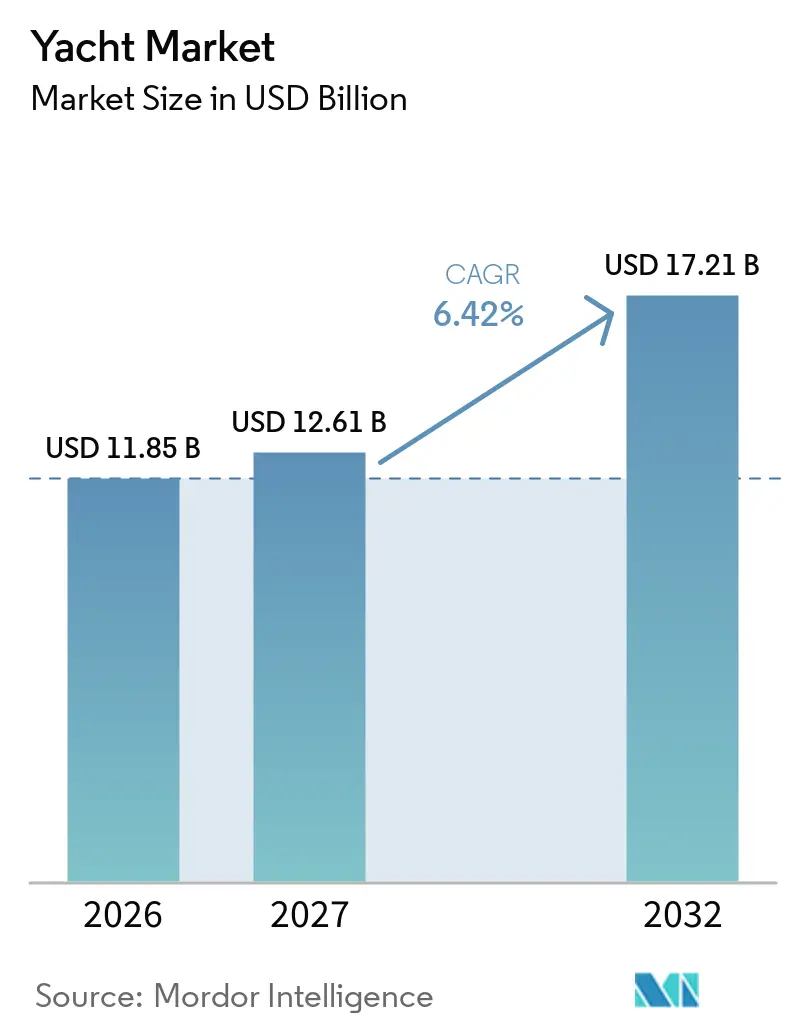
The Yacht market size was valued at USD 11.85 billion in 2026 and estimated to grow from USD 12.61 billion in 2027 to reach USD 17.21 billion by 2032, at a CAGR of 6.42% during the forecast period 2027 to 2032. The yacht market is supported by demand for private leisure travel, longer-range cruising, and vessels that can serve both personal use and charter programs. Buyers are placing greater weight on tailored layouts, reliable onboard systems, and lower-emission operating options when selecting a new vessel. Builders that can combine design flexibility with dependable delivery schedules are better positioned to retain clients through lengthy purchase decisions. The yacht market also benefits when marina networks, service facilities, and charter operations improve together, since each expands the practical use of a vessel after delivery. These connected services can influence whether a buyer views a vessel as practical to own, operate, and enjoy over time.
Key Report Takeaways
- By type, flybridge yacht held 28.63% share in 2026, while long-range/expedition yacht is forecast to grow at a 7.39% CAGR through 2032.
- By length, 20 to 50 m held 43.18% share in 2026, while above 50 m is forecast to grow at a 7.34% CAGR through 2032.
- By propulsion, motor, conventional diesel/gasoline, held 68.26% share in 2026, while hybrid and electric is forecast to grow at a 10.79% CAGR through 2032.
- By hull type, monohull held 83.16% share in 2026, while multihull is forecast to grow at a 7.36% CAGR through 2032.
- By hull material, fiberglass/composite held 74.18% share in 2026, while aluminum is forecast to grow at a 6.82% CAGR through 2032.
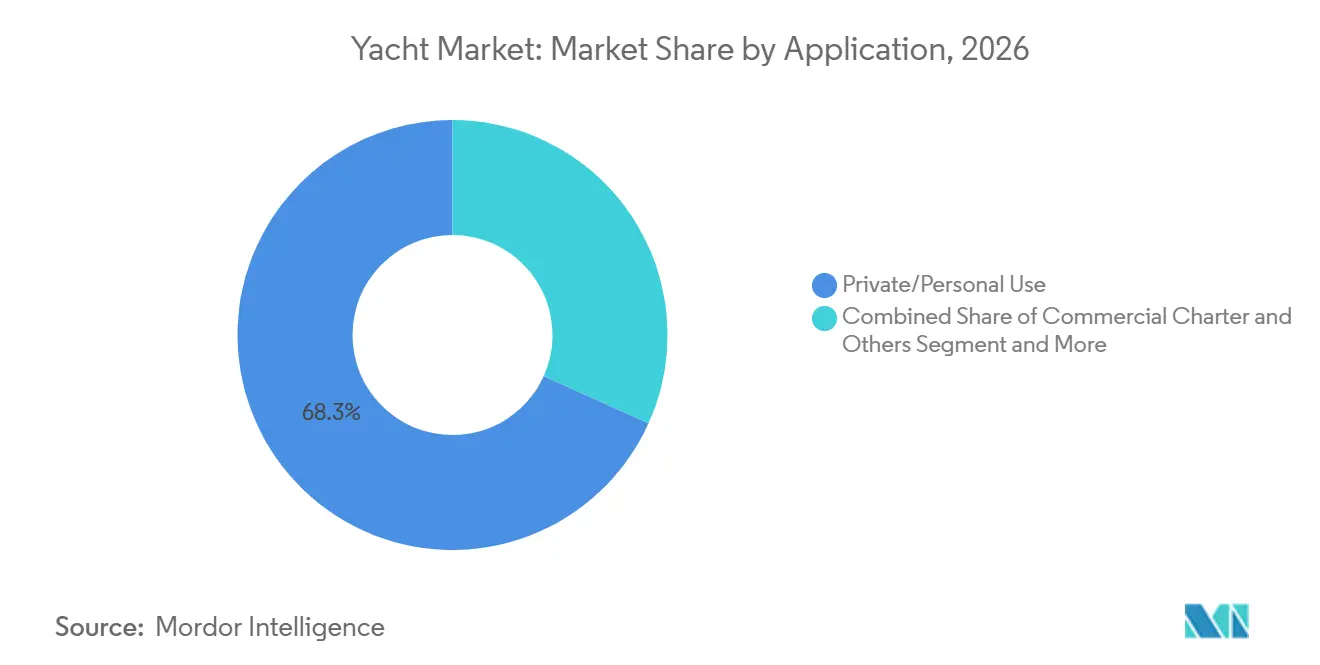
- By application, private/personal use held 68.27% share in 2026, while commercial charter is forecast to grow at a 7.37% CAGR through 2032.
- By sales channel, dealers and brokers held 58.73% share in 2026, while direct, shipyard, is forecast to grow at a 6.66% CAGR through 2032.
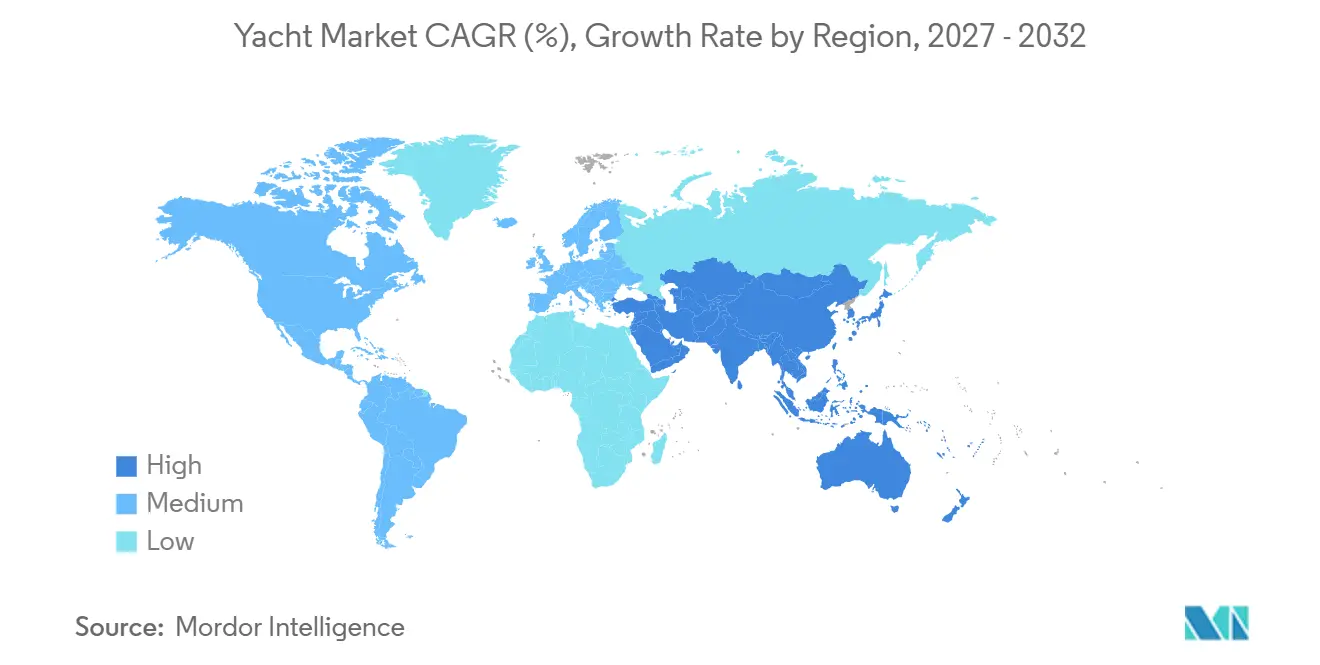
- By geography, Europe held 43.18% share in 2026, while Asia-Pacific is forecast to grow at a 7.86% CAGR through 2032.
Note: Market numbers in this report are based on Mordor Intelligence's proprietary estimation framework, which combines nine months of actuals with Q4 projections for base year 2026.
Market Trends and Insights
Drivers Impact Analysis of Yacht Market*
| Driver | (~) % Impact on CAGR Forecast | Geographic Relevance | Impact Timeline |
|---|---|---|---|
| Rising HNWI Wealth and Experiential Leisure Demand | +2.1% | Global, led by North America, Asia-Pacific, and Middle East | Long term (≥ 4 years) |
| Charter Expansion and Marina Infrastructure Investment | +1.4% | Mediterranean Europe, Southeast Asia, and UAE | Medium term (2–4 years) |
| Customization and Smart Onboard Systems | +0.9% | Global, with early adoption in North America and Northern Europe | Medium term (2–4 years) |
| Hybrid and Low-Emission Propulsion Adoption | +0.7% | EU, UK, North America, and Australia | Short term (≤ 2 years) |
| Tax Depreciation and Cross-Border Ownership Structuring | +0.5% | Malta, Cayman Islands, Marshall Islands, and UAE | Medium term (2–4 years) |
| Speculative-Build Visibility and Fractional-Ownership Access | +0.4% | North America, Western Europe, and Asia-Pacific | Long term (≥ 4 years) |
| Source: Mordor Intelligence | |||
Rising HNWI Wealth and Experiential Leisure Demand
The yacht market draws support from buyers who treat travel and private leisure as a major use of discretionary wealth. Demand for luxury yacht ownership is increasingly shaped by the desire to spend time in remote destinations, with greater control over timing and privacy, rather than by ownership alone. Younger buyers often expect dependable digital connectivity, flexible living spaces, and interiors that can adapt to family, work, and guest routines. These expectations make the purchase process more detailed and place greater value on a builder's ability to explain design choices in practical terms. They also increase the importance of service relationships that continue after delivery and support owners as their travel patterns change. The yacht market therefore rewards yards that translate personal preferences into sound vessel specifications without losing control of quality, cost, or delivery.
Charter Expansion and Marina Infrastructure Investment
Commercial charter gives owners a route to use a vessel while also generating revenue during available periods. That option can make ownership more attractive for buyers who are weighing operating commitments against private use and who want flexibility in how the yacht is deployed. New and upgraded marina facilities strengthen this model by improving access, berthing, repair support, and visitor services in popular cruising areas. The yacht market gains depth when larger vessels can find suitable facilities across several destinations rather than depending on a limited set of ports. Builders also benefit because charter requirements encourage layouts that are flexible, durable, and straightforward for crews to manage. A wider charter ecosystem can therefore support demand for vessels designed for regular guest turnover as well as personal travel.
Customization and Smart Onboard Systems
Customization has moved beyond interior finishes to include deck arrangements, operating systems, service features, and the way different parts of the vessel are used through a trip. Buyers increasingly expect to review design choices early and to follow technical decisions during construction, especially where those choices affect daily comfort or crew workload. Digital management tools can help crews monitor equipment, organize maintenance, and reduce the chance that a technical issue disrupts a planned journey. Azimut introduced its Neuron digital yacht management system in 2025 to support remote diagnostics, onboard automation, and predictive maintenance[1]. These tools can be valuable when owners want a simpler experience without giving up the individuality that is central to a bespoke purchase. The yacht market is likely to favor builders that make ownership more manageable while preserving the personal character buyers expect.
Hybrid and Low-Emission Propulsion Adoption
The yacht market is responding to closer attention to fuel emissions and local operating rules in important cruising areas. The Mediterranean Sea Emission Control Area took effect in 2025 and applies a lower sulphur limit under MARPOL Annex VI[2]. This change has made propulsion choices a more prominent part of vessel planning, refit discussions, and conversations about future resale expectations. Hybrid systems can provide quieter operation at low speeds and give owners another way to meet changing operating expectations without altering the purpose of a trip. Feadship delivered Valor in 2025 with a hybrid system that includes battery capacity for zero-emission operation[3]. As a result, builders need to discuss energy use, equipment support, crew knowledge, and cruising patterns much earlier in the design process.
Restraints Impact Analysis of Yacht Market*
| Restraint | (~) % Impact on CAGR Forecast | Geographic Relevance | Impact Timeline |
|---|---|---|---|
| High Total Cost of Ownership and Financing Burden | -1.2% | Global, most acute in North America and Northern Europe | Long term (≥ 4 years) |
| Skilled Shipyard Labor Shortages and Extended Build Cycles | -0.8% | Italy, Netherlands, Germany, and UK | Medium term (2–4 years) |
| Ecological Carrying-Capacity Limits and Anchoring Restrictions | -0.5% | Mediterranean Europe (Croatia, Greece, France, Balearics) | Short term (≤ 2 years) |
| Sanctions, Beneficial-Ownership and Flag-Compliance Friction | -0.4% | Global, elevated friction in EU and US jurisdictions | Medium term (2–4 years) |
| Source: Mordor Intelligence | |||
High Total Cost of Ownership and Financing Burden
The cost of operating a yacht includes crew, fuel, maintenance, insurance, marina access, periodic refits, and the administrative work that accompanies ownership. These recurring costs can affect purchase decisions even when a buyer has the resources to acquire a vessel, because the commitment continues through the life of the yacht. Financing conditions can add another layer of caution, particularly for buyers considering a larger or more specialized build with a longer delivery period. Some buyers respond by choosing charter use or shared ownership arrangements rather than keeping a vessel solely for private use. This shift does not remove demand, but it can change the features, operating arrangements, and service support an owner expects from a builder. The yacht market must therefore accommodate several ownership models instead of relying only on the traditional single-owner purchase.
Skilled Shipyard Labor Shortages and Extended Build Cycles
Yacht construction depends on experienced fabricators, electricians, engineers, naval architects, and project teams that can coordinate work across many specialized suppliers. Many of these roles require practical knowledge that cannot be replaced quickly when order books expand or when an experienced worker leaves a yard. A shortage of skilled workers can lengthen a build cycle and make delivery timing less certain for a buyer who may be planning travel or crew arrangements well in advance. Smaller yards may find it harder to retain specialist staff when competing with better-funded builders that can offer more continuity and resources. The issue can also affect the quality of documentation and handover support needed once a vessel enters service. The yacht market faces additional technical work as safety, emissions, and flag requirements evolve, which makes an experienced workforce a continuing competitive asset.
*Our forecasts treat driver/restraint impacts as directional, not additive. The impact forecasts reflect baseline growth, mix effects, and variable interactions.
Yacht Market Segment Analysis
By Type:
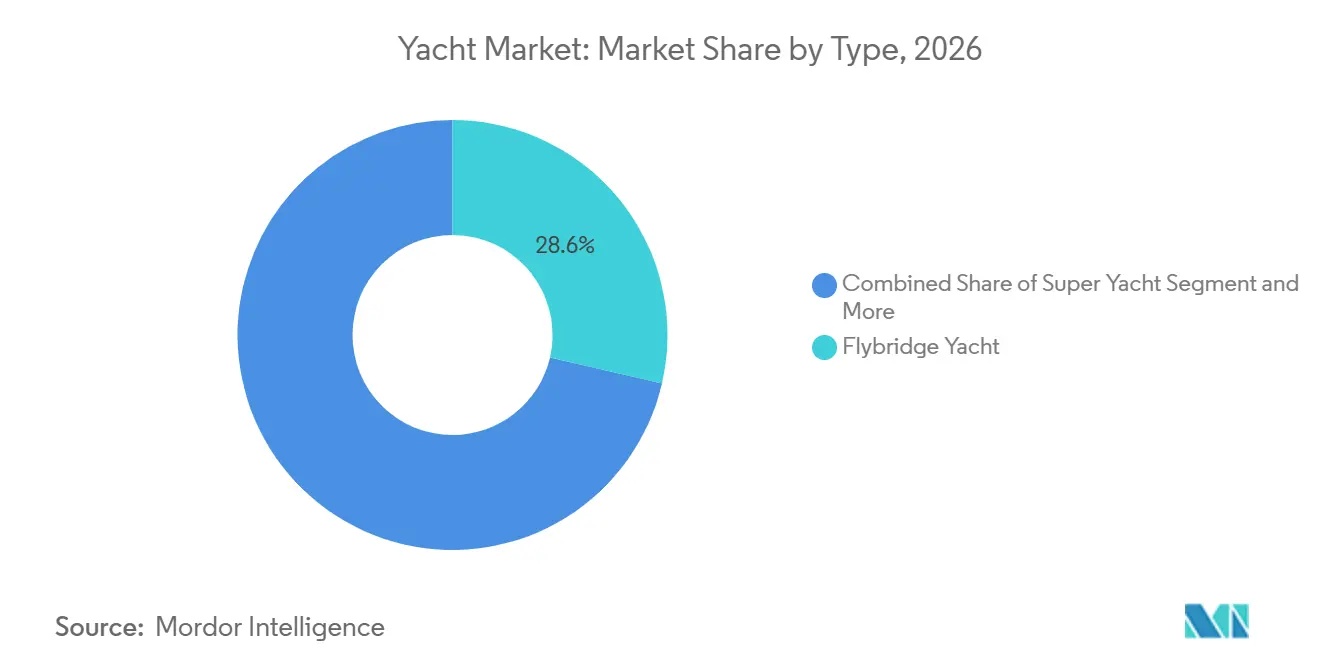
Flybridge Formats Lead Demand While Expedition Designs Gain MomentumFlybridge yacht held 28.63% of the yacht market share in 2026. Its elevated helm area and open social deck support private cruising and charter use. The format is familiar to a broad group of buyers and is offered by many established builders. Owners can select layouts for relaxed coastal travel or for trips that include guests and crew. This flexibility allows yards to adjust interior and deck spaces to a buyer's preferences. It also gives the category a practical role across several common ownership patterns.
Long-range/expedition yacht is projected to expand at a 7.39% CAGR through 2032. These vessels appeal to owners who want access to destinations beyond busy coastal routes. Their design supports longer passages, crew comfort, and extensive onboard systems. The format can also accommodate equipment that supports lower-emission operation and independent cruising. Builders are using expedition design to respond to demand for privacy, endurance, and access to less crowded locations. A clear purpose can make the category easier to position in a market with varied owner expectations.



By Length:
Mid-Sized Vessels Anchor Demand While Larger Builds AdvanceThe 20 to 50 m category held a 43.18% segment share in 2026. This range covers layouts from semi-custom leisure vessels to longer-range cruisers. It attracts buyers seeking a balance between onboard space, crew support, and manageable ownership needs. A more established resale environment can also make the category easier for new owners to consider. Competition is active because European and emerging yards offer several choices in this range. Builders must still provide a distinct design and reliable service to stand apart.
Above 50 m is forecast to grow at a 7.34% CAGR through 2032. Buyers in this category often seek extensive privacy, dedicated crew areas, and long-range capability. Each project usually involves detailed discussions of design, engineering, and owner preferences. The greater technical scope makes delivery schedules and shipyard capacity central to the purchase decision. The yacht market is likely to retain demand for these vessels where buyers value self-contained travel and tailored spaces. A yard's ability to manage complex work can be as important as its design reputation.
By Propulsion:
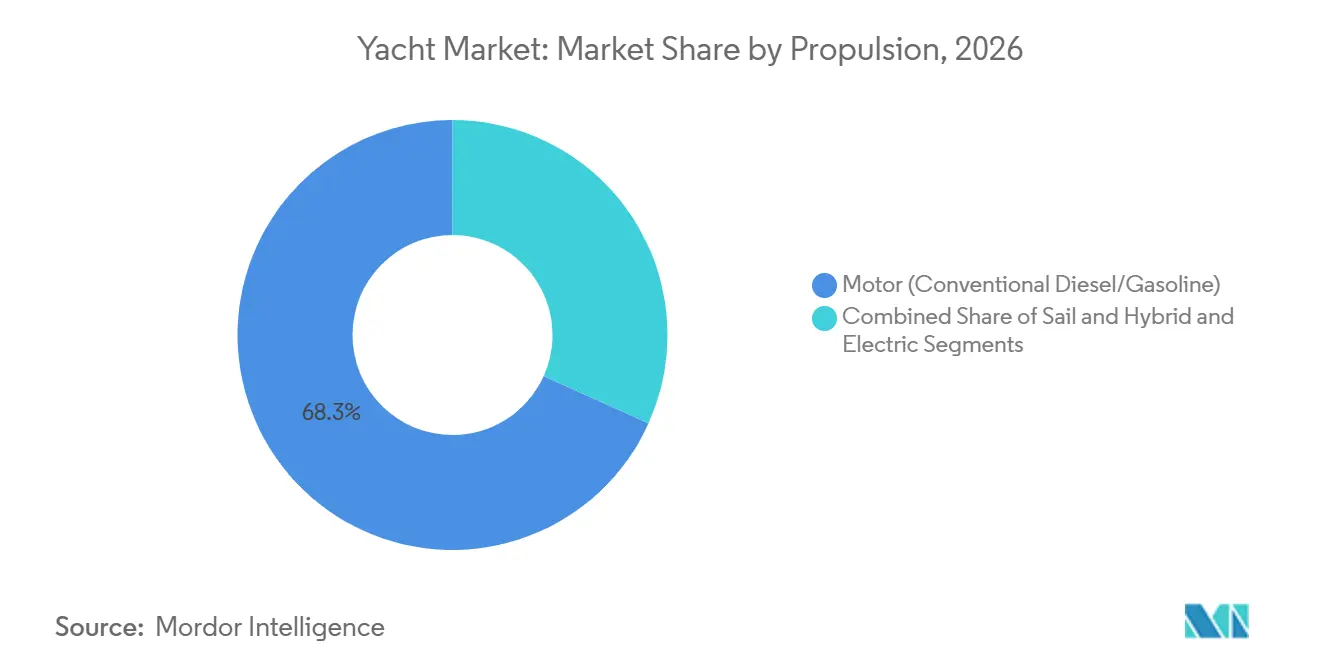
Conventional Motor Systems Lead While Hybrid and Electric Options ExpandMotor, conventional diesel/gasoline, held a 68.26% segment share in 2026. Established supplier networks, service knowledge, and crew familiarity continue to support this position. Many buyers value proven operating practices and maintenance support in major cruising regions. Conventional systems remain relevant for owners whose travel plans require range and dependable refueling access. The transition will depend on how readily new systems can meet similar reliability expectations. Builders must help clients assess propulsion choices against their actual cruising plans.
Hybrid and electric is projected to expand at a 10.79% CAGR through 2032. The category is supported by demand for quieter operation and more flexible energy use at anchor. It also responds to environmental rules that increasingly influence new-build specifications. Sunreef launched its first Sunreef 100 Eco in 2026, presenting an electric sailing catamaran with solar integration. The yacht market is moving toward propulsion choices that can meet regulatory needs without limiting the ownership experience. Adoption will also depend on crew training, service availability, and the confidence owners place in the technology.

By Hull Type:
Monohulls Retain Their Lead While Multihulls Build AppealMonohull held a 83.16% segment share in 2026. The design has a long operating history and remains the standard choice across many vessel formats. Builders, classification bodies, crews, and service providers have deep experience with monohull construction. Owners may also prefer the familiar handling and layout choices associated with this format. These factors give the category a durable base even as other designs develop. Its broad acceptance also supports resale considerations for many buyers.
Multihull is forecast to grow at a 7.36% CAGR through 2032. Wider deck areas can support spacious accommodation and greater surface area for solar equipment. A shallow draft can provide access to destinations that may be less suitable for larger monohulls. The format has particular relevance for buyers considering electric or hybrid systems. The yacht industry sees multihulls as a way to combine leisure space with new approaches to onboard energy management. Specialist builders can use this design to address clients who value a different onboard living experience.
By Hull Material:
Fiberglass and Composite Hold Volume Leadership While Aluminum GainsFiberglass/composite held a 74.18% segment share in 2026. The material remains well suited to repeatable production and a wide variety of leisure vessel designs. Builders can use composites to balance structural needs, finish quality, and manufacturing efficiency. Ongoing work in laminates and carbon elements broadens the choices available to designers. This helps the yacht market serve buyers who want modern styling without moving to a fully custom metal build. The material's familiarity also gives shipyards a dependable basis for series construction.
Aluminum is forecast to grow at a 6.82% CAGR through 2032. Its weight, strength, and fabrication properties make it relevant for larger and more complex projects. The material can support systems and internal arrangements associated with long-range cruising. It is also used where owners value performance and design flexibility. Builders with aluminum expertise can compete for projects that require a tailored hull and advanced onboard equipment. This expertise can be especially valuable when a project has unusual technical requirements.
By Application:
Private Use Leads While Charter Becomes More ImportantPrivate/personal use held a 68.27% segment share in 2026. Privacy, personal scheduling, and control over the onboard environment remain core reasons for ownership. Many owners use vessels for family travel and private entertainment. They often seek layouts that reflect their preferences rather than the needs of a broad guest base. The category remains central to the yacht market because it supports demand for bespoke features and long-term client relationships. It also reinforces the value placed on discretion and consistent service.
Commercial charter is projected to grow at a 7.37% CAGR through 2032. Charter gives more travelers access to yacht experiences without committing to full ownership. It can help owners make practical use of a vessel during periods when they are not aboard. This model encourages designs that can be reconfigured and maintained efficiently between guests. The yacht market benefits when charter introduces prospective buyers to vessel types and cruising destinations. Charter programs can also increase the importance of experienced management and responsive service.
By Sales Channel:
Brokers Maintain Trust-Based Distribution While Direct Sales GrowDealers and brokers held a 58.73% segment share in 2026. These intermediaries help buyers understand technical choices, compare available vessels, and navigate a complex transaction. Their role is important where new-build allocations and pre-owned supply can be difficult to access. Established relationships may also help buyers coordinate surveys, financing, and delivery arrangements. The channel remains valuable for builders that need reach across international client markets. Brokers can also offer guidance when an owner is weighing a new build against an available vessel.
Direct, shipyard, is forecast to grow at a 6.66% CAGR through 2032. Buyers seeking a bespoke vessel often want to work with the builder from the first design discussion. Direct contact can improve the exchange of information on layout, systems, and personal preferences. It also gives the yard a clearer view of how an owner expects to use the yacht. The yacht market can support both channels because buyers may value direct technical access while relying on a broker for specialist advice. This blended approach can help a client retain independent guidance during a highly personal purchase.
Geography Analysis
Europe held 43.18% of the yacht market share in 2026. Italy remains important for series-built motor yachts, while the Netherlands is widely associated with custom superyacht construction. Germany also contributes engineering and specialized construction capability. The region has a dense network of marinas, refit sites, suppliers, and charter destinations. This ecosystem supports the yacht market throughout a vessel's operating life, not only at delivery. The Mediterranean's environmental rules make propulsion and compliance planning more prominent for owners and builders. They also increase the value of yards and service providers that can explain changing requirements clearly. For global buyers, this concentration of experience can make Europe a practical place to commission, operate, and maintain a yacht.
North America remains an important source of demand, supported by established cruising routes and a large base of affluent buyers. Florida and the Caribbean are particularly relevant for sales, charter, and after-sales service. Builders adapt layouts and equipment to regional preferences, including formats suited to coastal and inland waterways. Regional service access matters because owners often expect prompt support during active cruising periods. Buyer relationships can therefore depend on the quality of local representation as much as the original sale. North American clients also provide an important customer base for European builders seeking closer after-sales contact. South America offers a different opportunity, with destination-led demand in selected coastal and river regions rather than the same depth of domestic demand seen in North America. The contrast between these regions means that builders need locally informed sales and service plans rather than a uniform approach.
Asia-Pacific is projected to grow at a 7.86% CAGR through 2032. Singapore, Indonesia, and Australia are building relevance through marina development, tourism activity, and a growing population of potential buyers. The Middle East also merits close attention as local groups invest in service facilities, production capability, and waterfront destinations. These investments can make a region more practical for owners who want to cruise rather than only berth their vessels. Oceania benefits from established boating culture and suitable cruising grounds. Africa remains more constrained by marina availability and domestic wealth depth, though selected destinations can still attract international charter activity. The yacht market will develop unevenly across these geographies because service readiness and local cruising conditions vary widely. Builders that enter these regions will need to assess infrastructure, local partners, and client support with care.
Competitive Landscape
Market Concentration
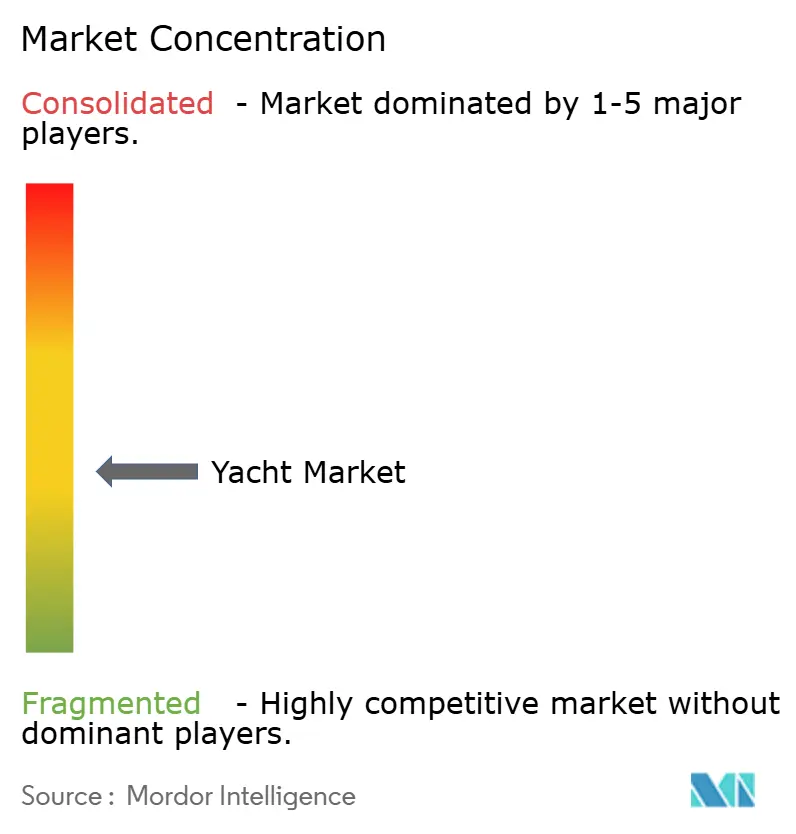
The yacht market has a moderate concentration. Competition differs across series production, custom superyachts, performance vessels, and multihull designs. Leading companies compete through design reputation, technical capability, delivery confidence, and client service. Builders also need to maintain supplier relationships and skilled workforces that support complex custom work. This structure leaves room for specialist yards that address a specific vessel format or propulsion preference. It also gives buyers several routes to pursue, depending on the degree of customization they require. No single approach serves every category of owner or vessel. The result is a field in which differentiation matters, but buyers can still compare a broad range of specialist capabilities.
Strategic ownership changes have remained important within the yacht market. Oceanco changed ownership in 2025 and communicated a future focus on people, technology, and innovation under its new owner. Heesen and Sunseeker also underwent ownership or financing changes during the period covered by the source material. These moves show why access to long-term capital matters in a business that requires specialized facilities and extended build programs. Builders are also reviewing acquisition opportunities where a brand, workforce, or shipyard site could add useful capacity. Such transactions can protect established capabilities when market conditions place pressure on individual companies. They can also change the competitive choices available to buyers and suppliers. A successful transition depends on retaining technical knowledge and preserving trust with clients whose projects may take years to complete.
Technology is becoming a more visible source of differentiation in the yacht market. Azimut's Neuron system is an example of a builder using software features to support maintenance and onboard control. Feadship's delivery of Valor shows how a shipyard can use hybrid engineering as part of its client offering. Builders that pair a strong design identity with dependable systems and service coverage can be better placed to retain demanding owners over several vessel cycles. Digital tools can also make the ownership experience more manageable when equipment and crew arrangements become complex. This gives technology a practical role alongside traditional strengths in naval architecture and craftsmanship. The competitive value comes from making these tools useful to owners and crews rather than treating them as a separate feature.
Yacht Industry Leaders
-
Azimut Benetti S.p.A.
-
Ferretti S.p.A.
-
Sanlorenzo S.p.A.
-
Fr. Lürssen Werft GmbH & Co. KG
-
Feadship
- *Disclaimer: Major Players sorted in no particular order
Yacht Market Companies Covered in this Report
- Azimut Benetti S.p.A.
- Ferretti S.p.A.
- Sanlorenzo S.p.A.
- Feadship
- Fr. Lurssen Werft GmbH & Co. KG
- Princess Yachts Limited
- Sunseeker International Limited
- Heesen Yachts Builders B.V.
- Damen Shipyards Group N.V.
- Oceanco B.V.
- Groupe Beneteau S.A.
- Bavaria Yachtbau GmbH
- Viking Yacht Company
- Christensen Shipyards Ltd.
- Alexander Marine International Co., Ltd.
- Baglietto S.p.A.
- Gulf Craft LLC
- Fincantieri S.p.A.
- Horizon Yacht Co., Ltd.
- The Italian Sea Group S.p.A.
- Overmarine Group S.p.A.
- HanseYachts AG
- Sunreef Yachts
Recent Industry Developments in Yacht Market
- October 2026: Safe Harbor Marinas, a Blackstone Infrastructure company, agreed to acquire MarineMax, the world's largest recreational boat and yacht retailer, for approximately USD 1.5 billion in cash, aiming to integrate marinas, superyacht services, boat sales, and maintenance.
- September 2026: Ferretti Group presented 8 yachts at the Monaco Yacht Show across its Riva, CRN, Pershing, Custom Line, and Wally brands, including 3 premieres: the Riva 54Metri, the CRN 67m Amor à Vida, and the Custom Line Navetta 35.
- September 2026: Lürssen confirmed the sale of Project M, a superyacht exceeding 125 m in length and 6,000 GT, to be built at its Bremen facility, placing it among the largest yachts in the world.
- September 2026: Sunseeker unveiled a rebrand at the Cannes Yachting Festival, introducing a new 45M superyacht concept, the 86 Ocean Enclosed, and the Manhattan 94, while also acquiring assets of former distributors Sunseeker London and Sunseeker Poole to form Sunseeker Europe.
Global Yacht Market Report Scope
The Yacht Market is segmented by Type, Length, Propulsion, Hull Type, Hull Material, Application, Sales Channel, and Geography. By Type, the market is segmented into Super Yacht, Flybridge Yacht, Sport Yacht, Long-Range/Expedition Yacht, and Others (Sailing, Trawler, Classic). By Length, the market is segmented into Up to 20 m, 20 to 50 m, and Above 50 m. By Propulsion, the market is segmented into Motor (Conventional Diesel/Gasoline), Sail, and Hybrid and Electric. By Hull Type, the market is segmented into Monohull and Multihull. By Hull Material, the market is segmented into Fiberglass/Composite, Aluminum, Steel, and Others. By Application, the market is segmented into Private/Personal Use, Commercial Charter, and Others (Racing, Government). By Sales Channel, the market is segmented into Direct (Shipyard) and Dealers and Brokers. By Geography, the market is segmented into North America (United States, Canada, and Mexico), Europe (Italy, Germany, United Kingdom, France, Netherlands, Spain, Russia, and Rest of Europe), Asia-Pacific (China, Japan, South Korea, India, Australia, and Rest of Asia-Pacific), South America (Brazil, Argentina, Chile, and Rest of South America), and Middle East and Africa (United Arab Emirates, Saudi Arabia, Qatar, Turkey, South Africa, and Rest of Middle East and Africa). Market forecasts are provided in terms of Value (USD) and Volume (Units).
Segmentation Overview
| Super Yacht |
| Flybridge Yacht |
| Sport Yacht |
| Long-Range/Expedition Yacht |
| Others (Sailing, Trawler, Classic) |
| Up to 20 m |
| 20 to 50 m |
| Above 50 m |
| Motor (Conventional Diesel/Gasoline) |
| Sail |
| Hybrid and Electric |
| Monohull |
| Multihull |
| Fiberglass/Composite |
| Aluminum |
| Steel |
| Others |
| Private/Personal Use |
| Commercial Charter |
| Others (Racing, Government) |
| Direct (Shipyard) |
| Dealers and Brokers |
| North America | United States |
| Canada | |
| Mexico | |
| Europe | Italy |
| Germany | |
| United Kingdom | |
| France | |
| Netherlands | |
| Spain | |
| Russia | |
| Rest of Europe | |
| Asia-Pacific | China |
| Japan | |
| South Korea | |
| India | |
| Australia | |
| Rest of Asia-Pacific | |
| South America | Brazil |
| Argentina | |
| Chile | |
| Rest of South America | |
| Middle East and Africa | United Arab Emirates |
| Saudi Arabia | |
| Qatar | |
| Turkey | |
| South Africa | |
| Rest of Middle East and Africa |
| By Type | Super Yacht | |
| Flybridge Yacht | ||
| Sport Yacht | ||
| Long-Range/Expedition Yacht | ||
| Others (Sailing, Trawler, Classic) | ||
| By Length | Up to 20 m | |
| 20 to 50 m | ||
| Above 50 m | ||
| By Propulsion | Motor (Conventional Diesel/Gasoline) | |
| Sail | ||
| Hybrid and Electric | ||
| By Hull Type | Monohull | |
| Multihull | ||
| By Hull Material | Fiberglass/Composite | |
| Aluminum | ||
| Steel | ||
| Others | ||
| By Application | Private/Personal Use | |
| Commercial Charter | ||
| Others (Racing, Government) | ||
| By Sales Channel | Direct (Shipyard) | |
| Dealers and Brokers | ||
| By Geography | North America | United States |
| Canada | ||
| Mexico | ||
| Europe | Italy | |
| Germany | ||
| United Kingdom | ||
| France | ||
| Netherlands | ||
| Spain | ||
| Russia | ||
| Rest of Europe | ||
| Asia-Pacific | China | |
| Japan | ||
| South Korea | ||
| India | ||
| Australia | ||
| Rest of Asia-Pacific | ||
| South America | Brazil | |
| Argentina | ||
| Chile | ||
| Rest of South America | ||
| Middle East and Africa | United Arab Emirates | |
| Saudi Arabia | ||
| Qatar | ||
| Turkey | ||
| South Africa | ||
| Rest of Middle East and Africa | ||
Key Questions Answered in the Report
What is the forecast growth rate for the yacht sector?
The Yacht market is forecast to grow at a 6.42% CAGR from 2027 to 2032, reaching USD 17.21 billion by 2032. Demand is supported by private travel, charter use, and evolving vessel specifications that improve the ownership experience.
Which yacht type is growing fastest?
Long-range/expedition yacht is forecast to expand at a 7.39% CAGR through 2032, supported by interest in extended and remote cruising. Buyers value the privacy, endurance, onboard comfort, and operating flexibility associated with this format.
Why are hybrid and electric yachts gaining attention?
Hybrid and electric propulsion is projected to grow at a 10.79% CAGR through 2032 as owners consider quieter operation, emissions requirements, and flexible energy use. Compliance planning, crew familiarity, and service readiness are becoming more important in purchase decisions.
Which region leads yacht demand?
Europe held the largest share at 43.18% in 2026, supported by its established builder base, marina network, and charter destinations. Its supplier, refit, and service ecosystem also supports vessels through their operating life and regular maintenance needs.