
Acrylic Solid Surface Wall Panels Market Size and Share
Market Overview
| Study Period | 2021 - 2031 |
|---|---|
| Market Size (2026) | USD 608.02 Million |
| Market Size (2031) | USD 794.20 Million |
| Growth Rate (2026 - 2031) | 5.49 % |
| Fastest Growing Market | Asia-Pacific |
| Largest Market | Asia-Pacific |
| Market Concentration | Medium |
Major Players *Disclaimer: Major Players sorted in no particular order Image © Mordor Intelligence. Reuse requires attribution under CC BY 4.0. | |
Acrylic Solid Surface Wall Panels Market Analysis by Mordor Intelligence
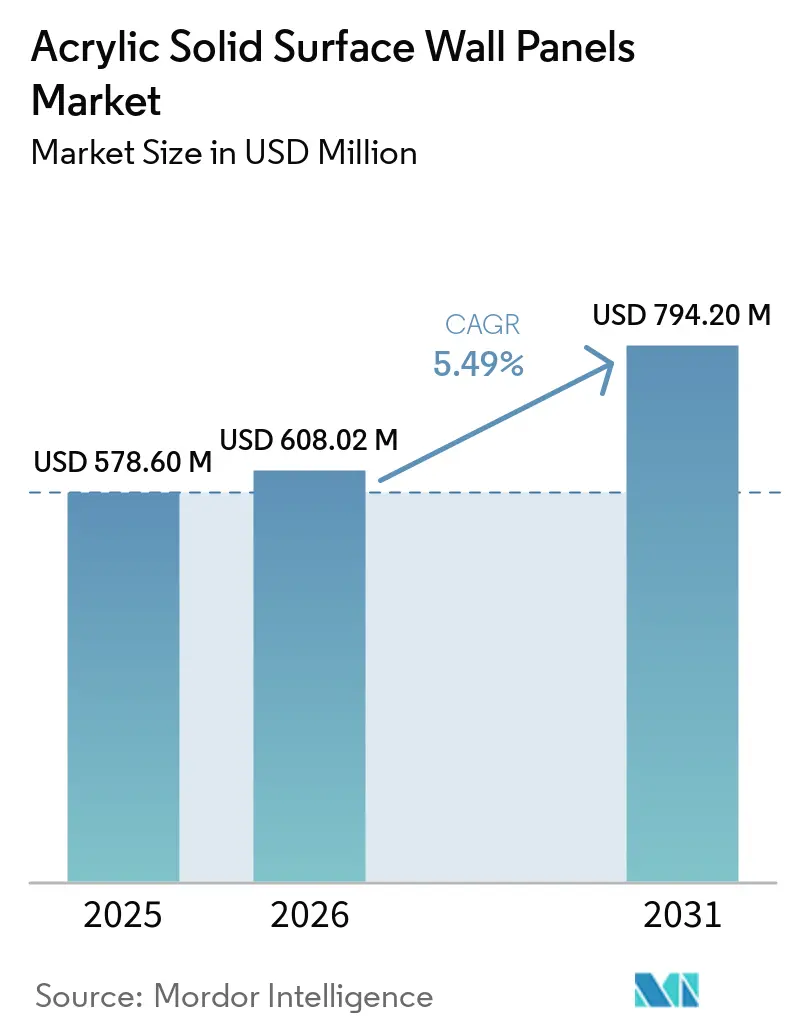
The acrylic solid surface wall panels market was valued at USD 578.60 million in 2025, is estimated at USD 608.02 million in 2026, and is forecast to reach USD 794.20 million by 2031, growing at a 5.49% CAGR during 2026–2031. Commercial construction and healthcare renovation support demand because both settings require durable, nonporous interior finishes. Procurement teams increasingly assess cleaning, repair, and service-life needs alongside initial installation cost. This favors seamless panels in projects where grout lines and frequent surface replacement create operating concerns. Competition remains moderate because established brands hold strong specification positions, while regional producers compete on delivery time, pricing, and fabricator support. Supply risk remains centered on acrylic resin inputs and the availability of qualified fabricators for complex installations.
Key Report Takeaways
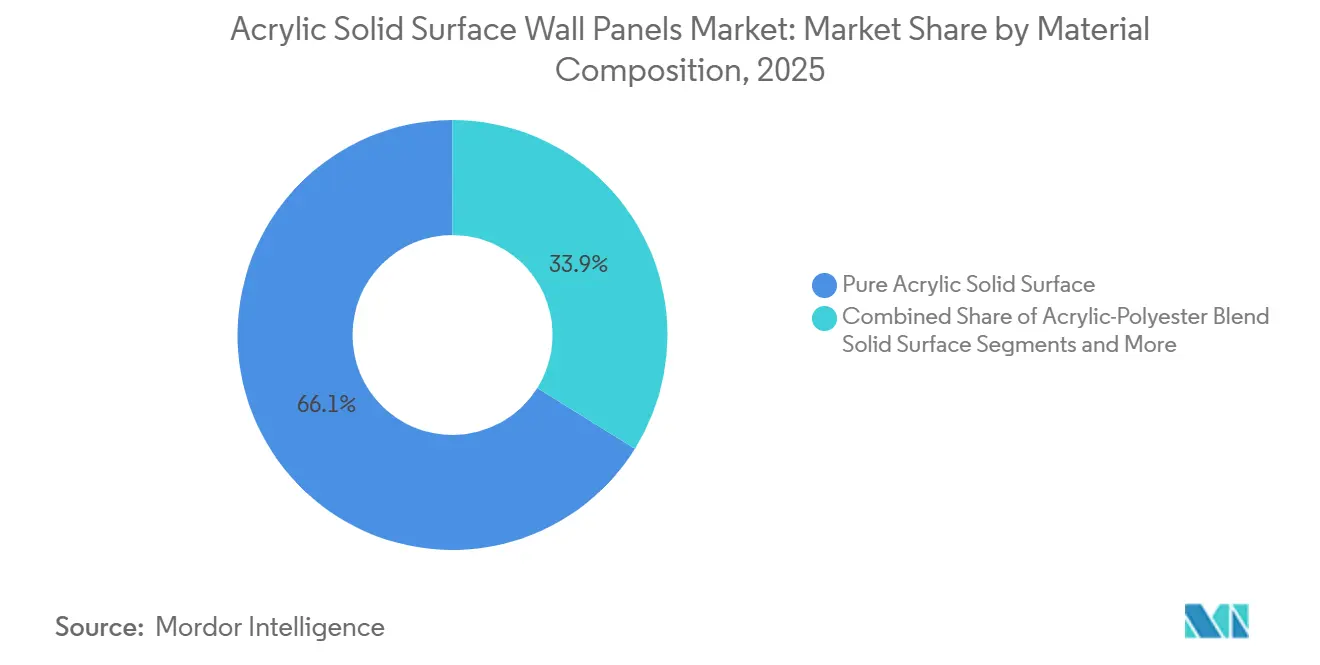
- By material composition, pure acrylic held 66.1% of revenue in 2025, while modified acrylic and acrylic-polyester blends are forecast to grow at a 6.9% CAGR during 2026–2031.
- By product and panel format, standard panels accounted for 35.6% of revenue in 2025, while 3D and textured panels are forecast to grow at a 7.8% CAGR during 2026–2031.
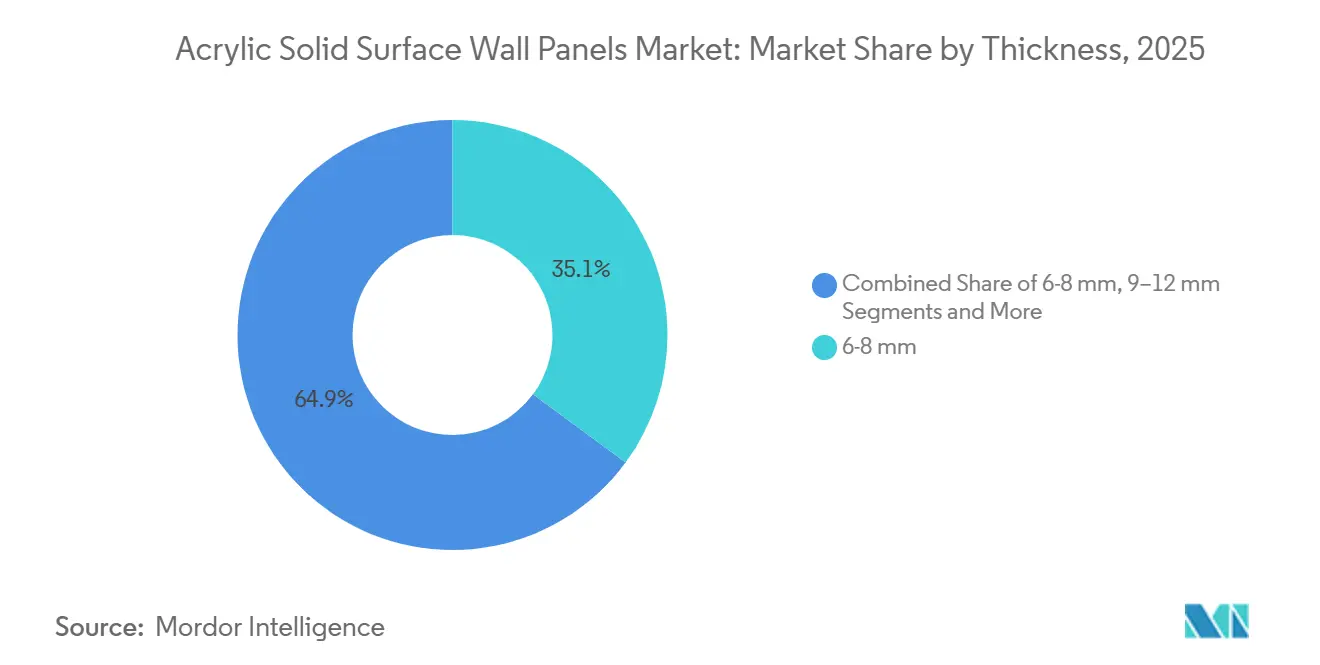
- By thickness, the 6-8 mm range held 36.1% of revenue in 2025, while the sub-6 mm range is forecast to grow at a 7.4% CAGR during 2026–2031.
- By end user, commercial facilities held 75% of revenue in 2025, and are forecast to grow at a 7.6% CAGR during 2026–2031.
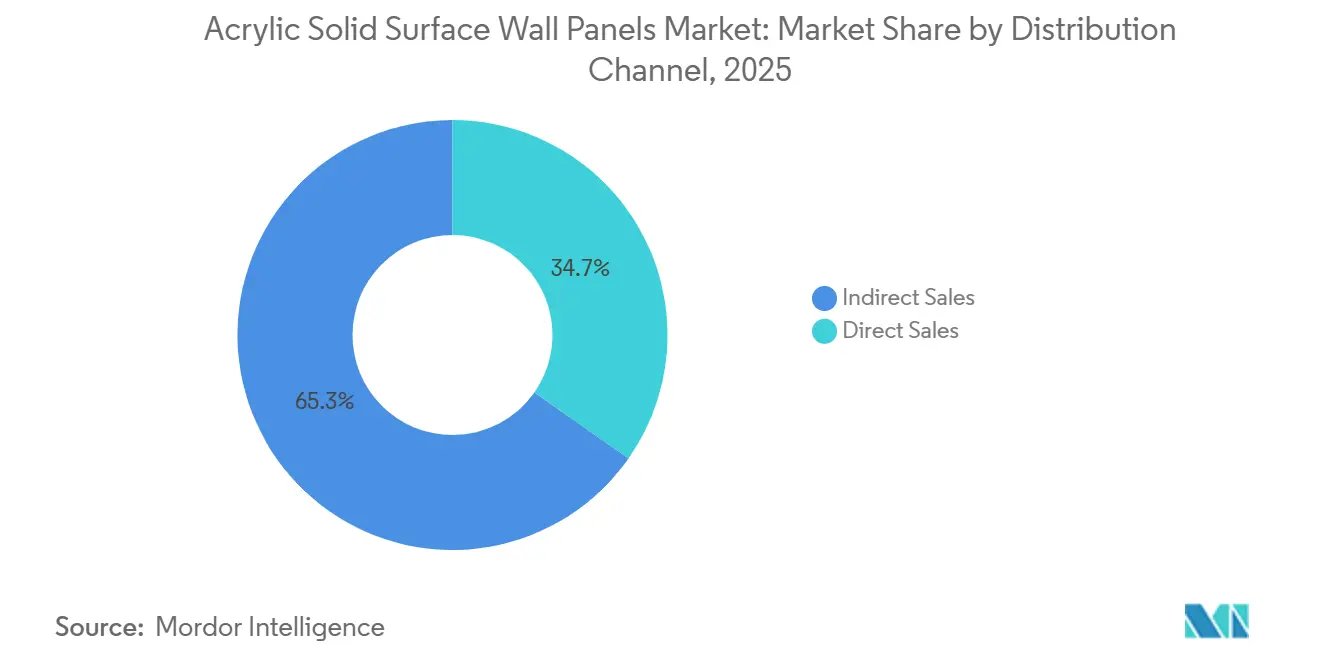
- By distribution channel, indirect sales held 65.2% of revenue in 2025, while direct sales are forecast to grow at a 7.7% CAGR during 2026–2031.
- By geography, Asia-Pacific held 36.8% of revenue in 2025 and is forecast to grow at a 7.3% CAGR during 2026–2031.
Note: Market size and forecast figures in this report are generated using Mordor Intelligence’s proprietary estimation framework, updated with the latest available data and insights as of January 2026.
Global Acrylic Solid Surface Wall Panels Market Trends and Insights
Drivers Impact Analysis*
| Driver | (~) % Impact on CAGR Forecast | Geographic Relevance | Impact Timeline |
|---|---|---|---|
| Healthcare and Infection-Controlled Interior Design | +1.4% | Global, concentrated in North America, Europe, and the GCC | Medium term (2-4 years) |
| Commercial Interior Refurbishment and Retrofit Activity | +1.2% | Global, led by North America and Europe | Short term (≤ 2 years) |
| Demand for Seamless, Low-Maintenance Wall Finishes | +0.9% | Global, strongest in hospitality-led Asia-Pacific and Middle East, and Africa | Medium term (2-4 years) |
| Urban Hospitality and Institutional Construction in Asia-Pacific and the Middle East | +0.8% | Asia-Pacific core, the Middle East, and Africa spillover to South Asia | Long term (≥ 4 years) |
| Architect Demand for Thermoformed, Curved, and Integrated Wall Systems | +0.6% | North America, Europe, and GCC premium projects | Long term (≥ 4 years) |
| Reduced Renovation Downtime Through Large-Format Panel Installation | +0.4% | North America, Europe, and Oceania | Short term (≤ 2 years) |
| Source: Mordor Intelligence | |||
Healthcare and Infection-Controlled Interior Design Drives Core Demand
Nonporous and seamless walls have become a clinical design requirement in many hospitals, surgical facilities, and outpatient centers. LX Hausys' position is HIMACS for healthcare environments and carries certifications relating to resistance to mold, viruses, bacteria, and more than 150 chemicals [1]LX Hausys, “HIMACS Healthcare Brochure 2026,” LX Hausys Europe, lxhausys.com. KRION is also positioned for healthcare wall applications, including operating rooms, sterilization areas, and patient corridors [2]KRION, “Solid Surface in the Healthcare Sector,” KRION, krion.com. A single wall-surface specification can now extend from nurse stations to intensive care headwalls and corridors, increasing the material scope of each facility project. The acrylic solid surface wall panels market benefits when suppliers can offer coordinated colors, panel formats, cleaning guidance, and compliance documentation across those locations. ISO 22196 and GREENGUARD Gold are increasingly important in healthcare evaluations because they support documented antimicrobial and indoor-air-quality requirements.
Commercial Interior Refurbishment and Retrofit Activity Sustains Near-Term Pipeline
Large-format panels can be installed over suitable existing substrates without wet-trade work or curing time. This makes them relevant for hotel bathrooms, commercial washrooms, and lobby corridors where closure periods reduce revenue. Replacing tiled shower surrounds can reduce room-out-of-service time by 60-70% compared with tile removal and regrouting. Retail and food-service operators also refresh interior environments on recurring cycles and require surfaces that can meet hygiene needs. Wilsonart expanded its HPL collection in July 2026 with design families intended to integrate with its Solid Surface, Quartz, Thinscape, and Wetwall ranges. The acrylic solid surface wall panels market, therefore, has an installation-led opportunity in refurbishments, where lower downtime can matter as much as visual consistency.
Architect Demand for Thermoformed, Curved, and Integrated Wall Systems Expands the Design Ceiling
Thermoformability distinguishes acrylic solid surface from ceramic tile, natural stone, and standard laminates in curved-wall applications. Heated acrylic sheets can be formed into radii and three-dimensional shapes that other wall materials may not achieve at comparable installed cost. HIMACS Ultra-Thermoforming has 30% greater thermoplastic capability than standard HIMACS, according to LX Hausys. The same source documents the Bionic Wall installation in Prague, which used the formulation for a flowing lobby surface. DuPont introduced its 2026 Nature in Motion collection with 7 new Corian solid surface designs for vertical surfaces and feature walls. These product directions support the acrylic solid surface wall panels market demand in hospitality, corporate reception areas, and premium residential projects where curved design features are specified.
Urban Hospitality and Institutional Construction in Asia-Pacific and the Middle East Creates Volume Demand
Hospitality, healthcare, airport, and mixed-use projects in the Asia-Pacific and the Middle East require durable interior materials at a larger project scale. Saudi Arabia’s Vision 2030 development pipeline supports demand for certified wall finishes in luxury hospitality and healthcare projects. India is also gaining production capacity, with Stylam Industries commissioning a 100% acrylic solid surface line at Panchkula. Mid-tier hotels in secondary Chinese cities and Indian tier-2 markets provide a further renewal cycle when bathroom finishes reach the end of their service period. This source of replacement activity is separate from new hotel construction and can support repeat orders. Fire classification requirements and Indian standards also favor suppliers that can provide the documentation needed for public and institutional projects.
Restraints Impact Analysis*
| Restraint | (~) % Impact on CAGR Forecast | Geographic Relevance | Impact Timeline |
|---|---|---|---|
| Premium Price Compared With Ceramic Tile, PVC, and Laminates | -0.7% | Global, most acute in price-sensitive Asia-Pacific and South America | Short term (≤ 2 years) |
| Acrylic Resin and Methyl Methacrylate Feedstock Price Volatility | -0.5% | Global, amplified in Asia, and regions dependent on imported MMA | Medium term (2-4 years) |
| Limited Availability of Certified Fabricators for Complex Projects | -0.4% | North America, Europe, and GCC | Long term (≥ 4 years) |
| Project-Specific Fire, VOC, Antimicrobial, and Chemical-Resistance Certification Burden | -0.3% | Global, most acute for cross-jurisdictional launches | Long term (≥ 4 years) |
| Source: Mordor Intelligence | |||
Premium Price Relative to Substitute Wall Finishes Limits Volume Penetration
Acrylic solid surface panels have a first-fit cost of 3-5 times ceramic tile and 2-3 times PVC or HPL-faced boards at comparable installed thicknesses. The gap limits adoption in residential and budget commercial projects, even where durability, repairability, and lower grout maintenance offer lifecycle benefits. Healthcare and hospitality buyers in North America and northern Europe have more often incorporated lifecycle cost into procurement decisions. Developers in South and Southeast Asia and South America may instead choose PVC or modified acrylic products that have a similar appearance but do not offer the same performance or certification record. Thinner panels can reduce material use, but their lower thermoforming capability limits feature-wall applications. The acrylic solid surface wall panels market also faces a communication challenge when indirect channels present a price without a direct manufacturer explanation of maintenance and installation benefits.
Acrylic Resin and MMA Feedstock Price Volatility Compresses Manufacturer Margins
MMA is the principal monomer in solid surface sheet production and represents 1/3 of the raw material cost in pure acrylic formulations. Supply disruptions can increase input costs and pressure manufacturers that have committed to fixed project pricing. Trinseo reported that its Engineered Materials net sales fell 5% year over year to USD 263 million in the first quarter of 2026, while its Italian virgin MMA closure changed volumes and cost exposure [3]Trinseo PLC, “Trinseo Reports First Quarter 2026 Financial Results,” Trinseo Investor Relations, trinseo.com. The company also began a May 2026 initiative to diversify aluminum trihydrate sourcing and qualify alternative suppliers against particle size and color requirements. Qualified fabricator availability remains a related restraint for curved installations, while fire, VOC, antimicrobial, and chemical-resistance documentation can add time to cross-border launches. EN 13501-1, GREENGUARD Gold, NSF/ANSI 51, and ISO 22196 remain important specification benchmarks in commercial settings.
*Our forecasts treat driver/restraint impacts as directional, not additive. The impact forecasts reflect baseline growth, mix effects, and variable interactions.
Segment Analysis
By Material Composition: Pure Acrylic Maintains Quality Lead, Blends Accelerate
Pure acrylic held 66.1% of the acrylic solid surface wall panels market share in 2025. Its position reflects strong thermoformability, resistance to yellowing over long service periods, and suitability for premium certification programs. The material has a homogeneous composition from its surface through its core. This enables damaged panels to be sanded and restored on-site instead of being replaced. That maintenance feature remains important in high-traffic healthcare and hospitality spaces where replacement disrupts operations. LX Hausys produces HIMACS at its Adairsville, Georgia, facility using acrylic, natural minerals, and pigments, with GREENGUARD and NSF certifications supporting its healthcare position. Translucent and backlit acrylic-based blends serve a more specialized role in lobby and retail accent walls.
The modified acrylic and acrylic-polyester blend segment is forecast to grow at a 6.9% CAGR through 2031. This acrylic solid surface wall panels market size opportunity is linked to commercial developers seeking a middle position between pure acrylic and laminate products. The blends can provide 60-75% of pure acrylic thermoforming depth at 25-35% lower material cost. They are suited to flat and gently curved cladding in hotel bathrooms, retail interiors, and office washrooms. These projects require visual uniformity even when infection-control certification is not required. KingKonree introduced a Zero Silica Solid Surface material in June 2026 and reported SGS-certified testing through FTIR, EDX, and XRD methods. The product addresses growing attention to crystalline silica exposure during fabrication.



By Product/Panel Format: Mid-Gauge Panels Lead While Sub-6 mm Panels Grow Fastest"
Standard panels accounted for 35.6% of the acrylic solid surface wall panels market share in 2025. They are widely used where a flat, clean, and nonporous finish meets the practical needs of healthcare, commercial washrooms, and hospitality bathrooms. Large-format seamless panels are also used for floor-to-ceiling coverage without horizontal seam breaks. This has increased interest in sheet lengths of 3,050 mm and 3,660 mm. Factory-cut and site-assembled methods can support these large installations. Decorative and patterned products serve mid-tier commercial programs that require standardized colors across several locations. Perforated and backlit panels remain in smaller applications in branded environments.
The 3D and textured panel segment is forecast to grow at a 7.8% CAGR through 2031. Architects use thermoforming for organic and sculptural surfaces in hotel lobbies, corporate reception areas, and luxury residences. DuPont’s Nature in Motion designs include Travertine and Vasto patterns for vertical surfaces and feature walls. GREENGUARD Gold and EN 13501-1 classification are increasingly assessed with aesthetic requirements in public commercial settings. This expands the certification work for suppliers in this product category. Investment in thermoforming facilities among fabricators in Asia and the GCC can allow these panels to move beyond prestige projects. The acrylic solid surface wall panels industry, therefore, has a design-led route to broader commercial use without changing the hygiene value of the material.
By Thickness: Mid-Gauge Formats Dominant, Thin Panels Reshaping Retrofit Economics
The 6-8 mm thickness range held 36.1% of the acrylic solid surface wall panels market size in 2025. It provides rigidity for adhesive installation while remaining light enough for handling during wall-panel installation. The range can also accommodate temperature cycling and humidity in bathroom and washroom settings. The 9-12 mm range is used for more thermoforming-intensive installations and curved feature walls. Panels from 13-20 mm and above 20 mm are primarily used for integrated sinks and countertops rather than wall-only work. Trinseo’s AVONITE Right Size program offers customizable sheet dimensions within the 6-12 mm range to reduce off-cut waste on larger commercial projects. Thickness selection, therefore, depends on installation method, design geometry, and project material efficiency.
The sub-6 mm segment is forecast to grow at a 7.4% CAGR through 2031. Existing buildings often have elevator payload limits, floor-loading constraints, and occupied spaces that make the removal of existing substrates difficult. Thin panels are intended to be installed over appropriate existing surfaces with less demolition. Avonite Wet Wall 6 mm sheets are positioned for hotel, multifamily residential, healthcare, and senior-living retrofits [4]SolidSurface.com, “Avonite Wet Wall,” SolidSurface.com, solidsurface.com. The installation without demolition or curing time is a practical benefit for room-refresh programs. Fire performance and panel weight are important technical requirements in these projects. The acrylic solid surface wall panels market can gain from this retrofit demand, although thinner products are less suitable for highly curved applications.
By End User: Commercial Dominance Deepens, Healthcare Subset Accelerates
Commercial facilities held 75% of the acrylic solid surface wall panels market share in 2025. This group includes hotels, healthcare facilities, corporate offices, retail interiors, educational buildings, and food-service environments. Many of these buyers use nonporous surfaces as a hygiene or durability requirement. Healthcare is forecast to grow at a 7.6% CAGR through 2031 as HAI prevention requirements influence wall-surface selection. Meganite’s AcryMed range incorporates antimicrobial protection during sheet production rather than as a surface coating. Futrus markets Halo Wall Panels made with Corian for healthcare corridors, and the system is associated with GREENGUARD Gold certification for resistance to mold and bacteria growth. The acrylic solid surface wall panels industry is thus supported by commercial buyers who can apply standardized hygiene specifications across multiple facilities.
Residential demand accounted for the remaining revenue share in 2025 and grew more slowly than commercial demand. Price sensitivity and lower-cost lookalike products constrain wider consumer adoption. Premium residential construction in India, the UAE, and Saudi Arabia is narrowing the difference in specification depth. High-end developers use solid surface panels in wet-zone walls in apartments and villas as part of premium interior packages. ISO 22196-compliant antimicrobial formulations and REACH-compliant chemistry can differentiate these higher-value installations. This creates a limited but relevant opening for suppliers with documented product ranges. The opportunity remains concentrated in premium homes rather than broad residential renovation.
By Distribution Channel: Indirect Channels Maintain Scale Advantage, Direct Formats Accelerate
Indirect sales held 65.2% of the acrylic solid surface wall panels market share in 2025. Distributors, dealer networks, and multi-brand specification showrooms connect manufacturers with architects, fabricators, and project sites. Corian and HIMACS use certified fabricator networks that provide local technical support, thermoforming capability, and warranty administration. These services are important for bespoke projects and cannot be easily replicated by direct e-commerce. Distributor relationships can influence projects at the design stage when an architect’s recommendation may affect several future purchases. ISFA certification structures also reinforce the role of fabricator shops in the installation process. The indirect model will remain significant where technical service and local fabrication are needed.
Direct sales are forecast to grow at a 7.7% CAGR through 2031. Large commercial developers can negotiate directly with manufacturers for multi-site programs. Digital sample ordering can shorten the time between design selection and product evaluation. Asian manufacturers can also use direct export relationships to establish their brands without full distributor margins. Stylam Industries has established a 100% acrylic solid surface line with 300,000-panel annual capacity and is expanding exports into Europe and North America with NSF certification. Direct international sales still require destination-country VOC, fire, and food-contact documentation. This requirement can slow channel expansion, but does not prevent it.
Geography Analysis
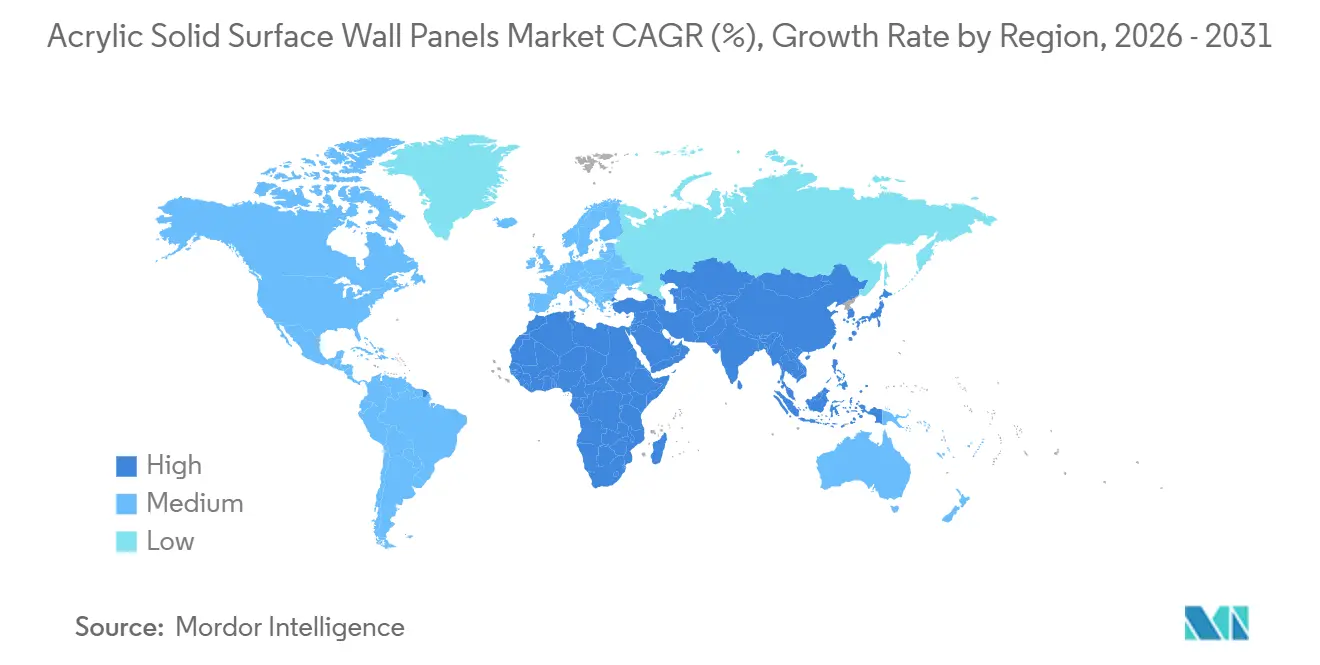
Asia-Pacific held 36.8% of the acrylic solid surface wall panels market share in 2025 and is forecast to grow at a 7.3% CAGR through 2031. China combines a large production capacity with domestic demand from hospitality and commercial interiors. Producers such as KingKonree and Durasein are developing translucent and zero-silica product options for export and local projects. India has a significant capacity expansion through Stylam’s Panchkula line, and its planned Stylam Industries has an acrylic solid surface capacity of about 300,000 panels a year. The company stated a planned investment of INR 320 crore, equivalent to USD 38 million, for the greenfield expansion. Vietnam, Thailand, and Indonesia are emerging demand centers where hospitality construction outpaces the supply of qualified fabricators. Japan and South Korea retain premium positions through HIMACS and Staron products, including mineral-based compositions aligned with evolving producer-responsibility expectations.
North America is forecast to grow at a 5.2% CAGR through 2031. Commercial retrofit, healthcare renovation, and multifamily refurbishment underpin demand in the region. LX Hausys operates 3 production lines across more than 293,000 square feet at Adairsville, Georgia, supporting domestic availability. Trinseo opened its North America Global Innovation Center in Exton, Pennsylvania, in November 2025. The 46,000-plus-square-foot facility includes testing laboratories and materials compounding lines, with Avonite featured as a demonstration material. Europe is forecast to grow at a 4.9% CAGR through 2031, with the UK, Germany, France, and BENELUX supported by commercial renovation. KRION, manufactured in Spain, is composed of two-thirds alumina trihydrate and one-third acrylic resin. GREENGUARD and EN 13501-1 remain important in specifications across North American and European commercial chains.
Western Asia, including the GCC and Levant, is forecast to grow at a 7.4% CAGR through 2031, making it the second-fastest regional area in the supplied analysis. Sub-Saharan Africa is forecast to grow at a 6.6% CAGR over the same period. Saudi Arabian hospitality, healthcare, airport, and mixed-use development support demand for high-specification wall surfaces. The UAE’s coastal conditions also favor materials selected for nonporous and chemically inert properties. Demand in Africa is concentrated in South Africa, Nigeria, and Egypt, where hotel chains and healthcare public-private partnership projects are key sources of activity. South America is forecast to grow at a 5.8% CAGR, led by project-driven hospitality and residential construction in Brazil and Peru. Oceania is forecast to grow at a 5.5% CAGR through healthcare, hospitality, and commercial washroom projects supported by an experienced contractor base.

Competitive Landscape
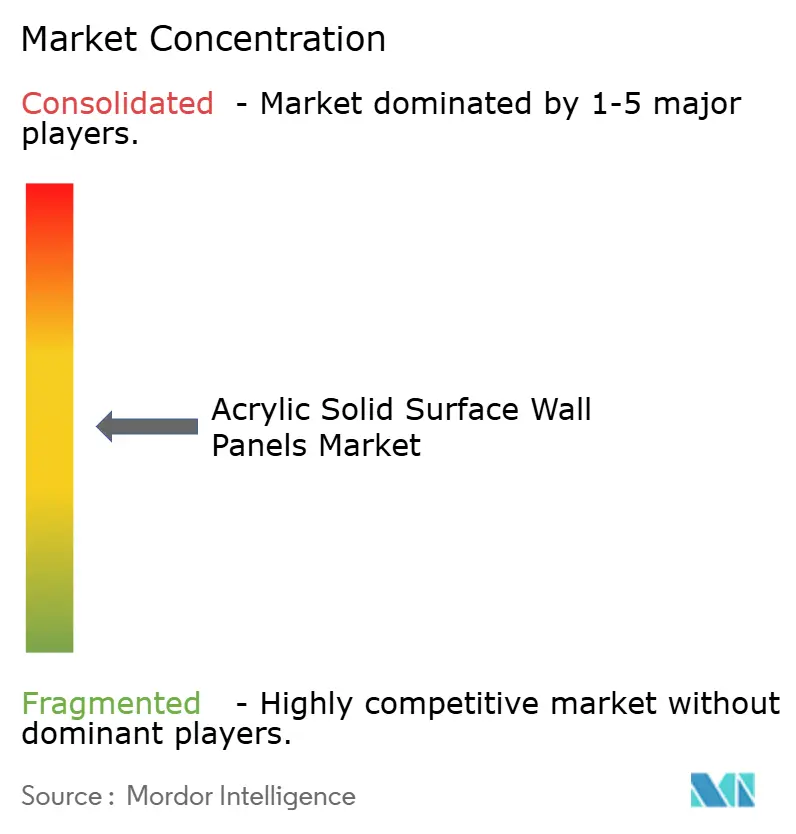
The acrylic solid surface wall panels market has moderate concentration, with DuPont, LX Hausys, LOTTE Chemical, Trinseo, and PORCELANOSA Grupo estimated to account for 45-55% of global revenue. A larger group of manufacturers in China, India, Korea, and Spain competes on pricing, lead times, and local fabricator support. Premium suppliers rely on brand recognition, thermoforming performance, and broad certification coverage. DuPont introduced its Nature in Motion collection in April 2026, adding 7 Corian designs for vertical and feature-wall applications. LX Hausys introduced 4 HIMACS colors and the BORTE premium panel system at KBIS 2026. These introductions help major brands remain visible to architects and specification teams.
Trinseo’s closure of virgin MMA production in Italy reflects a move toward downstream surfaces and supply-chain resilience. Its first-quarter 2026 results recorded the related shift in Engineered Materials volumes and sales. The company’s ATH supplier qualification initiative also addresses material continuity for Avonite products. Chinese and Indian suppliers are competing for mid-market commercial projects that previously favored Western brands. Stylam’s first Indian 100% acrylic line is a production capability move that supports this competition. Meganite’s AcryMed provides an antimicrobial option for healthcare projects seeking nonporous walls without the brand positioning of the largest suppliers.
Thermoforming process development is an important area of competition because tighter radii and shorter heating cycles support differentiated wall designs. Antimicrobial formulations using silver-ion or zinc-based mineral composites also remain a focus where suppliers seek defensible healthcare claims. Independent testing under ISO 22196 and compliance with REACH restrictions can affect supplier eligibility in regulated projects. The acrylic solid surface wall panels market rewards suppliers that can combine these documents with consistent fabrication guidance. Regional manufacturers remain relevant because they can offer shorter delivery times and local project support. However, international hotel and hospital groups may still favor brands with established color portfolios and certifications across several countries. This balance supports a moderate, rather than highly concentrated, competitive structure.
Acrylic Solid Surface Wall Panels Industry Leaders
DuPont de Nemours, Inc.
LX Hausys, Ltd.
LOTTE Chemical Corporation
Trinseo PLC
Wilsonart LLC
- *Disclaimer: Major Players sorted in no particular order

Recent Industry Developments
- April 2026: DuPont Corian Design introduced its 2026 Nature in Motion Color Collection, adding 7 new Corian Solid Surface aesthetics, including a new Travertine design aincluding a new Travertine aesthetic in two colors, two Vasto colors, and Artista Drift, Artista Mocha, and City Roast, targeting vertical surfaces, feature walls, healthcare, hospitality, and food-service environments.
- February 2026: PORCELANOSA Grupo presented Krion LUX technical solid surface, and the Undora cladding system, a lightweight, fire-resistant wall cladding installable without specialized tools, at the 32nd PORCELANOSA International Exhibition.


Global Acrylic Solid Surface Wall Panels Market Report Scope
| Pure Acrylic Solid Surface |
| Modified Acrylic / Acrylic-Polyester Blend Solid Surface |
| Other Acrylic-based Blends |
| Standard Solid Surface Wall Panels |
| Decorative / Patterned Wall Panels |
| Large-format Seamless Panels |
| 3D / Textured Panels |
| Others |
| Less then 6 mm |
| 6-8 mm |
| 9–12 mm |
| 13–20 mm |
| Above 20 mm |
| Residential |
| Commercial |
| Direct Sales |
| Indirect Sales |
| North America | Canada |
| United States | |
| Mexico | |
| South America | Brazil |
| Peru | |
| Chile | |
| Argentina | |
| Rest of South America | |
| Europe | United Kingdom |
| Germany | |
| France | |
| Spain | |
| Italy | |
| BENELUX (Belgium, Netherlands, Luxembourg) | |
| NORDICS (Denmark, Finland, Iceland, Norway, Sweden) | |
| Rest of Europe | |
| Asia-Pacific | India |
| China | |
| Japan | |
| Australia | |
| South Korea | |
| South-East Asia | |
| Rest of Asia-Pacific | |
| Middle East and Africa | United Arab Emirates |
| Saudi Arabia | |
| South Africa | |
| Nigeria | |
| Rest of Middle East and Africa |
| By Material Composition | Pure Acrylic Solid Surface | |
| Modified Acrylic / Acrylic-Polyester Blend Solid Surface | ||
| Other Acrylic-based Blends | ||
| By Product/Panel Format | Standard Solid Surface Wall Panels | |
| Decorative / Patterned Wall Panels | ||
| Large-format Seamless Panels | ||
| 3D / Textured Panels | ||
| Others | ||
| By Thickness | Less then 6 mm | |
| 6-8 mm | ||
| 9–12 mm | ||
| 13–20 mm | ||
| Above 20 mm | ||
| By End User | Residential | |
| Commercial | ||
| By Distribution Channel | Direct Sales | |
| Indirect Sales | ||
| By Geography | North America | Canada |
| United States | ||
| Mexico | ||
| South America | Brazil | |
| Peru | ||
| Chile | ||
| Argentina | ||
| Rest of South America | ||
| Europe | United Kingdom | |
| Germany | ||
| France | ||
| Spain | ||
| Italy | ||
| BENELUX (Belgium, Netherlands, Luxembourg) | ||
| NORDICS (Denmark, Finland, Iceland, Norway, Sweden) | ||
| Rest of Europe | ||
| Asia-Pacific | India | |
| China | ||
| Japan | ||
| Australia | ||
| South Korea | ||
| South-East Asia | ||
| Rest of Asia-Pacific | ||
| Middle East and Africa | United Arab Emirates | |
| Saudi Arabia | ||
| South Africa | ||
| Nigeria | ||
| Rest of Middle East and Africa | ||


Key Questions Answered in the Report
What is the projected value of the acrylic solid surface wall panels market by 2031?
It is forecast to reach USD 794.2 million by 2031, at a 5.4% CAGR from 2026.
Which region leads demand for acrylic solid surface wall panels?
Asia-Pacific held 36.8% of revenue in 2025 and is forecast to grow at a 7.3% CAGR.
Which end-user segment is the largest?
Commercial facilities held 75% of revenue in 2025, led by healthcare, hospitality, and institutional applications.
Which product format is growing fastest?
3D and textured panels are forecast to grow at a 7.8% CAGR through 2031.
What are the main challenges for suppliers?
High initial cost, MMA price volatility, limited fabricator capacity, and certification requirements constrain adoption.
Who are the leading manufacturers of acrylic solid surface wall panels?
DuPont, LX Hausys, LOTTE Chemical, Trinseo, and PORCELANOSA Grupo are the leading suppliers identified in the analysis.
Page last updated on:


 Your data is secure and never sold or shared.


