
Decorative Wall Panels Market Size and Share
Market Overview
| Study Period | 2020 - 2031 |
|---|---|
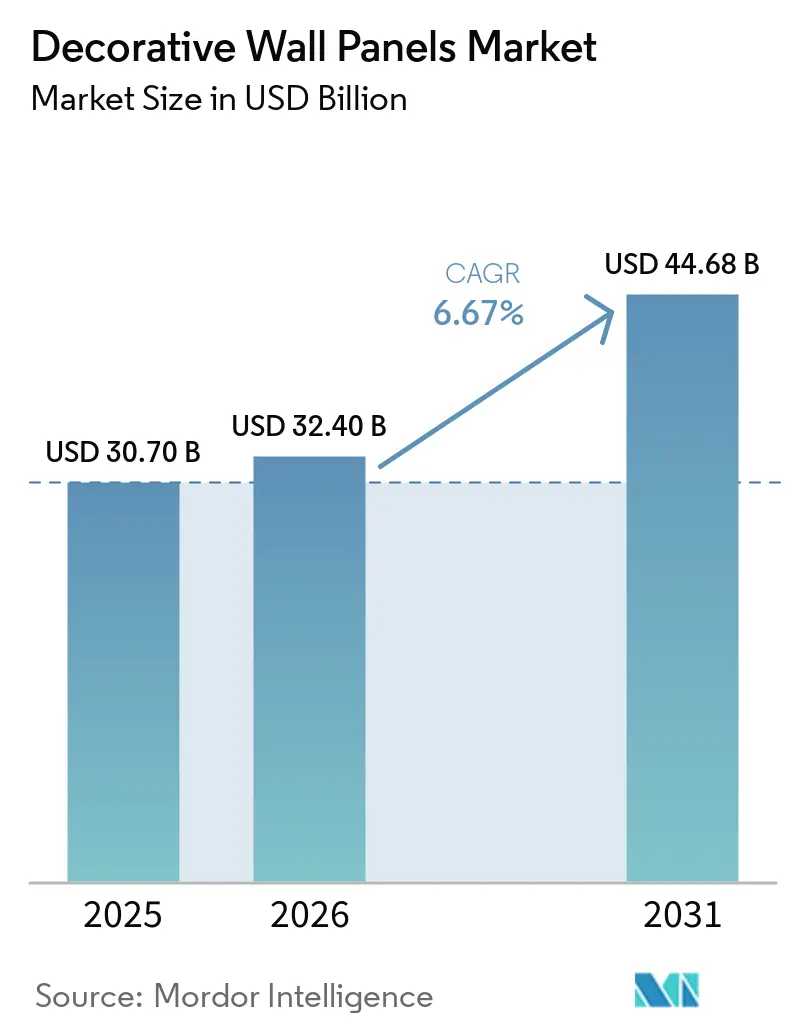
| Market Size (2026) | USD 32.40 Billion |
| Market Size (2031) | USD 44.68 Billion |
| Growth Rate (2026 - 2031) | 6.67 % |
| Fastest Growing Market | Asia-Pacific |
| Largest Market | Asia-Pacific |
| Market Concentration | Low |
Major Players *Disclaimer: Major Players sorted in no particular order Image © Mordor Intelligence. Reuse requires attribution under CC BY 4.0. | |
Decorative Wall Panels Market Analysis by Mordor Intelligence
The decorative wall panels market was valued at USD 30.70 billion in 2025, is estimated at USD 32.4 billion in 2026, and is forecast to reach USD 44.68 billion by 2031, growing at a 6.67% CAGR during 2026–2031. Renovation spending, commercial upgrades, and new construction support demand for finished wall systems that combine decorative and functional roles. Buyers increasingly consider acoustic control, moisture resistance, fire performance, and installation time when comparing interior finishes. Mature economies provide recurring renovation demand, while developing markets add new residential, hospitality, and commercial projects. Manufacturers are responding with certified materials, modular systems, digital surface options, and wider distribution coverage. Raw-material costs, installer availability, established alternatives, and end-of-life requirements remain important limits on adoption.
Key Report Takeaways
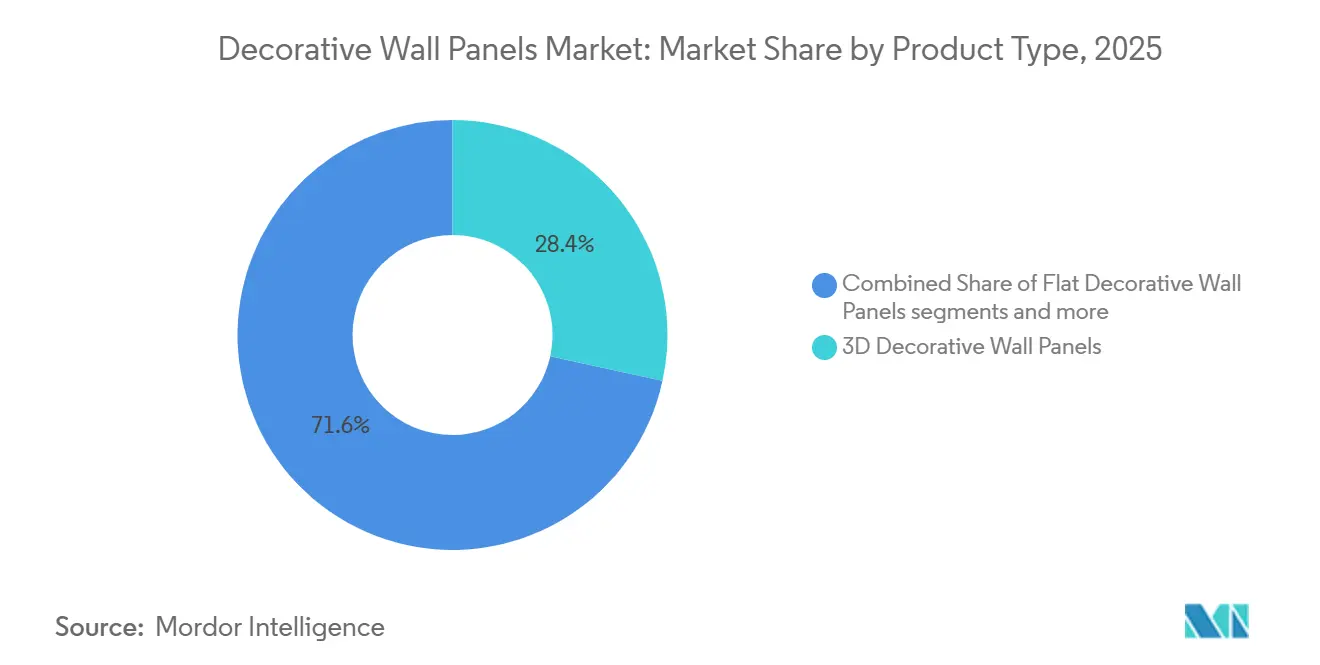
- 3D decorative wall panels accounted for the largest value share, at 28.42% in 2025, while slat wall panels are projected to grow at the fastest CAGR of 8.04% during 2026–2031.
- By material, wood-based panels held 32.2% of the decorative wall panels market share in 2025, while fabric-based panels are forecast to grow at a 7.9% CAGR through 2031.
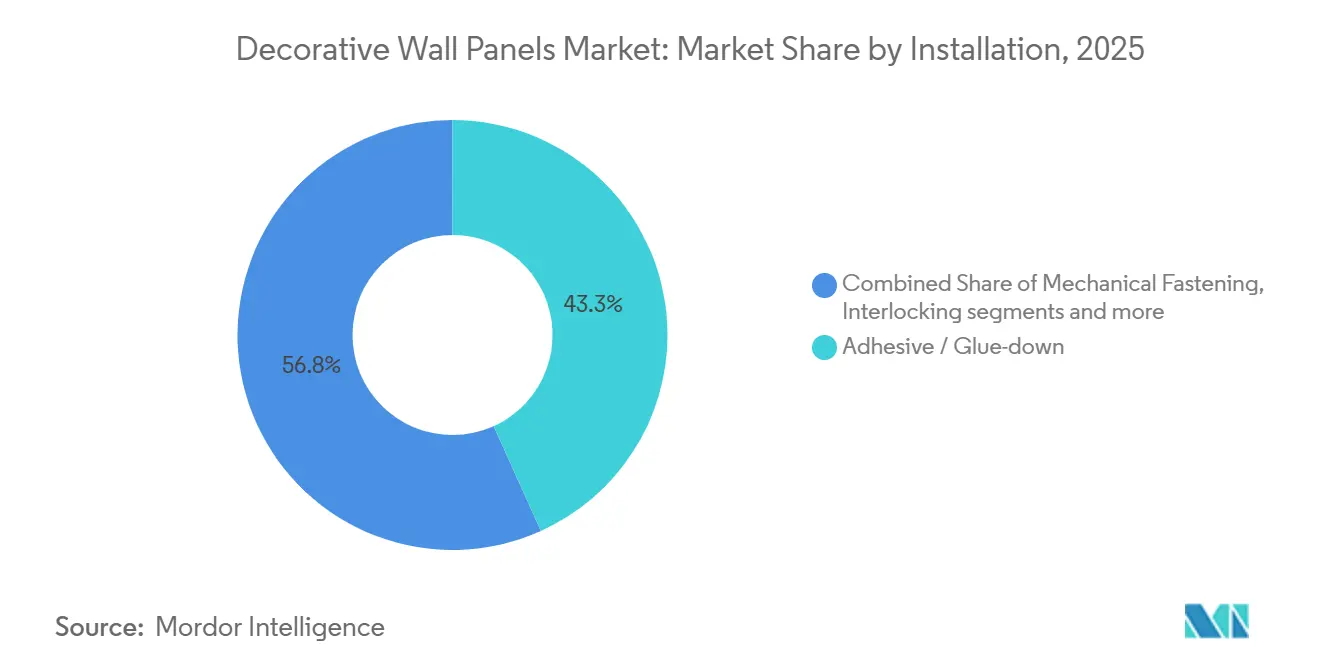
- By installation method, adhesive or glue-down methods held 43.3% share in 2025, while clip or rail systems are forecast to grow at a 7.8% CAGR through 2031.
- By format, sheet or board formats held 42.7% share in 2025, while slat formats are forecast to grow at an 8% CAGR through 2031.
- By end user, residential applications held 52.5% share in 2025, while commercial applications are forecast to grow at a 7.3% CAGR through 2031.
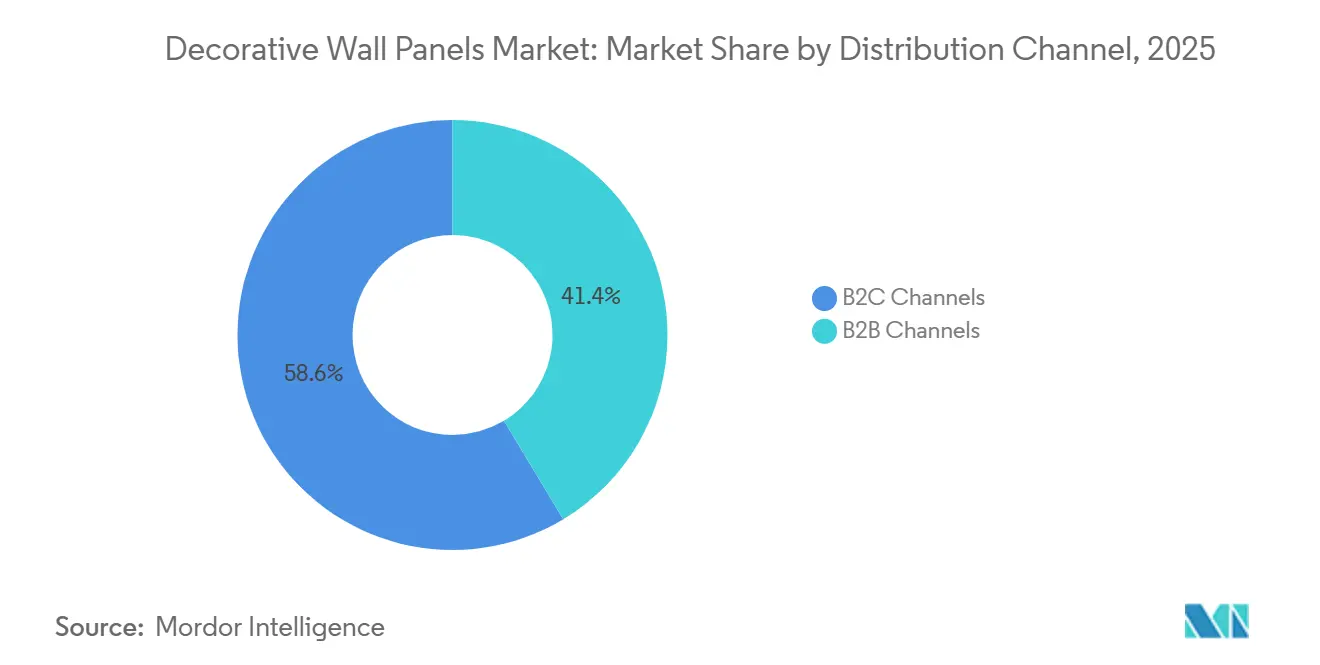
- By distribution channel, B2C channels held 58.6% share in 2025, while B2B channels are forecast to grow at a 7.2% CAGR through 2031.
- By geography, Asia-Pacific held 37.2% share in 2025 and is forecast to grow at a 7.8% CAGR through 2031.
Note: Market size and forecast figures in this report are generated using Mordor Intelligence’s proprietary estimation framework, updated with the latest available data and insights as of January 2026.
Global Decorative Wall Panels Market Trends and Insights
Drivers Impact Analysis*
| Driver | (~) % Impact on CAGR Forecast | Geographic Relevance | Impact Timeline |
|---|---|---|---|
| Residential Renovation and Remodeling Demand | +1.5% | Global, strongest in North America, Western Europe, and the Asia-Pacific core markets | Medium term (2-4 years) |
| Commercial Interior Modernization | +1.3% | Global, concentrated in North America, Europe, and GCC markets | Short term (≤ 2 years) |
| Rapid, Low-Disruption Installation Demand | +0.9% | Global, with spillover to the Middle East and Africa hospitality markets | Medium term (2-4 years) |
| Decorative Acoustic Applications | +1% | North America, Europe, and the Asia-Pacific commercial clusters | Medium term (2-4 years) |
| Digital Customization and Surface Printing | +0.8% | Global, with early gains in North America and Europe | Long term (≥ 4 years) |
| Circular, Traceable Material Design | +0.6% | Europe and North America, with early spillover to the Asia-Pacific | Long term (≥ 4 years) |
| Source: Mordor Intelligence | |||
Residential Renovation and Remodeling Demand
Aging housing stock supports a recurring need for interior surface upgrades across established economies. Homeowners replace finishes during renovation cycles even when new construction conditions are weaker. JCHS projects the US homeowner improvement and repair spending of USD 519 billion through mid-2027.[1]https://www.jchs.harvard.edu/. Statistics Finland reported EUR 5.2 billion in renovations of owner-occupied dwellings and one- and two-dwelling houses in 2025, up 14.7%.[2]https://www.stat.fi/. These spending patterns support the decorative wall panels market demand from projects that are less directly tied to developer financing. Dry-fit, adhesive-backed, and interlocking products also make panel installation accessible to more renovation and do-it-yourself buyers.
Commercial Interior Modernization
Hotels, offices, healthcare facilities, and retailers continue to update interiors to meet changing design and performance needs. These projects can favor panel systems that limit room closures and reduce work at the site. Commercial buyers often need documented fire performance and low-emission materials before products are specified. This requirement gives established manufacturers an advantage, where they can provide complete product records and technical support. The decorative wall panels market also benefits when hospitality refurbishment programs seek clean installation methods with predictable project schedules. Premium commercial projects can support more specialized acoustic, moisture-resistant, and surface-finish options.
Demand for Rapid and Low-Disruption Installation
Project owners place value on wall systems that can be installed without extensive wet trades. Fast installation can reduce disruption in occupied homes, hotels, shops, schools, and offices. Adhesive-backed, click-in, and modular products can simplify work compared with some traditional surface treatments. The benefit is important where labor availability is limited or where rooms must return to use quickly. Demountable systems also make later refurbishment easier because they can reduce damage to the underlying wall. This preference supports decorative wall panels market opportunities for suppliers that combine simple installation with verified product performance.
Expansion of Decorative Acoustic Applications
Acoustic control has become more relevant in offices, hospitality settings, educational buildings, and premium homes. WELL Building Standard v2 includes acoustic requirements for certified projects, and wall-mounted panels can help meet room performance goals[3]https://v2.wellcertified.com/en/wellv2/sound. Specifications increasingly seek visual finishes alongside tested sound absorption, rather than treating acoustics as a separate addition. Fabric-wrapped, PET felt, and mineral wool systems can therefore command higher prices when their documentation meets project requirements. Kronospan presented KronoOriginal Acoustic Wall Panels at DOMOTEX 2026 as an integrated interior finishing system[4]https://kronospan.com/en_US/company/news/view/kronospan-at-domotex-2026-wrapping-interiors-from-floors-to-walls-126. This direction supports the decorative wall panels market, where performance and appearance are purchased together.
Restraints Impact Analysis*
| Restraint | (~) % Impact on CAGR Forecast | Geographic Relevance | Impact Timeline |
|---|---|---|---|
| Competition From Paint, Wallpaper, Tiles, And Textured Finishes | -1.2% | Global, especially value residential segments in rural North America, South America, and South and Southeast Asia | Medium term (2-4 years) |
| PVC, Wood Fiber, Resin, Metal, And Adhesive Cost Volatility | -0.9% | Global, strongest for Asia-Pacific and European producers, with spillover to Middle East and Africa importers | Short term (≤ 2 years) |
| Limited End-Of-Life Separation For Multilayer Panels | -0.6% | Europe, with emerging relevance in North America and the Asia-Pacific | Long term (≥ 4 years) |
| Fragmented Installer Capability For Certified Panels | -0.7% | Global, particularly the Middle East and Africa, and South America, with effects in North America | Medium term (2-4 years) |
| Source: Mordor Intelligence | |||
Competition from Paint, Wallpaper, Tiles, and Textured Finishes
Paint remains a widely used wall finish because it requires little specialist installation and has a lower installation cost. Textured paint and digital visualization tools can narrow the visible difference between paint and panel applications. Wallpaper is also competing for accent-wall projects, particularly among renters who value removable formats. Tile remains well established in kitchens and wet rooms, where durability and moisture resistance matter. Newer polymer panel products address some of these needs but have not fully displaced tiles in premium bathrooms. The decorative wall panels market faces its strongest substitution pressure in entry-level residential projects and price-sensitive locations.
Volatility in PVC, Wood Fiber, Resins, Metals, and Adhesive Costs
Material-cost changes can compress margins across polymer, wood, metal, and composite panel categories. PVC, resins, waxes, metals, and adhesives are exposed to supply conditions that do not always match demand for finished panels. Wood-based producers are particularly exposed because resin and wax are meaningful parts of variable production costs. Larger producers can use supply contracts, integrated fiber operations, and broader purchasing programs to reduce some exposure. Smaller manufacturers may have less ability to absorb cost increases or pass them through quickly. This cost pressure can slow product development and make price competition harder in the decorative wall panels market.
*Our forecasts treat driver/restraint impacts as directional, not additive. The impact forecasts reflect baseline growth, mix effects, and variable interactions.
Segment Analysis
By Product Type: 3D Panels Lead Current Demand While Slat Panels Grow Fastest
3D decorative wall panels accounted for 28.4% of the decorative wall panels market size in 2025. Their lead reflects demand for dimensional surfaces in residential renovations and commercial interiors. These products can provide visual depth without major architectural work. Slat wall panels are expected to grow at an 8% CAGR through 2031. Natural wood finishes, felt-backed products, and vertical layouts support their use in living rooms, home offices, and bedrooms. Slat designs also offer acoustic diffusion benefits that extend their relevance beyond appearance.
Flat decorative and textured panels continue to serve budget and mid-range projects that need broad surface coverage. They are often selected where installation simplicity and cost control matter more than a highly textured finish. Acoustic decorative panels are gaining use in offices, hospitality lobbies, and educational settings with specific sound requirements. Modular custom configurations have a smaller role in healthcare and high-specification corporate interiors. These formats can support branding, hygiene requirements, and customized layouts. The decorative wall panels industry is also seeing broader interest in warm woodgrain and solid-color surfaces across product types.



By Material: Wood Holds the Largest Share While Fabric Products Advance in Commercial Projects
Wood-based panels held 32.2% of the decorative wall panels market share in 2025. Natural textures and the flexibility of MDF and veneer-based products support their position. Wood products also fit the demand for materials that appear warm and familiar in home and commercial interiors. Fabric-based panels are projected to grow at a 7.9% CAGR through 2031. Their use is linked to acoustic projects that require sound absorption with a finished decorative surface. Certified chain-of-custody systems can also support wood-panel selection in commercial and public projects.
Polymer-based panels include PVC, SPC, and WPC products that are valued for moisture resistance and easy maintenance. These products are used in hospitality and healthcare settings where cleaning and fire-rated formulations may be important. Metal panels are used in high-design residential and retail applications that need durable and printable surfaces. Gypsum-based panels serve budget and mid-range uses in both residential and commercial settings. Glass and mineral-based panels remain specialized choices for partitions and premium feature walls. The decorative wall panels market, therefore, covers materials selected for different combinations of appearance, durability, and project performance.
By Installation: Adhesive Methods Hold the Largest Share, While Clip and Rail Systems Expand
Adhesive or glue-down methods held 43.3% of the decorative wall panels market share in 2025. These methods need limited tooling and can work across a broad range of substrates. Their accessibility also fits do-it-yourself renovation projects and smaller residential installations. Clip or rail systems are forecast to grow at a 7.8% CAGR through 2031. Corporate tenants and other commercial users value systems that can be removed and reinstalled. Unilin’s Clicwall system is certified Cradle to Cradle Full Scope Bronze V4.0 and is verified for up to 10 reinstallations.
Mechanical fastening is used where adhesive bonding is unsuitable, including some fire-rated, exterior-grade, and high-humidity applications. Such systems can be appropriate when long service life and secure fixing are primary requirements. Interlocking formats offer a clean surface without exposed rails and can suit residential feature walls. They combine a relatively simple installation with panel-to-panel joining. Documented fixing-system performance matters more in commercial specifications where moisture control and technical sign-off are required. These needs create room for installation suppliers that can offer both hardware and supporting product documentation.
By Format: Sheet and Board Products Lead Large-Area Coverage, While Slat Formats Gain Interest
Sheet or board formats held 42.7% of decorative wall panels market size in 2025. Their position reflects use in large commercial walls, partitions, and laminated interior substrates. Standard and larger panel dimensions support more continuous surfaces in offices, retail spaces, and healthcare projects. Slat formats are expected to grow at an 8% CAGR through 2031. Their vertical lines, natural surface options, and sound-diffusion role fit current residential design preferences. The format can meet decorative and acoustic needs within the same installation.
Tile and plank formats are often used in residential projects where homeowners can complete sequential installation. Roll formats serve a smaller group of flexible decorative applications for curved or irregular walls. Modular and custom configurations are used in premium hospitality and healthcare interiors that require specific dimensions and finishes. Digital printing can make project-specific surface designs available without relying on large production runs. This development can lower the difference in cost between customized and standard panel formats. The decorative wall panels market can therefore address both repeated large-area installations and individual design-led projects.
By End User: Residential Applications Hold the Larger Base While Commercial Demand Grows Faster
Residential applications accounted for 52.5% of the decorative wall panels market share in 2025. Home renovation activity in North America and Europe, and new residential construction in the Asia-Pacific and the Middle East, support this base. Accent walls, kitchen backsplashes, and bedroom headboards contribute to many small and medium projects. Commercial applications are forecast to grow at a 7.3% CAGR through 2031. Offices, hospitality locations, healthcare facilities, and schools can require acoustic, fire-rated, and low-emission products. These requirements can increase the value of each commercial specification.
Commercial products can influence residential demand when architects and designers adapt successful finishes for homes. Slat, 3D, and fabric-wrapped options have moved from specialized projects into more visible residential settings. Distributors are responding by giving premium wood, slat, and acoustic products more dedicated display space. Residential buyers still represent a broad volume base because demand is distributed across many individual projects. Commercial work is more concentrated but can carry greater documentation and technical requirements. This balance shapes product design and channel strategy across the decorative wall panels industry.
By Distribution Channel: B2C Channels Lead Revenue While B2B Channels Grow Faster
B2C channels held 58.6% of the decorative wall panels market share in 2025. Their position reflects the weight of residential renovation and do-it-yourself purchasing. Home-improvement chains, specialty retailers, online stores, and local hardware sellers all serve consumer buyers. B2B channels are projected to grow at a 7.2% CAGR through 2031. Contractors, architects, designers, and institutional buyers influence product choice for commercial projects. Their decisions often depend on environmental declarations, fire tests, and material traceability records.
Online channels are expanding as producers use visualization tools and sample-delivery programs. These services help consumers assess finishes before purchasing material that is usually judged by touch and appearance. Home-improvement chains continue to sell large B2C volumes, especially for adhesive-backed and click-in products. Local hardware stores remain important in emerging markets where lower-cost local products compete with imported panels. B2B demand may gain modestly through 2031 as commercial renovation activity rises in several key regions. Suppliers that maintain both consumer availability and specification support can serve the full decorative wall panels market. Consumer channels require visual tools, samples, and products that can be selected with limited technical advice.
Geography Analysis
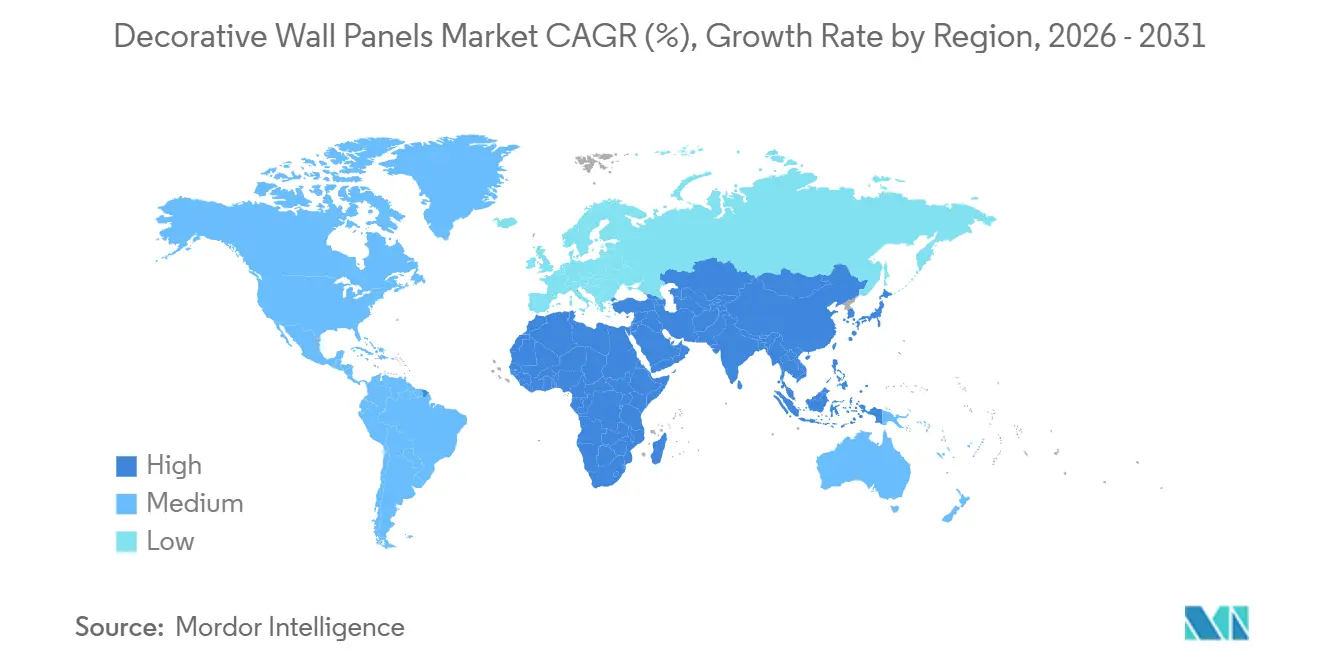
Asia-Pacific held 37.2% of the decorative wall panels market share in 2025 and is forecast to grow at a 7.8% CAGR through 2031. China and India are major sources of regional demand from residential and commercial building activity. Southeast Asia also combines new hospitality and commercial construction with growing manufacturing capacity. Global producers view local production and distribution as important for serving this region. India’s fire-rated interior-product requirements add weight to quality systems and product documentation. These factors support Asia-Pacific’s leading position in the decorative wall panels market.
North America and Europe have more mature volumes but support higher-value demand from renovation and certified building projects. JCHS projects US homeowner improvement and repair spending of USD 519 billion through mid-2027. Aging housing stock and home equity supported demand for mid-range and premium interior finishes. European buyers also place growing emphasis on material traceability and environmental documentation. Germany, France, the United Kingdom, and Nordic countries support renovation activity and interest in sustainable materials. Canada adds demand from commercial projects with green-building requirements.
South America has a smaller share of global revenue, with Brazil supporting mid-tier residential and retail construction demand. Material supply constraints and installer gaps can limit the conversion of potential demand in some markets. The Middle East and Africa demand is supported by Gulf construction programs in hospitality, institutional buildings, and luxury housing. Saudi Vision 2030 is reshaping material requirements toward sustainable building standards in relevant projects. South Africa and Nigeria are active African demand centers, although supply chains and installer capability remain constraints. Together, these regions provide developing opportunities for decorative wall panels market suppliers that can adapt products and channels to local conditions.

Competitive Landscape
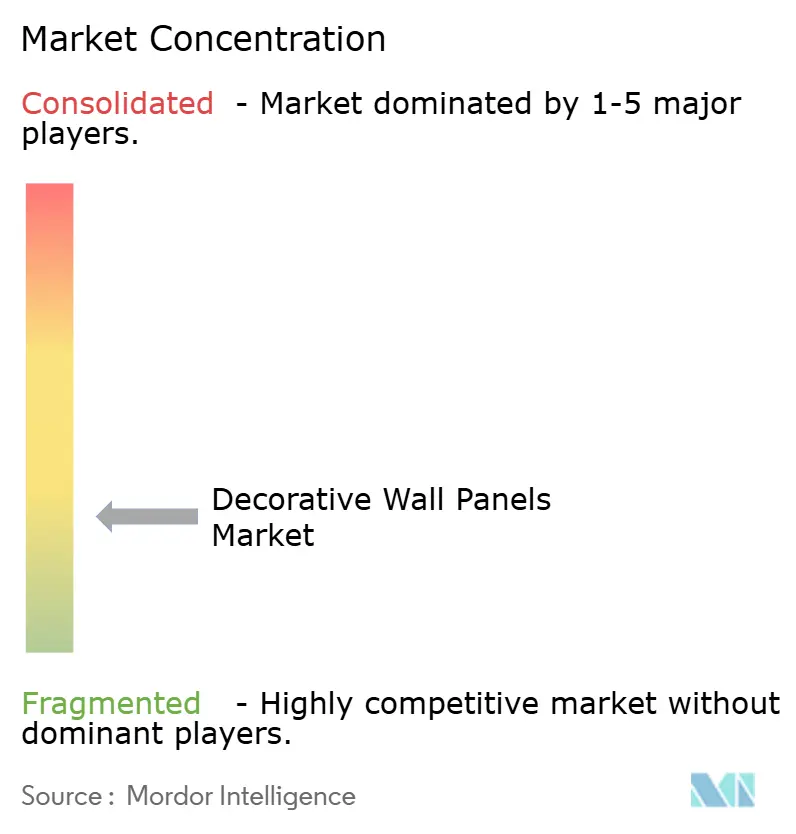
The decorative wall panels market is fragmented, and the top 5 manufacturers accounted for 28% to 32% of global revenue. No company has a dominant position across every product category, material, and geography. Competitive outcomes are often decided by regional coverage or the requirements of a particular application. Large building-materials producers compete through certifications, investment capacity, distribution networks, and technical documentation.
Design-led specialists compete through custom surfaces, acoustic performance, and a faster response to specific project requirements. Kronospan presented KronoOriginal Acoustic Wall Panels at DOMOTEX 2026 as a coordinated wall and flooring interior system. Unilin supports demountable commercial use through Clicwall, which is verified for repeated reinstallation and carries a Cradle to Cradle certification. Roland DG released the DIMENSE DA-640 in June 2025 for dimensional surface printing with up to 2 mm texture depth. These moves show how acoustic systems, reusable installation, and customized finishes can differentiate suppliers.
Opportunities remain in demountable systems that reduce demolition waste at the end of a lease. Healthcare-grade panels with antimicrobial coatings and verified low-emission formulations also remain a specialized area. Digital printing allows mid-sized fabricators to offer custom surfaces in project-specific volumes. Environmental Product Declarations and chemical compliance requirements can affect eligibility for European commercial projects. Suppliers without third-party material records can face exclusion from green-building specifications. The competitive landscape will continue to reward firms that can combine product performance, attractive finishes, reliable installation, and clear documentation.
Decorative Wall Panels Industry Leaders
Saint-Gobain S.A.
Armstrong World Industries, Inc.
USG Corporation
Knauf Group
Kingspan Group plc
- *Disclaimer: Major Players sorted in no particular order

Recent Industry Developments
- January 2026: Kronospan presented KronoOriginal Acoustic Wall Panels at DOMOTEX 2026, positioning its acoustic wall panel line as an integrated interior finishing system, available alongside coordinated flooring, addressing the growing demand for soundproofing quality in residential and commercial spaces.
- June 2025: Roland DG Corporation released the DIMENSE DA-640 wide-format dimensional surface printer, enabling on-demand production of full-color embossed decorative surfaces with up to 2 mm texture depth on PVC-free, GREENGUARD Gold-certified media, targeting print service providers, architects, and designers serving commercial, hospitality, and residential interiors.


Global Decorative Wall Panels Market Report Scope
| 3D Decorative Wall Panels |
| Flat Decorative Wall Panels |
| Textured Wall Panels |
| Slat Wall Panels |
| Acoustic Decorative Wall Panels |
| Other Product Types |
| Wood-Based Panels |
| Polymer-Based Panels |
| Metal Panels |
| Gypsum-Based Panels |
| Mineral-Based Panels |
| Fabric-Based Panels |
| Glass Panels |
| Other Materials |
| Adhesive / Glue-down |
| Mechanical Fastening |
| Clip / Rail System |
| Interlocking |
| Other Methods |
| Sheet/Board |
| Tile/Plank |
| Roll |
| Slats |
| Modular/Custom |
| Residential |
| Commercial |
| B2C Channels | Hypermarkets and Supermarkets |
| Specialty Stores | |
| Home Improvement Stores/DIY Chains | |
| Online | |
| Local Hardware Shops | |
| Other Distribution Channels | |
| B2B Channels (Contractors and Installers, Interior Designers and Architects, Project Procurement and Institutional Sales) |
| North America | Canada |
| United States | |
| Mexico | |
| South America | Brazil |
| Peru | |
| Chile | |
| Argentina | |
| Rest of South America | |
| Europe | United Kingdom |
| Germany | |
| France | |
| Spain | |
| Italy | |
| BENELUX (Belgium, Netherlands, Luxembourg) | |
| NORDICS (Denmark, Finland, Iceland, Norway, Sweden) | |
| Rest of Europe | |
| Asia-Pacific | India |
| China | |
| Japan | |
| Australia | |
| South Korea | |
| South-East Asia | |
| Rest of Asia-Pacific | |
| Middle East and Africa | United Arab Emirates |
| Saudi Arabia | |
| South Africa | |
| Nigeria | |
| Rest of Middle East and Africa |
| By Product Type | 3D Decorative Wall Panels | |
| Flat Decorative Wall Panels | ||
| Textured Wall Panels | ||
| Slat Wall Panels | ||
| Acoustic Decorative Wall Panels | ||
| Other Product Types | ||
| By Material | Wood-Based Panels | |
| Polymer-Based Panels | ||
| Metal Panels | ||
| Gypsum-Based Panels | ||
| Mineral-Based Panels | ||
| Fabric-Based Panels | ||
| Glass Panels | ||
| Other Materials | ||
| By Installation | Adhesive / Glue-down | |
| Mechanical Fastening | ||
| Clip / Rail System | ||
| Interlocking | ||
| Other Methods | ||
| By Format | Sheet/Board | |
| Tile/Plank | ||
| Roll | ||
| Slats | ||
| Modular/Custom | ||
| By End User | Residential | |
| Commercial | ||
| By Distribution Channel | B2C Channels | Hypermarkets and Supermarkets |
| Specialty Stores | ||
| Home Improvement Stores/DIY Chains | ||
| Online | ||
| Local Hardware Shops | ||
| Other Distribution Channels | ||
| B2B Channels (Contractors and Installers, Interior Designers and Architects, Project Procurement and Institutional Sales) | ||
| By Geography | North America | Canada |
| United States | ||
| Mexico | ||
| South America | Brazil | |
| Peru | ||
| Chile | ||
| Argentina | ||
| Rest of South America | ||
| Europe | United Kingdom | |
| Germany | ||
| France | ||
| Spain | ||
| Italy | ||
| BENELUX (Belgium, Netherlands, Luxembourg) | ||
| NORDICS (Denmark, Finland, Iceland, Norway, Sweden) | ||
| Rest of Europe | ||
| Asia-Pacific | India | |
| China | ||
| Japan | ||
| Australia | ||
| South Korea | ||
| South-East Asia | ||
| Rest of Asia-Pacific | ||
| Middle East and Africa | United Arab Emirates | |
| Saudi Arabia | ||
| South Africa | ||
| Nigeria | ||
| Rest of Middle East and Africa | ||


Key Questions Answered in the Report
What is the forecast for decorative wall panels through 2031?
The category is projected to grow from USD 32.4 billion in 2026 to USD 44.7 billion by 2031, at a 6.7% CAGR.
Which decorative wall panel product type is growing fastest?
Slat wall panels are forecast to grow at an 8% CAGR through 2031, supported by decorative and acoustic uses.
Which material leads to decorative wall panel demand?
Wood-based panels held 32.2% share in 2025, while fabric-based panels are the fastest-growing material category at a 7.9% CAGR.
Why are acoustic wall panels gaining use?
Commercial projects increasingly need acoustic performance alongside finished interior surfaces, especially in offices, hospitality, and education.
Which region leads demand for decorative wall panels?
Asia-Pacific held 37.2% share in 2025 and is forecast to grow at a 7.8% CAGR through 2031.
Page last updated on:


 Your data is secure and never sold or shared.


