
Market Overview
| Study Period | 2021 - 2031 |
|---|---|
| Market Size (2026) | USD 186.95 Billion |
| Market Size (2031) | USD 306.79 Billion |
| Growth Rate (2026 - 2031) | 10.41 % |
| Fastest Growing Market | Asia Pacific |
| Largest Market | Asia Pacific |
| Market Concentration | Medium |
Major Players *Disclaimer: Major Players sorted in no particular order Image © Mordor Intelligence. Reuse requires attribution under CC BY 4.0. | |
Wind Turbine Market Analysis by Mordor Intelligence
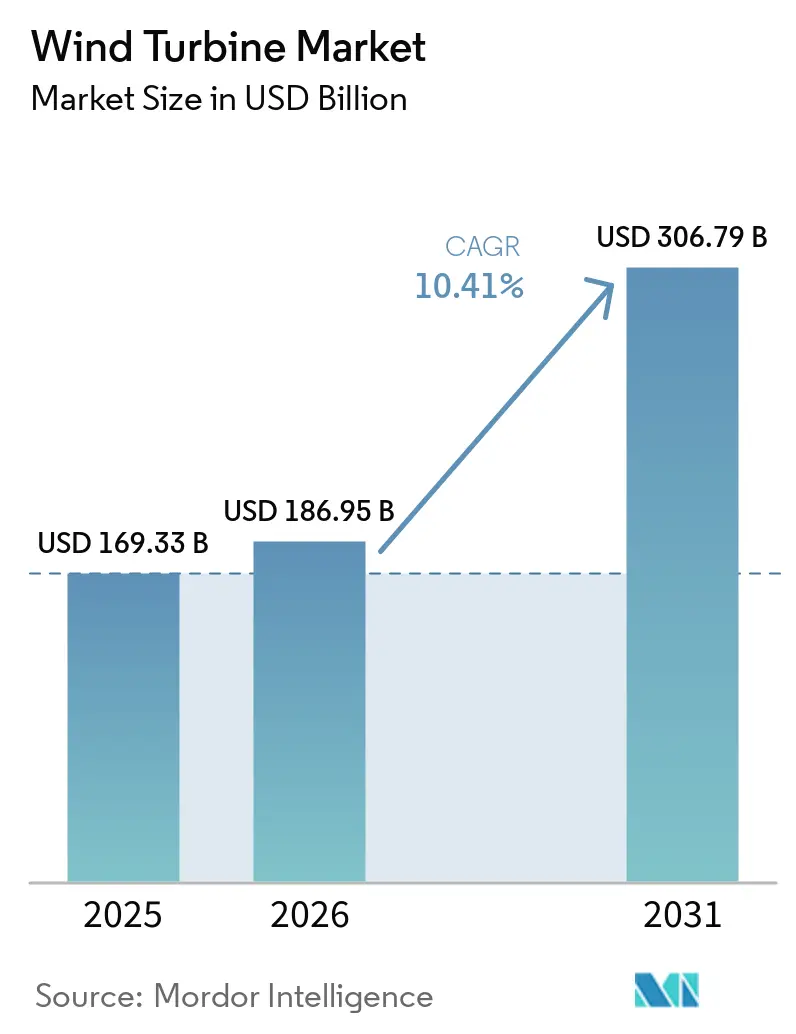
The Wind Turbine Market size was valued at USD 169.33 billion in 2025 and estimated to grow from USD 186.95 billion in 2026 to reach USD 306.79 billion by 2031, at a CAGR of 10.41% during the forecast period (2026-2031).
Growth is anchored in aggressive national renewable-energy mandates, steep LCOE declines for both onshore and offshore projects, and a steady shift toward turbines rated at 15 MW or higher that lift site energy density. Developers are also benefiting from wider access to green-bond financing, policy-driven demand for green hydrogen, and AI-enabled maintenance platforms that cut downtime by 35%. While onshore installations remain dominant, commercial-scale offshore installations, especially floating concepts, attract the fastest capital flows. The Asia Pacific supplies nearly half of the global market value, but the Middle East and Africa region is closing the gap, driven by record-low auction tariffs and multi-gigawatt build-outs.
Key Report Takeaways
- By location of deployment, onshore projects accounted for 91.83% of 2025 revenue, while offshore installations are forecast to expand at a 18.95% CAGR through 2031.
- By capacity rating, large 1–5 MW machines held 45.85% of the wind turbine market share in 2025, and very large units above 5 MW are projected to rise at a 14.05% CAGR to 2031.
- By axis type, horizontal turbines captured 96.12% of the wind turbine market size in 2025, whereas vertical designs are advancing at a 12.55% CAGR over the outlook period.
- By component, rotor blades led with a 29.84% share of the 2025 value pool; power electronics and control packages are expected to post a 12.78% CAGR through 2031.
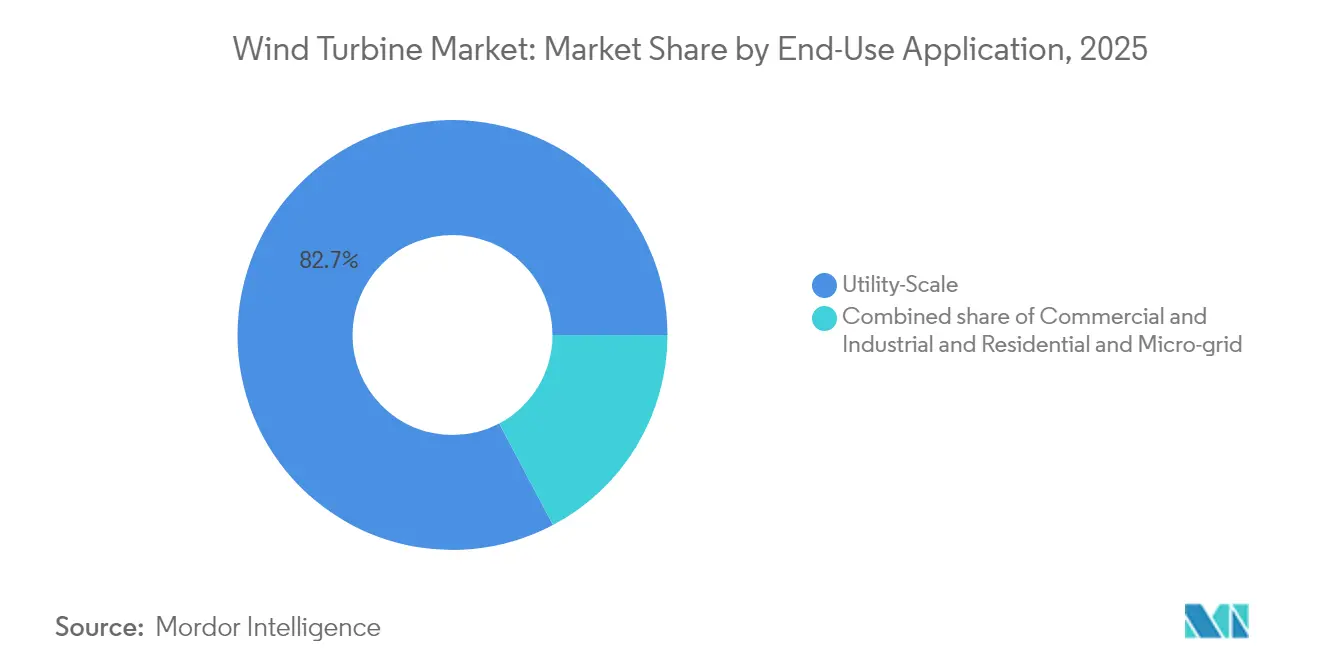
- By end-use application, utility-scale parks held 82.74% of 2025 revenue, while commercial & industrial systems are on track for a 15.05% CAGR to 2031.
- By geography, the Asia Pacific remained the largest contributor, with a 47.90% share in 2025, and the Middle East and Africa region is anticipated to log the fastest growth pace of 50.8% from 2026 to 2031.
Note: Market size and forecast figures in this report are generated using Mordor Intelligence’s proprietary estimation framework, updated with the latest available data and insights as of 2026.
Market Trends and Insights
Drivers Impact Analysis of Wind Turbine Market*
| Driver | (~) % Impact on CAGR Forecast | Geographic Relevance | Impact Timeline |
|---|---|---|---|
| Escalating national renewable-energy targets | 2.8% | Global, with EU leading at 42.5% by 2030 | Medium term (2-4 years) |
| Rapid fall in onshore & offshore LCOE | 2.1% | Global, particularly Asia Pacific and Middle East | Short term (≤ 2 years) |
| Utility appetite for ≥15 MW turbines | 1.5% | North America, Europe, Asia Pacific offshore | Medium term (2-4 years) |
| Favourable green-hydrogen linkage policies | 1.0% | EU, Australia, Middle East hydrogen hubs | Long term (≥ 4 years) |
| Floating-wind bankability milestones | 1.9% | Europe, Asia Pacific, emerging in Americas | Long term (≥ 4 years) |
| AI-enabled predictive-maintenance savings | 0.8% | Global, concentrated in developed markets | Short term (≤ 2 years) |
| Source: Mordor Intelligence | |||
Escalating National Renewable-Energy Targets Drive Unprecedented Policy Support
The European Union now mandates 42.5% renewable electricity by 2030, while Spain aims for 81% and Greece sets comparable goals.[1]European Commission, “Renewable Energy Targets,” ec.europa.eu India added 3.4 GW of wind capacity in 2024 as part of its goal to reach 500 GW of non-fossil energy.[2]Ministry of New and Renewable Energy, “India Adds 3.4 GW Wind Capacity in 2024,” mnre.gov.in The United Kingdom’s Clean Power 2030 mission seeks 95% low-carbon generation, removing prior onshore wind curbs. These frameworks guarantee revenue via feed-in tariffs, certificates, and competitive auctions, thereby accelerating the wind turbine market. Long-term policy certainty also fosters domestic manufacturing and the localization of supply chains.
Rapid LCOE Decline Transforms Wind Energy Economics
Saudi Arabia’s latest tender cleared at USD 15/MWh, underlining how far onshore costs have fallen. Offshore trajectories are similar; floating wind is projected to reach 40 EUR/MWh by 2050 as rotors exceeding 180 m become standard. The average turbine rating reached 5,500 kW in 2024, resulting in reduced balance-of-plant expenses.[3]Global Wind Energy Council, “Global Wind Report 2025,” gwec.net Serial wind turbine foundation fabrication, modular substations, and green-bond financing further compress unit costs. These trends entrench wind’s competitiveness against fossil and solar-plus-storage alternatives.
Utility Appetite for Mega-Turbines Reshapes Market Dynamics
Developers are increasingly specifying machines with capacities of≥15 MW, such as Siemens Gamesa’s 21 MW prototype and China’s first commercial 18 MW installation. Larger rotors harvest stronger winds aloft and reduce turbine counts, cutting O&M visits and crane mobilizations. Ports and jack-up vessels are upgrading to handle wind turbine nacelle units weighing over 500 tons, which opens up new revenue streams for logistics suppliers. This tilt toward mega-platforms raises the average capacity factor and enlarges the wind turbine market.
Green Hydrogen Integration Creates New Revenue Streams
The EU's Renewable Energy Directive now embeds hydrogen sub-targets, pushing developers to co-locate electrolysers with wind farms. Offshore North Sea projects plan direct-to-hydrogen export pipes to bypass grid bottlenecks, while Australia's Pilbara hub eyes similar models.[4]Policy Exchange, “Turning Wasted Wind into Hydrogen,” policyexchange.org.uk These schemes monetize surplus generation and hedge against price cannibalization, thereby deepening project bankability and broadening the wind turbine industry's footprint.
Restraints Impact Analysis of Wind Turbine Market*
| Restraint | (~) % Impact on CAGR Forecast | Geographic Relevance | Impact Timeline |
|---|---|---|---|
| Grid-connection queue bottlenecks | -1.2% | North America, Europe, Australia | Medium term (2-4 years) |
| Competition from utility-scale solar-plus-storage | -0.9% | Global, particularly sunny regions | Short term (≤ 2 years) |
| Rare-earth magnet supply security | -0.5% | Global, China dependency risk | Long term (≥ 4 years) |
| End-of-life blade-recycling costs | -0.4% | Europe, North America early adopters | Long term (≥ 4 years) |
| Source: Mordor Intelligence | |||
Grid Connection Bottlenecks Constrain Market Growth
U.S. interconnection queues swelled to 2,600 GW, and the UK faces 14-year wait times, which delay commissioning and inflate carrying costs.[5]Federal Energy Regulatory Commission, “Interconnection Queue Analysis,” ferc.gov Germany curtailed 9% of North Sea output in 2024 due to congestion. Although reforms, such as FERC Order 2023, aim to streamline approvals, transmission upgrades still lag behind wind build schedules, capping near-term additions.
Solar-Plus-Storage Competition Intensifies Market Dynamics
Utility solar secured 70% of new capacity in sun-rich regions, and the DOE expects battery costs to fall toward USD 0.05/kWh for long-duration storage.[6]U.S. Department of Energy, “Long-Duration Storage Roadmap,” energy.gov Dispatchable solar can undercut wind in peak-price hours, thereby forcing wind bids to lower levels. Hybrid layouts that pair wind with solar and storage can mitigate this risk; however, price competition remains a headwind for the wind turbine market.
*Our forecasts treat driver/restraint impacts as directional, not additive. The impact forecasts reflect baseline growth, mix effects, and variable interactions.
Wind Turbine Market Segment Analysis
By Location of Deployment:
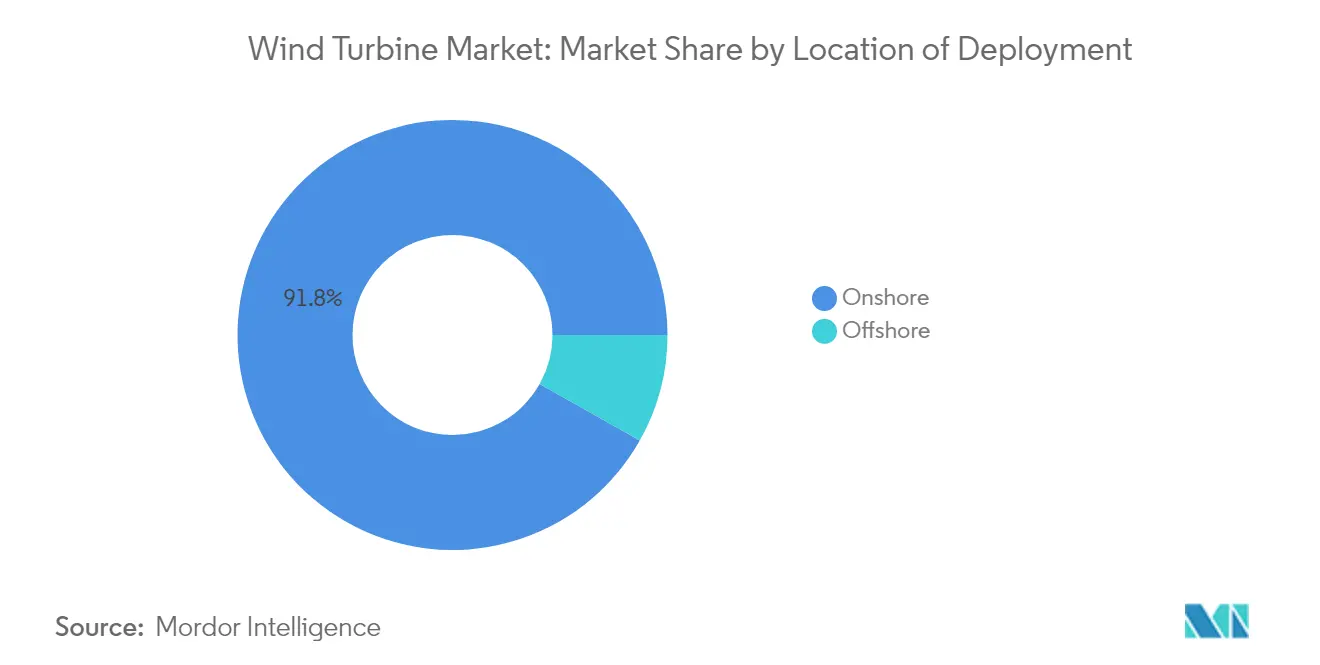
Offshore Acceleration Despite Onshore DominanceOnshore facilities continued to account for 91.83% of 2025 revenue, supported by mature supply chains and more streamlined permitting processes. Offshore wind turbine projects, however, are projected to record a 18.95% CAGR and steadily raise their share of the wind turbine market size through 2031. Asia Pacific’s 10 GW (Japan) and 12 GW (South Korea) pipelines illustrate that floating concepts are rapidly scaling, unlocking high-wind deep-water sites and attracting insurers once skeptical of novel mooring systems.
Cost parity with onshore turbines is expected to be achieved by the mid-2030s, as modular hulls and serial foundation fabrication reduce capital expenditures. As grid congestion mounts onshore, coastal nations are utilizing offshore hubs to de-risk interconnection timelines, thereby further increasing their share of the offshore wind turbine market.



By Capacity Rating:
Very Large Turbines Drive Market EvolutionLarge units, 1-5 MW, retained a 45.85% share in 2025; however, models exceeding 5 MW are forecast to expand at a 14.05% CAGR, driven by utility demand for fewer, higher-output machines. Siemens Gamesa’s 21 MW concept and China’s 18 MW rollout highlight the tilt toward mega-platforms. Bigger rotors harness stronger winds aloft, lower O&M truck rolls, and enhance project economics, reinforcing the growth trajectory of the very-large class.
By Axis Type:
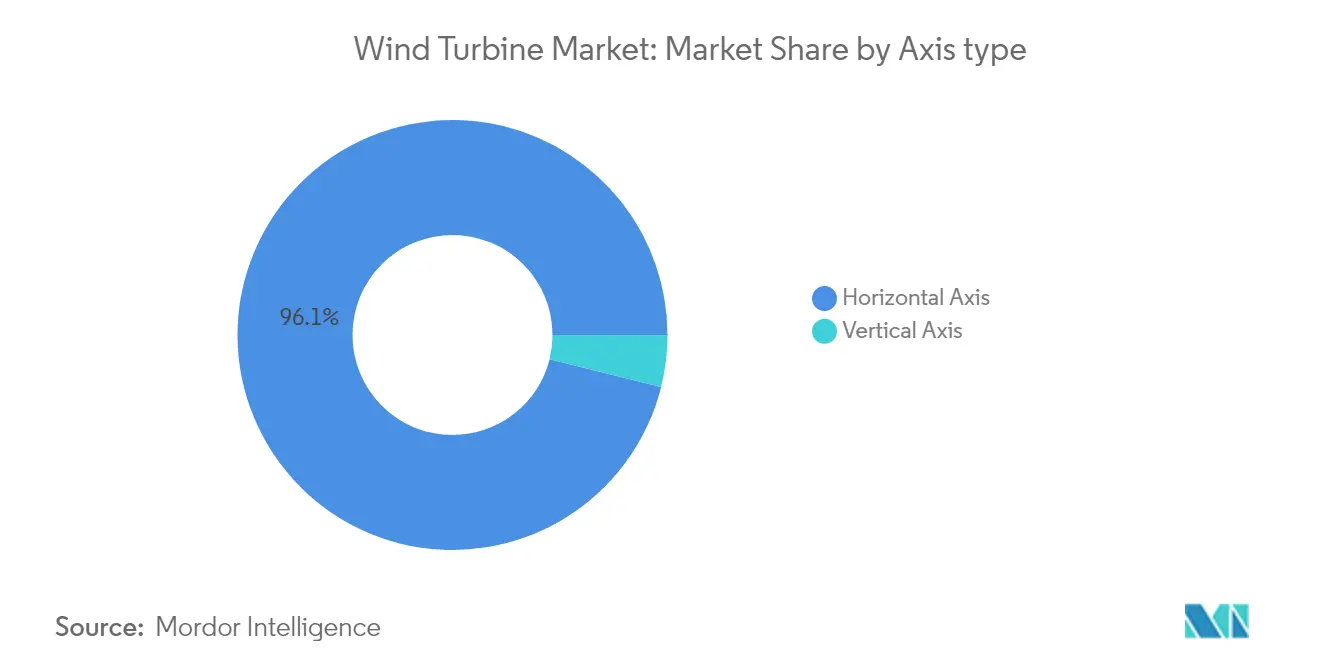
Horizontal Dominance with Vertical RenaissanceHorizontal designs still supply 96.12% of global output as of 2025, backed by decades of aerodynamic refinement. Vertical axis turbines, although a small portion of the installed fleet, are advancing at a 12.55% CAGR as machine-learning controls and composite helical blades drive niche adoption in urban and offshore settings.
By Component:
Power Electronics Outpaces Traditional LeadersRotor blades maintained a lead at 29.84% of the value in 2025, but power electronics and control packages are on pace for a 12.78% CAGR, reflecting demand for advanced grid-support functions, wide-bandgap semiconductors, and cybersecurity-hardened SCADA platforms.
By End-Use Application:
Commercial Installations Challenge Utility DominanceUtility-scale parks generated 82.74% of revenue in 2025; however, commercial and industrial systems are expected to grow at a rate of 15.05% annually through 2031, as corporations adopt virtual PPAs and onsite renewables to achieve science-based net-zero targets.
Geography Analysis
APAC and Europe Wind Turbine Market
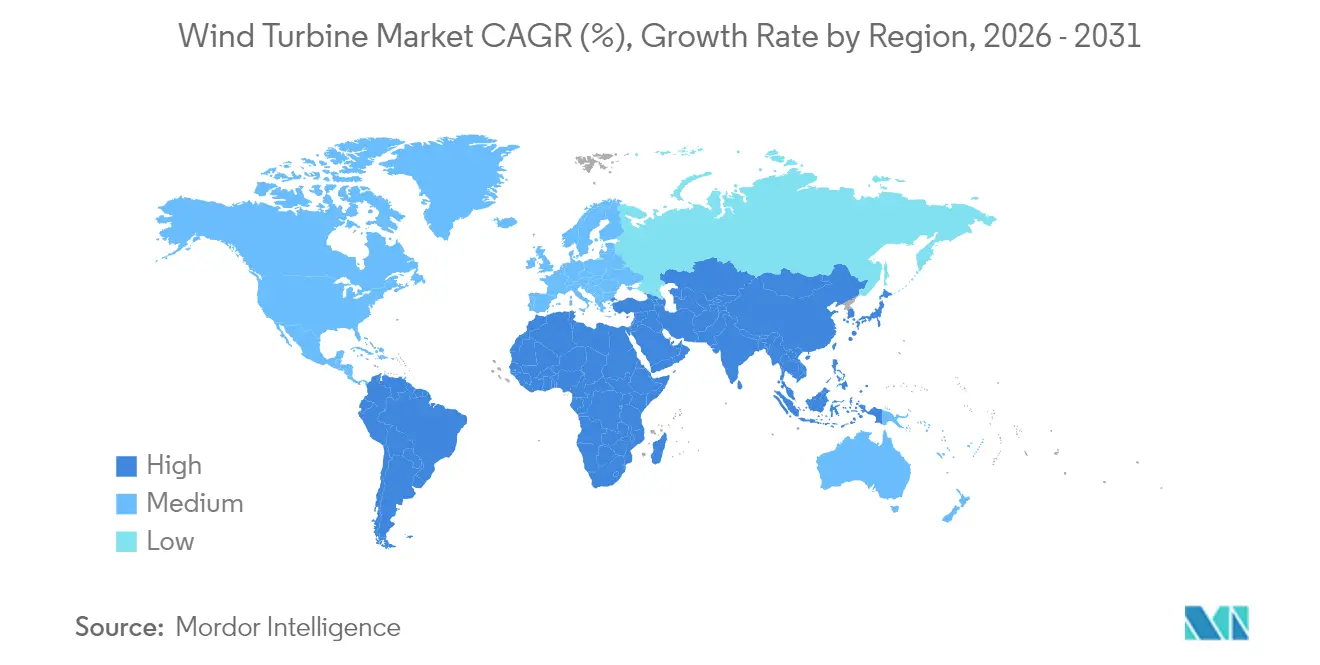
Asia Pacific accounted for 47.90% of the 2025 market value, energized by China’s domestic buildout, India’s 3.4 GW additions, and Japan’s floating push. The region’s 11.35% growth clip stems from local manufacturing depth and sustained policy incentives. Europe remains a technology pacesetter, with the EU’s 42.5% renewable mandate and robust offshore infrastructure keeping project momentum high.
The Americas and MEA Wind Turbine Market
The Middle East and Africa region is projected to be the fastest-expanding territory, buoyed by Egypt’s USD 10 billion 10 GW megaproject and Saudi tenders clearing at USD 15/MWh. North America is catching up on offshore potential as transmission rules evolve, while South America rides Brazil’s and Chile’s auction pipelines to deepen its regional role.

Regulatory Landscape
Policy support continues to rest on binding renewable targets and auction-led procurement, alongside tighter technical and trade compliance requirements for equipment. In Europe, the EU renewable target of 42.5% by 2030 underpins continued tendering activity, while trade instruments also affect tower and steel supply: Commission Implementing Regulation (EU) 2026/198 (28 January 2026) updated company-specific anti-dumping duty code assignments for utility-scale steel wind towers from China (including TSP Wind Power Group Co., Ltd.), affecting importer documentation and sourcing strategies.
Standards and national approval lists increasingly shape turbine design qualification, site assessment, and market access. IEC 61400-15-1:2025 formalized a framework for assessment and reporting of wind turbine site suitability conditions across onshore and offshore applications, supporting more consistent bankability and certification workflows. Cost and permitting levers also shifted: the United Kingdom removed import tariffs on 33 industrial goods used in wind turbine component manufacturing effective 01 April 2026 under an Authorised Use procedure, while emerging offshore markets advanced enabling frameworks, including Brazil’s offshore wind legal framework entering into force in January 2025 and South Korea’s OSW Promotion Act enabling competitive auctions (with 689 MW awarded for offshore wind in 2025).
Competitive Landscape
Manufacturers connected a record 127 GW from 23,098 units in 2024, reflecting scale and fierce rivalry. Constellation Energy’s USD 27 billion acquisition of Calpine created a 60 GW clean-power behemoth, illustrating the sector’s consolidation wave. BP–JERA’s USD 5.8 billion venture targets 13 GW of offshore wind, while Saipem7’s (merger of Saipem and Subsea7) formation signals mounting M&A activity among service providers.
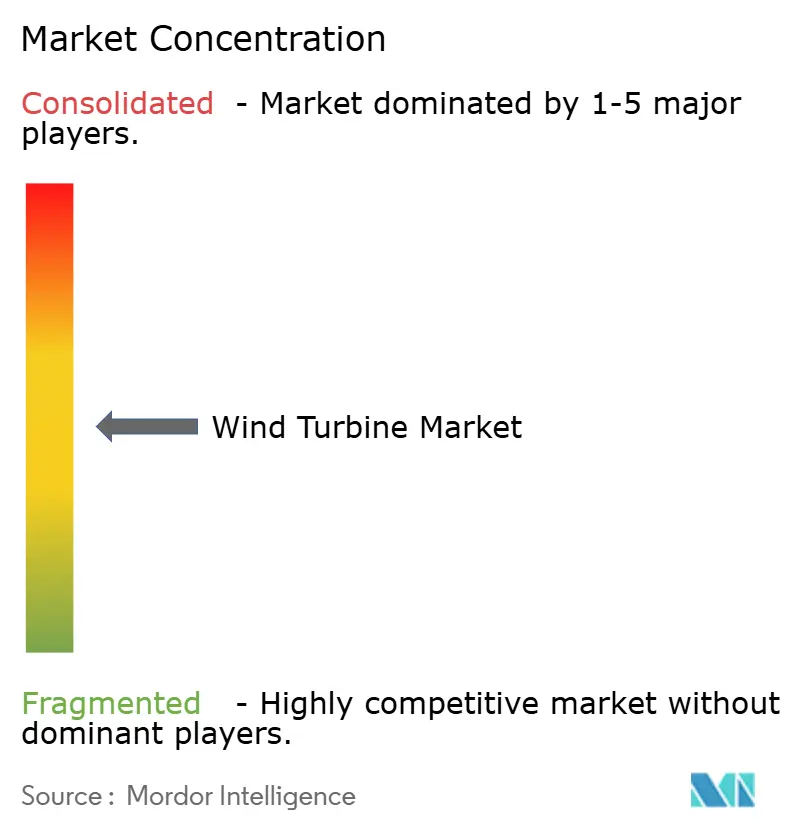
OEMs differentiate themselves through the launch of mega-turbines, AI-driven service contracts, and recyclable blade programs. The top five players control just over 80% of new installations, indicating a moderately concentrated structure that still allows regional challengers to gain share via price and local-content strategies.
Wind Turbine Industry Leaders
General Electric Company
Vestas Wind Systems A/S
Nordex SE
Suzlon Energy Limited
Siemens Gamesa Renewable Energy, S.A.
- *Disclaimer: Major Players sorted in no particular order
Wind Turbine Market Companies Covered in this Report
- Vestas Wind Systems A/S
- Siemens Gamesa Renewable Energy S.A.
- General Electric Company (GE Vernova)
- Nordex SE
- Suzlon Energy Ltd.
- Xinjiang Goldwind Science & Technology Co., Ltd.
- Envision Energy Ltd.
- Ming Yang Smart Energy Group Ltd.
- Dongfang Electric Corp.
- Enercon GmbH
- Hitachi Ltd.
- LM Wind Power A/S
- MHI Vestas Offshore Wind A/S
- Senvion SA
- Sinovel Wind Group Co., Ltd.
- Vergnet SA
- Eocycle Technologies Inc.
- Airgenesis LLC
- United Power Technology Co., Ltd.
- Siemens Energy AG

Market Opportunities and Future Outlook
Record annual deployment creates near-term whitespace in industrialized supply chains and services, particularly where larger turbine platforms and offshore buildouts concentrate demand in fewer, more complex projects. Wind recorded about 159 GW to 165 GW of global net additions in 2025, taking cumulative installed wind capacity above 1,299 GW by end-2025, with China adding 119.4 GW and India adding a record 6.3 GW in 2025. This scale-up supports OEM and tier-supplier opportunities across rotor blades, power electronics and controls, grid-support functions, and lifetime service agreements, as developers standardize fleets to reduce O&M costs and downtime using AI-enabled maintenance platforms.
Regulatory and procurement design are also opening additional routes to market beyond traditional utility auctions, including corporate frameworks and offshore-specific promotion acts that can widen the buyer set for new projects. South Korea’s OSW Promotion Act and Vietnam’s shift toward offshore wind regulations that enable corporate PPA frameworks and regional pricing provide reference points for how bankable offtake can expand into new geographies. Grid-connection constraints are additionally pushing opportunity toward solutions that improve deliverability, including hybridization with storage or hydrogen integration where policy frameworks exist, alongside equipment features that support grid compliance such as advanced converters, controls, and cybersecurity-hardened SCADA, consistent with the report’s component trend in power electronics and control packages.
Recent Industry Developments in Wind Turbine Market
- July 2026: Nordex Group received orders totaling 700 MW from UKA in Germany. The volume reinforces competitive intensity in onshore repowering and new-build pipelines, while also keeping utilization high across nacelle, blade, and tower supply chains tied to German deliveries.
- June 2026: GE Vernova signed an agreement with Powerica Limited to supply 28 of its 3.8 MW-154m onshore wind turbines for the 100 MW Botad Wind Farm in Gujarat, India, and also secured MNRE ALMM certification. The package links turbine orders with market-access compliance and highlights localization momentum, with the company targeting 1,500 MW per year manufacturing capacity at its Pune facility.
- December 2024: BP and JERA launched JERA Nex BP to pursue 13 GW of offshore wind assets. The combination adds scale in development and financing capability, supporting multi-country project pipelines that influence turbine order visibility and offshore supply-chain planning.


Wind Turbine Market Report Scope and Research Methodology
Market Definition and Coverage
For this study, the wind turbine market covers the revenues linked to wind turbines installed for electricity generation, including onshore and offshore deployments, across key countries and regions tracked in the model.
Scope exclusions: We exclude downstream electricity sales and broader balance of plant and grid infrastructure spend that sits outside the turbine system boundary.
Segments Covered in This Report
- By Location of Deployment
- Onshore
- Offshore
- Fixed-bottom
- Floating
- By Capacity Rating
- Small (Below 100 kW)
- Medium (100 kW to 1 MW)
- Large (1 to 5 MW)
- Very Large (Above 5 MW)
- By Axis Type
- Horizontal Axis
- Vertical Axis
- By Component
- Rotor Blades
- Nacelle and Drivetrain
- Generator
- Tower
- Power-Electronics and Control
- By End-Use Application
- Utility-Scale
- Commercial and Industrial
- Residential and Micro-grid
- By Geography
- North America
- United States
- Canada
- Mexico
- Europe
- Germany
- United Kingdom
- France
- Spain
- Russia
- Finland
- Sweden
- Turkey
- Netherlands
- Rest of Europe
- Asia Pacific
- China
- India
- Japan
- South Korea
- Australia
- Vietnam
- Rest of Asia Pacific
- South America
- Brazil
- Argentina
- Chile
- Rest of South America
- Middle East and Africa
- Saudi Arabia
- South Africa
- Egypt
- Morocco
- Rest of Middle East and Africa
- North America
Data Sources, Market Sizing, and Validation
Desk Research
Desk research was used to build the baseline structure of the market and to anchor the model to observable installation activity. We reviewed public data series such as International Energy Agency (IEA) statistics, International Renewable Energy Agency (IRENA) renewables database, Global Wind Energy Council (GWEC) publications, US Energy Information Administration (EIA) releases, and Eurostat energy indicators, which helped us align definitions and identify the most consistent time series.
To turn those signals into a revenue model, we also relied on sources such as national energy ministry announcements, grid-operator connection statistics where available, and company annual reports and investor presentations for mix and pricing commentary. In addition, we used approved paid databases for company financials and news, plus patent databases to understand technology change that can shift average selling prices over time. This list is illustrative, and many other public sources were also consulted for data collection, validation, and clarification.
Primary Interviews and Surveys
Primary work was run to pressure-test the desk assumptions using expert interviews and structured surveys across OEM-facing supply chain participants, project developers, EPC stakeholders, and independent industry experts. For global coverage, inputs were checked across APAC, EMEA, and the Americas so regional pricing, offshore uptake, and commissioning cadence could be adjusted before finalizing the market totals.
Distribution of primary research fieldwork respondents
| Company type | Respondent position | Region |
|---|---|---|
| Top tier: 28% | CXOs: 12% | APAC: 52% |
| Mid tier: 58% | Functional/Unit leaders: 39% | EMEA: 29% |
| Smaller Players: 14% | Managers: 49% | Americas: 19% |
Market-Sizing & Forecasting
The core sizing logic uses a top-down build where annual wind additions and commissioning timelines are reconstructed by region and then converted to turbine revenue using typical capacity mix and price ranges. Once the demand pool is established, we corroborate totals with selective bottom-up checks, such as sampled supplier roll-ups, channel discussions on shipment timing, and ASP times volume checks for key capacity bands.
Inputs that materially move the model include annual installed capacity additions (GW), the onshore versus offshore share, average turbine rating trends (MW per unit), observed pricing direction by turbine class, and the pace of permitting and grid connection activity that can shift revenue recognition between years. When country detail is thin, gaps are handled through proxy indicators like regional build plans and historical share patterns that are then re-validated through interviews.
For forecasting, scenario analysis is used around installation pipelines and policy-driven timing, and then the central case is smoothed using time-series techniques so short-term spikes do not overstate the trend. Assumptions on capacity mix and pricing are refreshed using expert consensus, so the forecast stays tied to what is being contracted and built in the market.
Data Validation & Update Cycle
Validation is done through multiple cross-checks so a single source does not drive the final output. Model totals are compared against independent signals such as reported annual installations, disclosed project pipelines, and directional ASP commentary, and then any outliers are reviewed and corrected before sign-off.
Each report goes through step-by-step analyst review, including consistency checks across regions and years, and re-contact triggers are used when a major variance is found or when a policy or supply shift changes near-term installations. The study is refreshed annually, and interim updates are made when material events occur, followed by a final pre-delivery pass so clients receive the latest updated view.
Mordor Intelligence's Wind Turbine Market Estimate Compared With Other Published Estimates
Published market sizes for wind turbines can look far apart because the underlying boundaries are not always aligned. Differences often come from what is counted as a turbine system versus adjacent project spend, how offshore timing is recognized, and which year is treated as the starting point.
Key gaps usually show up in three places. First, some sources mix turbine revenues with broader project components or services, which lifts the total even when installation volumes are similar. Second, pricing assumptions can vary depending on whether larger offshore unit sizes and inflation-linked contracts are reflected in the same way. Third, refresh cadence matters because annual commissioning and policy changes can shift revenue between years when datasets are updated at different times.
Benchmark comparison
| Source | Market Size | Gaps in Research Methodology |
|---|---|---|
| Mordor Intelligence | USD 186.95 B (2026) | |
| Global Consultancy A | USD 128.72 B (2024) | Uses a different base year and segment structure, and it appears to mix a broader set of component and application buckets, which can change what is treated as turbine revenue versus project scope. |
| Industry Publisher B | USD 112.50 B (2024) | Provides a 2024 point estimate with limited visible scope notes, so differences can come from how offshore deployments, capacity mix shifts, and currency timing are handled in the conversion to USD. |
Observed installation additions and the onshore-offshore mix are the checks that keep Mordor Intelligence tied to a clear turbine demand pool, and that is why the table shows a spread when other estimates apply different year anchors or broader inclusions. With scope boundaries stated and the core inputs traceable to market signals, the final number is easier to reproduce and update as new commissioning data comes in.


Key Questions Answered in the Report
What is the projected wind turbine market size by 2031?
The market is expected to reach USD 306.79 billion by 2031 on a 10.41% CAGR trajectory.
Which deployment type will grow the fastest through 2031?
Offshore installations, particularly floating foundations, are forecast to post a 18.95% CAGR, the highest among deployment types.
Why are turbines larger than 5 MW gaining popularity?
Very-large platforms deliver higher capacity factors and cut per-MW installation and maintenance costs, improving project economics.
Which region currently dominates wind turbine spending?
Asia Pacific led with 47.90% of global value in 2025, driven by China and India.
What is the main obstacle slowing new wind projects?
Grid-connection queues, especially in North America and Europe, represent the most significant near-term bottleneck.
How is AI changing turbine operations?
Predictive-maintenance systems achieve 92% fault-prediction accuracy and trim downtime by roughly 35%, boosting asset returns.
Page last updated on:


 Your data is secure and never sold or shared.


