
Wind Turbine Brakes Market Size and Share
Market Overview
| Study Period | 2021 - 2031 |
|---|---|
| Market Size (2026) | USD 1.82 Billion |
| Market Size (2031) | USD 3.11 Billion |
| Growth Rate (2026 - 2031) | 11.31 % |
| Fastest Growing Market | Asia-Pacific |
| Largest Market | Asia-Pacific |
| Market Concentration | Medium |
Major Players *Disclaimer: Major Players sorted in no particular order Image © Mordor Intelligence. Reuse requires attribution under CC BY 4.0. | |
Wind Turbine Brakes Market Analysis by Mordor Intelligence
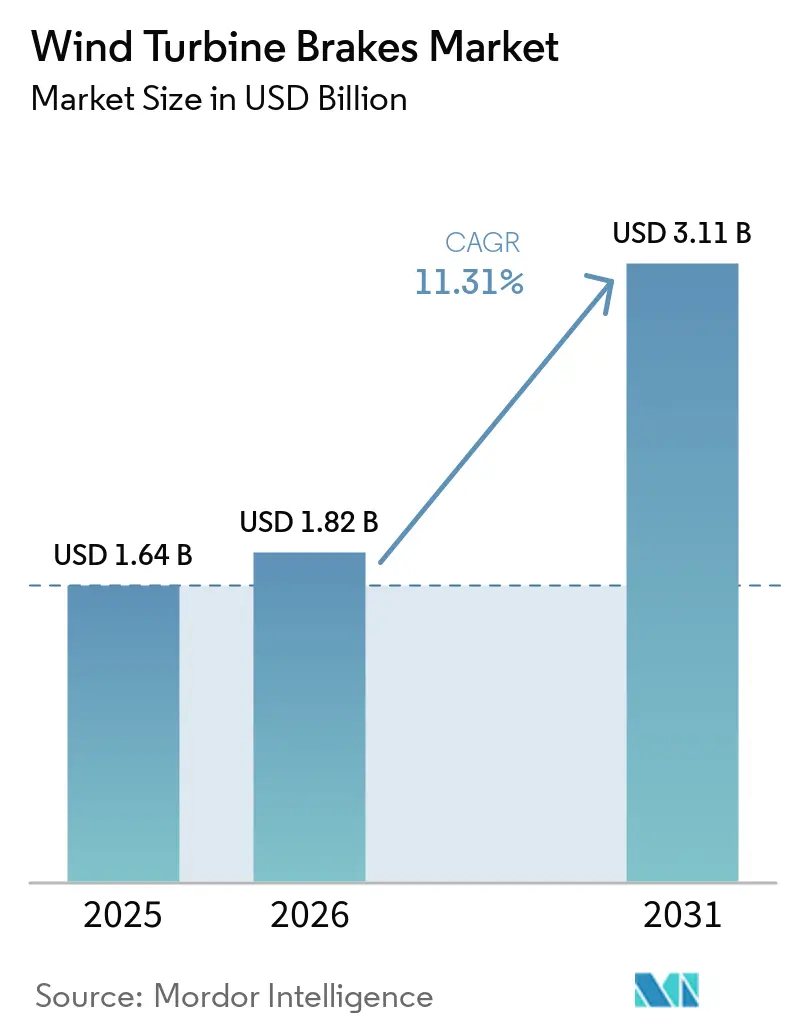
The wind turbine brakes market size was valued at USD 1.64 billion in 2025 and estimated to grow from USD 1.82 billion in 2026 to reach USD 3.11 billion by 2031, at a CAGR of 11.31% during the forecast period (2026-2031). The wind turbine brakes market follows the expansion of global wind generation because every new turbine requires braking equipment for rotor, yaw, and pitch functions. Global wind capacity additions reached 159 GW in 2025, taking cumulative capacity beyond 2,500 GW[1]International Renewable Energy Agency, “Renewable Capacity Statistics 2026,” International Renewable Energy Agency, irena.org. New installations support original-equipment demand, while the aging fleet supports replacement and retrofit work. Larger offshore machines are changing product requirements because their braking loads and safety requirements exceed those of earlier designs. The wind turbine brakes market therefore favors suppliers that can provide qualified systems, monitoring capability, and service support across several operating environments.
Key Report Takeaways
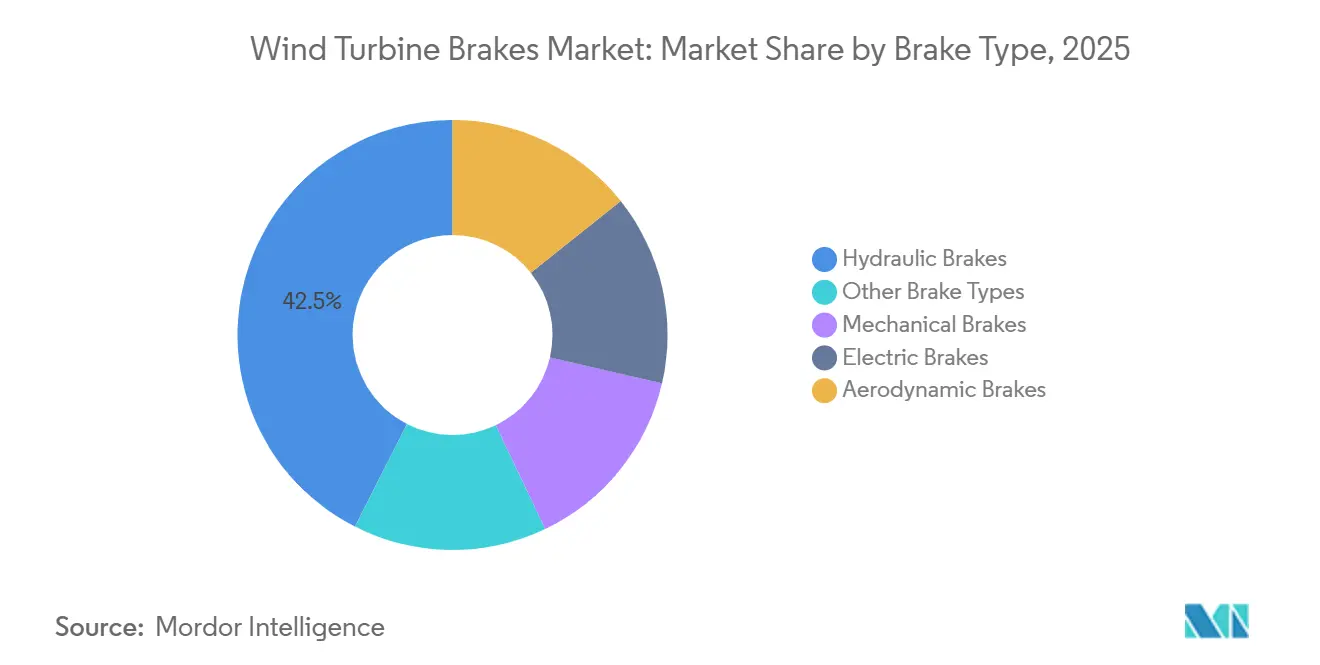
- By brake type, hydraulic brakes held 42.5% of the wind turbine brakes market share in 2025, while electric brakes are forecast to grow at 12.7% CAGR through 2031.
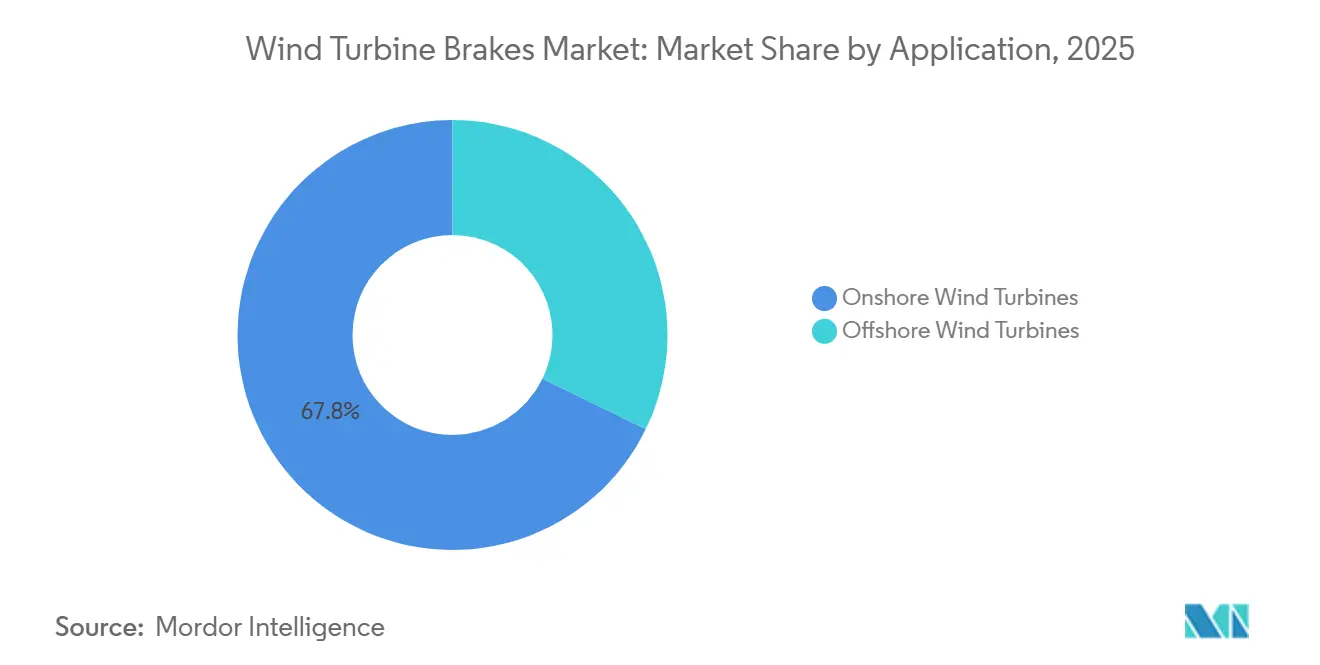
- By application, onshore wind turbines accounted for 67.8% of the wind turbine brakes market size in 2025, while offshore wind turbines are projected to expand at 13.1% CAGR through 2031.
- By geography, Asia-Pacific held 31.2% revenue share in 2025 and is forecast to grow at 13.8% CAGR through 2031.
Note: Market size and forecast figures in this report are generated using Mordor Intelligence’s proprietary estimation framework, updated with the latest available data and insights as of January 2026.
Global Wind Turbine Brakes Market Trends and Insights
Drivers Impact Analysis*
| Driver | (~) % Impact on CAGR Forecast | Geographic Relevance | Impact Timeline |
|---|---|---|---|
| Global Wind-Farm Capacity Expansion | +3.50% | Global | Short-term (≤ 2 years) |
| Offshore Turbine Scale-Up and Higher Braking Loads | +2.00% | Europe (North Sea), APAC offshore (China, Taiwan, South Korea) | Medium-term (2–4 years) |
| Aging Turbine Fleet Replacement and Retrofit Demand | +1.80% | North America & Europe, spill-over to early APAC | Medium-term (2–4 years) |
| Smart Brake Monitoring for Predictive Maintenance | +1.40% | Global, early gains in North America & Europe | Long-term (≥ 4 years) |
| Corrosion-Resistant Braking Requirements in Harsh Marine Environments | +0.90% | Europe (North Sea, Baltic), APAC offshore | Medium-term (2–4 years) |
| Localized Aftermarket Parts Availability in Emerging Wind Markets | +0.60% | APAC core (India, Vietnam, Indonesia), spill-over to MEA | Long-term (≥ 4 years) |
| Source: Mordor Intelligence | |||
Global Wind-Farm Capacity Expansion
Wind additions reached 159 GW in 2025, a record level that lifted global installed wind capacity past 2,500 GW. Wind accounted for 20% of the 800 GW of renewable capacity added worldwide during that year[2]International Energy Agency, “Renewables 2025, Renewable Electricity,” International Energy Agency, iea.org. The wind turbine brakes market benefits from this buildout because each new turbine needs primary yaw and rotor brake circuits. Offshore platforms also add braking assemblies for individual pitch drives. The number of turbines installed in 2025 reached 28,395 across 57 countries, which broadened the service and spare-parts requirements beyond established wind markets. The wind turbine brakes market gains from both the equipment supplied with new installations and the local maintenance capacity needed after commissioning.
Offshore Turbine Scale-Up and Higher Braking Loads
Offshore turbines have moved beyond the 10 MW to 15 MW range that shaped earlier project designs. MingYang installed its MySE 18.X-20 MW turbine in 2025, while Dongfang Electric tested a 26 MW prototype during the same year. Rotor diameters above 250 meters increase stored kinetic energy and place heavier demands on braking components. This change requires brake systems that can meet higher loads, thermal cycles, and emergency-stop requirements. The wind turbine brakes market has a higher technical threshold in offshore projects because access, replacement, and failure costs are more demanding at sea. The offshore pipeline also supports this direction, with 24.5 GW of offshore capacity expected to enter operation in 2026 and final investment decisions forecast for 22.3 GW.
Aging Turbine Fleet Replacement and Retrofit Demand
Turbines installed in Europe and North America between 2000 and 2012 are reaching mid-life or end-of-life stages. European repowering reached 1.6 GW in 2024, and permitting reform is expected to shorten project schedules in Germany, France, and Iberia. Brake-pad replacement needs rise as turbines accumulate operating hours, especially at high-wind sites. The wind turbine brakes market also benefits when operators update yaw and rotor assemblies to meet current safety and monitoring requirements. Certified retrofit providers can support assets that have moved beyond direct original-equipment service coverage. Uptower disc resurfacing can avoid nacelle removal, which makes service work more practical for operators managing older fleets.
Smart Brake Monitoring for Predictive Maintenance
Sensor-based brake monitoring changes the way operators manage safety-critical components during a turbine's operating life. A real-world study used deep-learning methods with controller data to predict yaw-brake failures in 3 MW turbines early enough to support planned maintenance[3]M. Lützen and S. Beji, “Predictive Maintenance for Offshore Wind Turbines Through Deep Learning and Online Clustering of Unsupervised Subsystems, A Real-World Implementation,” Journal of Ocean Engineering and Marine Energy, eng.serdarbeji.com. A physics-informed maintenance framework tested with northern China wind-farm data reported zero failures over simulated 19-year operating lives. Real-time remaining-life estimates can help operators combine brake work with other maintenance activities and reduce separate crane or vessel mobilizations[4]“Condition Monitoring of Wind Turbine Drivetrains, State-of-the-Art Technologies, Recent Trends, and Future Outlook,” Wind Energy Science, wes.copernicus.org. The wind turbine brakes market can gain recurring service value when monitoring is compatible with remote maintenance systems. IEC 61400-1:2019+AMD1:2025 provides the design framework that applies to protection-function monitoring solutions.
Restraints Impact Analysis*
| Restraint | (~) % Impact on CAGR Forecast | Geographic Relevance | Impact Timeline |
|---|---|---|---|
| High Upfront Cost of Engineered Brake Systems | -1.50% | Emerging markets: APAC (India, Vietnam, Indonesia), MEA, South America | Medium-term (2–4 years) |
| Volatile Steel, Friction-Material and Hydraulic-Component Costs | -1.00% | Global, concentrated in Europe and North America | Short-term (≤ 2 years) |
| Offshore Access and Maintenance Logistics | -0.70% | Europe (North Sea, Baltic), APAC offshore | Medium-term (2–4 years) |
| Limited Field Data Interoperability Across OEM Platforms | -0.50% | Global | Long-term (≥ 4 years) |
| Source: Mordor Intelligence | |||
High Upfront Cost of Engineered Brake Systems
Utility-scale turbine brake assemblies require product design, testing, documentation, and original-equipment qualification. These requirements create a purchasing barrier where developers place greater weight on initial cost than lifecycle value. IEC 61400-1 requires braking-system design provisions that include emergency-stop operation during grid-loss events and mechanical braking redundancy for offshore applications. Local-content rules and import duties can increase the cost of advanced systems supplied from outside South and Southeast Asia, the Middle East, and Sub-Saharan Africa. Operators cannot omit braking systems because safety codes require them. The wind turbine brakes market may therefore see demand shift toward lower-cost products, even when those products create longer-term reliability and operating risks.
Volatile Steel, Friction-Material and Hydraulic-Component Costs
Brake systems require substantial volumes of steel, friction materials, seals, pumps, and accumulators. WindEurope reported that European steel prices had doubled within one year during a period of continued pressure from steel safeguard measures. Steel affects the cost of housings, discs, and calipers, while copper and nickel cycles affect sintered-metal and ceramic friction materials. The wind turbine brakes market also faces separate cost movements for hydraulic parts, which limits the value of single-material hedging. Suppliers with long-term material contracts or integrated friction-material production have a cost advantage. These cost pressures can narrow margins on contracts that were priced before material movements occurred.
*Our forecasts treat driver/restraint impacts as directional, not additive. The impact forecasts reflect baseline growth, mix effects, and variable interactions.
Segment Analysis
By Brake Type: Hydraulic Brakes Retain the Largest Installed Base
Hydraulic brakes accounted for 42.5% of revenue in 2025, giving them the largest position among brake types. This share reflects established use in yaw and rotor applications across the global installed fleet. Hydraulic units can deliver the braking torque required for high-load configurations, including large offshore rotor systems. Their use also fits the hydraulic infrastructure already present in many nacelle designs. Hydraulic-system demand remains supported by replacement needs from existing turbines. Mechanical brakes continue to provide rotor-lock capability for maintenance access. Aerodynamic brakes use pitch-to-feather operation as a primary stopping function in variable-speed, pitch-controlled turbines. Hydraulic or mechanical systems provide independent backup under applicable IEC design requirements. Other brake types, including pneumatic systems addressed by China's GB/T 47557-2026 standard, serve more specialized applications.
Electric brakes are forecast to expand at 12.7% CAGR during 2026-2031. Their growth follows the shift from hydraulic pitch cylinders to permanent-magnet pitch motors in newer turbines. Spring-applied electromagnetic brakes activate when power is lost and work with digital monitoring systems. The wind turbine brakes industry is adopting these systems where electrical actuation can simplify pitch-drive design. China's GB/T 47557-2026 covers pneumatic and electrical braking control and aligns domestic requirements with IEC standards. This framework supports the use of electrically actuated braking equipment in China. KTR offers both the EMB-STOP electromechanical line and the hydraulic KTR-STOP line. Its position across both types shows that hydraulic and electric braking systems can operate alongside one another during the technology transition.



By Application: Onshore Volume Supports Offshore Product Value
Onshore wind turbines generated 67.8% of revenue in 2025, making them the largest application segment. The wind turbine brakes market share held by onshore turbines reflects their dominant position in operating capacity and annual additions. China alone added more than 110 GW of onshore wind capacity in 2025. This volume supports original-equipment and aftermarket demand for brake assemblies. Competition is strongest in onshore turbines below 3 MW, where several suppliers can meet standard requirements. Systems used in turbines above 5 MW have higher value content because performance requirements are more demanding. European repowering added 1.6 GW in 2024 and supports upgrades that include modern brake assemblies and digital-monitoring compatibility. The wind turbine brakes industry continues to depend on this large installed base for service demand.
Offshore wind turbines are projected to grow at 13.1% CAGR during 2026-2031. This application places a premium on reliability because maintenance access is more difficult than on land. Offshore systems require corrosion-resistant alloys, sealed hydraulic systems, manual emergency pumps, and friction materials suited to salt exposure. The wind turbine brakes market size in offshore applications rises with higher turbine ratings and more demanding safety specifications. The offshore project pipeline provides a continuing source of demand, with final investment decisions for 22.3 GW expected in 2026. Offshore requirements are increasingly influencing the upper end of onshore product design as turbine sizes increase. Suppliers that can document qualification and provide long-interval service capability are better placed in this application. The wind turbine brakes market has a clearer premium tier where offshore experience is relevant.
Geography Analysis
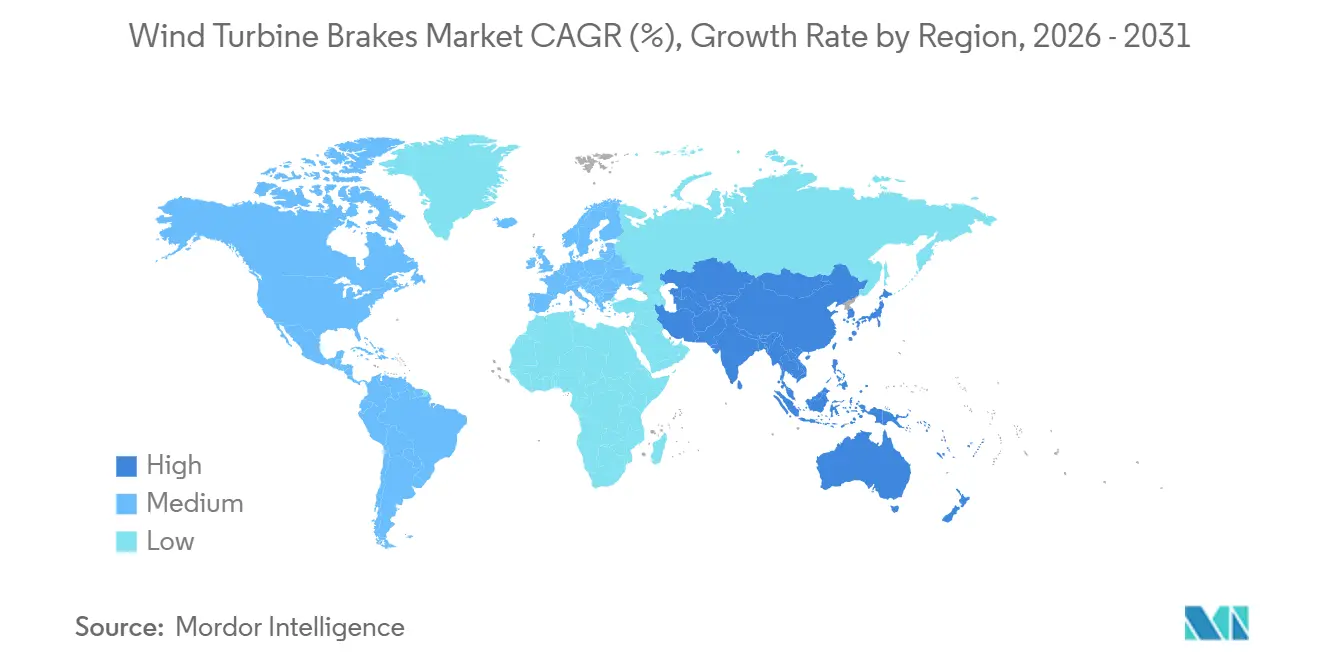
Asia-Pacific held 31.2% of revenue in 2025 and is forecast to grow at 13.8% CAGR through 2031. This gives the region the largest wind turbine brakes market size and the fastest geographic growth rate in the draft forecast. China installed 120.5 GW of wind capacity in 2025, including more than 110 GW onshore, and reached 640.5 GW of cumulative capacity. India added 6.3 GW during 2025, an 86% increase from the prior year, while installed capacity exceeded 50 GW. India's capacity is expected to exceed 60 GW in 2026. China's GB/T 47557-2026 standard took effect in August 2026 and raises the compliance baseline for turbine braking systems. Domestic manufacturers had achieved localization above 65% in the Chinese wind-brake supply by 2025. Vietnam reached 7.4 GW of cumulative wind capacity in 2025, while South Korea, Indonesia, and Australia added depth beyond China and India.
Europe has a significant revenue position because it combines a large operational fleet with an advanced offshore sector and a growing repowering cycle. Germany added 5.7 GW of onshore and offshore capacity in 2025, while the European Union commissioned 14 GW across both applications. The United Kingdom operated more than 2,500 offshore turbines in 2025, supporting demand for systems suited to marine conditions. EU wind generation is projected to rise from 17% of electricity in 2025 to 25% in 2030. IEC 61400-1:2019+AMD1:2025 and DIN EN 81-44 influence temperature ratings, material certification, and monitoring requirements in European procurement. North America also supports demand through United States federal incentives and Canadian renewable targets. Larger wind farms in the United States have adopted condition-monitoring platforms, which supports the use of digitally connected brake systems.
South America, the Middle East, and Africa are earlier-stage areas within the wind turbine brakes market. Brazil anchors South American demand through its wind resources and government auction programs. Argentina and Chile contribute additional volume through renewable-energy mandates. Saudi Arabia and the United Arab Emirates are commissioning utility-scale wind projects under national diversification programs. Morocco had more than 1.4 GW of installed wind capacity and serves as a regional reference point for supply-chain development. Africa and the Middle East recorded another installation record in 2025, supported by large projects and competitive energy costs. These areas favor cost-competitive products backed by local service networks. Localization requirements may lead specialist suppliers to develop regional manufacturing or service partnerships during the forecast period.

Competitive Landscape
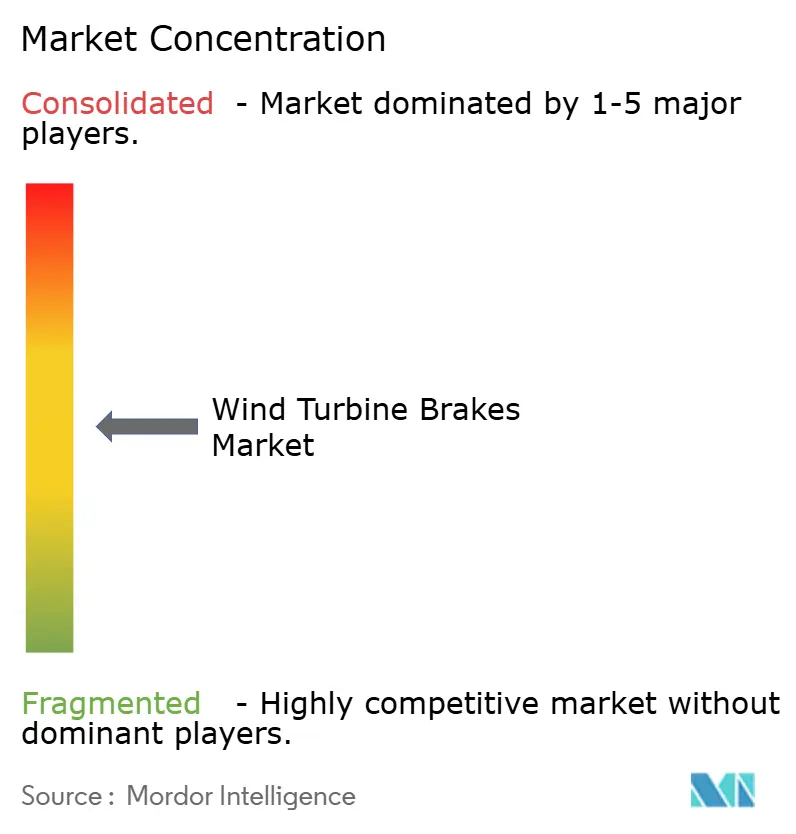
The wind turbine brakes market is moderately concentrated at the system level. Dedicated global specialists hold stronger positions in high-torque hydraulic and electromechanical applications. Regional manufacturers compete more actively on price in standard onshore configurations. Dellner Group completed its acquisition of ANTEC Group in September 2024. The transaction added brake and hydraulic capabilities to Dellner's portfolio and expanded its aftermarket presence across Spain, China, and Brazil. Dellner had also acquired Pintsch Bubenzer and Hydratech Industries before that transaction. Its combined offering covers caliper assemblies, brake discs, hydraulic power units, and condition-monitoring systems. This breadth reflects the importance of providing both equipment and aftermarket support.
Svendborg Brakes supports more than 200,000 onshore and offshore turbines and offers a service platform that uses remote monitoring. The company also positions its Green Alternative friction-material range around compliance with material requirements. KTR competes with hydraulic KTR-STOP and electromechanical EMB-STOP products. KTR's Ident system creates documentation trails through production and certification, which responds to original-equipment documentation requirements. The wind turbine brakes market places value on this traceability because braking components are subject to qualification and safety requirements. Suppliers are also adding monitoring connectivity and uptower tools to move beyond stand-alone component sales. Svendborg Brakes demonstrated a yaw-brake lifting and installation tool in 2024 for uptower replacement work.
The competitive opportunity includes independent power producers operating older platforms outside original-equipment service contracts. It also includes turnkey braking solutions for floating offshore wind, where structural dynamics differ from fixed-bottom projects. Chinese domestic manufacturers have exceeded 65% localization in the domestic wind-brake supply chain and may increase pressure in South and Southeast Asian export markets. The wind turbine brakes market is likely to reward suppliers with qualified designs, local service capacity, and monitoring capability. No combined market-share figure for leading companies was provided in the source material. The available evidence therefore does not support a numerical ranking of supplier concentration. Acquisition activity and broadening product portfolios show that larger specialists are seeking more complete service coverage. The wind turbine brakes market remains open to regional suppliers in standard onshore configurations. Premium offshore work remains more difficult to enter because it requires higher performance, certification, and service capabilities.
Wind Turbine Brakes Industry Leaders
Svendborg Brakes
Dellner Bubenzer Group
Pintsch Bubenzer GmbH
ANTEC Group
Stromag GmbH
- *Disclaimer: Major Players sorted in no particular order

Recent Industry Developments
- September 2026: KTR Systems GmbH and KTR Brake Systems GmbH exhibited at WindEnergy 2026 in Hamburg, showcasing their full portfolio of couplings, brakes, and hydraulic components for the wind industry. The company highlighted its KTR Ident traceability system, which catalogs all product-related data through the production and certification chain, positioning it as a compliance tool for evolving turbine design documentation requirements under IEC 61400-1.
- August 2026: China's GB/T 47557-2026, Technical Specification for Braking System of Wind Power Generation Sets, came into force, establishing mandatory national standards for mechanical, hydraulic, aerodynamic, and pneumatic braking systems in wind turbines. Issued by the National Administration for Market Regulation on April 30, 2026, and drafted with participation from domestic brake manufacturers, including Jiangxi Huawu Brake, Goldwind, MingYang, and Shanghai Electric Wind Power, the standard creates a compliance-led upgrade cycle across China's wind market.
- December 2025: IEC published IEC 61400-1:2019+AMD1:2025, an amendment to the foundational wind turbine design standard. Amendment 1 updates design load cases, including DLC 2.1 and 2.2 for emergency brake engagement scenarios, and revises partial safety-factor specifications.


Global Wind Turbine Brakes Market Report Scope
Wind turbine brakes are mechanical, hydraulic, or electrical braking systems used to slow down, stop, or hold the rotor and drivetrain of a wind turbine. They are primarily used for emergency stopping, maintenance, protection against excessive rotor speed, and securing the turbine during high-wind or fault conditions. Wind turbine brakes are typically installed in the high-speed or low-speed drivetrain, depending on the turbine design, and operate in conjunction with the turbine's aerodynamic pitch and control systems.
The Wind Turbine Brakes Market is segmented by brake type, application, and geography. By brake type, the market is segmented into mechanical brakes, hydraulic brakes, electric brakes, aerodynamic brakes, and other brake types. By application, the market is segmented into onshore wind turbines and offshore wind turbines. The report also covers the market size and forecasts for the global Wind Turbine Brakes Market across 26 countries in key regions. For each segment, the market sizing and forecasts have been provided on the basis of value (USD).
| Mechanical Brakes |
| Hydraulic Brakes |
| Electric Brakes |
| Aerodynamic Brakes |
| Other Brake Types |
| Onshore Wind Turbines |
| Offshore Wind Turbines |
| North America | United States |
| Canada | |
| Mexico | |
| Europe | Germany |
| France | |
| Italy | |
| Spain | |
| United Kingdom | |
| Poland | |
| Russia | |
| Rest of Europe | |
| Asia-Pacific | China |
| India | |
| Japan | |
| South Korea | |
| Australia | |
| Indonesia | |
| Vietnam | |
| Thailand | |
| Rest of Asia-Pacific | |
| South America | Brazil |
| Argentina | |
| Chile | |
| Rest of South America | |
| Middle East and Africa | Saudi Arabia |
| United Arab Emirates | |
| Egypt | |
| South Africa | |
| Morocco | |
| Rest of Middle East and Africa |
| By Brake Type | Mechanical Brakes | |
| Hydraulic Brakes | ||
| Electric Brakes | ||
| Aerodynamic Brakes | ||
| Other Brake Types | ||
| By Application | Onshore Wind Turbines | |
| Offshore Wind Turbines | ||
| By Geography | North America | United States |
| Canada | ||
| Mexico | ||
| Europe | Germany | |
| France | ||
| Italy | ||
| Spain | ||
| United Kingdom | ||
| Poland | ||
| Russia | ||
| Rest of Europe | ||
| Asia-Pacific | China | |
| India | ||
| Japan | ||
| South Korea | ||
| Australia | ||
| Indonesia | ||
| Vietnam | ||
| Thailand | ||
| Rest of Asia-Pacific | ||
| South America | Brazil | |
| Argentina | ||
| Chile | ||
| Rest of South America | ||
| Middle East and Africa | Saudi Arabia | |
| United Arab Emirates | ||
| Egypt | ||
| South Africa | ||
| Morocco | ||
| Rest of Middle East and Africa | ||


Key Questions Answered in the Report
What is the projected value of the wind turbine brakes market by 2031?
The wind turbine brakes market is forecast to reach USD 3.11 billion by 2031, from USD 1.82 billion in 2026, at an 11.31% CAGR.
Which brake type leads wind turbine applications?
Hydraulic brakes led with 42.5% revenue share in 2025 because of their established use in yaw and rotor applications.
Why are electric wind turbine brakes growing quickly?
Electric brakes are forecast to grow at 12.7% CAGR as turbine designs increasingly use electrified pitch-drive architectures and connected monitoring.
Which wind turbine application is growing fastest?
Offshore wind turbines are projected to grow at 13.1% CAGR through 2031 because larger machines require higher-performance braking systems.
Which region leads demand for wind turbine brake systems?
Asia-Pacific held 31.2% of revenue in 2025 and is projected to expand at 13.8% CAGR through 2031.
What is the main challenge for brake-system suppliers?
High qualification costs and volatility in steel, friction materials, and hydraulic components can pressure margins and purchasing decisions.
Page last updated on:





