
Waterproofing Admixture Market Size and Share
Market Overview
| Study Period | 2020 - 2031 |
|---|---|
| Forecast Data Period | 2026 - 2031 |
| Historical Data Period | 2020 - 2024 |
| Growth Rate | 4.92 % |
| Fastest Growing Market | Asia-Pacific |
| Largest Market | Asia-Pacific |
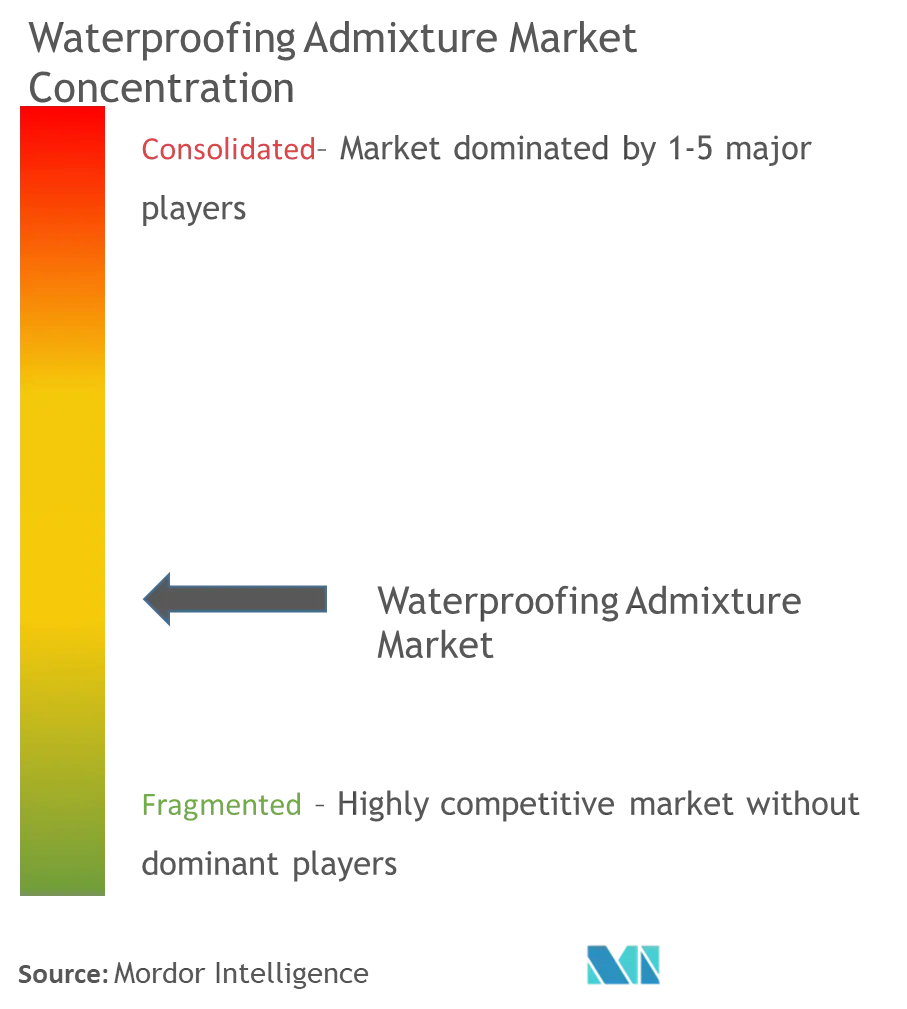
| Market Concentration | Medium |
Major Players *Disclaimer: Major Players sorted in no particular order Image © Mordor Intelligence. Reuse requires attribution under CC BY 4.0. | |
Waterproofing Admixture Market Analysis by Mordor Intelligence
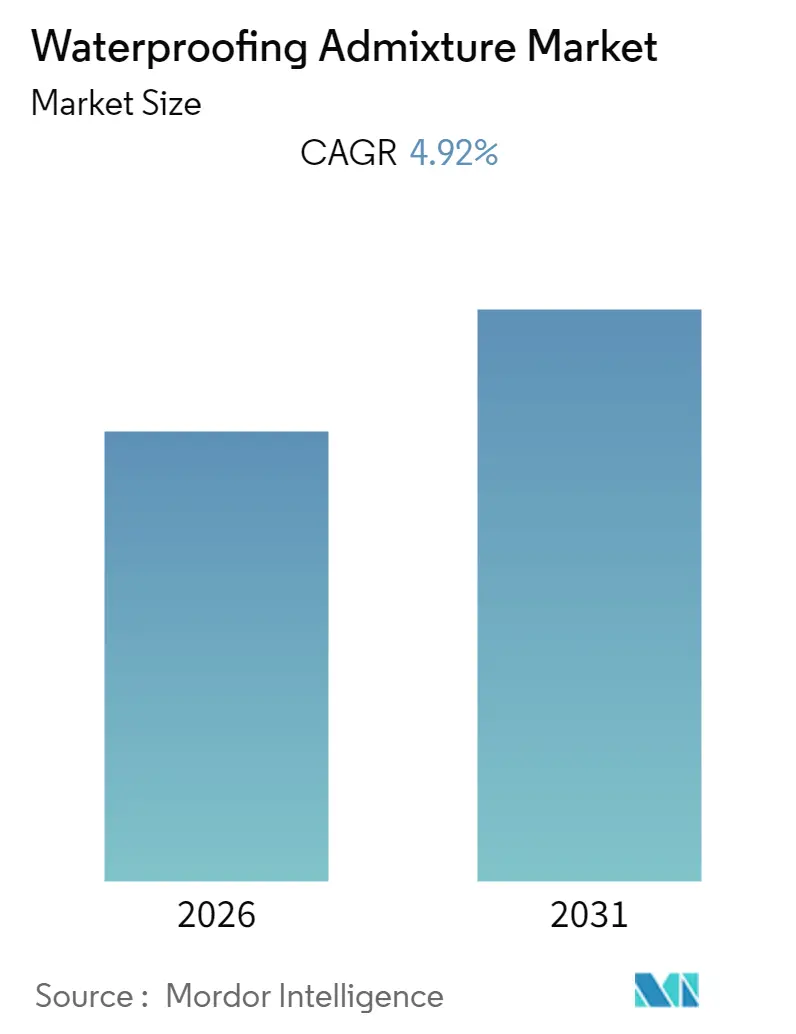
The Waterproofing Admixture Market size is expected to register a CAGR of 4.92% during the forecast period.
COVID-19 outbreak negatively impacted the market in 2020. The COVID-19 pandemic affected the waterproofing admixture market because of disruption in the supply chain. During the pandemic, many factories responsible for raw material production for waterproofing admixture were shut down. However, the market started recovering in 2021 and it is expected to reach its pre covid level during the forecasted period.
- Over the short term, rapid urbanization in developing countries and rising demand for effective waterproofing solutions are some of the driving factors stimulating the market demand.
- Already established advanced infrastructure in developed countries and lack of technical knowledge about waterproofing admixture usage, are the factors that are hindering the market's growth.
- Increasing R&D for new product development in the construction industry is likely to create opportunities for the market in the coming years.
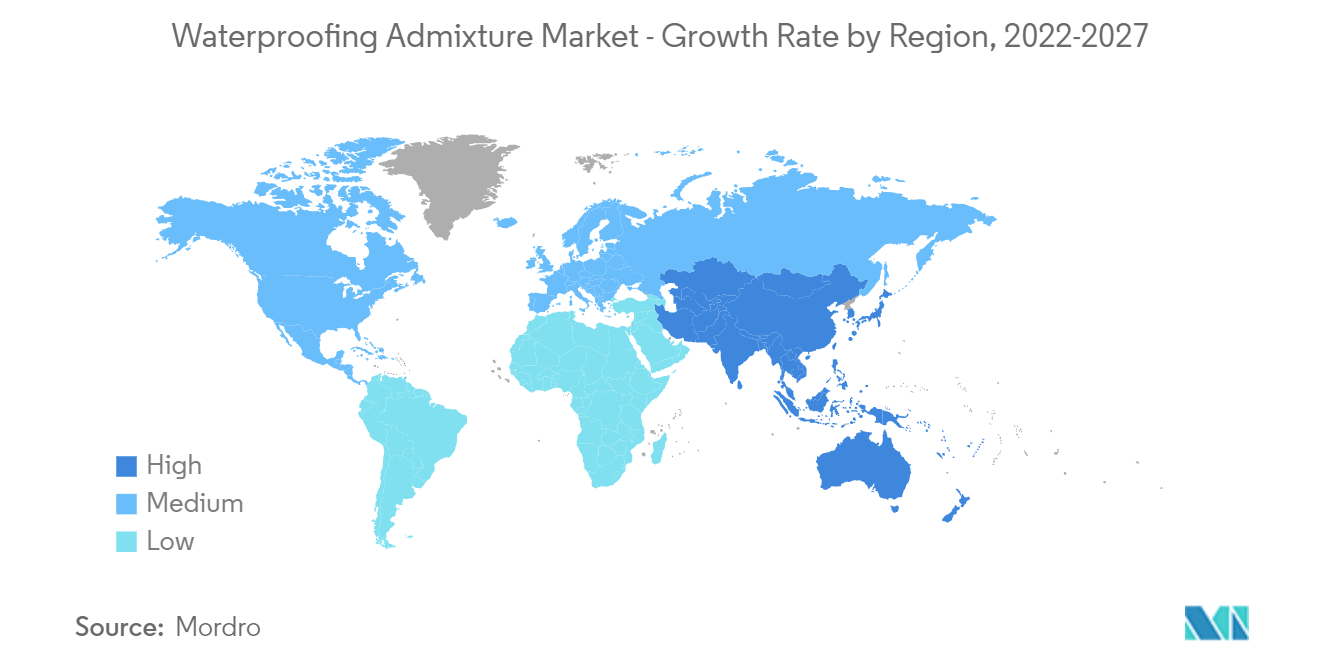
- The Asia-Pacific region is expected to dominate the market and will also witness the highest CAGR during the forecast period.
Note: Market size and forecast figures in this report are generated using Mordor Intelligence’s proprietary estimation framework, updated with the latest available data and insights as of 2026.
Global Waterproofing Admixture Market Trends and Insights
Increasing Usage in the Residential Construction
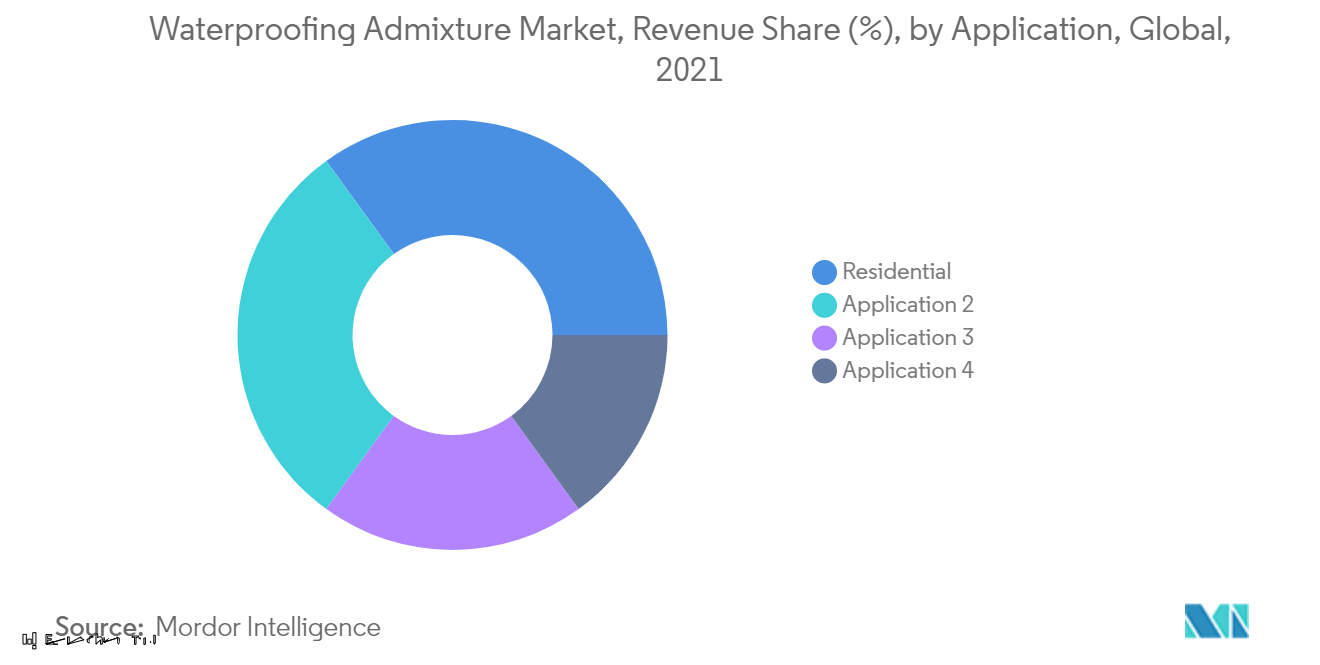
The residential sector is likely to serve as the major application in the waterproofing admixture market. Increasing construction of new residential buildings owing to the rise in disposable income of the middle class is expected to drive the waterproofing admixture market.
Superior properties of waterproofing admixture such as reduced maintenance cost and increased durability will boost the market studied. In the residential construction industry waterproofing admixture is used to prevent water penetration in concrete and improve concrete cohesion capacity.
The waterproofing admixture also offers various others benefits such as long-lasting protection, is useful in corrosive environments, and cannot be damaged or torn during the backfill.
According to the United Nations (UN), around 50% of the global population resides in urban cities, which is projected to increase to 68%, by 2050. The pace of economic and demographic growth must be in harmony with the demand for residential construction activities.
Furthermore, by 2030, about 40% of the population worldwide is likely to need housing at the rate of over 96,150 houses per day. Hence, with the growth of the residential sector, the use of waterproofing admixture is likely to increase.
Owing to all these factors, the market for waterproofing admixture is likely to grow globally during the forecast period.


Asia-Pacific Region to Dominate the Market
The Asia-Pacific region is expected to dominate the market. In the region, China is the largest economy, in terms of GDP. China and India are among the fastest emerging economies in the world.
The construction industry in Asia-Pacific is expected to become the largest and the fastest-growing industry globally, with over 45% share of global construction spending coming from the region. Construction output in Asia-Pacific is estimated to reach USD 7.4 trillion by 2030, according to an Oxford Economics report.
China dominates the construction industry in the Asia-Pacific region. The Chinese construction industry depicted significant growth over the years. China's construction market witnessed the slowest growth of just over 1% in 30 years in 2020. In 2020, the construction industry in China was valued at USD 1,049.19 billion. However, major government spending, especially focused on infrastructure has resulted in a rebounding of construction activity in 2021.
India's construction industry is expected to grow due to increased demand for infrastructure projects and real estate. FDI in the construction sector stood at USD 26.17 billion between April 2000 to December 2021, according to the Department for Promotion of Industry and Internal Trade (DPIIT). In the fiscal year 2021, infrastructure activities amounted to over 13% share of the total Foreign Direct Investment (FDI) inflow in the country. Besides, in the union budget 2021, the Indian government announced the allocation of USD 32.02 billion to transport infrastructure.
Owing to the sudden rise in the residential construction and projects related to the Tokyo Olympics 2021, the Japanese construction sector remained positive in terms of short-term growth. Additionally, Increasing investments in public infrastructure, renewable energy infrastructure, and commercial projects, the construction sector in the country is expected to record growth at a moderate pace during the forecasted period.
Due to all such factors, the market for waterproofing admixture in the region is expected to have a steady growth during the forecast period.

Competitive Landscape
The Waterproofing Admixture Market is partially fragmented in nature. Some of the major players in the market include BASF SE, Sika AG, MAPEI S.p.A, W. R. Grace & Co.-Conn. and Penetron, among others (not in any particular order).
Waterproofing Admixture Industry Leaders
BASF SE
Sika AG
MAPEI S.p.A
Penetron
W. R. Grace & Co.-Conn.
- *Disclaimer: Major Players sorted in no particular order

Market Opportunities and Future Outlook
Product innovation and portfolio upgrades in waterproofing admixtures are expanding application areas where durability and low-permeability concrete are specified, including marine, bridge, wastewater, and below-grade infrastructure. For example, BASF introduced high-performance formulations such as MasterLife SF 100 in 2024 for demanding infrastructure exposures, while Chryso introduced CWA Liquid 200, a liquid crystalline waterproofing admixture, in Africa in February 2026 for infrastructure use cases.
Producers are also increasing localized supply and capability coverage to meet project demand and specification requirements across construction regions. In February 2026, Sika expanded its global manufacturing footprint by opening new facilities across multiple countries to add concrete admixture capacity closer to end markets. In June 2026, Saint-Gobain (Chryso) started building a new 10,000 m2 admixture plant in Turkey, with commissioning targeted for end-2026, and the group also signed a definitive agreement to acquire Xypex Chemical Corp. (announced July 2026) to strengthen its crystalline waterproofing technology position.
Recent Industry Developments
- April 2026: BASF introduced ELASTOSPRAY BMB, a biomass balance isocyanate for spray polyurethane foam systems in North America. While the product is for polyurethane systems, the launch reflects BASF's focus on lower-embodied-carbon chemistry, which can affect waterproofing-related material choices and specifications across construction products.
- November 2025: The Penetron Group reported PENETRON ADMIX SB and PENETRON ADMIX RP were specified for the Central Pumping Station and Wastewater Plant project in Tupelo, Mississippi. The use in water infrastructure points to ongoing, specification-driven demand for integral waterproofing admixtures in concrete exposed to aggressive service conditions.
- October 2024: The Penetron Group stated PENETRON ADMIX SB was specified for elevator pits at the UT Health San Antonio Multispecialty and Research Hospital project. This indicates continued adoption of crystalline waterproofing admixtures in below-grade and moisture-sensitive building elements where long-term maintenance reduction is a key requirement.


Research Methodology Framework and Report Scope
Market Definition and Coverage
This market covers chemical admixtures added to concrete or mortar mixes to reduce water permeability and improve water resistance during the service life of the structure, captured as manufacturer revenues at selling prices.
Scope exclusions: We exclude membranes, coatings, and sealants applied as external waterproofing layers, and we also exclude standalone water-repellent surface treatments that are not dosed into the mix.
Segmentation Overview
- Type
- Crystalline
- Pore-blocking
- Other Types
- Application
- Residential
- Commercial
- Infrastructure
- Industrial and Institutional
- Geography
- Asia-Pacific
- China
- India
- Japan
- South Korea
- Rest of Asia-Pacific
- North America
- United States
- Canada
- Mexico
- Europe
- Germany
- United Kingdom
- Italy
- France
- Rest of Europe
- South America
- Brazil
- Argentina
- Rest of South America
- Middle-East and Africa
- Saudi Arabia
- South Africa
- Rest of Middle-East and Africa
- Asia-Pacific
Data Sources, Market Sizing, and Validation
Desk Research
Desk research helped us understand where demand is coming from and how the supply chain is behaving across regions. We referenced public construction and infrastructure indicators from sources such as the U.S. Census Bureau, Eurostat, and national statistics offices, which helped us sanity check building activity trends. For concrete intensity and cement linkage, sources such as the U.S. Geological Survey and World Cement Association style publications were used as context signals rather than direct sizing inputs.
We also reviewed building code and standards updates, for example concrete durability and water tightness guidance, plus technical papers in peer reviewed civil engineering journals to map typical admixture usage in water retaining and below grade structures. Company annual reports, investor decks, and press releases were used to understand product positioning and regional exposure, then cross checked using paid subscriptions for company financials and news, patent databases, and import export shipment level signals where trade classification mapping was clear. The desk sources listed above are not exhaustive, and additional public and proprietary references were used to collect data, validate assumptions, and clarify gaps.
Primary Interviews and Surveys
Primary work focused on getting realistic dosage norms, price movements, and where waterproofing admixtures are being substituted by other waterproofing choices. We spoke with a mix of admixture manufacturers, distributors, ready mix producers, and project side roles such as contractors and specifiers. These interviews were used to validate regional splits and measure how often application level adoption matches what desk research suggested. For a global market, inputs were checked across major demand centers so the model does not over rely on one construction cycle.
Distribution of primary research fieldwork respondents
| Company type | Respondent position | Region |
|---|---|---|
| Top tier: 31% | CXOs: 18% | APAC: 46% |
| Mid tier: 50% | Functional/Unit leaders: 34% | EMEA: 35% |
| Smaller Players: 19% | Managers: 48% | Americas: 19% |
Market-Sizing & Forecasting
Sizing starts with a demand pool build that links construction activity to waterproofing critical concrete uses, then converts that pool into admixture value using penetration and price logic. We used a top-down approach where construction output indicators and cement and concrete demand signals are reconstructed by region, and then adjusted by the share of structures that require water tightness performance. To keep this grounded, results are corroborated with selective bottom-up approximations such as sampled supplier revenue splits, distributor channel checks, and volume by typical dosage rate multiplied by average selling prices.
Key inputs used in the model include new construction versus repair mix, infrastructure spend direction (especially water retaining and transport), ready mix production intensity, typical dosage rates by application, and average selling price progression by region and chemistry type. Where bottom-up inputs were incomplete for smaller markets, gaps were handled by applying validated adoption curves and price bands from comparable countries, then rechecked through follow up calls.
Forecasting was built using scenario analysis supported by short series trend smoothing, since construction cycles and public spending can shift quickly and do not always fit one clean time series. Assumptions on penetration, pricing, and activity growth were kept visible in the model so we could adjust them quickly after primary feedback and macro changes.
Data Validation & Update Cycle
Before sign off, we run multiple variance checks so totals make sense against independent signals such as cement consumption direction, construction output, and large project pipelines. Outliers are reviewed at the region and application level, and if the split looks inconsistent, we recheck the underlying drivers and reconnect with sources to confirm what changed.
The model and narrative are reviewed in steps by another analyst, so calculation errors and scope drift are caught early. Reports are refreshed annually, and interim updates are triggered when material events happen, such as sharp raw material price shifts, major regulation changes, or large construction cycle swings. Right before delivery, we do a fresh validation pass so clients receive the most current view we can support with evidence.
Mordor Intelligence's Waterproofing Admixture Market Size Compared With Other Published Estimates
Published market values for waterproofing admixtures can vary widely because different teams count different product baskets, apply different price points, and choose different years for currency conversion and inflation assumptions. We also see gaps when one study leans heavily on supply side revenue roll ups while another anchors on construction activity and usage rates.
The biggest differences usually come from scope, and from how demand intensity is translated into dollars, then from how often the inputs are refreshed. Some estimates treat broad waterproofing chemicals as part of this market, or they use one blended price across all chemistries, which can inflate totals in high price regions. Others project an aggressive adoption curve without validating whether ready mix producers and contractors are actually switching specifications at that pace.
Benchmark comparison
| Source | Market Size | Gaps in Research Methodology |
|---|---|---|
| Mordor Intelligence | USD 2.23 B (2025) | |
| Industry Intelligence Firm A | USD 5.89 B (2025) | Often presented as a broad global value without clear separation between admixtures dosed into concrete and adjacent waterproofing chemical categories, and the pricing basis by chemistry and region is not explained. |
| Trade News Release B | USD 6.88 B (2025) | Typically uses headline growth assumptions over a long horizon with limited disclosure on how penetration rates, dosage norms, and currency timing are applied, which can lift the starting year value. |
The spread is largely explained by what gets counted as an admixture versus a broader waterproofing chemical spend, and by how prices and penetration are applied across regions and applications. Scope is kept tighter here, and the specific gap driver is category overlap, where Mordor Intelligence counts only mix dosed waterproofing admixtures and leaves out membranes and coatings that are applied after concrete placement. With the same drivers made explicit and periodically rechecked, the resulting market value is easier to trace back to real construction demand and repeat in future updates.


Key Questions Answered in the Report
What is the current Waterproofing Admixture Market size?
The Waterproofing Admixture Market is projected to register a CAGR of 4.92% during the forecast period (2026-2031)
Who are the key players in Waterproofing Admixture Market?
BASF SE, Sika AG, MAPEI S.p.A, Penetron and W. R. Grace & Co.-Conn. are the major companies operating in the Waterproofing Admixture Market.
Which is the fastest growing region in Waterproofing Admixture Market?
Asia-Pacific is estimated to grow at the highest CAGR over the forecast period (2026-2031).
Which region has the biggest share in Waterproofing Admixture Market?
In 2025, the Asia-Pacific accounts for the largest market share in Waterproofing Admixture Market.
What years does this Waterproofing Admixture Market cover?
The report covers the Waterproofing Admixture Market historical market size for years: 2019, 2020, 2021, 2022, 2023 and 2024. The report also forecasts the Waterproofing Admixture Market size for years: 2026, 2027, 2028, 2029, 2030 and 2031.
Page last updated on:





