India Waterproofing Solutions Market Size and Share
Market Overview
| Study Period | 2021 - 2031 |
|---|---|
| Forecast Data Period | 2026 - 2031 |
| Base Year Market Size (2025) | USD 1.37 Billion |
| Market Size (2026) | USD 1.47 Billion |
| Market Size (2031) | USD 2.09 Billion |
| Growth Rate (2026 - 2031) | 7.29 % |
| Market Concentration | Medium |
Major Players *Disclaimer: Major Players sorted in no particular order Image © Mordor Intelligence. Reuse requires attribution under CC BY 4.0. | |
India Waterproofing Solutions Market Analysis by Mordor Intelligence
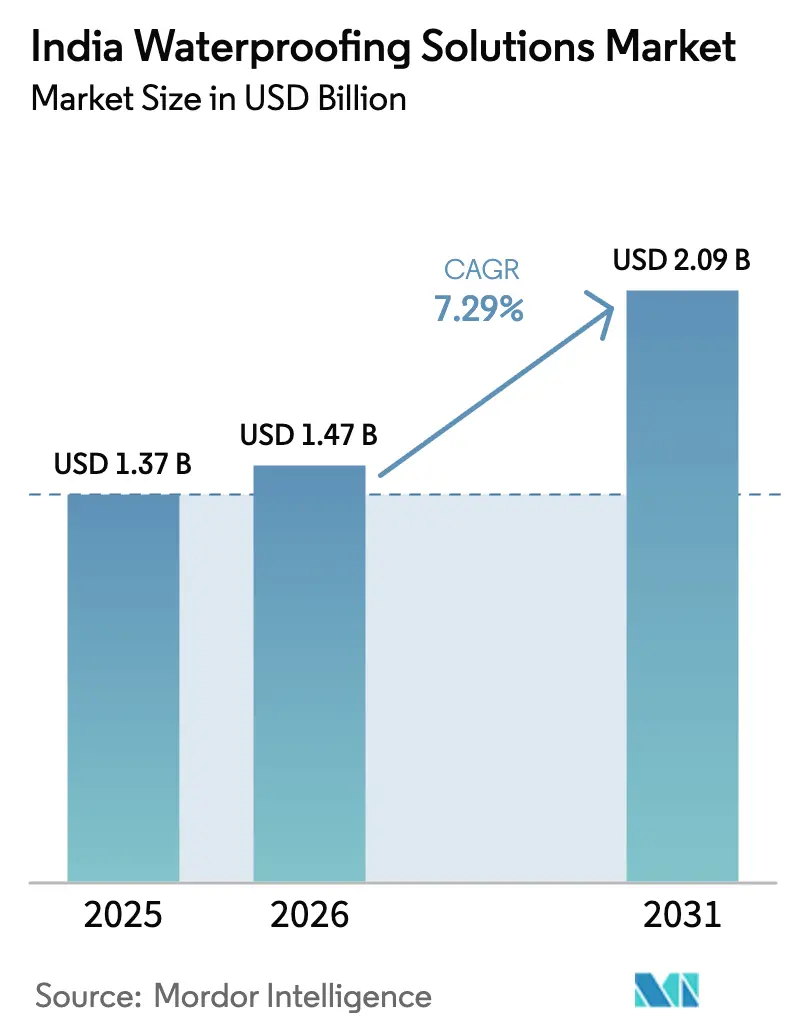
The India Waterproofing Solutions Market size is projected to be USD 1.37 billion in 2025, USD 1.47 billion in 2026, and reach USD 2.09 billion by 2031, growing at a CAGR of 7.29% from 2026 to 2031. Rising affordable-housing completions, metro-rail tunneling and stricter Bureau of Indian Standards (BIS) codes are accelerating product substitution away from traditional lime-concrete finishes toward polymer-modified membranes and low-VOC chemistries. Supply chains continue to rebalance as crude-linked feedstock swings lift input costs for polyurethane and bituminous systems, nudging contractors toward water-based acrylics that cure rapidly and meet green-building norms. Global majors deepen technical-service footprints in Tier-2 cities, while domestic leaders defend share through dense retail networks and region-specific formulations. Counterfeit membranes remain a drag on consumer confidence, yet BIS-led quality-control orders set for April 2026 are expected to remove non-compliant stock and create headroom for certified brands. E-commerce DIY kits, supported by same-day logistics, compress purchase-to-application cycles, allowing small-ticket residential work to proceed during narrow monsoon windows.
Key Report Takeaways
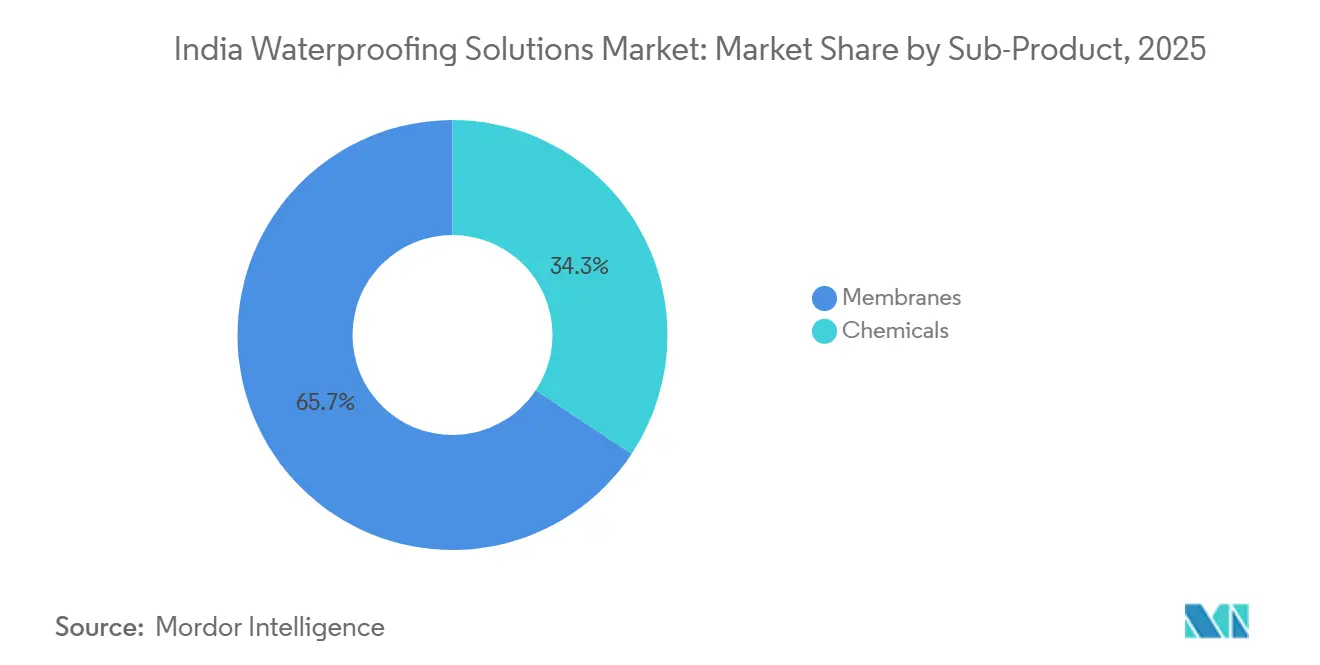
- By sub-product, membranes led with 65.68% of India waterproofing solutions market share in 2025, and is advancing at a 7.48% CAGR to 2031.
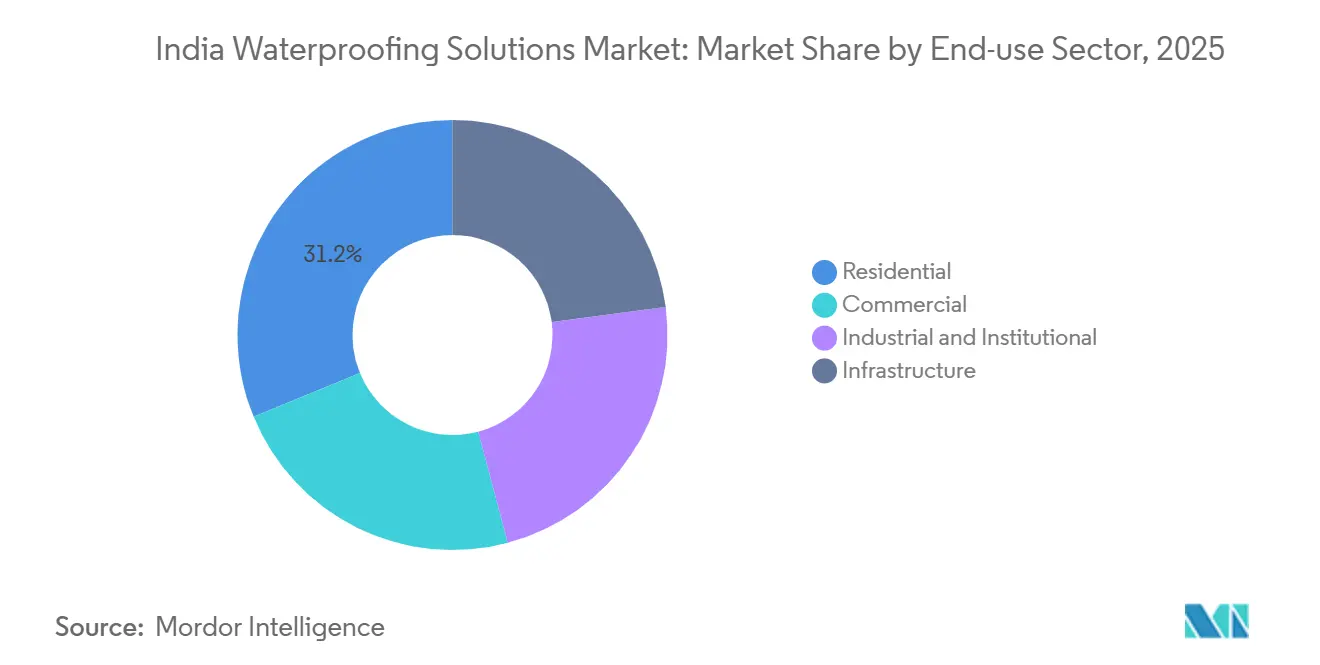
- By end-use sector, residential captured 31.21% share of the India waterproofing solutions market size in 2025 and is projected to grow at a 7.71% CAGR through 2031.
Note: Market size and forecast figures in this report are generated using Mordor Intelligence’s proprietary estimation framework, updated with the latest available data and insights as of 2026.
India Waterproofing Solutions Market Trends and Insights
Drivers Impact Analysis*
| Driver | (~) % Impact on CAGR Forecast | Geographic Relevance | Impact Timeline |
|---|---|---|---|
| Rapid urbanization and affordable-housing stimulus | +2.1% | National, with early gains in Mumbai, Bengaluru, Hyderabad | Medium term (2-4 years) |
| Intensifying monsoons prompting climate-resilient codes | +1.8% | APAC core, spill-over to coastal Maharashtra, Kerala, Odisha | Long term (≥ 4 years) |
| Shift toward low-VOC nano-penetrating chemistries | +1.0% | National, led by metro cities enforcing green building norms | Medium term (2-4 years) |
| Home-owner premiumization and 10-year warranty demand | +1.5% | National, concentrated in Tier-1 and Tier-2 residential | Short term (≤ 2 years) |
| Agile e-commerce DIY kits penetrating Tier-2 cities | +0.9% | Tier-2 cities (Coimbatore, Nagpur, Lucknow, Jaipur) | Short term (≤ 2 years) |
| Source: Mordor Intelligence | |||
Rapid Urbanization and Affordable-Housing Stimulus
India’s urban population surpassed 500 million in 2024 and is projected to reach 600 million by 2031, generating 25-30 million new dwelling units that require BIS-compliant waterproofing. The Pradhan Mantri Awas Yojana (Urban) alone sanctioned 11.2 million units by December 2024, each mandated to follow IS 13182:2020 for wet areas and IS 2645:2003 for integral compounds. State schemes in Maharashtra and Karnataka added 1.8 million units during 2024-2025, 60-70% of which sit in flood-prone zones requiring below-grade membranes per IS 16471:2017. Urban developers are shifting from lime-concrete roof finishes (IS 3036:2022) to APP/SBS-modified bituminous membranes that deliver 15-20 year service life. Parallel demand arises from 450 km of metro tunnels scheduled by 2026, where crystalline admixtures and polyurethane injection grouting meet IS 456:2000 permeability limits for underground structures.
Intensifying Monsoons Prompting Climate-Resilient Codes
The India Meteorological Department logged 110% of long-period average rainfall in the 2024 southwest monsoon, with coastal metros recording multiple 24-hour deluges above 200 mm[1]. The National Building Code 2016 (revised 2024 draft) now requires membrane systems with hydrostatic-head resistance ≥10 m in regions exceeding 2,500 mm annual precipitation. Kerala and Tamil Nadu inserted permit riders demanding third-party certification of waterproofing for projects larger than 5,000 sq ft, effectively squeezing counterfeit suppliers. Failures of Brick Bat Koba layers during intense rainfall accelerate adoption of polyurethane and acrylic membranes that balance thermal comfort with moisture control.
Shift Toward Low-VOC Nano-Penetrating Chemistries
BIS amended IS 2645:2003 in 2022 to include nano-silica and nano-TiO₂ products capped at 50 g/L VOC, aligning with the Ministry of Environment’s green-material guidelines. Silane-based repellents under the updated IS 12027 (Part 2):2025 achieve 5-10 mm penetration depths, cutting capillary absorption by up to 90% while maintaining breathability. The Indian Green Building Council awarded LEED credits for low-VOC waterproofing in 340 projects during 2024-2025, stimulating demand for water-based polyurethane dispersions. Pidilite’s March 2025 launch of Dr. Fixit Polyplus CP targets this niche with a sub-30 g/L VOC crystalline admixture.
Home-Owner Premiumization and 10-Year Warranty Demand
Escalating apartment prices in Mumbai, Bengaluru and Delhi—up 8-12% year-on-year through 2025—encourage buyers to seek 10-year transferable waterproofing warranties. Asian Paints’ SmartCare Damp Shield Pro, launched January 2025, offers such coverage backed by ICICI Lombard insurance. Contractor surveys show 68% now insist on BIS-certified membranes to avoid warranty disputes, versus 42% in 2022. Fully adhered APP/SBS sheets grew 9.2% in 2024-2025, reflecting consumer preference for adhesion strength in cyclone-prone coasts.
Restraints Impact Analysis*
| Restraint | (~) % Impact on CAGR Forecast | Geographic Relevance | Impact Timeline |
|---|---|---|---|
| Crude-linked volatility in polyurethane and bitumen feedstocks | -1.2% | National, with acute impact on membrane manufacturers | Short term (≤ 2 years) |
| Counterfeit membranes eroding consumer confidence | -0.7% | Semi-urban and rural markets, Tier-3 cities | Medium term (2-4 years) |
| Winter humidity window limiting site applications | -0.6% | North India (Delhi NCR, UP, Haryana, Punjab, Rajasthan) | Short term (≤ 2 years) |
| Source: Mordor Intelligence | |||
Crude-Linked Volatility In Polyurethane And Bitumen Feedstocks
Polyurethane and bitumen account for roughly 60% of membrane raw-material costs, and both mirror Brent-crude swings that ranged USD 70-90 per barrel during 2024-2025. MDI prices jumped 15-20% within 2024, squeezing gross margins for Sika India by 180 basis points despite 5-7% price hikes. Bitumen rose from INR 38,000 to INR 44,500 per tonne between January and September 2024, forcing two price rounds totaling 12% and delaying price-sensitive infrastructure jobs. Smaller manufacturers without hedging capacity operated at sub-10% EBITDA margins by H2 2024, down from 14-16% a year earlier.
Counterfeit Membranes Eroding Consumer Confidence
Field inspections in Uttar Pradesh, Bihar and Madhya Pradesh found 22% of tested membranes failing IS 1322:1993 impermeability criteria, while 18% lacked minimum tensile strength. These counterfeit sheets often under-dose SBS/APP modifiers, cutting service life to 3-5 years and inflating lifecycle costs by up to 80%. A 2024 Nielsen survey showed 34% of homeowners delaying projects due to product-quality doubts. BIS Quality-Control Orders effective April 2026 will compel all makers to obtain ISI marks, likely eliminating a quarter of non-compliant supply but causing short-term price firmness.
*Our forecasts treat driver/restraint impacts as directional, not additive. The impact forecasts reflect baseline growth, mix effects, and variable interactions.
Segment Analysis
By Sub-Product: Membranes Lead On Infrastructure Tailwinds, Chemicals Gain In Retrofit
Membranes held 65.68% of India waterproofing solutions market share in 2025, and is forecast to post a 7.48% CAGR to 2031, buoyed by metro-tunnel waterproofing and high-rise residential mandates under IS 16525-16540:2017. Within membranes, fully adhered APP/SBS sheets control majority of segment revenue, especially in below-grade and tunnel works where hydrostatic resistance above 10 m is essential. Cold liquid-applied polyurethane and acrylic membranes cover use is also growing because they adapt to complex rooftops and cure in 4-6 hours. Hot liquid-applied bitumen is declining due to 200°C application safety concerns, while loose-laid sheets occupy lower market in low-slope commercial roofs.
Waterproofing chemicals make up the remaining 34.32% segment R as weather-dependent curing elongates schedules. Polyurethane liquids lead chemicals on the strength of more than 400% elongation at break, suitable for terraces seeing thermal cycling. Epoxy systems are used in chemically aggressive industrial floors, while water-based acrylics are surging because low-VOC limits and DIY kits favor their easy cleanup. Crystalline admixtures and cementitious coatings are also growing as affordable-housing builders seek integral solutions that cut maintenance 30-40%.

By End-use Sector: Residential Premiumization Outpaces Infrastructure Volume
Residential captured 31.21% of India waterproofing solutions market size in 2025 and is the fastest-growing end use at 7.71% CAGR, underpinned by 11.2 million PMAY units and premium buyers demanding 10-year warranties. Affordable-housing opts for integral compounds priced INR 40-60 per sq ft, whereas projects above INR 10,000 per sq ft install APP/SBS sheets and polyurethane membranes costing INR 150-250 per sq ft. Commercial buildings, with Grade-A offices in Bengaluru and Hyderabad specifying SRI ≥78 cool-roof coatings to meet the Energy Conservation Building Code 2017[2]. Industrial and institutional sites are growing due tp pharmaceutical cleanrooms and hospital floors that require epoxy-polyurethane hybrids.
Infrastructure contributes smaller share because budget reallocations have slowed some expressway and bridge projects, even though absolute demand stays high. Metro tunnels in Mumbai and Kolkata, sitting below high water tables, heavily use crystalline admixtures able to self-seal cracks up to 0.4 mm, reducing long-term leakage repairs by 30-40%. Segment regulatory frameworks differ for residential and commercial must comply with IS 13182:2020 for wet areas, while infrastructure follows IS 456:2000 concrete thresholds and Indian Railway or Roads Clause Books.
Geography Analysis
Maharashtra, Karnataka and Tamil Nadu together generated majority of India waterproofing solutions market size in 2025 as robust construction pipelines mesh with strict BIS enforcement. Maharashtra’s share is supported by Mumbai’s 85 km metro build-out and Pune’s 12 million sq ft Grade-A office pipeline, both specifying polyurethane injection grouting and SRI-compliant cool roofs. Karnataka demand is propelled by Bengaluru’s 42 million sq ft housing launches and electronics parks demanding epoxy floors. Tamil Nadu, with cyclone-exposed Chennai choosing wind-resistant APP sheets and Coimbatore textile retrofits leaning on liquid-applied polyurethane.
North India expands more slowly because winter humidity exceeds 80% RH for three months, limiting membrane application. In Delhi NCR, commercial offices and Phase IV metro tunnels need crystalline admixtures. Uttar Pradesh and Bihar see counterfeit rates up to 25% and fewer than 50 enforcement raids in 2024. In West India—Gujarat and Rajasthan—Ahmedabad chemical corridors specify solvent-free epoxies, and Rajasthan solar parks demand reflective roof membranes to cool modules. East and Northeast states demand is anchored by Kolkata Metro extensions and Odisha’s coastal expressway bridges, where high Wind-Driven Rain Index obliges fully adhered membranes resisting 10 m hydrostatic head.
Competitive Landscape
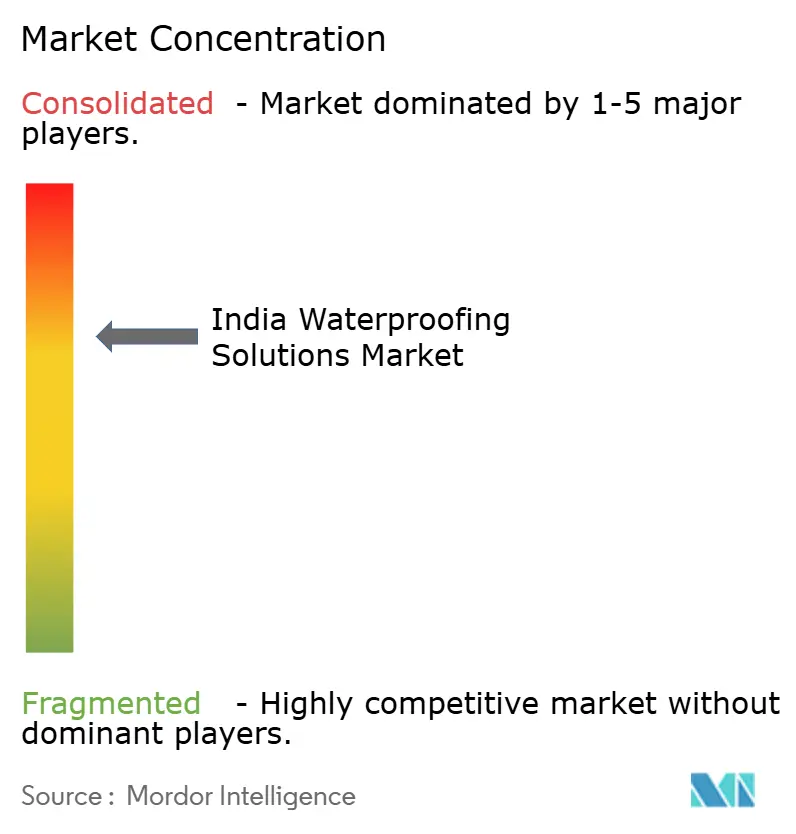
India waterproofing solutions market remains moderately fragmented; the top five—Asian Paints, Pidilite, Sika, MAPEI and Berger Paints—controlled roughly 70% revenue in 2025. Global majors deepen service networks: Sika runs 18 technical centers that conduct on-site failure analysis within 24 hours, while MAPEI’s 12 regional labs turn around custom recipes in 48 hours. Domestic leaders counter with retail density—Pidilite supplies 500,000 outlets, enabling same-day reach to 85% of Tier-2/3 towns—and climate-specific chemistries like low-VOC acrylics for North Indian winters.
Vertical integration gathers pace. UltraTech Cement bought Wonder WallCare Chemicals in October 2024 to bundle waterproofing additives with ready-mix concrete, echoing Thermax’s August 2024 entry into epoxy membranes via Buildtech Products. White-space opportunities cluster in nano-silica formulations, self-healing crystalline admixtures and e-commerce DIY kits. Niche players such as Xypex and Kryton leverage IS 2645:2003-approved crystalline technology to secure 3-4% share in infrastructure tenders. Saint-Gobain’s Weber brand gained BIS certification for crystalline admixtures in February 2025, broadening access to metro and dam projects.
India Waterproofing Solutions Industry Leaders
-
Pidilite Industries Ltd.
-
Sika AG
-
Asian Paints Ltd.
-
Berger Paints India
-
MAPEI S.p.A.
- *Disclaimer: Major Players sorted in no particular order
Recent Industry Developments
- August 2025: Ramco Cements introduced "Hard Worker," a new brand within its Construction Chemicals product portfolio. The range includes 20 specialized Hard Worker products, including waterproofing solutions, each specifically designed to address the evolving requirements of India's construction industry.
- July 2025: TIKIDAN expanded its product portfolio by introducing Revestidan Protect Max to the Indian market. This waterproofing solution is designed to safeguard rooftops, terraces, and other exposed surfaces against leaks, cracks, and weather-related damage.
India Waterproofing Solutions Market Report Scope
Waterproofing solutions encompass various materials and methods, such as liquid membranes, sheet membranes, and cementitious coatings, designed for specific applications including roofs, basements, and bathrooms to protect against water damage.
The India waterproofing solutions market is segmented by sub-product and end-use sector. By sub-product, the market is segmented into membranes and chemicals. The membranes are further segmented into cold liquid applied, fully adhered sheet, hot liquid applied, and loose-laid sheet. The chemicals are further segmented into epoxy-based, polyurethane-based, water-based, and other technologies. By end-use sector, the market is segmented into residential, commercial, industrial and institutional, and infrastructure. For each segment, the market sizing and forecasts have been done on the basis of value (USD).
| Membranes | Cold Liquid Applied |
| Fully Adhered Sheet | |
| Hot Liquid Applied | |
| Loose-Laid Sheet | |
| Chemicals | Epoxy-based |
| Polyurethane-based | |
| Water-based | |
| Other Technologies |
| Residential |
| Commercial |
| Industrial and Institutional |
| Infrastructure |
| By Sub Product | Membranes | Cold Liquid Applied |
| Fully Adhered Sheet | ||
| Hot Liquid Applied | ||
| Loose-Laid Sheet | ||
| Chemicals | Epoxy-based | |
| Polyurethane-based | ||
| Water-based | ||
| Other Technologies | ||
| By End-use Sector | Residential | |
| Commercial | ||
| Industrial and Institutional | ||
| Infrastructure | ||
Market Definition
- END-USE SECTOR - Waterproofing solutions consumed in the construction sectors such as commercial, residential, industrial, institutional, and infrastructure are considered under the scope of the study.
- PRODUCT/APPLICATION - Under the scope of the study, the consumption of waterproofing solutions such as membranes, coatings, and chemicals are considered.
| Keyword | Definition |
|---|---|
| Accelerator | Accelerators are admixtures used to fasten the setting time of concrete by increasing the initial rate and speeding up the chemical reaction between cement and the mixing water. These are used to harden and increase the strength of concrete quickly. |
| Acrylic | This synthetic resin is a derivative of acrylic acid. It forms a smooth surface and is mainly used for various indoor applications. The material can also be used for outdoor applications with a special formulation. |
| Adhesives | Adhesives are bonding agents used to join materials by gluing. Adhesives can be used in construction for many applications, such as carpet laying, ceramic tiles, countertop lamination, etc. |
| Air Entraining Admixture | Air-entraining admixtures are used to improve the performance and durability of concrete. Once added, they create uniformly distributed small air bubbles to impart enhanced properties to the fresh and hardened concrete. |
| Alkyd | Alkyds are used in solvent-based paints such as construction and automotive paints, traffic paints, flooring resins, protective coatings for concrete, etc. Alkyd resins are formed by the reaction of an oil (fatty acid), a polyunsaturated alcohol (Polyol), and a polyunsaturated acid or anhydride. |
| Anchors and Grouts | Anchors and grouts are construction chemicals that stabilize and improve the strength and durability of foundations and structures like buildings, bridges, dams, etc. |
| Cementitious Fixing | Cementitious fixing is a process in which a cement-based grout is pumped under pressure to fill forms, voids, and cracks. It can be used in several settings, including bridges, marine applications, dams, and rock anchors. |
| Commercial Construction | Commercial construction comprises new construction of warehouses, malls, shops, offices, hotels, restaurants, cinemas, theatres, etc. |
| Concrete Admixtures | Concrete admixtures comprise water reducers, air entrainers, retarders, accelerators, superplasticizers, etc., added to concrete before or during mixing to modify its properties. |
| Concrete Protective Coatings | To provide specific protection, such as anti-carbonation or chemical resistance, a film-forming protective coat can be applied on the surface. Depending on the applications, different resins like epoxy, polyurethane, and acrylic can be used for concrete protective coatings. |
| Curing Compounds | Curing compounds are used to cure the surface of concrete structures, including columns, beams, slabs, and others. These curing compounds keep the moisture inside the concrete to give maximum strength and durability. |
| Epoxy | Epoxy is known for its strong adhesive qualities, making it a versatile product in many industries. It resists heat and chemical applications, making it an ideal product for anyone needing a stronghold under pressure. It is widely used in adhesives, electrical and electronics, paints, etc. |
| Fiber Wrapping Systems | Fiber Wrapping Systems are a part of construction repair and rehabilitation chemicals. It involves the strengthening of existing structures by wrapping structural members like beams and columns with glass or carbon fiber sheets. |
| Flooring Resins | Flooring resins are synthetic materials applied to floors to enhance their appearance, increase their resistance to wear and tear or provide protection from chemicals, moisture, and stains. Depending on the desired properties and the specific application, flooring resins are available in distinct types, such as epoxy, polyurethane, and acrylic. |
| High-Range Water Reducer (Super Plasticizer) | High-range water reducers are a type of concrete admixture that provides enhanced and improved properties when added to concrete. These are also called superplasticizers and are used to decrease the water-to-cement ratio in concrete. |
| Hot Melt Adhesives | Hot-melt adhesives are thermoplastic bonding materials applied as melts that achieve a solid state and resultant strength on cooling. They are commonly used for packaging, coatings, sanitary products, and tapes. |
| Industrial and Institutional Construction | Industrial and institutional construction includes new construction of hospitals, schools, manufacturing units, energy and power plants, etc. |
| Infrastructure Construction | Infrastructure construction includes new construction of railways, roads, seaways, airports, bridges, highways, etc. |
| Injection Grouting | The process of injecting grout into open joints, cracks, voids, or honeycombs in concrete or masonry structural members is known as injection grouting. It offers several benefits, such as strengthening a structure and preventing water infiltration. |
| Liquid-Applied Waterproofing Membranes | Liquid-Applied membrane is a monolithic, fully bonded, liquid-based coating suitable for many waterproofing applications. The coating cures to form a rubber-like elastomeric waterproof membrane and may be applied over many substrates, including asphalt, bitumen, and concrete. |
| Micro-concrete Mortars | Micro-concrete mortar is made up of cement, water-based resin, additives, mineral pigments, and polymers and can be applied on both horizontal and vertical surfaces. It can be used to refurbish residential complexes, commercial spaces, etc. |
| Modified Mortars | Modified Mortars include Portland cement and sand along with latex/polymer additives. The additives increase adhesion, strength, and shock resistance while also reducing water absorption. |
| Mold Release Agents | Mold release agents are sprayed or coated on the surface of molds to prevent a substrate from bonding to a molding surface. Several types of mold release agents, including silicone, lubricant, wax, fluorocarbons, and others, are used based on the type of substrates, including metals, steel, wood, rubber, plastic, and others. |
| Polyaspartic | Polyaspartic is a subset of polyurea. Polyaspartic floor coatings are typically two-part systems that consist of a resin and a catalyst to ease the curing process. It offers high durability and can withstand harsh environments. |
| Polyurethane | Polyurethane is a plastic material that exists in various forms. It can be tailored to be either rigid or flexible and is the material of choice for a broad range of end-user applications, such as adhesives, coatings, building insulation, etc. |
| Reactive Adhesives | A reactive adhesive is made of monomers that react in the adhesive curing process and do not evaporate from the film during use. Instead, these volatile components become chemically incorporated into the adhesive. |
| Rebar Protectors | In concrete structures, rebar is one of the important components, and its deterioration due to corrosion is a major issue that affects the safety, durability, and life span of buildings and structures. For this reason, rebar protectors are used to protect against degrading effects, especially in infrastructure and industrial construction. |
| Repair and Rehabilitation Chemicals | Repair and Rehabilitation Chemicals include repair mortars, injection grouting materials, fiber wrapping systems, micro-concrete mortars, etc., used to repair and restore existing buildings and structures. |
| Residential Construction | Residential construction involves constructing new houses or spaces like condominiums, villas, and landed homes. |
| Resin Fixing | The process of using resins like epoxy and polyurethane for grouting applications is called resin fixing. Resin fixing offers several advantages, such as high compressive and tensile strength, negligible shrinkage, and greater chemical resistance compared to cementitious fixing. |
| Retarder | Retarders are admixtures used to slow down the setting time of concrete. These are usually added with a dosage rate of around 0.2% -0.6% by weight of cement. These admixtures slow down hydration or lower the rate at which water penetrates the cement particles by making concrete workable for a long time. |
| Sealants | A sealant is a viscous material that has little or no flow qualities, which causes it to remain on surfaces where they are applied. Sealants can also be thinner, enabling penetration to a certain substance through capillary action. |
| Sheet Waterproofing Membranes | Sheet membrane systems are reliable and durable thermoplastic waterproofing solutions that are used for waterproofing applications even in the most demanding below-ground structures, including those exposed to highly aggressive ground conditions and stress. |
| Shrinkage Reducing Admixture | Shrinkage-reducing admixtures are used to reduce concrete shrinkage, whether from drying or self-desiccation. |
| Silicone | Silicone is a polymer that contains silicon combined with carbon, hydrogen, oxygen, and, in some cases, other elements. It is an inert synthetic compound that comes in various forms, such as oil, rubber, and resin. Due to its heat-resistant properties, it finds applications in sealants, adhesives, lubricants, etc. |
| Solvent-borne Adhesives | Solvent-borne adhesives are mixtures of solvents and thermoplastic or slightly cross-linked polymers such as polychloroprene, polyurethane, acrylic, silicone, and natural and synthetic rubbers. |
| Surface Treatment Chemicals | Surface treatment chemicals are chemicals used to treat concrete surfaces, including roofs, vertical surfaces, and others. They act as curing compounds, demolding agents, rust removers, and others. They are cost-effective and can be used on roadways, pavements, parking lots, and others. |
| Viscosity Modifier | Viscosity Modifiers are concrete admixtures used to change various properties of admixtures, including viscosity, workability, cohesiveness, and others. These are usually added with a dosage of around 0.01% to 0.1% by weight of cement. |
| Water Reducer | Water reducers, also called plasticizers, are a type of admixture used to decrease the water-to-cement ratio in the concrete, thereby increasing the durability and strength of concrete. Various water reducers include refined lignosulfonates, gluconates, hydroxycarboxylic acids, sugar acids, and others. |
| Water-borne Adhesives | Water-borne adhesives use water as a carrier or diluting medium to disperse resin. They are set by allowing the water to evaporate or be absorbed by the substrate. These adhesives are compounded with water as a dilutant rather than a volatile organic solvent. |
| Waterproofing Chemicals | Waterproofing chemicals are designed to protect a surface from the perils of leakage. A waterproofing chemical is a protective coating or primer applied to a structure's roof, retaining walls, or basement. |
| Waterproofing Membranes | Waterproofing membranes are liquid-applied or self-adhering layers of water-tight materials that prevent water from penetrating or damaging a structure when applied to roofs, walls, foundations, basements, bathrooms, and other areas exposed to moisture or water. |
Research Methodology
Mordor Intelligence follows a four-step methodology in all our reports.
- Step-1: Identify Key Variables: The quantifiable key variables (industry and extraneous) pertaining to the specific product segment and country are selected from a group of relevant variables & factors based on desk research & literature review; along with primary expert inputs. These variables are further confirmed through regression modeling (wherever required).
- Step-2: Build a Market Model: In order to build a robust forecasting methodology, the variables and factors identified in Step-1 are tested against available historical market numbers. Through an iterative process, the variables required for market forecast are set and the model is built on the basis of these variables.
- Step-3: Validate and Finalize: In this important step, all market numbers, variables and analyst calls are validated through an extensive network of primary research experts from the market studied. The respondents are selected across levels and functions to generate a holistic picture of the market studied.
- Step-4: Research Outputs: Syndicated Reports, Custom Consulting Assignments, Databases & Subscription Platforms