
Voice Biometrics Market Size and Share
Market Overview
| Study Period | 2021 - 2031 |
|---|---|
| Market Size (2026) | USD 3.06 Billion |
| Market Size (2031) | USD 6.54 Billion |
| Growth Rate (2026 - 2031) | 16.41 % |
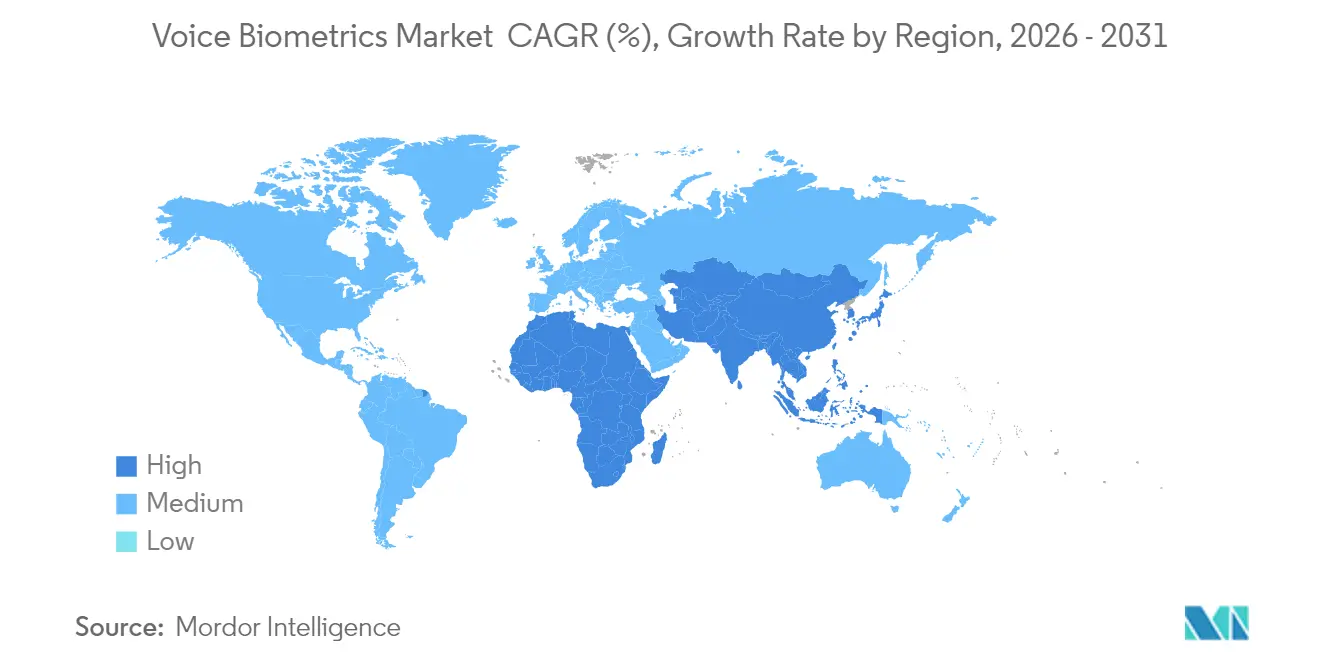
| Fastest Growing Market | Asia |
| Largest Market | North America |
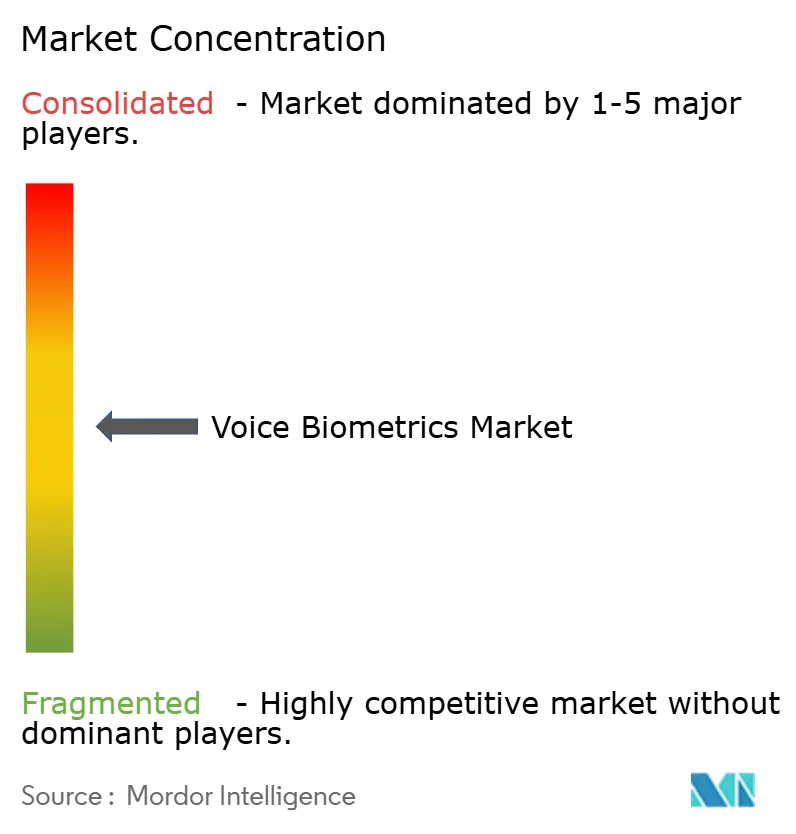
| Market Concentration | Medium |
Major Players
*Disclaimer: Major Players sorted in no particular order Image © Mordor Intelligence. Reuse requires attribution under CC BY 4.0. |
|
Voice Biometrics Market Analysis by Mordor Intelligence
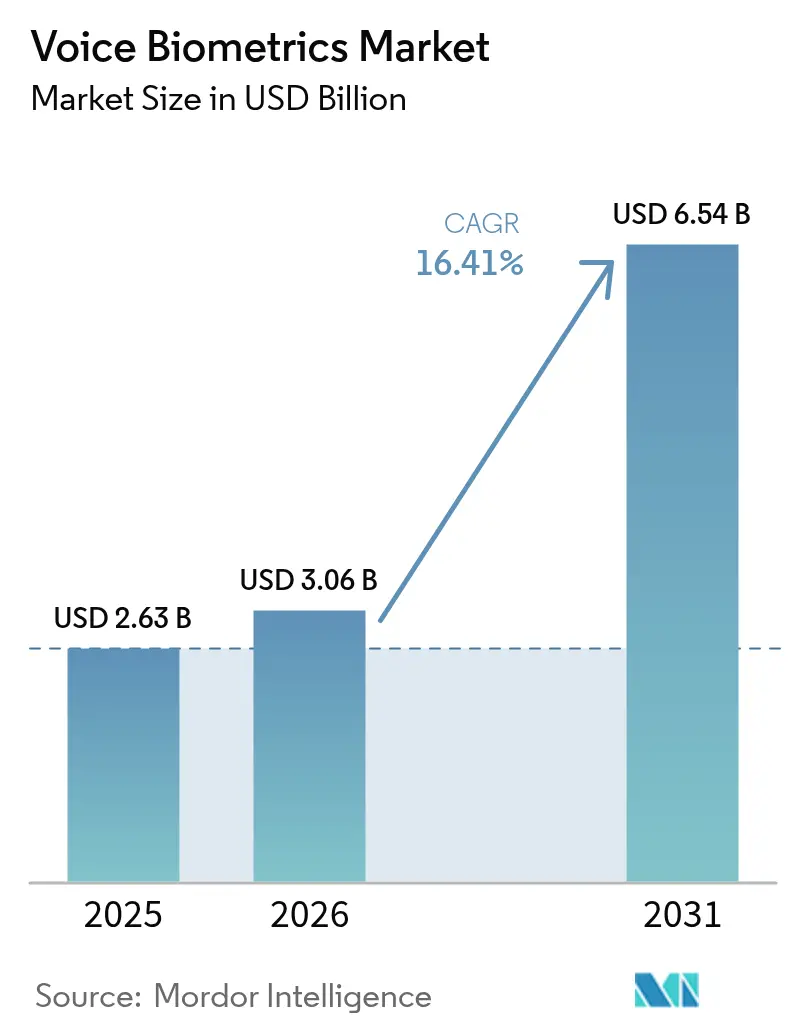
The voice biometrics market size is expected to grow from USD 2.63 billion in 2025 to USD 3.06 billion in 2026 and is forecast to reach USD 6.54 billion by 2031 at 16.41% CAGR over 2026-2031. Demand is rising because cyber-criminals now weaponize artificial intelligence, social engineering, and synthetic speech, rendering passwords unreliable. Financial institutions, telecom operators, and government agencies respond by replacing knowledge-based questions with real-time voice verification. Wider 5G coverage, edge AI chips in smartphones, and lower cloud inference costs also sustain adoption. Regulatory authorities classify voiceprints as sensitive personal data, so organizations must combine privacy-by-design practices with anti-spoofing analytics. Vendor consolidation is underway as platform players integrate biometrics into zero-trust toolkits, while specialist firms supply deepfake detection modules and multilingual models tuned for low-resource dialects.
Key Report Takeaways
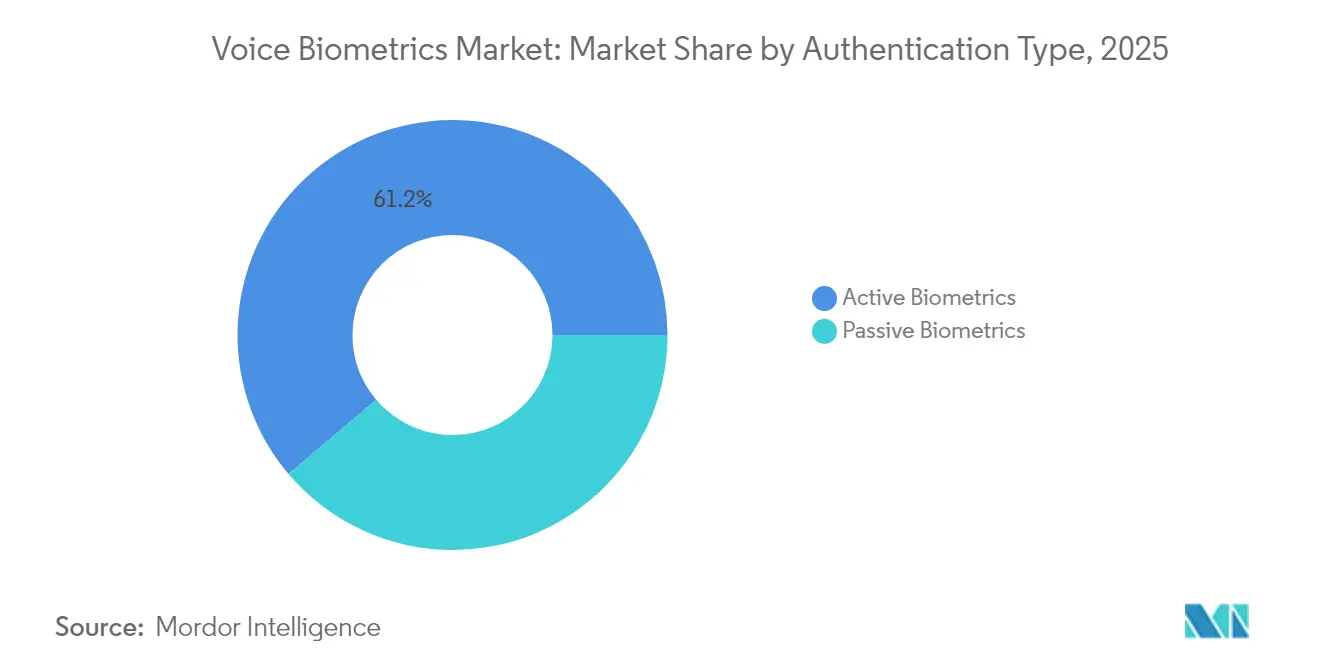
- By authentication type, active solutions held 61.20% of the voice biometrics market share in 2025; passive solutions are projected to expand at an 18.36% CAGR to 2031.
- By component, software captured 69.10% revenue share in 2025, whereas services are on track to grow at 18.02% CAGR through 2031.
- By deployment model, cloud accounted for 67.10% share of the voice biometrics market size in 2025 and is forecast to climb at an 17.74% CAGR between 2026-2031.
- By enterprise size, large organizations led with 57.20% share in 2025; small and medium businesses are expected to post 18.89% CAGR to 2031.
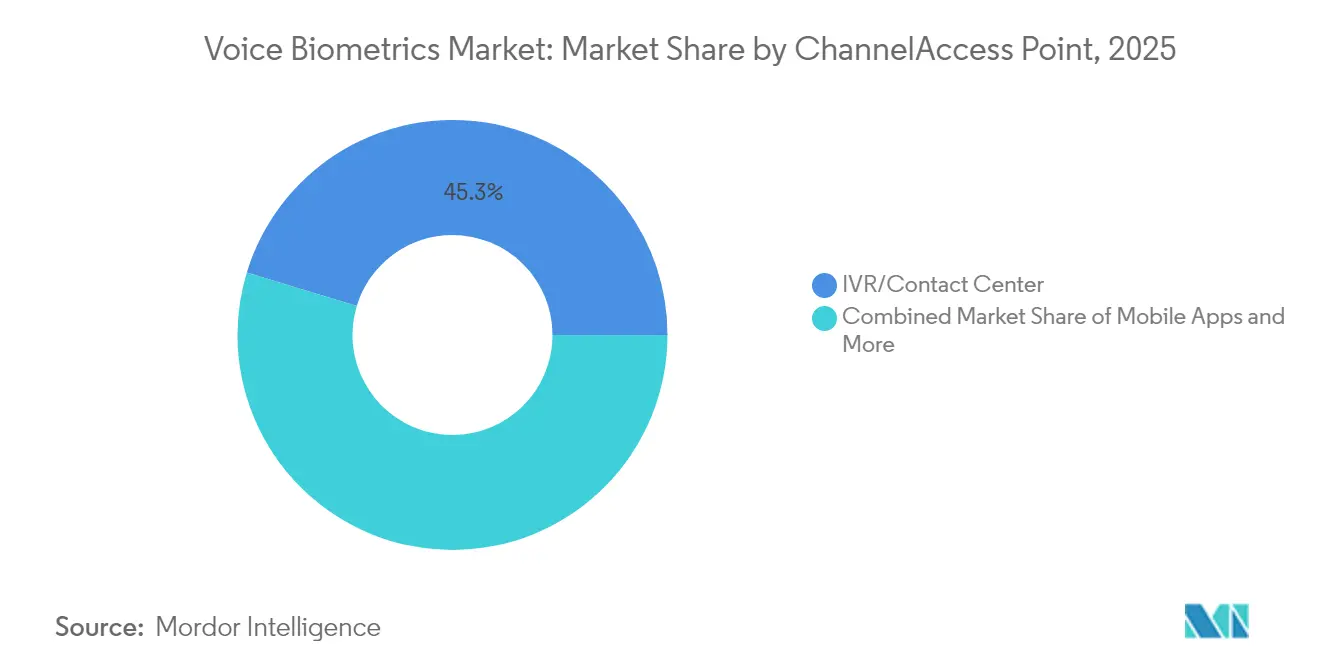
- By channel, IVR and contact centers led with 45.30% share of the voice biometrics market size in 2025, while mobile apps should record a 19.62% CAGR to 2031.
- By end-use industry, BFSI commanded 31.40% of the voice biometrics market share in 2025, and healthcare is projected to progress at 19.05% CAGR through 2031.
Note: Market size and forecast figures in this report are generated using Mordor Intelligence’s proprietary estimation framework, updated with the latest available data and insights as of 2026.
Global Voice Biometrics Market Trends and Insights
Drivers Impact Analysis*
| Driver | (~) % Impact on CAGR Forecast | Geographic Relevance | Impact Timeline |
|---|---|---|---|
| Transition to password-less authentication in mobile banking | +3.2% | North America, Europe, APAC spillover | Medium term (2-4 years) |
| Regulatory pressure for strong customer authentication | +2.8% | EU, India, United States | Short term (≤ 2 years) |
| Deepfake-driven contact-center upgrades | +4.1% | North America, Europe | Short term (≤ 2 years) |
| Fintech-led payment growth in emerging Asia | +2.5% | India, China, ASEAN-5 | Medium term (2-4 years) |
| Source: Mordor Intelligence | |||
Transition to password-less authentication in mobile banking
Banks and e-wallet providers substitute static passwords with voiceprints to decrease abandonment during log-in and to stop account-takeover fraud. 81% of contact-center leaders already deploy or plan voice verification, and flagship institutions such as Bank of Ireland invested USD 36 million to embed voice checks into interactive voice response menus.[1]Biometric Update, "Bank of Ireland to introduce voice biometrics to authentication for phone interactions", biometricupdate.com The method suits small screens where typing is slow and error-prone, while continuous authentication during a call trims handle time and removes one-time codes.
Regulatory pressure for strong customer authentication
Rules such as PSD2, the Reserve Bank of India’s guidelines, and US instant-payment rails oblige financial firms to prove user identity with at least two independent factors. Voice biometrics adds an inherent layer that satisfies compliance without extra hardware for customers. The EU Artificial Intelligence Act labels voice verification a high-risk category, obliging providers to document model governance, bias testing, and incident response, accelerating procurement of certified platforms.[2]European Parliament, "Regulation (EU) 2024/1689 of the European Parliament and of the Council of 13 June 2024 Laying Down Harmonised Rules on Artificial Intelligence", eur-lex.europa.eu
Deepfake-driven contact-center upgrades
Synthetic speech now imitates senior executives with near-perfect prosody, enabling large-scale fraud. A USD 25 million heist in 2024 revealed gaps in caller validation, leading enterprises to augment existing speaker recognition with real-time deepfake scoring and voice-liveness checks.[3]Reality Defender, "Contact Center Security - Reality Defender", realitydefender.comSpecialist engines compare spectral cues and emotional variance to flag cloned audio, and managed-service outsourcers integrate these APIs to reopen customer lines with lower friction.
Fintech-led payment growth in emerging Asia
Super-apps and payment banks scale across India and Southeast Asia, enrolling first-time digital users who may not possess high-quality identity documents. Voice verification, agnostic to literacy and compatible with local dialects, simplifies KYC and supports inclusive onboarding. Government incentive schemes for open banking and real-time payments further encourage providers to embed voice authentication into mobile flows.
Restraints Impact Analysis*
| Restraint | (~) % Impact on CAGR Forecast | Geographic Relevance | Impact Timeline |
|---|---|---|---|
| Bias in multilingual and dialect-rich models | −1.8% | India, EU, Africa | Medium term (2-4 years) |
| Data-residency rules limiting cloud deployment | −2.2% | EU, Middle East, Africa | Short term (≤ 2 years) |
| Source: Mordor Intelligence | |||
Bias in multilingual and dialect-rich models
Academic benchmarks show higher word-error rates for under-represented accents, genders, and age groups, triggering fairness debates. Disparities erode trust, slow public roll-outs, and may breach equality directives. Vendors now widen training corpora, run periodic bias audits, and issue transparent model cards to reassure regulators and civil-society observers.
Data-residency rules limiting cloud deployment
The GDPR and similar statutes classify voiceprints as sensitive data, forcing providers to process and store records within specific jurisdictions. Cloud hyperscalers respond by opening sovereign zones and offering customer-managed encryption keys, yet enterprises sometimes default to on-premise nodes, increasing capital expenditure and lengthening procurement cycles.
*Our forecasts treat driver/restraint impacts as directional, not additive. The impact forecasts reflect baseline growth, mix effects, and variable interactions.
Segment Analysis
By Authentication Type: Passive adoption accelerates frictionless security
Passive verification analyzed less than 40% of the voice biometrics market in 2025, yet is forecast to grow faster than the headline rate, moving at 18.36% CAGR. Its appeal lies in authenticating callers during natural conversation, eliminating scripted phrases, and shaving up to 45 seconds from average handle-time. The Credit Union of Colorado confirmed time savings after replacing keypad questions. Active methods retain 61.20% leadership because mandated phrases deliver robust audit trails critical for high-value transfers and government clearances. Hybrid stacks are emerging that trigger active fallback only when risk scores exceed tolerance.
Passive solutions benefit from advances in real-time signal processing and speaker diarization running on edge devices. Continuous monitoring throughout a session also helps detect account sharing and coercion. Meanwhile, active engines innovate with shorter passphrases and promptless verification on supported handsets. The two branches together reinforce the voice biometrics market as enterprises mix assurance and usability.



By Component: Services revenue expands as integration complexity rises
Software still provided 69.10% of spending in 2025 thanks to core speech-feature extraction libraries and model-management consoles. Yet professional and managed services are projected to advance 18.02% CAGR, reflecting the need to fine-tune engines for dozens of languages, connect to legacy IVR platforms, and run red-team tests against deepfake attacks. Telecom-business-process outsourcers partner with niche algorithm suppliers to offer turnkey packages that bundle hosting, tuning, and continuous fraud monitoring.
Consultants also steer clients through evolving privacy law, draft data-protection-impact assessments, and design consent flows. Managed-service contracts include rapid-response teams for breach events and quarterly bias reporting. As these engagements mature, outcome-based pricing linked to fraud-loss reduction gains traction, embedding service revenue deeper into the voice biometrics market.
By Deployment Model: Cloud retains the scale advantage
Cloud nodes process 67.10% of traffic today and will maintain dominance with an 17.74% CAGR, supported by elastic compute for deep-learning inference and pay-per-use economics for seasonal contact-center peaks. Continuous model updates detect novel spoof vectors sooner than appliance refresh cycles. Nonetheless, critical sectors deploy hybrid topologies that route low-risk transactions through regional clouds while storing enrolment templates on-premise behind hardware-security-modules.
EU data-sovereignty directives and Middle East financial regulators push vendors to certify local hosting and offer zero-knowledge architectures. Government agencies occasionally opt for fully isolated installations, as illustrated by the US Department of Veterans Affairs biometric-access pilot where sensitive enrolment data never leaves federal premises. These blended approaches further diversify the voice biometrics market.
By Enterprise Size: SMBs close the capability gap
Large organizations held 57.20% share in 2025 because they could fund bespoke integrations and extensive user-acceptance tests. Yet SMB adoption is accelerating at 18.89% CAGR as vendors launch subscription bundles with usage-based pricing and low-code APIs. Voice biometrics as a service reduces procurement friction, and pre-configured risk policies suit regional banks, medical clinics, and e-commerce merchants.
At the upper end, multinational corporations integrate speaker recognition into zero-trust access gateways, cutting password-reset tickets and insider-threat exposure. Thirty percent of enterprises that replaced passwords with multimodal biometrics report measurable declines in credential-stuffing incidents. This dual-segment momentum reinforces sustained expansion for the voice biometrics market.
By Channel/Access Point: Mobile apps outpace legacy IVR
Interactive-voice-response and agent-handled calls still account for 45.30% of deployments because fraudsters target telephone banking. Yet mobile applications are climbing at 19.62% CAGR on the back of digital-first consumer behavior. Amazon Pay India pilots voice checkout flows that work across regional languages and noisy environments. Developers embed voice verification into mobile SDKs alongside device-binding and behavioral-biometric signals to create layered defences.
Smart-home assistants represent an exploratory domain. Studies show background speech can trigger false accepts, prompting research into directional microphones and context-aware models. Kiosks in hospitals and government offices use speaker recognition to streamline check-in while satisfying accessibility standards. These diverse access points amplify surface area yet also expand total addressable revenue within the voice biometrics market.
By End-use Industry: Healthcare demand gathers pace
BFSI remains the anchor vertical with 31.40% revenue because account-takeover losses directly threaten capital ratios. Regulators encourage biometric controls, and many banks market voice prints as customer-friendly. Healthcare, however, is forecast to post a 19.05% CAGR, propelled by telemedicine, e-prescription access, and clinician single-sign-on to electronic medical records. The MATCH IT Act prioritizes correct patient identification, making frictionless voice checks attractive during virtual consultations.
Government, law enforcement, and border management employ voice biometrics for inmate monitoring and remote probation check-ins. Retailers explore voice-activated payments to quicken checkout and personalize offers. Each domain contributes unique requirements, yet combined they broaden use-case diversity, underpinning resilient growth across the voice biometrics market.
Geography Analysis
North America holds the largest portion of the voice biometrics market owing to early adoption by banks, card networks, and healthcare providers. Federal rules classify voiceprints as sensitive identifiers, so vendors deploy FedRAMP-authorized clouds and encryption to satisfy agency audits. Contact-center modernization funded under corporate cyber-resilience budgets further boosts demand. Venture capital also backs speech-security startups, keeping innovation local.
Asia Pacific is the swiftest-growing region. India’s unified-payments interface and rapid smartphone uptake create fertile ground for inclusive, language-agnostic authentication. China scales speaker recognition across super-app ecosystems, while ASEAN telcos embed voice liveness to curb SIM-swap fraud. Regional data-localization laws encourage joint ventures that host models inside national borders, stimulating domestic capacity.
Europe combines advanced infrastructure with the world’s strictest privacy framework. The Artificial Intelligence Act designates speaker recognition as high-risk, so enterprises procure certified toolkits with explainable inference and detailed audit logs. Investment announcements such as Bank of Ireland’s EUR 34 million (USD 36 million) program show that budget still flows where compliance and customer convenience intersect.
Latin America and Africa trail in absolute spend but present sizable upside. Telecom operators in Brazil and South Africa deploy voice-enabled IVR to cut agent workload and verify prepaid subscribers. Independent tower roll-outs have improved 4G coverage, enabling cloud inference. Local accent diversity and low-resource languages are challenges that vendors address through transfer learning and regional datasets, thereby extending reach of the voice biometrics market.

Regulatory Landscape
Voice biometrics deployments sit at the intersection of biometric privacy law, sector authentication rules, and AI governance. In the European Union, the Artificial Intelligence Act (Regulation (EU) 2024/1689, adopted in June 2024) sets obligations for certain biometric use cases and requires providers to demonstrate documented model governance, bias testing, and incident handling. It also keeps typical verification scenarios, such as authentication to access a service, distinct from broader biometric identification concepts.
At the same time, major privacy regimes such as the GDPR treat voiceprints as sensitive personal data, which raises the bar for consent, purpose limitation, and controls for cross-border processing. Outside the EU, compliance is shaped by a patchwork of biometric privacy statutes and standards-led procurement. US state laws such as Illinois BIPA, Texas CUBI, and Washingtons biometric statute require explicit consent, retention schedules, and data-handling discipline for voiceprints. On the technical assurance side, ISO/IEC 30107-3:2023 has become a key reference for presentation attack detection testing and reporting, reinforcing liveness and anti-spoof requirements in regulated BFSI and public-sector procurements. The UK government has also highlighted ethical issues around public-sector use of biometric voice recognition, pointing to tighter scrutiny of oversight, accuracy, and proportionality for government and law enforcement implementations.
Value Chain Analysis
The voice biometrics value chain begins with audio capture across IVR/contact centers, mobile apps, and enterprise communications. It then moves through preprocessing (noise suppression and diarization), feature extraction and model inference (speaker verification and liveness), and finally policy decisioning and logging for audit trails. Core algorithm providers and platform vendors supply SDKs and cloud APIs, while contact-center and communications platforms (CCaaS/UCaaS, IVR, and SIP infrastructure) shape the integration layer that affects latency, call-flow continuity, and the ability to run passive authentication during natural conversation. Standards and security evaluation practices, including presentation attack detection testing aligned with ISO/IEC 30107-3, increasingly act as gating inputs for vendor selection.
Downstream, systems integrators and managed service providers configure multilingual models, connect engines to CRM, case management, and fraud orchestration, and run continuous tuning against new deepfake and replay tactics. Partnerships reflect the modular supply chain, including integrations that embed voice biometrics into customer engagement stacks (such as Verint platform collaborations) and protocol-layer telephony workflows using SBC-driven media forking so audio can be analyzed without disrupting the call. Data residency and sensitive-data controls influence deployment topology, pushing some enterprises toward hybrid designs where enrollment templates and keys remain in-jurisdiction or on-premise, while elastic inference and model updates run in regional cloud zones.
Competitive Landscape
Industry structure is moderately concentrated. Microsoft’s 2022 purchase of Nuance embedded voice prints into the Azure trust portfolio, giving the platform economy a strong foothold. Specialist vendors such as Pindrop, Veridas, and Reality Defender differentiate with spoof-resistant spectral analysis, multilingual engines, and streaming deepfake detection. These firms target compliance-driven sectors seeking certified accuracy rather than generalist speech services.
Strategic moves emphasize ecosystem partnerships. HGS paired with ValidSoft to offer managed contact-center security, aligning product, delivery, and outcome metrics. Auraya upgraded its EVA engine with deepfake heuristics, signalling continuous innovation to protect installed bases. Y Combinator funds early-stage ventures that package voice AI into developer-friendly APIs, accelerating diffusion into long-tail applications.
White-space remains in verticalized solutions for healthcare, public safety, and retail. Vendors capable of supplying full stacks—enrolment, storage, analysis, and privacy controls—are positioned to capture share as clients rationalize point tools. Patent filings on liveness cross-checks and speech-content correlation imply sustained defensive investment, consolidating intellectual property around core algorithms and reinforcing entry barriers across the voice biometrics market.
Voice Biometrics Industry Leaders
-
Nuance Communications Inc.
-
NICE Ltd
-
Verint Systems Inc.
-
Pindrop Security Inc.
-
LexisNexis Risk Solutions Inc.
- *Disclaimer: Major Players sorted in no particular order

Market Opportunities and Future Outlook
A near-term whitespace is the shift from standalone voice biometrics deployments to embedded controls inside broader customer engagement, communications, and AI agent ecosystems. Enterprises increasingly want one workflow that covers caller authentication, deepfake scoring, and fraud decisioning. Integration demand shows up through platform-level moves such as Pindrops integration into NICE CXone, delivering real-time fraud and deepfake defense within the contact center stack, and Illumas partnership with Eltropy to place voice security into conversational workflows used by financial institutions. These integrations expand addressability beyond banks legacy IVR programs into omnichannel customer journeys, including mobile apps and agent-assist, while lifting demand for implementation services to manage language coverage, tuning, and governance artifacts.
Public sector and defense modernization also creates room for multimodal identity programs that add voice as a deployable modality rather than a call-center-only control. In June 2026, the US Air Force Office of Special Investigations initiated market research for lightweight mobile biometric collection kits that include voice processing, and the US Army began fielding its Next-Generation Battlefield Biometrics Collection Capability that includes voice alongside iris, face, and fingerprint modalities. On the enabling side, security evaluation and interoperability work such as ISO/IEC 19792:2025 (biometric security evaluation principles) and emerging protocol efforts like the IETF Verifiable Voice Protocol draft support procurement requirements that emphasize trustworthy identity binding, auditability, and anti-spoof resilience across telephony and mobile environments.
Recent Industry Developments
- June 2026: Illuma partnered with Eltropy to embed IllumaSHIELD voice security into Eltropy conversational workflows used by financial institutions. The move brings voice-based authentication and fraud defenses closer to day-to-day digital engagement channels rather than treating voice biometrics as a standalone control. It also strengthens Illumas distribution through a workflow platform already integrated into messaging and contact center processes.
- May 2026: ValidSoft launched an enhanced Voice Identity Platform (VIP) adding real-time synthetic voice detection and transaction-level intent binding features. By combining voice identity with anti-deepfake defenses at the transaction layer, the release supports higher-assurance use cases where fraudsters exploit generative audio to bypass standard verification. The update raises competitive pressure on vendors that only provide speaker matching without continuous liveness and content-risk scoring.
- February 2026: Pindrop announced integration of its Passport, Protect, and Pulse capabilities into NICE CXone, extending real-time fraud and deepfake defense within a leading contact center platform. Native availability inside CXone reduces implementation friction for enterprises that standardize on CCaaS suites and want voice security embedded in agent and IVR operations. The pairing also reflects broader convergence between customer experience platforms and dedicated voice biometrics specialists.


Research Methodology Framework and Report Scope
Market Definition and Coverage
This market covers the revenues earned from voice biometric solutions that verify or identify a person using their voiceprint across phone and digital channels, including software, SDKs, and related services used in live deployments.
Scope exclusions: We exclude pure speech to text tools, voice assistants that do not perform identity verification, and hardware only audio capture equipment.
Segmentation Overview
-
By Authentication Type
- Active Biometrics
- Passive Biometrics
-
By Component
- Software/SDK
- Services (Integration, Consulting, Managed)
-
By Deployment Model
- Cloud
- On-premise
-
By Enterprise Size
- Small and Medium Enterprises
- Large Enterprises
-
By Channel/Access Point
- IVR/Contact Center
- Mobile Apps
- Web and Kiosk
- Smart Devices/IoT
-
By Application
- Fraud Detection and Prevention
- Customer Authentication and IDandV
- Payments and Transaction Security
- Workforce Management/Logical Access
-
By End-use Industry
- Banking, Financial Services and Insurance
- Government and Law Enforcement
- Telecom and IT
- Healthcare
- Retail, E-commerce and CPG
- Transport and Logistics
- Others (Education, Hospitality)
-
By Geography
-
North America
- United States
- Canada
- Mexico
-
South America
- Brazil
- Argentina
- Rest of South America
-
Europe
- United Kingdom
- Germany
- France
- Italy
- Spain
- Nordics
- Rest of Europe
-
APAC
- China
- India
- Japan
- South Korea
- ASEAN-5
- Australia
- New Zealand
- Rest of APAC
-
Middle East
- GCC
- Turkey
- Rest of Middle East
-
Africa
- South Africa
- Nigeria
- Rest of Africa
-
North America
Data Sources, Market Sizing, and Validation
Desk Research
Desk research was used to frame the demand context, set realistic adoption bounds, and sanity check regional growth. We relied on public sources such as national cybercrime and fraud reporting, financial regulator and central bank publications on digital identity and authentication, telecom regulator updates on SIM swap and account takeover risk, and standards bodies guidance on biometric performance and presentation attack detection. We also reviewed datasets and papers from organizations such as NIST and peer reviewed journals that discuss speaker recognition accuracy, spoofing trends, and testing protocols.
To translate that context into a market model, we complemented it with company filings, earnings call transcripts, and investor presentations, plus credible press coverage of large authentication programs. Where helpful, paid subscriptions for company financials and intelligence, patent databases, and news and financials were used to validate product focus and track solution maturity. This desk research list is illustrative only, and we also reviewed other public sources to collect, cross check, and clarify data points.
Primary Interviews and Surveys
Primary work focused on confirming what is actually being purchased for voice authentication, how solutions are priced (license, usage, or managed service), and how fast deployments are expanding across contact centers and digital channels. We spoke with solution providers, system integrators, and enterprise buyers across APAC, EMEA, and the Americas. The respondent input helped us tighten adoption assumptions and resolve gaps that were not clear from public information alone.
Distribution of primary research fieldwork respondents
| Company type | Respondent position | Region |
|---|---|---|
| Top tier: 28% | CXOs: 19% | APAC: 43% |
| Mid tier: 51% | Functional/Unit leaders: 35% | EMEA: 32% |
| Smaller Players: 21% | Managers: 46% | Americas: 25% |
Market-Sizing & Forecasting
Sizing starts from a top-down build where digital customer interaction volumes and regulated identity checks are used to reconstruct the addressable pool for voice authentication across key end users. Those demand pools are then translated into spend using pricing patterns seen in the market, with adjustments for cloud versus on-premise delivery and active versus passive use cases.
To keep the totals realistic, we corroborated the outcome with selective bottom-up approximations, such as sampled supplier revenue disclosures, channel checks on typical contract sizes, and a few volume times ASP checks for contact center and IVR deployments. Inputs used in the model include contact center seat and call volume trends, fraud loss and account takeover indicators, deployment mix shifts to cloud, adoption of passive enrollment, and anti-spoofing feature uptake tied to presentation attack risk. When data was missing for smaller markets, we used proxy indicators like enterprise digital banking penetration and telecom subscriber digital service usage, then tuned the result through expert feedback.
Data Validation & Update Cycle
Each major output is checked against independent signals, including vendor commentary on pipeline, public program announcements, and the implied spend per deployment for common channels. If a region or end user total looks out of range, we re-test the underlying drivers, and follow-up questions are triggered with relevant respondents to confirm what changed.
Before sign-off, the model goes through multi-step analyst reviews that look for unit consistency, currency timing alignment, and unusual jumps between years. Reports are refreshed annually, and interim updates are made when material events occur, such as major regulatory changes, large contract wins, or sharp shifts in fraud patterns. Right before delivery, a fresh pass is completed so clients receive the most current view.
Mordor Intelligence's Voice Biometrics Market Sizing Compared With Other Published Estimates
Published market numbers for voice biometrics can look far apart because the product boundary is not always treated the same, and because different sources time their pricing and adoption assumptions differently. In practice, small choices, like counting only identity verification use cases versus bundling broader voice AI functions, can move the total by a lot.
The biggest gap drivers we see are whether speech analytics and generic voice recognition are included, how cloud managed services are valued versus perpetual licensing, and how fast anti-spoofing upgrades are assumed to spread across contact centers. Currency conversion timing and the refresh cadence of vendor revenue mapping also matter, especially when fast-growing regions change mix quickly, which is why the benchmark below stays tied to authentication deployments and recurring software and service revenues, a scope choice applied by Mordor Intelligence.
Benchmark comparison
| Source | Market Size | Gaps in Research Methodology |
|---|---|---|
| Mordor Intelligence | USD 3.06 B (2026) | |
| Industry Publisher A | USD 3.61 B (2026) | This estimate appears to use a wider solution bucket and faster scaling assumptions, which can pull in adjacent voice AI and broader enterprise identity spending that is not always limited to voice-based verification. |
| Industry Publisher B | USD 2.40 B (2024) | This figure is anchored to an earlier base year and a slower growth path, and it may reflect more conservative adoption for passive voice biometrics and managed services, which reduces the revenue recognized in the modeled years. |
Looking across the three values, most of the spread is explained by scope width and the year used for the base case rather than by a single arithmetic issue. When the counted revenues are kept to voice authentication software and services, and then validated with buyer and provider checks, the market size becomes easier to trace back to real deployment drivers and repeatable assumptions.


Key Questions Answered in the Report
What is driving the rapid expansion of the voice biometrics market?
Rapid growth stems from deepfake fraud escalation, password fatigue, and new regulations that mandate multi-factor authentication, pushing enterprises toward voiceprints for secure yet user-friendly identity checks.
How large is the voice biometrics market size today and where is it heading?
The voice biometrics market size stands at USD 3.06 billion in 2026 and is projected to reach USD 6.54 billion by 2031, reflecting a 16.41% CAGR.
Which region is expected to grow fastest in voice authentication adoption?
Asia Pacific shows the highest trajectory as fintech apps, digital identity schemes, and inclusive banking initiatives accelerate demand across India, China, and ASEAN economies.
Why are passive voice biometrics solutions gaining momentum over active methods?
Passive engines verify speakers during natural conversation, cutting call-handling time and improving user experience, while advances in real-time spectral analysis close historical accuracy gaps.
How do data-residency laws influence deployment choices?
Strict sovereignty requirements push some organizations toward hybrid or on-premise setups, even though cloud remains dominant for scalability; vendors now offer regional hosting and customer-controlled keys to comply.
Which industries beyond banking show strong uptake potential for voice authentication?
Healthcare is moving quickly to secure telehealth and electronic records, while retail and public sector services explore voice-enabled payments and secure citizen verification respectively.
Page last updated on:


 Your data is secure and never sold or shared.


