
Virtualized RAN Software Market Size and Share
Market Overview
| Study Period | 2020 - 2031 |
|---|---|
| Market Size (2026) | USD 5.84 Billion |
| Market Size (2031) | USD 28.42 Billion |
| Growth Rate (2026 - 2031) | 37.23 % |
| Fastest Growing Market | Asia-Pacific |
| Largest Market | North America |
| Market Concentration | High |
Major Players *Disclaimer: Major Players sorted in no particular order Image © Mordor Intelligence. Reuse requires attribution under CC BY 4.0. | |
Virtualized RAN Software Market Analysis by Mordor Intelligence
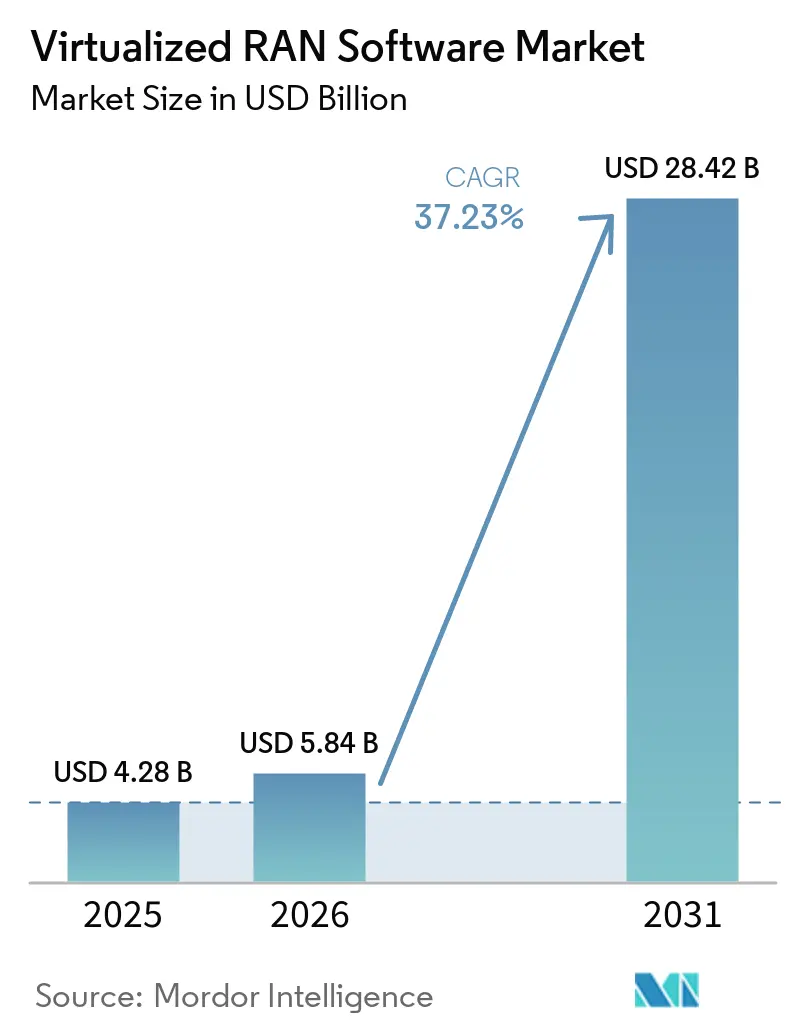
The virtualized RAN software market size is expected to increase from USD 4.28 billion in 2025 to USD 5.84 billion in 2026 and reach USD 28.42 billion by 2031, expanding at a CAGR of 37.23% over 2026-2031. This expansion reflects operator spending on software-defined radio access networks as 5G standalone deployments replace non-standalone configurations. Cloud-native operating models are making it easier to separate software functions from purpose-built radio hardware. This change increases the importance of software updates, automation, and shared compute resources in network planning. Suppliers are responding with platforms that support multi-vendor networks, private 5G deployments, and AI-enabled optimization. The virtualized RAN software market is also affected by integration requirements, fiber availability, and the performance of merchant compute platforms.
Key Report Takeaways
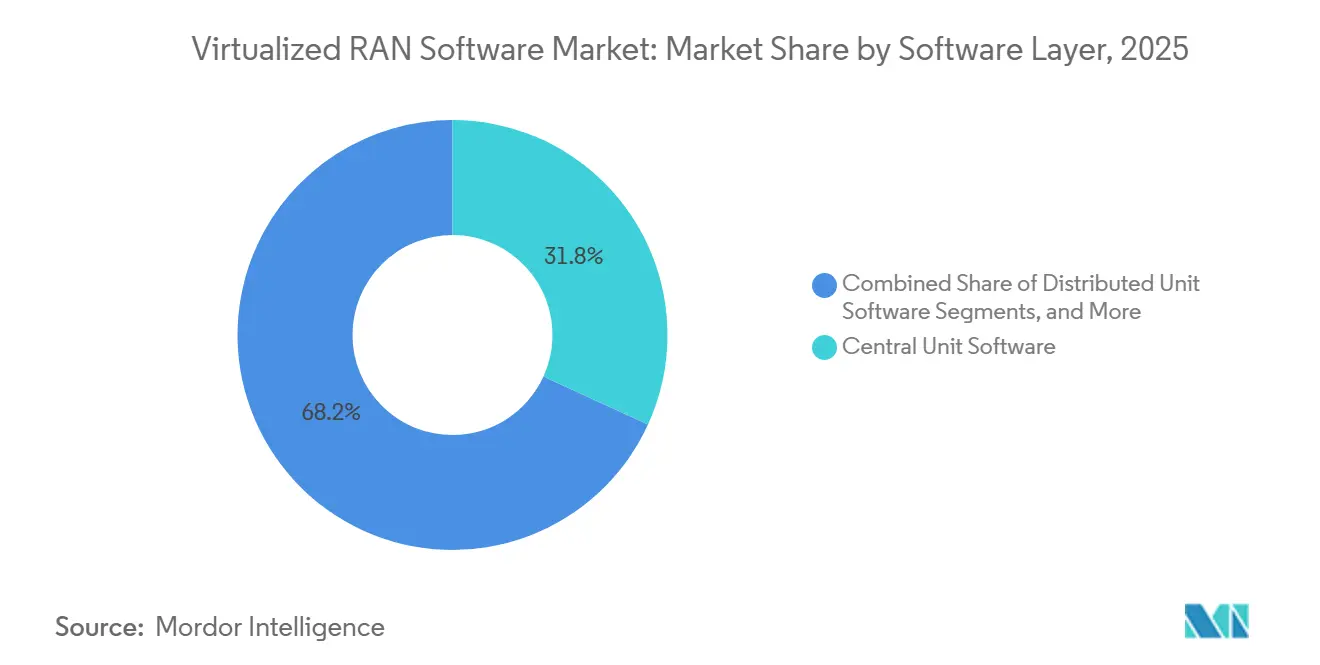
- By software layer, central unit software held 31.83% of the virtualized RAN software market share in 2025, while RAN intelligent controller and automation software is projected to expand at a 38.43% CAGR through 2031.
- By architecture, open vRAN accounted for 34.42% of the virtualized RAN software market share in 2025, while cloud-native vRAN is expected to expand at a 38.03% CAGR through 2031.
- By deployment model, public cloud and telco cloud held 39.71% of the virtualized RAN software market share in 2025, while private cloud and on-premises deployment are projected to expand at a 37.82% CAGR through 2031.
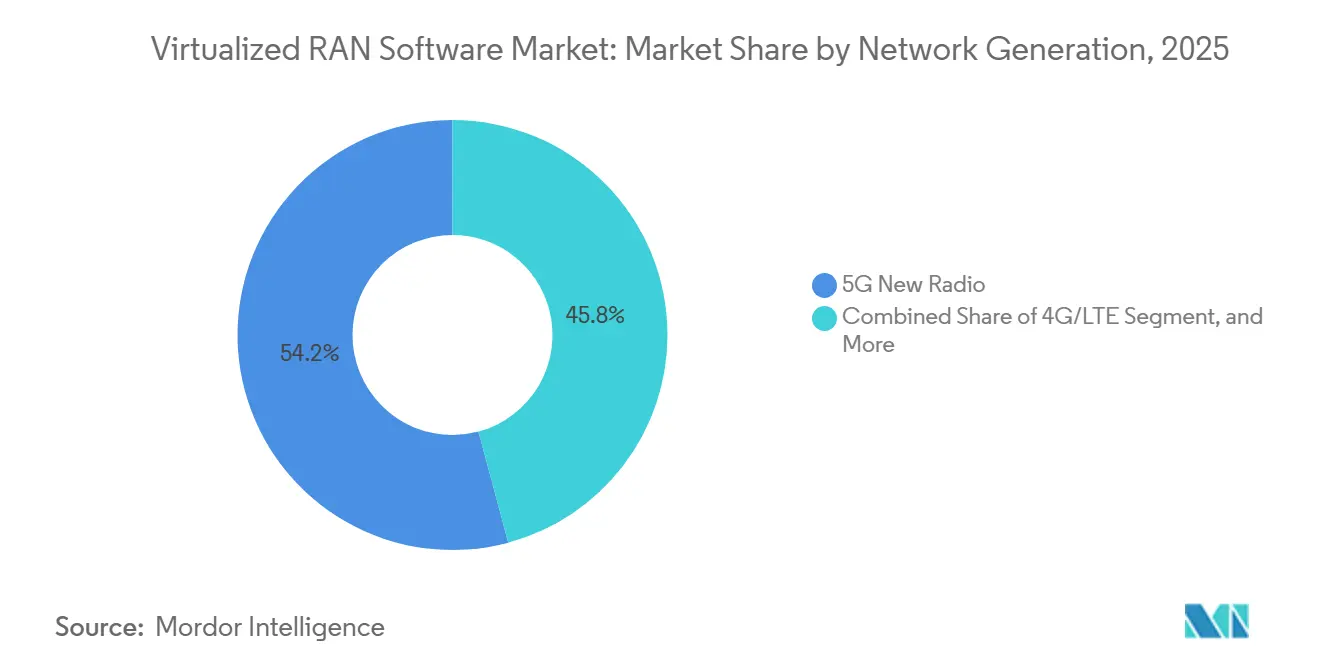
- By network generation, 5G New Radio accounted for 54.18% of the virtualized RAN software market size in 2025, while 3G and legacy modernization are expected to expand at a 37.78% CAGR through 2031.
- By end user, macrocell networks held 39.68% of the virtualized RAN software market share in 2025, while private 5G and industrial networks are projected to expand at a 38.41% CAGR through 2031.
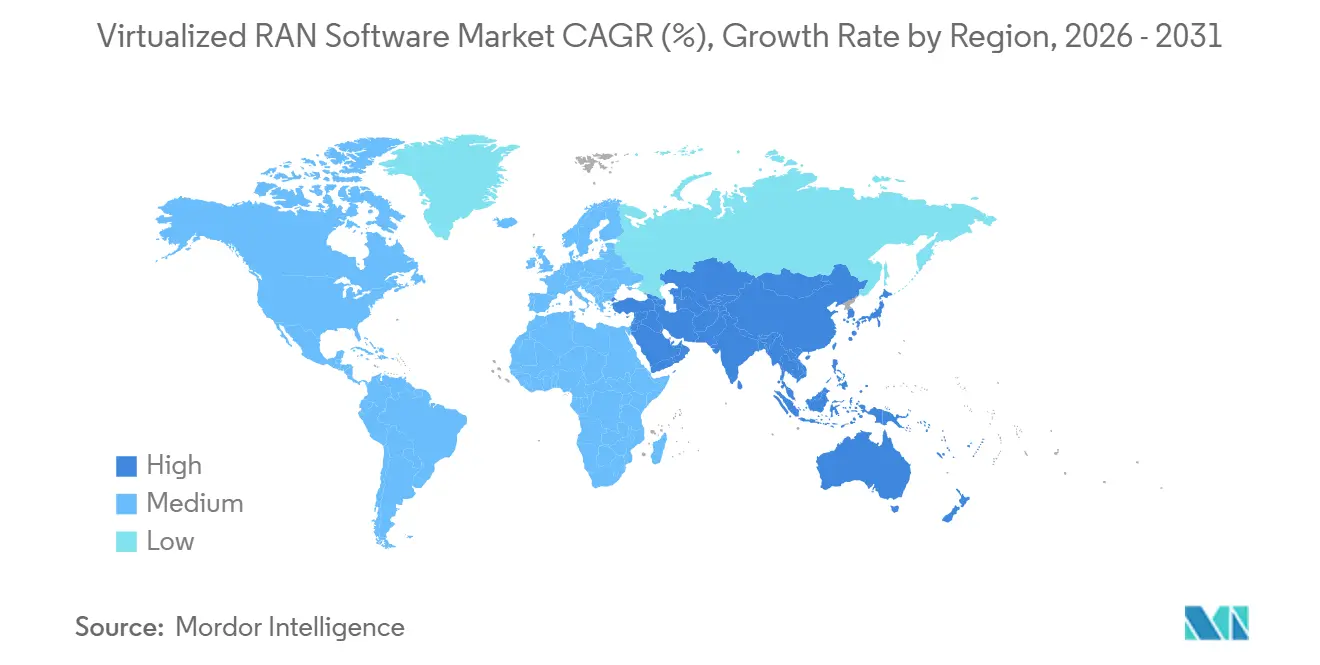
- By geography, North America accounted for 38.26% of the virtualized RAN software market size in 2025, while Asia-Pacific is expected to expand at a 38.22% CAGR through 2031.
Note: Market size and forecast figures in this report are generated using Mordor Intelligence’s proprietary estimation framework, updated with the latest available data and insights as of January 2026.
Global Virtualized RAN Software Market Trends and Insights
Drivers Impact Analysis*
| Driver | (~) % Impact on CAGR Forecast | Geographic Relevance | Impact Timeline |
|---|---|---|---|
| Accelerating 5G Standalone and Cloud-Native RAN Modernization | +12.8% | Global, concentrated in North America, Japan, and Western Europe | Short term (≤ 2 years) |
| O-RAN Interface Standardization and Supplier Flexibility | +7.6% | Global, with early gains in North America, Japan, and South Korea | Medium term (2-4 years) |
| RAN Energy Efficiency and Emissions Reduction Targets | +3.8% | Europe, Asia-Pacific core, spill-over to North America | Medium term (2-4 years) |
| Private 5G and Industrial Edge Deployment | +5.2% | North America, Western Europe, East Asia, spill-over to the Middle East and Africa | Short term (≤ 2 years) |
| GPU-Accelerated AI-RAN Commercialization | +2.9% | North America, Japan, and the Nordic countries | Long term (≥ 4 years) |
| Telecom Software Reuse Across Terrestrial and Non-Terrestrial Networks | +1.3% | Global, with early gains in Japan, the United States, and European Union satellite hubs | Long term (≥ 4 years) |
| Source: Mordor Intelligence | |||
Accelerating 5G Standalone and Cloud-Native RAN Modernization
The shift from non-standalone 5G to standalone 5G is a major near-term driver of demand for the virtualized RAN software market. By March 2026, 95 operators had commercially launched 5G standalone services, out of an estimated 1,400 operators worldwide. Standalone deployments require a complete 5G core and entail broader software requirements than networks that retain a 4G core anchor. Operators are also moving away from virtual network functions as support horizons narrow and microservices-based software becomes the preferred model. This raises the cost of retaining older network software and makes modernization a nearer operational decision. Ericsson extended its partnership with Virgin Media O2 in March 2026 to power most of the operator's nationwide RAN under a five-year agreement, showing that multi-year software-led network commitments are entering major operator plans.
O-RAN Interface Standardization and Supplier Flexibility
The O-RAN ALLIANCE completed Release 5 in November 2025 and announced it in June 2026, providing operators with a more clearly defined technical baseline for interoperable deployments.[1]O-RAN ALLIANCE, “O-RAN ALLIANCE Completed Its Specification Release 5,” O-RAN ALLIANCE, o-ran.org. The release requires TLS 1.3 across O-RAN interfaces and adds a Zero Trust framework for service management, O-Cloud, radio units, and RAN intelligent controllers. It also formalizes energy-saving capabilities aligned with 3GPP Release 18. These requirements give procurement teams clearer reference points when they assess multi-vendor offers. The standards can reduce the need for customized interface terms in operator contracts, especially for smaller carriers. The virtualized RAN software market can therefore benefit as compliant components become easier to specify, test, and integrate across suppliers.
RAN Energy Efficiency and Emissions Reduction Targets
Energy use is becoming an important factor in radio access network investment decisions. Research presented at IEEE INFOCOM 2025 found that advanced sleep-mode control via an xApp can reduce O-RAN radio unit energy consumption by 15% to 72%, depending on network traffic conditions. The range shows that software-based control can have a significant effect when demand changes during the day. Rakuten Mobile deployed an in-house RIC platform across its 4G and 5G Open RAN network in May 2025 and stated it aimed to reduce network energy consumption by up to 20%. Release 5 adds radio-unit energy features beyond those addressed in 3GPP Release 18. European operators are increasingly considering energy performance in RAN procurement, which favors suppliers that can validate per-site savings on commercial off-the-shelf compute systems.
Private 5G and Industrial Edge Deployment
Private 5G is moving from limited trials to larger, repeatable deployments across industrial sites. Cargill had deployed private 5G at 50 manufacturing facilities by February 2026 and planned to add more than 100 sites each year, with NTT Data acting as systems integrator. This pattern gives the virtualized RAN software market a source of demand outside the traditional mobile network operator channel. Large enterprises are building internal network capabilities and can increasingly influence component selection rather than relying solely on managed service providers. Rakuten Symphony and Celona announced a collaboration in April 2026 for managed, end-to-end Open RAN private 5G offerings for large and medium enterprises. Manufacturing, logistics, agriculture, ports, and mining need low-latency connectivity for equipment, vehicles, and local data processing, which supports demand for integrated software stacks.
Restraints Impact Analysis*
| Restraint | (~) % Impact on CAGR Forecast | Geographic Relevance | Impact Timeline |
|---|---|---|---|
| Multi-Vendor Integration and Lifecycle Complexity | -4.2% | Global, most acute in North America and Europe | Short term (≤ 2 years) |
| Fronthaul Fiber, Timing, and Deterministic-Latency Constraints | -3.1% | Emerging markets in the Middle East and Africa and South America, and rural North America | Medium term (2-4 years) |
| Merchant-Compute Power and Performance Parity Risk | -2.1% | Global, particularly where high-capacity 5G New Radio Layer 1 processing is required | Medium term (2-4 years) |
| RAN Software Supply-Chain and Cybersecurity Exposure | -1.4% | Global, with the strongest regulatory influence in North America, the European Union, and Japan | Long term (≥ 4 years) |
| Source: Mordor Intelligence | |||
Multi-Vendor Integration and Lifecycle Complexity
Multi-vendor disaggregation remains a central operational barrier in the virtualized RAN software market. Interfaces such as F1, E1, E2, and Open Fronthaul add integration points where incompatible software versions can delay deployment. Central unit, distributed unit, and radio unit applications may also follow separate release cycles. This creates a larger maintenance burden as operators add suppliers. Release 5 requires TLS 1.3 and Zero Trust measures across O-RAN interfaces, which can require coordinated updates throughout the stack. Systems integrators and orchestration platforms can reduce this burden, but operators still need to account for added testing, cost, and delivery risk before selecting a disaggregated architecture.
Fronthaul Fiber, Timing, and Deterministic-Latency Constraints
Centralized RAN designs require high-capacity fronthaul connections between radio sites and processing locations. eCPRI transport needs a latency below 100 microseconds, which requires fiber close to the radio site. This condition limits the use of centralized cloud RAN designs in parts of the Middle East and Africa, rural North America, and Tier 2 and Tier 3 locations in South America. Research published at NSDI 2025 found that vRAN server CPU demand can change at sub-millisecond intervals and that control operations can create substantial load peaks. These conditions make timing and capacity management more difficult as automated control functions expand. Distributed unit deployments close to radio sites will remain important in fiber-constrained areas, limiting the savings that more centralized designs could otherwise provide.
*Our forecasts treat driver/restraint impacts as directional, not additive. The impact forecasts reflect baseline growth, mix effects, and variable interactions.
Segment Analysis
By Software Layer: CU Software Leads While RIC and Automation Expand Fastest
Central unit software held 31.83% of the virtualized RAN software market share in 2025. Its position reflects its role in radio resource control, packet data convergence protocol, and service data adaptation protocol functions, which support baseband coordination across multi-vendor Open RAN deployments. Distributed unit software, radio unit, and low-PHY software handle processing tasks that affect latency and spectrum efficiency. Vendors with a strong hardware background retain an advantage in these near-radio functions. Operations, administration, and orchestration software is becoming more important as operators need coordinated lifecycle management across RAN applications and existing operational support systems.
RAN intelligent controller and automation software is projected to expand at a 38.43% CAGR through 2031. Rakuten Mobile and Rakuten Symphony completed a nationwide RIC deployment in Japan in February 2026, incorporating third-party rApps from AirHop Communications and Future Connections for predictive maintenance, mobility improvement, and traffic optimization. The deployment shows that RIC platforms are being used in commercial networks rather than remaining limited to trials. As rApp ecosystems develop, RIC platforms can function as an AI inference layer within the RAN. The remaining software category includes emerging functions such as AI model serving and intent-based policy engines that have not yet become standard reporting categories but are beginning to attract commercial interest.



By Architecture: Open vRAN Holds the Lead While Cloud-Native vRAN Advances
Open vRAN accounted for 34.42% of the virtualized RAN software market size in 2025. Its position is supported by more mature O-RAN specifications and by operators that now use compliance as a procurement requirement. Rakuten Mobile operates the largest open vRAN network and remains an important example of multi-vendor, cloud-native operations. Samsung became Rakuten Mobile's nationwide 5G Open RAN radio provider in March 2026 after testing and validation. Samsung also partnered with KDDI on 4G and 5G vRAN expansion, reinforcing Japan's role in the commercial validation of open RAN systems, while proprietary and hybrid vRAN architectures retain demand among operators that prefer established vendor relationships and move radio functions to commercial servers.
Cloud-native vRAN is projected to expand at a 38.03% CAGR through 2031. This reflects a shift from fixed appliances to containerized software that can run on Kubernetes and O-Cloud frameworks. Samsung completed a commercial call with its vRAN solution on an Intel Xeon 6700P-B processor with up to 72 cores on a Tier 1 US operator network in January 2026. The test supports using a single commercial server for cloud-native vRAN workloads in dense sites, and consolidating the central unit, the distributed unit, and related AI functions on a single server can improve site economics. Security requirements in Release 5 are also being incorporated into cloud-hosted RAN procurement specifications.
By Deployment Model: Public and Telco Cloud Lead While Private Deployments Accelerate
Public cloud and telco cloud held 39.71% of the virtualized RAN software market share in 2025. Operators use these environments for flexible capacity, lower upfront infrastructure needs, and access to AI and machine learning resources near network workloads. Hybrid cloud strategies are becoming more practical as providers improve performance and cost visibility for telecom workloads. Mavenir's Converged Packet Core was live on the Rakuten Cloud Platform in April 2026. Mavenir also migrated the first 100,000 Telefónica Germany mobile customers to its cloud-native IMS platform on AWS in May 2026, showing how telco cloud environments are extending beyond isolated core functions.
Private cloud and on-premises deployment are projected to expand at a 37.82% CAGR through 2031. Enterprise private 5G requirements for data control, latency, and cybersecurity support this model. On-site designs enable enterprises to maintain direct control over software updates and data handling. Defense, health care, and critical infrastructure users particularly value this control. The virtualized RAN software industry, therefore, includes both shared cloud deployments and private installations, depending on the operating environment and compliance needs.
By Network Generation: 5G New Radio Dominates While Legacy Modernization Creates Demand
5G New Radio accounted for 54.18% of the virtualized RAN software market size in 2025. This lead reflects 5G standalone upgrades and the related procurement of 5G-specific central-unit and distributed-unit software. A standalone network requires both 5G core and RAN software, whereas a non-standalone network retains a 4G core anchor, making standalone deployments more software-intensive at the site level. Established equipment vendors are strengthening their 5G core and RAN software positions as standalone activity expands. 4G and LTE remain relevant because operators continue to serve large LTE subscriber bases while sharing commercial server infrastructure with 5G workloads.
The 3G and legacy modernization segment is projected to expand at a 37.78% CAGR through 2031. Growth comes from spectrum refarming and the migration of remaining 3G traffic, rather than new 3G network investment. Radisys introduced 3GPP Release 19-compliant 5G-Advanced RAN software in February 2026, with support for terrestrial and non-terrestrial networks and backward compatibility with Release 18. Operators facing refarming deadlines need software platforms that can coordinate traffic migration, 4G densification, and 5G standalone expansion. A common orchestration layer can reduce the need for separate procurement and maintenance cycles and give legacy modernization an ongoing role in the virtualized RAN software market.
By End User: Macrocell Networks Generate Most Revenue While Private 5G Expands
Macrocell networks held 39.68% of the virtualized RAN software market share in 2025. Mobile network operators deploy software across large nationwide cell grids, giving this group the largest installed base. AT&T is continuing a multi-vendor Open RAN deployment with Ericsson, Mavenir, and Fujitsu. Vodafone selected Samsung as its primary Open RAN partner for Germany and Europe under a multi-year program. KDDI is also expanding Samsung-powered vRAN in Japan, while mobile network operators are the main buyers of RIC and automation software, as their scale enables investment in AI-enabled optimization.
Private 5G and industrial networks are projected to expand at a 38.41% CAGR through 2031. Manufacturers are using private cellular systems for factory equipment, automated vehicles, robotics, and local data processing. Samsung and Hyundai Motor completed a RedCap trial on a private 5G network and planned to extend the technology to Hyundai's newest electric vehicle facilities in the first half of 2026. Ports, mining sites, agricultural enterprises, and logistics operators are also potential users. Airspan and Druid Software supported a private 5G deployment for a major European railway company at Deutsche Bahn sites in March 2025, encouraging specialized integrators to develop repeatable software and deployment models for industrial customers.
Geography Analysis
North America accounted for 38.26% of the virtualized RAN software market share in 2025. The region benefits from AT&T's Open RAN program, Dish Network's greenfield vRAN design, and large operator investment in multi-vendor 5G standalone infrastructure, while public support for domestic Open RAN development provides additional demand support in the United States. Airspan delivered a commercial Open RAN deployment for Rakuten Mobile in December 2025, funded in part by a National Telecommunications and Information Administration grant.[2]Airspan Networks, “Airspan Networks Delivers Industry’s First Commercial Open RAN Deployment Stemming From NTIA Grant,” Airspan Networks, airspan.com. Canada is developing enterprise private 5G use cases, and TERAGO and Ericsson launched a private 5G network at the McMaster Manufacturing Research Institute in May 2026.
Asia-Pacific is projected to expand at a 38.22% CAGR through 2031. Japan leads the region through Rakuten Mobile's open vRAN network, as well as commercial vRAN activity at NTT Docomo and KDDI. Samsung's 2026 appointment as Rakuten Mobile's nationwide 5G Open RAN radio provider supports the country's role as a reference market. Rakuten Symphony announced a collaboration with Celona for enterprise Open RAN private 5G in April 2026, adding a private-network route to regional demand. Regional activity includes trials and deployments in India, South Korea, Southeast Asia, and other emerging markets, while Japan's export activity supports wider adoption across these countries.
Europe holds a substantial position through operator programs in Germany and the United Kingdom, including Vodafone's multi-vendor program with Ericsson, Nokia, and Samsung. Samsung's role in Vodafone's German Open RAN deployment covers thousands of sites over 5 years. Orange Group and Samsung expanded their vRAN and Open RAN partnership in Europe in February 2026 after earlier testing. The Middle East has early cloud-native O-RAN activity through Zain Kuwait. Africa and South America face greater fronthaul and spectrum constraints, although software-defined systems can reduce physical hardware requirements compared with traditional RANs.

Competitive Landscape
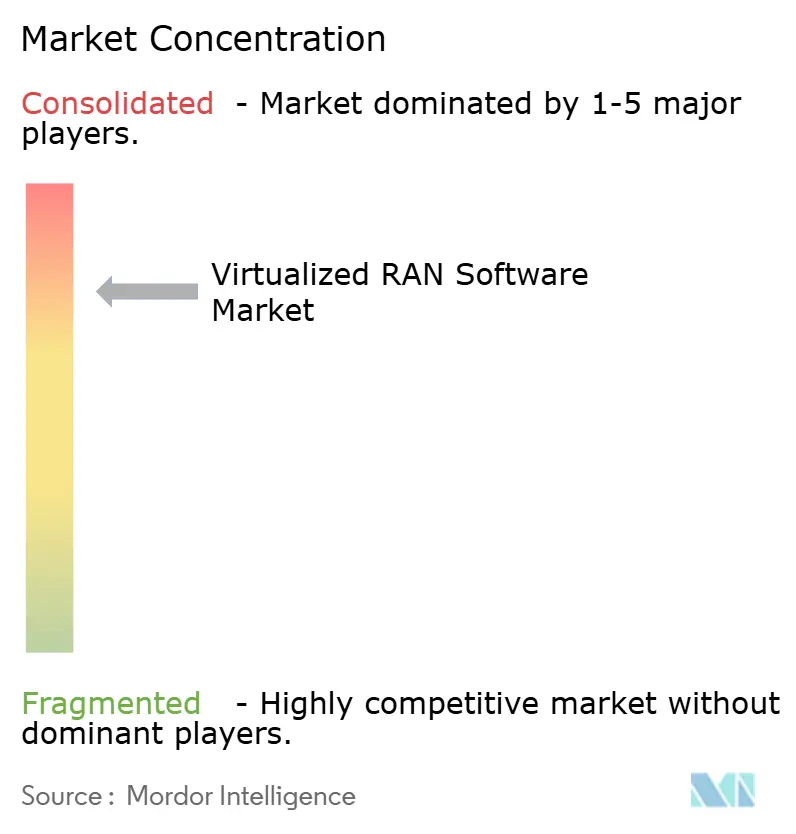
The market is concentrated, with Samsung, Rakuten Symphony, and 1Finity identified as the leading 3 vRAN vendors by worldwide revenue on a trailing 4-quarter basis through the second quarter of 2025, competing on platform coverage, integration experience, and carrier-grade performance on commercial off-the-shelf infrastructure. Nokia and Ericsson are adapting their RAN portfolios toward cloud-native software while retaining large installed hardware bases, and Nokia is pairing its anyRAN software with NVIDIA technology to support GPU-accelerated AI-RAN capabilities. Nokia stated in February 2026 that it had tested AI-RAN capabilities with T-Mobile, Indosat, and SoftBank and aimed for pilot deployments at the end of 2026.[3]Nokia, “Nokia Accelerates AI-RAN Momentum With New Partnerships Driving Path to AI-Native 6G,” Nokia, nokia.com. This approach enables Nokia to offer software upgrades to existing macrocell customers.
The supplier base below the leading vendors is fragmented across functional layers and vertical use cases. Mavenir has expanded its presence in operator networks through its cloud-native packet core on Rakuten Mobile's platform and its IMS deployment for Telefónica Germany. These projects show how a software-focused supplier can participate across several network domains. Druid Software acquired Node-H RAN software intellectual property in 2025, extending its portfolio beyond the 5G core, while private 5G providers are increasingly pursuing full-stack offers that include RAN functions. This places pressure on specialized suppliers to demonstrate clear interoperability and systems-integration value.
RIC and xApp ecosystems remain an open area for competition in the virtualized RAN software market. Release 5 formalized the rApp framework, providing vendors with a more consistent environment for automation applications. Rakuten Mobile's nationwide RIC deployment with third-party rApps offers a working example of this model at commercial scale. Software Radio Systems and Amarisoft contribute to an open-source testing path for smaller commercial and academic users. Suppliers that can deliver tested software updates and practical multi-vendor integration will have an advantage, while the virtualized RAN software industry remains concentrated among leading platform vendors but has many specialized competitors in software functions, systems integration, and private network deployments.
Virtualized RAN Software Industry Leaders
Mavenir Systems, Inc.
Samsung Electronics Co., Ltd.
Nokia Corporation
Telefonaktiebolaget LM Ericsson
Rakuten Symphony, Inc.
- *Disclaimer: Major Players sorted in no particular order

Recent Industry Developments
- July 2026: Nokia confirmed that its debut AI-RAN platform with NVIDIA will target pilot deployments at the end of 2026, with general commercial release in 2027, delivering projected spectral efficiency gains exceeding 100% within 1 year of launch. The platform integrates Nokia's anyRAN software with NVIDIA's ARC-Pro GPU and will be distributed via a subscription model rather than requiring upfront hardware replacement, materially changing the upgrade economics for existing Nokia macro-cell base stations.
- May 2026: Mavenir's Converged Packet Core went live in Rakuten Mobile's nationwide network on Rakuten Cloud Platform, enabling multi-carrier roaming through JAPAN Roaming, Japan's nationwide emergency roaming service launched April 1, 2026. The deployment extends Mavenir's position across both core and adjacent RAN-cloud functions in Japan's reference open-network infrastructure.
- May 2026: Mavenir completed migration of the first 100,000 Telefónica Germany mobile customers to its cloud-native IMS platform running on AWS, under a multi-year contract extension announced in February 2025. Full migration of all sites using automation is scheduled for 2027, establishing AWS Cloud as a validated carrier-grade host for German mobile voice infrastructure.
- May 2026: TERAGO and Ericsson launched a private 5G network at McMaster Manufacturing Research Institute in Canada, marking a significant deployment of enterprise-grade 5G in a live manufacturing and research environment utilizing recently released Canadian industry spectrum.


Global Virtualized RAN Software Market Report Scope
The Virtualized RAN (vRAN) Software Market comprises software solutions that virtualize, disaggregate, control, automate, and manage radio access network (RAN) functions using software-based network architectures running on general-purpose or cloud infrastructure. The market includes software that replaces or abstracts traditionally hardware-integrated RAN functions and enables network operators and other users to deploy RAN workloads through virtualized, cloud-native, open, proprietary, or hybrid architectures.
The Virtualized RAN Software Market Report is Segmented by Software Layer (Central Unit Software, Distributed Unit Software, Radio Unit and Low-PHY Software, RAN Intelligent Controller and Automation Software, Operations, Administration, and Orchestration Software, and Rest of Virtualized RAN Software), Architecture (Open vRAN, Cloud-Native vRAN, Proprietary vRAN, and Hybrid vRAN), Deployment Model (Cloud-Native vRAN, and On Premise), Network Generation (5G New Radio, 4G/LTE, and 3G and Legacy Modernization), End User (Mobile Network Operators, Enterprises and Industrial Organizations, Neutral Hosts and Tower Companies, and Government and Defense Organizations), and Geography (North America, South America, Europe, Asia-Pacific, Middle East, and Africa). The Market Forecasts are Provided in Terms of Value (USD).
| Central Unit Software |
| Distributed Unit Software |
| Radio Unit and Low-PHY Software |
| RAN Intelligent Controller and Automation Software |
| Operations, Administration, and Orchestration Software |
| Rest of Virtualized RAN Software |
| Open vRAN |
| Cloud-Native vRAN |
| Proprietary vRAN |
| Hybrid vRAN |
| Cloud-Native vRAN |
| On Premise |
| 5G New Radio |
| 4G/LTE |
| 3G and Legacy Modernization |
| Mobile Network Operators |
| Enterprises and Industrial Organizations |
| Neutral Hosts and Tower Companies |
| Government and Defense Organizations |
| North America | United States |
| Canada | |
| Mexico | |
| South America | Brazil |
| Argentina | |
| Rest of South America | |
| Europe | Germany |
| United Kingdom | |
| France | |
| Italy | |
| Spain | |
| Russia | |
| Rest of Europe | |
| Asia-Pacific | China |
| Japan | |
| India | |
| South Korea | |
| Australia | |
| Rest of Asia-Pacific | |
| Middle East | Saudi Arabia |
| United Arab Emirates | |
| Turkey | |
| Rest of Middle East | |
| Africa | South Africa |
| Nigeria | |
| Kenya | |
| Rest of Africa |
| By Software Layer | Central Unit Software | |
| Distributed Unit Software | ||
| Radio Unit and Low-PHY Software | ||
| RAN Intelligent Controller and Automation Software | ||
| Operations, Administration, and Orchestration Software | ||
| Rest of Virtualized RAN Software | ||
| By Architecture | Open vRAN | |
| Cloud-Native vRAN | ||
| Proprietary vRAN | ||
| Hybrid vRAN | ||
| By Deployment Model | Cloud-Native vRAN | |
| On Premise | ||
| By Network Generation | 5G New Radio | |
| 4G/LTE | ||
| 3G and Legacy Modernization | ||
| By End User | Mobile Network Operators | |
| Enterprises and Industrial Organizations | ||
| Neutral Hosts and Tower Companies | ||
| Government and Defense Organizations | ||
| By Geography | North America | United States |
| Canada | ||
| Mexico | ||
| South America | Brazil | |
| Argentina | ||
| Rest of South America | ||
| Europe | Germany | |
| United Kingdom | ||
| France | ||
| Italy | ||
| Spain | ||
| Russia | ||
| Rest of Europe | ||
| Asia-Pacific | China | |
| Japan | ||
| India | ||
| South Korea | ||
| Australia | ||
| Rest of Asia-Pacific | ||
| Middle East | Saudi Arabia | |
| United Arab Emirates | ||
| Turkey | ||
| Rest of Middle East | ||
| Africa | South Africa | |
| Nigeria | ||
| Kenya | ||
| Rest of Africa | ||


Key Questions Answered in the Report
What is the virtualized RAN software market size?
The virtualized RAN software market size is expected to reach USD 28.42 billion by 2031, from USD 5.84 billion in 2026, at a 37.23% CAGR.
What is driving demand for virtualized RAN software?
5G standalone deployments, cloud-native network upgrades, O-RAN standards, energy management, and private 5G deployments support demand.
Which software layer has the largest share?
Central unit software held 31.83% share in 2025, supported by its role in key baseband control and data functions.
Which virtualized RAN software segment is expanding fastest?
RAN intelligent controller and automation software is projected to expand at a 38.43% CAGR through 2031.
Which region leads virtualized RAN software adoption?
North America held 38.26% share in 2025, while Asia-Pacific is projected to expand at a 38.22% CAGR through 2031.
Why do enterprises deploy private 5G networks?
Enterprises use private 5G for reliable local connectivity, low latency, cybersecurity, and control of data and software updates.
Page last updated on:





