
Virtualization Software Market Size and Share
Market Overview
| Study Period | 2020 - 2031 |
|---|---|
| Market Size (2026) | USD 110.21 Billion |
| Market Size (2031) | USD 224.59 Billion |
| Growth Rate (2026 - 2031) | 15.30 % |
| Fastest Growing Market | Asia Pacific |
| Largest Market | North America |
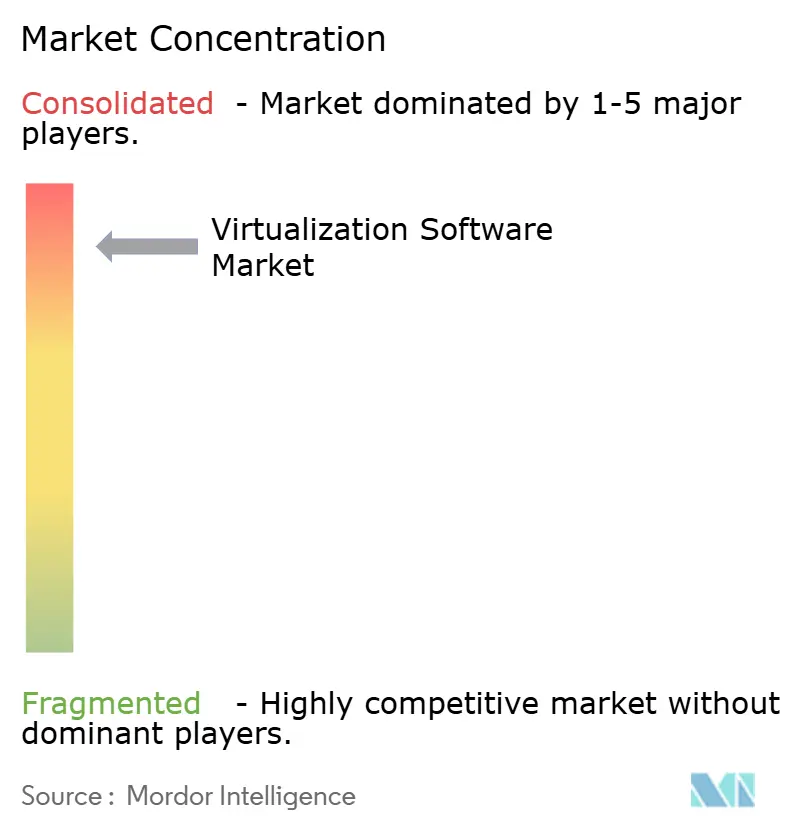
| Market Concentration | High |
Major Players *Disclaimer: Major Players sorted in no particular order Image © Mordor Intelligence. Reuse requires attribution under CC BY 4.0. | |
Virtualization Software Market Analysis by Mordor Intelligence
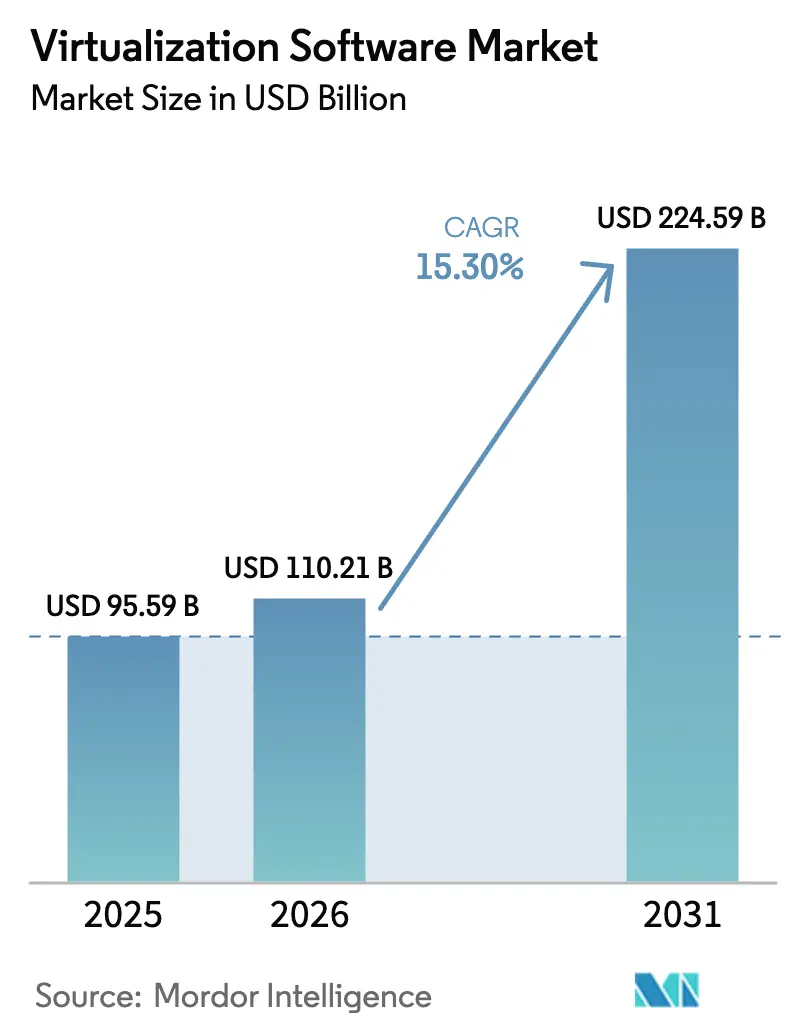
The Virtualization Software Market size is projected to expand from USD 95.59 billion in 2025 and USD 110.21 billion in 2026 to USD 224.59 billion by 2031, registering a CAGR of 15.30% between 2026 to 2031. Enterprises are revisiting hypervisor budgets after Broadcom converted VMware’s flagship products to subscription-only licensing, which accelerated evaluations of Nutanix AHV, Microsoft Hyper-V, KVM, and other alternatives. North American incumbents still anchor spending, but sovereign-cloud policies in China and India, coupled with 5G core virtualisation across Asia Pacific, signal faster regional upside. Server consolidation remains a cost lever, while confidential-computing features baked into new silicon from Intel and AMD strengthen compliance postures in healthcare and finance. Competitive momentum is also shifting as hyperscalers embed lightweight hypervisors into infrastructure-as-a-service offerings, blurring the line between private cloud and public cloud procurement.
Key Report Takeaways
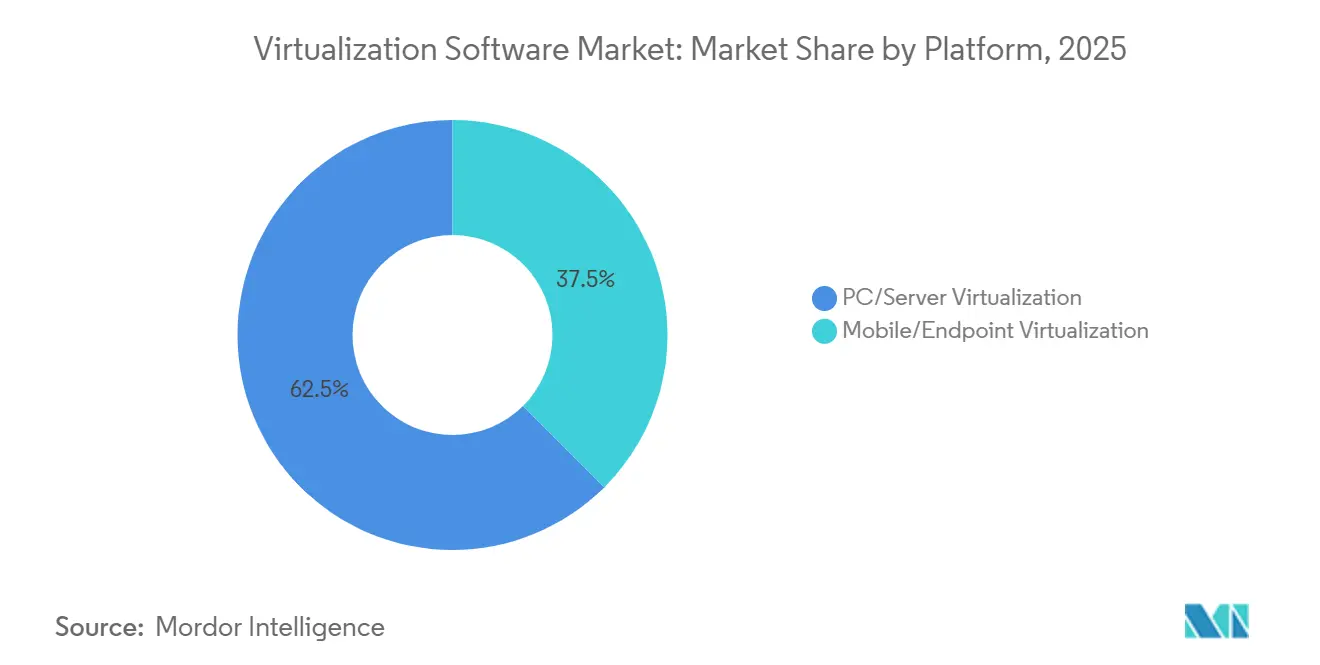
- By platform, PC and server virtualisation led with 62.46% revenue share in 2025, while mobile and endpoint virtualisation is projected to expand at a 16.32% CAGR through 2031.
- By virtualisation category, server and compute virtualisation held 42.72% of the 2025 base, whereas network and software-defined-network virtualisation is forecast to accelerate at 15.96% CAGR to 2031.
- By deployment model, on-premise clusters accounted for 50.54% of installations in 2025, yet hybrid configurations are advancing at a 17.74% CAGR to 2031.
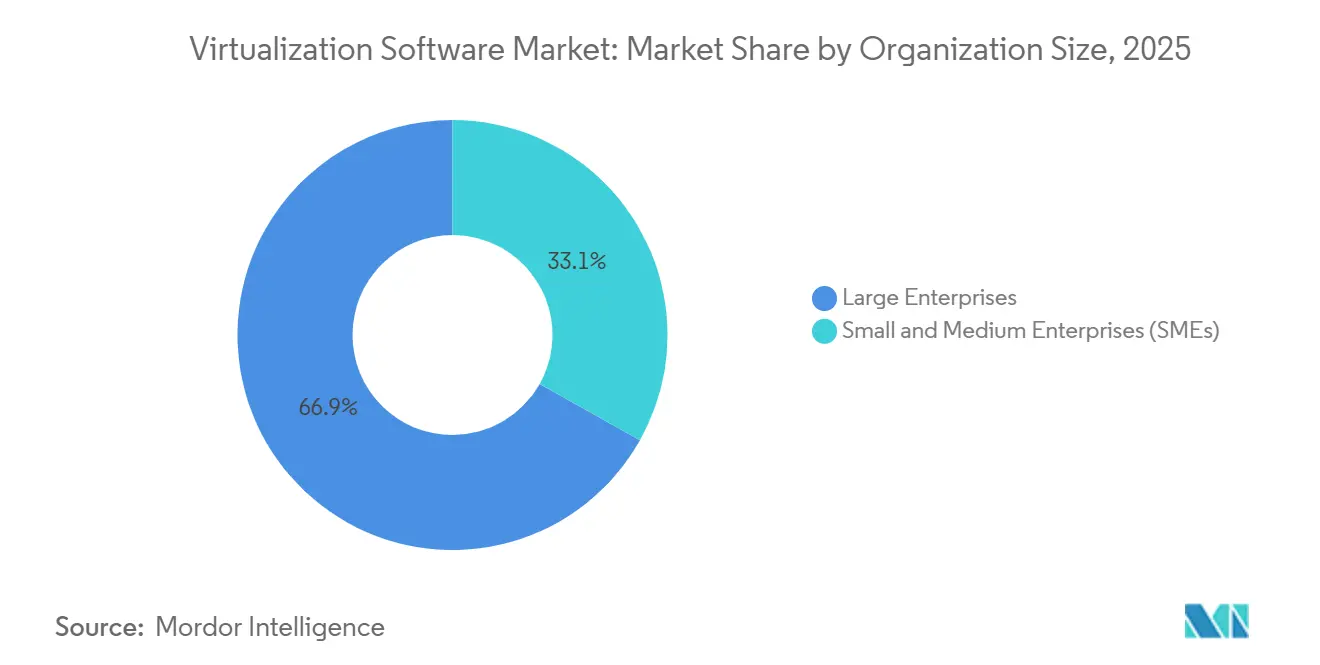
- By organisation size, large enterprises captured 66.86% of 2025 spending, while small and medium enterprises are expanding at 17.28% CAGR through 2031.
- By end-user industry, IT and telecommunications commanded 28.88% in 2025; healthcare and life sciences is the fastest sectoral riser at 16.92% CAGR to 2031.
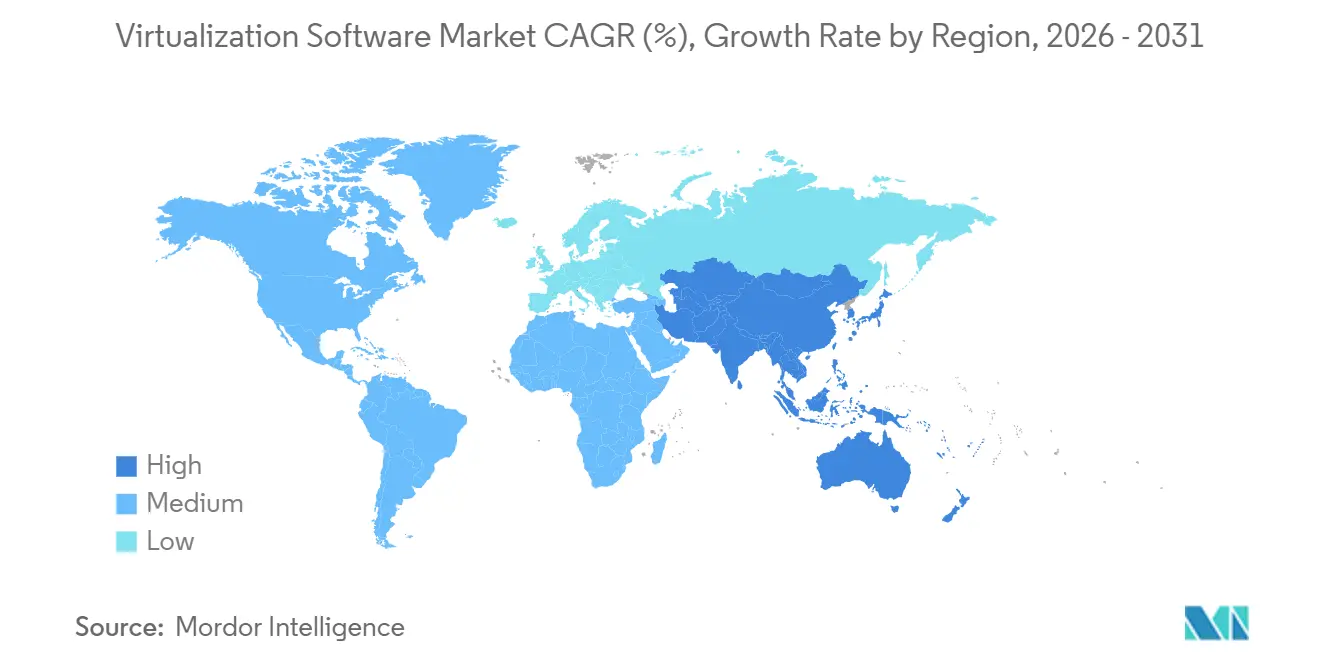
- By geography, North America contributed 42.42% of 2025 revenue, whereas Asia Pacific is scaling at a 17.26% CAGR across the outlook period.
Note: Market size and forecast figures in this report are generated using Mordor Intelligence’s proprietary estimation framework, updated with the latest available data and insights as of January 2026.
Market Trends and Insights
Drivers Impact Analysis of Virtualization Software Market*
| Driver | (~) % Impact on CAGR Forecast | Geographic Relevance | Impact Timeline |
|---|---|---|---|
| Cost-reduction from server consolidation | +2.8% | Global, strongest in North America and Europe | Medium term (2-4 years) |
| Cloud-first enterprise IT strategies | +3.2% | Global, led by North America and Asia Pacific | Long term (≥4 years) |
| Remote-work and edge-compute proliferation | +2.5% | Global, faster in Asia Pacific and Latin America | Short term (≤2 years) |
| Vendor diversification away from vSphere | +2.1% | North America and Europe | Short term (≤2 years) |
| Confidential-computing enabled virtualisation | +1.9% | North America, Europe, China | Medium term (2-4 years) |
| AI-optimised workload placement | +1.7% | Global, early uptake in North America and China | Long term (≥4 years) |
| Source: Mordor Intelligence | |||
Cost-Reduction From Server Consolidation
Enterprises running hundreds of physical hosts routinely devote more than one-third of data-center operating budgets to power, cooling, and real-estate overhead. Packing dozens of virtual machines onto each socket pushes utilisation above 60%, lengthens hardware refresh cycles, and allows factories to drop under-utilised racks without jeopardising throughput.[1] IBM Editorial Team, “Server Consolidation Benefits,” IBM, ibm.com European operators face additional pressure as the Energy Efficiency Directive obliges sites above 1 megawatt to publish annual power-usage-effectiveness figures, making workload density metrics a board-level key performance indicator.[2]European Commission, “Energy Efficiency Directive,” europa.eu Edge deployments magnify savings; lightweight hypervisors on shop-floor gateways locally filter sensor traffic, cutting wide-area-network egress fees for manufacturing firms by up to half.
Cloud-First Enterprise IT Strategies
Chief information officers now architect directly for workload mobility, pairing on-premise clusters with hyperscale regions to meet latency and data-residency targets without refactoring legacy applications. Financial-services institutions cite Basel III operational-resilience rules that keep transactional data on domestic soil yet permit non-sensitive analytics in public cloud, fueling projects such as Google Cloud VMware Engine and Azure VMware Solution, both of which logged triple-digit growth in billable hours during 2024. The United States Department of Defense’s Joint Warfighting Cloud Capability contract reinforces the pattern by requiring vendors to support monolithic virtual machines alongside microservices, acknowledging that COBOL and Ada workloads remain mission-critical.
Remote-Work and Edge-Compute Proliferation
Virtual-desktop-infrastructure shipments rose 22% in 2024 as hospitals issued secure desktops to clinicians working from home, satisfying HIPAA encryption mandates while keeping clinical latency under 50 milliseconds. Retailers are also embedding hypervisors into point-of-sale terminals and digital-signage controllers to isolate payment flows from inventory systems, meeting PCI-DSS segmentation requirements without purchasing duplicate hardware. At the automotive edge, real-time operating systems run beside infotainment Linux guests on in-vehicle compute modules, and hardware-assisted virtualisation guarantees sub-10-millisecond interrupt response for brake-by-wire functions, meeting ISO 26262 safety certification.
Vendor Diversification Away From vSphere
Broadcom’s decision to end VMware perpetual licences and boost subscription prices by roughly 300% prompted the sector’s largest migration wave in a decade. Nutanix disclosed that 40% of fiscal 2025 bookings involved VMware displacement, with predictable node-based pricing and integrated storage cited as advantages. Open-source ecosystems are expanding in parallel; Proxmox enterprise subscriptions climbed 60% in 2024 as mid-market firms pursued low-cost, high-availability clusters outside traditional licensing models.
Restraints Impact Analysis of Virtualization Software Market*
| Restraint | (~) % Impact on CAGR Forecast | Geographic Relevance | Impact Timeline |
|---|---|---|---|
| Deployment and lifecycle-management complexity | -1.4% | Global, acute in SME segment | Short term (≤2 years) |
| Escalating hypervisor licence costs | -1.8% | North America and Europe | Short term (≤2 years) |
| Rising VM-specific security attack surface | -0.9% | Global, higher in BFSI and healthcare | Medium term (2-4 years) |
| Container-first cultural shift dampening VM use | -1.2% | North America, Europe, Asia Pacific | Long term (≥4 years) |
| Source: Mordor Intelligence | |||
Deployment and Lifecycle-Management Complexity
Administering high-availability clusters, tuning memory ballooning, and orchestrating rolling upgrades still demand specialized skills. Certification programs can cost several thousand United States dollars per engineer and must be renewed biennially, a barrier for small enterprises that seldom maintain dedicated platform teams. In emerging markets, managed-service fees often rival software subscription costs, raising total cost of ownership. Compliance adds friction: life-sciences firms must document every configuration change under FDA 21 CFR Part 11, forcing additional tooling that integrates with hypervisor APIs.
Escalating Hypervisor Licence Costs
Post-acquisition price increases from Broadcom routinely reach triple digits during contract renewals, pushing many customers to evaluate competing platforms or adopt open-source alternatives. For organisations running tens of thousands of virtual machines, incremental annual expenses can stretch into eight-figure USD totals, overwhelming planned capital budgets. While subscription models promise flexible term lengths, abrupt hikes have highlighted the risk of vendor lock-in, especially in jurisdictions where exit-strategy skills are scarce.
*Our forecasts treat driver/restraint impacts as directional, not additive. The impact forecasts reflect baseline growth, mix effects, and variable interactions.
Virtualization Software Market Segment Analysis
By Platform:
Endpoint Mobility Fuels Dual-Screen GrowthThe server side of the virtualization software market accounted for 62.46% of 2025 revenue, underpinned by financial-services and telecommunications operators that rely on Type-1 hypervisors for mission-critical uptime. Sub-millisecond failover, hardware-assisted memory encryption, and deterministic I/O scheduling remain non-negotiable for these workloads. Conversely, the virtualization software market is witnessing rapid demand for lightweight stacks that can run on low-power edge gateways, enabling local processing of sensor data before sending compressed payloads to regional clouds.
Mobile and endpoint virtualization is poised to grow at a 16.32% CAGR, the fastest track inside the virtualization software market. Employers increasingly stream high-resolution desktops to browsers, avoiding capital outlays for fully provisioned laptops. Hospitals retiring on-premise Citrix farms report endpoint management savings near 40% after pivoting to cloud-hosted thin clients. As password-less authentication becomes table stakes, virtual desktop instances can be spun up or torn down automatically, maintaining contextual security without manual patching cycles.


By Virtualization Category:
Software-Defined Networks Capture Telco SpendServer and compute layers still command 42.72% of category revenue because they consolidate sprawling x86 estates and enable live workload migration during maintenance windows. Financial traders segment latency-sensitive engines onto dedicated core pairs while relegating batch analytics to shared pools, balancing speed with cost. Network-focused virtualization, however, is pacing at 15.96% CAGR, aided by telecom providers that are virtualizing 5G core functions to trim per-site capital spend from roughly USD 500,000 for proprietary appliances to sub-USD 100,000 on commodity servers.
Within the virtualization software market, SD-WAN overlays replace multiprotocol label switching circuits, boosting agility for distributed branch offices. ETSI NFV blueprints ensure that disaggregated network functions remain interoperable, and ISO/IEC 27001 frameworks impose consistent security baselines. Storage and application virtualization continue to facilitate lift-and-shift of monolithic workloads, with policy-based data placement allowing administrators to pin sensitive datasets to encrypted media.
By Deployment Model:
Hybrid Configurations Reconcile Sovereignty and AgilityOn-premise clusters represented 50.54% of 2025 deployments as banks, pharmaceuticals, and public-sector agencies grapple with data-sovereignty statutes that limit cross-border transfers. The virtualization software market size for hybrid deployments is now scaling faster than either pure on-premise or pure software-as-a-service footprints. Azure Arc and Google Anthos extend cloud control planes into private racks, letting administrators enforce uniform policies while preserving local data residency.
Hybrid configurations are projected to grow at 17.74% CAGR because they let pharmaceutical firms keep FDA-validated production batches local while bursting computational-chemistry simulations to hyperscale clouds during peak discovery cycles. The virtualization software market share for subscription-based platforms that support policy-driven placement is therefore likely to inch upward as licensing moves to flex consumption across locations.
By Organization Size:
SMEs Embrace Consumption ModelsLarge enterprises commanded 66.86% of 2025 spending, standardizing global footprints on VMware Cloud Foundation or Nutanix stacks and negotiating multi-year enterprise agreements that bundle support and upgrades. Such customers often operate tens of thousands of virtual machines and can justify dedicated platform-engineering personnel.
Small and medium enterprises are forecast to expand at 17.28% CAGR by exploiting pay-as-you-go pricing that removes upfront capital hurdles. A regional bank can provision virtual desktops in the public cloud for a low monthly charge, paying only during active business hours. Local-currency billing and self-service portals further lower barriers across South America and Southeast Asia, allowing hospitality and retail chains to scale environments seasonally without stranded capacity.
By End-User Industry:
Clinical Workflows Drive Healthcare SurgeIT and telecommunications firms retained 28.88% of 2025 end-user expenditure, virtualizing packet cores and radio access networks to support Open RAN architectures that cut vendor lock-in. Carriers generally target 75% network-function virtualisation by 2026, affirming a central role for the virtualization software market in telco capital-budget plans.
Healthcare and life sciences is advancing at a 16.92% CAGR, the fastest of any vertical, as hospitals migrate electronic-health-record systems into hybrid clouds. HIPAA requires encryption at rest and in transit, and virtual machines can enforce those controls without rewriting legacy applications. Cloud-enabled hosting from vendors such as Epic reduces server-room footprints and enables operating-expenditure financing models that free capital for patient-care initiatives.
Geography Analysis
North America Virtualization Software Market
North America contributed 42.42% of 2025 revenue thanks to abundant hyperscaler regions that provide sub-ten-millisecond proximity to metro customers. Regulated enterprises adopt hybrid setups to satisfy the Digital Operational Resilience Act in Europe and similar regulations elsewhere that require critical data to remain within national borders for recovery-time objectives below four hours.
APAC Virtualization Software Market
Asia Pacific is growing at 17.26% CAGR as China enforces cybersecurity rules that mandate domestic storage of personal information, bolstering demand for Huawei FusionSphere and indigenous KVM distributions.[3] India’s national cloud initiative likewise favors open-source hypervisors to reduce dependency on foreign providers while supporting rapid rollout of digital public infrastructure. Japan, South Korea, and Australia continue to pair on-premise clusters with regional public clouds for disaster-recovery resilience, reflecting the broadening reach of the virtualization software market into regulated industries across the region.
EMEA and South America Virtualization Software Market
Europe remains pivotal as the General Data Protection Regulation obliges firms to quantifiably govern personal data flows. Hybrid compliance architectures dominate banking and insurance deployments in Germany, France, and the United Kingdom, assuring that sensitive workloads never traverse borders without explicit consent. South America and the Middle East and Africa trail in overall volumes but post double-digit growth as telecom modernisation and digital-government programs ramp.

Regulatory Landscape
Regulation is increasingly shaping virtualization deployment architectures through operational resilience, data residency, and sovereign-cloud procurement requirements. In the EU, the Digital Operational Resilience Act (DORA, Regulation (EU) 2022/2554) sets ICT risk management, major incident reporting, and resilience testing obligations for financial entities, and extends accountability to critical ICT third-party service providers, raising expectations for hypervisor platforms, management suites, and related support operations used in regulated workloads.
Sovereign cloud policy is also tightening procurement requirements that influence virtualization stacks used for public-sector and regulated environments. In June 2026, the European Commission proposed the Cloud and AI Development Act (CADA), introducing a sovereign-cloud framework with four Union assurance levels. Higher assurance tiers include stronger controls around EU-only processing and effective control over software components, reinforcing demand for verifiable supply-chain practices (such as SBOMs and auditability) within virtualization ecosystems serving EU institutions and critical sectors.
Value Chain Analysis
The virtualization software value chain starts with foundational compute and security enablers, including x86 server OEM platforms and confidential-computing capable CPUs, and then moves through core hypervisor layers (commercial and open-source). From there, it extends to management and automation suites and adjacent infrastructure software such as storage and network virtualization.
Distribution and adoption rely on direct enterprise sales, hyperscaler marketplaces and managed services, and channel partners that bundle virtualization with hyperconverged infrastructure and validated designs for on-premise and hybrid deployments. Services and ecosystem integrations increasingly influence buying decisions as enterprises run multi-hypervisor and VM-plus-Kubernetes operating models, and security maintenance remains a critical dependency across the chain. July 2026 patch activity for a guest-to-host escape vulnerability in KVM (Januscape, CVE-2026-53359) is pushing buyers to prioritize hardened configurations, timely patching, and supported distributions when standardizing on KVM-based stacks.
Competitive Landscape
Broadcom’s October 2023 purchase of VMware redefined market economics. VMware commanded roughly 70% of the on-premise hypervisor installed base pre-deal, and the new subscription-only model lifted list prices by an average 300%, triggering a wave of proofs of concept for Nutanix AHV, Microsoft Hyper-V, Proxmox, and KVM derivatives. Nutanix reported that 40% of fiscal 2025 bookings were direct VMware displacements, buoyed by integrated storage and predictable node pricing.
Hyperscalers are leveraging silicon innovation to bake hypervisors beneath the user plane. AWS Nitro separates control functions into dedicated cards, trimming overhead and enabling confidential-computing attestations recognised by healthcare and finance regulators.[4]Amazon Web Services, “Amazon EC2 Nitro System,” aws.amazon.com Google Cloud VMware Engine and Azure VMware Solution each posted triple-digit growth in billable hours in 2024 as customers stretched familiar VMware tooling into public-cloud zones without re-architecting workloads.
Emerging challengers occupy niche frontiers. Scale Computing bundles hyperconverged stacks with an intentionally lightweight interface for mid-market clients, while Virtuozzo offers per-container billing models coveted by hosting providers. At the processor layer, Intel Trust Domain Extensions and AMD Secure Encrypted Virtualization encrypt guest memory inline, enabling banks to pursue zero-trust strategies without sacrificing performance. As confidential-computing use cases mature, these hardware roadmaps will increasingly influence the purchasing calculus inside the virtualization software market.
Virtualization Software Industry Leaders
VMware Inc.
Microsoft Corporation
Citrix Systems Inc.
Red Hat Inc. (IBM Corporation)
Nutanix Inc.
- *Disclaimer: Major Players sorted in no particular order
Virtualization Software Market Companies Covered in this Report
- VMware Inc.
- Microsoft Corporation
- Citrix Systems Inc.
- Red Hat Inc. (IBM Corporation)
- Nutanix Inc.
- Oracle Corporation
- Amazon Web Services Inc.
- Google LLC (Google Cloud)
- Huawei Technologies Co. Ltd.
- Parallels International GmbH
- NComputing Co. Ltd.
- Lynx Software Technologies
- TenAsys Corporation
- Proxmox Server Solutions GmbH
- SUSE LLC (Harvester)
- Virtuozzo International GmbH
- Xen Project
- KVM (Open-Source)
- QEMU Project
- Scale Computing Inc.
- Dell Technologies Inc.
- Cisco Systems Inc.
- Hewlett Packard Enterprise (SimpliVity)
- IBM PowerVM (IBM Corporation)
- TuxCare (KernelCare)

Market Opportunities and Future Outlook
A primary opportunity is in enterprise migration and modernization programs triggered by the post-acquisition VMware licensing reset, as buyers test alternatives and look for tooling that reduces switching friction. Red Hat’s virtualization migration enablement expansion in March 2026, including a free self-service OpenShift Migration Assessment (OMA), supports that shift, alongside broader market narratives around multi-hypervisor strategies and unified operations across VM and cloud-native estates. Platforms that package assessment, automated conversion, and ongoing lifecycle management can capture spend from organizations that want to preserve existing VM applications while changing control planes or licensing models.
Another opportunity is the convergence of virtualization with Kubernetes-centric operations and hardware-aware workload placement for AI/HPC and edge use cases. KubeVirt v1.8 (March 2026) introduced a hypervisor abstraction layer to support multi-hypervisor backends and added PCIe NUMA topology awareness, pointing to growing demand for consistent VM operations inside Kubernetes and better performance tuning for accelerator-heavy workloads. On the infrastructure side, Microsoft Windows Server 2025 became generally available in November 2024 with Azure Arc-enabled hotpatching and Hyper-V improvements, including GPU partitioning, supporting organizations that want centralized policy and patch operations across hybrid footprints without rewriting applications.
Recent Industry Developments in Virtualization Software Market
- July 2026: Citrix released XenServer 9, positioning it as a mainstream server virtualization option for organizations re-evaluating hypervisor costs. The release adds a refreshed Xen-based foundation and gives IT teams another supported alternative when building exit plans from VMware-centric environments.
- September 2025: Microsoft partnered with Nutanix to integrate Azure Arc management with Nutanix AHV, enabling a unified control plane for hybrid virtualization estates. The move aligned with enterprise demand to standardize governance and operations across mixed on-premise and cloud environments while diversifying away from a single hypervisor vendor.
- November 2024: Microsoft made Windows Server 2025 generally available, adding Azure Arc-enabled hotpatching and performance and security updates for Hyper-V, including GPU partitioning. This strengthened Microsofts ability to bundle virtualization with hybrid management workflows, particularly for enterprises consolidating VM operations alongside broader cloud governance.


Virtualization Software Market Report Scope and Research Methodology
Market Definition and Coverage
For this study, the market covers revenues earned from software that creates and manages virtual computing environments across servers, desktops, networks, storage, and applications. We count licenses, subscriptions, and software support tied to these virtualization functions across on-premise, cloud, and hybrid deployments.
Scope exclusions: We exclude standalone container orchestration stacks when they operate without a hypervisor layer.
Segments Covered in This Report
- By Platform
- PC / Server Virtualization
- Mobile / Endpoint Virtualization
- By Virtualisation Category
- Application Virtualization
- Network / SD-Network Virtualization
- Server / Compute Virtualization
- Storage Virtualization
- By Deployment Model
- On-Premise
- Cloud / SaaS-Hosted
- Hybrid
- By Organization Size
- Large Enterprises
- Small and Medium Enterprises (SMEs)
- By End-User Industry
- IT and Telecommunications
- BFSI
- Healthcare and Life Sciences
- Manufacturing
- Government and Defence
- Media and Entertainment
- Other End-User Industries
- By Geography
- North America
- United States
- Canada
- Mexico
- South America
- Brazil
- Argentina
- Chile
- Rest of South America
- Europe
- Germany
- United Kingdom
- France
- Italy
- Spain
- Russia
- Rest of Europe
- Asia Pacific
- China
- India
- Japan
- South Korea
- Singapore
- Malaysia
- Australia
- Rest of Asia Pacific
- Middle East
- United Arab Emirates
- Saudi Arabia
- Turkey
- Rest of Middle East
- Africa
- South Africa
- Nigeria
- Egypt
- Rest of Africa
- North America
Data Sources, Market Sizing, and Validation
Desk Research
Desk research was used to build the base structure of the model and keep definitions consistent across regions and deployment setups. We referenced public materials such as the National Institute of Standards and Technology (NIST) cloud guidance, International Telecommunication Union (ITU) publications on network virtualization topics, and European Union Agency for Cybersecurity (ENISA) papers that reflect enterprise virtualization and cloud risk practices.
To anchor demand and spend signals, we also reviewed sources such as US Census Bureau data on IT investment proxies, OECD digital economy indicators, and International Data Corporation style public briefings when available through open excerpts, along with vendor 10-K filings, investor presentations, and product documentation. A paid subscription for company financials and a separate news and financials service were used for quick cross checks on reported software revenue mixes and major enterprise IT spending commentary. The sources listed here are illustrative, and many other public and paid references were used for data collection, validation, and clarification.
Primary Interviews and Surveys
Primary work focused on validating what portion of virtualization spend is still tied to hypervisor-led stacks versus adjacent tooling, and how pricing is evolving under subscription and hybrid delivery. We spoke with a mix of software publishers, channel partners, managed service providers, and enterprise IT buyers across APAC, EMEA, and the Americas to confirm adoption drivers, renewal patterns, and realistic ASP movement assumptions.
Distribution of primary research fieldwork respondents
| Company type | Respondent position | Region |
|---|---|---|
| Top tier: 31% | CXOs: 18% | APAC: 49% |
| Mid tier: 49% | Functional/Unit leaders: 29% | EMEA: 32% |
| Smaller Players: 20% | Managers: 53% | Americas: 19% |
Market-Sizing & Forecasting
The market was first reconstructed using a top-down approach, where enterprise IT spend and cloud infrastructure adoption signals were translated into a realistic virtualization software demand pool by region and deployment environment. To keep totals grounded, we corroborated model outputs using selective bottom-up checks such as sampled price points for common subscription tiers, channel feedback on deal sizes, and supplier revenue split checks. Where a sub-segment could not be reliably rolled up, we adjusted for gaps rather than forcing a full carry-through.
Inputs used in the model included virtualization penetration within enterprise workloads, server and data center modernization activity, the share of hybrid deployments, subscription renewal rates, and typical support attach behavior. Since pricing is not static, ASP progression was handled through a blended view of list pricing, discount norms mentioned by practitioners, and mix shifts from perpetual to subscription. For forecasting, we relied on scenario analysis tied to macro IT budget expectations and platform refresh cycles, and tuned the scenarios using consensus ranges gathered from expert interviews.
Data Validation & Update Cycle
Model outputs were checked against independent signals such as enterprise infrastructure software spend direction, cloud and hybrid adoption indicators, and reported revenue commentary in public filings. When large variances appeared, we revisited assumptions, rechecked the underlying driver series, and triggered follow-up calls to confirm whether the change came from pricing, mix shift, or a scope boundary.
Before sign-off, the work goes through multiple analyst review steps, including consistency checks across regions and a final pass for arithmetic and unit alignment. The report is refreshed annually, and interim updates are made when material events occur that can move demand or pricing. Right before delivery, we do a last update sweep so readers receive the latest view.
Mordor Intelligence's Virtualization Software Market Sizing Compared With Other Published Estimates
Published market sizes for virtualization software can differ quite a lot, even when the topic name looks identical, because the counted revenue streams and timing assumptions are not always the same. Differences usually come from what is treated as core virtualization software versus adjacent infrastructure tools, and from how subscription pricing is normalized across regions.
A major driver is refresh cadence and currency timing, since software revenues and ASPs move through annual contract resets and mid-year price actions, and those changes can shift the current-year number if exchange rates are locked too early. By updating FX inputs closer to the sizing cut and stress-testing ASP movement with renewal and discount feedback, Mordor Intelligence reduces drift between reported vendor commentary and the final market total.
Benchmark comparison
| Source | Market Size | Gaps in Research Methodology |
|---|---|---|
| Mordor Intelligence | USD 110.21 B (2026) | |
| Global Consultancy A | USD 58.60 B (2025) | Uses an earlier base year and a narrower revenue capture that appears to emphasize selected platform categories, which can undercount broad enterprise virtualization management and support revenues when defined differently. |
| Industry Research Group B | USD 83.25 B (2025) | Applies a different timing and growth window, and the scope language suggests a wider blend of virtualization types without clearly separating hypervisor-led software from closely related infrastructure tooling, which can shift totals. |
The spread in the table is mainly explained by timing and scope boundaries, followed by how pricing is carried forward under subscription models. When scope is kept consistent and assumptions like FX and ASP movement are refreshed and checked with real buying patterns, the resulting market size becomes easier to trace, repeat, and defend in planning discussions.


Key Questions Answered in the Report
How large is the virtualization software market in 2026?
The virtualization software market size is USD 110.21 billion in 2026 and is projected to reach USD 224.59 billion by 2031.
What CAGR is expected for virtualization platforms to 2031?
Overall market revenue is forecast to advance at a 15.3% CAGR across 2026-2031.
Which region will grow fastest over the forecast horizon?
Asia Pacific is set to rise at a 17.26% CAGR, propelled by sovereign-cloud requirements in China and India.
Why are enterprises migrating away from VMware?
Broadcom replaced perpetual licences with costlier subscriptions, prompting customers to evaluate Nutanix AHV, Microsoft Hyper-V, and open-source KVM solutions.
What sector is leading adoption among end users?
IT and telecommunications retains the largest spend, whereas healthcare and life sciences is logging the fastest growth on the back of electronic-health-record migration.
How does hybrid deployment help with data-sovereignty rules?
Hybrid setups let organizations keep sensitive datasets on-premise while bursting non-critical workloads into public cloud regions, ensuring compliance with jurisdiction-specific residency laws.
Page last updated on:




