
Market Overview
| Study Period | 2020 - 2031 |
|---|---|
| Forecast Data Period | 2026 - 2031 |
| Base Year Market Size (2025) | USD 433.01 Million |
| Market Size (2026) | USD 443.35 Million |
| Market Size (2031) | USD 504.59 Million |
| Growth Rate (2026 - 2031) | 2.62 % |
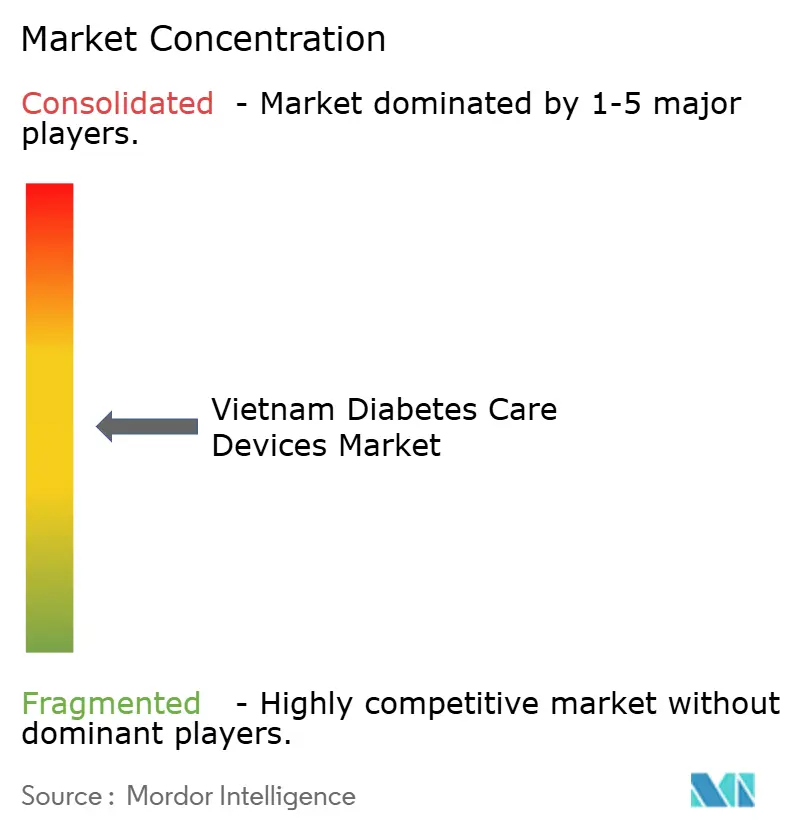
| Market Concentration | Medium |
Major Players *Disclaimer: Major Players sorted in no particular order Image © Mordor Intelligence. Reuse requires attribution under CC BY 4.0. | |
Vietnam Diabetes Care Devices Market Analysis by Mordor Intelligence
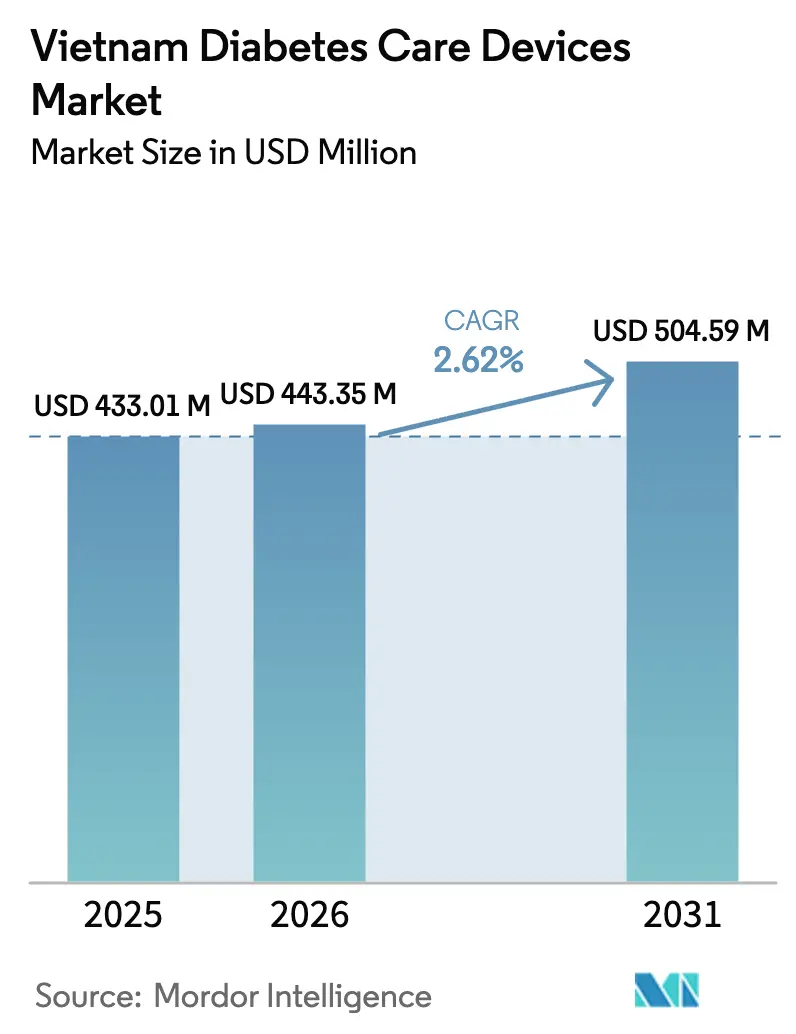
The Vietnam Diabetes Care Devices Market size is expected to grow from USD 433.01 million in 2025 to USD 443.35 million in 2026 and is forecast to reach USD 504.59 million by 2031 at 2.62% CAGR over 2026-2031.
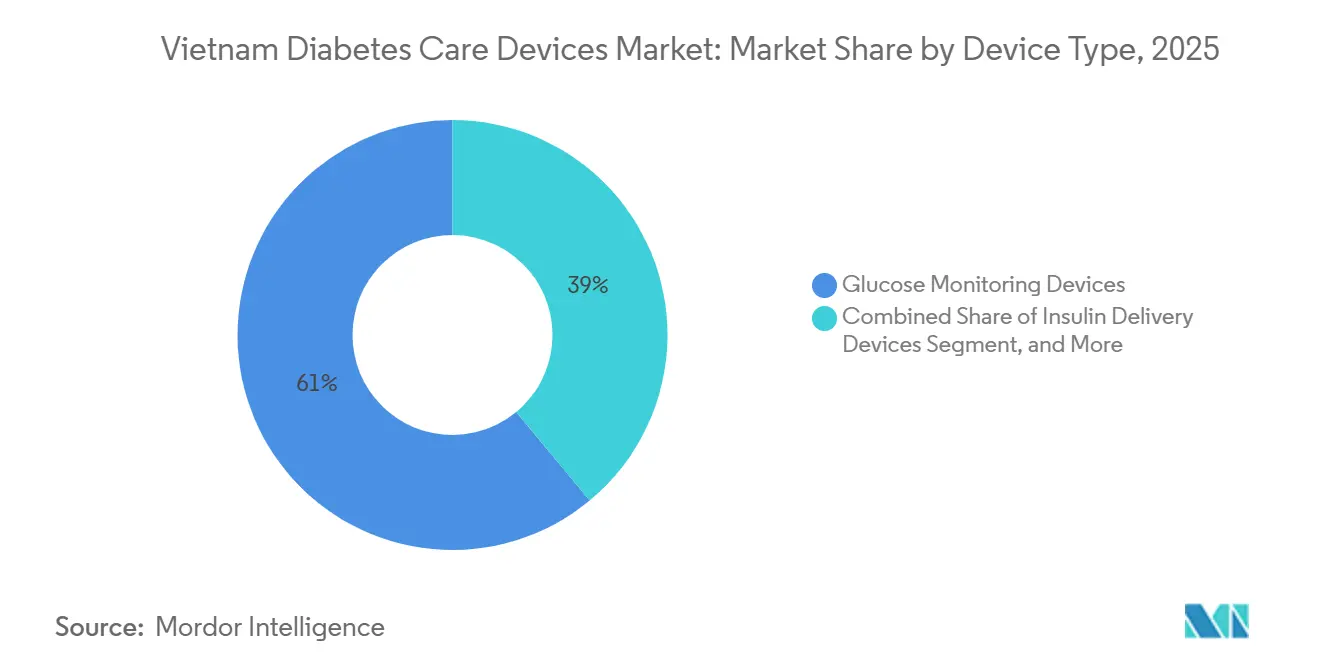
The rising incidence of both Type 1 and Type 2 diabetes, expanding insurance coverage, and a steady shift toward self-care are sustaining demand, even as affordability constraints temper headline growth. Glucose monitoring devices led the Vietnam diabetes devices market with a 61.01% market share in 2025, but insulin delivery devices are advancing faster as pediatric Type 1 cases climb and reimbursement pathways for pens and syringes improve. The Vietnam diabetes devices market also benefits from e-pharmacy deregulation, telemedicine roll-outs, and targeted domestic manufacturing incentives that aim to reduce the country’s >90% import dependence, yet price-sensitive users still ration test-strip consumption, slowing unit growth. Competitive intensity remains moderate: multinationals dominate premium technology, while local firms are moving into mid-tier continuous glucose monitors, creating a two-speed trajectory in the Vietnam diabetes devices market.
Key Report Takeaways
- By device category, glucose monitoring commanded 61.01% of the Vietnam diabetes devices market share in 2025, while insulin delivery is projected to register the fastest 3.35% CAGR through 2031.
- By diabetes type, Type 2 accounted for 84.56% of the Vietnam diabetes devices market size in 2025, whereas Type 1 devices are set to expand at a 4.56% CAGR to 2031.
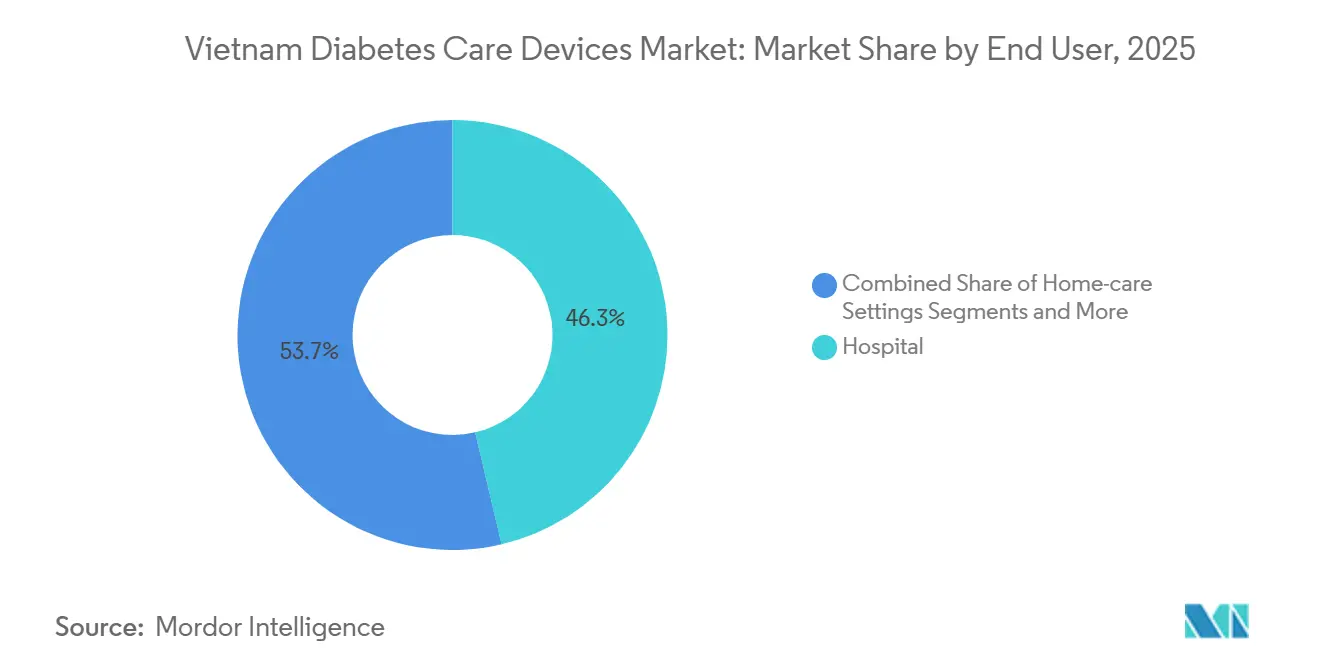
- By end user, hospital accounted for 46.34% of the Vietnam diabetes devices market in 2025, and home-care settings are forecast to grow at a 3.89% CAGR through 2031.
Note: Market size and forecast figures in this report are generated using Mordor Intelligence’s proprietary estimation framework, updated with the latest available data and insights as of January 2026.
Vietnam Diabetes Care Devices Market Trends and Insights
Drivers Impact Analysis*
| Driver | (~) % Impact on CAGR Forecast | Geographic Relevance | Impact Timeline |
|---|---|---|---|
| Rising Diabetes Prevalence & Urban Lifestyles | +0.9% | National, concentrated in Hanoi, HCMC, Da Nang | Medium term (2-4 years) |
| Increasing Healthcare Expenditure & UHC Expansion | +0.7% | National, with urban-rural coverage gaps narrowing | Long term (≥ 4 years) |
| Growing Adoption of Self-Monitoring & Wearables | +0.5% | Urban centers (Hanoi, HCMC), spill-over to secondary cities | Short term (≤ 2 years) |
| Domestic Manufacturing Initiatives Cut Import Costs | +0.3% | National, policy-driven with Hanoi and HCMC manufacturing hubs | Long term (≥ 4 years) |
| Tele-Medicine & E-Pharmacy Policies Widen Rural Access | +0.4% | Rural and remote provinces, ethnic minority areas | Medium term (2-4 years) |
| Medical Tourism Boosts Demand for Advanced Tech | +0.2% | HCMC, Hanoi, Da Nang medical tourism hubs | Short term (≤ 2 years) |
| Source: Mordor Intelligence | |||
Rising Diabetes Prevalence & Urban Lifestyles
Vietnam’s adult diabetes prevalence rose to 3.6% in 2025, translating to 2.5 million diagnosed cases and another 37.8% undiagnosed. Urban residents aged 15–59 face 1.86 times higher odds of diabetes than rural peers, showing how dietary westernization and sedentary work patterns accelerate risk.[1]PubMed, “Urban–Rural Diabetes Risk in Vietnam,” pubmed.ncbi.nlm.nih.gov Northern Vietnam recorded 0.77 Type 1 cases per 100,000 children in 2025, and more than 57% of presentations were in ketoacidosis, proving that monitoring gaps remain wide. For the Vietnam diabetes devices market, this epidemiological burden splits demand between affordable glucometers for mass Type 2 management and premium pumps plus continuous glucose monitors for pediatric Type 1 care. Device makers that align their portfolios with these divergent needs stand to capture the next wave of growth in Vietnam's diabetes device market.
Increasing Healthcare Expenditure & UHC Expansion
National health spending climbed from USD 24.7 billion in 2024 toward a projected USD 57.1 billion by 2029, reflecting an 18.3% CAGR that outpaces GDP growth.[2]International Trade Administration, “Vietnam Pharmaceutical Industry Updates,” trade.gov Insurance now covers 91–94% of citizens, yet out-of-pocket payments still make up roughly 40% of total outlays, capping uptake of advanced devices. Health Insurance Law 51/2024 and Circular 22/2024 streamlined reimbursement for Class C and D devices, improving the processing of claims for glucometers and insulin pens. Decree 188/2025 mandates electronic claims from 2026 and prioritizes local procurement, signaling political will to widen access while containing costs. Collectively, these reforms enlarge the addressable Vietnam diabetes devices market but favor products priced for mass insurance schedules over top-tier imported tech.
Growing Adoption of Self-Monitoring & Wearables
A 2024 study linked home glucometer ownership to a 2.59 odds ratio for better self-care practices. Abbott’s FreeStyle Libre, launched in 2021, and FPT Medicare’s locally distributed 3P CGM, launched in November 2024, demonstrate the expansion of continuous monitoring options. Yet, with average annual diabetes spending at USD 418, CGM adoption remains clustered among affluent urbanites, leaving vast untapped potential once subsidy levels rise. Integration of telehealth and pharmacist counseling through the Abbott–FPT Long Chau alliance (October 2025) highlights how omnichannel care models are reshaping the Vietnam diabetes devices market toward connected ecosystems.
Domestic Manufacturing Initiatives Cut Import Costs
Vietnam targets 80% self-sufficiency in medicines by 2030 and seeks similar momentum in devices. Decree 07/2023 simplified Class B registrations, and multinationals such as Omron filed local conformity requests in June 2025 to qualify for procurement preferences. While no domestic firm yet produces insulin or advanced sensors, assembly of glucometers and pen components is scaling, and Decree 188/2025 grants tenders extra points for locally made products. Over time, this policy mix can compress landed costs and increase price-elasticity of demand in the Vietnamese diabetes devices market.
Restraints Impact Analysis*
| Restraint | (~) % Impact on CAGR Forecast | Geographic Relevance | Impact Timeline |
|---|---|---|---|
| High Device Cost & Limited Reimbursement | -0.6% | National, acute in rural and low-income urban areas | Medium term (2-4 years) |
| Regulatory Delays for Imported Devices | -0.3% | National, affecting all importers and distributors | Short term (≤ 2 years) |
| Shortage of Trained Educators Outside Cities | -0.2% | Rural provinces, ethnic minority regions | Long term (≥ 4 years) |
| Data-Security Concerns for CGM Adoption | -0.1% | Urban early adopters, privacy-conscious segments | Medium term (2-4 years) |
| Source: Mordor Intelligence | |||
High Device Cost & Limited Reimbursement
Median glucometer prices are USD 35.18, and strips cost USD 0.27–0.56 each, equal to several days’ wages for low earners. Pumps cost USD 7,000–9,000, far exceeding covered benefits, so only wealthier families adopt them. Although Circular 22/2024 reimburses selected insulin pens and syringes, CGMs remain mostly uncovered, constraining volume in the Vietnam diabetes devices market.
Regulatory Delays for Imported Devices
Despite harmonization efforts, approvals for Class C and D products still stretch 24–36 months, deterring the rapid entry of hybrid closed-loop systems.[3]Luat Vietnam, “Circular 22/2024 on Medical Device Reimbursements,” luatvietnam.vn Novo Nordisk’s 2024 upgrade to full FIE status trimmed internal lead time, yet multinationals still face multilayer distributor rules that prolong time-to-market. These lags slow refresh cycles and limit the pace at which new technology lifts the Vietnam diabetes devices market.
*Our forecasts treat driver/restraint impacts as directional, not additive. The impact forecasts reflect baseline growth, mix effects, and variable interactions.
Segment Analysis
By Device Category: Insulin Delivery Momentum Accelerates
Glucose monitoring devices accounted for 61.01% of the Vietnam diabetes devices market share in 2025, but insulin delivery is forecast to grow at a 3.35% CAGR, outpacing overall growth. Rising pediatric Type 1 diagnoses and streamlined reimbursement for pens under Circular 22/2024 underpin this shift. The Vietnam diabetes devices market for insulin pens is growing as analog formulations gain favor over human insulin, while pumps remain a niche due to high out-of-pocket costs. Continuous glucose monitors add value to pen-based regimens; however, strip-dependent glucometers remain dominant among Type 2 patients who test less frequently to manage costs, underscoring that unit volumes hinge on consumable affordability within the Vietnam diabetes devices market size calculus.
Insulin pens provide easier dosing and fewer training barriers than vials, aligning with clinician guidelines issued after the 2024 Novo Nordisk-MOH memorandum. Domestic distributors are exploring contract assembly to tap into Decree 188/2025 procurement incentives, suggesting that pen prices could soften in the near term. CGM manufacturers court the same premium cohort, and the Abbott-Medtronic interoperability initiative foreshadows hybrid closed-loop systems entering Vietnam, albeit for the top decile of earners. For mass segments, cost-effective meters bundled with discounted strips will continue anchoring the Vietnam diabetes devices market share landscape.



By Diabetes Type: Pediatric Type 1 Drives Premium Uptake
Type 2 diabetes generated 84.56% of 2025 demand, yet devices targeting Type 1 are on track for a 4.56% CAGR, nearly double the aggregate rate. Hospitals now report a tenfold increase in pediatric caseloads compared with a decade ago, making basal-bolus pens and CGMs essential. This accelerates revenue concentration in higher-value modalities even though Type 1 accounts for fewer absolute users in the Vietnam diabetes devices market.
Novo Nordisk-backed clinical protocols standardize pump candidacy, and insurers are reviewing pilot reimbursements for sensor-augmented therapy, signaling incremental traction. Type 2 patients remain strip-centric, yet as obesity rates rise, more adults shift to basal insulin, lifting pen volumes. Undiagnosed and poorly controlled Type 2 cases now 37.8% and 71.1% respectively represent latent demand that Vietnam diabetes devices market players can unlock through affordable starter kits and tele-counseling.
By End-user: Hospital Dominance Yielding to Home-care Growth
Hospitals accounted for 46.34% of device value in 2024, underscoring Vietnam’s traditional hospital-centric care model. Inpatient wards rely on ward meters and have begun rotating CGM sensors during acute admissions to prevent hypoglycaemia. Yet the proportion is slowly eroding as national insurance incentivises primary health stations to manage stable cases nearer to where people live.
Commune health stations in Ho Chi Minh City demonstrated that 80% of mild diabetes cases can be safely followed without referral, releasing beds for complex tertiary care. Home use thus registers the fastest growth at 3.89% CAGR, driven by teleconsult platforms that integrate prescription renewal, remote glucometer uploads, and same-day courier supply of consumables. The Vietnam diabetes care devices market size generated by home-care channels could overtake small-town hospital revenue by 2030 if current momentum holds. Ambulatory surgical centres, still a minor slice, gain relevance as new day-procedure hubs for insulin pump implantation open in private hospital networks, illustrating the expanding continuum of device-supported care.
Geography Analysis
Urban hubs dominate device spend. Ho Chi Minh City posts the highest patient pool, with 18.3% diabetes prevalence among screened high-risk adults, and private centers like Cardiff Diabetes Center stock hybrid closed-loop systems. Hanoi follows, buoyed by the National Children’s Hospital’s 200-plus annual Type 1 caseload, spurring adoption of pumps and CGMs. Da Nang and tourist corridors leverage medical tourism, attracting 300,000 foreign visitors annually, to justify premium inventory and English-language support, reinforcing brand presence for multinationals in the Vietnam diabetes devices market.
Rural provinces lag because only one-quarter of commune health stations handle non-communicable disease prevention, and travel costs deter regular follow-up. Telemedicine statutes and the national electronic prescription system aim to narrow gaps by 2027, yet uneven broadband coverage and low digital literacy are slowing the rollout. The Asian Development Bank’s plan to equip 685 health stations with point-of-care devices is behind schedule, revealing procurement bottlenecks that are delaying rural penetration of Vietnam's diabetes devices market.
Ethnic minority regions face compounded barriers: physician density is lowest, insurance co-pay exemptions often fail in practice, and language differences impede education. Technology solutions like smartphone-linked glucometers could leapfrog infrastructure, but high unit prices and limited training resources currently restrain uptake. Companies that localize apps and subsidize devices via micro-insurance may unlock incremental growth pockets within the Vietnam diabetes devices market over the next five years.
Regulatory Landscape
Vietnam regulates diabetes care devices as medical devices under the Ministry of Health, with the Infrastructure and Medical Device Administration (IMDA) overseeing classification and registration. Devices are categorized into Classes A to D by risk. Class A and B products generally follow notification pathways at provincial Departments of Health, while higher-risk Class C and D products require full registration with the MOH. This classification is a practical constraint for imported CGM systems and insulin pumps, given the report-noted 24 to 36 month approval timelines for some Class C/D items.
Recent updates have also tightened market access and procurement rules. Decree 04/2025/ND-CP (amending Decree 98/2021/ND-CP) continued regulatory adjustments to device management. Circular 57/2025/TT-BYT, effective December 31, 2025, guides categorization of medical equipment by technical standards and quality for bidding and procurement, shaping how hospitals and public buyers compare glucose monitoring and insulin delivery device offerings. Vietnam also aligns submissions to ASEAN requirements via the Common Submission Dossier Template (CSDT), including MOH processes referenced through Decision 166/QD-BYT. Imported devices typically need manufacturing sites with valid ISO 13485 certification to support conformity and registration.
Competitive Landscape
Three global insulin giants, Novo Nordisk, Eli Lilly, and Sanofi, control a significant portion of low-income-country insulin volume, yet in Vietnam, because biosimilars and local distributors discount human insulin. Abbott has led continuous monitoring since its 2021 FreeStyle Libre debut and has reinforced its footprint through the October 2025 FPT Long Chau partnership, which bundles telehealth and training. Novo Nordisk’s July 2024 upgrade to full FIE status grants direct import rights, reducing channel layers and enabling faster rollout of analog pens. Roche and Medtronic rely on capacity-building programs with the Ministry of Health, positioning themselves as technology partners rather than mere suppliers, which enhances stickiness in the Vietnam diabetes devices market.
Domestic challengers emerge. FPT Medicare’s 3P CGM, launched in 2024, undercuts imported sensors and uses local 4G modules for real-time data, a template that other Vietnamese conglomerates may follow. Sinocare Vietnam distributes dual glucose-uric acid meters, broadening its value-tier offerings, while NIPRO Vietnam maintains its Japanese-quality positioning. Procurement rules that favor locally assembled units could swing tenders toward these regional firms, squeezing multinational margins within segments of the Vietnam diabetes devices market.
Strategic moves illustrate differentiation. Abbott joined forces with Medtronic in August 2024 to integrate FreeStyle Libre sensors with automated insulin delivery algorithms, protecting the premium corner. Novo Nordisk co-developed national Type 1 guidelines to embed pen and analog use into standard protocols. Omron’s local manufacturing facilities aim to achieve cost advantages in blood-pressure and potentially glucose devices. As policy nudges amplify local sourcing, hybrid models of multinational IP plus Vietnamese final assembly are likely to define the next competitive phase of the Vietnam diabetes devices market.
Vietnam Diabetes Care Devices Industry Leaders
Medtronic
Abbott Diabetes Care
Dexcom Inc.
Novo Nordisk A/S
Roche Diabetes Care
- *Disclaimer: Major Players sorted in no particular order

Market Opportunities and Future Outlook
Opportunity is concentrated in expanding access to self-monitoring and connected care, while aligning with reimbursement and procurement rules. With glucose monitoring at 61.01% of 2025 revenue, affordability-sensitive strips and starter kits remain a key expansion lever, particularly as telemedicine and e-pharmacy policies extend reach beyond major cities. The October 2025 Abbott and FPT Long Chau collaboration also points to an actionable route for home-care adoption, since pharmacist counseling and remote support are bundled around monitoring and consumables to improve adherence.
Premium-tier upgrades and reduced import friction create additional pockets of demand. Circular 57/2025/TT-BYT emphasizes technical standards and quality in tendering, which leaves room for differentiated CGM and insulin delivery portfolios that match hospital procurement specifications. Decree 188/2025, with electronic claims mandated from 2026 in the report context, further reinforces device pathways that are traceable and reimbursable. On the product side, the June 2026 launch of Abbott FreeStyle Libre 2 Plus in Vietnam shows supplier investment in newer CGM generations and broader channel availability, supporting uptake among urban users and private providers. For supply-chain strategy, local conformity filings and domestic manufacturing initiatives cited in the report, including Omron pursuing local conformity requests, support partnerships for local assembly of meters or pen components to compete in price-driven tenders and reduce the report-noted more than 90% import dependence.
Recent Industry Developments
- June 2026: Abbott Diabetes Care officially launched the FreeStyle Libre 2 Plus Flash Glucose Monitoring System in Vietnam. The launch expands direct CGM market presence in the country and improves real-time glucose data access for patients. The initiative strengthens Abbott's distribution and accelerates adoption of advanced monitoring technology in Vietnam's diabetes care devices market.
- June 2026: FreeStyle Libre 2 Plus sensor made available in Vietnam through e-commerce, Pharmacity and Abbott channels. The sensor availability through these channels expands consumer access and accelerates market uptake. The launch reinforces Abbott's distribution footprint in Vietnam and broadens access to CGM for Vietnamese users.
- June 2026: Medtronic reports FY2026 results with global Diabetes business revenue rising to 837 million in Q4. The earnings release signals a growing demand trajectory for diabetes devices on a global basis. The update supports market confidence and could influence Vietnam market dynamics in chronic-disease device adoption.


Research Methodology Framework and Report Scope
Market Definition and Coverage
For this report, the market covers diabetes care devices sold and used in Vietnam for monitoring blood glucose and delivering insulin, plus other supporting diabetes-use devices. The size is captured in value terms based on device sales across key care settings.
Scope exclusions: Diabetes drugs, general lab diagnostics not used for routine diabetes monitoring, and broad hospital consumables that are not diabetes-specific are excluded.
Segmentation Overview
- By Device Category
- Glucose Monitoring Devices
- Self-Monitoring Blood Glucose (SMBG) Devices
- Glucometers
- Test Strips
- Lancets
- Continuous Glucose Monitoring (CGM) Devices
- Sensors
- Durables (Receivers & Transmitters)
- Self-Monitoring Blood Glucose (SMBG) Devices
- Insulin Delivery Devices
- Insulin Pens
- Insulin Pumps
- Insulin Syringes
- Jet Injectors
- Other Diabetes-Care Devices
- Glucose Monitoring Devices
- By Diabetes Type
- Type 1 Diabetes
- Type 2 Diabetes
- Gestational & Others
- By End User
- Hospital
- Specialty Clinics
- Home Care Settings
- Other End Users
Data Sources, Market Sizing, and Validation
Desk Research
Desk research was used to ground the model in Vietnam-specific healthcare context and the practical availability of diabetes devices. We referenced public sources such as Vietnam Ministry of Health releases, General Statistics Office of Vietnam datasets, the World Health Organization, the International Diabetes Federation, and World Bank indicators to align on diabetes burden, care access, and macro spend patterns.
We also reviewed supporting materials like distributor and manufacturer public documents, product registration and tender notes available through public portals, and reputable press coverage to understand channel mix and adoption direction. Where needed, paid subscriptions for company financials and news, import and export shipment-level signals, and patent databases were used to cross-check supplier footprints and product activity. The desk sources listed here are illustrative, and many other public and paid references were used during data collection, validation, and clarification.
Primary Interviews and Surveys
Primary work focused on validating which diabetes devices are actively moving through Vietnam channels, and how pricing differs across hospital procurement and retail and home-care routes. We spoke with a mix of device distributors, healthcare providers, and industry specialists so that adoption patterns for monitoring and delivery devices could be checked and then adjusted where desk signals were thin.
Distribution of primary research fieldwork respondents
| Company type | Respondent position |
|---|---|
| Top tier: 27% | CXOs: 20% |
| Mid tier: 53% | Functional/Unit leaders: 23% |
| Smaller Players: 20% | Managers: 57% |
Market-Sizing & Forecasting
Market sizing starts with a top-down build where the treated diabetes population and care-setting usage are translated into a device demand pool for Vietnam, and then converted to value using typical replacement cycles and average selling prices. The totals are then corroborated with selective bottom-up approximations, such as supplier and distributor roll-ups, sampled price checks, and volume-to-value sense checks by device class, which helps us avoid overcounting overlaps between channels.
Key inputs used in the model include diabetes prevalence and diagnosed share, insulin-using patient share, monitoring frequency and strip or sensor usage intensity, device replacement timelines (for meters and delivery devices), and the split of demand between hospitals, specialty clinics, and home-care settings. When a variable could not be sourced consistently, gaps were handled through ranges agreed during interviews, followed by sensitivity checks so the final number did not hinge on a single assumption.
For forecasting, scenario analysis is applied around adoption and affordability changes, and it is anchored to expected shifts in diagnosis, treatment intensity, and channel expansion. The forward curve is kept realistic by letting price movement and utilization move differently by device type, and then reconciling the result back to what providers and distributors say is feasible over the period.
Data Validation & Update Cycle
Validation is done by comparing the modeled outputs with independent signals like import patterns for relevant device categories, care-setting purchasing behavior, and the implied spend per treated patient. Outliers are reviewed with a second analyst, and if a variance cannot be explained by a clear driver like pricing or channel shifts, the assumption is revisited and respondents may be re-contacted.
Reports are refreshed annually, and interim updates are made when material events occur that can change demand or pricing. Before delivery, a final review pass is completed so the numbers and assumptions reflect the latest available information at the time the report is supplied.
Mordor Intelligence's Vietnam Diabetes Care Devices Market Size Measured Against Other Published Estimates
Published numbers for Vietnam diabetes care devices can look different because the device list included is not always the same, and because some estimates mix hospital purchasing with retail and home-care spending in different ways. Timing also matters since inflation, exchange rates, and reimbursement or tender cycles can shift the value view from one year to the next.
Key gap drivers usually come down to what is counted as a diabetes device (for example, whether only glucose monitoring and insulin delivery are included, or whether adjacent consumables get pulled in), how average selling prices are built (single national ASP versus channel-weighted pricing), and how quickly assumptions are refreshed. Differences also show up when a model assumes aggressive uptake of newer monitoring formats without checking practical availability and patient affordability in Vietnam.
Benchmark comparison
| Source | Market Size | Gaps in Research Methodology |
|---|---|---|
| Mordor Intelligence | USD 433.01 M (2025) | |
| Industry Association A | USD 470.00 M (2025) | This figure appears to reflect a broader basket that can pull in a wider set of diabetes-related consumables, and it is often presented using a single price assumption that does not fully separate hospital procurement from retail pricing. |
| Regional Consultancy B | USD 390.00 M (2025) | This estimate likely applies more conservative utilization and replacement assumptions for monitoring supplies, and it may understate home-care purchasing by leaning heavily on formal facility demand signals. |
The table shows a spread around the 2025 value, and in Mordor Intelligence's model the device scope is kept to diabetes care devices sold through hospitals, specialty clinics, and home-care routes, with channel-weighted ASP logic applied instead of a single blended price. Once the scope and pricing approach are made explicit, the remaining differences tend to be explained by monitoring intensity assumptions and how quickly the inputs are updated.


Key Questions Answered in the Report
How fast is the Vietnam diabetes devices market expected to grow to 2031?
It is projected to rise from USD 0.44 billion in 2026 to USD 0.50 billion by 2031, registering a 2.62% CAGR.
Which product category is expanding the quickest?
Insulin delivery devices are forecast to outpace overall growth at a 3.35% CAGR through 2031 as Type 1 incidence rises.
What share do glucose monitoring devices hold?
They accounted for 61.01% of 2025 revenue, making them the largest segment in the Vietnam diabetes devices market.
What policy changes most affect reimbursement?
Circular 22/2024 and Health Insurance Law 51/2024 broaden coverage for Class C and D devices and remote services, easing patient cost burden.
Page last updated on:





