
Market Overview
| Study Period | 2021 - 2031 |
|---|---|
| Forecast Data Period | 2026 - 2031 |
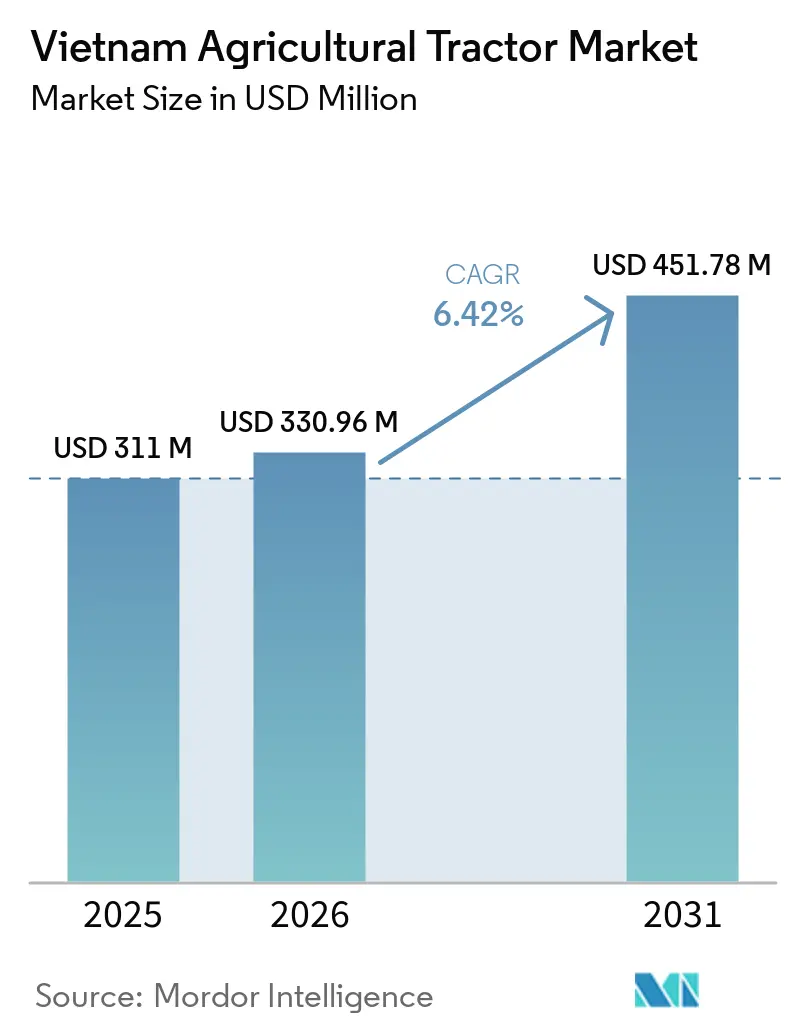
| Base Year Market Size (2025) | USD 311 Million |
| Market Size (2026) | USD 330.96 Million |
| Market Size (2031) | USD 451.78 Million |
| Growth Rate (2026 - 2031) | 6.42 % |
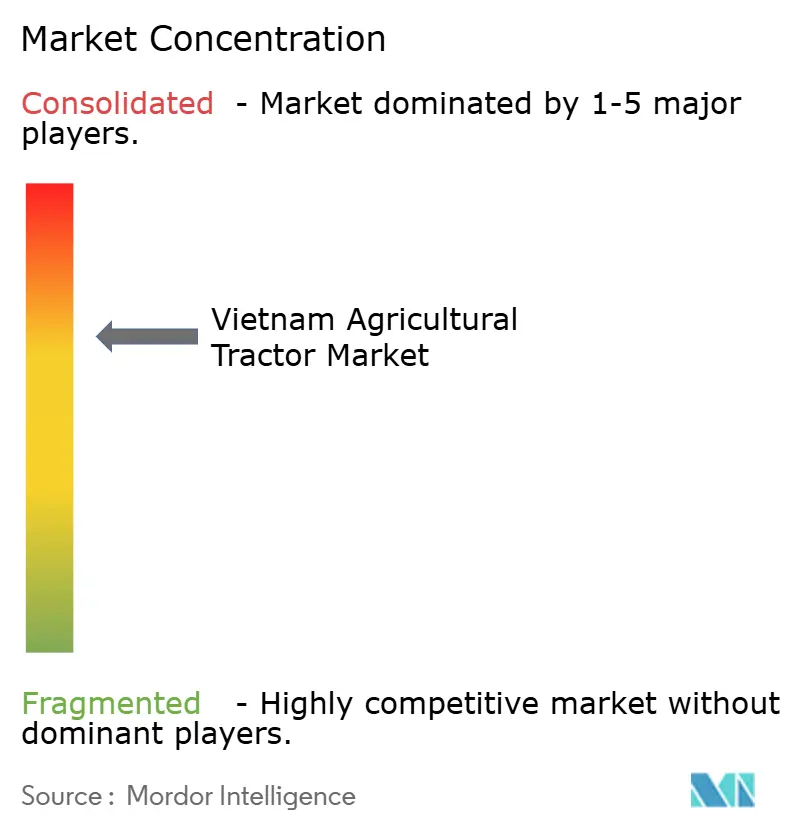
| Market Concentration | Medium |
Major Players *Disclaimer: Major Players sorted in no particular order Image © Mordor Intelligence. Reuse requires attribution under CC BY 4.0. | |
Vietnam Agricultural Tractor Market Analysis by Mordor Intelligence
The Vietnam agricultural tractor market size is expected to grow from USD 311.0 million in 2025 to USD 330.96 million in 2026 and is forecast to reach USD 451.78 million by 2031 at 6.42% CAGR over 2026-2031. This uptrend mirrors the country’s policy-led march toward agricultural mechanization, the reorganization of the Ministry of Agriculture and Environment, and the surge in low-interest credit lines that lower acquisition costs for farmers.[1] Rural labor out-migration, rising rice export volumes, and escalating demand for precision farming are translating into higher unit sales across power bands, while financing programs stimulate nearer-term purchases. Four-wheel-drive formats dominate because they handle monsoon soil conditions and sloped fields more effectively, but compact two-wheel models still appeal to fragmented farms in the north. Electric and hybrid propulsion remain nascent yet gather pace on the back of a charging roll-out. At the same time, service-based machinery sharing schemes and contract-farming models allow smallholders to access equipment without incurring full ownership costs.
Key Report Takeaways
- By engine power, the 46 -75 HP band held 40.62% of the Vietnam agricultural tractor market share in 2025, whereas the 31- 45 HP category is advancing at a 5.74% CAGR from 2026 to 2031.
- By drive type, four-wheel-drive units accounted for 57.48% of the Vietnam agricultural tractor market size in 2025 and are growing at a 6.43% CAGR from 2026 to 2031.
- By application, row-crop farming accounted for 47.12% of the Vietnam agricultural tractor market size in 2025, while orchard and plantation use cases post a 6.05% CAGR from 2026 to 2031.
- By propulsion, diesel engines control 92.55% of Vietnam agricultural tractor market share in 2025, and fully electric models are posting a 9.18% CAGR from 2026 to 2031.
Note: Market size and forecast figures in this report are generated using Mordor Intelligence’s proprietary estimation framework, updated with the latest available data and insights as of 2026.
Market Trends and Insights
Drivers Impact Analysis of Vietnam Agricultural Tractor Market*
| Driver | (~) % Impact on CAGR Forecast | Geographic Relevance | Impact Timeline |
|---|---|---|---|
| Rising Focus on Farm Mechanization | +1.8% | National, with early gains in Mekong Delta, and Red River Delta | Medium term (2-4 years) |
| Surge in Government Mechanization Subsidies | +1.5% | National, concentrated in priority agricultural zones | Short term (≤ 2 years) |
| Growth of Contract-farming Programs | +1.2% | Mekong Delta, Central Highlands, spill-over to Northern regions | Medium term (2-4 years) |
| Expansion of High-value Crop Acreage | +0.9% | Central Highlands, Northern mountains, and coastal provinces | Long term (≥ 4 years) |
| Growing Trade Support for Agricultural Goods | +0.7% | Export-oriented regions and Mekong Delta dominance | Medium term (2-4 years) |
| Emerging Low-interest Agribank Credit Lines | +0.6% | National, with enhanced access in rural cooperatives | Short term (≤ 2 years) |
| Source: Mordor Intelligence | |||
Rising Focus on Farm Mechanization
Labor migration to industrial centers is creating workforce gaps in agriculture, driving farms to adopt mechanization to maintain productivity.[2] National development plans encourage a shift from manual labor, increasing the need for machinery across rural regions. In coastal areas, machinery services have become an income stream, helping farmers access equipment without ownership costs. Larger plot sizes in fertile regions like the Mekong Delta support mechanized farming adoption. Inspection centers ensure equipment meets safety standards, increasing confidence in machine use and supporting the transition to technology-driven agricultural practices.
Surge in Government Mechanization Subsidies
Government financial initiatives are increasing agricultural machinery adoption through low-interest loans and support for local equipment manufacturers. These subsidies lower farmers' financial burden and encourage investment in productivity-enhancing tools. The programs strengthen domestic parts suppliers, reducing import dependence and shortening delivery times. Performance-based funding ensures subsidized equipment improves crop yields and operational efficiency. This approach modernizes farming practices and strengthens the agricultural supply chain, supporting rural economic development.
Growth of Contract-farming Programs
Contract farming transforms agricultural investment through guaranteed purchase agreements and stable income for growers. These structures make machinery investments more predictable for small-scale farmers. In the Mekong Delta, contract-based rice production with mechanization requirements drives equipment adoption. Cooperative models promote shared equipment use and improve utilization rates. This collaboration increases technology access, reduces individual costs, and supports sustainable community-based farming practices.
Expansion of High-value Crop Acreage
Agricultural policy prioritizes high-value crops over volume production, increasing demand for specialized machinery for crops like coffee and durian. Orchard and hillside plantation farmers invest in tractors with GPS, data logging, and slope-stability features to manage terrain and optimize harvests. Precision agriculture systems improve consistency and quality. This shift reflects the agricultural sector's focus on value-driven farming, where technology enhances profitability and global market competitiveness.
Restraints Impact Analysis of Vietnam Agricultural Tractor Market*
| Restraints | (~) % Impact on CAGR Forecast | Geographic Relevance | Impact Timeline |
|---|---|---|---|
| Highly Fragmented Landholding Structure | -1.4% | National, most severe in Northern regions, moderate in Mekong Delta | Long term (≥ 4 years) |
| Volatility in Farm Commodity Prices | -1.1% | Export-dependent regions, Mekong Delta rice, Central Highlands coffee | Medium term (2-4 years) |
| Limited Rural Charging Infrastructure for E-tractors | -0.8% | Rural areas nationwide, infrastructure gaps in remote provinces | Medium term (2-4 years) |
| Shortage of Skilled Farmers | -0.6% | National, acute in mechanized farming regions | Long term (≥ 4 years) |
| Source: Mordor Intelligence | |||
Highly Fragmented Landholding Structure
Vietnam's agricultural sector is characterized by small, fragmented landholdings, which restrict farmers' ability to invest in machinery due to limited economies of scale. The small plot sizes make individual equipment ownership financially impractical. Land-service providers have emerged as intermediaries, offering shared machinery access. In mountainous areas, steep terrain increases operational costs and limits the use of large machinery. Despite government initiatives for land consolidation to improve mechanization potential, traditional social practices and inheritance laws impede progress, forcing farmers to rely on informal sharing arrangements and community-based solutions.
Limited Rural Charging Infrastructure for E-tractors
The adoption of electric tractors faces obstacles due to insufficient rural charging infrastructure. While national plans include extensive charging station deployment targets, current implementation concentrates on urban areas, leaving agricultural regions underserved. This gap affects the feasibility of electric machinery for farmers who need rapid equipment turnaround during planting and harvesting periods. Despite private sector efforts to expand the charging network, the current infrastructure remains inadequate for supporting intensive agricultural operations. The limited availability of fast-charging stations in rural areas continues to restrict electric tractor adoption, particularly in regions where mechanization is essential.
*Our forecasts treat driver/restraint impacts as directional, not additive. The impact forecasts reflect baseline growth, mix effects, and variable interactions.
Vietnam Agricultural Tractor Market Segment Analysis
By Engine Power:
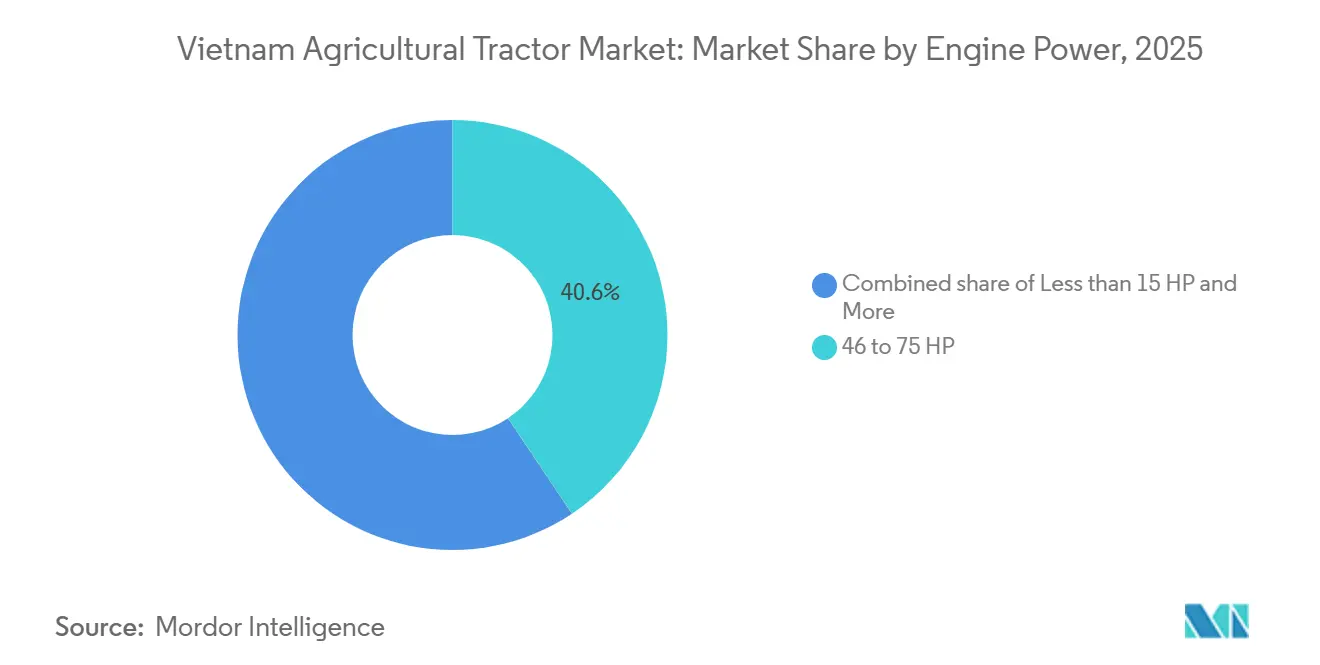
Mid-Range Models Anchor VersatilityThe 46-75 HP segment accounted for 40.62% of the 2025 Vietnam agricultural tractor market size, demonstrating its versatility across Vietnamese terrains. These mid-range agricultural tractors effectively handle plowing, harrowing, and transport tasks in rice paddies and upland fields. Their capacity to operate multi-row planters while navigating tight headlands makes them popular among farmers seeking balanced power and maneuverability. Compact 31- 45 HP units show the highest growth at 5.74% CAGR from 2026 to 2031, driven by smaller farm sizes in regions like the Mekong Delta, where cost and agility are primary concerns.
Agricultural tractors under 15 HP maintain their presence in terraced northern plots, while units above 75 HP serve larger contract farms. The industry now incorporates GPS, ISOBUS compatibility, and telemetry in mid-power machines as standard features. These frames readily accommodate precision agriculture upgrades like variable-rate fertilization, and manufacturers focusing on 31-75 HP models for hybridization position themselves for increased volume and margins.

By Drive Type:
Four-Wheel Traction Dominates Monsoon FieldsFour-wheel-drive tractors accounted 57.48% of the Vietnam agricultural tractor market share in 2025, and are forecast to grow at a 6.43% CAGR from 2026 to 2031. Their prevalence reflects the requirement for reliable traction in water-logged rice paddies and steep coffee estates. These machines reduce slippage, minimize soil compaction, and support heavier implements without stalling essential features in monsoon regions. Two-wheel-drive units remain viable in dry upland areas but decline as financing options improve four-wheel-drive accessibility.
Four-wheel-drive agricultural tractors record 18% more annual operating hours, improving investment returns. Electric variants face engineering challenges due to the increased power requirements of four-wheel systems. While intelligent torque vectoring manages power consumption, a reliable charging infrastructure remains crucial. Manufacturers now focus on power-train efficiency algorithms and traction optimization, competing on fuel or watt-hour consumption per hectare to meet data-driven farming needs.
By Application:
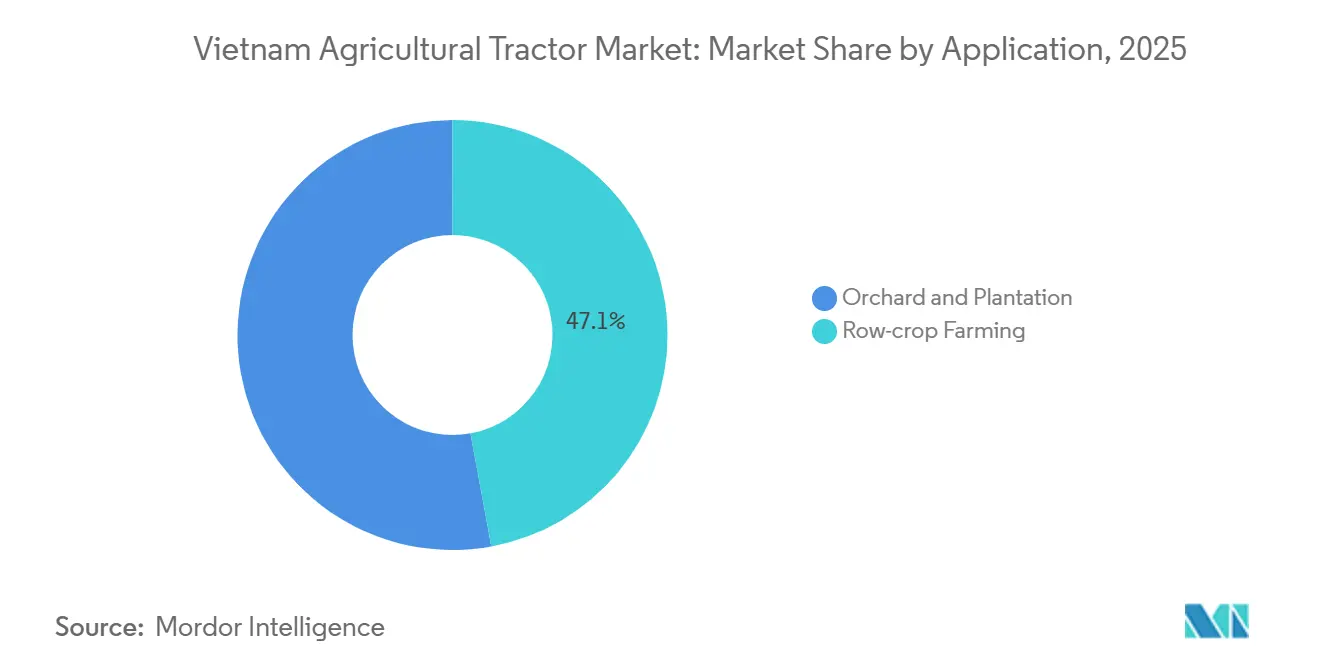
Row-Crop Core with Orchard UpsideRow-crop accounted for 47.12% of agricultural tractor usage in Vietnam as of 2025. This segment's importance in food security and exports drives continued mechanization, supporting puddling, transplanting, and harvesting operations. These time-sensitive tasks, governed by monsoon seasons, benefit from mechanization to address labor shortages and maintain crop schedules.
Orchard and plantation applications are forecast to grow at a CAGR of 6.05% from 2026 to 2031, driven by expanding cultivation of durian, longan, and pepper. The market offers narrow-chassis, high-clearance agricultural tractors with flexible PTO speeds for specialized equipment like pruning saws and mist blowers. As farms adopt drip irrigation and sensor networks, tractors serving as mobile power and data hubs gain importance, reflecting the transition toward precision farming practices.
By Propulsion Technology:
Electric Momentum Builds from a Small BaseDiesel engines accounted for 92.55% of the Vietnam agricultural tractor market share in 2025, supported by widespread fuel availability, lower initial costs, and simple maintenance requirements. These units remain essential for mechanized farming, particularly in remote areas lacking alternative fuel infrastructure. Their dependability suits farmers managing strict budgets and challenging field conditions.
The electric segment will expand at a 9.18% CAGR from 2026 to 2031, supported by decreasing battery costs and stricter carbon-reduction policies. Hybrid systems provide an intermediate option, offering fuel efficiency and regenerative braking for hydraulic operations. Manufacturers explore swappable battery systems and field-side micro-grids to address range limitations. These advancements indicate progression toward cleaner propulsion technologies, with electric and hybrid models anticipated to expand as infrastructure and policies develop.
Geography Analysis
The Mekong Delta, Vietnam's primary rice-exporting region, drives agricultural tractor demand through intensive crop rotations that require versatile machines for saturated soils and tight planting windows. Infrastructure improvements have increased field reliability, promoting higher tractor usage across seasons. The Red River Delta's proximity to Hanoi's network of dealers and component suppliers provides logistical advantages, reducing downtime and enabling upgrades to advanced models. Farmers in this region are adopting four-wheel-drive units due to better traction and performance in various field conditions.
The Central Highlands focuses on specialty-crop machinery for coffee cultivation, with tractors featuring slope-stability systems to protect root zones on uneven terrain. Sustainability certification programs influence equipment selection, as growers implement precision tools for consistent crop quality. The northern mountainous areas, despite lower overall demand, function as testing grounds for compact electric and hybrid tractors suited for steep terraces and offering reduced torque fluctuations. Coastal provinces utilize their port access for imported attachments and benefit from shared repair infrastructure through industrial cluster initiatives. Vietnam's varied geography creates specific needs across agricultural regions, requiring manufacturers to provide diverse tractor models and support services. Farmers need machines with different power ratings, chassis configurations, and terrain adaptability across saturated deltas and highlands. This diversity influences innovation in design and after-sales support, with suppliers developing solutions for local conditions. Government programs and regional logistics hubs influence purchasing decisions, particularly in export-oriented crop areas. The ability to match equipment to specific agronomic and environmental requirements determines market competitiveness as mechanization increases.
Regulatory Landscape
Vietnam frames agricultural tractor adoption under a national mechanization policy architecture led by the Prime Minister and implemented by the sector ministry. Decision 858/QD-TTg (July 20, 2022) sets the direction for synchronized mechanization and the integration of smart and digital technology through 2030, while the implementation plan under Decision 3394/QD-BNN-KTHT (August 11, 2023) translates this into ministry-level actions across priority farming zones.
Compliance and market access are shaped by standards and fiscal and trade levers. Tractor safety alignment draws on national standards such as TCVN 8744-1:2011 and TCVN 8744-2:2012. On the trade side, the Ministry of Industry and Trade issued Notice 78/QD-BCT effective June 20, 2026, applying a 3% special adjustment duty for 12 months on selected Chinese-origin agricultural machinery categories, including wheeled tractors, while Circular 101/2025/TT-BNNMT guides which special-purpose machinery qualifies for a 5% VAT rate.
Competitive Landscape
The industry remains moderately concentrated. The Vietnam agricultural tractor market is dominated by several key players, with Kubota Corporation maintaining a strong market position through its extensive dealer network and integrated financing solutions. Truong Hai Group Corporation (THACO) has enhanced its market position by establishing local production facilities and developing strategic partnerships to minimize trade barrier impacts. Deere & Company (TTC Bien Hoa) has increased its market presence by providing precision agriculture solutions and autonomous machinery. These companies maintain their positions through established brand recognition, technical support networks, and product lines that meet Vietnam's diverse agricultural requirements, from rice cultivation to highland farming.
Yanmar Holdings Co., Ltd. and Vietnam Engine & Agricultural Machinery Corp (VEAM) are significant market players, utilizing their manufacturing expertise and regional production facilities. Yanmar specializes in dry-field applications, while VEAM's integration with local supply chains enables both companies to serve small landholdings and cooperative farms. These companies maintain market dominance by providing reliable machinery and comprehensive after-sales support. Their established networks ensure farmers have access to essential parts, training, and maintenance services across Vietnam's agricultural regions.
New market entrants are focusing on electric vehicles and digital agriculture solutions. Start-up companies are introducing service-based business models that reduce equipment ownership costs, while infrastructure companies develop charging network systems. Current regulations favor manufacturers with established safety and compliance measures, limiting unauthorized imports. Market leaders are integrating hardware with software and financial services, moving from single transactions to ongoing service relationships. This integration of technology, services, and regulatory compliance is transforming market competition and advancing agricultural mechanization.
Vietnam Agricultural Tractor Industry Leaders
-
Kubota Corporation
-
Truong Hai Group Corporation (THACO)
-
Yanmar Holdings Co., Ltd.
-
Vietnam Engine & Agricultural Machinery Corp (VEAM)
-
Deere & Company (TTC Bien Hoa)
- *Disclaimer: Major Players sorted in no particular order
Vietnam Agricultural Tractor Market Companies Covered in this Report
- Kubota Corporation
- Yanmar Holdings Co., Ltd.
- Vietnam Engine & Agricultural Machinery Corp (VEAM)
- Iseki & Co., Ltd.
- Truong Hai Group Corporation (THACO)
- Deere & Company (TTC Bien Hoa)
- Mahindra & Mahindra Ltd.
- LS Group
- Zetor Tractors a.s. (HTC Investments)
- Zoomlion Heavy Industry Science and Technology Co., Ltd.
Market Opportunities and Future Outlook
A key opportunity sits in the mechanization gap that industry bodies have highlighted. In April 2026, the Vietnam Agricultural Mechanical Association reported that domestic agricultural machinery investment meets about 60% of actual demand, indicating a sizable addressable whitespace for tractor OEMs and distributors, particularly in rice, coffee, and fruit production chains highlighted in the mechanization strategy (Decision 858/QD-TTg). Domestic production covers roughly 30% of total demand and imports account for the balance, creating room for suppliers that can differentiate on durability in monsoon conditions, aftersales uptime, and precision-ready configurations.
Policy-linked financing and technology-transfer platforms also create commercial entry points beyond pure unit sales. MARD has circulated draft incentive mechanisms centered on subsidized credit (including proposals around a 3% annual interest rate on project values for machinery and technology equipment purchases), supporting bundled offers that combine tractors, implements, and training for cooperatives and contract-farming operators. The Vietnam International Agricultural Machinery Exhibition 2026 (scheduled July 23 to 25, 2026 at Sky Expo Center, Ho Chi Minh City) is positioned around technology transfer from land preparation to smart irrigation, providing an active channel for OEMs to showcase ISOBUS/telemetry-ready mid-power tractors and build partnerships with service providers that address fragmented landholding through shared-use and contractor models.
Recent Industry Developments in Vietnam Agricultural Tractor Market
- June 2026: Vietnam's Ministry of Industry and Trade issued Notice 78/QD-BCT applying a 3% special adjustment duty for 12 months on selected Chinese-origin agricultural machinery categories, including wheeled tractors. The measure alters pricing for import-led supply and supports a stronger role for locally assembled and locally sourced equipment in dealer portfolios.
- April 2026: THACO INDUSTRIES inaugurated its Specialized Equipment Factory in Chu Lai with a USD 30 million investment and stated capacity of 75,000 industrial and agricultural equipment products per year. The added manufacturing footprint strengthens local availability of equipment and parts, improving lead times and aftersales support that influence tractor total cost of ownership.
- December 2024: Yanmar Holdings partnered with International Tractors Limited to distribute Solis tractors in Thanh Hoa Province, expanding brand and model availability and intensifying competition in core horsepower bands through provincial dealer coverage.
Vietnam Agricultural Tractor Market Report Scope and Research Methodology
Market Definition and Coverage
This market covers the value of agricultural tractors sold for farming use in Vietnam, counted in USD and tied to on-farm demand for land preparation, planting, and hauling work across crop operations.
Scope exclusions: It excludes tractors bought mainly for industrial or construction use, and it also excludes separate sales of attachments and other agricultural machines.
Segments Covered in This Report
- By Engine Power
- Less than 15 HP
- 15 - 30 HP
- 31- 45 HP
- 46 -75 HP
- Above 75 HP
- By Drive Type
- Two-wheel Drive (2WD)
- Four-wheel Drive (4WD)
- By Application
- Row-crop Farming
- Orchard and Plantation
- By Propulsion Technology
- Diesel
- Hybrid
- Fully Electric
Data Sources, Market Sizing, and Validation
Desk Research
Desk research was used to set the factual base for the model and to make sure the assumptions match Vietnam conditions. We relied on public data points such as Vietnam General Statistics Office releases, Ministry of Agriculture and Rural Development updates, Vietnam Customs trade statistics for tractor imports, and FAOSTAT series for cropping and farm structure indicators. We also reviewed material from tractor and farm-mechanization associations, along with peer-reviewed agronomy and mechanization studies that explain how tractor power needs change by crop and field size.
To translate those signals into a sizing structure, company annual reports, distributor announcements, and credible local business press were checked for product mix, pricing direction, and dealer coverage. In a few places, paid subscriptions were used for company financials and intelligence, patent lookups, and shipment-level import records so the trend lines could be cross-checked. The desk sources listed here are illustrative, and many other public references were used for data collection, validation, and clarification during the study.
Primary Interviews and Surveys
Primary work centered on interviews and structured surveys with tractor OEM teams, dealer and service networks, parts and financing partners, and mechanization decision makers close to farms. We used these conversations to confirm typical horsepower preferences, replacement timing, the split between import and locally assembled mix, and realistic price bands by tractor class, with checks across the main rice and upland crop areas so assumptions stayed practical.
Distribution of primary research fieldwork respondents
| Company type | Respondent position |
|---|---|
| Top tier: 33% | CXOs: 16% |
| Mid tier: 45% | Functional/Unit leaders: 24% |
| Smaller Players: 22% | Managers: 60% |
Market-Sizing & Forecasting
Sizing starts from a top-down demand pool build where tractor value is reconstructed from Vietnam farm activity signals, import flows, and mechanization adoption by major crop systems, then translated into expected unit needs by power class and priced into USD. Core inputs include cultivated area trends for key crops, typical mechanized hours per hectare, replacement cycles for small and mid-HP tractors, the split between 2WD and 4WD demand where applicable, and average selling price movement that reflects mix shifts and currency timing.
After that, selective bottom-up approximations were used to keep totals sensible, including dealer-channel checks on annual sell-through, sampled unit volumes multiplied by observed price bands, and sanity checks against import shipment patterns when imported units dominate a band. When a sub-segment had thin visibility, gaps were handled by using adjacent power-band ratios confirmed in interviews, then rechecked against the national demand indicators so the model did not overstate smaller niches.
For forecasting, scenario analysis was applied around the main drivers local experts highlighted, such as mechanization support programs, labor availability in rural areas, and farmer access to credit and leasing. Each scenario was converted into yearly unit and ASP paths, and the final forecast was set where interview consensus aligned with the most stable trend signals.
Data Validation & Update Cycle
Validation is done through several passes so odd jumps are caught early. We compare the final totals against independent signals such as import value trends, crop area changes, and dealer inventory movements, then revisit assumptions when model output moves away from these reference checks.
Before sign-off, another analyst reviews the calculation chain, unit logic, and price progression so errors or double counting are removed. If a material variance shows up, respondents are re-contacted to clarify what changed, such as a policy shift or a sharp price move. Reports are refreshed annually, and interim updates are made when major events occur, followed by a final freshness check right before delivery.
Mordor Intelligence's Vietnam Agricultural Tractor Market Sizing Compared With Other Published Estimates
Published market values for Vietnam agricultural tractors can differ because the underlying scope and the way value is built up are not the same across sources. The most common differences come from what is counted as a tractor sale, the choice of base year, and how import value and pricing are converted into a clean demand number.
In practice, some estimates blend in adjacent farm equipment revenue, apply broad regional ASP curves without checking Vietnam dealer pricing, or use long-range growth paths that are not revalidated when policy or currency conditions shift. The spread becomes larger when definitions mix industrial tractors with farm tractors, or when the model does not separate tractor value from attachments and implements, which can inflate the headline number.
Benchmark comparison
| Source | Market Size | Gaps in Research Methodology |
|---|---|---|
| Mordor Intelligence | USD 311.00 M (2025) | |
| Global Consultancy A | USD 666.72 M (2025) | The estimate appears to use a broader value pool that may blend tractors with related mechanization spending, and the scope wording is less explicit on excluding attachments and non-farm tractor use, which can lift the total. |
| Industry Publisher B | USD 292.01 M (2024) | The base year differs and the value build seems more anchored to current market activity signals, but it is less clear how ASP is progressed and how import value is normalized, which can pull the figure down in a weaker year. |
The table shows that scope clarity and year choice create much of the gap, especially when attachments or non-agriculture applications are silently included. By keeping the market limited to agricultural tractor sales value and by checking import signals against dealer price bands before finalizing the number, a key difference is made clear in the approach used by Mordor Intelligence.
Key Questions Answered in the Report
How large is the Vietnam tractor market in 2026?
The market stands at USD 330.96 million in 2026 and is moving on a 6.42% CAGR path to USD 451.78 million by 2031.
Which engine power band sells most units?
Tractors rated 46-75 HP hold 40.62% of Vietnam Agricultural Tractor Market share, balancing versatility and fuel efficiency for diverse Vietnamese field conditions.
Why do four-wheel-drive tractors dominate?
Monsoon soils and hilly coffee zones require better traction; thus four-wheel variants make up 57.48% of sales and are growing faster than two-wheel models.
How concentrated is competition?
The industry remains moderately concentrated in terms of competition.