
Video Encoder Market Size and Share
Market Overview
| Study Period | 2020 - 2031 |
|---|---|
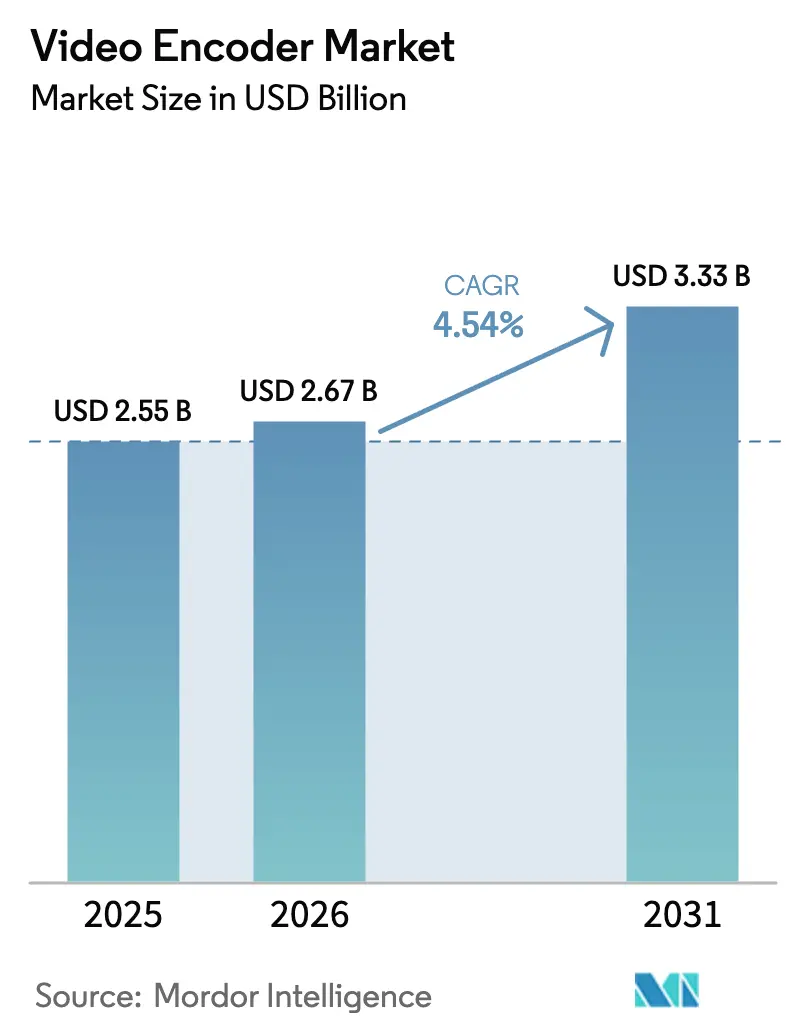
| Market Size (2026) | USD 2.67 Billion |
| Market Size (2031) | USD 3.33 Billion |
| Growth Rate (2026 - 2031) | 4.54 % |
| Fastest Growing Market | Asia Pacific |
| Largest Market | North America |
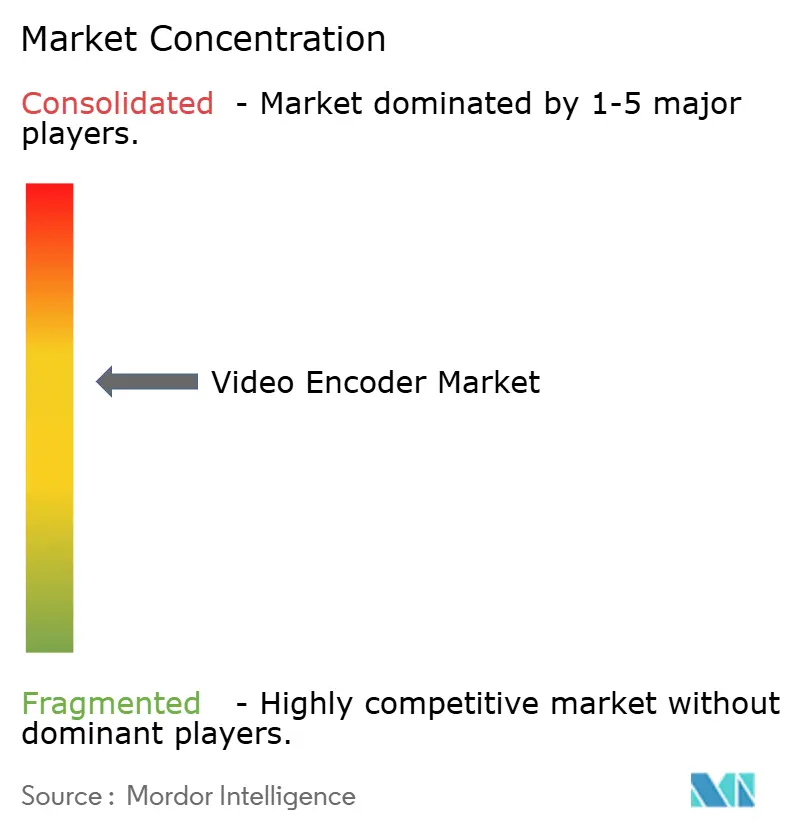
| Market Concentration | Medium |
Major Players *Disclaimer: Major Players sorted in no particular order Image © Mordor Intelligence. Reuse requires attribution under CC BY 4.0. | |
Video Encoder Market Analysis by Mordor Intelligence
The video encoder market size is expected to grow from USD 2.55 billion in 2025 to USD 2.67 billion in 2026 and is forecast to reach USD 3.33 billion by 2031 at 4.54% CAGR over 2026-2031. This steady trajectory mirrors the sector’s ongoing transition from legacy H.264/AVC toward more efficient standards such as AV1 and VVC/H.266 while workflows migrate from fixed-function appliances to cloud-native infrastructure. Demand accelerates as multiscreen OTT viewing, 5G-enabled live streaming, and the proliferation of ultra-high-definition (UHD) formats place bandwidth optimization at the core of investment decisions. Hardware encoders currently anchor mission-critical broadcast operations, yet SaaS offerings gain momentum because elastic scaling lowers total cost of ownership for variable workloads. Supply-chain pressures on ASIC and FPGA components, coupled with codec royalty uncertainties, temper near-term spending but simultaneously widen opportunities for royalty-free alternatives.
Key Report Takeaways
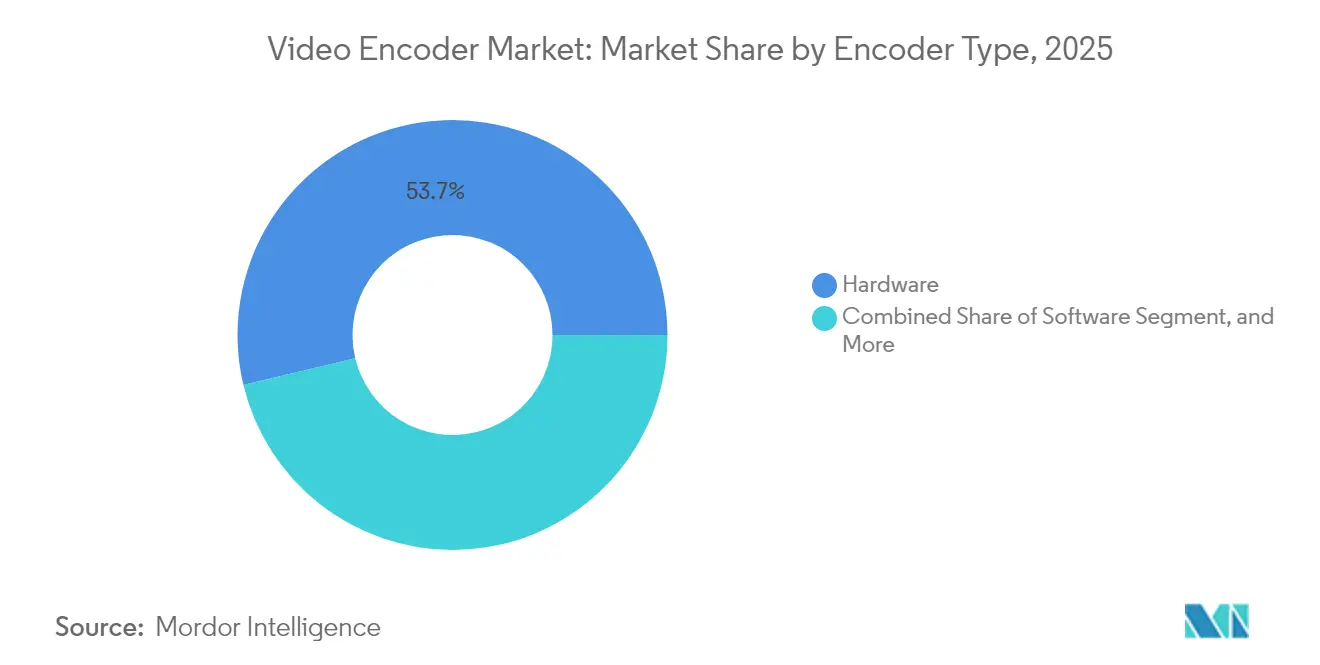
- By encoder type, hardware encoders led with 53.74% of the video encoder market share in 2025; cloud/SaaS solutions are projected to post the fastest 5.88% CAGR through 2031.
- By encoding standard, H.264/AVC captured 44.20% of the video encoder market size in 2025, while VVC/H.266 is expected to grow at a 5.29% CAGR to 2031.
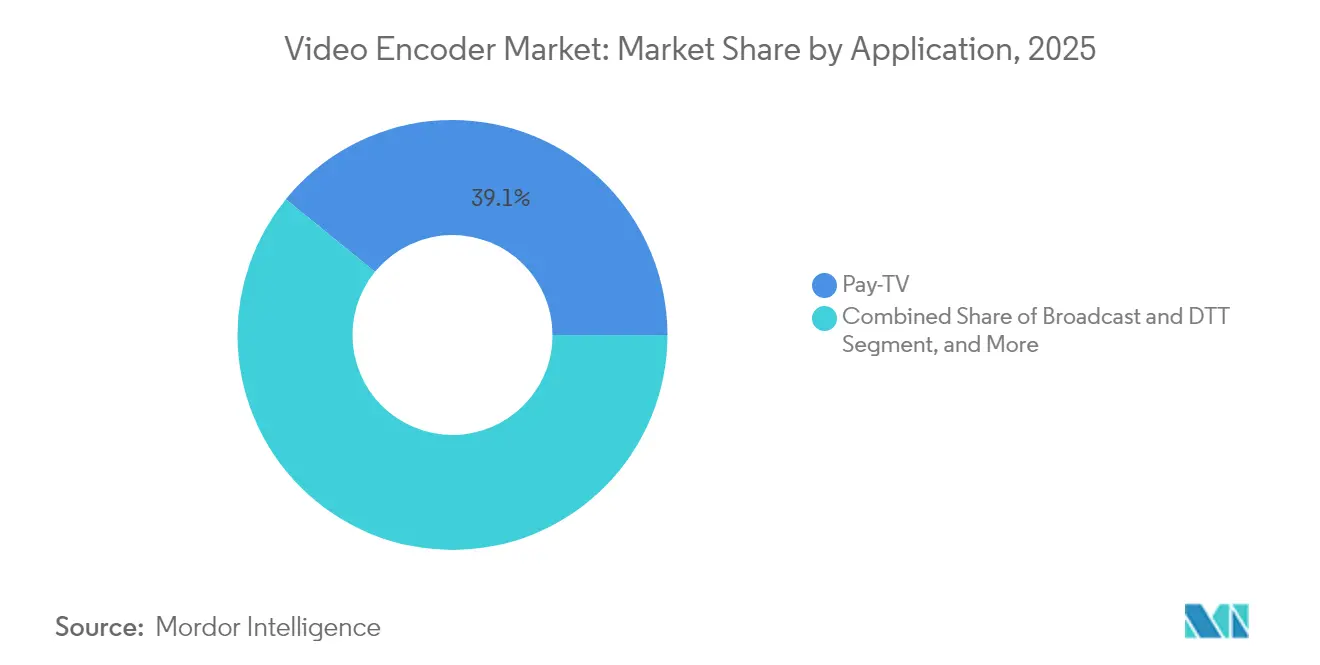
- By application, pay-TV held 39.12% revenue share in 2025; OTT and live streaming are advancing at a 5.52% CAGR through 2031.
- By end-user, media and entertainment represented 44.91% demand in 2025, whereas enterprise/corporate usage is rising at a 5.41% CAGR to 2031.
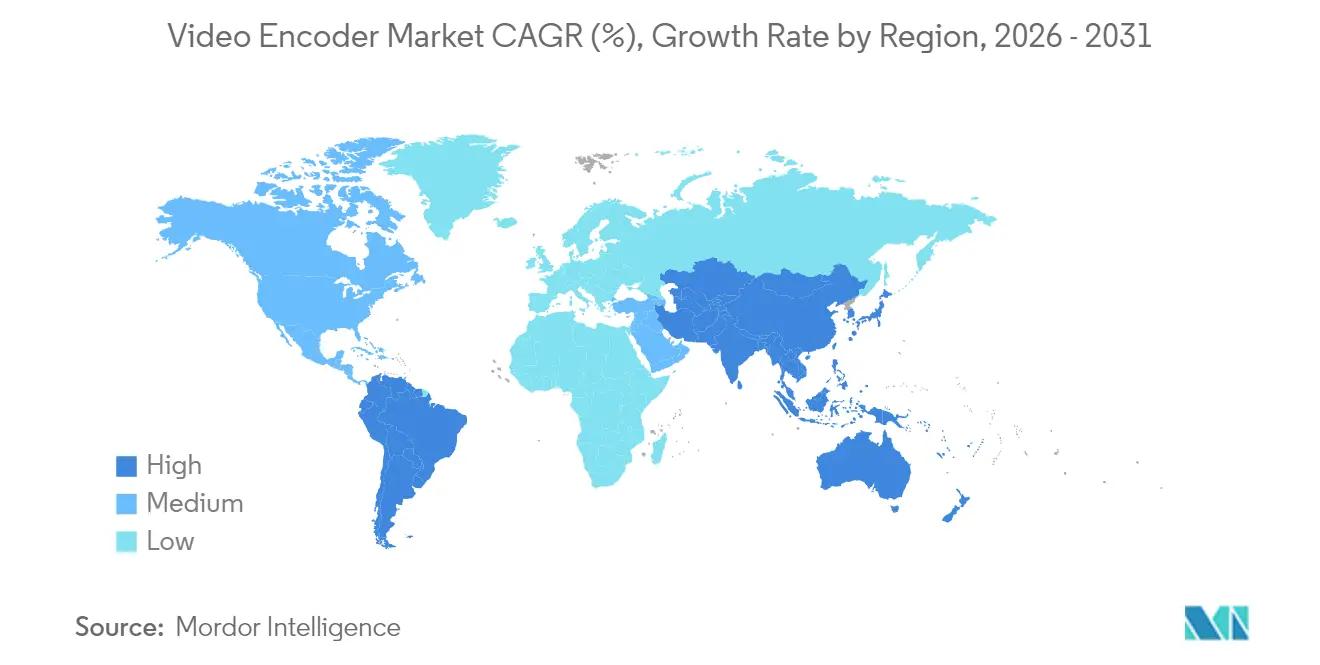
- By geography, North America accounted for 33.25% of 2025 revenue, yet Asia-Pacific is on track for the highest 5.26% CAGR through 2031.
Note: Market size and forecast figures in this report are generated using Mordor Intelligence’s proprietary estimation framework, updated with the latest available data and insights as of 2026.
Market Trends and Insights
Drivers Impact Analysis of Video Encoder Market*
| Driver | (~) % Impact on CAGR Forecast | Geographic Relevance | Impact Timeline |
|---|---|---|---|
| Rising popularity of multiscreen and OTT video consumption | +1.2% | Global; strongest in North America and Asia-Pacific | Medium term (2-4 years) |
| Proliferation of 5G networks enabling UHD live streaming | +0.9% | Asia-Pacific core; spill-over to North America and Europe | Long term (≥ 4 years) |
| Migration from AVC to royalty-free AV1 | +0.8% | Global; led by North America and Europe | Medium term (2-4 years) |
| Cloud-native encoding workflows lowering TCO for broadcasters | +0.7% | North America and Europe; expanding in Asia-Pacific | Short term (≤ 2 years) |
| Edge encoding demand for low-latency interactive video | +0.5% | Global; early adoption in developed markets | Medium term (2-4 years) |
| Government funding for emergency surveillance networks | +0.4% | Asia-Pacific and Middle East; selective North America | Long term (≥ 4 years) |
| Source: Mordor Intelligence | |||
Rising popularity of multiscreen and OTT video consumption
OTT platforms optimize delivery across smartphones, tablets, and connected TVs, often producing 15 adaptive-bitrate profiles per asset to guarantee uninterrupted playback. Netflix’s shift to AV1 brought 30% bandwidth savings and lower CDN costs, proving the economic value of advanced compression. [1]Netflix Technology Blog, “AV1 Codec Implementation and Performance Analysis,” NETFLIXTECHBLOG.COM Manufacturers such as Samsung embed HDR10+ support that pushes content owners to preserve wider color gamut, raising demand for high-performance encoders able to process HDR and SDR simultaneously. As more smart-TV operating systems integrate voice-controlled search, frame-accurate trick-play features require additional metadata, further enlarging encoding workloads. These factors collectively sustain premium encoder adoption for multiscreen environments.
Proliferation of 5G networks enabling UHD live streaming
Commercial 5G deployments in Japan and South Korea have already enabled field tests of 8K and 4K60 live feeds, delivering uplink speeds of 100 Mbps from moving vehicles.[2]NTT Docomo, “5G Network 8K Live Streaming Trial Results,” DOCOMO.NE.JP Broadcasters can now bypass satellite links for remote production, trimming contribution costs and setup times. Low-latency edge nodes bring end-to-end delays below 50 ms, critical for interactive sports betting and fan engagement applications. China Mobile’s rollout of 5G-based surveillance across 200 cities further underscores how cellular backhaul can substitute fixed fiber in massive video networks. Encoder vendors capable of integrating 5G modems and network slicing APIs gain first-mover advantage as mobile operators commercialize premium video tiers.
Migration from AVC to high-efficiency, royalty-free codecs (AV1)
YouTube’s migration of all ≥480p assets to AV1 eliminated roughly USD 100 million in annual H.264 royalties and delivered 20% bitrate savings, illustrating powerful incentives to adopt open codecs. Alliance for Open Media’s expansion to include Intel, AMD, and ARM ensures silicon-level decoding becomes ubiquitous, mitigating device compatibility risks that stalled earlier transitions. Meta’s adoption across Facebook and Instagram strengthens AV1’s network effect by improving mobile user experience in bandwidth-constrained markets. For broadcasters, royalty-free licensing simplifies long-term budgeting as content libraries grow into petabyte scale. As cloud GPU instances add AV1 hardware acceleration, encoding throughput rises, lowering per-minute costs and unblocking at-scale adoption.
Cloud-native encoding workflows lowering TCO for broadcasters
AWS Elemental MediaConvert processed over 1 billion minutes of video monthly in 2024, showcasing elasticity that cuts 40–60% off lifetime ownership cost compared with fixed appliances.[3]Amazon Web Services, “Elemental MediaConvert Usage Statistics and Performance Metrics,” AWS.AMAZON.COM Serverless pipelines let broadcasters spin up thousands of transcodes during prime time and wind them down minutes later. Microsoft Azure’s FPGA-based instances match appliance-grade performance while preserving cloud flexibility, satisfying latency-sensitive users. Hybrid deployments-on-premises appliances bursting to the cloud-gain favor among tier-1 sports networks that require deterministic performance for marquee events yet want to avoid over-provisioning idle hardware. Consequently, vendors blending appliance reliability with SaaS orchestration capture an expanding share.
Restraints Impact Analysis of Video Encoder Market*
| Restraint | (~) % Impact on CAGR Forecast | Geographic Relevance | Impact Timeline |
|---|---|---|---|
| High capex for ultra-low-latency hardware encoders | -0.8% | Global; acute for small broadcasters | Short term (≤ 2 years) |
| Fragmented patent pools and codec royalty uncertainties | -0.6% | Global; highest in cost-sensitive markets | Medium term (2-4 years) |
| Supply-chain risks for ASIC/FPGA components | -0.5% | Global; concentration in Asia-Pacific fabrication | Short term (≤ 2 years) |
| Power-consumption limits in edge/portable use-cases | -0.4% | Global; critical for mobile and IoT | Long term (≥ 4 years) |
| Source: Mordor Intelligence | |||
High capex for ultra-low-latency hardware encoders
Encoders delivering sub-20 ms glass-to-glass latency cost USD 50,000–200,000 per unit, pricing smaller broadcasters out of interactive or VR offerings. ASIC-based designs demand bespoke silicon, and volumes remain niche, limiting economies of scale. E-sports tournament organizers frequently allocate six-figure budgets merely for encoding rigs across multi-camera broadcasts, squeezing margins for mid-tier events. With semiconductor talent diverted toward AI inference and crypto, advances in purpose-built video silicon slow, prolonging premium pricing.
Fragmented patent pools and codec royalty uncertainties
VVC/H.266’s multiple pools require separate negotiations, pushing combined royalties above HEVC and delaying broad deployment. Firms lacking deep legal resources hesitate to incorporate VVC, instead extending AVC lifetimes despite efficiency penalties. HEVC’s lingering disputes illustrate how opaque royalties can suppress market momentum for years. The contrast with AV1’s zero-royalty model intensifies pressure on patent holders but leaves current adopters in limbo, forcing multi-codec strategies that inflate operational complexity.
*Our forecasts treat driver/restraint impacts as directional, not additive. The impact forecasts reflect baseline growth, mix effects, and variable interactions.
Video Encoder Market Segment Analysis
By Encoder Type:
Cloud solutions accelerate infrastructure reinventionHardware appliances represented 53.74% of 2025 revenue, underscoring their legacy foothold in mission-critical contribution and distribution. Yet the video encoder market size for cloud/SaaS offerings is projected to expand at a 5.88% CAGR, the fastest among all types, as broadcasters prioritize opex flexibility over capex lock-in. Cloud adoption surges among digital-first studios needing instantaneous scale for episodic releases, while software encoders on COTS servers continue serving corporate campuses where IT staff can manage workloads internally.
In live sports, appliances retain primacy owing to deterministic performance and SDI integration, but hybrid architectures emerge wherein on-site gear sends mezzanine feeds to cloud clusters for ABR packaging at scale. Disaster recovery strategies increasingly mirror this approach, allowing rapid failover to the cloud without duplicating entire appliance fleets. Vendors able to orchestrate transcodes across heterogeneous infrastructures widen competitive moats as customers avoid single-point dependencies.



By Encoding Standard:
Next-gen codecs redefine efficiency frontier.H.264/AVC still commands 44.20% of the video encoder market share because of near-universal device support, yet bandwidth pressures and royalty costs push operators toward alternatives. VVC/H.266 leads growth at a 5.29% CAGR thanks to 50% bitrate savings over HEVC, pivotal for 8K streaming. Meanwhile, AV1’s royalty-free proposition lures OTT services seeking predictable costs, even if computational complexity remains higher today.
The video encoder market size tied to AV1 receives a tailwind from Intel’s Arc Pro GPUs and Apple’s iPhone 15, both offering native decode. As such, silicon populates consumer devices, and distributors accelerate AV1 adoption to reduce CDN bills. In the professional realm, GPU-accelerated VVC encoding within AWS MediaConvert removes prior performance bottlenecks, convincing early adopters to test live trials for 4K HDR channels. Multi-codec ladders will persist through 2031 as content owners hedge against licensing risks and device heterogeneity.
By Application:
OTT’s rapid ascent reshapes revenue mix.Pay-TV still generated 39.12% of 2025 demand as cable and satellite operators refresh headends, but growth pivots to OTT and live streaming, which will post a 5.52% CAGR. The expansion reflects cord-cutting coupled with sports rights migrating online. Security and surveillance maintain a stable trajectory, aided by smart-city programs specifying centralized video analytics that depend on efficient encoding for petabyte-scale archives. Remote education and corporate webcasting enjoy structural tailwinds from hybrid work, spurring enterprises to embed broadcast-grade quality into town-halls and training sessions.
OTT workflows place a premium on adaptive bitrate efficiency and DRM integration, steering buyers toward software-definable products. Conversely, surveillance deployments emphasize continuous 24/7 operation, favoring ruggedized hardware encoders dissipating minimal heat. The resulting application diversity prevents consolidation around a single architecture, necessitating modular portfolios that address disparate latency, reliability, and cost requirements.
By End-user Industry:
Enterprise adoption broadens customer baseMedia and entertainment accounted for 44.91% of 2025 revenue, reflecting studios, broadcasters, and streaming giants that ingest massive libraries. Enterprises, however, will show the fastest 5.41% CAGR as video becomes embedded in daily operations-from earnings webcasts to immersive product demos. Healthcare providers deploy encoders inside telemedicine carts for real-time diagnostics, while schools capture lectures for asynchronous learning.
Corporate IT teams favor cloud-native services to avoid specialty hardware, yet financial-services firms often stipulate on-premises solutions to satisfy data residency mandates. Government agencies mandate FIPS-certified modules, opening niches for vendors with compliance pedigrees. Thus, suppliers must tailor products to vertical-specific security and integration needs while maintaining common codec roadmaps.
Geography Analysis
North America Video Encoder Market
North America generated 33.25% of revenue in 2025, underpinned by entrenched broadcast networks and the headquarters of major streaming services that demand premium UHD workflows. Replacement investment outweighs greenfield builds, yet software-defined transformations continue as cloud economics improve.
APAC Video Encoder Market
Asia-Pacific’s video encoder market size is on a 5.26% CAGR path to 2031, buoyed by massive smart-city surveillance projects, rapid 5G densification, and growing appetite for multilingual OTT catalogs. Local manufacturing ecosystems for electronics and semiconductors shorten supply chains and accelerate pilot deployments.
Europe Video Encoder Market
Europe pursues sustainability by mandating lower power envelopes and enforcing privacy protections, prompting adoption of efficient codecs and on-premises processing for sensitive footage. Regional public broadcasters modernize in step with DVB and HbbTV updates, forming steady demand for hybrid workflows.

Regulatory Landscape
Video encoder deployments sit at the intersection of broadcast standards-setting and codec licensing, where compliance and intellectual-property terms directly shape product roadmaps. The Joint Video Experts Team (JVET) continues to advance next-generation video coding work, including an H.267 target of at least a 40% bitrate reduction versus VVC Main 10 for 4K and higher content, with standardization discussed around 2028. In broadcast policy, Brazil formally established its TV 3.0 system in August 2025 as a national benchmark that uses VVC as the primary codec (with LCEVC as an enhancement layer), creating a concrete regulatory pull-through for VVC-capable encoding chains in a major market.
Codec licensing and FRAND treatment remain a material constraint for global rollouts, with standard-essential patent disputes and negotiations spanning the US, Europe, Brazil, and Asia. The Access Advance Video Distribution Patent (VDP) Pool is one of the mechanisms used to package licensing across multiple codecs (including HEVC, VVC, AV1, and VP9), but buyers still face multi-codec risk management, especially where VVC pools are fragmented. As a result, vendors increasingly emphasize flexible multi-codec support and royalty-aware packaging options rather than single-standard lock-in.
Value Chain Analysis
The value chain spans codec standardization and patent licensing, silicon and compute platforms (ASIC/FPGA/GPU and cloud instances), encoder software stacks and appliances, and downstream integrators serving broadcasters, pay-TV operators, OTT platforms, and enterprise video teams. The shift from fixed appliances to cloud-native and hybrid delivery is increasingly reflected in go-to-market models, with cloud/SaaS encoding and management layers built on top of hyperscaler infrastructure and specialized acceleration. Licensing considerations (for HEVC/VVC versus royalty-free AV1) influence product planning upstream and customer procurement downstream.
Industry structure also reflects consolidation and portfolio refocusing among infrastructure suppliers. In June 2026, MediaKind completed the acquisition of Harmonic's video business for USD 145 million, creating a larger independent video infrastructure vendor and changing supplier options for operators and broadcasters sourcing encoders and video processing. Following the divestiture, Harmonic repositioned toward pure-play virtualized broadband infrastructure, reinforcing a split in the ecosystem between broadband access platforms and specialized video encoding and processing vendors. Consolidation in adjacent video network businesses continues to tighten the supplier landscape, while increasing the importance of interoperable, multi-vendor workflows across contribution, processing, packaging, and delivery.
Competitive Landscape
Innovation and Adaptability Drive Market Success
The market remains moderately fragmented. Hardware stalwarts such as Harmonic, Cisco, and MediaKind anchor broadcast workflows, whereas AWS Elemental and Google Cloud target elastic, usage-based encoding in the cloud arena. Hybrid orchestration is becoming the competitive battleground as customers demand appliance-like reliability paired with on-demand scale.
Strategic moves illustrate convergence. Harmonic’s acquisition of Ateme’s broadcast unit broadens software talent while preserving appliance lineage. Intel’s Arc Pro silicon underpins a hardware ecosystem optimized for AV1, supplying cloud providers and workstation OEMs alike. Cisco’s USD 120 million capacity build reinforces North American self-reliance amid supply-chain vulnerabilities.
Emerging vendors emphasize AI-assisted quality optimization and ultra-low-latency edge devices. Bitmovin’s ISO 27001 certification removes compliance roadblocks for regulated industries, while VITEC’s sub-50 ms appliances unlock new interactive use cases.
Video Encoder Industry Leaders
Harmonic Inc.
CommScope Holding Company, Inc.
MediaKind Global, Inc.
Cisco Systems, Inc.
Imagine Communications Corp.
- *Disclaimer: Major Players sorted in no particular order
Video Encoder Market Companies Covered in this Report
- Harmonic Inc.
- CommScope Holding Company, Inc.
- MediaKind Global, Inc.
- Cisco Systems, Inc.
- Imagine Communications Corp.
- Z3 Technology, LLC
- Ateme S.A.
- Adtec Digital, Inc.
- VITEC Holdings S.A.S.
- Axis Communications AB
- AWS Elemental, Inc.
- Haivision Systems Inc.
- Telestream, LLC
- Matrox Electronic Systems Ltd.
- AJA Video Systems, Inc.
- Brightcove Inc.
- Synamedia Ltd.
- Bitmovin, Inc.
- Beamr Imaging Ltd.
- Teradek, LLC

Market Opportunities and Future Outlook
Opportunities cluster where buyers can translate measurable bandwidth, compute, or operational savings into faster refresh cycles, particularly in cloud/SaaS and next-generation codecs. AV1 adoption momentum is reinforced by large-scale OTT usage and the economic rationale of royalty-free licensing, while VVC activity is supported by concrete broadcast-system decisions such as Brazil's TV 3.0 standardization (August 2025) that specifies VVC as the primary codec. Together, these factors create whitespace for vendors that can operationalize multi-codec ladders, automate codec selection, and control licensing exposure through packaging and workflow governance.
A second opportunity pocket is performance-per-watt and latency optimization for live streaming and premium sports, where suppliers are investing in new transport and processing techniques. Ateme has highlighted R&D themes including green sustainable TV services, ultra-low-latency streaming using Media-over-QUIC, and advanced frame-rate conversion for premium sports, aligning encoder differentiation with operator goals around energy use and viewer experience. Separately, AI-enhanced encoding is being productized to reduce bitrate and automate quality decisions, as reflected by Beamr Imaging's focus on AI-driven video compression in 2026. Vendors that integrate AI-based quality assessment and optimization into enterprise-ready pipelines (including security, compliance, and orchestration) have room to expand beyond traditional broadcast headends into broader cloud video operations.
Recent Industry Developments in Video Encoder Market
- June 2026: Completed the divestiture of its Video Business segment to MediaKind for cash consideration, refocusing Harmonic on core broadband virtualization. The divestiture reshapes the video processing and encoders ecosystem by accelerating consolidation among leading players. The action strengthens MediaKind's standalone video ecosystem leadership while freeing Harmonic to pursue broadband innovations.
- March 2026: Introduced the Spectrum X Plus media server, doubling channel density for broadcast playout and showcasing AI-driven video workflow innovations at NAB 2026. The upgrade expands capacity for high-density playout and AI optimization in broadcast workflows. It positions Harmonic to set new expectations for next generation hardware in live and linear environments.
- January 2026: Formed a global IPTV and OTT partnership with Smartlabs to combine MK.IO cloud-native video headend technology with Smartlabs’ platform and client applications. The collaboration extends MediaKind cloud-native headend capabilities and OTT reach across platforms. The alliance could shift market dynamics toward cloud-based video headends in OTT/IPTV ecosystems.


Video Encoder Market Report Scope and Research Methodology
Market Definition and Coverage
For this study, the video encoder market covers revenue generated from products and software used to compress and convert video into streaming or broadcast-ready formats, including on-premise hardware, installed software, and cloud-based encoding services.
Scope exclusions: We exclude downstream video distribution services like CDN delivery, player apps, and general video editing tools unless they are sold as a defined encoding or transcoding offering.
Segments Covered in This Report
- By Encoder Type
- Hardware
- Software
- Cloud / SaaS
- By Encoding Standard
- H.264 / AVC
- H.265 / HEVC
- AV1
- VVC / H.266
- Other Encoding Standard
- By Application
- Pay-TV
- Broadcast and DTT
- OTT and Live Streaming
- Security and Surveillance
- Remote Education and Corporate Webcasting
- By End-user Industry
- Media and Entertainment
- Enterprise / Corporate
- Government and Defence
- Education
- Healthcare
- By Geography
- North America
- United States
- Canada
- Mexico
- Europe
- Germany
- United Kingdom
- France
- Russia
- Rest of Europe
- Asia-Pacific
- China
- Japan
- India
- South Korea
- Australia
- Rest of Asia-Pacific
- Middle East and Africa
- Middle East
- Saudi Arabia
- United Arab Emirates
- Rest of Middle East
- Africa
- South Africa
- Egypt
- Rest of Africa
- Middle East
- South America
- Brazil
- Argentina
- Rest of South America
- North America
Data Sources, Market Sizing, and Validation
Desk Research
Desk research was used to set the market boundaries and to anchor the demand-side story to observable signals. We reviewed public references such as FCC filings and spectrum releases, ITU guidance on video and broadcast standards, NIST cybersecurity guidance that impacts media systems procurement, and ISO and IEC publications that influence interoperability and testing. For streaming and traffic direction, we also used widely cited internet measurement publications and open web performance datasets that help explain workload growth and codec adoption.
On the supply and commercialization side, we relied on company annual reports, earnings transcripts, product documentation, and pricing pages to understand typical packaging and how licensing is structured across hardware, software, and cloud usage. When needed, paid subscriptions were used for company financials and intelligence, patent landscaping for codec and acceleration activity, and shipment-level trade checks for electronics categories that often map to encoder appliances. These desk research sources are illustrative, and many other public and paid references were also used during data collection, cross-checking, and clarification.
Primary Interviews and Surveys
Primary work was carried out to pressure-test what we saw in public sources and to fill gaps that are usually not published, especially around real-world deployments and price realization. We spoke with stakeholders across the value chain, including product managers, solution architects, broadcast operations leads, and enterprise video owners, and we also validated regional buying patterns across APAC, EMEA, and the Americas. Feedback was used to confirm codec mix changes, cloud versus on-premise splitting, procurement cycles, and the practical reasons behind upgrades, including UHD workflows and low-latency live streaming requirements.
Distribution of primary research fieldwork respondents
| Company type | Respondent position | Region |
|---|---|---|
| Top tier: 26% | CXOs: 13% | APAC: 48% |
| Mid tier: 60% | Functional/Unit leaders: 31% | EMEA: 33% |
| Smaller Players: 14% | Managers: 56% | Americas: 19% |
Market-Sizing & Forecasting
Sizing was built using a top-down and bottom-up approach. The top-down side reconstructed the demand pool from media workflow build-outs and the installed base refresh behavior in broadcast, pay-TV, OTT streaming, and enterprise video. We translated these demand drivers into annual encoder spending by using a mix of deployment counts, average channels or streams per deployment, utilization patterns for live versus file-based workloads, and typical replacement cycles for appliances and software stacks.
To keep totals realistic, we corroborated the model with selective bottom-up approximations, such as sampled price ranges for hardware units, channel density assumptions, and cloud encoding consumption converted into annual spend through published pricing structures. The model also used market fingerprints like codec transition timing (H.264 to H.265 and newer options), UHD and HDR penetration in delivery workflows, live event volume trends, and cloud migration pace for variable workloads. Forecasts were built using scenario analysis, where adoption curves for newer standards and cloud usage were adjusted based on what interviewees considered achievable under cost, bandwidth, and compliance constraints. Where bottom-up visibility was patchy for smaller countries or niche applications, we used proxy indicators like broadband speed growth, broadcaster counts, and enterprise video penetration, and then rechecked the output with experts before locking the final totals.
Data Validation & Update Cycle
Validation was handled through several passes, where model outputs were checked against independent signals such as broadcast equipment spending direction, cloud infrastructure expansion tied to video workloads, and observed codec adoption in major streaming ecosystems. Outliers were flagged when growth rates or implied pricing moved beyond what buyers and integrators described as feasible, and then assumptions were revisited and corrected.
Before sign-off, the work goes through peer review to confirm the math logic, scope consistency, and year-on-year reasonableness by region and end use. Reports refresh annually, and interim updates are made when material events occur, such as standards shifts, major regulatory changes, or clear pricing moves. Right before delivery, an analyst performs a fresh pass so clients receive the latest updated view based on the most recent information available.
Mordor Intelligence's Video Encoder Market Size Measured Against Other Published Estimates
Published numbers for this market often differ because the scope line between encoders, broader video processing, and full streaming infrastructure is drawn differently across studies. Differences also show up when one publisher assumes faster codec transitions or counts cloud usage in a more aggressive way, which can change the annual spend noticeably.
Key gaps usually come from whether audio and video encoders are combined, whether transcoding platforms are treated as a separate market or merged in, and how pricing is handled for usage-based cloud encoding versus perpetual software licensing. Timing choices also matter, since some estimates use older exchange rates or do not refresh device and workload assumptions when UHD adoption and live streaming volumes shift.
Benchmark comparison
| Source | Market Size | Gaps in Research Methodology |
|---|---|---|
| Mordor Intelligence | USD 2.55 B (2025) | |
| Industry Publisher A | USD 4.52 B (2025) | This figure combines audio and video encoders and uses a longer horizon that can lift near-term sizing through broader category inclusion and faster assumed adoption of newer formats. |
| Research Aggregator B | USD 2.36 B (2024) | This estimate is framed as video encoding and transcoding together, but its base year and scope mix can differ, especially if cloud encoding consumption is captured mainly as software revenue rather than end-user spend. |
The spread in the table is mainly explained by category overlap and year alignment, rather than by a single growth assumption. By separating encoder spend across hardware, installed software, and cloud usage and then validating the codec mix and workload intensity with interviews, the totals stay closer to what buyers actually purchase, a discipline applied by Mordor Intelligence.


Key Questions Answered in the Report
What is the current value of the video encoder market?
The market is valued at USD 2.67 billion in 2026 and is projected to reach USD 3.33 billion by 2031.
Which encoder type is growing the fastest?
Cloud/SaaS solutions are expected to post the highest 5.88% CAGR through 2031.
How dominant is H.264/AVC today?
H.264/AVC retains 44.20% share, remaining the most widely deployed codec despite efficiency limits.
Why are AV1 and VVC gaining traction?
AV1 offers royalty-free licensing and about 20% bitrate savings, while VVC/H.266 provides 50% better compression over HEVC, critical for 8K workflows.
Which region will lead future growth?
Asia-Pacific is forecast to expand at a 5.26% CAGR, propelled by 5G rollouts and large-scale surveillance projects.
How are 5G networks influencing encoder demand?
5G enables high-bandwidth, low-latency UHD streaming, encouraging broadcasters to adopt encoders that can deliver 4K and 8K live content economically.
Page last updated on:





