
Vetiver Oil Market Size and Share
Market Overview
| Study Period | 2021 - 2031 |
|---|---|
| Market Volume (2026) | 338.72 tons |
| Market Volume (2031) | 470.43 tons |
| Growth Rate (2026 - 2031) | 6.79 % |
| Fastest Growing Market | Asia Pacific |
| Largest Market | Europe |
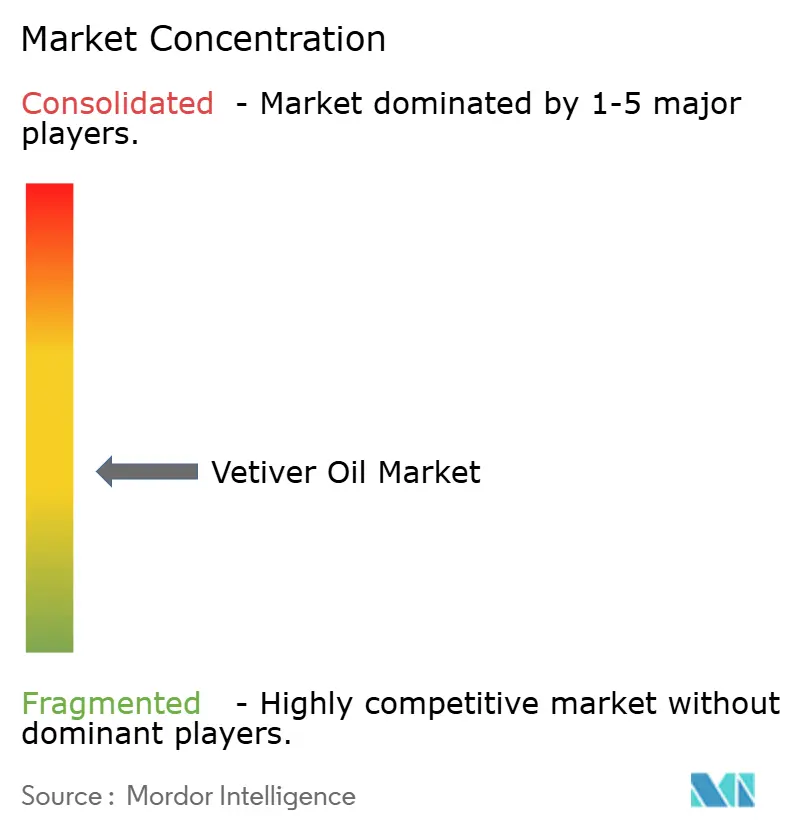
| Market Concentration | Medium |
Major Players *Disclaimer: Major Players sorted in no particular order Image © Mordor Intelligence. Reuse requires attribution under CC BY 4.0. | |
Vetiver Oil Market Analysis by Mordor Intelligence
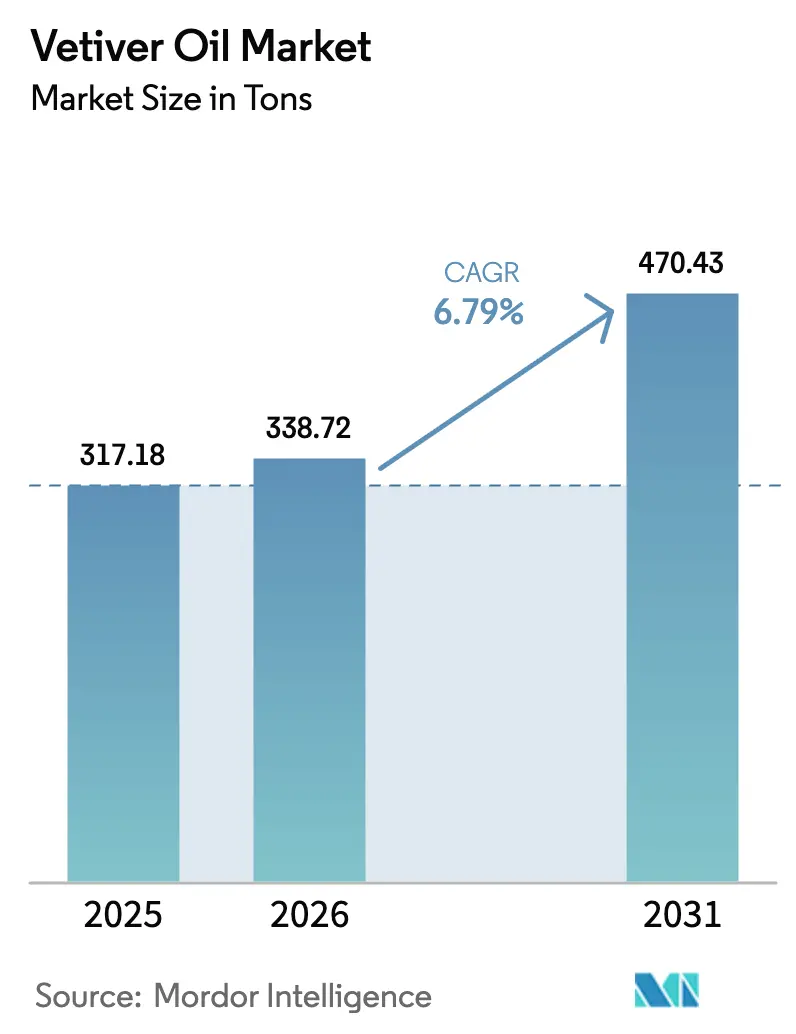
The Vetiver Oil Market size is expected to increase from 317.18 tons in 2025 to 338.72 tons in 2026 and reach 470.43 tons by 2031, growing at a CAGR of 6.79% over 2026-2031. Robust demand from wellness tourism, accelerating spa revenues and expanding neuro-pharmaceutical exploration continue to outweigh supply-side fragilities rooted in Haiti’s smallholder-centric production base. Carbon-credit monetization, traceable sourcing schemes and premium positioning for organic grades further elevate the long-term growth runway for the vetiver oil market. Competitive intensity remains moderate as multinational fragrance houses pursue deeper vertical integration while cooperatives attempt to stabilize farmer incomes through group certification and long-rotation harvesting.
Key Report Takeaways
- By application, Spa and Relaxation captured 80.58% of the vetiver oil market share in 2025 while recording a 7.09% CAGR through 2031.
- By origin, vetiver oil from Haiti accounted for 54.19% of the global vetiver oil market size in 2025, while Indian vetiver oil is forecast to expand at an 11.20% CAGR to 2031.
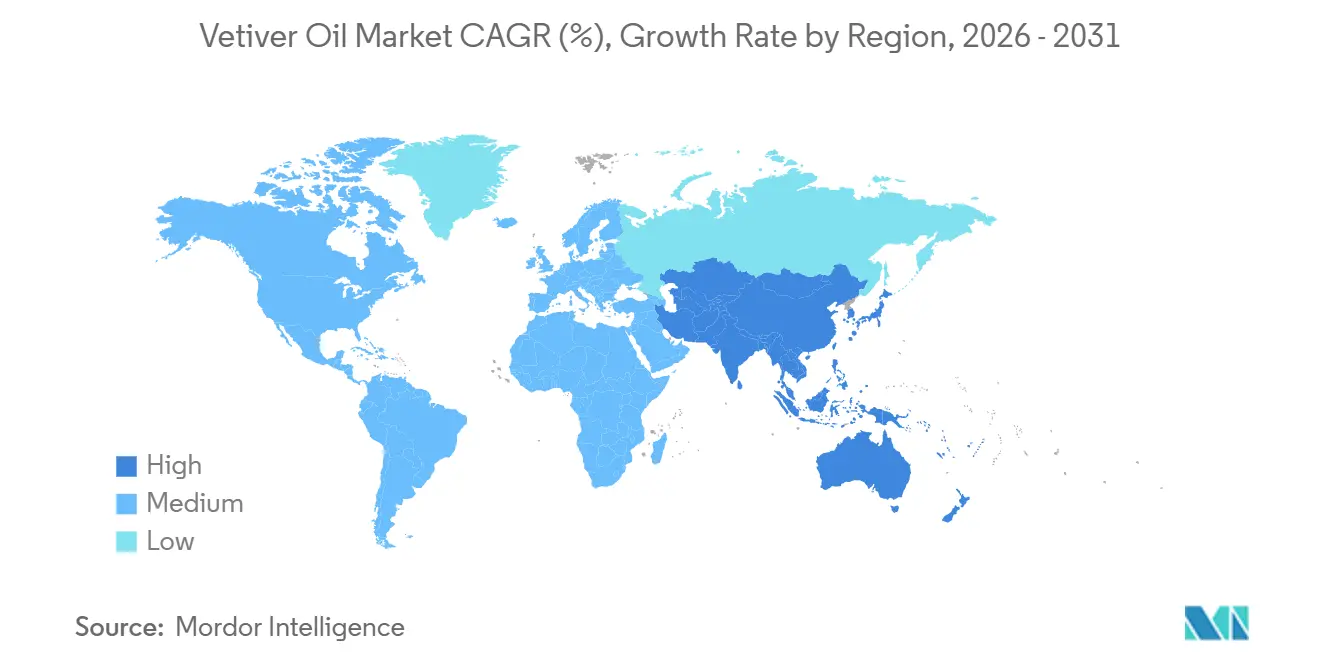
- By geography, Europe led with a 36.82% volume share of the vetiver oil market in 2025; Asia-Pacific is projected to post the fastest regional CAGR at 7.57% through 2031.
Note: Market size and forecast figures in this report are generated using Mordor Intelligence’s proprietary estimation framework, updated with the latest available data and insights as of January 2026.
Market Trends and Insights
Drivers Impact Analysis of Vetiver Oil Market*
| Drivers | (~) % Impact on CAGR Forecast | Geographic Relevance | Impact Timeline |
|---|---|---|---|
| Rising demand in fragrance and perfumery | +1.8% | Europe, North America | Medium term (2-4 years) |
| Surge in personal-care, spa and aromatherapy usage | +2.1% | Asia-Pacific, Europe | Medium term (2-4 years) |
| Preference for organic and natural ingredients | +1.3% | North America, Europe, urban Asia-Pacific | Long term (≥4 years) |
| Carbon-credit potential from vetiver cultivation | +0.9% | India, Latin America, Sub-Saharan Africa | Long term (≥4 years) |
| Neuro-pharma and CNS wellness applications | +0.6% | North America, Europe, Japan | Long term (≥4 years) |
| Source: Mordor Intelligence | |||
Rising Demand in Fragrance and Perfumery
Vetiver features in roughly 90% of Western fine-fragrance formulas as both a fixative and an olfactory anchor, reinforcing longevity and depth in compositions that must comply with evolving allergen restrictions[1]USDA Foreign Agricultural Service, “Essential Oils Annual Report,” fas.usda.gov. Prestige-fragrance sales rose 8% in 2025, and heritage scents such as Chanel No. 5 and Miss Dior rely on Haitian or Bourbon grades whose terroir confers bright, airy facets prized by perfumers. France exported USD 7.6 billion of perfumes in 2024, signaling inelastic demand for high-grade vetiver despite spot-price volatility. Industry R&D—about 8% of net sales—targets reformulation strategies that preserve natural inputs amid the EU Chemical Strategy’s stringent proposals. Biotech alternatives remain in pilot phases and lack the 200-plus synergistic compounds delivered by steam-distilled oil.
Surge in Personal-Care, Spa and Aromatherapy Usage
Global spa revenues climbed to USD 136.8 billion in 2023 and are forecast to reach USD 184.3 billion by 2028, eclipsing pre-pandemic trajectories[2]Global Wellness Institute, “Global Wellness Economy Monitor 2025,” globalwellnessinstitute.org. Vetiver’s dual utility as a massage oil base and diffusion agent aligns with hotel-and-resort protocols that emphasize single-origin essential oils for experiential differentiation. Peer-reviewed work shows that 2.5% inhalation of vetiver oil reduces anxiety in laboratory models by modulating c-fos expression in the central amygdala. Corporate wellness programs across Japan and South Korea now incorporate aromatherapy sessions featuring vetiver, extending demand into workplace health settings. The progression of wellness tourism-already above USD 1 trillion in 2024-further entrenches vetiver within multiday itineraries that bundle tactile and olfactory therapies.
Preference for Organic and Natural Ingredients
Over 70% of consumers under 35 choose personal-care products formulated with natural inputs, pushing brands to secure organic-certified vetiver and third-party audited supply chains. doTERRA’s Union for Ethical BioTrade membership in October 2025 underscores a broader shift toward biodiversity and fair-compensation standards that mitigate reputational risk in high-margin aromatherapy channels. Group certification initiatives-exemplified by Givaudan’s 250-producer network in Les Cayes-amortize audit expenses and unlock price premiums that smallholders could not achieve individually. Regulatory uncertainty persists: proposed Safe-and-Sustainable-by-Design frameworks under the EU Chemical Strategy could still reclassify natural essential oils, compelling pre-emptive life-cycle testing among ingredient suppliers. Companies that complete full biodegradability assessments today are positioned to capture millennial loyalty even under tighter labeling rules.
Carbon-Credit Potential from Vetiver Cultivation
Vetiver sequesters 15.24 megagrams of carbon per hectare per year, outperforming other aromatic crops and creating a tradable offset stream alongside oil revenues. India’s Vetiver Foundation, established in 2023, collaborates with CSIR-CIMAP Lucknow to scale genotypes G10, G12, G14, and G15 that yield 10-30 kg ha-1 while rebuilding soil organic carbon. With voluntary-credit prices in the USD 5-15 tCO₂e range, a 10,000-hectare expansion could open an additional USD 760 million in carbon revenue across a 5-year compliance window. Haiti remains hampered by missing national registries and political uncertainty, limiting near-term project development despite the island’s acute erosion crisis. Phytoremediation projects that deploy vetiver on contaminated sites add a potential third revenue stream, yet food- or cosmetic-grade approvals for oil extracted from remediated soil remain unclear.
Restraints Impact Analysis of Vetiver Oil Market*
| Restraints | (~) % Impact on CAGR Forecast | Geographic Relevance | Impact Timeline |
|---|---|---|---|
| High product cost and price volatility | -1.2% | Haiti, India, global buyers | Short term (≤2 years) |
| Competition from synthetics and other essential oils | -0.8% | Global mass-market personal care | Medium term (2-4 years) |
| Supply-chain fragility in Haiti and other origins | -0.7% | Haiti (54.19% of supply) | Short term (≤2 years) |
| Source: Mordor Intelligence | |||
High Product Cost and Price Volatility
Farm-gate prices in India range from ₹120–₹800 per kg (USD 1.40–9.60 per kg), while retail prices exceed ₹20,000 per kg (USD 240 per kg), a 25-fold spread reflective of multi-tiered margins and quality-grading opacity. A 21% rise in fertilizer costs during 2025, coupled with 15–30% yield losses from erratic rainfall, compressed smallholder profitability, and prompted premature harvesting that both degrades oil quality and worsens soil erosion in Haiti. Java crude trades at USD 155–180 per kg compared with historic Bourbon prices of USD 250–300 per kg, illustrating terroir-driven premiums that price-sensitive brands struggle to absorb. Lacking forward contracts, farmers remain exposed to spot-price swings, and substitution with synthetic vetiverol looms when natural prices spike. Cooperative bargaining and shared warehousing offer partial mitigation but require capital infusions that remain scarce in most origins.
Competition from Synthetics and Other Essential Oils
Roughly 76% of perfumery ingredients are petrochemical-derived, and synthetic vetiverol offers price stability and regulatory simplicity that appeal to mass-market formulators. Biotech routes—fermentation-derived khusimol, enzymatic replicas—could achieve sub-USD 100 per kg cost curves within 7 years, threatening natural oil’s premium tiers. Cedarwood, sandalwood, and patchouli compete for fixative roles, and fragrance trend cycles occasionally depress vetiver pull-through when sweeter profiles dominate season launches. Clean-label momentum partially offsets this threat, yet natural oils remain exposed to EU hazard reclassification scenarios that could unintentionally favor synthetics. Economies of scale remain elusive; vetiver captures under 1% of global essential-oil tonnage, limiting leverage on logistics and processing costs.
*Our forecasts treat driver/restraint impacts as directional, not additive. The impact forecasts reflect baseline growth, mix effects, and variable interactions.
Vetiver Oil Market Segment Analysis
By Application:
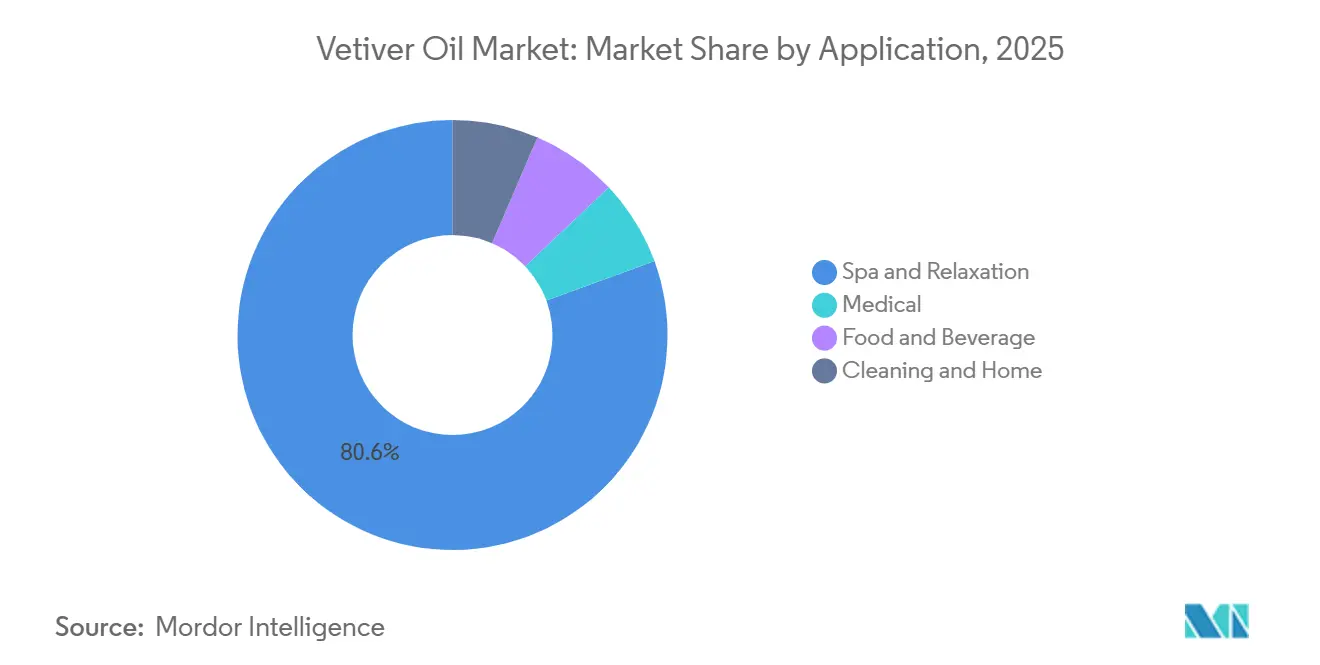
Spa and Relaxation Anchors Volume GrowthSpa and Relaxation accounted for 80.58% of 2025 demand in the vetiver oil market by application. The segment is projected to expand at 7.09% CAGR through 2031, ahead of overall market averages as hotel, resort, and destination-spa operators bundle aromatherapy and massage protocols that favor single-origin essential oils. Vetiver’s proven anxiolytic activity, antimicrobial profile, and woody-earthy aroma suit both tactile and diffusion modalities, creating defensible shelf presence in premium spa menus. The rise of integrated wellness retreats that combine nutrition, mindfulness, and sensory therapies ensures continued pull-through for high-grade oils.
Personal-care and cosmetics leverage vetiver’s antimicrobial minimum-inhibitory concentrations of 15.63–62.5 µg/ml in deodorants, body washes, and leave-on skin products. Fragrance houses integrate the oil as a base note in chypre, fougère, and woody compositions that require stability against light and oxidation. Medical and food-and-beverage uses remain niche but emerging; GRAS approval since 1970 enables beverage mixers and craft spirits to employ trace quantities for flavor depth. Cleaning and home-care segments exploit vetiver’s insect-repellent effects in candles and room sprays. Continued validation of cortisol-lowering properties could unlock regulated nutraceutical formats, although therapeutic marketing will remain constrained by FDA and EU health-claim frameworks.



By Origin:
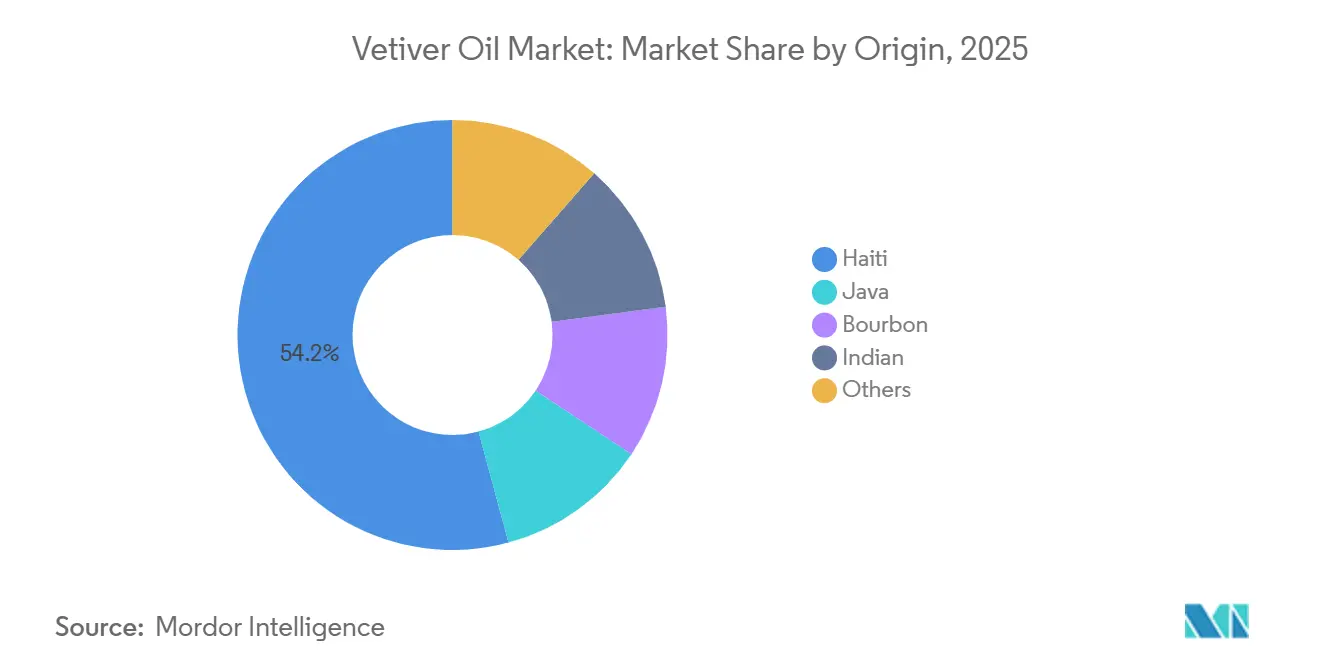
Haiti Dominance Meets Indian MomentumHaiti supplied 54.19% of global output in 2025, yet structural fragility persists: 90% of farmers earn under USD 2 per day, political unrest disrupts logistics, and premature harvesting erodes both yield and soil stability. The February 2024 passing of Pierre Léger, whose Frager plant handled 60% of Haitian oil, highlighted succession vulnerabilities in a concentrated processing landscape. Despite risk, Haitian terroir imparts bright, citrus fresh-cut characteristics that command FOB prices of USD 200-250 per kg, anchoring its premium status.
India’s 11.20% CAGR—fastest among origins—results from government-backed genotype rollouts and the Vetiver Foundation’s 2023 launch. High-yield varieties G10-G15 deliver 10–30 kg per hectare and meet carbon-market criteria, encouraging acreage expansion beyond the current 10,000 ha. Java maintains the largest planted area, but its smoky profile caps usage to fixative roles in cost-sensitive fragrances. Bourbon vetiver from Réunion remains scarce, yet retains benchmark quality status that perfumers leverage for limited-edition runs. The net effect positions India and Java to absorb incremental demand, while Haiti must secure financing and agronomic support to preserve its flagship share.
Geography Analysis
Europe Vetiver Oil Market
Europe accounted for 36.82% of global volume in 2025, propelled by a EUR 49.7 billion spa sector, 65,385 establishments, and a fragrance industry investing 8% of net sales into R&D that safeguards natural-ingredient usage against looming EU Chemical Strategy curbs. France’s USD 7.6 billion perfume exports anchor demand for premium Haitian oil, while Germany’s USD 8.73 billion spa revenues and Italy’s artisanal perfumery traditions strengthen pull-through. Trade groups lobby to prevent blanket hazard reclassification of essential oils, arguing for risk-proportionate approaches that maintain access to heritage ingredients. The United Kingdom’s post-Brexit rules complicate border checks but have not materially dented demand. Eastern Europe and Russia show nascent adoption, though supply-chain sanctions introduce routing complexities.
APAC Vetiver Oil Market
Asia-Pacific will post a 7.57% CAGR through 2031, the fastest of any region. Thailand, Indonesia, and India integrate vetiver across Ayurveda, traditional Chinese medicine, and Jamu practices, embedding the oil into both clinical and tourist-oriented therapy packages. China’s USD 11.74 billion spa market and Japan’s USD 5.65 billion share drive volume gains, while South Korean corporate wellness programs broaden weekday consumption. India’s twin role as producer and buyer creates internal market tension; domestic distillers still import 60–70 tons annually to satisfy perfumery and personal-care demand unserved by internal capacity.
North America, LATAM and MEA Vetiver Oil Market
North America accounted for considerable consumption through imports in 2025 with the United States accounting for the majority through direct-selling and specialty-beauty channels. The USD 28.70 billion U.S. spa market emphasizes experiential differentiation, favoring transparent supply chains and third-party certifications that confirm ethical sourcing. Canada leverages reciprocal organic-certification agreements for streamlined cross-border trade, while Mexico shows gradual uptake in resort corridors and emerging clean-beauty brands. Latin America’s Brazil and Argentina remain volume-light because of currency volatility, although boutique aromatherapy in Argentina hints at future upside. The Middle East and Africa gain from luxury hotel infrastructure in Dubai and Riyadh, integrating single-origin vetiver into high-end spa rituals; however, regional processing capacity remains limited, necessitating imports.

Value Chain Analysis
The vetiver oil value chain begins with smallholder cultivation and root harvesting (often manual or with mechanical excavators), followed by washing, chopping, and steam distillation at farm-level or local distilleries. Crude oil then moves to aggregators, exporters, and ingredient houses for grading, blending, and quality verification, which commonly requires gas chromatography capabilities that many small producers lack, before reaching fragrance, personal care, and spa formulators and ultimately retail and professional spa channels. Haiti remains central to supply (54.19% share in 2025), but it is also exposed to logistics disruption and processor concentration, while India and Indonesia/Java provide alternate sourcing routes with different odor profiles for end-use needs.
Value capture shifts downstream where certification, traceability, and specification management determine buyer access and price premiums. Multinational fragrance and ingredient players increasingly work through structured producer networks and certifications to secure volumes and stabilize incomes, exemplified by Givaudan working with a cooperative of 250 producers in Haiti under Ecocert Fair for Life. Key bottlenecks include long crop cycles (commonly 18-20 months for traditional varieties), labor-intensive harvesting, and limited lab infrastructure for consistent quality and compliance documentation, which together widen the gap between farm-gate economics and premium-grade pricing in export markets.
Competitive Landscape
The global vetiver oil market is moderately fragmented. Givaudan’s acquisition of Albert Vieille, plus Fair-For-Life certification for 250 Haitian farmers, exemplifies a strategy that secures premium grades while satisfying ESG mandates. Technology differentiation widens competitive gaps. Disruptive biotech entrants experiment with fermentation-based vetiverol priced to undercut natural oils; time-to-scale remains contingent on achieving sub-USD 100 per kg cost structures. Cooperative models in India aggregate landholdings to improve bargaining power and certification uptake, while Haiti looks to carbon-credit finance to prolong rotation cycles that enhance yield and soil health.
Competitive positioning increasingly hinges on compliance frameworks such as IFRA standards and emergent EU Safe-and-Sustainable-by-Design criteria. Producers investing early in life-cycle analysis, biodegradability and legitimate carbon accounting can court premium buyers and pre-empt regulatory shocks. Conversely, distillers dependent on price-volume tradeoffs risk margin compression when synthetic substitutes or biotech analogs achieve sensory parity.
Vetiver Oil Industry Leaders
UniKode S.A.
Robertet
FRAGER ESSENTIAL OIL S.A.
Fleurchem, Inc.
BERJE INC
- *Disclaimer: Major Players sorted in no particular order
Vetiver Oil Market Companies Covered in this Report
- Absolute Aromas
- Albert Vieille
- Amphora Aromatics Ltd
- BERJE INC
- doTERRA
- Eden Botanicals
- Falcon
- Fleurchem, Inc.
- FRAGER ESSENTIAL OIL S.A.
- Kanta Enterprises Private Limited
- PerfumersWorld
- PLANT THERAPY ESSENTIAL OILS
- Rakesh Sandal Industries
- Robertet
- Ultra International B.V.
- UniKode S.A.
- Van Aroma

Market Opportunities and Future Outlook
Supply diversification and localized processing are emerging as a practical whitespace as buyers manage single-origin exposure and traceability demands. The Vetiver Filipina Project in Camarines Sur, Philippines, is a concrete example, built around a 1,000-hectare vetiver plantation and a steam distillation facility operated by Iba Botanicals, where new-origin development is tied to dedicated extraction capacity rather than fragmented toll distillation. Similar origin-expansion efforts also connect to land-restoration narratives and carbon-accounting potential, which supports projects that combine agronomy support with auditable sustainability reporting.
Partnership-led, direct-to-farm models also offer a route to reducing intermediaries, improving root quality, and standardizing specifications for premium perfumery and wellness uses, particularly when Haiti supply-chain fragility creates continuity gaps. Givaudan maintains a verified Haiti program with Fair for Life certification for producer groups, and the Vetiver Together partnership between IFF and Unilever focuses on strengthening smallholder livelihoods and food security in Haiti, reinforcing a pathway in which long-term sourcing commitments, producer support, and compliance-ready traceability shift from optional to commercial requirements. For market participants, the near-term opportunity centers on scaling certified volumes, building basic testing and documentation closer to origin, and adding alternative origins that can meet consistent odor-profile and quality targets for spa and fine-fragrance demand.
Recent Industry Developments in Vetiver Oil Market
- April 2026: Robertet reported continued activity in natural raw materials alongside the Board approval of its 2025 results. The update signaled sustained prioritization of naturals within its portfolio, supporting long-term procurement and vertical-integration programs that help manage supply variability in ingredients such as vetiver.
- October 2025: doTERRA joined the Union for Ethical BioTrade (UEBT) to formalize its Haiti Co-Impact Sourcing model and strengthen biodiversity and ethical-sourcing governance. The membership raised traceability and third-party verification expectations in aromatherapy-focused channels, tightening competitive requirements for smaller exporters selling into compliance-sensitive markets.
- May 2024: The Haitian vetiver sector faced increased operational uncertainty following the passing of Pierre Leger, linked to the Frager processing base that historically handled a large share of Haitian output. The event highlighted succession and concentration risks in origin processing, encouraging buyers to reinforce multi-origin sourcing and supplier redundancy.


Vetiver Oil Market Report Scope and Research Methodology
Market Definition and Coverage
The market covers natural vetiver oil traded and consumed for fragrance, wellness, flavor, and home-care uses, measured as physical volume moving through the supply chain from producers to end-use manufacturers.
Scope exclusions: We exclude finished consumer products that only contain vetiver oil as an ingredient (for example, perfumes, creams, candles, and cleaners).
Segments Covered in This Report
- By Application
- Medical
- Food and Beverage
- Spa and Relaxation
- Personal Care and Cosmetics
- Massage Oil
- Aromatherapy
- Fragrances
- Cleaning and Home
- By Origin
- Java
- Bourbon
- Haiti
- Indian
- Others
- By Geography
- North America
- United States
- Canada
- Mexico
- South America
- Brazil
- Argentina
- Rest of South America
- Europe
- Germany
- United Kingdom
- Italy
- France
- Russia
- Rest of Europe
- Asia-Pacific
- China
- India
- Japan
- South Korea
- Rest of Asia-Pacific
- Middle-East and Africa
- Saudi Arabia
- South Africa
- Rest of Middle-East and Africa
- North America
Data Sources, Market Sizing, and Validation
Desk Research
Desk research was used to map where vetiver is grown, how essential oils are traded, and which downstream industries pull demand. We relied on public sources such as UN Comtrade trade statistics, FAOSTAT agriculture data, national customs and port dashboards where available, and publications from bodies like ISO and the International Fragrance Association, along with peer reviewed articles on extraction yields and quality markers.
To keep assumptions realistic, we also reviewed company annual reports and sustainability notes, plus importer and distributor websites. Where available, we checked reputable press coverage on harvest cycles and supply constraints. In a few places, paid subscriptions were used for company financials, shipment level import and export visibility, and patent searches to cross check product activity. This list is illustrative and many other public sources were also referred to for collection, validation, and clarification.
Primary Interviews and Surveys
Primary work focused on interviews and short surveys with growers and distillers, traders and exporters, fragrance and personal-care formulators, and buyers in food and home-care uses. Since the market is global, we balanced inputs across production hubs and demand centers so that pricing, yield, and application mix assumptions could be challenged against what is actually purchased.
The respondent input also helped refine how traders report origin versus re-exported lots, and how formulators describe grade preferences tied to fragrance versus wellness applications.
Distribution of primary research fieldwork respondents
| Company type | Respondent position | Region |
|---|---|---|
| Top tier: 33% | CXOs: 16% | APAC: 45% |
| Mid tier: 45% | Functional/Unit leaders: 40% | EMEA: 31% |
| Smaller Players: 22% | Managers: 44% | Americas: 24% |
Market-Sizing & Forecasting
The core model is built in volume terms, where production and trade data reconstruct the addressable flow of vetiver oil by origin and by end use, and then the results are split across regions. We then corroborate the totals with selective bottom-up approximations, including sampled export volumes by origin, typical yield ranges from root to oil, and a channel check on how much material is absorbed by fragrance and wellness buyers.
Key inputs in the model include harvested root availability and distillation capacity indicators, average oil yield and recovery rates, export and re-export trends by major producing countries, application mix shifts (for example, fragrances versus spa and aromatherapy), and observed price ranges that signal quality and scarcity. Where data gaps exist for smaller origins, we scale from comparable producing regions using yield bands and trade intensity, and then adjust after expert feedback.
For forecasting, we use scenario analysis linked to farming supply signals, expected demand from perfumery and wellness, and trade continuity, since weather and smallholder supply can swing year to year. The final outlook is tightened after our calls confirm whether yield and demand assumptions are expected to hold, or whether we should run a conservative or aggressive case.
Data Validation & Update Cycle
Validation is done through repeated cross checks across independent signals, so the model is not relying on a single dataset. We compare implied consumption against trade flows, sanity check origin splits with interview feedback, and review sharp step changes against harvest news and policy updates.
Before sign-off, the full set of assumptions and outputs is reviewed in multiple analyst passes, and unusual variances trigger a re-check of inputs and, when needed, a quick re-contact with experts. Reports are refreshed annually, and interim updates are made when material events occur, such as supply disruptions or sudden demand shifts. Right before delivery, we run a final sweep so the latest public data and market signals are reflected.
Mordor Intelligence's Vetiver Oil Market Size Compared Against Other Published Estimates
Published market numbers for vetiver oil can look far apart because the underlying unit of measurement, what is counted as the market, and the year used as the starting point are not consistent. Differences also come from how firms handle re-exports, conversion from volume to value, and whether pricing assumptions are refreshed often or left unchanged.
Finished perfumes and personal-care products that contain vetiver oil sit outside Mordor Intelligence's scope, which keeps the estimate focused on the oil itself rather than the much larger retail value chain. Another common gap is currency and pricing treatment, since some sources apply a single global average price without separating origin quality, and without checking if recent harvest conditions changed spot and contract pricing.
Benchmark comparison
| Source | Market Size | Gaps in Research Methodology |
|---|---|---|
| Mordor Intelligence | USD 0.34 M (2026) | |
| Industry Publisher A | USD 88.00 M (2025) | Value-based sizing is likely mixing ingredient demand with downstream product value, and the year and pricing basis do not clearly separate origin quality grades or re-export effects. |
| Research Publisher B | USD 759.60 M (2024) | The reported revenue level suggests a broader definition that may include finished fragrance and personal-care categories, and it also uses a different base year and forecast frame that can inflate totals. |
The spread in published values mainly comes from scope and unit consistency, followed by how prices are assigned and updated. By keeping the definition tied to physical oil volumes and then stress-testing assumptions with trade signals and interviews, our estimate stays easier to trace back to clear steps and repeatable inputs from year to year.


Key Questions Answered in the Report
What is the projected size of the vetiver oil market in 2031?
The vetiver oil market is expected to reach 470.43 tons by 2031.
Which application segment uses the most vetiver oil?
Spa and Relaxation dominate, accounting for 80.58% of 2025 demand and expanding at a 7.09% CAGR.
Why is Haiti critical to global supply?
Haiti provided 54.19% of global output in 2025, but its smallholder-driven model and political instability pose supply risks.
How can farmers increase income from vetiver cultivation?
Carbon-credit schemes pay for the grass’s high sequestration rate of 15.24 megagrams of carbon per hectare per year, adding revenue alongside oil sales.
Page last updated on:


 Your data is secure and never sold or shared.


