
Vascular Screening Market Size and Share
Market Overview
| Study Period | 2020 - 2031 |
|---|---|
| Market Size (2026) | USD 1.93 Billion |
| Market Size (2031) | USD 2.49 Billion |
| Growth Rate (2026 - 2031) | 5.28 % |
| Fastest Growing Market | Asia-Pacific |
| Largest Market | North America |
| Market Concentration | Low |
Major Players *Disclaimer: Major Players sorted in no particular order Image © Mordor Intelligence. Reuse requires attribution under CC BY 4.0. | |
Vascular Screening Market Analysis by Mordor Intelligence
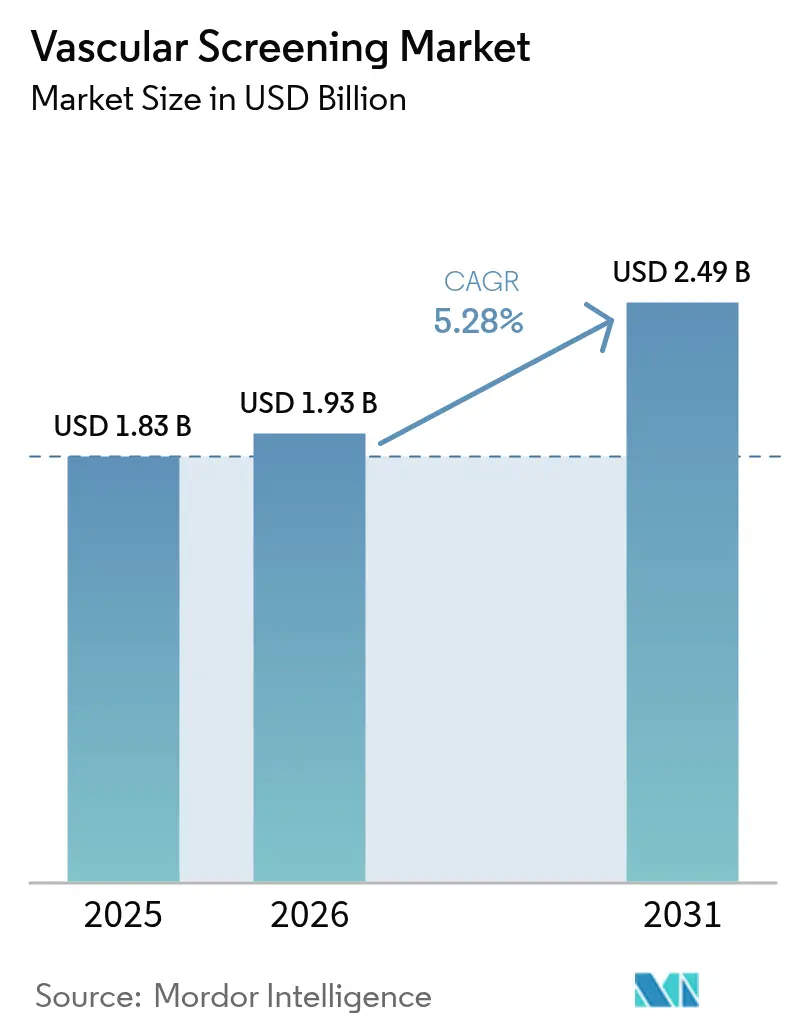
Vascular Screening market size in 2026 is estimated at USD 1.93 billion, growing from 2025 value of USD 1.83 billion with 2031 projections showing USD 2.49 billion, growing at 5.28% CAGR over 2026-2031.
During the COVID-19 pandemic, it was known that the lung was the primary organ to be affected; however, recent research indicates that SARS-CoV-2 infection can result in vascular illness also. According to the study published in JACC: Cardiovascular Imaging Journal in September 2021, in the early stages of the pandemic, there was a considerable decrease in cardiovascular testing in the United States, with significant variation between locations.
Furthermore, numerous studies revealed that persons with heart illnesses were particularly vulnerable to COVID-19, which decreased patient traffic in hospitals and diagnostic centers. According to the study published by the National Center for Biotechnology Information (NCBI) in May 2021, during the COVID-19 pandemic, cardiac procedural activity in England decreased dramatically, with a deficit of approximately 45,000 procedures, with no increase in the risk of mortality for most cardiac procedures performed during the pandemic. Thus, the decline in surgical procedures during the pandemic significantly impacted the market growth.
The growing burden of vascular diseases and the rising geriatric population are the key factors in the vascular screening market. As per the 2020 updates by the World Health Organization (WHO), ischemic heart disease was responsible for 16% of the world's total deaths. As per the article published in May 2021 in the Journal of Circulation Research, there were around 6,859,623 heart failure patients in the United States in 2020, reflecting 2.1% of the population. Furthermore, in 2020, the prevalence of heart failure in the United States and Canada was 1.5% and 1.9%, respectively. Thus, the growing burden of cardiovascular diseases is expected to boost market growth during the forecast period.
Furthermore, chronic diseases are more prevalent in the geriatric population and will likely boost market growth over the forecast period. For instance, the WHO's data published in October 2021 reported that the pace of population aging is much faster than in the past, and by 2030, 1 in 6 people worldwide will be aged 60 years or over. At this time, the population aged 60 years and over will increase from 1 billion in 2020 to 1.4 billion by 2030. This growth in the aging population will ultimately drive the demand for the vascular screening device market, as vascular diseases are more prone in the geriatric population.
However, reimbursement issues may restrain market growth over the forecast period.
Note: Market size and forecast figures in this report are generated using Mordor Intelligence’s proprietary estimation framework, updated with the latest available data and insights as of 2026.
Global Vascular Screening Market Trends and Insights
Hospital Segment is Expected to Hold a Major Market Share in the Vascular Screening Market
The segment is driven by the rise in hospital admission and product launches by the key market players. The increasing number of hospital admissions and admissions in the critical care unit creates the need for vascular screening devices and thus drives the growth of the market.
For instance, as per data released by the Australian Institute of Health and Welfare (AIHW) in May 2022, about 11.8 million hospital admission occurred in 2020-2021, which was 6.3% more compared to 2019-2020. It also reported that in 2020-2021, out of 11.8 million admissions, 7.0% of hospitalizations involved a stay in the intensive care unit, 3.8% of hospitalizations involved cardiovascular disease, and 10.3% of hospitalizations had a separation mode indicating the patient died in the hospital. Such increasing admission in emergency and critical care is likely to increase the demand for vascular screening devices and thus expected to drive the market segment's growth.
The increasing number of hospitals in the United States is also propelling the market's growth. For instance, the American Hospital Association Statistics published in January 2021 reported that there were 207 federal government hospitals, and several state and local government community hospitals in the United States in 2021. Such an increase in hospitals is likely to support market growth.


North America is Expected to Hold a Significant Share in the Market and Expected to do Same in the Forecast Period
North America is expected to hold a significant market share in the global vascular screening market due to increased vascular diseases, such as coronary artery disease, renal artery diseases, and carotid artery aneurysms. Coronary artery disease is the most affected heart disease.
According to the Centers for Disease Control and Prevention (CDC) data published in September 2020, heart disease is the leading cause of death in the United States. The same source also reported that about 805,000 Americans have a heart attack every year. As the number of deaths due to heart diseases is increasing, there is a continuous need for the proper treatment of cardiac diseases since vascular screening devices help diagnose artery blockages and narrowing and are expected to show significant growth over the forecast period.
Moreover, the growing number of vascular ambulatory services centers in the country is expected to increase the demand for vascular screening devices, thereby boosting the market's growth. For instance, in April 2021, a super-hybrid ambulatory surgical center was opened in Southern California, which offers the most comprehensive outpatient vascular surgical services within Orange County and represents a transformative vision for the future of ambulatory surgery.
Thus, all the above-mentioned factors are expected to boost the market in the North American region over the forecast period.

Competitive Landscape
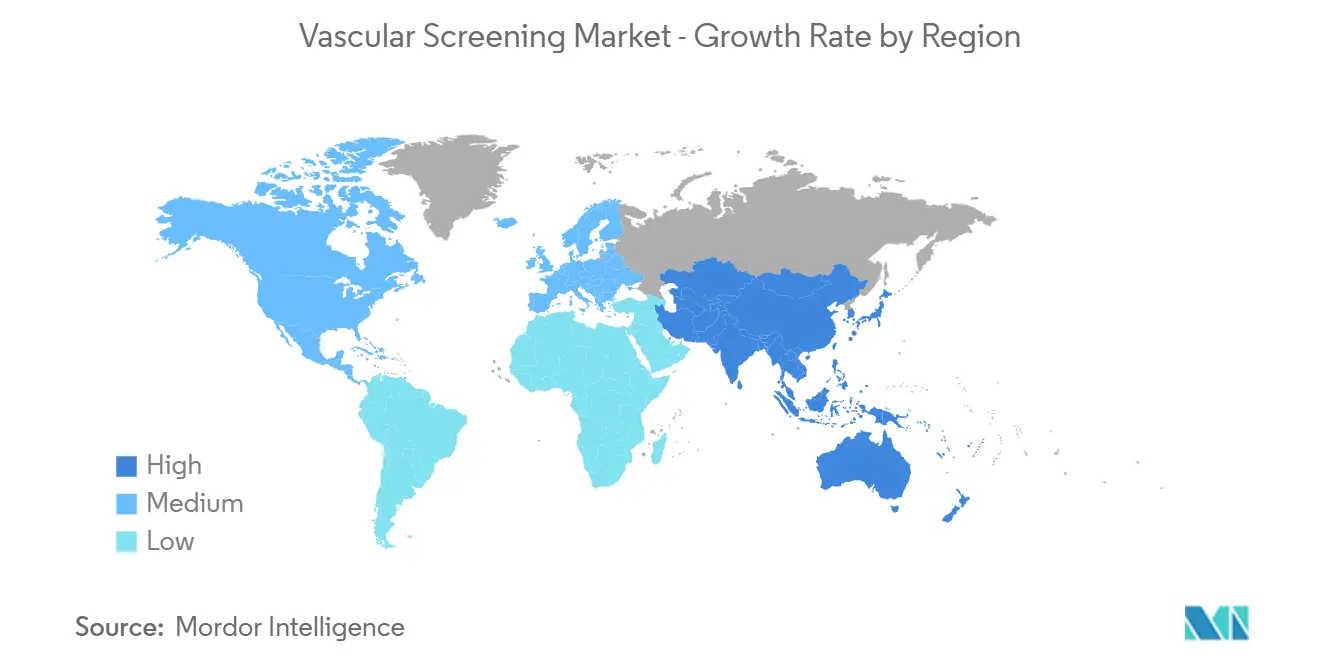
The vascular screening market is moderately competitive and consists of several major players. Some of the companies that are operating in the vascular screening market are Fukuda, Unetixs Vascular Inc., Collaborative Care Diagnostics LLC (Biomedix), CorVascular Diagnostics LLC, Koven Technology Inc., D.E. Hokanson Inc., enverdis GmbH, OMRON HEALTHCARE Co. Ltd, Viasonix, and Shenzhen Mindray Bio-Medical Electronics Co. Ltd.
Vascular Screening Industry Leaders
Fukuda
Omron Healthcare
Koven Technology, Inc.
Shenzhen Mindray Bio-Medical Electronics Co., Ltd
Enverdis GmbH
- *Disclaimer: Major Players sorted in no particular order

Market Opportunities and Future Outlook
Guideline reinforcement around peripheral arterial disease (PAD) case-finding and standardized first-line testing supports wider use of ABI and ultrasound-based screening workflows across hospitals and outpatient settings. In 2024, major society guidance (ESC and the ACC/AHA-led lower extremity PAD guideline) emphasized ABI as an initial diagnostic test for PAD, which lines up with demand for automated and portable ABI systems, as well as Doppler-based assessments used in vascular screening.
Opportunities are concentrating on workflow simplification and decision support as imaging and guidance platforms add software intelligence and tighter integration into cath labs and cardiology and vascular service lines. In March 2026, Philips launched IntraSight Plus with FDA 510(k) clearance and a CE mark as an integrated interventional guidance platform. In April 2026, Abbott received FDA clearance and a CE mark for Ultreon 3.0 AI-powered coronary imaging software, indicating continued investment in software-driven standardization for vascular assessment and intervention planning. At the care-delivery edge, newer portable and clinic-deployed arterial screening offerings (for example, products positioned for arterial screening by companies such as Ayati Devices and SOT Medical Systems) point to whitespace in decentralized screening programs, where reimbursement and protocol alignment remain key adoption gates.
Recent Industry Developments
- June 2026: OMRON Healthcare launched smart blood pressure monitors with AI-enabled AFib detection in Thailand, expanding its connected screening footprint beyond core North American and European retail markets. The rollout supports broader adoption of home and community-based cardiovascular risk screening that can feed into downstream vascular assessment pathways.
- March 2026: Koven Technology, Inc. received a U.S. Department of Veterans Affairs federal supply schedule contract (36F79726D0089), with an effective date listed as May 1, 2026, covering vascular monitoring devices such as sphygmomanometers and hand-held Dopplers. The award improves access to a large public procurement channel for vascular screening and monitoring equipment across VA facilities.
- November 2024: OMRON Healthcare received FDA De Novo authorization for blood pressure monitors with an AI-powered AFib detection feature. The authorization broadened the regulatory pathway for AI-enabled screening in consumer and clinical blood pressure monitoring, supporting further product iterations and market entry in connected vascular and cardiac screening tools.


Research Methodology Framework and Report Scope
Market Definition and Coverage
For this study, the vascular screening market is defined as revenue from noninvasive screening systems used to assess vascular health and identify risk of vascular disease in clinical and screening settings.
Scope exclusions: We exclude therapeutic vascular procedures and devices, and we also exclude routine cardiology imaging performed for diagnosis rather than screening.
Segmentation Overview
- By Product Type
- Portable
- Standalone
- By End User
- Hospitals
- Diagnostic Centres/Clinics
- Other End Users
- Geography
- North America
- United States
- Canada
- Mexico
- Europe
- Germany
- United Kingdom
- France
- Italy
- Spain
- Rest of Europe
- Asia-Pacific
- China
- Japan
- India
- Australia
- South Korea
- Rest of Asia-Pacific
- Rest of the World
- North America
Data Sources, Market Sizing, and Validation
Desk Research
To set a clean starting point, we first map which vascular risk conditions are covered and where these tests are typically performed, then align that mapping with public data signals. Desk research uses sources such as the World Health Organization for cardiovascular risk context, CDC publications for screening and risk-factor prevalence, and OECD health statistics for procedure and utilization proxies in major countries.
We also reference sources such as the US FDA device databases for product clearances and indications, peer-reviewed clinical journals for screening pathway norms, and trade and customs statistics where device trade patterns are relevant. Company annual reports, investor presentations, and reputable health care press help confirm product positioning and broad pricing direction. In a few cases, we use paid subscriptions for company financials and patent databases to validate timelines and innovation intensity. These examples are not exhaustive, and many other public sources were also used for data collection, validation, and clarification.
Primary Interviews and Surveys
Primary interviews focus on validating what portion of vascular risk assessment is actually conducted with dedicated screening systems, and how purchasing and utilization differ across hospitals and diagnostic centers. We speak with a mix of device-focused executives, clinical leaders, and operational managers, then cross-check assumptions on typical test volumes, replacement cycles, and average selling price ranges by region. For global coverage, inputs are balanced across mature and emerging health systems so regional shares do not get over-weighted by one geography.
Distribution of primary research fieldwork respondents
| Company type | Respondent position | Region |
|---|---|---|
| Top tier: 32% | CXOs: 13% | APAC: 47% |
| Mid tier: 46% | Functional/Unit leaders: 29% | EMEA: 32% |
| Smaller Players: 22% | Managers: 58% | Americas: 21% |
Market-Sizing & Forecasting
Market sizing starts from a top-down build, where country-level demand pools are reconstructed using vascular disease risk prevalence, screening adoption in target age bands, typical tests per patient per year, and the split of tests done in hospitals versus diagnostic centers. Those volumes are translated into revenue using practical price bands for portable and standalone systems, and then adjusted for replacement cycles and utilization intensity.
After forming the first totals, we corroborate the direction using selective bottom-up approximations, including supplier revenue checks, channel feedback on shipment momentum, and sampled ASP checks implied by unit volumes in key countries. When gaps appear, they are typically linked to uneven penetration assumptions, bundled pricing, or undercounted demand from smaller facilities. In those cases, we rebalance the model using interview-backed ranges.
Forecasting is built with scenario analysis tied to trend lines in aging population, diabetes burden, preventive care emphasis, and technology shift toward portable systems. Growth rates are stress-tested using expert views on reimbursement sensitivity and capital budget cycles, then applied consistently across regions so the final forecast remains traceable and repeatable.
Data Validation & Update Cycle
Outputs are checked against independent signals, including regional health spending direction, device approval cadence, and expected replacement demand, before final review. If a country shows an unusual jump or drop, we trace the driver back to volume, price, or mix assumptions, then review the outlier again with at least one additional external input.
A multi-step analyst review is followed so calculations, units, and currency handling remain consistent across the time series. The report is refreshed annually, and interim updates are made when material events occur, such as major policy shifts or large product launches. Before delivery, the model is re-opened for a fresh pass so the most current market signals are reflected.
Mordor Intelligence's Vascular Screening Market Size Measured Against Other Published Estimates
Published market values for vascular screening do not always align because firms often count different revenue streams, use different base years, and assume different rates of portable systems replacing standalone systems. Currency conversion timing, and whether services and software are included, can also change the headline number even when the narrative appears similar.
In our checks, the largest spread typically comes from whether the estimate is device-only or includes screening services, software, and consumables, and whether the base year is anchored to a utilization-led demand pool or a forecast-led revenue curve. The device-only, product-type, and end-user-aligned scope, with 2026 treated as the sizing year and then validated through utilization and pricing checks, explains where the 2026 figure in the table lands, reflecting the approach applied by Mordor Intelligence.
Benchmark comparison
| Source | Market Size | Gaps in Research Methodology |
|---|---|---|
| Mordor Intelligence | USD 1.93 B (2026) | |
| Industry Publisher A | USD 1.86 B (2024) | Uses a different base year and a broader product framing that can blend adjacent items like software, services, and consumables, which can shift the starting value and growth path versus a device-revenue definition. |
| Global Publisher B | USD 2.77 B (2025) | Higher base-year number is consistent with wider geographic coverage plus more aggressive adoption assumptions, and the definition may capture more of the screening ecosystem beyond device sales. |
Across the three figures, the range is mainly explained by what gets counted as market revenue and how the starting year is set. When scope is kept tight to screening systems and inputs are tied back to test volumes, setting mix, and price bands, the market size stays traceable to clear drivers and is easier to update consistently year after year.


Key Questions Answered in the Report
How big is the Vascular Screening Market?
The Vascular Screening Market size is expected to reach USD 1.93 billion in 2026 and grow at a CAGR of 5.28% to reach USD 2.49 billion by 2031.
What is the current Vascular Screening Market size?
In 2026, the Vascular Screening Market size is expected to reach USD 1.93 billion.
Who are the key players in Vascular Screening Market?
Fukuda, Omron Healthcare, Koven Technology, Inc., Shenzhen Mindray Bio-Medical Electronics Co., Ltd and Enverdis GmbH are the major companies operating in the Vascular Screening Market.
Which is the fastest growing region in Vascular Screening Market?
Asia-Pacific is estimated to grow at the highest CAGR over the forecast period (2026-2031).
Which region has the biggest share in Vascular Screening Market?
In 2026, the North America accounts for the largest market share in Vascular Screening Market.
What years does this Vascular Screening Market cover, and what was the market size in 2025?
In 2025, the Vascular Screening Market size was estimated at USD 1.93 billion. The report covers the Vascular Screening Market historical market size for years: 2019, 2020, 2021, 2022, 2023 and 2024. The report also forecasts the Vascular Screening Market size for years: 2026, 2027, 2028, 2029, 2030 and 2031.
Page last updated on:


 Your data is secure and never sold or shared.


