
UV-Curable Adhesives Market Size and Share
Market Overview
| Study Period | 2021 - 2031 |
|---|---|
| Market Size (2026) | USD 5.43 Billion |
| Market Size (2031) | USD 7.09 Billion |
| Growth Rate (2026 - 2031) | 5.48 % |
| Fastest Growing Market | Asia Pacific |
| Largest Market | North America |
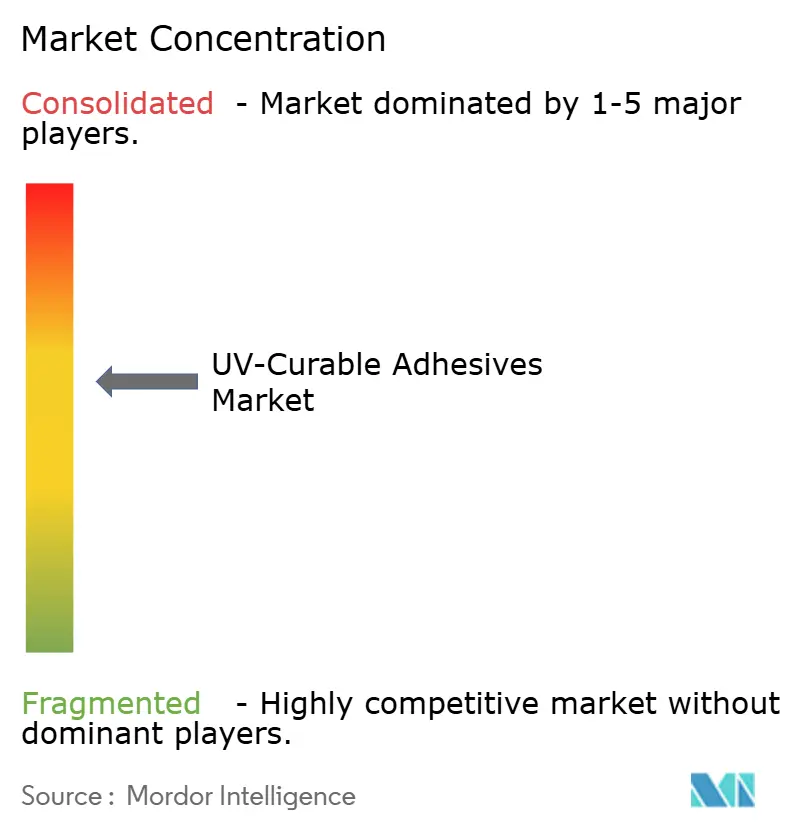
| Market Concentration | Medium |
Major Players *Disclaimer: Major Players sorted in no particular order Image © Mordor Intelligence. Reuse requires attribution under CC BY 4.0. | |
UV-Curable Adhesives Market Analysis by Mordor Intelligence
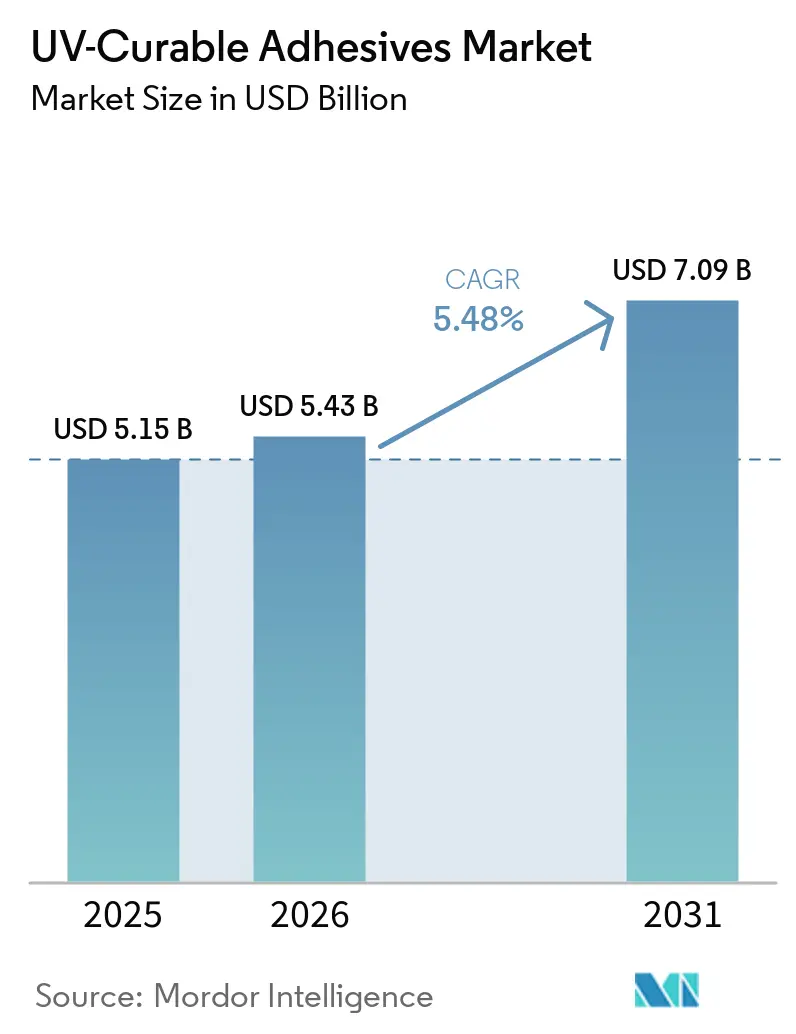
The UV-Curable Adhesives Market size is expected to grow from USD 5.15 billion in 2025 to USD 5.43 billion in 2026 and is forecast to reach USD 7.09 billion by 2031 at 5.48% CAGR over 2026-2031. Expanding regulatory pressure for solvent-free chemistries, rapid miniaturization in consumer electronics, and the medical sector’s pivot toward biocompatible instant-cure bonding solutions jointly sustain demand. Automotive lightweighting programs are substituting mechanical fasteners with UV-curable structural adhesives to cut assembly time, and packaging converters are installing in-line digital presses that rely on adhesives curing in under 200 milliseconds to support just-in-time workflows. Hybrid formulations combining UV and moisture cure are gaining attention because they bond shadow-tolerant assemblies without secondary ovens. Supply-chain resilience remains a focus after photoinitiator price spikes in 2025, prompting leading producers to expand captive capacity and diversify raw-material sourcing.
Key Report Takeaways
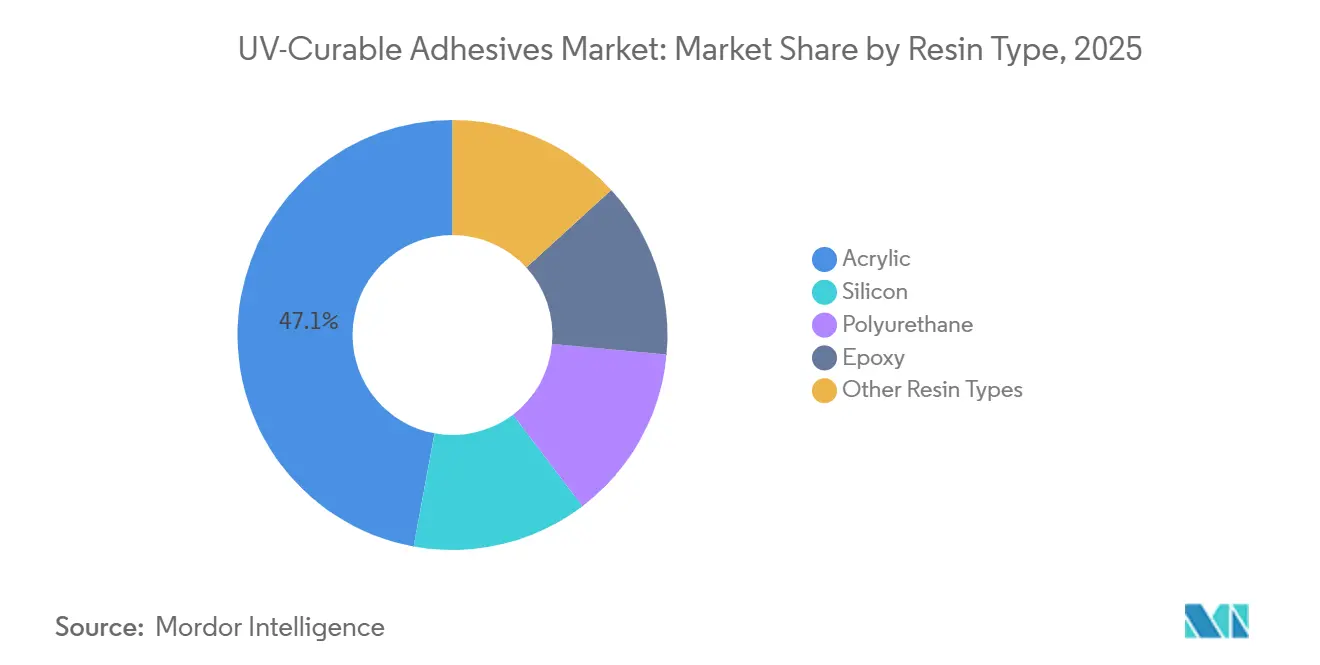
- By resin type, acrylic led with 47.12% of the UV-curable adhesives market share in 2025, while epoxy is projected to advance at a 5.61% CAGR through 2031.
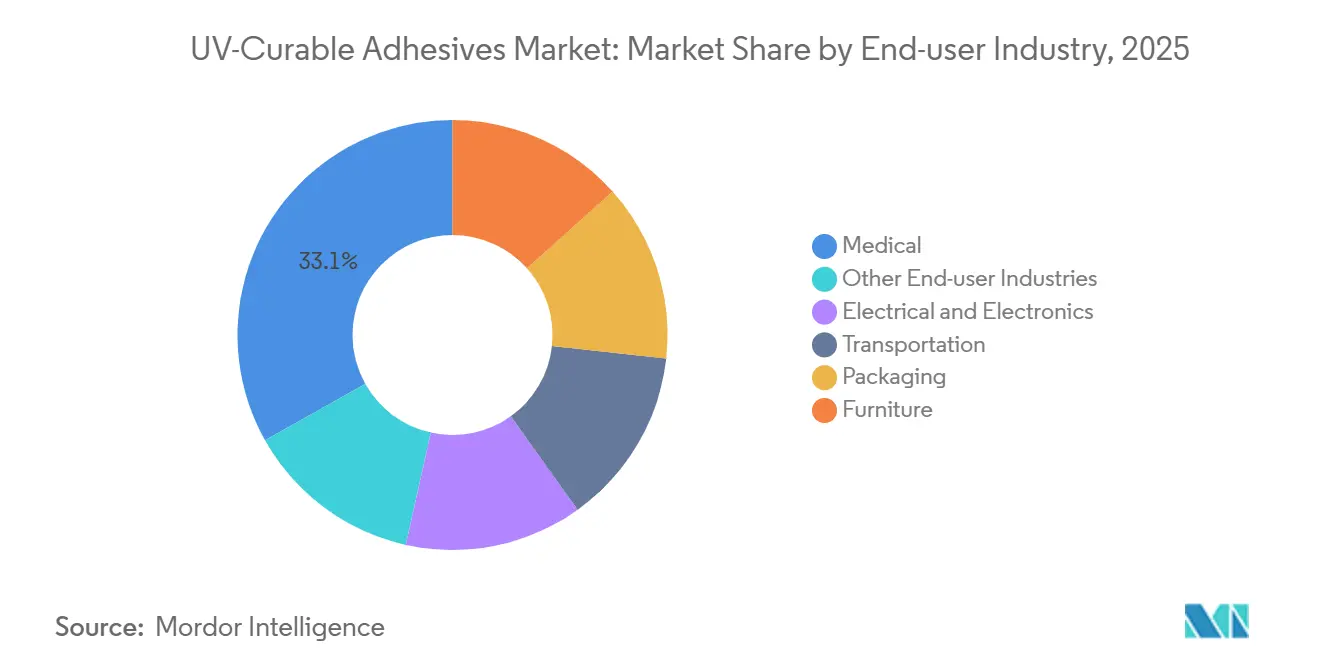
- By end-user industry, medical held 33.14% of the UV-curable adhesives market share in 2025 and is expected to grow at a 6.68% CAGR to 2031.
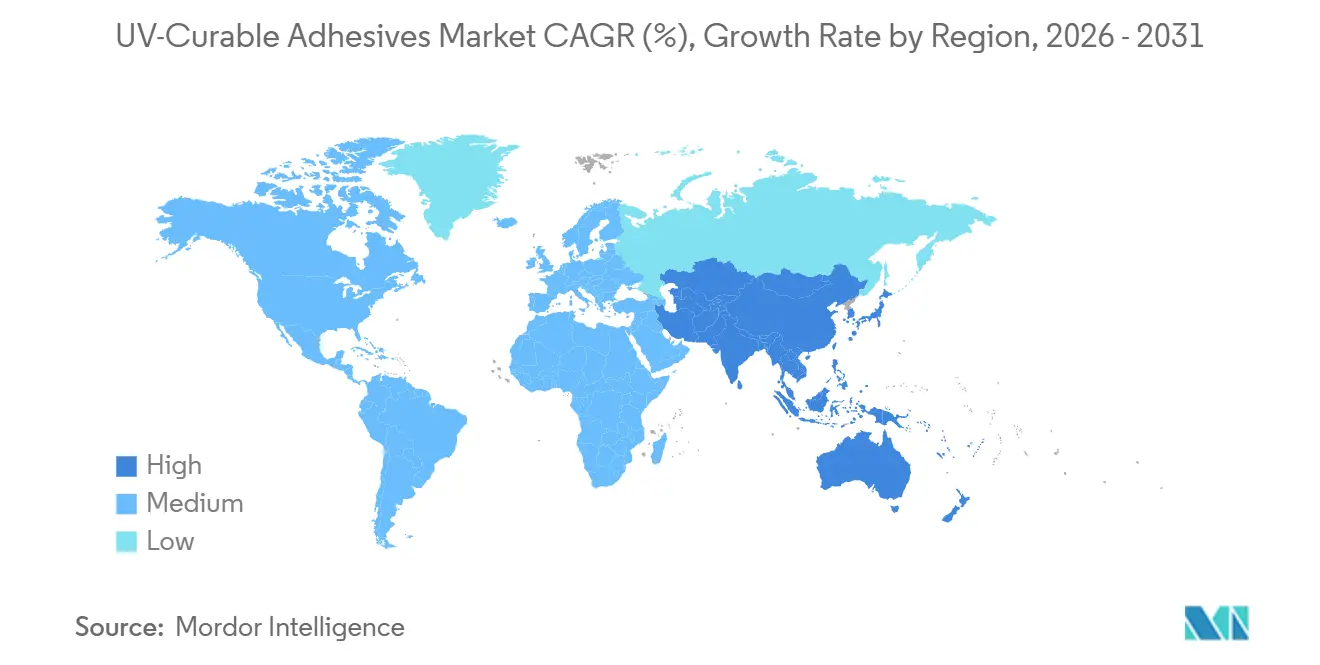
- By geography, North America accounted for 42.88% of the UV-curable adhesives market share in 2025, whereas Asia-Pacific is forecast to post a 5.69% CAGR through 2031.
Note: Market size and forecast figures in this report are generated using Mordor Intelligence’s proprietary estimation framework, updated with the latest available data and insights as of 2026.
Market Trends and Insights
Drivers Impact Analysis of UV-Curable Adhesives Market*
| Driver | (~) % Impact on CAGR Forecast | Geographic Relevance | Impact Timeline |
|---|---|---|---|
| UV-curable adhesives adoption in automotive and aerospace | +1.2% | Global, with concentration in Germany, United States, Japan | Medium term (2-4 years) |
| Stricter VOC/REACH regulations favor solvent-free chemistries | +1.5% | North America and Europe, spillover to APAC export hubs | Short term (≤ 2 years) |
| Miniaturization in consumer electronics | +0.9% | APAC core (China, South Korea, Vietnam), secondary in North America | Medium term (2-4 years) |
| Rapid uptake in wearable medical devices | +1.3% | North America and Europe, early adoption in urban India and China | Long term (≥ 4 years) |
| In-line digital packaging print lines demanding instant bonding | +0.6% | Global, with early gains in Germany, United States, India | Short term (≤ 2 years) |
| Source: Mordor Intelligence | |||
UV-Curable Adhesives Adoption in Automotive and Aerospace
Original-equipment manufacturers are swapping two-part epoxies for UV-curable adhesives when bonding ADAS camera modules, panoramic-roof glass, and electric-vehicle battery-pack components, lowering fixture time from 30 minutes to under 60 seconds. DELO’s LED-curable resin for stator potting, introduced May 2025, boosted line throughput by 30% while withstanding 150°C continuous operation. The IEC 62899-1 guideline, published in 2024, standardized validation protocols, reducing qualification effort for Tier-1 suppliers by six months.
Stricter VOC/REACH Regulations Favor Solvent-Free Chemistries
The European Chemicals Agency added three glycol ethers to the REACH Candidate List in March 2025, accelerating the shift to UV-curable acrylic adhesives containing zero VOCs. California’s South Coast Air Quality Management District cut VOC limits for industrial adhesives to 50 g/L effective January 2026, compelling converters to retool production lines[1]“Rule 1168 – Adhesives and Sealants,” South Coast AQMD, aqmd.gov . China’s GB 38507-2024 lowered plant-level VOC emissions to 80 mg/m³, stimulating UV technology investment in Guangdong. The U.S. EPA’s October 2025 draft revision of hazardous-air-pollutant standards is projected to displace 15% of solvent-based adhesive volume by 2029.
Miniaturization in Consumer Electronics
Smartphone assemblers now cure UV-acrylic adhesives in under 5 seconds to bond 0.3 mm glass covers, raising automated throughput to 120 units per hour. Apple employed a UV-silicone grade for Series 9 Watch biometric-sensor bonding, ensuring electrical stability over 10,000 flex cycles. Hydrophobic UV epoxies that pass IPX7 testing, such as Master Bond UV15-7HP, prevent sweat ingress in true-wireless earbuds. Semiconductor packaging houses are piloting die-attach UV epoxies with sub-10 µm bond lines to manage heat in advanced packages.
Rapid Uptake in Wearable Medical Devices
The U.S. FDA cleared 47 wearable devices in 2025, all relying on UV-curable biocompatible adhesives meeting ISO 10993-5 and -10 standards. Abbott’s FreeStyle Libre 3 glucose monitor uses a UV-acrylic bond line stable for 14 days of continuous wear. Europe’s Pharmacopoeia 11.0 capped residual monomer content at 0.1%, intensifying demand for ultra-low-extractable UV grades. H.B. Fuller’s purchase of Medifill in December 2024 positioned the company to target 20% share of the wearable-patch segment by 2027. ISO 20417 simplifies documentation, trimming four months from Class II device approvals.
Restraints Impact Analysis of UV-Curable Adhesives Market*
| Restraint | (~) % Impact on CAGR Forecast | Geographic Relevance | Impact Timeline |
|---|---|---|---|
| High capital cost of UV-LED curing systems | -0.8% | Global, acute in price-sensitive APAC and South America | Short term (≤ 2 years) |
| Availability of alternative 2-part epoxies and cyanoacrylates | -0.5% | Global, particularly in industrial maintenance and repair | Medium term (2-4 years) |
| Supply volatility of key photoinitiators | -0.4% | Global, with bottlenecks in China and India monomer plants | Short term (≤ 2 years) |
| Source: Mordor Intelligence | |||
High Capital Cost of UV-LED Curing Systems
Industrial UV-LED conveyors cost USD 50,000 to USD 300,000, deterring small converters. A 2024 Adhesive & Sealant Council survey showed 38% of North American packagers citing capital cost as their chief barrier. Indian label printers absorb 28% customs duty plus 18% GST on imported systems, inflating price by 52%[2]“Import Tariff Schedule,” Ministry of Commerce & Industry, commerce.gov.in . Subscription models from Phoseon trimmed upfront cost by 60% for 40 European early adopters. Lawrence Berkeley National Laboratory documented 70% electricity savings relative to mercury-arc technology, offsetting USD 15,000-25,000 annual operating expenses.
Availability of Alternative 2-Part Epoxies and Cyanoacrylates
Two-part epoxies still dominate structural repairs where gap-filling and shear strength exceed 25 MPa, especially in aerospace composite work. Cyanoacrylates cure instantly without light, making them preferable for opaque substrates; Henkel’s Loctite 401 alone generated USD 180 million revenue in 2024. Medical syringe assemblers prefer cyanoacrylates for stainless-steel cannula bonding. Hybrid solutions blur categories: 3M Scotch-Weld EC-3524, introduced in September 2024, enables optional UV acceleration, giving manufacturers process flexibility. UV-curable grades remain 30-50% more expensive per kilogram than commodity epoxies, impeding uptake in furniture and footwear assembly.
*Our forecasts treat driver/restraint impacts as directional, not additive. The impact forecasts reflect baseline growth, mix effects, and variable interactions.
UV-Curable Adhesives Market Segment Analysis
By Resin Type:
Acrylic Leads, Epoxy AcceleratesAcrylic accounted for 47.12% of UV-curable adhesives market share in 2025 and delivered the cost-to-performance blend favored for pressure-sensitive labels and medical assemblies. Epoxy is forecast to post a 5.61% CAGR through 2031, powered by automotive and aerospace needs for tensile strengths above 25 MPa and glass-transition temperatures over 120 °C. The UV-curable adhesives market size for epoxy products is projected to expand steadily alongside rising electric-vehicle battery-pack adoption. Silicone UV grades serve high-temperature electronics and LED packaging as demonstrated by Dow Corning OE-6630 qualifying for engine-compartment sensors. Polyurethane UV adhesives attract flexible-circuit and textile users because elongation surpasses 300%, absorbing substrate movement without delamination.
Acrylic supply chains benefit from commodity monomer pricing near USD 2.20 /kg, whereas cycloaliphatic epoxy resins exceed USD 6.50 /kg, supporting acrylic cost leadership. Hybrid UV-plus-moisture epoxies such as SikaFlex-525 UV reach 80% of ultimate strength after 10 seconds of irradiation, finishing cure in shaded areas through moisture curing adhesive technology. Polyurethane formulations face higher raw material costs after the EU restricted aromatic di-isocyanates in consumer products in 2024. Silicone UV adhesives command a triple price premium but remain indispensable where 200 °C thermal endurance is non-negotiable.



By End-user Industry:
Medical Devices Outpace All SegmentsMedical held 33.14% of the UV-curable adhesives market share in 2025 and is advancing at a 6.68% CAGR to 2031, spurred by continuous glucose monitors, cardiac patches, and minimally invasive surgical tools. Electrical and electronics manufacturers, such as those involved in smartphone, tablet, and wearable assembly lines, require instant-cure, low-outgassing adhesives for bonding applications. Transportation demand grows from electric-vehicle battery packs and head-up displays, while packaging converters pivot to UV-curable laminations that eliminate solvent-recovery infrastructure.
Stringent ISO 10993 biocompatibility testing drives elevated specification requirements in the medical sector; adhesives must show leachable monomers below 0.1% and pass cytotoxicity and sensitization assays. Electronics producers specify defogging-resistant UV grades for camera modules, such as Dymax 9014-F, which recorded total mass loss under 0.5% during ASTM E 595 testing. Furniture plants explore UV-cure edge-banding to lower cycle time from 45 seconds to under 5 seconds while dropping VOC emissions to meet SCAQMD standards. Packaging adoption accelerates as European Regulation 10/2011 constrains overall migration to 10 mg/dm², a threshold readily achieved by low-migration UV acrylics.
Geography Analysis
North America UV-Curable Adhesives Market
North America led the UV-curable adhesives market in 2025 with 42.88% revenue owing to dense medical-device clusters in Massachusetts, California, and Minnesota, where 60% of FDA-cleared wearables are designed. Automotive OEMs such as General Motors and Ford integrated UV-curable bonding on ADAS cameras and panoramic roofs, trimming assembly time by 40%. California’s 50 g/L VOC limit, effective 2026, further accelerates migration from solvent-based grades. Health Canada’s March 2024 endorsement of ISO 10993 strengthened demand for biocompatible UV-curable bonds in insulin pumps and diagnostic cartridges.
APAC UV-Curable Adhesives Market
Asia-Pacific is projected to grow at a 5.69% CAGR over 2026-2031, propelled by vast smartphone and display manufacturing in China’s Yangtze River Delta, South Korea’s semiconductor hubs, and Vietnam’s assembly corridors. China’s GB 38507-2024 VOC cap is moving converters toward UV systems, while India’s two-wheeler OEMs adopt UV adhesives to satisfy Bharat Stage VI rules on manufacturing emissions. Japan’s Olympus and Terumo cut endoscope and catheter assembly time by 30% after switching to UV bonding in 2024. South Korean panel manufacturers utilized UV-curable adhesives in response to the increasing demand for foldable OLEDs.
EMEA and South America UV-Curable Adhesives Market
Europe’s demand is led by Germany, France, and the United Kingdom. Germany’s EV battery-pack lines now specify UV-curable adhesives to save 35% energy on cure cycle. France’s pharma sector adopted UV bonds in prefilled syringes and transdermal patches to meet European Pharmacopoeia residual-monomer limits. The U.K. enforces EU migration rules post-Brexit, prompting flexible-pack converters to replace solvent-borne laminating adhesives with UV grades. South America and Middle-East and Africa remain early-stage markets constrained by UV-LED equipment costs, although Brazil’s automakers and the UAE’s medical-device free zones are piloting niche uses.

Regulatory Landscape
Regulation is tightening around both VOC emissions and specific UV-chemistry inputs used in UV-curable adhesive formulations. In the United States, national VOC provisions under 40 CFR Part 59 and state programs (for example, Virginia air rules and Rhode Island Air Pollution Control Regulation No. 44) run alongside local air-district enforcement; in Southern California, South Coast AQMD Rule 1168 serves as a primary compliance anchor for adhesive and sealant applications, including manufacturer reporting (QERs) and a technology check-in cadence referenced for 2026 updates.
In Europe, compliance pressure extends beyond VOCs into substance restrictions and authorization requirements for UV stabilizers and certain photoinitiator chemistries. Commission Regulation (EU) 2025/843 restricts UV-328 in substances, mixtures, or articles (effective August 4, 2025), and ECHA published its 13th draft recommendation for the REACH Authorisation List (Annex XIV) on February 2, 2026, listing UV-326, UV-329, triphenyl phosphate, and Photoinitiator 379 for potential inclusion. This adds requalification and documentation requirements for suppliers serving electronics, medical, and packaging applications.
Value Chain Analysis
The value chain begins with upstream petrochemical feedstocks and specialty intermediates, which become monomers, oligomers/resins (notably acrylates and cycloaliphatic epoxies), and photoinitiators. These are then compounded and formulated into application-specific UV-curable adhesives and distributed to medical, electronics, transportation, packaging, and furniture end users. A defining structural feature is the geographic concentration of upstream capacity, with most photoinitiator manufacturing and large-scale monomer/oligomer production located in Asia, especially China, increasing exposure to trade and logistics disruptions as well as regional compliance shifts.
Midstream adhesive producers differentiate through formulation choices, regulatory files, and process validation with UV-LED curing platforms, while equipment suppliers (UV-LED lamp heads, conveyors, and controls) influence adoption economics through lead times and installed-base compatibility. Supply resilience remains a purchasing criterion after the 2025 photoinitiator volatility noted in the report context. An additional operational constraint is equipment and component lead times (often cited as 12 to 16 weeks for custom OEM parts), which pushes converters toward build-to-order planning and longer qualification windows. Regulatory actions affecting critical inputs also feed directly into procurement and continuity planning, including South Korea initiating a K-REACH supply-shortage registration procedure in May 2026 for photoinitiator TPO-L and the monomer HDDA to prevent import prohibitions effective July 1, 2026.
Competitive Landscape
The UV-curable adhesives market exhibits consolidation. The top five suppliers, Henkel, 3M, H.B. Fuller, Dymax, and Arkema, held 60-70% combined revenue in 2025. Competitive levers revolve around cure speed, depth, and substrate versatility. Henkel filed a 2024 patent for photoinitiator-free thiol-ene UV acrylics that could disrupt food-contact adhesives by eliminating migration risk. Arkema will add 30% photoinitiator capacity at Nansha by 2026 to secure inputs for its Sartomer resins and raise margin by roughly 200 basis points. Dymax, DELO, and Master Bond specialize in high-value niches such as ADAS camera modules and moisture-resistant wearables, commanding double-digit price premiums.
Technology convergence is evident as 3M’s hybrid two-part epoxy can optionally receive UV acceleration, offering single-line flexibility for opaque and transparent sections. Panacol’s Vitralit UC 6694, certified to ISO 10993-5 in August 2024, targets implantable devices, while DELO focuses on EV stator potting requiring 1 W/m·K thermal conductivity alongside 30% faster throughput. Sustainability is an emerging differentiator: start-ups are piloting lignin-based photoinitiators to cut petrochemical reliance, though commercial scale remains years away.
Regulatory compliance forms a pricing moat. Suppliers holding ISO 10993 certification and FDA Drug Master Files can price 25-40% above commodity levels because customer revalidation is costly. As UV-LED lamp penetration climbs and VOC limits tighten globally, competitive intensity is expected to rise, especially among mid-tier Asian formulators competing on application engineering rather than cost.
UV-Curable Adhesives Industry Leaders
3M
Dymax
H.B. Fuller Company
Henkel AG & Co. KGaA
Arkema
- *Disclaimer: Major Players sorted in no particular order
UV-Curable Adhesives Market Companies Covered in this Report
- 3M
- Arkema
- artience Co., Ltd.
- AVERY DENNISON CORPORATION
- DELO Industrie Klebstoffe GmbH & Co. KGaA
- Dymax
- H.B. Fuller Company
- Henkel AG & Co. KGaA
- Master Bond Inc.
- Panacol-Elosol GmbH
- Parson Adhesives, Inc.
- Permabond Engineering Adhesives Ltd
- Sika AG

Market Opportunities and Future Outlook
Standards and compliance-driven requalification are creating whitespace for suppliers that can package UV-curable adhesive performance with validated UV-LED curing windows, documentation, and global regulatory support. IEC 62877-3:2026 (published May 3, 2026) formalizes UV-LED compatibility testing at 365 nm, 385 nm, and 405 nm for UV-curable adhesives used in electronics and medical manufacturing. This expands the value of application engineering, lamp-adhesive co-validation, and multi-wavelength formulations that maintain cure speed while reducing process risk on high-throughput lines.
Regulatory attention on specific chemistries is also reshaping formulation roadmaps, particularly toward low-migration and input-flexible platforms for packaging and medical assemblies. In Europe, Commission Regulation (EU) 2025/843 restricts UV-328 from August 2025, while ECHA’s February 2026 draft Annex XIV recommendation flags additional UV stabilizers and a photoinitiator for potential authorization. As a result, customers are seeking alternative additive packages with stable supply and safety dossiers. Sustainability positioning is being productized in UV-curable portfolios, including DELO’s July 2026 announcement of a bio-based multi-purpose adhesive (DELO PHOTOBOND SJ4192) with over 50% renewable raw materials, which aligns UV-curable bonding with customer programs that screen for renewable content alongside performance and compliance.
Recent Industry Developments in UV-Curable Adhesives Market
- June 2026: Biesterfeld SE expanded its medical adhesives offering through a distribution agreement covering Arkema segment Bostik solutions, including UV-curing medical adhesive products. This broadens local technical support for light-curing assembly processes and strengthens access to regulated medical customers.
- May 2026: Dymax launched HLC-M-1004, a low-viscosity medical-grade UV-curable hybrid adhesive positioned for bonding complex geometries and less transparent substrates. The launch targets higher-spec medical device assembly needs where instant cure and process robustness reduce takt time and rework.
- June 2024: Meridian Adhesives Group announced the acquisition of Bondloc UK Ltd. The acquisition expands Meridian's European footprint and accelerates UV-curing product portability across core markets. Bondloc UK adds focused capability in specialty adhesives, enabling expanded service coverage for customers requiring UV-curing solutions.


UV-Curable Adhesives Market Report Scope and Research Methodology
Market Definition and Coverage
For this study, the UV curable adhesives market covers adhesive products that cure when exposed to ultraviolet light and are sold for bonding across manufacturing uses, with the market measured in value terms (USD) at the point of sale.
Scope exclusions: This sizing excludes UV curable coatings and inks, and it also excludes UV lamps and curing equipment revenue.
Segments Covered in This Report
- By Resin Type
- Acrylic
- Silicon
- Polyurethane
- Epoxy
- Other Resin Types
- By End-user Industry
- Medical
- Electrical and Electronics
- Transportation
- Packaging
- Furniture
- Other End-user Industries
- By Geography
- Asia-Pacific
- China
- India
- Japan
- South Korea
- Indonesia
- Malaysia
- Thailand
- Vietnam
- Rest of Asia-Pacific
- North America
- United States
- Canada
- Mexico
- Europe
- Germany
- United Kingdom
- France
- Italy
- Spain
- Turkey
- Russia
- NORDIC Countries
- Rest of Europe
- South America
- Brazil
- Argentina
- Colombia
- Rest of South America
- Middle-East and Africa
- Saudi Arabia
- United Arab Emirates
- Qatar
- Egypt
- Nigeria
- South Africa
- Rest of Middle-East and Africa
- Asia-Pacific
Data Sources, Market Sizing, and Validation
Desk Research
Desk work starts by building a clean view of demand drivers and supply availability, and then aligning terminology used by manufacturers and regulators. We rely on public sources such as the US Census Bureau manufacturing statistics, USITC trade data, Eurostat, UN Comtrade, and OECD industry indicators to understand production and trade direction for key end markets tied to UV curing.
After that, we layer in technical and market context using sources such as USPTO and WIPO patent filings (to track UV curing chemistry activity), peer reviewed journals covering photopolymerization and adhesion, and trade association materials relevant to adhesives and electronics manufacturing. Company filings, product brochures, and investor presentations are used to confirm application focus and approximate price positioning, and a paid subscription for company financials, patent analytics, and shipment level trade checks is used when it helps validate a specific assumption. This list is illustrative, and many other public sources were also reviewed for collection, cross checks, and clarification.
Primary Interviews and Surveys
Primary work is used to convert the desk indicators into realistic market shares and price volume linkages, especially where public datasets do not separate UV curable adhesives from adjacent chemistries. We speak with formulators, raw material suppliers, converters, and end users in electronics, medical devices, transportation, and packaging across APAC, EMEA, and the Americas, and then we re check outliers with follow up questions before finalizing the model.
Distribution of primary research fieldwork respondents
| Company type | Respondent position | Region |
|---|---|---|
| Top tier: 33% | CXOs: 13% | APAC: 41% |
| Mid tier: 46% | Functional/Unit leaders: 29% | EMEA: 34% |
| Smaller Players: 21% | Managers: 58% | Americas: 25% |
Market-Sizing & Forecasting
Sizing is built using top-down and bottom-up logic, so the totals stay tied to a realistic demand pool and still get sanity checked from the supply side. The top-down build reconstructs UV curable adhesive demand by mapping end use production activity and adoption, and then applying usage intensity and price ranges to arrive at value, which is then corroborated with selective bottom-up approximations from supplier roll ups, channel checks, and sampled ASP multiplied by estimated volumes.
Key inputs that shape the model include electronics and medical device output trends, packaging and label converting activity where UV curing is used, the shift toward solvent free processes, and UV LED curing penetration versus mercury lamp systems (which influences formulation choices and pricing). We also track resin mix changes, typical cure speed requirements, and regional manufacturing shifts, since these factors move both volumes and average selling prices. Where bottom-up visibility is partial, gaps are handled by using proxy indicators from adjacent end markets and then adjusting with interview based ranges until the numbers converge.
For forecasting, scenario analysis is used with a central case that is anchored to end market growth and adoption rates, and the assumptions are tuned using expert expectations on ASP movement, capacity additions, and substitution risk from alternative curing technologies. The forecast is reviewed across regions so growth does not get overstated in places where electronics exports or medical production are slowing.
Data Validation & Update Cycle
Results are triangulated through multiple checks, including comparing implied consumption against end market output signals and checking whether the price volume mix is reasonable by region. When a variance looks large, we re open the assumption, review the source trail, and then re contact relevant participants to understand whether the change is real or a data artifact.
Before sign off, the model goes through stepwise analyst reviews that focus on outliers, year over year jumps, and currency conversion timing so the story matches the math. The report is refreshed annually, and we also do interim updates when major events occur, such as regulatory shifts, sharp raw material price moves, or meaningful capacity changes. Right before delivery, a final pass is completed so clients receive the latest updated view.
Mordor Intelligence's Uv Curable Adhesives Market Sizing Compared With Other Published Estimates
Published numbers for UV curable adhesives do not always match because the included product scope and the way end uses are counted can differ from one publisher to another. Differences also come from how pricing is averaged across high value electronics grades versus more general purpose bonding uses, and from the year and currency assumptions used in conversion.
The main gap comes from whether adjacent UV cured materials are pulled into the total and whether small volume, high ASP niches are treated as representative of the wider market, where Mordor Intelligence counts only UV curable adhesive revenue tied to defined end user consumption and then validates the implied ASP range through interviews across regions. Timing differences also matter, since some estimates lock prices early in the year while others blend multi month changes, which can shift USD totals even when volumes are similar.
Benchmark comparison
| Source | Market Size | Gaps in Research Methodology |
|---|---|---|
| Mordor Intelligence | USD 5.43 B (2026) | |
| Global Research Firm A | USD 5.12 B (2024) | Uses an earlier base year and appears to apply a broader CAGR window, which can compress or expand the current value when UV LED adoption and pricing shifts are not rechecked close to the estimate year. |
| Industry Publisher B | USD 0.39 B (2025) | The stated total is closer to a narrow subset definition, likely counting only select high visibility applications or a limited product interpretation, which leaves out large volume industrial bonding uses captured in wider market scopes. |
The spread in the table is mostly explained by what is included in the definition and how prices are averaged across end uses. When scope is kept consistent and assumptions are tied back to adoption, end market output, and realistic ASP bands, the final number becomes easier to trace and repeat year to year.


Key Questions Answered in the Report
What is the size of the UV-curable adhesives market?
The UV-curable adhesives market stands at USD 5.43 billion in 2026 and is expected to reach USD 7.09 billion by 2031, registering a 5.48% CAGR from 2026 to 2031.
Which resin type dominates global demand in 2025?
Acrylic led with 47.12% demand in 2025 because it combines optical clarity and versatile adhesion.
Why is medical the fastest-growing end-user industry through 2031?
Rising FDA approvals for wearable sensors and stricter ISO 10993 limits on residual monomers are pushing medical adoption at a 6.68% CAGR through 2031.
What geographical region shows the strongest growth through 2031?
Asia-Pacific is forecast to expand at a 5.69% CAGR through 2031, propelled by electronics and automotive manufacturing in China, South Korea, and India.
Page last updated on:


 Your data is secure and never sold or shared.


