
Market Overview
| Study Period | 2020 - 2031 |
|---|---|
| Forecast Data Period | 2026 - 2031 |
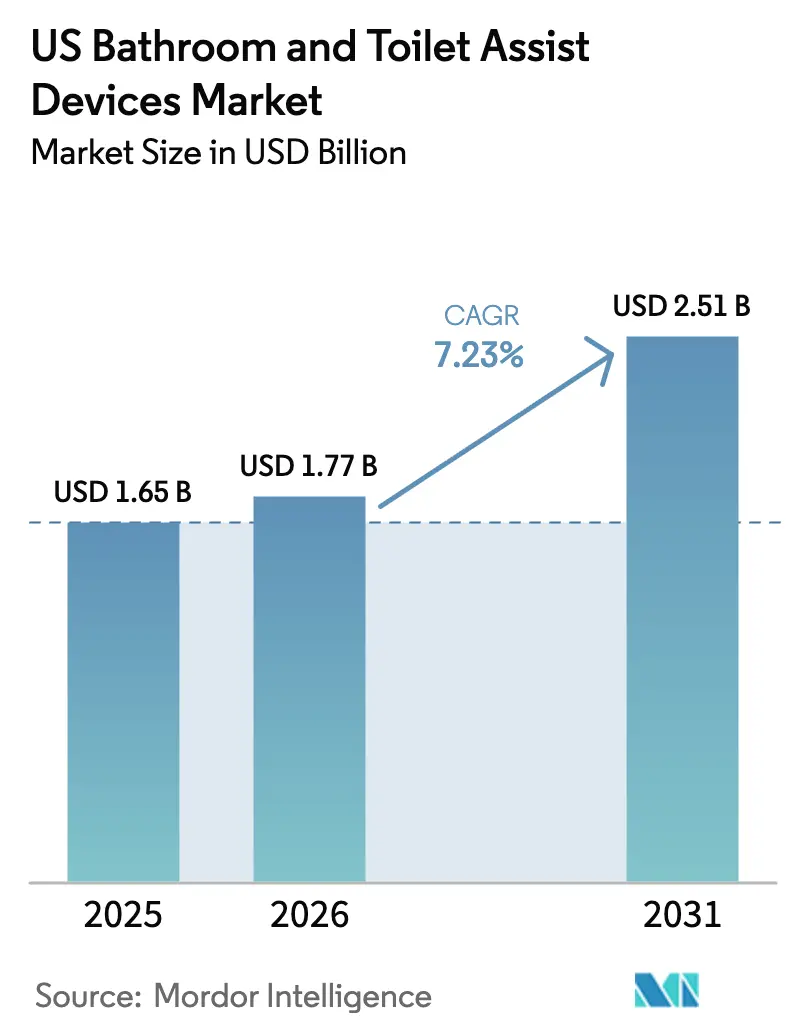
| Base Year Market Size (2025) | USD 1.65 Billion |
| Market Size (2026) | USD 1.77 Billion |
| Market Size (2031) | USD 2.51 Billion |
| Growth Rate (2026 - 2031) | 7.23 % |
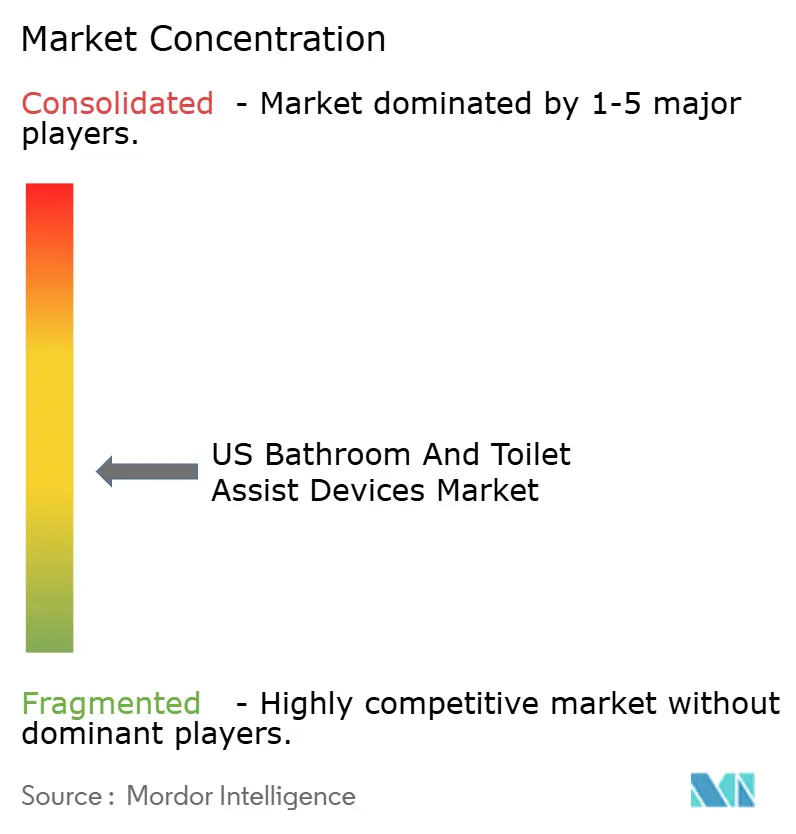
| Market Concentration | Medium |
Major Players *Disclaimer: Major Players sorted in no particular order Image © Mordor Intelligence. Reuse requires attribution under CC BY 4.0. | |
US Bathroom And Toilet Assist Devices Market Analysis by Mordor Intelligence
The bathroom assist devices market size in the United States market size in 2026 is estimated at USD 1.77 billion, growing from 2025 value of USD 1.65 billion with 2031 projections showing USD 2.51 billion, growing at 7.23% CAGR over 2026-2031. This expansion is propelled by rapid population aging, the shift toward home-based care, and targeted federal funding that offsets out-of-pocket costs for safety modifications. Medicaid Home and Community-Based Services (HCBS) waivers, the Department of Veterans Affairs’ adaptive-housing grants, and expanding Medicare Advantage benefits are funneling capital directly into residential retrofits. Manufacturers are responding with lightweight aluminum frames that comply with new weight-bearing tests, antimicrobial surface treatments that satisfy infection-control policies, and digitally connected devices that support remote monitoring. The bathroom assist devices market is also benefiting from value-based reimbursement models that reward hospitals and payers for preventing fall-related readmissions.
Key Report Takeaways
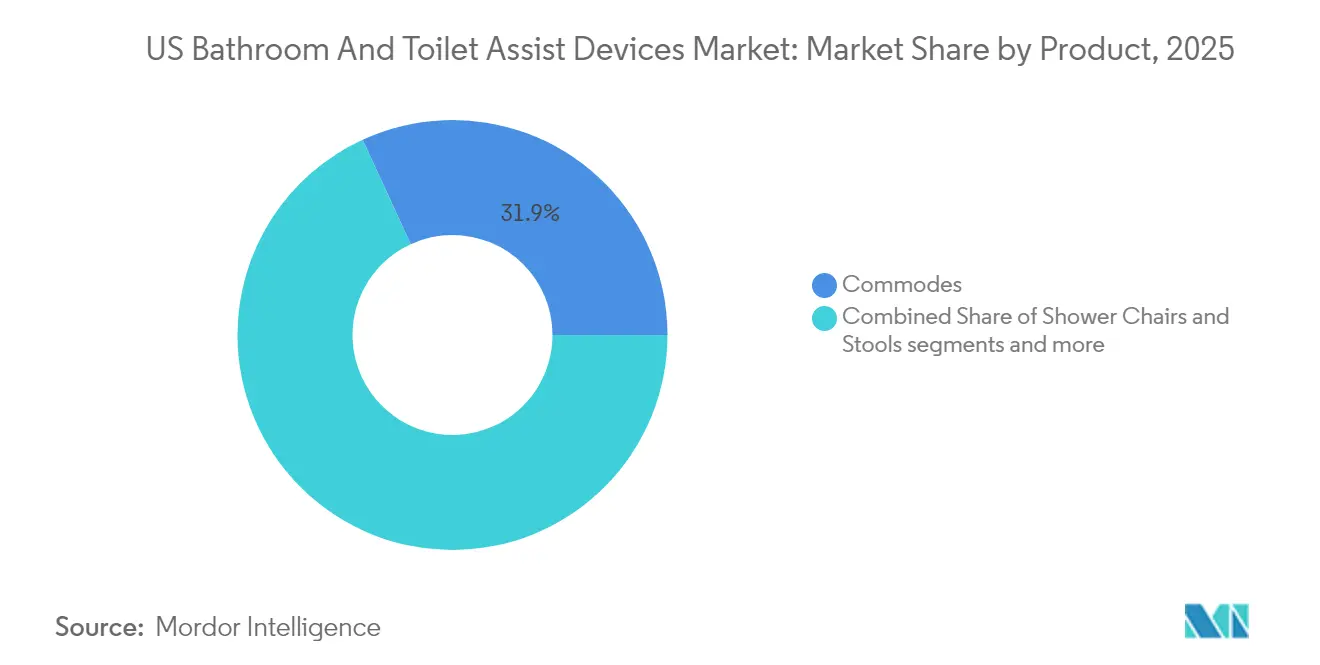
- By product type, commodes led with 31.86% of bathroom assist devices market share in 2025, while bath lifts are projected to post the fastest 9.46% CAGR through 2031.
- By end use, the residential segment held 65.58% of the bathroom assist devices market size in 2025 and is set to grow at an 8.63% CAGR to 2031.
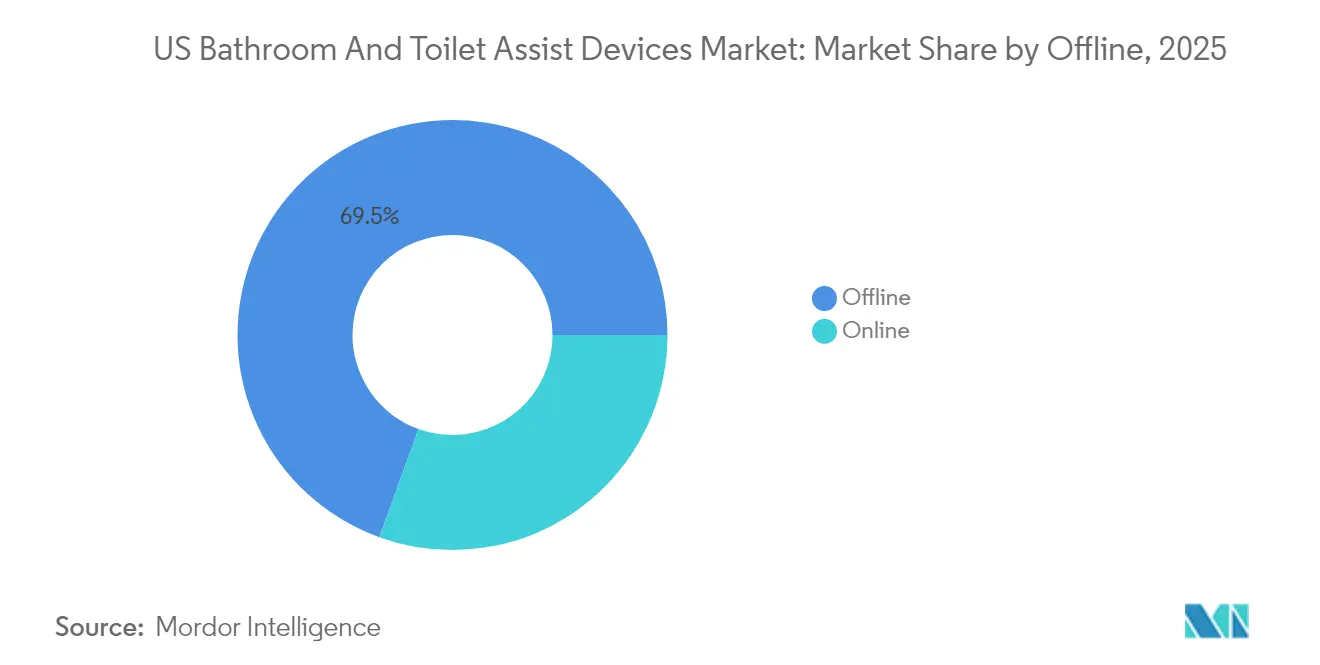
- By distribution channel, offline outlets retained 69.47% revenue share in 2025, whereas online sales are forecast to expand at an 10.72% CAGR through 2031.
- By material composition, plastic accounted for 47.62% of revenue in 2025; aluminum is the fastest-growing material at 9.18% CAGR to 2031.
- By region, the Northeast commanded 32.21% revenue in 2025 and is projected to accelerate at 10.94% CAGR, the highest among all regions.
- Drive DeVilbiss Healthcare, Etac AB, Invacare Corporation, and ArjoHuntleigh together represented the bulk of branded volume in 2024, with Invacare’s North American sale to MIGA Holdings LLC signaling further consolidation.
Note: Market size and forecast figures in this report are generated using Mordor Intelligence’s proprietary estimation framework, updated with the latest available data and insights as of 2026.
US Bathroom And Toilet Assist Devices Market Trends and Insights
Drivers Impact Analysis*
| Driver | (~) % Impact on CAGR Forecast | Geographic Relevance | Impact Timeline |
|---|---|---|---|
| Rising Prevalence of Mobility-Related Conditions | +1.8% | National, concentrated in Northeast and Southeast | Long term (≥ 4 years) |
| Government Initiatives and Regulations Promoting Adoption | +1.5% | National, with state-level variations | Medium term (2-4 years) |
| Home-Based Care and Aging in Place | +1.2% | National, stronger in suburban areas | Long term (≥ 4 years) |
| Insurance Reimbursement via Medicaid HCBS Waivers | +0.9% | State-dependent, strongest in expansion states | Medium term (2-4 years) |
| Surge in VA Adaptive-Housing Grants | +0.6% | National, concentrated near military installations | Short term (≤ 2 years) |
| Source: Mordor Intelligence | |||
Rising Prevalence of Mobility-Related Conditions
One-third of households with older adults reported an accessibility need in 2024, reflecting the growing burden of chronic disease and post-surgical rehabilitation. Sixty percent of seniors live with two or more chronic conditions that often impair activities of daily living. The Food and Drug Administration classifies many mechanical supports, including transfer chairs, as Class I devices exempt from pre-market notification, ensuring a streamlined supply pathway. Hospitals operating under value-based payment contracts increasingly prescribe bathroom safety equipment to avoid costly readmissions. The bathroom assist devices market therefore receives stable demand from both clinical and consumer channels as clinicians integrate assist devices into discharge plans.
Government Initiatives and Regulations Promoting Adoption
Federal and state programs have elevated accessibility from a consumer option to a compliance mandate. The Specially Adapted Housing Assistive Technology Grant Program can now disburse up to USD 200,000 annually to qualifying innovators. Alaska’s Medicaid waiver funds environmental modifications up to USD 18,500 every three years. Americans with Disabilities Act audits continue to drive institutional retrofits. At the payer level, Medicare Advantage plans expand coverage for home safety products deemed medically necessary, lowering direct costs for older adults. As states add environmental-modification benefits to HCBS waivers, the bathroom assist devices market experiences a direct infusion of reimbursable demand.
Home-Based Care and Aging in Place
Aging-in-place has shifted from personal preference to national policy priority. Only 10% of U.S. homes are currently age-friendly, triggering a surge of retrofit projects[1]Administration for Community Living, “2022 Profile of Older Americans,” acl.gov . Smart sensors integrated into bath lifts and grab bars support remote monitoring, allowing caregivers to verify safe usage without intrusive supervision. Fall-related injuries cost the healthcare system billions each year, so payers view proactive bathroom modifications as essential. Consequently, the bathroom assist devices market aligns closely with broader home-health strategies focused on cost containment and patient autonomy.
Insurance Reimbursement via Medicaid HCBS Waivers
State Medicaid programs now allocate meaningful budget lines for environmental adaptations. Minnesota’s Environmental Accessibility Adaptations benefit extends up to USD 40,000 annually for specific waivers[2]Minnesota Department of Human Services, “Environmental Accessibility Adaptations Policy,” mn.gov. Applications typically move through a 6-to-12-month cycle, creating predictable production windows for manufacturers. Managed care organizations standardize product specifications, favoring vendors with proven quality histories. Because waivers explicitly reference bathroom safety products, the bathroom assist devices market enjoys recurring, policy-driven purchasing momentum in waiver-expansion states.
Restraints Impact Analysis*
| Restraint | (~) % Impact on CAGR Forecast | Geographic Relevance | Impact Timeline |
|---|---|---|---|
| Tightening FDA Weight-Bearing Certification Tests | -0.8% | National, affecting all manufacturers | Short term (≤ 2 years) |
| Raw-Material Price Volatility (Aluminum and Plastics) | -0.6% | National, concentrated in manufacturing regions | Medium term (2-4 years) |
| Low Consumer Awareness Beyond Grab Bars and Risers | -0.5% | National, stronger in rural areas | Medium term (2-4 years) |
| Competitive Gray-Market Imports (Non-ANSI/RESNA) | -0.4% | National, concentrated in price-sensitive segments | Short term (≤ 2 years) |
| Source: Mordor Intelligence | |||
Tightening FDA Weight-Bearing Certification Tests
The FDA has intensified scrutiny of third-party laboratories after uncovering data-integrity lapses, subjecting non-compliant shipments to detention without physical examination. New guidance on biocompatibility and static-load testing requires extensive documentation under 21 CFR Part 880, escalating compliance costs. Established manufacturers with ISO-certified quality systems can absorb these expenses, while new entrants face higher barriers. As a result, the bathroom assist devices market may experience slower product introductions until suppliers recalibrate their testing pipelines.
Raw-Material Price Volatility (Aluminum and Plastics)
Polyethylene prices climbed 3 cents per pound in 2024, while polypropylene retreated by 2 cents, exemplifying the uncertainty facing device makers. Supply-chain realignments designed to shorten lead times have pushed labor costs upward. Because medical-grade resins and aircraft-grade aluminum have few viable substitutes, sudden price swings directly compress margins. Some manufacturers hedge with long-term supply contracts, but smaller firms may respond by passing costs to end customers, tempering adoption among price-sensitive buyers.
*Our forecasts treat driver/restraint impacts as directional, not additive. The impact forecasts reflect baseline growth, mix effects, and variable interactions.
Segment Analysis
By Product Type: Mechanized Aids Outpace Static Fixtures
In revenue terms, commodes captured 31.86% of bathroom assist devices market share in 2025, anchoring the category through brand familiarity and prescriber confidence. Enhanced anti-microbial coatings and tool-free height adjustments have expanded commode adoption beyond institutional settings. Bath lifts, although inherently higher in price, are expanding at a 9.46% CAGR, reflecting rising bariatric demand and safer lithium-ion battery systems. Drive DeVilbiss Healthcare’s Bellavita Nova illustrates how regional manufacturing and 30-minute installation appeal to contractors and caregivers alike. Grab bars and handgrips remain volume staples, but heightened commoditization encourages vendors to bundle them with sensors that detect abnormal traction forces.
Toilet seats incorporating bidet functionality respond to hygiene concerns, bridging traditional assist devices with smart bathroom ecosystems. Collectively, these innovations signal that the bathroom assist devices market is pivoting from mechanical aids to integrated safety solutions. Second-generation products emphasize remote diagnostics, enabling clinicians to adjust lift speeds or lock commode casters through mobile apps. The bathroom assist devices market size for bath lifts is projected to expand steadily as veterans receive higher grant ceilings for lift installations. Meanwhile, shower chairs add quick-drain seat perforations that reduce water pooling and infection risk.



By End Use: Residential Installations Sustain Growth Momentum
Residential applications controlled 65.58% of revenue in 2025, underpinned by the nation’s aging-in-place movement. Homeowners favor low-profile, tool-free designs that blend with contemporary décor. Many manufacturers now offer color-matched grab bars that complement faucet finishes, solving historical stigma barriers. Institutional buyers—hospitals, skilled-nursing facilities, and veteran centers—procure through three-to-five-year capital cycles, emphasizing durability and infection control. Under CMS Minimum Data Set 3.0, facilities must document individualized toileting plans, guaranteeing baseline demand for transfer benches and bariatric commodes.
Telehealth expansion allows therapists to prescribe bathroom safety products remotely, accelerating residential throughput. The bathroom assist devices market size allocated to direct-pay consumers is set to grow as Medicare Advantage and Medicaid waivers broaden eligibility for in-home modifications. Conversely, institutional budgets remain relatively flat, prompting suppliers to offer rental programs that convert capital expenses into operating expenditures. As a result, the bathroom assist devices market continues to segment along functionality lines: aesthetic flexibility for homes versus industrial specification for care facilities.
By Distribution Channel: Digital Acceleration Redefines Consultation
Offline distributors maintained 69.47% of revenue in 2025 by coupling product selection with professional installation. However, online platforms grew at double-digit rates, aided by e-commerce portals that verify Medicare numbers during checkout. Amazon’s accredited DME storefront illustrates how frictionless reimbursement boosts conversion among older adults. Some manufacturers pilot “click-to-contractor” models in which customers purchase online and schedule certified installers within 48 hours.
Hybrid fulfillment now dominates big-ticket items: consumers research bath lifts online, but final purchase occurs through local dealers who manage in-home fitting. The bathroom assist devices market benefits from this omnichannel integration, which blends digital convenience with clinical oversight. Suppliers that invest in augmented-reality apps enabling customers to visualize grab-bar placement on a smartphone screen are achieving higher close rates. Consequently, logistics partners that can deliver bulky products within narrow time windows gain competitive leverage as last-mile experience becomes part of brand value.
By Material Composition: Aluminum Innovation Gains Ground
Plastic retained 47.62% revenue in 2025, buoyed by cost advantages and color versatility. Yet the FDA’s weight-bearing focus elevates aluminum, which is advancing at 9.18% CAGR thanks to superior structural integrity. Hospital purchasing teams also favor aluminum for its recyclability, aligning with internal carbon-reduction targets advocated by the Georgetown Climate Center. Composite materials marry carbon-fiber stiffness with polymer flexibility, targeting high-end residential users, although regulatory validation costs remain high.
Aluminum’s momentum is further reinforced by high-capacity lifts designed for bariatric patients. The bathroom assist devices market size tied to aluminum framed commodes could grow faster if commodity spot prices stabilize. Some vendors anodize aluminum frames in matte black to match modern fixtures, demonstrating how aesthetics now complement safety. Resin suppliers, meanwhile, develop anti-yellowing additives to extend plastic product lifespans, maintaining relevance in price-sensitive segments.
Geography Analysis
The Northeast remains the focal point for the bathroom assist devices market, commanding 32.21% revenue in 2025 and outpacing all regions at 10.94% CAGR through 2031. High urban density, aging infrastructure, and generous state-level waivers amplify retrofit demand, especially for multistory brownstones lacking ground-floor bathrooms. Maryland’s Environmental Modification program funds grab bars, roll-in showers, and alarm systems, sustaining contractor pipelines. Institutional demand concentrates around teaching hospitals and rehabilitation centers, which upgrade transfer benches and lift systems to comply with evolving CMS safety metrics.
Sunbelt states in the Southeast and Southwest exhibit rising potential as retirement inflows swell senior populations. Florida’s condominium associations increasingly mandate universal-design elements in renovation bylaws, bolstering premium shower seat installations. Texas combines extensive veterans’ facilities with sprawling suburban housing, generating hybrid demand that spans residential and institutional procurement. Rapid housing starts allow builders to integrate blocking for future grab-bar placement, embedding bathroom assist devices market opportunities into new construction cycles.
The Midwest and West reveal contrasting drivers. In the Midwest, local fabrication shortens lead times for aluminum frames and custom-cut rails, appealing to hospital systems pressed for capital project deadlines. The West Coast prioritizes sustainability; healthcare alliances use ecolabel purchasing criteria that reward recyclable materials. California’s CalAIM waiver finances accessibility modifications up to USD 7,500, seeding a substantial baseline of funded projects even within a lifetime cap context. Tech adoption also runs higher, with Silicon Valley start-ups co-designing sensor-equipped shower stools, reinforcing the bathroom assist devices market’s convergence with digital health.
Regulatory Landscape
Bathroom and toilet assist devices sold through clinical channels in the United States are governed by US FDA medical-device classification and general controls. Many mechanical supports fall under Class I categories that are 510(k)-exempt when they meet applicable limitations. Examples relevant to the category include daily activity assist devices under 21 CFR 890.5050 and non-AC-powered patient lifts under 21 CFR 880.5510, both Class I and generally exempt from premarket notification, but still subject to establishment registration, labeling, and quality requirements.
Regulatory complexity rises for powered and electronically enabled products that can be classified beyond exempt Class I, including certain powered lift concepts that may trigger 510(k) premarket notification under applicable provisions (for example, Class II pathways cited for powered lift-type devices). Procurement and retrofit demand are also shaped by accessibility and reimbursement-linked compliance, including Americans with Disabilities Act-driven audits for commercial and institutional bathrooms and payer requirements tied to Medicaid HCBS waiver-funded environmental modifications and Department of Veterans Affairs adaptive-housing grant programs.
Value Chain Analysis
The value chain typically starts with component and materials sourcing, including injection-molded polymer resins for seats and arm supports, extruded aluminum (and, in some products, 304-grade stainless steel) for frames and rails, and corrosion-resistant coating chemistries designed for wet environments. For mechanized aids such as bath lifts and powered seating, suppliers add subassemblies such as motors/actuators, control electronics, and battery systems (including lithium cells). Manufacturers then perform final assembly, static-load and weight-bearing validation, surface-finish QA, and packaging designed for bulky-parcel handling.
Go-to-market routes split between B2B and consumer pathways. Institutional demand (hospitals, long-term care, rehabilitation centers, and VA-linked channels) flows through durable medical equipment (DME) dealer networks and contracted distributors, where installation, training, and service programs are bundled with the product. Residential demand is increasingly served through omnichannel models that combine online discovery and reimbursement-enabled checkout with offline delivery, in-home fitting, and contractor scheduling, which matters most for higher-ticket bath lifts and safety retrofits.
Competitive Landscape
The bathroom assist devices market exhibits moderate concentration. Drive Medical, Etac AB, Invacare Corporation, and Arjo dominate through broad catalogs and deep distribution. Drive Medical offers more than 200 SKUs spanning raised toilet seats, bath benches, and bariatric commodes, enabling cross-selling to group-purchasing organizations. Etac leverages Scandinavian ergonomics to differentiate its Molift transfer solutions. Arjo’s 2024 European acquisitions added rental diagnostics units, allowing U.S. customers to trial products before capital purchase.
Technology integration now defines competitive edges. Leading manufacturers embed Bluetooth modules that transmit lift-cycle counts, guiding preventive maintenance scheduling for long-term care operators. Veterans Affairs grants increasingly favor bids that include remote-monitoring features, steering procurement toward tech-enabled incumbents. Smaller niche players emphasize bespoke aesthetics for high-end residential bathrooms, but stringent FDA documentation may limit scale. Suppliers with vertically integrated U.S. plants mitigate tariff exposure, appealing to distributors wary of gray-market imports that lack ANSI/RESNA certification.
Regulatory compliance functions as a strategic moat. The FDA’s heightened oversight strains firms lacking ISO 13485 accreditation. Companies investing in automated tensile-test rigs and digital traceability secure smoother 510(k) submissions, reducing time-to-market. Consequently, the bathroom assist devices market tilts toward players with both engineering depth and policy fluency, even as e-commerce opens front-end channels for smaller brands.
US Bathroom And Toilet Assist Devices Industry Leaders
Drive DeVilbiss / Drive Medical
Etac AB
Invacare Corporation
ArjoHuntleigh
EZ-ACCESS
- *Disclaimer: Major Players sorted in no particular order

Market Opportunities and Future Outlook
Aging-in-place programs and reimbursable home modification budgets create a clear whitespace for vendors that package products, installation, and documentation into waiver- and grant-friendly offerings. The market already reflects this channel structure through Medicaid HCBS environmental-modification benefits (with state-specific caps and cycles) and Department of Veterans Affairs adaptive-housing grants, which shift purchase decisions from out-of-pocket retail toward funded retrofits and favor compliant, spec-ready product lines.
On the product side, opportunity centers on integrated safety solutions that combine infection-control surfaces, higher load ratings, and simple installation with optional connectivity for caregivers and home-health workflows. Recent launches that expand showering and toileting portfolios, including Invacare additions to the Aquatec Pure range such as a 3-in-1 commode and shower seating, and durability upgrades aimed at continence and cleaning needs, such as Etac Axiom incontinence-resistant covers, indicate continued feature investment aligned with home care and facility use. This creates space for suppliers to differentiate on validated weight-bearing performance, serviceability, and reimbursement documentation support.
Recent Industry Developments
- July 2026: Invacare International Holdings Corp expanded the Aquatec Pure range to include the Pure Azure (3-in-1 commode), Pure Isla (shower chair), and Pure Sol, Pure Bay, and Pure Siro (shower stools). The expansion broadens the modular bath and assistive seating portfolio to support adoption in home-care retrofits.
- May 2026: Etac AB introduced Axiom Incontinence Resistant Covers for the Axiom Seating Lineup. The covers provide durable moisture protection for clinical and home seating. The new covers strengthen reliability and infection-control compatibility in care settings.
- January 2026: Invacare International Holdings Corp completed the merger of Invacare Europe/APAC and Direct Healthcare Group to create the new entity DHCare. This consolidation streamlines distribution and manufacturing footprint to serve US bathroom assist devices more efficiently.


Research Methodology Framework and Report Scope
Market Definition and Coverage
For this methodology, the market covers assistive products used in bathrooms and toilets to support safe transfers, stability, and hygiene for people with limited mobility in the United States.
Scope exclusions: We exclude smart toilets and general bathroom fixtures, and we also exclude installation-only services unless they are bundled and priced with an assist device.
Segmentation Overview
- By Product Type
- Shower Chairs and Stools
- Bath Lifts
- Toilet Seats
- Raisers
- Commodes
- Handgrips and Grab Bars
- Bath Aids
- Others
- By End Use
- Residential
- Commercial (Hospitals, LTC, Hotels, Airports)
- Other Institutional (VA, Rehab Centers)
- By Distribution Channel
- Offline
- Online
- By Material Composition
- Plastic
- Aluminum
- Steel
- Composite and Others
- By Region
- Northeast
- Southeast
- Midwest
- Southwest
- West
Data Sources, Market Sizing, and Validation
Desk Research
Desk research was used to frame the demand pool and pricing context before any model math was finalized. We reviewed public health and aging datasets and safety evidence, such as sources from CDC injury publications, the National Health and Aging Trends Study (NHATS) research outputs, and peer reviewed journals that track falls and home modifications.
To translate need into market value, we also referenced public data for population aging and disability prevalence, such as U.S. Census Bureau tables and federal health statistics, and then cross checked those signals with company filings, investor presentations, major retailer disclosures, and reputable press coverage. For pricing and supply side context, we selectively used paid subscriptions for company financials and intelligence, patent databases, and an import export shipment level database for relevant product categories where trade flows were meaningful. These desk research sources are illustrative, and many additional public and proprietary references were used for data collection, validation, and clarification.
Primary Interviews and Surveys
Primary work focused on validating what gets bought, by whom, and at what typical price points across the United States, since bathroom safety purchases can be driven by episodic events (such as a fall) and by care pathway choices. We spoke with a mix of manufacturers, distributors, home medical equipment channels, and care delivery stakeholders. We then pressure tested adoption assumptions by setting (home care, assisted living, and acute care discharge planning). Where gaps remained, we rechecked the assumptions with follow up questions so the final model stayed consistent with how products are actually specified and reimbursed.
Distribution of primary research fieldwork respondents
| Company type | Respondent position |
|---|---|
| Top tier: 35% | CXOs: 12% |
| Mid tier: 47% | Functional/Unit leaders: 32% |
| Smaller Players: 18% | Managers: 56% |
Market-Sizing & Forecasting
Sizing starts from a top-down demand pool build using the U.S. older adult base, mobility limitation indicators, and the share of households and care facilities that typically adopt bathroom safety aids. That demand is then converted into value using price bands and replacement cycles for common devices, and the total is further filtered through channel mix (online, retail, and medical channels) because pricing and bundle behavior differ by route to market.
To keep the model tied to market behavior, we corroborated it with selective bottom-up checks, such as sampled SKU pricing, distributor level channel checks, and supplier revenue splits where disclosures were clear enough to use. A few inputs were treated as key fingerprints, including fall and injury signals tied to bathing and transfers, growth in home care preference, new housing and remodeling activity that supports accessibility upgrades, and mix shifts between basic rails and higher ticket transfer supports. Forecasts were built using scenario analysis, where adoption, price progression, and channel shift assumptions were aligned to the consensus view we got from interviewees and then stress tested against recent demand disruptions. When product level detail was missing for smaller brands, we used conservative price and mix proxies based on observed shelf pricing and typical category margins. We then checked that the implied totals did not overstate category penetration.
Data Validation & Update Cycle
Validation is done through repeated cross checks so the final number does not depend on a single dataset or one interview track. We compare outputs against independent signals such as aging trends, reported home modification prevalence, and the implied per user spend, and then investigate any variance that looks too large to be realistic.
Before sign off, the model and assumptions go through multi step analyst reviews, where calculation logic, unit consistency, and year to year movements are rechecked. If a major mismatch appears, respondents are re contacted and the assumption is adjusted only after the reason is clear and documented. Reports are refreshed annually, and interim updates are made when material events change pricing, reimbursement access, or channel behavior, followed by a final pre delivery review so clients receive the latest updated view.
Mordor Intelligence's US Bathroom and Toilet Assist Devices Market Size Compared Against Other Published Estimates
Published numbers for this market often do not match because each publisher picks a different product list, channel definition, and base year timing, and they also treat pricing very differently. In assist devices, small scope choices can create large value changes because a few high volume items sit next to adjacent bathroom categories that look similar.
Some estimates fold in broader bathroom safety and home modification spend, which can pull in installation and non assistive fixtures. In Mordor Intelligence sizing, only device revenue is counted for the United States, and items are included only when they function as transfer or stability aids for bathing or toileting, with smart toilets and general fittings kept out.
Benchmark comparison
| Source | Market Size | Gaps in Research Methodology |
|---|---|---|
| Mordor Intelligence | USD 1.77 B (2026) | |
| Trade Platform A | USD 1.43 B (2023) | Uses an earlier base year and a narrower product basket that emphasizes a few grouped categories, and this can undercount rails and transfer supports sold through non-pharmacy channels. |
| Industry Digest B | USD 2.30 B (2030) | Reports a later forecast year and may apply faster adoption and price lift assumptions across all products, which can overstate value if mix stays weighted toward basic, lower priced aids. |
Overall, the spread is mainly explained by year selection and what gets counted as an assist device versus a broader bathroom modification purchase. By anchoring demand to mobility need signals and then checking the result with channel pricing and category penetration logic, we keep the number traceable to clear steps that can be repeated and audited.


Key Questions Answered in the Report
What is the current size of the US bathroom assist devices market?
The market is valued at USD 1.77 billion in 2026.
How fast is the market expected to grow?
It is projected to expand at a 7.23% CAGR, reaching USD 2.51 billion by 2031.
Which product category holds the largest market share?
Commodes lead with 31.86% of revenue in 2025.
Which US region shows the strongest growth outlook?
The Northeast is forecast to advance at an 10.94% CAGR through 2031.
How significant is the residential end-use segment?
Residential applications accounted for 65.58% of revenue in 2025 and are growing at an 8.63% CAGR.
Page last updated on:





