
Unsecured Business Loans Market Size and Share
Market Overview
| Study Period | 2020 - 2031 |
|---|---|
| Market Size (2026) | USD 4.81 Trillion |
| Market Size (2031) | USD 7.04 Trillion |
| Growth Rate (2026 - 2031) | 7.92 % |
| Fastest Growing Market | Asia-Pacific |
| Largest Market | Asia-Pacific |
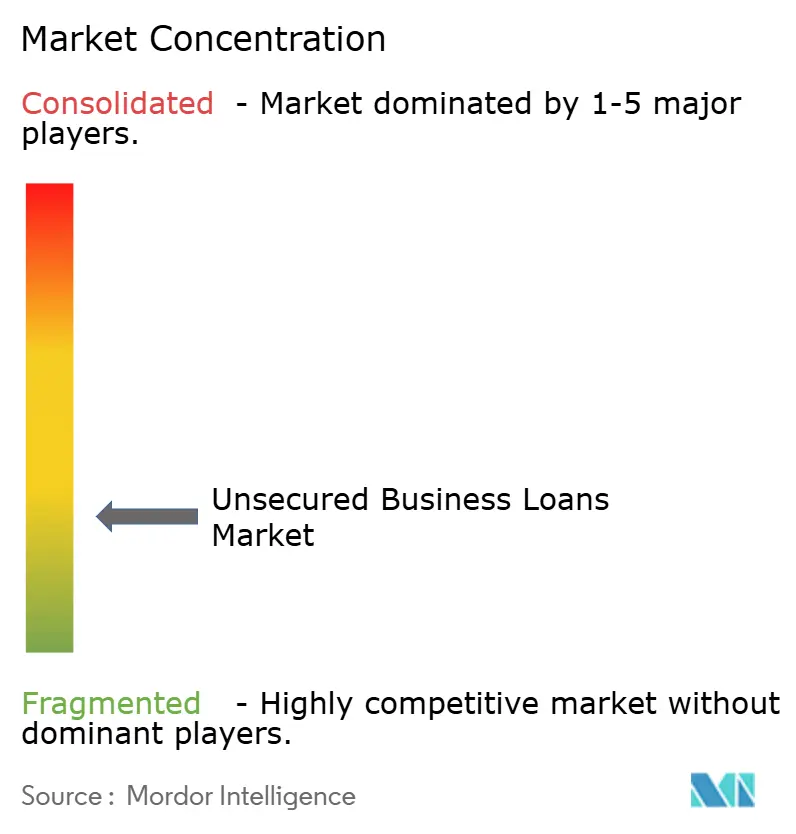
| Market Concentration | Low |
Major Players *Disclaimer: Major Players sorted in no particular order Image © Mordor Intelligence. Reuse requires attribution under CC BY 4.0. | |
Unsecured Business Loans Market Analysis by Mordor Intelligence
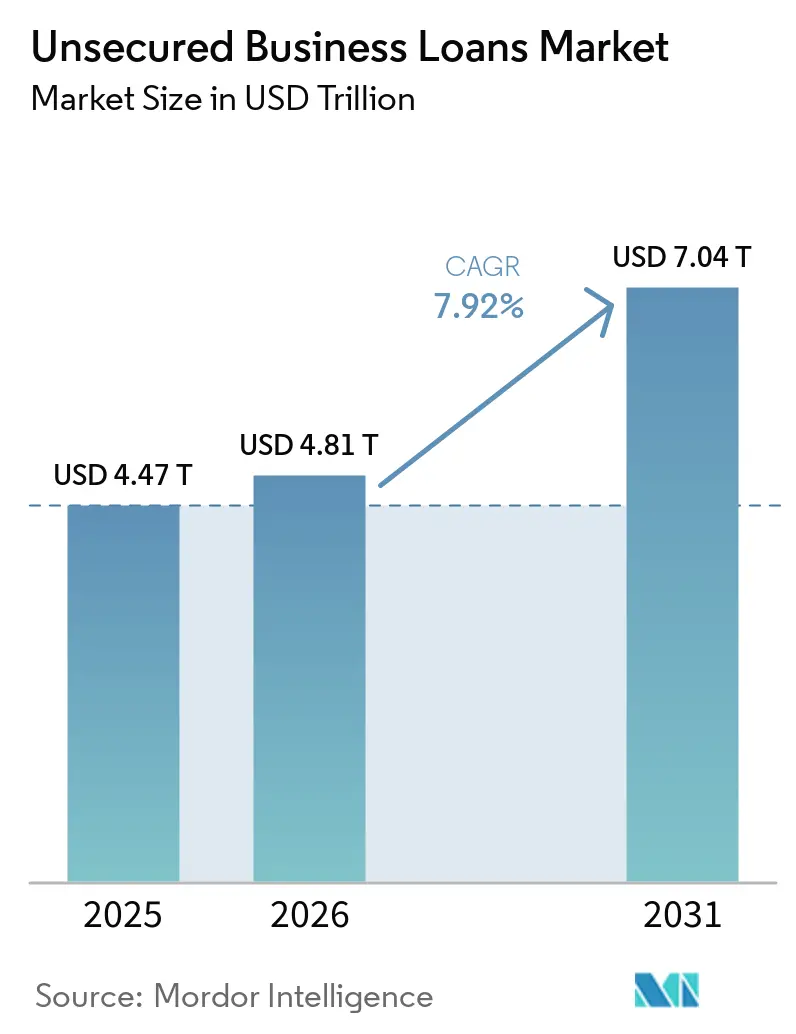
The Unsecured Business Loans Market size is projected to expand from USD 4.47 trillion in 2025 and USD 4.81 trillion in 2026 to USD 7.04 trillion by 2031, registering a CAGR of 7.92% between 2026 to 2031.
The current market position reflects a persistent gap between business borrowing demand and many lenders' ability to extend secured credit to firms with limited collateral. That gap remains especially important for small and medium enterprises, since the International Finance Corporation continues to place the MSME financing gap in emerging markets and developing economies at USD 5.7 trillion. Embedded finance models and AI-led underwriting systems are also changing origination economics, which is helping more lenders serve smaller borrowers without relying on physical assets to the same extent. Regulatory capital changes are pushing parts of the banking system toward lower-risk corporate lending, which leaves a clearer opening for nonbank lenders and platform-based credit providers in the unsecured business loans market. Large banks are still responding aggressively, and JPMorgan Chase’s March 2026 commitment to lend nearly USD 80 billion to small businesses over the next decade shows that incumbent institutions are moving more directly into this opportunity set.
Key Report Takeaways
- By loan purpose, working capital facilities (revolving) held 59.24% of the unsecured business loans market share in 2025, while receivables-based financing is projected to grow at 11.43% CAGR through 2031.
- By borrower size, small enterprises accounted for 36.57% of the unsecured business loans market share in 2025, while micro enterprises are forecast to expand at a 10.12% CAGR through 2031.
- By distribution channel, banks held 63.83% of the unsecured business loans market share in 2025, while digital and alternative lenders are projected to grow at 13.77% CAGR through 2031.
- By interest rate structure, variable and floating-rate loans accounted for 57.46% of the unsecured business loans market share in 2025, while fixed-rate loans are forecast to grow at an 8.93% CAGR through 2031.
- By end-use industry, wholesale and retail trade captured 21.69% of the unsecured business loans market share in 2025, while information technology and telecom are projected to grow at 9.68% CAGR through 2031.
- By geography, Asia-Pacific captured 41.92% of the unsecured business loans market share in 2025 and is projected to grow at 9.03% CAGR through 2031.
Note: Market size and forecast figures in this report are generated using Mordor Intelligence’s proprietary estimation framework, updated with the latest available data and insights as of January 2026.
Market Trends and Insights
Drivers Impact Analysis of Unsecured Business Loans Market*
| Driver | (~) % Impact on CAGR Forecast | Geographic Relevance | Impact Timeline |
|---|---|---|---|
| SME Working Capital Gap | +1.8% | Global, most acute in Asia-Pacific core, with spillover to the Middle East, Africa, and South America | Medium term (2-4 years) |
| Embedded Finance Distribution Expansion | +1.5% | Global, led by North America and Asia-Pacific, with continued expansion into Europe | Short term (≤ 2 years) |
| AI-Enabled Underwriting Compression | +1.3% | Global, with early gains in the United States, India, and China | Medium term (2-4 years) |
| Alternative Data Credit Scoring Adoption | +1.0% | Asia-Pacific, South America, and the Middle East and Africa, where formal credit history is limited | Medium term (2-4 years) |
| Cross-Sell From Payments and Software Ecosystems | +0.9% | North America and Europe, with expansion into Southeast Asia | Short term (≤ 2 years) |
| Government-Supported Credit Access Programs | +0.7% | Europe, India, and Southeast Asia | Long term (≥ 4 years) |
| Source: Mordor Intelligence | |||
SME Working Capital Gap Remains the Primary Demand Engine
The main demand driver for the unsecured business loans market remains the persistent funding shortfall faced by small and medium enterprises. The International Finance Corporation continued to estimate the MSME financing gap in emerging markets and developing economies at USD 5.7 trillion, which keeps baseline demand for unsecured credit elevated across many lending systems[1]International Finance Corporation, “GPFI Action Plan for MSME Financing,” IFC, ifc.org. This gap matters because many viable firms still cannot meet collateral thresholds even when their operating cash flows justify financing. In that setting, the unsecured business loans market becomes the practical route for businesses that need liquidity for inventory, payroll, and trade-cycle management rather than asset-backed expansion. The OECD also noted that global fintech revenue rose 21% in 2024, with SMEs remaining the largest single customer segment, which shows that capital providers continue to build around unmet business credit demand. The result is that demand for unsecured business lending remains durable even when traditional credit channels appear more stable at the headline level.
Embedded Finance Distribution Expansion Reshapes the Origination Stack
Embedded finance is changing how the unsecured business loans market reaches borrowers, as lending is increasingly offered within software, payment, and commerce workflows rather than through separate branch or broker channels. This model reduces friction in the borrowing process, since many businesses encounter financing options while already using operating platforms that hold their payment or sales data. PayPal’s December 2025 application to establish a Utah industrial loan company reflects this shift, because direct origination would allow it to lend without relying on partner banks for the same borrower journey[2]PayPal Holdings, “PayPal Submits Applications to Establish an Industrial Bank to Expand Access to Financial Services for U.S. Small Businesses,” PayPal Newsroom, newsroom.paypal-corp.com. The strategic effect is that distribution power is moving closer to platforms that already sit inside day-to-day business activity. This change also helps explain why incumbent banks are responding more actively, since platform-led origination can influence credit selection, pricing discipline, and borrower retention long before a customer approaches a traditional lender.
AI-Enabled Underwriting Compression Accelerates Credit Velocity
AI-led underwriting is becoming a major operational driver in the unsecured business loans market because it shortens approval cycles and expands the set of borrowers who can be assessed at a reasonable cost. The Bank for International Settlements has noted that machine-learning credit scoring and digital data trails can reduce reliance on collateral and improve access to lending for smaller firms, especially in emerging markets. The Federal Reserve also highlighted in May 2026 that United States banking agencies amended model risk management guidance and clarified that it does not apply to generative or agentic AI, which reduces part of the uncertainty around adoption. Funding Circle’s 2025 results showed how this plays out commercially, as the company expanded beyond legacy term loans and achieved close to 50% of 2025 credit extended through non-term loan products, while bringing forward its FY 2026 revenue guidance[3]Funding Circle Holdings, “Full Year 2025 Results, Achieves FY 2026 Revenue Guidance a Year Early,” GlobeNewswire, globenewswire.com. As adoption grows, the strongest advantage is likely to come less from the model itself and more from access to deep, proprietary transaction and repayment data.
Alternative Data Credit Scoring Adoption Broadens the Eligible SME Pool
Alternative data is widening the borrower pool for the unsecured business loans market because many firms that lack formal collateral still leave clear digital traces of revenue, payments, and operating activity. The Bank for International Settlements has already shown that digital innovation can improve small-firm credit access by relying more on cash flow and platform data than on traditional collateral. The OECD’s 2026 financing scoreboard also pointed to faster AI adoption among fintech firms serving SMEs, which supports broader use of data-led origination and collections tools. In policy terms, the Reserve Bank of India’s February 2026 increase in the collateral-free MSME loan limit directly supports a lending environment where smaller businesses can be served with lighter asset requirements[4]Reserve Bank of India, “Lending to Micro, Small and Medium Enterprises Sector Amendment Directions, 2026,” RBI, rbi.org.in . The shift is important for the unsecured business loans market because it improves the economics of small-ticket lending while keeping underwriting anchored in verified operating behavior.
Restraints Impact Analysis of Unsecured Business Loans Market*
| Restraint | (~) % Impact on CAGR Forecast | Geographic Relevance | Impact Timeline |
|---|---|---|---|
| Elevated Default Risk in Unsecured Portfolios | -1.8% | Global, most acute in North America and Europe | Short term (≤ 2 years) |
| Regulatory and Compliance Burden | -1.2% | Global, with intensifying activity in the United States and Europe | Medium term (2-4 years) |
| Fraud, Identity, and Synthetic Borrower Risk | -0.9% | Global, rising sharply in North America and Asia-Pacific | Short term (≤ 2 years) |
| Funding Cost Pressure on Nonbank Lenders | -0.7% | Global, most acute for United States and European fintech origination platforms | Medium term (2-4 years) |
| Source: Mordor Intelligence | |||
Elevated Default Risk in Unsecured Portfolios Constrains Portfolio Growth
Default risk remains the clearest operating restraint in the unsecured business loans market because lenders lack collateral recovery when borrowers weaken. The FDIC reported that the commercial and industrial past-due and nonaccrual rate at community banks rose to 1.81% in Q4 2025, above the pre-pandemic average of 1.62%, indicating that business credit stress remains visible in the banking system. The Financial Stability Board also noted in May 2026 that private credit borrowers are showing rising incidences of selective defaults, and that this rate can reach 5% when restructuring transactions are included. These conditions matter because even efficient origination models can struggle if portfolio seasoning reveals weaker repayment quality over longer terms. As a result, lenders in the unsecured business loans market still need to balance growth against tighter pricing, shorter tenors, and stricter account monitoring.
Regulatory and Compliance Burden Raises Costs for Non-Bank Lenders
Regulation is becoming a more material restraint in the unsecured business loans market because compliance obligations do not rise evenly across lender types. Chartered banks already operate with established reporting, risk, and governance infrastructure, while many fintech and alternative lenders must build those capabilities as they scale. The Federal Reserve’s May 2026 discussion of revised capital treatment for investment-grade corporate loans also showed how regulation can redirect bank lending capacity toward lower-risk borrowers rather than smaller firms. In Europe, the ECB has described how tighter capital requirements affect the distribution of credit exposures across banks and nonbanks, adding another layer of complexity to SME lending structures. The result is that compliance costs, product design, and funding structures are now more closely linked in the unsecured business loans market than they were a few years ago.
*Our forecasts treat driver/restraint impacts as directional, not additive. The impact forecasts reflect baseline growth, mix effects, and variable interactions.
Unsecured Business Loans Market Segment Analysis
By Loan Purpose:
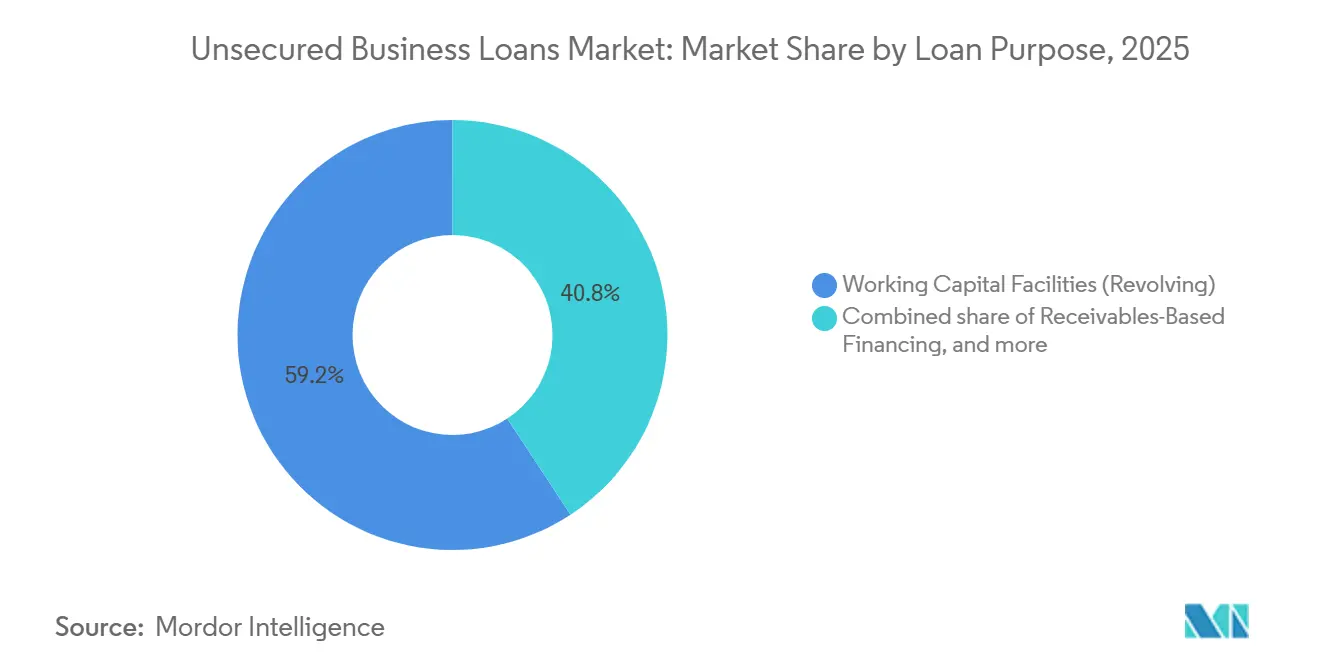
Receivables Financing Gains Ground on Core Working CapitalWorking capital facilities (revolving) held 59.24% of the unsecured business loans market share in 2025, making this category the largest part of the unsecured business loans market by loan purpose. This segment includes business lines of credit, overdrafts, and business credit card facilities, which are mainly used to manage day-to-day liquidity rather than for long-term capital investment. Its position remains strong because many businesses need flexible borrowing capacity that can rise and fall with inventory cycles, supplier payment dates, and customer collection timing. The segment is especially relevant in operating models where cash conversion cycles remain uneven, and firms need a constant liquidity buffer. Term loans (non-revolving) remain an important middle segment because they suit borrowers who need drawdown certainty for planned expansion, equipment, or structured business growth.
Receivables-based financing is projected to grow at an 11.43% CAGR through 2031, making it the fastest-growing loan-purpose segment in the unsecured business loans market. Its growth reflects a lending model that relies more directly on sales flows, invoice behavior, and repayment visibility than on hard collateral. That shift is important because receivables data can often support faster underwriting decisions than traditional balance-sheet review, especially for small firms with thin asset bases. Other unsecured facilities remain a smaller category, but they still matter for borrowers with short-duration funding needs or temporary liquidity gaps that do not fit standard revolving or installment products. Over time, this mix suggests that the unsecured business loans market is keeping its working-capital core while also moving toward structures that are more closely tied to operating cash flow.


By Borrower Size:
Micro Enterprises Expand Fastest While Small Enterprises LeadSmall enterprises accounted for 36.57% of the unsecured business loans market share in 2025, which made them the largest borrower group in the unsecured business loans market. This position reflects a practical balance, since these firms are often large enough to support regular repayment schedules but still too limited in fixed assets to secure traditional collateral-backed borrowing at scale. They are also more likely than micro firms to have formal accounts, stable customer relationships, and repeat borrowing needs, which improves lender confidence. Medium enterprises and large enterprises remain active participants, but they usually have broader access to formal bank facilities, syndicated lending, or secured credit lines. Large enterprises use unsecured structures more selectively, mainly where speed, flexibility, and treasury efficiency matter more than asset-backed pricing.
Micro enterprises are projected to grow at a 10.12% CAGR through 2031, which makes them the fastest-growing borrower category in the unsecured business loans market. The Reserve Bank of India’s February 2026 amendment raised the collateral-free MSME loan limit from INR 10 lakh to INR 20 lakh (USD 12,000-24,000), thereby expanding the formal addressable base for smaller borrowers. In France, Bpifrance continues to offer unsecured loans of EUR 5,000 to EUR 75,000 (USD 5,400-81,000), under its Prêt Boost program with fast disbursement and no personal guarantee requirement. These policy and institutional frameworks matter because they lower barriers for very small firms that were previously uneconomical to serve through manual underwriting. The unsecured business loans market is therefore broadening downward in ticket size, even as lenders remain selective about verification, fraud control, and repayment predictability.
By Distribution Channel:
Digital Lenders Scale Faster but Banks Still LeadBanks maintained a 63.83% of the unsecured business loans market share in 2025, making them the largest channel in the unsecured business loans market. Their lead is still supported by lower funding costs, established SME relationships, nationwide servicing capacity, and a clearer regulatory framework than most nonbank competitors. This channel also benefits from borrower familiarity, since many businesses prefer to work through existing operating bank relationships when seeking working capital or term credit. Non-banking financial companies and finance companies remain important in several emerging markets because they can serve borrower groups that are lightly covered by branch-led banking networks. Peer-to-peer platforms remain in the mix but play a smaller role than banks, finance companies, and platform-led lenders in the global unsecured business loans market.
Digital and Alternative Lenders are projected to grow at a 13.77% CAGR through 2031, which makes them the fastest-expanding distribution segment in the unsecured business loans market. Funding Circle reported that United Kingdom term loan originations rose to GBP 1.6 billion (USD 2.16 billion) in FY 2025 from GBP 1.4 billion (USD 1.89 billion) in FY 2024, while close to 70% of FlexiPay revenue came from existing term loan customers, demonstrating the strength of repeat engagement in digitally managed lending ecosystems. The scaling advantage comes from faster interfaces, stronger use of transaction data, and the ability to embed credit offers inside broader business workflows. At the same time, the Bank for International Settlements has noted that fintech lenders do not have access to low-cost insured deposits, which means funding cost pressure can narrow margins as origination volumes grow. The channel is therefore gaining share quickly, but its long-term economics still depend on disciplined underwriting, repeat borrowing, and stable capital market access.
By Interest Rate Structure:
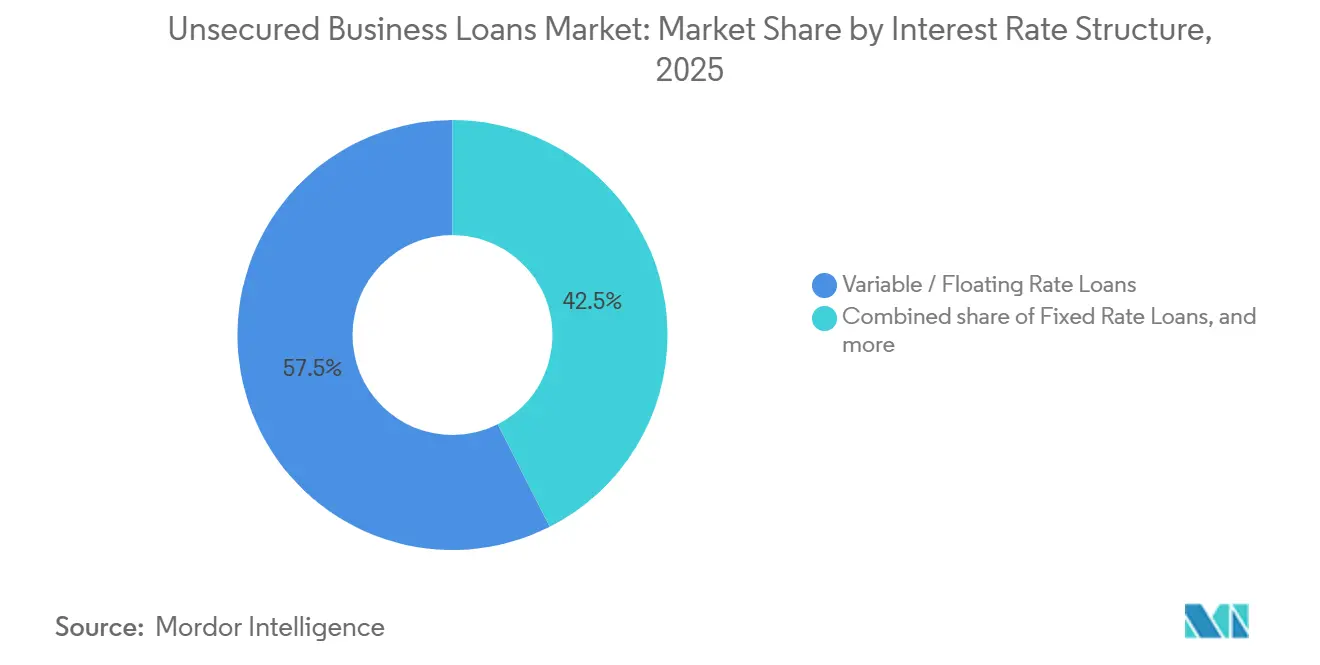
Fixed Rate Products Gain Relevance as Rates NormalizeVariable and floating-rate loans commanded a 57.46% of the unsecured business loans market share in 2025, making them the largest interest-rate category in the unsecured business loans market. This structure has historically appealed to lenders because it passes a larger part of rate risk to borrowers, which is especially useful for institutions that rely on floating-rate wholesale funding. It also gives some borrowers flexibility when they expect rates to soften or when they prefer not to lock pricing over a longer period. Hybrid rate products remain relevant as a transitional option because they combine initial payment certainty with later repricing flexibility. Together, these structures show that the unsecured business loans market still places strong weight on balancing borrower affordability with lender balance-sheet risk.
Fixed-rate loans are forecast to grow at a 8.93% CAGR through 2031, making them the fastest-growing rate structure in the unsecured business loans market. KfW’s ERP-Förderkredit KMU program offered fixed rates starting at 3.57% for eligible SME borrowers as of May 2026, with pricing set at the time of commitment, which supports demand for rate certainty in a softer interest-rate environment. The FDIC also confirmed that interest rates fell during 2025, with shorter-term rates declining more than longer-term rates, which improved the appeal of fixing loan costs for part of the borrower base. From the lender side, the Bank for International Settlements has warned that greater fixed-rate origination can create duration mismatch risks if liability structures do not adjust in parallel. This means fixed-rate growth should continue, but its profitability will depend on how well lenders manage funding tenors and balance-sheet sensitivity.
By End-Use Industry:
Trade Leads While IT and Telecom Grows FasterWholesale and retail trade maintained the largest end-use share at 21.69% of the unsecured business loans market share in 2025, making it the leading vertical in the unsecured business loans market. This segment depends heavily on short-cycle liquidity because businesses often pay suppliers on fixed terms while waiting for customer receipts, seasonal turnover, or credit sales collections. That operating structure makes revolving facilities and short-duration unsecured funding particularly useful for managing inventory and cash timing. Healthcare and life sciences also represent an important mid-tier opportunity because providers and service firms often need capital for equipment, digital tools, and working-capital support. Manufacturing and logistics continue to rely on unsecured loans for selective capacity support, while construction and real estate services use shorter-duration facilities for project-linked needs.
Information technology and telecom is projected to grow at a 9.68% CAGR through 2031, making it the fastest-growing end-use category in the unsecured business loans market. Businesses in this segment often need funding for software subscriptions, payroll, talent expansion, and project execution rather than for heavy physical assets, which fits well with unsecured borrowing structures. Their operating models also produce recurring or observable revenue streams that are easier to interpret through transaction-led underwriting methods. This makes the segment a strong fit for receivables-based and data-led credit products that can respond quickly to shifts in contract revenue or platform usage. Energy and utilities remain a smaller but emerging opportunity area in the unsecured business loans market, especially where smaller firms need bridge funding ahead of program-linked or project-linked cash inflows.
Geography Analysis
APAC Unsecured Business Loans Market
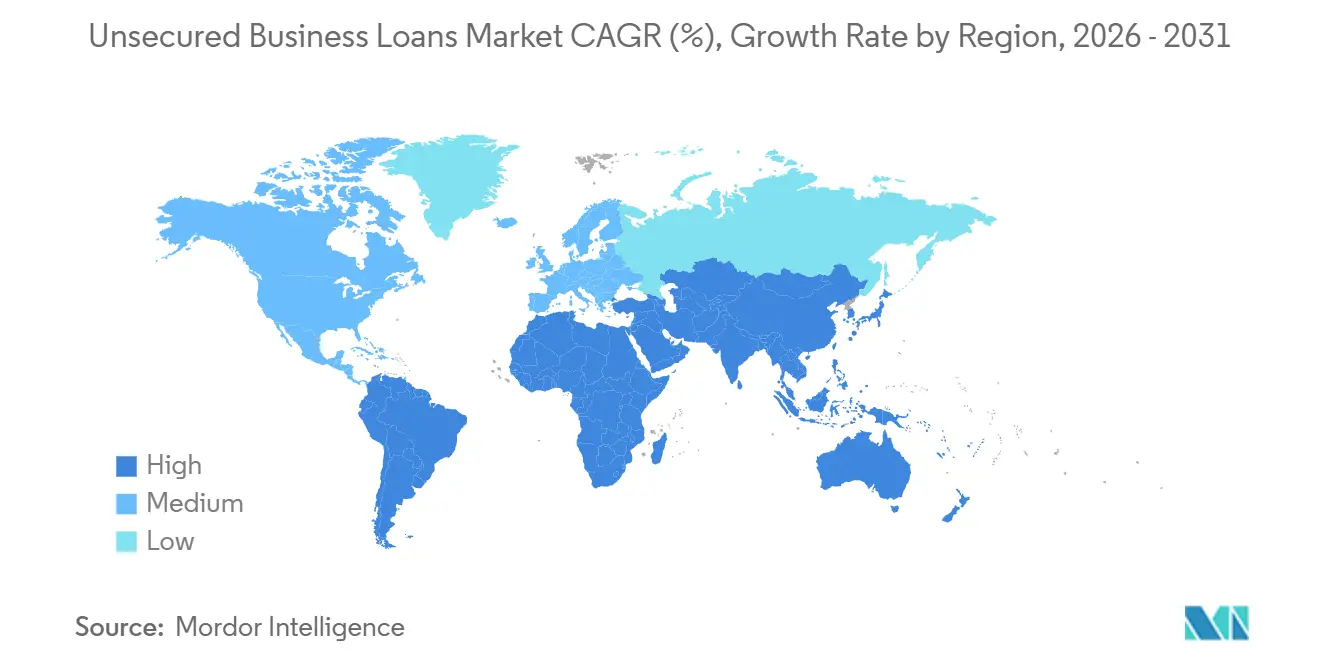
Asia-Pacific held 41.92% of the unsecured business loans market share in 2025 and is projected to grow at a 9.03% CAGR through 2031, making it both the largest and fastest-growing regional component of the unsecured business loans market. Regional demand remains anchored by large SME populations, high working-capital needs, and a broad set of firms that still operate with limited collateral coverage. India remains especially important because formal policy support for smaller enterprises continues to widen access to collateral-free borrowing through the 2026 MSME amendment directions. The region also benefits from stronger adoption of digital payments and transaction-led business models, which improve the operating basis for unsecured origination. For the unsecured business loans market, this means Asia-Pacific combines scale, policy support, and technology adoption in a way that few other regions currently match.
North America and Europe Unsecured Business Loans Market
North America remains the second-largest regional market in the unsecured business loans market, with the United States setting the pace through its large nonbank and online lending ecosystem. The Federal Reserve’s 2026 report on employer firms showed that online lenders accounted for 29% of small business financing applications in 2025, up from 17% in 2020, which confirms continued borrower migration toward digital channels. The FDIC also reported that community banks held USD 717 billion in small business loans in 2025, representing 37% of industry total small business loans volume while holding only 14% of total industry assets, which highlights their outsized role in SME credit delivery. In Europe, Germany’s KfW supports SME lending with programs of up to EUR 25 million (USD 29.4 million) and 50% risk transfer at rates starting from 3.57%, while France’s Bpifrance continues to facilitate collateral-free borrowing for smaller firms. The IMF and ECB also point to a regional credit environment in which tighter prudential conditions can shift part of SME financing activity toward nonbank channels, which supports continued diversification in the unsecured business loans market.
South America and MEA Unsecured Business Loans Market
South America and the Middle East and Africa remain smaller in absolute size, but they are still important frontier zones for the unsecured business loans market. Brazil continues to stand out in South America because fintech-led business lending is becoming more formalized, while Argentina still carries higher macro volatility that can constrain credit penetration and loan tenor. In the Middle East and Africa, the demand case stays strong because many SMEs remain outside conventional collateral-based finance even when working-capital needs are clear. The IFC’s February 2026 launch of a USD 6 billion credit insurance facility, backed by 19 global insurers and designed to mobilize up to USD 10 billion in new lending capacity, directly supports expansion in these emerging-market financing environments. This leaves the unsecured business loans market with a meaningful long-term opportunity in regions where institutional lending structures are still catching up with underlying enterprise demand.

Competitive Landscape
The unsecured business loans market operates through a two-tier competitive structure that combines large universal banks with a fragmented but fast-scaling challenger group of fintechs, NBFCs, and platform-led lenders. Major banks such as JPMorgan Chase, HSBC, Bank of America, Wells Fargo, Barclays, and Deutsche Bank retain advantages in funding cost, balance-sheet capacity, and relationship depth. Their position remains strongest in larger-ticket SME lending and in borrower segments where risk selection, pricing discipline, and treasury cross-sell matter more than speed alone. The challenger tier is expanding most visibly in smaller-ticket, faster-turnaround lending, where underwriting speed and data integration are more decisive factors. This means the unsecured business loans market is not shifting entirely away from banks. Still, it is becoming more contested in the borrower ranges where distribution and data have become central competitive tools.
Strategic moves made in 2025 and 2026 show how both incumbents and challengers are adjusting within the unsecured business loans market. JPMorgan Chase launched the American Dream Initiative in March 2026 and committed to lending nearly USD 80 billion to small businesses over the next decade and to hiring 1,000 additional small-business bankers. PayPal’s December 2025 application to establish a Utah industrial loan company followed a different path, seeking direct origination capability rather than continued reliance on partner-bank structures. Funding Circle, meanwhile, expanded product breadth and capital-market support, and its March 2026 results indicated that close to 50% of 2025 credit extended came through non-term-loan products. These moves show that competition in the unsecured business loans market is now centered on distribution control, product adjacency, and faster borrower capture rather than on price alone.
Technology remains the main differentiator in the unsecured business loans market because it shapes how quickly lenders can assess risk, present offers, and retain customers across multiple products. The Bank for International Settlements has noted that fintech lenders can improve access by leveraging digital data more effectively, even though they still face structural funding disadvantages compared to deposit-funded banks. Regulatory capital shifts also matter, since the Federal Reserve’s discussion of lower risk weights for investment-grade corporates suggests banks may still prioritize larger, lower-risk borrowers in their portfolio allocation. Taken together, these conditions leave the unsecured business loans market competitive at the top, but still fragmented enough for specialist and platform-native lenders to keep gaining ground in targeted borrower segments.
Unsecured Business Loans Industry Leaders
Bank of America Corporation
JPMorgan Chase and Co.
Wells Fargo and Co.
American Express Co.
Funding Circle Holdings Plc
- *Disclaimer: Major Players sorted in no particular order
Unsecured Business Loans Market Companies Covered in this Report
- American Express Co.
- Bank of America Corporation
- Barclays Bank Plc
- Bluevine Inc.
- Block Inc.
- Credibly
- Deutsche Bank AG
- Funding Circle Holdings Plc
- HDFC Bank Ltd.
- HSBC Holdings Plc
- JPMorgan Chase and Co.
- National Funding Inc.
- OnDeck Capital Inc.
- PayPal Holdings Inc.
- Poonawalla Fincorp Ltd.
- Santander Bank, N.A.
- Starling Bank Limited
- Stripe Inc.
- Wells Fargo and Co.

Recent Industry Developments in Unsecured Business Loans Market
- June 2026: IFC and Santander Bank, N. A., launched a USD 500 million risk-sharing supply chain finance facility targeting emerging-market SMEs. The structure is expected to support USD 1.5 billion in supply chain finance transactions over 3 years, directly expanding unsecured working capital access for emerging-market suppliers in the Santander network.
- March 2026: JPMorgan Chase launched the American Dream Initiative, committing to lend nearly USD 80 billion to small businesses over the next decade through direct origination and partnerships with community development financial institutions. The plan includes hiring 1,000 additional small business bankers and scaling its SME client base from 7 million to 10 million.
- February 2026: IFC launched a USD 6 billion credit insurance policy, underwritten by a consortium of 19 global insurance companies, to support up to USD 10 billion in new IFC MSME lending across emerging markets.
- February 2026: The Reserve Bank of India issued MSME Sector Amendment Directions 2026, increasing the collateral-free unsecured loan limit for MSE borrowers from INR 10 lakh to INR 20 lakh (USD 12,000-24,000), effective April 1, 2026.


Global Unsecured Business Loans Market Report Scope
| Working Capital Facilities (Revolving) | Business Lines of Credit |
| Overdrafts | |
| Business Credit Card Facilities | |
| Term Loans (Non-Revolving / Fixed Repayment Schedule) | |
| Receivables-Based Financing | Invoice Discounting & Factoring |
| Merchant Cash Advances (Future Receivables) | |
| Other Unsecured Facilities |
| Micro Enterprises |
| Small Enterprises |
| Medium Enterprises |
| Large Enterprises |
| Banks |
| Non-Banking Financial Companies (NBFCs) & Finance Companies |
| Digital & Alternative Lenders (Fintech Platforms, Embedded Finance Providers) |
| Peer-to-Peer (P2P) Lending Platforms |
| Fixed Rate Loans |
| Variable / Floating Rate Loans |
| Hybrid Rate Loans |
| Wholesale & Retail Trade |
| Information Technology and Telecom |
| Healthcare & Life Sciences |
| Manufacturing |
| Energy and Utilities |
| Logistics, Transportation & Warehousing |
| Hospitality, Tourism & Leisure |
| Construction & Real Estate Services |
| Other End Industries |
| North America | United States |
| Canada | |
| Mexico | |
| South America | Brazil |
| Argentina | |
| Rest of South America | |
| Europe | United Kingdom |
| Germany | |
| France | |
| Italy | |
| Spain | |
| Rest of Europe | |
| Asia-Pacific | China |
| Japan | |
| India | |
| South Korea | |
| Australia | |
| Indonesia | |
| Thailand | |
| Malaysia | |
| Singapore | |
| Vietnam | |
| Rest of Asia-Pacific | |
| Middle East and Africa | Saudi Arabia |
| United Arab Emirates | |
| Turkey | |
| South Africa | |
| Egypt | |
| Rest of Middle East and Africa |
| By Loan Purpose | Working Capital Facilities (Revolving) | Business Lines of Credit |
| Overdrafts | ||
| Business Credit Card Facilities | ||
| Term Loans (Non-Revolving / Fixed Repayment Schedule) | ||
| Receivables-Based Financing | Invoice Discounting & Factoring | |
| Merchant Cash Advances (Future Receivables) | ||
| Other Unsecured Facilities | ||
| By Borrower Size | Micro Enterprises | |
| Small Enterprises | ||
| Medium Enterprises | ||
| Large Enterprises | ||
| By Distribution Channel | Banks | |
| Non-Banking Financial Companies (NBFCs) & Finance Companies | ||
| Digital & Alternative Lenders (Fintech Platforms, Embedded Finance Providers) | ||
| Peer-to-Peer (P2P) Lending Platforms | ||
| By Interest Rate Structure | Fixed Rate Loans | |
| Variable / Floating Rate Loans | ||
| Hybrid Rate Loans | ||
| By End-Use Industry | Wholesale & Retail Trade | |
| Information Technology and Telecom | ||
| Healthcare & Life Sciences | ||
| Manufacturing | ||
| Energy and Utilities | ||
| Logistics, Transportation & Warehousing | ||
| Hospitality, Tourism & Leisure | ||
| Construction & Real Estate Services | ||
| Other End Industries | ||
| By Geography | North America | United States |
| Canada | ||
| Mexico | ||
| South America | Brazil | |
| Argentina | ||
| Rest of South America | ||
| Europe | United Kingdom | |
| Germany | ||
| France | ||
| Italy | ||
| Spain | ||
| Rest of Europe | ||
| Asia-Pacific | China | |
| Japan | ||
| India | ||
| South Korea | ||
| Australia | ||
| Indonesia | ||
| Thailand | ||
| Malaysia | ||
| Singapore | ||
| Vietnam | ||
| Rest of Asia-Pacific | ||
| Middle East and Africa | Saudi Arabia | |
| United Arab Emirates | ||
| Turkey | ||
| South Africa | ||
| Egypt | ||
| Rest of Middle East and Africa | ||


Key Questions Answered in the Report
What is the current size of unsecured business lending globally?
The unsecured business loans market is USD 4.8 trillion in 2026 and is forecast to reach USD 7.0 trillion by 2031, with a 7.9% CAGR.
Which region leads the worldwide demand for unsecured business borrowing?
Asia-Pacific leads with 41.92% share in 2025 and is also the fastest-growing region with a 9.03% CAGR through 2031.
Which loan type generates the most revenue in unsecured business lending?
Working Capital Facilities (Revolving) led the mix with a 59.24% share in 2025 because businesses continue to rely on flexible short-term liquidity.
Which borrower group is expanding the fastest?
Micro Enterprises are projected to grow at a 10.12% CAGR through 2031 as policy support and digital underwriting improve the economics of small-ticket lending.
Why are digital lenders gaining traction against banks?
Digital and Alternative Lenders are growing at a 13.77% CAGR because they combine faster interfaces, stronger use of transaction data, and embedded distribution.
Which end-use vertical is showing the strongest growth outlook?
Information Technology and Telecom is forecast to grow at a 9.68% CAGR through 2031, as many firms in this segment need unsecured funding for recurring operating expenses rather than asset-backed borrowing.
Page last updated on:





