
Market Overview
| Study Period | 2019 - 2031 |
|---|---|
| Forecast Data Period | 2026 - 2031 |
| Historical Data Period | 2019 - 2024 |
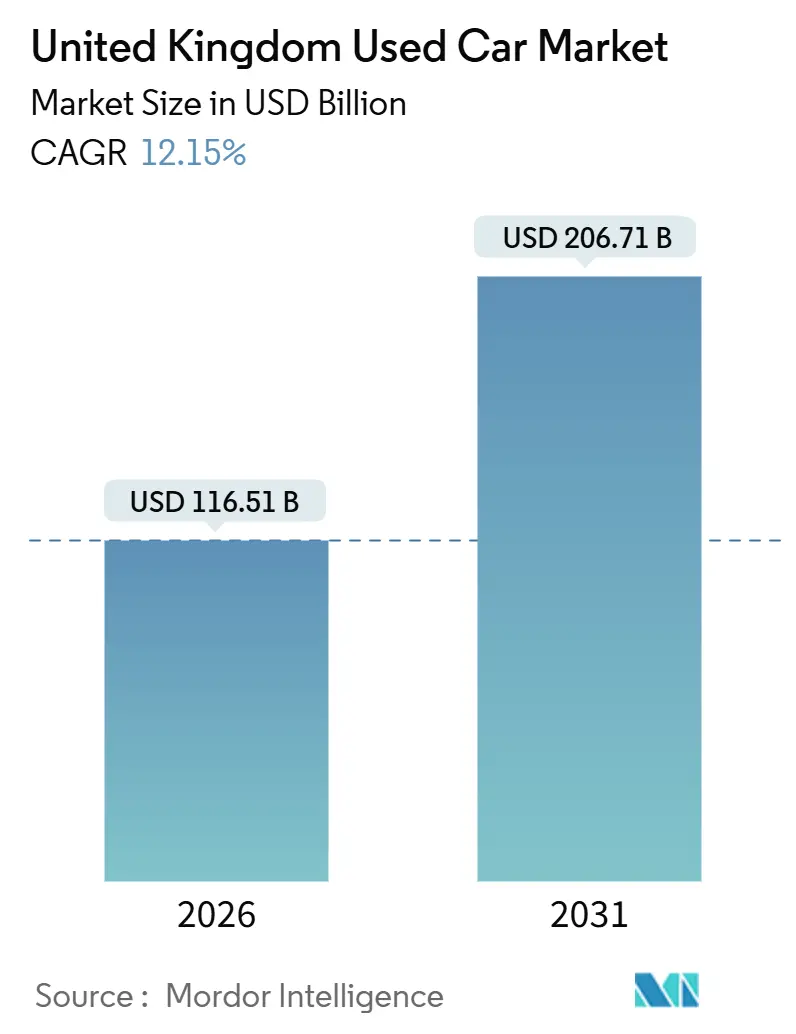
| Market Size (2026) | USD 116.51 Billion |
| Market Size (2031) | USD 206.71 Billion |
| Growth Rate (2026 - 2031) | 12.15 % |
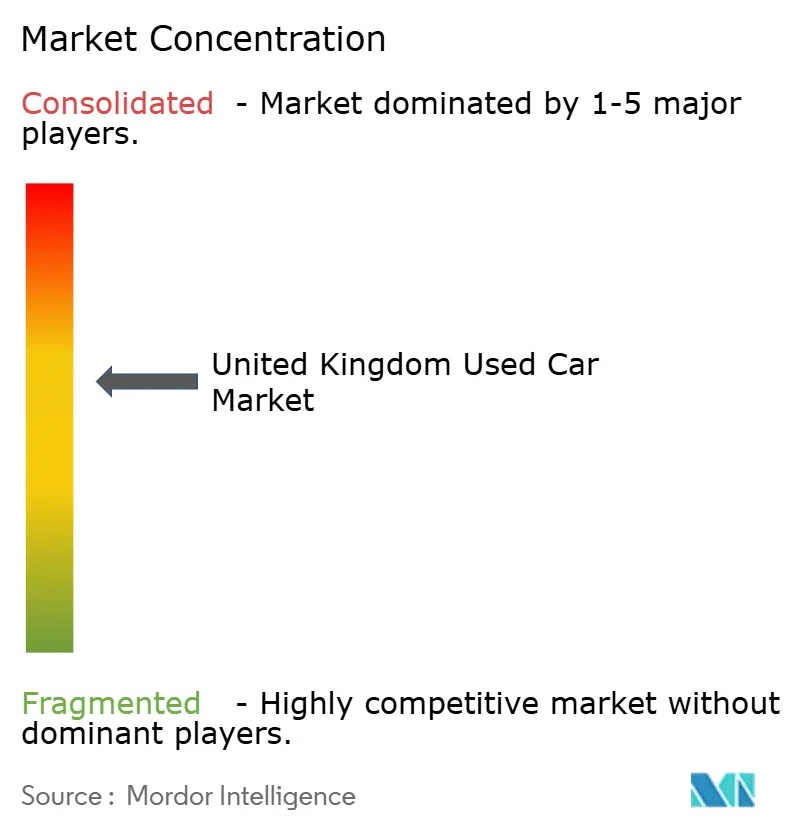
| Market Concentration | Medium |
Major Players *Disclaimer: Major Players sorted in no particular order Image © Mordor Intelligence. Reuse requires attribution under CC BY 4.0. | |
United Kingdom Used Car Market Analysis by Mordor Intelligence
The United Kingdom used car market size stands at USD 116.51 billion in 2026 and is projected to reach USD 206.71 billion by 2031, translating into a 12.15% CAGR over the forecast period. Growth is driven by faster fleet renewal triggered by urban emissions zones, the rise of trusted certified pre-owned programs, and the rapid migration of transactions to digital marketplaces. Buyers are gravitating toward flexible ownership models, such as subscription services, while residual-value guarantees on battery-electric vehicles (BEVs) help alleviate depreciation concerns and accelerate the adoption of electrification. Competitive dynamics are intensifying as franchised dealer groups, auction majors, and pure-play online platforms deploy data-driven pricing tools that compress days-to-sale and widen geographic reach, according to Investegate. Persistent interest-rate headwinds and elevated used-vehicle prices remain the principal brakes on volume recovery. Yet, structurally tighter new-car output keeps near-new stock scarce, supporting pricing power.
Key Report Takeaways
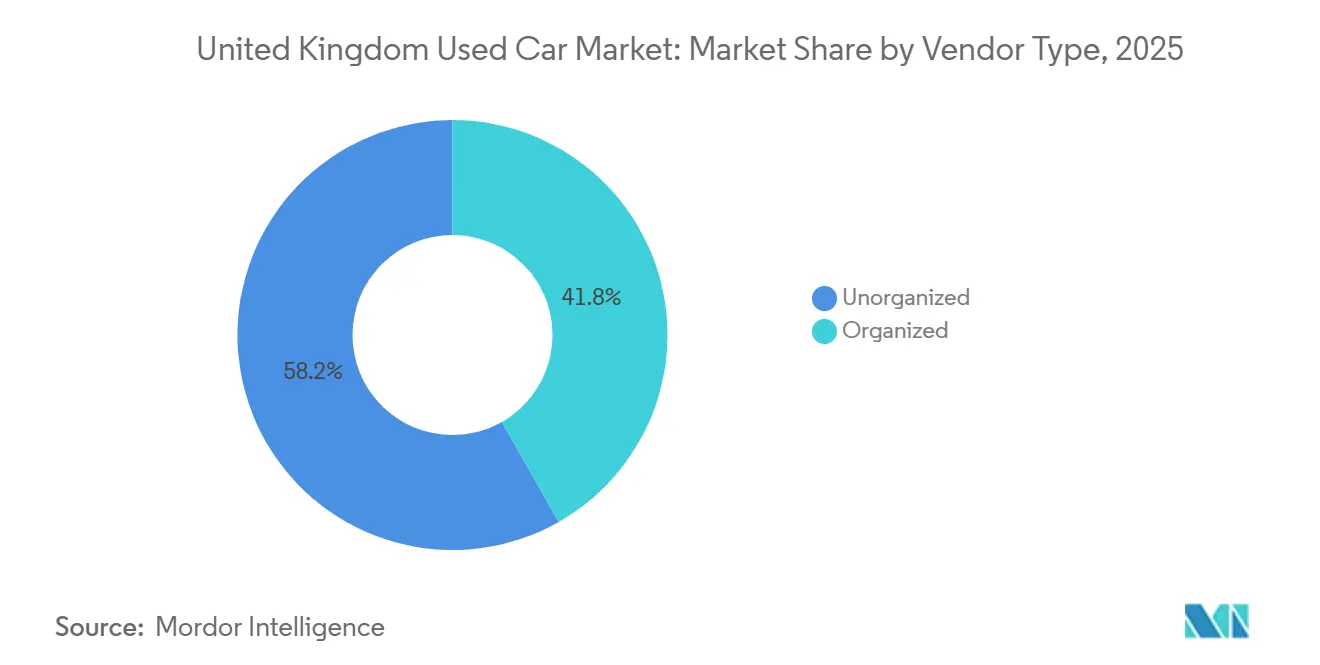
- By vendor type, unorganized vendors led the United Kingdom used car market with 58.23% of the market share in 2025; organized players are projected to expand at a 12.82% CAGR through 2031.
- By vehicle age, cars aged 3-5 years captured 34.28% of the United Kingdom used car market share in 2025, while the 0-2 year cohort is advancing at a 12.43% CAGR to 2031.
- By fuel type, petrol models dominated at 53.34% of the United Kingdom used car market share in 2025, whereas used BEVs are rising at a 19.23% CAGR through 2031.
- By body type, hatchbacks accounted for 41.93% of the United Kingdom used car market share in 2025; sport utility vehicles are projected to grow at a 13.21% CAGR through 2031.
- By sales channel, offline franchised dealers accounted for 34.84% of the United Kingdom used car market share in 2025, while online-only platforms are projected to scale at a 14.48% CAGR through 2031.
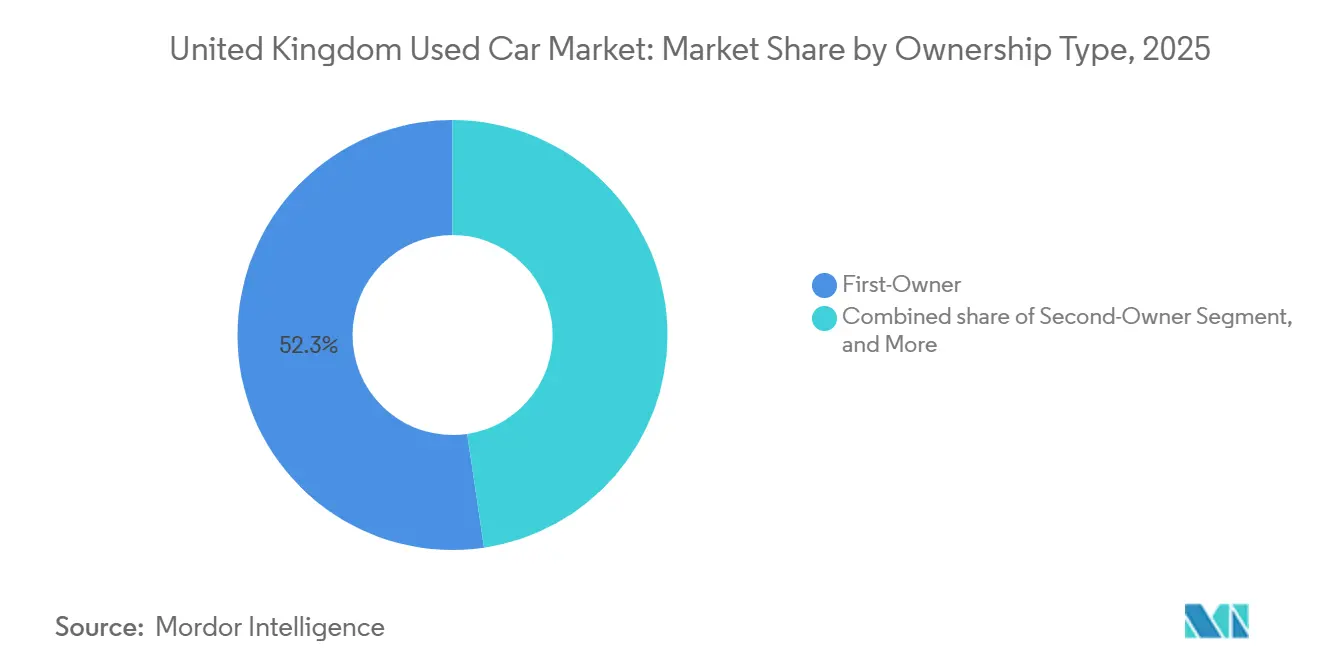
- By ownership, first-owner vehicles represented 52.34% of the United Kingdom used car market share in 2025 and are expected to grow at a 12.72% CAGR through 2031.
- By price band, the USD 7,000-15,000 bracket accounted for 39.87% of the United Kingdom's used car market share in 2025, whereas cars priced above USD 30,000 are forecast to increase at a 13.73% CAGR through 2031.
- By region, England contributed 80.34% of the United Kingdom's used car market share in 2025, while Northern Ireland is poised for the fastest growth, with a 12.61% CAGR through 2031.
Note: Market size and forecast figures in this report are generated using Mordor Intelligence’s proprietary estimation framework, updated with the latest available data and insights as of January 2026.
United Kingdom Used Car Market Trends and Insights
Drivers Impact Analysis*
| Drivers | (~) %Impact on CAGR | Geographic Relevance | Peak Impact |
|---|---|---|---|
| Online Only Marketplaces Surge | +2.1% | National, with early gains in urban England and Scotland | Short term (≤ 2 years) |
| Clean-Air Zones Speed Fleet Turnover | +1.8% | England (London, Birmingham, Manchester), Scotland (Glasgow, Edinburgh, Aberdeen, Dundee), Wales (Cardiff) | Medium term (2-4 years) |
| OEM CPO Programs Boost Trust and Prices | +1.5% | National, concentrated in England and Scotland dealer networks | Medium term (2-4 years) |
| Residual Guarantees Lift BEV/Hybrid Appeal | +1.4% | National, stronger in England and Scotland with charging infrastructure | Medium term (2-4 years) |
| Used-Car Subscriptions Drive Repeat Demand | +0.9% | National, urban-focused (London, Manchester, Birmingham) | Long term (≥ 4 years) |
| Telematics Weaken Older Car Competitiveness | +0.8% | National, disproportionate impact in England | Short term (≤ 2 years) |
| Source: Mordor Intelligence | |||
Rapid Uptake of Online-Only Marketplaces and Click-and-Deliver Models
Auto Trader dominates marketplace browsing time, leveraging instant-offer tools and guaranteed part-exchange options to streamline sales for private sellers. Carwow uses a dealer-bidding engine, introducing transparent auction-style pricing to its retail inventory. This strategy not only earns recognition through Top-Rated badges for low complaint rates but also strengthens digital trust. Real-time pricing engines, such as Vertu Insights, enhance stock turnover and increase profit margins. Mobile-centric buyers now expect home delivery within a short timeframe, prompting even traditional groups to embrace an omnichannel approach.
ULEZ, ZEZ and Clean-Air Zones Accelerating Fleet Turnover Toward Newer Used Cars
London’s Ultra-Low Emission Zone now covers every borough, raising compliance to 96% by mid-2024 and pushing owners of older engines to trade into Euro 6-compliant used stock[1]. Similar clean-air charging schemes in Birmingham, Manchester, and Scotland’s four Low Emission Zones levy daily fees that erode the economics of running vehicles aged eight years or more. The resulting demand shifts split the United Kingdom's used car market, with compliant petrol and diesel cars attracting urban premiums. At the same time, non-compliant stock is either relocated to rural areas or scrapped. The policy cascade lifts transaction velocity and underpins residual values for younger vehicles. Regional rollouts, including Cardiff’s planned 2026 zone, are expected to maintain the regulatory tailwind through the forecast horizon.
OEM-Backed Certified Pre-Owned Programs Boost Buyer Trust and Prices
Manufacturer-run certified schemes provide warranty extensions and comprehensive inspections, reducing information asymmetry. This allows dealers to charge premiums while also shortening the time required to sell vehicles. Premium groups such as Sytner focus on retailing Euro 6-compliant stock, positioning themselves as one-stop shops for low-emission vehicles. Battery-health reports included in BEV certifications further address concerns about range degradation. As more OEMs transition to direct-sales formats, certified programs are becoming essential for maintaining residual values and ensuring customer loyalty for services and upgrades.
Attractive Residual-Value Guarantees on Used BEVs and Hybrids
OEM buy-back pledges that limit depreciation over a few years significantly reduce the risks historically associated with second-hand EV batteries. Independent tracking shows that BEVs maintain a higher percentage of their launch value compared to equivalent petrol cars, narrowing the total cost of ownership gap. The practical appeal of EVs is further enhanced by the ongoing expansion of charger installations at dealer sites. Additionally, upcoming Zero Emission Vehicle quotas are driving more compliant stock into the market.
Restraints Impact Analysis*
| Restraints | (~) %Impact on CAGR | Geographic Relevance | Peak Impact |
|---|---|---|---|
| High Rates Raise Used-Car Finance Costs | -2.3% | National, acute in England and Scotland | Short term (≤ 2 years) |
| Used-Car Prices Surge Amid Output Crunch | -1.6% | National, concentrated in England | Short term (≤ 2 years) |
| ICE Residuals Uncertain Before Fuel Ban | -1.4% | National, stronger impact in urban England and Scotland | Medium term (2-4 years) |
| Data-Privacy Concerns in Ownership Transfers | -0.5% | National, emerging concern in urban areas | Long term (≥ 4 years) |
| Source: Mordor Intelligence | |||
High Interest-Rate Environment Raising Finance Costs for Buyers
Although the Bank of England eased the base rate to 4.25% by May 2025, for prime borrowers, used-car APRs hover at moderate levels, while subprime rates can reach significantly higher percentages [2]. This results in an increase in monthly costs on standard loans. The Finance & Leasing Association has reported a decline in used-car finance volumes, citing the exit of entry-level buyers from the market. To sustain sales, dealers are absorbing rate buy-downs, which in turn pressures their gross margins. Additionally, negative equity on older ICE vehicles is making trade-ins more challenging.
Used-Car Prices Surge as New-Car Output Faces Crunch
Semiconductor shortages have disrupted new-car registrations in the United Kingdom, keeping them below typical levels. This has slowed fleet turnover and increased prices for newer vehicles. Transaction values have risen, with the sharpest increases observed in nearly-new cars. Despite these challenges, Vertu Motors improved its used gross margin, but affordability issues continue to exclude many price-sensitive households. A gradual improvement is expected as OEM production stabilizes over time.
*Our forecasts treat driver/restraint impacts as directional, not additive. The impact forecasts reflect baseline growth, mix effects, and variable interactions.
Segment Analysis
By Vendor Type: Organized Players Scale Through Digital and CPO
Independent, unorganized vendors, traditionally dominant in rural catchments and lower price bands, accounted for 58.23% of the United Kingdom's used car market size in 2025. However, their market share is steadily declining due to increasing compliance pressures. The CMA’s Phase 2 investigation into Constellation’s acquisition of Aston Barclay underscores the increasing regulatory scrutiny of auction consolidations. Larger players leverage scale advantages in data analytics, captive finance, and logistics, leaving smaller, fragmented traders increasingly at risk of losing market share.
Organized dealers captured 41.77% of the United Kingdom's used car market share in 2025; yet, the group is expected to add volume at a 12.82% CAGR through 2031, as certified-pre-owned schemes and nationwide digital storefronts build trust and convenience. This structural tailwind positions organized operators to undercut smaller rivals on nearly-new stock while monetizing finance and service add-ons.
By Vehicle Age: Nearly-New Stock Captures Premium Demand
Vehicles aged 3-5 years accounted for 34.28% of the United Kingdom used car market share in 2025, reflecting the traditional depreciation “sweet spot.” However, the United Kingdom used car market demand for 0-2 year models is rising fastest at a 12.43% CAGR through 2031, driven by short-cycle fleet returns and demonstrator oversupply.
Younger inventory benefits from full OEM warranty and eligibility for certified programs, supporting premium pricing and faster turns. In contrast, cars older than eight years face mounting urban access fees and higher insurance costs, which suppress their resale values despite their appeal to cash buyers outside city centers. Dealers are increasingly channeling high-mileage or non-compliant stock to export markets, thereby protecting domestic residuals.
By Fuel Type: Electrification Reshapes Powertrain Mix
Petrol cars still led the United Kingdom's used car market share in 2025, with 53.34%. Yet, BEVs are sprinting ahead with a 19.23% CAGR as infrastructure improves and warranty-supported battery health reports reduce buyer anxiety. The United Kingdom used car market size tied to electrified powertrains is expected to more than triple by 2031.
Diesel’s retreat quickens under Clean-Air Zone charges, while hybrids enjoy a hedge against range and refueling constraints. Export demand for diesel units to less-regulated regions partly cushions domestic price falls, but the long-term trajectory remains downward.
By Body Type: SUVs Gain Share Across Price Bands
Hatchbacks maintained the most significant share at 41.93% of the United Kingdom's used car market in 2025, due to their affordability and city-friendly footprint. However, SUV penetration is expected to accelerate at a 13.21% CAGR through 2031. Dealers such as Arnold Clark launched premium concepts to showcase high-margin SUVs and crossover BEVs, mirroring new-car preferences.
Sedans and MPVs continue to find niche demand. Yet, they suffer from limited automaker investment, while BEV-centric SUV models, such as the Tesla Model Y, improve residual performance relative to their same-segment petrol peers. The body-mix shift forces forecourt re-layout and stocking changes, emphasizing higher-ticket, tech-rich vehicles.
By Sales Channel: Digital Platforms Disrupt Traditional Dealers
Offline franchised dealerships accounted for 34.84% of the United Kingdom's used car market share in 2025, supported by service networks and OEM finance. Online-only channels, however, are growing at the fastest rate, with a 14.48% CAGR through 2031, driven by instant financing, transparent pricing, and doorstep delivery.
Private sales are on the decline as sellers opt for the speed of dealer-bidding platforms; independent forecourts must adopt omnichannel tools or risk ceding ground. Auto Trader’s data ecosystem and Carwow’s quality-score badges set new standards for digital trust, reshaping customer expectations.
By Ownership Type: First-Owner Vehicles Command Premium
First-owner cars represented 52.34% of the United Kingdom used car market share in 2025, and are expected to outpace the broader United Kingdom used car market at a 12.72% CAGR through 2031. Lenders prize the clearer history and lower risk profile, offering more favorable terms that widen the buyer pool.
Second-owner stock balances affordability and remaining warranty, while third-owner vehicles concentrate in cash-only, price-sensitive sub-segments. The ownership pattern is more pronounced in BEVs, where battery condition reports have a significant influence on finance approvals and resale valuations.

By Price Band: Premium Tier Expands Amid Bifurcation
Cars priced between USD 7,000 and 15,000 captured 39.87% of the United Kingdom's used car market share in 2025; however, the premium tier of USD 30,000 or more is expanding at a 13.73% CAGR through 2031, buoyed by luxury SUVs and near-new electric models. The United Kingdom used car market size for premium stock could double by the end of the forecast window.
Organized dealers invest in concierge-style showrooms and warranty packages to differentiate high-value inventory. Conversely, vehicles priced below USD 7,000 face a shrinking supply as elevated wholesale prices and reconditioning costs deter professional retailers, leaving unorganized operators to serve the lowest price segment.
Geography Analysis
England anchors the United Kingdom's used car market, holding an 80.34% share in 2025, supported by a dense dealer network, mature online platforms, and the most significant Clean-Air Zone footprint. Transaction velocity rises in metropolitan areas as ULEZ rules shorten the economic life of non-compliant engines, pushing residual premiums on Euro 6 petrol and diesel cars.
Scotland holds a significant share of the total volume and is experiencing strong growth. The enforcement of Low Emission Zones in Glasgow, Edinburgh, Aberdeen, and Dundee has driven faster replacement cycles, particularly for diesel cars subject to daily fines [3]. Higher incomes in Edinburgh and Aberdeen support the demand for premium SUVs and the increased adoption of Battery Electric Vehicles (BEVs), primarily due to the traction needs during snowy conditions.
Northern Ireland, although currently holding a smaller market share, is showing the fastest growth momentum, with a 12.61% CAGR through 2031. Dealers in the region capitalize on the sterling-euro differential to import vehicles from mainland Britain and sell them across the open Irish border, where they are priced more competitively than in the domestic market. The region's port infrastructure simplifies logistics for these cross-channel transactions, and lower vehicle registration taxes attract buyers from the Republic of Ireland.
Wales, as the smallest market, is expected to see a shift towards compliant petrol, hybrid, and BEV models with the introduction of Cardiff's Clean-Air Zone. Rural driving patterns and limited fast-charging infrastructure have maintained a preference for petrol vehicles, but government grants for charger installations aim to address the infrastructure gap over time.
Regulatory Landscape
Regulation in the United Kingdom used car market is shaped by consumer-finance oversight, road-tax policy and tightening environmental compliance, which affects vehicle eligibility and total cost of ownership. In motor finance, the Financial Conduct Authority (FCA) announced a final motor finance redress scheme on 30 March 2026, reinforcing conduct and documentation requirements across dealers, brokers and lenders involved in used-car financing.
On operating costs and emissions-linked policy, Vehicle Excise Duty (VED) standard rates for cars registered after April 2017 increased effective 1 April 2026, while tax treatment for zero-emission vehicles continues to evolve (including changes in thresholds and supplements referenced by the trade). Separately, extended producer responsibility guidance for end-of-life vehicle infrastructure was updated in late 2025 by DEFRA, raising compliance focus across the authorized treatment facility (ATF) network and influencing remarketing decisions for older, higher-emissions stock.
Value Chain Analysis
Used-vehicle supply in the United Kingdom starts with new-car registrations, then moves through fleet returns (leasing, rental and corporate), dealer part-exchange pipelines and private disposals. It is subsequently remarketed through auctions, dealer groups and online platforms. Consolidation continues to reshape the chain, and Constellation Automotive, which holds assets spanning BCA, webuyanycar, cinch and Marshall Motors, has been deepening its retail and remarketing footprint. This includes a disclosed 19.15% holding in Vertu Motors as of May 2026, which points to tighter links between wholesale disposal and retail distribution.
Downstream value creation centers on inspection, reconditioning and financing, with diagnostics and battery health reporting becoming more central as electrified vehicles age into the secondary market. End-of-life vehicle responsibility also feeds back into the chain by increasing attention on compliant depollution and recycling infrastructure, which shapes residual decisions for older vehicles and favors organized channels that can manage compliance, logistics and data-handling at scale.
Competitive Landscape
In the United Kingdom used car market, the top organized players command a significant portion of the national volume. Auto Trader leverages its vast audience scale to create a proprietary data advantage, enhancing lead quality and pricing insights. Furthermore, the company's ongoing share buybacks reflect management's confidence in its sustained market dominance.
Constellation Automotive is pushing for deeper vertical integration. Its acquisition of Aston Barclay, a leading B2B auction operator, is under regulatory scrutiny due to concerns over potential wholesale price increases. In response, Stellantis and Cox Automotive have launched "Spoticar Trade," a pan-European digital auction designed to increase throughput and expand annual volumes over time.
Dealer groups are bolstering their positions with advanced technology. Vertu's real-time pricing engine has driven an increase in retail volume. Meanwhile, Arnold Clark introduced "Luxe" experiential stores, aiming for premium margins. Subscription models from companies like Onto and Wagonex are reshaping demand, turning vehicle ownership into monthly usage fees, accelerating vehicle turnover, and enhancing residual values.
Independent lots, often lacking a digital presence or in-house financing, are carving out their own niches. They're focusing on specialized imports, export channels, or budget-friendly cash segments to stay competitive. Given the ongoing consolidation, rising regulatory compliance costs, and a shift in customer preference towards transparent, warranty-backed transactions, larger players are poised for further share gains in the future.
United Kingdom Used Car Industry Leaders
-
Constellation Automotive Group Ltd
-
Arnold Clark Automobiles Ltd
-
Cazoo Group Ltd
-
Car Giant Ltd
-
Auto Trader Group plc
- *Disclaimer: Major Players sorted in no particular order
Market Opportunities and Future Outlook
A core opportunity is the continued expansion of organized, trust-led routes to market that bundle diagnostics, warranty and financing for newer and electrified used vehicles. This shift is visible in used BEV momentum, where SMMT highlighted record used electric-car activity in Q1 2026, including 32.0% transaction growth, which lifts demand for standardized battery condition reporting, refurbishment capability and residual-value support programs across dealer groups and digital marketplaces.
Tax and access-policy changes also create room for dealers and platforms to position compliant stock more effectively and differentiate propositions around total cost of ownership. From 1 April 2026, policy changes such as the higher Expensive Car Supplement threshold for zero-emission vehicles (moving from GBP 40,000 to GBP 50,000) intersect with the move toward near-new and premium EV inventory, supporting value-added services such as tailored finance, home delivery, and trade-in sourcing programs. At the same time, supply tightness is pushing competition toward acquiring part-exchange vehicles, favoring players with stronger acquisition engines, remarketing reach and data-driven pricing tools.
Recent Industry Developments
- July 2026: Shareholders approved all AGM resolutions (including 7.8p final dividend and board re-elections) at the 2026 AGM. The approvals reinforce governance continuity and support capital return to shareholders, contributing to investor confidence amid market headwinds.
- July 2026: Launch of 2026 Save As You Earn (SAYE) employee share scheme. The SAYE plan expands employee ownership and aligns incentives with platform performance, potentially boosting investment in product development and retention in a competitive market.
- June 2026: Increased stake in Vertu Motors to 19.15% (approximately 20 million pounds share purchase; disclosed 29 May 2026). The stake increase strengthens integration potential with a major dealer network, signaling consolidation pressure in the UK used-car retail market.
Research Methodology Framework and Report Scope
Market Definition and Coverage
For this methodology, the market covers the value generated from used vehicle transactions in the United Kingdom, including dealer and online retail, along with other organized resale routes. The market is measured in USD for consistency across years.
Scope exclusions: It excludes new vehicle sales, aftersales services (repairs, parts, insurance, and financing fees), and informal person-to-person transfers that are not captured in reported transaction data.
Segmentation Overview
- By Vendor Type
- Organized
- Unorganized
- By Vehicle Age
- 0 - 2 Years
- 3 - 5 Years
- 6 - 8 Years
- More than 8 Years
- By Fuel Type
- Petrol
- Diesel
- Hybrid
- Battery Electric
- Plug-in Hybrid
- Other Alt-Fuels (CNG/LPG)
- By Body Type
- Hatchback
- Sedan
- Sport Utility Vehicle (SUV)
- Multi-Purpose Vehicle (MPV)
- By Sales Channel
- Online
- Offline - Franchised Dealers
- Offline - Independent Dealers
- Private-to-Private
- By Ownership Type
- First-Owner
- Second-Owner
- Third-or-More Owners
- By Price Band
- Less than USD 7,000
- USD 7,001 - USD 15,000
- USD 15,000 - USD 30,000
- More than 30,000
- By Region
- England
- Scotland
- Wales
- Northern Ireland
Data Sources, Market Sizing, and Validation
Desk Research
Desk research starts with getting the basics right, specifically how many used cars are transacted in the United Kingdom, what mix is changing, and what price direction looks like. We use public datasets and official releases such as the Driver and Vehicle Licensing Agency (vehicle stock and registrations), the Society of Motor Manufacturers and Traders (used transaction series), the Office for National Statistics (household spending and inflation), and Bank of England releases (rates and credit conditions). We also review government policy pages that influence demand and supply, including rules linked to emissions and local clean air measures, since these can shift the age and fuel mix seen in resale.
On top of that, we review company filings, investor presentations, association websites, and reputable press coverage to track channel shifts toward online listings, dealer inventory patterns, and changes in lead times. Where needed, analysts reference paid subscriptions that support company financials and news monitoring, conduct patent checks around vehicle retail technology, and use shipment-level trade views for cross-border flows. The sources listed here are illustrative, and we use additional references to collect inputs, validate figures, and clarify assumptions.
Primary Interviews and Surveys
Expert interviews and surveys with dealer, auction, finance, marketplace, fleet, and vehicle remarketing professionals across the United Kingdom help clarify secondary transaction trends, age and fuel mix, channel shares, retail price movement, and the treatment of private sales. Follow-up questions address reported assumptions or forecast signals that do not align with observed United Kingdom market data.
Distribution of primary research fieldwork respondents
| Company type | Respondent position |
|---|---|
| Top tier: 28% | CXOs: 20% |
| Mid tier: 47% | Functional/Unit leaders: 30% |
| Smaller Players: 25% | Managers: 50% |
Market-Sizing & Forecasting
Sizing is built using a top-down and bottom-up mix, starting from a demand-pool reconstruction that links used vehicle transactions to observable market signals. The top-down build uses indicators such as total used transactions, the passenger car versus light commercial split, average transaction values (by age and fuel where possible), consumer credit tightness, and inflation-adjusted affordability, which are then converted into an annual market value series. Because reported series can show breaks during supply shocks, we also track the share of near-new stock, the shift in diesel versus petrol versus electrified vehicles, and retail channel participation as fingerprints that explain changes in price and volume.
Those totals are then cross-checked through selective bottom-up approximations, including sampled price bands multiplied by estimated volumes, dealer and auction channel checks, and revenue sanity checks informed by public financial disclosures for relevant parts of the value chain. If a bottom-up view lacks coverage for smaller independents or certain vehicle ages, we apply expansion factors anchored to the best available transaction totals, and then retest the output using interview feedback.
Forecasting uses scenario analysis supported by simple multivariate regression, since the market responds to a small set of visible drivers rather than a single trend. Key inputs include interest rates and credit availability, new car supply effects that feed future used stock, consumer confidence, fuel price direction, and the expected pace of electrified vehicle share growth, which are stress-tested using primary feedback before the final forecast is signed off.
Data Validation & Update Cycle
Validation happens in layers so that no single weak data point drives the result. We compare model outputs against independent signals such as published transaction totals, changes in vehicle parc by age, and price trend direction from widely observed market reporting, and then review outliers for explainable events like supply shortages or policy changes. When a mismatch persists, we trigger follow-ups with respondents to confirm whether the issue is pricing, volume capture, or channel coverage.
Before release, the full model goes through multiple analyst reviews, including checks on currency conversion timing and year-to-year continuity so the series remains consistent. Reports are refreshed annually, and interim updates are made when material events shift market behavior, followed by a final pre-delivery pass so clients receive the latest updated view.
Mordor Intelligence's Unitedkingdom Used Car Market Size Compared Against Other Published Estimates
It is normal to see different market values for used cars, because publishers do not always count the same transaction types, years, or pricing basis. Some figures lean more on listing prices or partial channel coverage, and others use older base years that do not reflect recent price resets.
Some external estimates also fold in related revenue streams like financing or service add-ons, and they can blend informal private transfers into the total. In contrast, Mordor Intelligence limits the model to used vehicle transaction value captured through traceable resale activity in the United Kingdom, and then it is refreshed with the latest available inputs as of January 2026 to avoid stale pricing assumptions.
Benchmark comparison
| Source | Market Size | Gaps in Research Methodology |
|---|---|---|
| Mordor Intelligence | USD 116.51 B (2026) | |
| Trade Journal A | USD 104.80 B (2024) | Uses an earlier year and typically leans on transaction counts with broad average price assumptions, which can miss the post-2021 pricing level and the newer fuel mix shift. |
| Industry Publisher B | USD 135.20 B (2026) | Often includes adjacent revenue layers around the used sale (such as dealer services and financing-related value) or applies higher assumed pricing, which pushes the value above pure transaction value. |
The table shows that most of the spread comes from year selection and what gets counted inside the transaction value line. By keeping inputs tied to observable transactions and consistent USD conversion, our estimate stays easier to audit and replicate when clients update assumptions.
Key Questions Answered in the Report
What is the current value of the United Kingdom used car market?
The market is valued at USD 116.51 billion in 2026 and is forecast to reach USD 206.71 billion by 2031.
Which vehicle age bracket is growing fastest in UK used-car demand?
Nearly-new cars aged 0-2 years are expanding at a 12.43% CAGR, driven by ex-demonstrators and short-lease returns.
How quickly are online-only platforms gaining share?
Transactions completed through online-only channels are rising at a 14.48% CAGR, outpacing all other sales formats.
What is driving the surge in used battery-electric vehicle uptake?
Residual-value guarantees, warranty-backed battery-health reports, and wider charging infrastructure are pushing BEV demand up at a 19.23% CAGR.
Which UK region shows the fastest used-car market growth?
Northern Ireland leads with a projected 12.61% CAGR through 2031, supported by cross-border trade advantages.