
United States Mechanical, Electrical, and Plumbing (MEP) Services Market Size and Share
Market Overview
| Study Period | 2020 - 2031 |
|---|---|
| Forecast Data Period | 2026 - 2031 |
| Base Year Market Size (2025) | USD 48.13 Billion |
| Market Size (2026) | USD 51.09 Billion |
| Market Size (2031) | USD 68.85 Billion |
| Growth Rate (2026 - 2031) | 6.15 % |
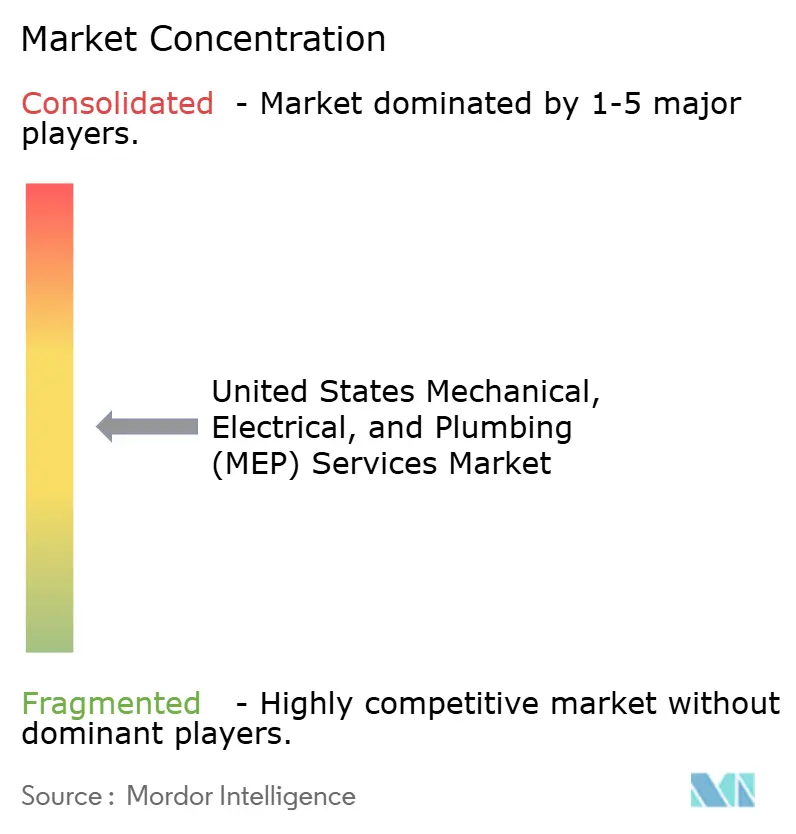
| Market Concentration | Medium |
Major Players *Disclaimer: Major Players sorted in no particular order Image © Mordor Intelligence. Reuse requires attribution under CC BY 4.0. | |
United States Mechanical, Electrical, and Plumbing (MEP) Services Market Analysis by Mordor Intelligence
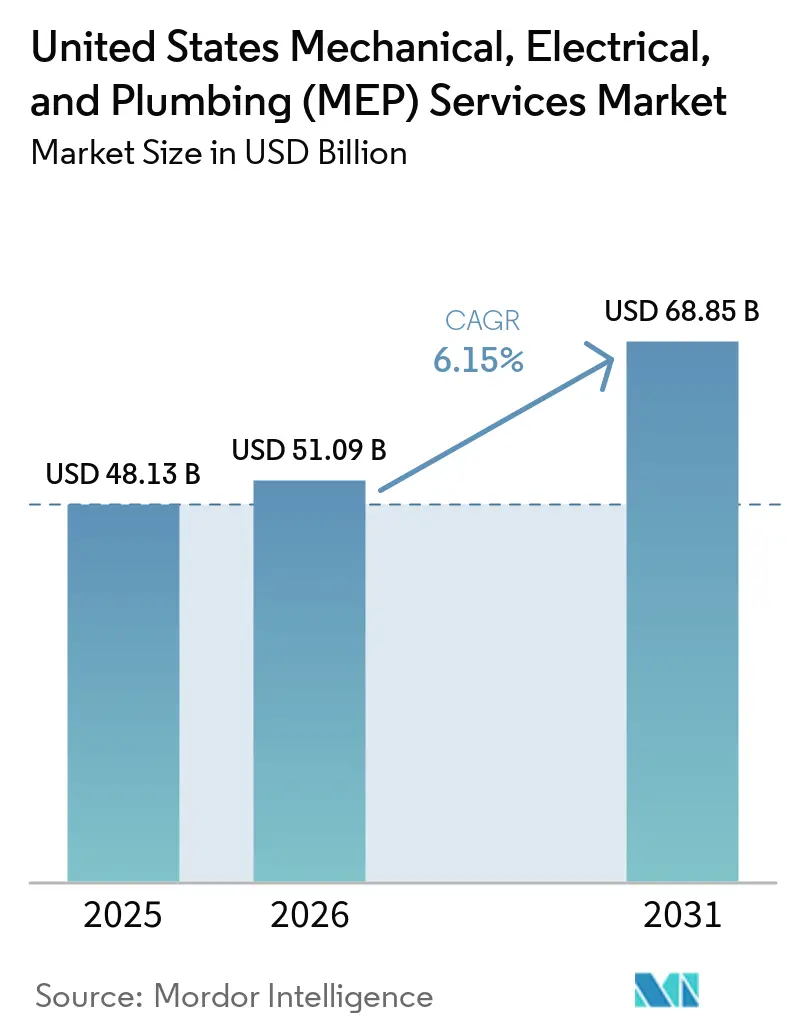
The United States Mechanical, Electrical, And Plumbing Services Market size is projected to be USD 48.13 billion in 2025, USD 51.09 billion in 2026, and reach USD 68.85 billion by 2031, growing at a CAGR of 6.15% from 2026 to 2031.
The United States MEP services market is being supported by larger and more complex requirements in data centers, healthcare facilities, and advanced manufacturing plants. These projects require more coordinated mechanical, electrical, and plumbing work than conventional offices and retail buildings. Contractors are responding through earlier equipment procurement, greater use of fabrication, and broader design-to-service offerings. National firms are concentrating on technical work where long backlogs and complex delivery requirements create a clearer advantage. Labor shortages, equipment costs, and fixed-price contract exposure continue to limit project capacity and margins.
Key Report Takeaways
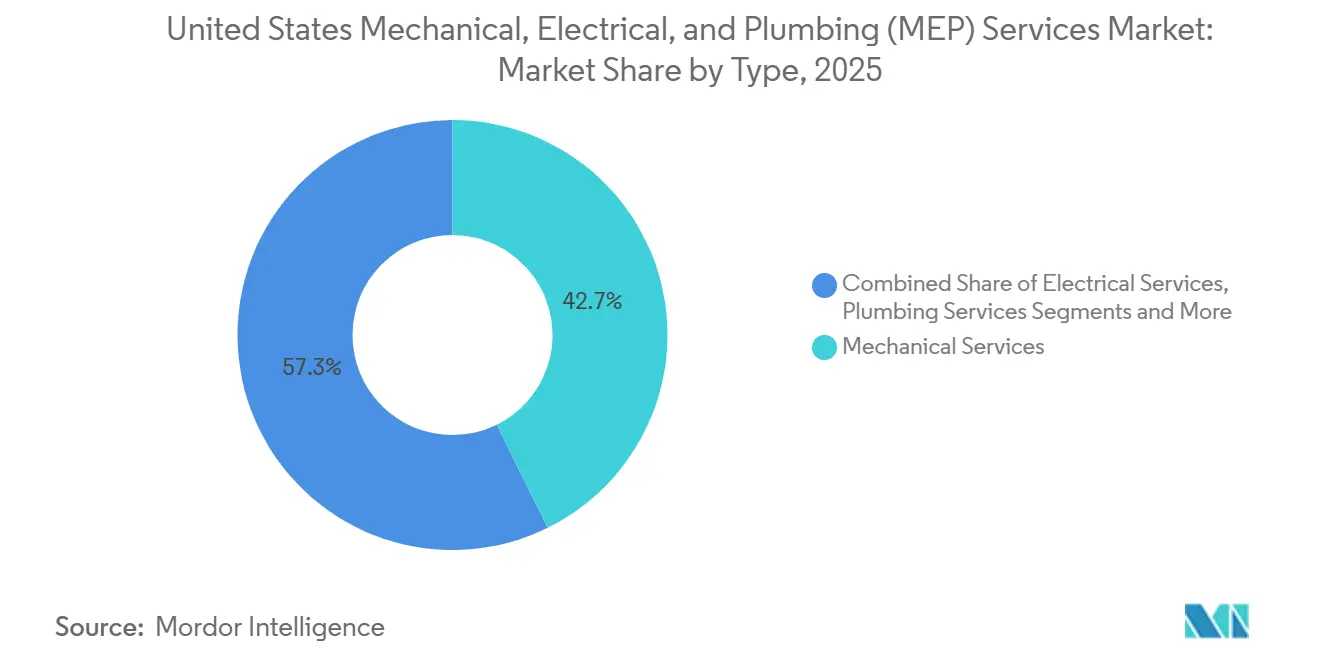
- By type, mechanical services held 42.7% of the United States MEP services market share in 2025, while electrical services are forecast to grow at a 7.05% CAGR through 2031.
- By service type, design and engineering held 33.2% of the United States MEP services market share in 2025, while managed and performance-based services are forecast to grow at a 6.93% CAGR through 2031.
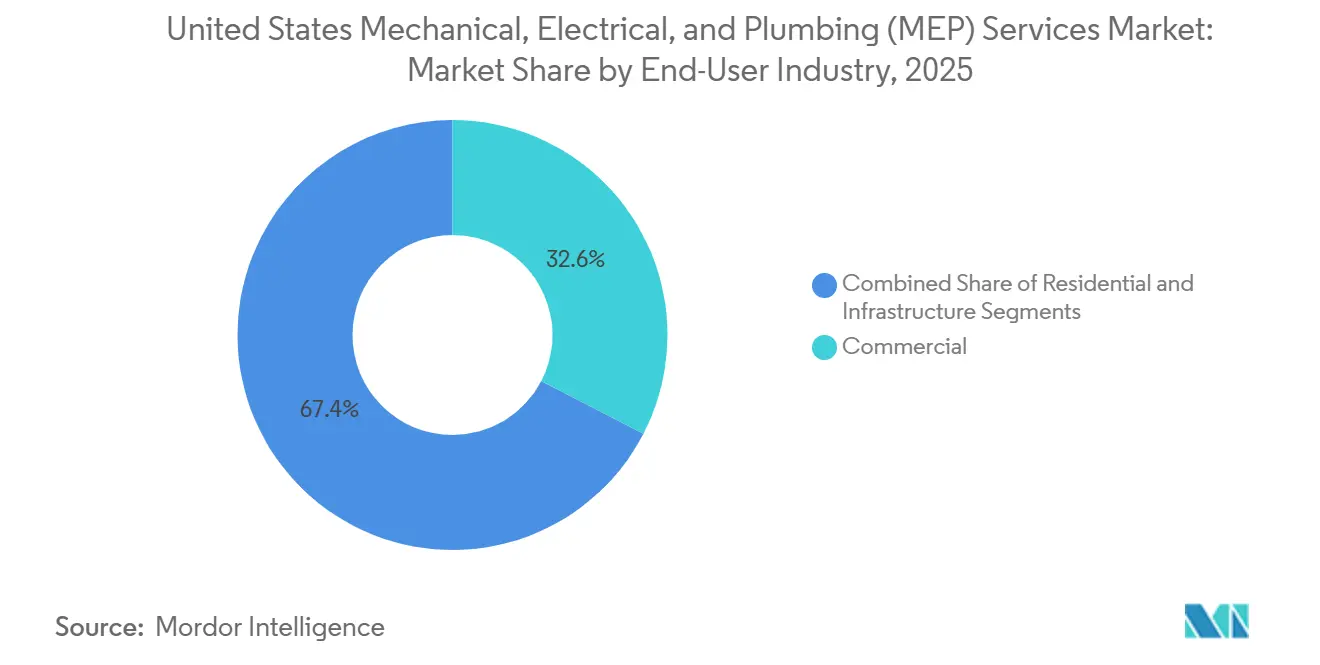
- By end-user industry, commercial accounted for 32.6% of the United States MEP services market size in 2025, while infrastructure is forecast to grow at a 6.85% CAGR through 2031.
- By state, Texas held 15.7% of the United States MEP services market share in 2025 and is forecast to grow at a 7.29% CAGR through 2031.
Note: Market size and forecast figures in this report are generated using Mordor Intelligence’s proprietary estimation framework, updated with the latest available data and insights as of January 2026.
United States Mechanical, Electrical, and Plumbing (MEP) Services Market Trends and Insights
Drivers Impact Analysis*
| Drivers | (~) % Impact on CAGR Forecast | Geographic Relevance | Impact Timeline |
|---|---|---|---|
| Hyperscale Data Centers and AI Compute Cooling | +1.4% | Texas, Virginia, Arizona, Ohio, with spillover to Illinois and Florida | Short term (≤ 2 years) |
| Healthcare Construction and Infection-Control Upgrades | +1.3% | National, with concentration in Texas, California, Florida, and New York | Medium term (2-4 years) |
| Electrification and HVAC-Efficiency Retrofits | +1.1% | California and the Northeast, with adoption in the Mid-Atlantic and Pacific Northwest | Medium term (2-4 years) |
| Reshoring and Advanced-Manufacturing Facility Buildout | +0.9% | Texas, Arizona, Ohio, Indiana, and the New York semiconductor corridor | Long term (≥ 4 years) |
| Grid-Interactive Buildings and Distributed Energy Integration | +0.6% | National, with early activity in California, Colorado, and New England | Long term (≥ 4 years) |
| Fabrication-First Delivery for Schedule-Critical Projects | +0.4% | National, especially data center and life sciences corridors | Short term (≤ 2 years) |
| Source: Mordor Intelligence | |||
Hyperscale Data Centers and AI Compute Cooling
Artificial intelligence workloads are making hyperscale data centers a major source of work for the United States MEP services market in 2026. Higher rack power density is increasing the need for liquid cooling, air-side economization, and hybrid cooling designs. Each option requires distinct equipment, controls, commissioning, and coordination between mechanical and electrical teams. Jacobs received the engineering, procurement, and construction management contract for Hut 8’s 1-gigawatt Beacon Point campus in Nueces County, Texas, in May 2026. The project uses a data center digital twin during commissioning and targets initial energization in 2027[1]. Texas had at least 596 operating and planned data center facilities in September 2026, concentrating technical MEP demand in one state[2].
Healthcare Construction and Infection-Control Upgrades
Healthcare systems are building new facilities, modernizing occupied hospitals, and extending outpatient networks. These programs raise the importance of ventilation, controls, plumbing, electrical systems, and careful work sequencing near patient areas. Infection control requirements make coordination and site procedures important parts of delivery. Federal support for drinking water projects provides a separate source of plumbing-intensive work across the country[3]. Prefabricated assemblies can reduce the amount of on-site labor required where work zones limit the number of trades that can operate at once. This gives capable contractors a way to manage labor constraints without changing hospital safety requirements.
Electrification and HVAC-Efficiency Retrofits
Electrification is increasing the scope of commercial building retrofit projects in the United States MEP services market. Heat pump replacements can require electrical redesign, controls programming, and commissioning instead of a simple equipment replacement. California’s 2025 Building Energy Efficiency Standards took effect on January 1, 2026, and set requirements that increase the role of coordinated building systems work. Energy efficiency improvements in multifamily properties also create repeatable work across larger building portfolios. The U.S. Department of Energy supports whole-building retrofit approaches that combine building measures and standardized delivery methods. Contractors with monitoring and maintenance capabilities can retain a longer service relationship after the original installation is complete.
Reshoring and Advanced-Manufacturing Facility Buildout
Advanced manufacturing is adding complex MEP work across the United States MEP services market in 2026. Semiconductor, pharmaceutical, and materials plants need cleanroom environmental controls, ultra-pure water systems, process-gas distribution, and coordinated commissioning. Bristol Myers Squibb selected Houston, Texas, for a USD 2.3 billion biomanufacturing campus in 2026, creating specialized cleanroom and process-system requirements. MP Materials selected Northlake, Texas, for its USD 1.3 billion rare-earth magnet manufacturing campus, with commissioning targeted for 2028. Amazon also announced more than USD 100 million for an advanced manufacturing facility in Greenwood, Indiana, in September 2026. These facilities can create long-running service relationships after construction ends.
Restraints Impact Analysis*
| Restraints | (~) % Impact on CAGR Forecast | Geographic Relevance | Impact Timeline |
|---|---|---|---|
| Skilled-Labor Scarcity and Wage Escalation | -0.9% | National, with acute conditions in Texas, Arizona, Virginia, and semiconductor hubs | Short term (≤ 2 years) |
| HVAC, Copper, and Equipment Price Volatility | -0.7% | National, with high exposure to copper-intensive electrical work | Short term (≤ 2 years) |
| Fixed-Price Contract Exposure to Long-Lead Equipment | -0.5% | National, with exposure in data center and manufacturing work | Medium term (2-4 years) |
| Cybersecurity Liability in Connected Building Systems | -0.4% | National, with elevated risk in healthcare, data center, and federal facilities | Long term (≥ 4 years) |
| Source: Mordor Intelligence | |||
Skilled-Labor Scarcity and Wage Escalation
Workforce availability is limiting how quickly contractors can convert demand into revenue in the United States MEP services market. Associated Builders and Contractors estimated that construction must attract 349,000 net new workers in 2026 to meet demand. Electricians, heating, ventilation, and air conditioning technicians, and plumbers are particularly important for the projects now concentrated in data center and semiconductor corridors. The shortage raises wages and creates delivery risk for projects with immovable completion dates. Contractors are therefore using fabrication, training, and selective bidding to protect available field capacity. The constraint is likely to remain most visible where several large projects compete for the same specialized workforce.
HVAC, Copper, and Equipment Price Volatility
Material price changes continue to affect bids and margins across the United States MEP services market. The input draft identifies 50% tariffs on copper imports from July 2025 and 15% tariffs on imported heating, ventilation, and air conditioning equipment. These categories are central to many mechanical and electrical packages. The Associated General Contractors maintains current tariff resources for contractors managing these exposures. Contractors carrying fixed-price commitments face the greatest pressure when supplier price changes occur after a bid is submitted. More open cost structures and earlier procurement can reduce the risk, but they do not remove the underlying volatility.
*Our forecasts treat driver/restraint impacts as directional, not additive. The impact forecasts reflect baseline growth, mix effects, and variable interactions.
Segment Analysis
By Type: Electrical Scope Gains Ground on Mechanical Leadership
Mechanical services held 42.7% of the United States MEP services market share in 2025. The segment is supported by heating, ventilation, and air conditioning work in hospitals and hyperscale data centers. These facilities require substantial cooling, controls, and commissioning capacity. Electrical services are forecast to grow at a 7.05% CAGR from 2026 to 2031. Its growth is supported by medium-voltage distribution, battery energy storage integration, and commercial electrification retrofits. ANSI/CAN/UL 3001, published in April 2025, provides a safety framework for distributed energy generation equipment used in these applications.
Plumbing services retain demand from healthcare renovation, drinking-water projects, lead service line replacement, and process-piping work at advanced manufacturing facilities. The Environmental Protection Agency’s State Revolving Fund program supports drinking-water infrastructure projects that can create plumbing work for regional firms. Integrated MEP services are becoming more relevant where owners seek a single contractor for several building systems. That model can reduce handoffs during design, installation, and commissioning. Prefabricated assemblies also reduce the need for field labor on schedule-sensitive projects. Contractors that combine mechanical and electrical capabilities are better placed to manage the interface between cooling and power systems in liquid-cooled data centers.

By Service Type: Performance Contracts Redefine the Revenue Model
Design and engineering accounted for 33.2% of the United States MEP services market size in 2025. Owners often engage engineering teams early on complex programs, particularly data center campuses. This provides contractors with a role before the installation phase begins. Installation, testing, and commissioning remain a major service category because hospitals and other critical facilities require operating systems to be tested before use. Maintenance, repair, and retrofit activity is also supported by aging mechanical equipment and tighter energy requirements. These activities give contractors several ways to remain involved after a construction project ends.
Managed and performance-based services are forecast to expand at a 6.93% CAGR through 2031. These contracts shift responsibility for energy performance, uptime, or maintenance outcomes to the MEP provider. Jacobs’ use of a digital twin at Hut 8’s Beacon Point campus shows how commissioning technology can support this service approach. Remote monitoring and predictive maintenance are becoming more important for institutional clients with several facilities. The approach can produce recurring revenue that is less dependent on new installation starts. It also favors contractors that can combine technical service personnel with project-delivery capabilities.
By End-User Industry: Infrastructure Emerges as a Long-Cycle Growth Pillar
Commercial users held 32.6% of the United States MEP services market share in 2025. Data center campuses, healthcare renovation, and office retrofits are key sources of mechanical and electrical work within this group. These facilities often require several building systems to be redesigned together. Infrastructure is forecast to expand at a 6.85% CAGR from 2026 to 2031. The U.S. Department of Transportation reported USD 490.2 billion in Infrastructure Investment and Jobs Act obligations by April 2026, supporting a long project pipeline. Water, transit, and public-facility programs provide visibility that is less dependent on private construction cycles.
The Environmental Protection Agency allocated more than USD 15 billion for lead service line replacement and supported more than 1,200 drinking-water State Revolving Fund projects, according to the input draft. Residential work is smaller but benefits from whole-building retrofit solutions for multifamily properties. Data center, power, and advanced manufacturing projects face different labor and procurement conditions than traditional office projects. Comfort Systems USA reported that technology customers accounted for 58.7% of its second-quarter 2026 revenue. The United States MEP services industry is therefore separating between specialized contractors and general commercial providers. Infrastructure work offers a portfolio balance for contractors that want to reduce their exposure to private capital cycles.
Geography Analysis
Texas held 15.7% of the United States MEP services market size in 2025 and is forecast to expand at a 7.29% CAGR through 2031. The state combines data center construction, manufacturing investment, healthcare expansion, and infrastructure work. Texas had at least 596 operating and planned data center facilities in September 2026. Bristol Myers Squibb’s Houston campus and MP Materials’ Northlake facility add cleanroom and process-system demand to the state’s project pipeline. Contractors must manage licensing requirements and a growing need for electrical designs that address large-load requirements.
California and the Northeastern states form another major revenue concentration for the United States MEP services market. California’s 2025 Building Energy Efficiency Standards took effect in 2026 and increased controls and commissioning work on heating, ventilation, and air conditioning projects. Dense urban building stocks create continuing retrofit work even when new construction activity changes. New York’s Local Law 97 supports studies and retrofits that reduce building emissions. These areas also face higher costs and labor pressure on renovation work. Contractors with retrofit engineering and project-management experience have a stronger fit with the region’s demand profile.
Florida, Illinois, and the Rest of the US category present different sources of MEP demand. Florida’s coastal construction requires resilient mechanical and electrical systems, while healthcare development adds to project complexity. Illinois benefits from data center growth near Chicago, logistics facilities, food processing, universities, and hospitals. The Rest of US category is broadening as infrastructure, semiconductor, defense, water, and transit programs reach locations outside the largest coastal and Sun Belt markets. Regional contractors with specialized technical skills can compete for these projects without a national platform. The geographic spread also gives local firms an opportunity to build relationships around public and industrial programs.
Competitive Landscape
The United States MEP services market is moderately concentrated among national contractors and remains fragmented among regional firms. National leaders hold the deepest backlogs in data centers, manufacturing, healthcare, and other complex projects. EMCOR Group reported USD 17.1 billion in remaining performance obligations in the second quarter of 2026, while Comfort Systems USA reported a USD 14.1 billion backlog. This gap gives larger contractors greater capacity to manage large programs and procure equipment earlier. Smaller firms continue to compete through local relationships, skilled field teams, and specialization.
Acquisitions are a central competitive strategy in the United States MEP services market. EMCOR completed its USD 865 million acquisition of Miller Electric Company in February 2025, expanding electrical construction coverage in Florida and the Southeast. Limbach acquired 1901 Inc. in September 2026 for USD 63 million, creating its largest electrical operation in Wisconsin and the Midwest. Limbach also completed its acquisition of Pioneer Power in 2025. These moves add geography, licensed labor, and specialized capability rather than merely adding revenue.
Fabrication and digital commissioning are also shaping competition in the United States MEP services market. Comfort Systems USA is targeting 4 million square feet of modular fabrication capacity by the end of 2026. Jacobs is using a digital twin during commissioning at Hut 8’s Beacon Point campus. Connected building automation systems also create a need for better cybersecurity practices during commissioning and service. The Cybersecurity and Infrastructure Security Agency issued an advisory on vulnerabilities affecting Johnson Controls Metasys building automation systems in August 2026. A market concentration score of 5 reflects substantial national-scale backlog among leading contractors, but the absence of evidence that the top 5 firms collectively hold at least 60% of revenue.
United States Mechanical, Electrical, and Plumbing (MEP) Services Industry Leaders
-
EMCOR Group, Inc.
-
Comfort Systems USA, Inc.
-
Southland Industries
-
ACCO Engineered Systems
-
Harris
- *Disclaimer: Major Players sorted in no particular order
Recent Industry Developments
- September 2026: Limbach Holdings acquired 1901 Inc., a Madison, Wisconsin-based union MEP contractor with approximately 450 employees, for USD 63 million, creating Limbach's largest electrical operation to date across Wisconsin and the Midwest, with 1901 projected to contribute approximately USD 140 million in 2027 revenue.
- September 2026: Amazon announced more than USD 100 million for a 585,000-square-foot advanced manufacturing facility in Greenwood, Indiana. The facility is expected to launch by 2028.
- May 2026: Jacobs Solutions received a sole-source engineering, procurement, and construction management contract from Hut 8 to deliver Beacon Point, a 1-gigawatt artificial intelligence data center campus in Nueces County, Texas, using a data center digital twin for commissioning de-risking. Initial energization is targeted for 2027.
United States Mechanical, Electrical, and Plumbing (MEP) Services Market Report Scope
| Mechanical Services |
| Electrical Services |
| Plumbing Services |
| Integrated MEP Services |
| Design and Engineering |
| Installation, Testing, and Commissioning |
| Maintenance, Repair, and Retrofit |
| Managed / Performance-based Services |
| Residential |
| Commercial |
| Infrastructure |
| Texas |
| California |
| Florida |
| New York |
| Illinois |
| Rest of US |
| By Type | Mechanical Services |
| Electrical Services | |
| Plumbing Services | |
| Integrated MEP Services | |
| By Service Type | Design and Engineering |
| Installation, Testing, and Commissioning | |
| Maintenance, Repair, and Retrofit | |
| Managed / Performance-based Services | |
| By End-User Industry | Residential |
| Commercial | |
| Infrastructure | |
| By State | Texas |
| California | |
| Florida | |
| New York | |
| Illinois | |
| Rest of US |
Key Questions Answered in the Report
What is the forecast for the United States MEP services market?
The United States MEP services market is forecast to rise from USD 51.09 billion in 2026 to USD 68.85 billion by 2031, at a 6.15% CAGR.
Which MEP service type is growing the fastest in the United States?
Electrical services are the fastest-growing type, with a forecast CAGR of 7.05% through 2031.
What is driving demand for MEP contractors in the United States?
Data center cooling and power systems, healthcare modernization, electrification retrofits, and advanced manufacturing construction are the main demand sources.
Which end-user segment has the highest growth outlook?
Infrastructure is projected to grow at a 6.85% CAGR through 2031, supported by water, transit, and public-facility programs.
Why is Texas important for MEP service providers?
Texas held 15.7% of revenue in 2025 and is forecast to grow at 7.29% CAGR through 2031, supported by data centers, manufacturing, healthcare, and infrastructure.
What are the main risks facing MEP contractors?
Skilled-labor shortages, wage escalation, equipment price volatility, long-lead procurement, and connected-building cybersecurity exposure remain key risks.