
United States Institutional Marketing Market Size and Share
Market Overview
| Study Period | 2021 - 2031 |
|---|---|
| Forecast Data Period | 2026 - 2031 |
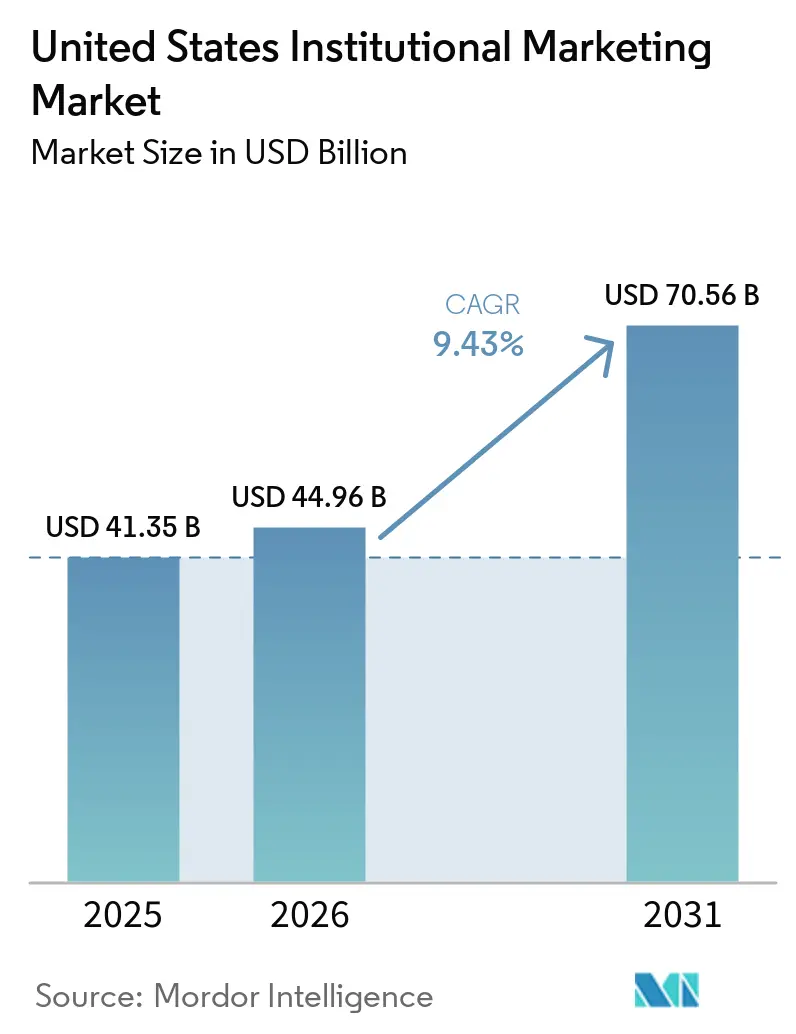
| Base Year Market Size (2025) | USD 41.35 Billion |
| Market Size (2026) | USD 44.96 Billion |
| Market Size (2031) | USD 70.56 Billion |
| Growth Rate (2026 - 2031) | 9.43 % |
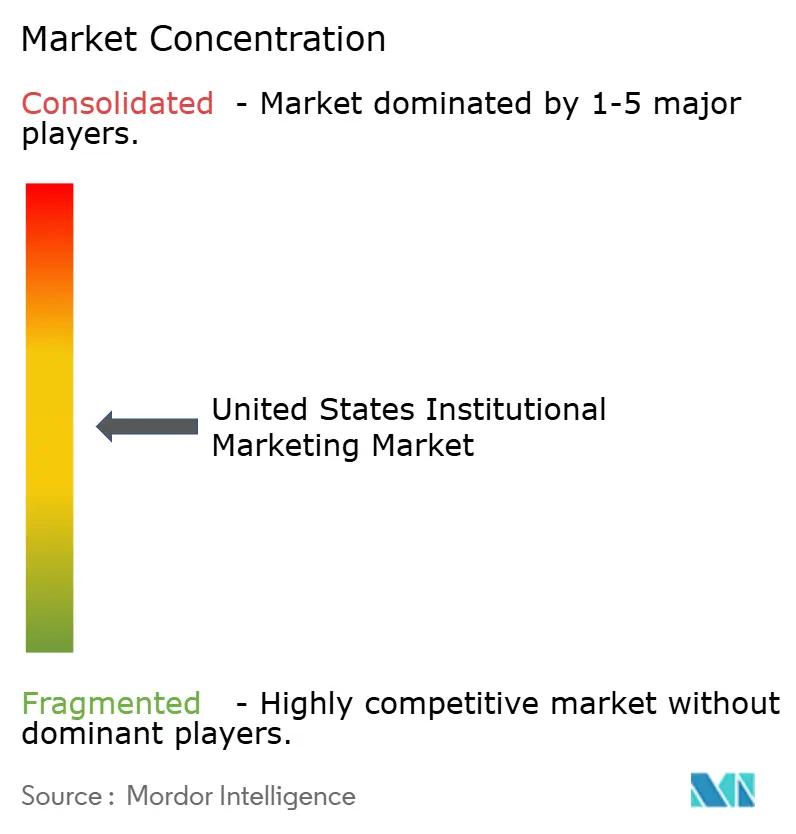
| Market Concentration | Medium |
Major Players *Disclaimer: Major Players sorted in no particular order Image © Mordor Intelligence. Reuse requires attribution under CC BY 4.0. | |
United States Institutional Marketing Market Analysis by Mordor Intelligence
The United States institutional marketing market was valued at USD 41.35 billion in 2025 and estimated to grow from USD 44.96 billion in 2026 to reach USD 70.56 billion by 2031, at a CAGR of 9.43% during the forecast period (2026-2031). This growth surpasses the 1.7% increase in overall United States marketing spending reported in early 2026, highlighting increased specialized spending despite broader budget constraints[1]. The market is shaped by long buying cycles, complex approval processes, stricter compliance requirements, and a demand for measurable outcomes that traditional advertising models fail to address. AI-driven account targeting, first-party data systems, and sector-specific content strategies are influencing spending patterns, pushing buyers toward partners skilled in execution, data control, and predictive modeling to optimize live ad placements automatically. Large networks are restructuring, while specialist firms are growing by offering faster, data-focused delivery in healthcare, higher education, and enterprise branding. Despite institutions enhancing in-house capabilities, market expansion continues, driven by rapid AI adoption. Marketers expect AI to account for over 50% of marketing activities within three years.
Key Report Takeaways
- By service type, Digital Marketing Services led with 38.3% share in the United States Institutional Marketing market in 2025, while Marketing Analytics & Automation Services is projected to grow at 16.40% CAGR through 2031.
- By client type, Corporate Institutions held 42.0% of market value in the United States Institutional Marketing market in 2025, while Healthcare Institutions recorded the highest projected CAGR at 11.72% through 2031.
- By engagement model, Retainer-Based models accounted for 32.0% share in the United States Institutional Marketing market in 2025, while Subscription-Based models are forecast to expand at 17.20% CAGR through 2031.
- By marketing channel, Digital Channels captured 58.5% share in the United States Institutional Marketing market in 2025, while Webinar & Virtual Engagement Channels are projected to grow at 13.85% CAGR through 2031.
- By geography, the South held a 34.9% share of the United States Institutional Marketing market in 2025 and posted the highest forecast CAGR of 11.70% through 2031.
Note: Market size and forecast figures in this report are generated using Mordor Intelligence’s proprietary estimation framework, updated with the latest available data and insights as of January 2026.
United States Institutional Marketing Market Trends and Insights
Drivers Impact Analysis*
| Driver | (~) % Impact on CAGR Forecast | Geographic Relevance | Impact Timeline |
|---|---|---|---|
| AI-Led Account Prioritization And Pipeline Scoring | +2.0% | National, early gains in New York, Boston, San Francisco, and Dallas | Short term (≤ 2 years) |
| Growth of Compliance-Ready Thought Leadership Across Regulated Institutions | +1.3% | National, with concentrated impact across healthcare hubs in the South and Northeast | Medium term (2-4 years) |
| Shift Toward First-Party Data Activated Demand Generation | +1.8% | National, strongest in states with advanced privacy frameworks, including California, Virginia, and Colorado | Short term (≤ 2 years) |
| Procurement-Led Preference For Measurable, Outcome-Based Campaigns | +1.5% | National, with accelerated adoption in Midwest corporate and government buyers | Medium term (2-4 years) |
| Expansion Of Verticalized Messaging For Complex Institutional Buying Committees | +1.2% | National, with early gains in healthcare, financial services, and higher education clusters | Medium term (2-4 years) |
| Rising Need For Hybrid Digital And Field Marketing Orchestration | +1.0% | National, particularly active in the South and Northeast, where field event spending is concentrated | Short term (≤ 2 years) |
| Source: Mordor Intelligence | |||
AI-Led Account Prioritization And Pipeline Scoring
AI-driven account scoring is transforming the United States institutional marketing market by enabling vendors to identify high-potential accounts before initiating outreach. This capability is particularly significant in institutional selling, where approval processes are formal and involve large buying groups. An official survey highlighted a significant increase in AI adoption for marketing since 2022, with expectations that AI will manage over half of marketing activities within a few years. This shift is directing resources toward fewer, high-value accounts, reducing opportunities for basic execution vendors while enhancing the importance of firms with expertise in scoring logic, intent signals, and integrated delivery tools. Salesforce’s planned 2025 launch of Marketing Cloud Next reflects the industry's move toward continuous decision-making in campaigns, replacing traditional one-time execution models[2].
Growth of Compliance-Ready Thought Leadership Across Regulated Institutions
Compliance-ready thought leadership is becoming increasingly important in the United States Institutional Marketing Market. This approach simplifies procurement and legal reviews compared to strategies relying on sensitive data or aggressive retargeting. In healthcare, the HHS Office for Civil Rights has placed online tracking on patient-facing platforms under HIPAA regulations, restricting the use of third-party tools without proper controls. As a result, regulated buyers are favoring content programs that educate, build trust, and drive demand generation while minimizing compliance risks. Firms with trained review teams, documented workflows, and compliant technology stacks are well-positioned to meet these needs. Additionally, the IAB’s multi-state privacy agreement, effective in 2026, will establish a broader compliance framework for digital advertising, reinforcing this trend[3].
Shift Toward First-Party Data Activated Demand Generation
The shift toward first-party data is transforming the United States Institutional Marketing Market as stricter privacy regulations reduce the reliance on external audience signals. California's updated CCPA framework, which takes effect in January 2026, introduces requirements for risk assessments, disclosures for automated decision-making, and opt-out confirmation rules for digital platforms. Additional state privacy laws are also set to expand the regulatory landscape, further complicating how institutional buyer data is collected and utilized. The acquisition of LiveRamp by Publicis Groupe for USD 2.2 billion highlights the growing importance of data collaboration and identity resolution as essential assets in this market. Organizations with control over consent, clean-room access, and first-party data infrastructure are better positioned compared to those relying on third-party targeting methods.
Procurement-Led Preference For Measurable, Outcome-Based Campaigns
Institutional buyers are increasingly evaluating external marketing partners using the same criteria as software or operational vendors, emphasizing measurable outcomes over creative claims. Growing budget scrutiny in United States marketing organizations has intensified this focus, as expenditures are justified line by line, and contracts must clearly demonstrate business value. This shift is driving the United States Institutional Marketing Market toward integrated models that combine attribution, reporting, and delivery within a unified structure. HubSpot’s transition to outcome-based pricing for Breeze AI agents reflects this trend, aligning recurring commercial models with measurable performance. Similarly, Adobe CX Enterprise and Salesforce Marketing Cloud Next are adapting their campaign systems to prioritize continuous engagement, orchestration, and feedback loops, moving beyond isolated campaign tasks.
Restraints Impact Analysis*
| Restraint | (~) % Impact on CAGR Forecast | Geographic Relevance | Impact Timeline |
|---|---|---|---|
| Lengthening Sales Cycles In Multi-Stakeholder Institutional Buying | -1.2% | National, particularly acute in Midwest government and Northeast healthcare procurement | Medium term (2-4 years) |
| Data Privacy Constraints On Audience Segmentation And Retargeting | -0.9% | National, highest friction in California, Virginia, Colorado, and states with comprehensive privacy laws | Short term (≤ 2 years) |
| Internal Marketing Team Expansion At Large Institutions | -0.8% | National, concentrated at large universities, healthcare networks, and Fortune 500 firms | Long term (≥ 4 years) |
| Fragmented Attribution Across Offline, Events, And Digital Touchpoints | -0.7% | National, most impactful in integrated hybrid-channel campaigns | Medium term (2-4 years) |
| Source: Mordor Intelligence | |||
Lengthening Sales Cycles In Multi-Stakeholder Institutional Buying
Institutional campaigns often require approval from multiple teams, including marketing, legal, procurement, finance, and operations, which extends the approval process. This delays revenue generation for service providers and makes short-term projects less viable. Budget constraints further contribute to this delay, as buyers spend more time evaluating and documenting expected value before committing funds. However, this process also strengthens long-term relationships once a vendor is selected, explaining the dominance of retainer-based models in recent years. In the United States Institutional Marketing Market, this creates a challenge in which acquiring new business takes longer, while the stability and value of existing client relationships have increased significantly.
Data Privacy Constraints On Audience Segmentation And Retargeting
Data privacy regulations are reducing the accuracy of digital programs, affecting audience segmentation and retargeting in the United States institutional marketing sector. Stricter disclosure and procedural requirements have been introduced, while additional state laws have expanded the jurisdictions marketers must consider when designing campaigns[4]. In healthcare, guidance from HHS has made standard analytics setups on patient-facing platforms more challenging, requiring proper agreements and controls. These changes increase compliance costs, particularly for mid-sized agencies with limited legal, data, and security resources. Larger firms benefit from their ability to distribute these costs across broader client portfolios and advanced technology solutions.
*Our forecasts treat driver/restraint impacts as directional, not additive. The impact forecasts reflect baseline growth, mix effects, and variable interactions.
Segment Analysis
By Service Type: Analytics Platforms Displace Creative-Led Service Models
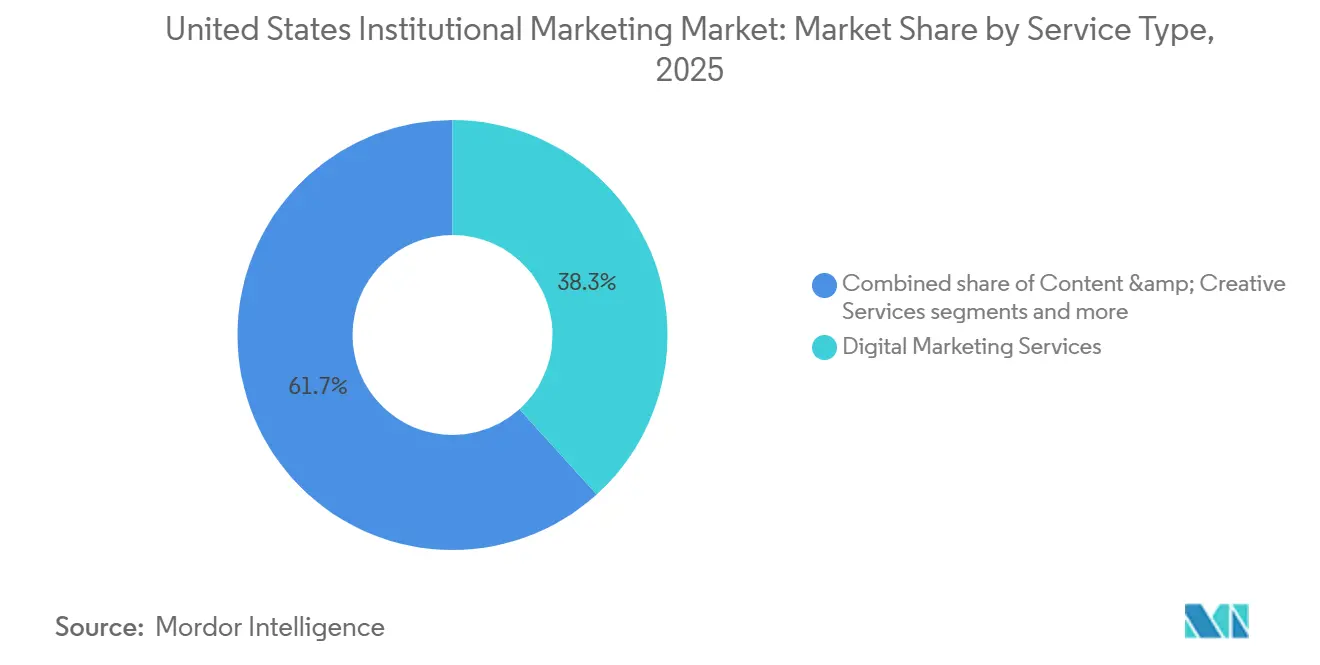
Digital Marketing Services accounted for 38.3% of the United States Institutional Marketing Market share in 2025. Marketing Analytics & Automation Services are projected to grow at 16.40% CAGR through 2031. This reflects a shift in enterprise branding and demand programs toward measurable digital execution over long buying cycles. Digital formats better align with procurement needs, as they enable easier documentation of reporting, targeting, and optimization compared to offline methods. The market is moving from broad channel execution to data-driven delivery. Salesforce’s July 2025 launch of Marketing Cloud Next supports this shift by emphasizing AI-assisted orchestration and continuous engagement over one-time campaign setups.
Traditional and Offline Marketing Services, along with Print & Direct Marketing, remain relevant in government and educational procurement, where physical materials and formal outreach are integral. However, their combined influence is declining as buyers demand stronger attribution and more adaptable campaigns. Content & Creative Services are divided into two tiers: routine production is becoming automated, while compliance-focused tasks retain higher importance. HHS guidance on online tracking has heightened the need for sector-specific content operations in healthcare, where workflows differ from those of standard digital campaigns. ABM and analytics-linked services are gaining traction, aligning more closely with the United States Institutional Marketing Market than creative-only models.

By Client Type: Healthcare Buyers Redefine Institutional Marketing Standards
Corporate Institutions held 42.0% of the United States Institutional Marketing Market in 2025. Healthcare Institutions are projected to grow at an 11.72% CAGR through 2031. Large corporations dominate spending due to structured agency review cycles, formal budgets, and extensive external support for brand, demand, and enterprise communication. Stricter procurement standards are reducing the advantage of firms unable to link messaging with measurement and operational control. Healthcare growth is driven by provider networks, insurers, and related organizations addressing patient engagement and compliance challenges. HHS guidance on online tracking emphasizes data handling and technology setup as core service requirements.
Educational Institutions, including universities, colleges, and professional learning providers, require specialized enrollment, reputation, and outreach programs. Increasing pressure on student recruitment demands precise targeting, improved digital experiences, and accountable agency relationships. Non-Profit Organizations focus on brand support and donor communication, but enforce tighter spending discipline and measurable service expectations. Government and Public Sector Institutions prefer established vendors due to longer procurement windows and formal compliance steps. SAP’s 2026 integration of Emarsys into SAP SE highlights the growing concentration of enterprise marketing technology and its closer alignment with customer management systems.
By Engagement Model: Subscription Models Signal a Structural Shift in Value Delivery
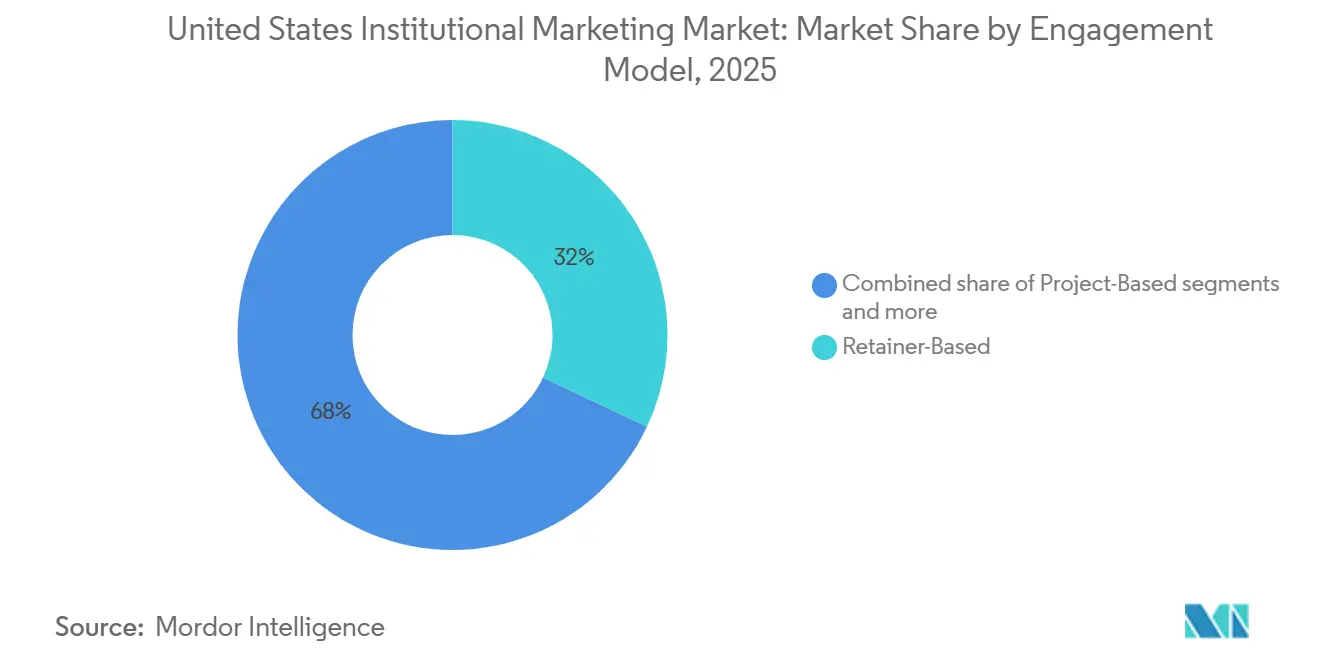
Retainer-Based models held a 32.0% share of the United States Institutional Marketing Market in 2025. Subscription-Based models are projected to grow at a 17.20% CAGR through 2031. Retainers dominate as institutional buyers value continuity, account knowledge, and stable strategic support. This is critical in healthcare and financial services, where compliance and complexity make frequent vendor onboarding inefficient. Despite evolving pricing structures, the market remains anchored by long-term service relationships. Subscription models are growing due to increasing demand for recurring access to platforms, automation, and consistent delivery over one-off campaigns.
HubSpot’s 2026 shift to per-result pricing for Breeze AI agents highlights the trend toward outcome-based valuations in marketing services. Consulting-Based and Performance-Based models are also gaining relevance as clients seek strategy, system integration, and measurable accountability before scaling operations. Project-Based models remain relevant for smaller institutions and limited campaigns but face risks from approval delays and budget reviews. As Adobe and Salesforce expand connected engagement systems, the distinction between service delivery and software-driven solutions is narrowing. This shift is driving the market toward models emphasizing data control, platform access, and measurable value.
By Marketing Channel: Virtual Engagement Bridges the Events Gap in Institutional Outreach
Digital channels accounted for 58.5% of the United States institutional marketing market in 2025. Webinar and virtual engagement channels are projected to grow at 13.85% CAGR through 2031. Digital channels dominate because paid search, programming, and account-based advertising are compatible with enterprise procurement needs for measurable, scalable solutions. Webinars and virtual formats are expanding rapidly, enabling participation from multiple stakeholders without the cost and time constraints of in-person events. This supports the thought-leadership approach to demand generation, which institutional buyers often prefer over direct performance advertising. The increasing number of channels used by United States marketing organizations highlights that digital growth is occurring alongside other outreach methods.
Events and field marketing remain essential in government, education, and healthcare sectors, where relationship-building is critical. These channels help establish trust before formal RFP processes or final committee reviews. Print and direct marketing continue to play a stable role in scenarios requiring physical documentation, direct mail, or mandated disclosures. The United States institutional marketing market is shifting toward a blended approach that integrates digital systems, webinars, field activities, and direct outreach. This shift emphasizes the importance of orchestration capabilities alongside channel specialization in the evolving marketing landscape.
Geography Analysis
The South held 34.9% of the United States Institutional Marketing Market share in 2025 and is projected to grow at an 11.70% CAGR through 2031, making it the largest and fastest-growing region. Growth is driven by expanding health system networks in Texas, Florida, and Georgia, corporate headquarters moving to Dallas, Atlanta, and Charlotte, and growing educational clusters in the Sun Belt. These sectors demand specialized marketing programs with strong data control and sector awareness. The South also adopts subscription-led and AI-driven delivery models more readily than slower-growth regions. HIPAA-related marketing requirements remain critical as healthcare expansion drives regional spending.
The Northeast has the highest spend intensity in institutional marketing, despite the South leading in total share and growth. Financial services, universities, pharmaceutical companies, and federal contractors in the New York, Boston, and Washington corridors sustain demand. The region focuses on enterprise branding, account-based marketing (ABM), and compliance-heavy communications, where large buying committees manage reputational risks. Specialist firms excel in regulated messaging and measurable account-level programs. The Northeast continues to generate high-value work without matching the South’s growth rate.
The Midwest and West exhibit distinct demand patterns. The Midwest relies on legacy corporate buyers, state-linked entities, and procurement-led campaigns, emphasizing retainer structures and defined deliverables. The West, particularly California, Washington, and Colorado, favors AI-driven tools, first-party data systems, and software-enabled engagement models. California’s 2026 privacy rules require stricter data use controls, automated decision-making, and digital disclosures, increasing demand for specialist partners. Universities and healthcare accounts in the West face complex compliance requirements, further driving the need for expertise.
Competitive Landscape
The United States Institutional Marketing Market is moderately concentrated, with the top firms holding a significant share, while the rest is distributed among consulting-led providers, mid-sized agencies, and specialist boutiques. Omnicom’s acquisition of Interpublic in late 2025 reshaped the competitive landscape among large network groups. Publicis Groupe has focused on strengthening its data capabilities, including acquiring LiveRamp in 2026 to enhance privacy-safe identity and collaboration tools. WPP has responded to challenges with restructuring efforts, such as its Elevate28 plan and a new operating model aimed at improving integration and cost efficiency. Dentsu has also adjusted its structure under a global management framework introduced in 2026, reflecting the ongoing shift toward data, AI, and efficiency-driven competition.
Opportunities remain for firms prioritizing compliance and technology integration over media scale. Consulting-led players like Accenture Song, Deloitte Digital, and IBM iX are well-positioned to handle projects that require CRM, cloud, and data systems integration alongside campaign execution. This trend puts pressure on pure-play creative models, especially in healthcare, financial services, and government-linked sectors, where integration is critical. Mid-sized agencies differentiate themselves by offering focused expertise and flexibility without the overhead of global networks. Specialist firms, such as Ruder Finn, continue to expand through targeted acquisitions in communications and B2B services.
In-housing is growing among large institutions, supported by AI adoption, which enables smaller internal teams to manage routine tasks. While this reduces demand for tactical project work, external partners remain essential for platform integration, regulated workflows, and strategic guidance. The market is shifting away from agencies offering only execution without systemic depth. Competitive advantage increasingly depends on data control, compliance readiness, orchestration capabilities, and the delivery of measurable value to institutional buyers.
United States Institutional Marketing Industry Leaders
-
WPP plc
-
Omnicom Group Inc.
-
Publicis Groupe SA
-
Stagwell Inc.
-
Dentsu Group Inc.
- *Disclaimer: Major Players sorted in no particular order
Recent Industry Developments
- May 2026: Publicis Groupe has announced its acquisition of LiveRamp for USD 2.2 billion, with the deal revealed in May 2026. The merger aims to enhance data co-creation for AI-driven marketing while prioritizing user privacy across client networks. Finalizing the transaction depends on obtaining regulatory and shareholder approvals.
- April 2026: Adobe introduced Adobe CX Enterprise at the Adobe Summit, an AI-driven system designed to manage the entire customer lifecycle, including acquisition, engagement, conversion, and loyalty. The solution integrates AI agents directly into the customer engagement process. It is available on Microsoft 365 Copilot and offers beta access on platforms such as Claude Enterprise, ChatGPT Enterprise, Gemini Enterprise, and IBM watsonx Orchestrate, expanding its reach in institutional marketing.
- March 2026: Publicis Groupe has acquired AdgeAI, an Israel-based predictive creative analytics platform, for approximately USD 100 million. This acquisition is part of its USD 970 million deal budget allocated for 2026. By integrating AdgeAI into its CoreAI stack, Publicis enables institutional marketing clients to scale creative messaging based on predicted outcomes, reducing reliance on retrospective reporting.
- February 2026: WPP announced its Elevate28 strategic transformation plan, targeting GBP 500 million (USD 674.56 million) in annual gross cost savings by 2028. The restructuring organizes WPP into four operating units: WPP Media, WPP Creative, WPP Production, and WPP Enterprise Solutions. The newly established WPP Enterprise Solutions focuses on competing for institutional AI transformation projects. In 2025, WPP reported revenue of GBP 13.55 billion (USD 18.28 billion), reflecting a 5.4% decline on a like-for-like basis.
United States Institutional Marketing Market Report Scope
| Digital Marketing Services |
| Traditional and Offline Marketing Services |
| Account-Based Marketing (ABM) Services |
| Content & Creative Services |
| Marketing Analytics & Automation Services |
| Corporate Institutions |
| Non-Profit Organizations |
| Educational Institutions |
| Healthcare Institutions |
| Government and Public Sector Institutions |
| Project-Based |
| Retainer-Based |
| Consulting-Based |
| Performance-Based |
| Subscription-Based |
| Digital Channels |
| Events & Field Marketing |
| Print & Direct Marketing |
| Webinar & Virtual Engagement Channels |
| Northeast |
| Midwest |
| South |
| West |
| By Service Type | Digital Marketing Services |
| Traditional and Offline Marketing Services | |
| Account-Based Marketing (ABM) Services | |
| Content & Creative Services | |
| Marketing Analytics & Automation Services | |
| By Client Type | Corporate Institutions |
| Non-Profit Organizations | |
| Educational Institutions | |
| Healthcare Institutions | |
| Government and Public Sector Institutions | |
| By Engagement Model | Project-Based |
| Retainer-Based | |
| Consulting-Based | |
| Performance-Based | |
| Subscription-Based | |
| By Marketing Channel | Digital Channels |
| Events & Field Marketing | |
| Print & Direct Marketing | |
| Webinar & Virtual Engagement Channels | |
| By Region | Northeast |
| Midwest | |
| South | |
| West |
Key Questions Answered in the Report
What is the size of the United States Institutional Marketing Market in 2026?
The United States Institutional Marketing Market is estimated at USD 44.96 billion in 2026 and is forecast to reach USD 70.56 billion by 2031 at a 9.43% CAGR.
Which service category leads revenue generation?
Digital Marketing Services led with a 38.3% share in 2025, as buyers continue to favor measurable, scalable digital execution.
Which client group is expanding the fastest?
Healthcare Institutions are projected to grow at 11.72% CAGR through 2031, supported by stricter compliance needs and rising digital patient engagement.
Why is the South the most important region?
The South held 34.9% share in 2025 and is forecast to grow at 11.70% CAGR, supported by large health systems, corporate relocations, and expanding education clusters.
What is changing in commercial models used by agencies and service providers?
Retainer-Based models led with 32.0% share in 2025, but Subscription-Based models are growing faster at 17.20% CAGR as buyers move toward recurring, measurable delivery.
How concentrated is competition among leading firms?
The top 5 companies controlled approximately 55% of the market in 2025, which points to moderate concentration rather than dominance by a small number of firms.