
United States General Liability Insurance Market Size and Share
Market Overview
| Study Period | 2020 - 2031 |
|---|---|
| Forecast Data Period | 2026 - 2031 |
| Base Year Market Size (2025) | USD 104.30 Billion |
| Market Size (2026) | USD 109.52 Billion |
| Market Size (2031) | USD 136.48 Billion |
| Growth Rate (2026 - 2031) | 4.50 % |
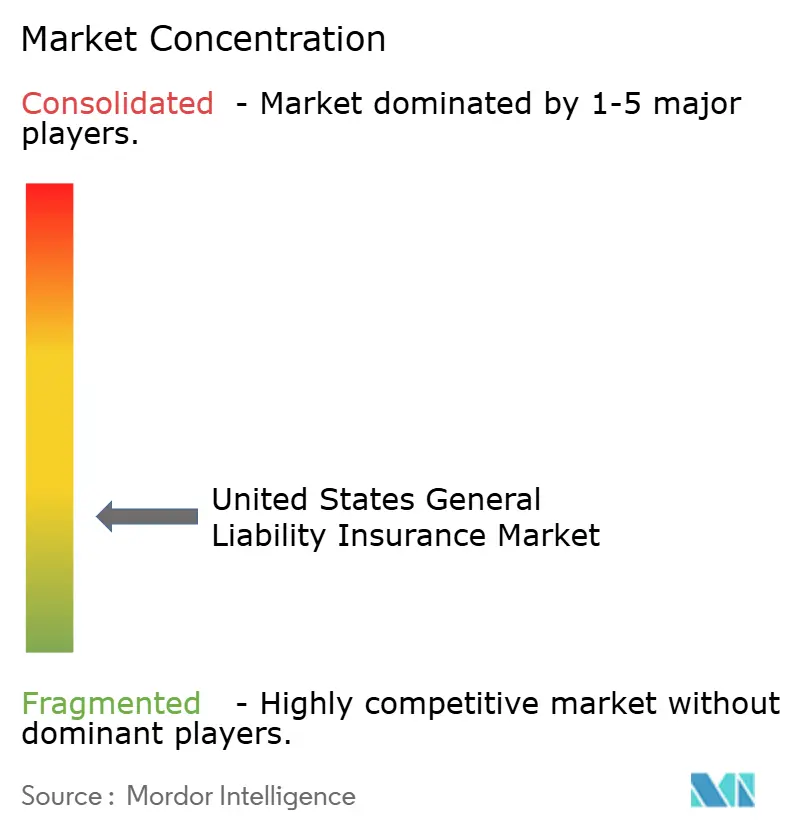
| Market Concentration | Low |
Major Players *Disclaimer: Major Players sorted in no particular order Image © Mordor Intelligence. Reuse requires attribution under CC BY 4.0. | |
United States General Liability Insurance Market Analysis by Mordor Intelligence
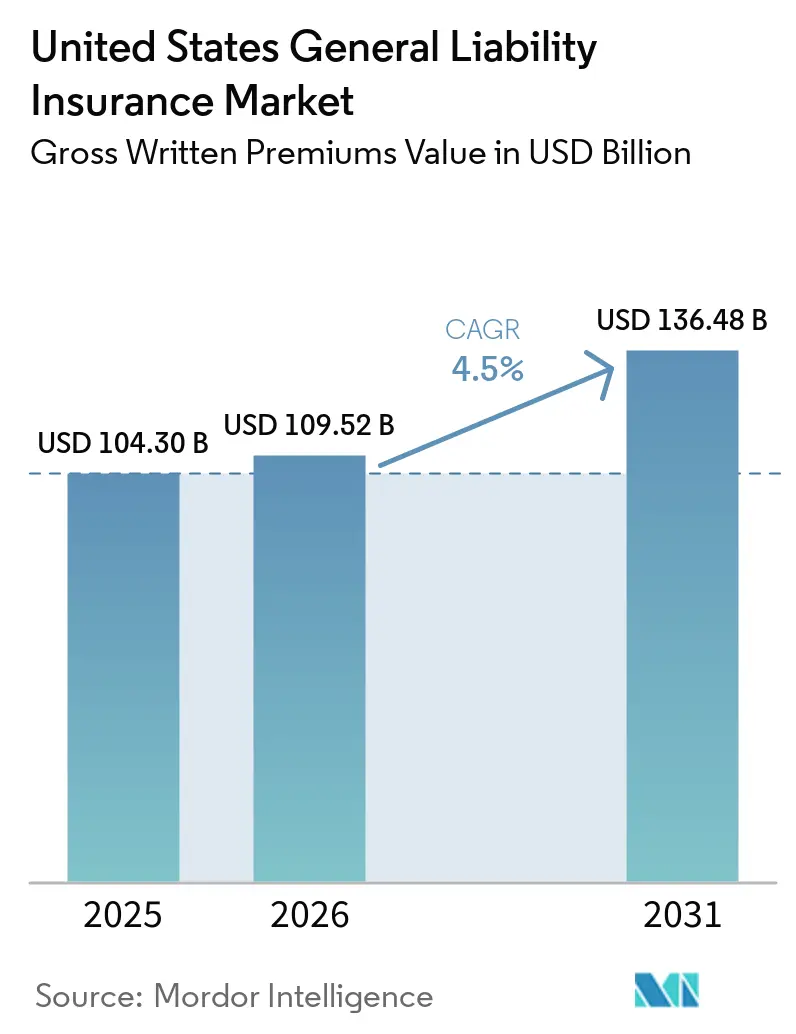
The United States General Liability Insurance Market size in terms of gross written premiums value is projected to expand from USD 104.30 billion in 2025 and USD 109.52 billion in 2026 to USD 136.48 billion by 2031, registering a CAGR of 4.5% between 2026 and 2031.
Contractual insurance requirements in leases, vendor agreements, permits, and commercial contracts continue to support demand across the United States general liability insurance market. New business formation also expands the pool of organizations that need liability coverage, with 5,671,836 business applications recorded in 2025. Rising claims severity has made rate adequacy and reserve discipline more important, particularly where litigation costs are increasing. Construction activity, manufacturing investment, and healthcare exposure are supporting premium demand across several commercial lines. Digital underwriting tools and embedded distribution are helping carriers reach smaller and specialized risks more efficiently.
Key Report Takeaways
- By policy type, commercial general liability captured 47.3% of the United States general liability insurance market share in 2025, while products and completed operations liability is projected to grow at a 6.3% CAGR through 2031.
- By policy trigger, occurrence-based policies held 82.1% of the United States general liability insurance market share in 2025, while claims-made policies are projected to grow at a 5.9% CAGR through 2031.
- By policyholder type, SMEs accounted for 44.8% of United States general liability insurance market share in 2025, while households and individuals are projected to grow at a 6.5% CAGR through 2031.
- By distribution channel, agents and brokers accounted for 63.4% of United States general liability insurance market share in 2025, while bancassurance, affinity, and embedded channels are projected to grow at a 7.5% CAGR through 2031.
- By industry vertical, construction and real estate accounted for 24.4% of United States general liability insurance market share in 2025, while healthcare and life sciences are projected to grow at a 6.0% CAGR through 2031.
Note: Market size and forecast figures in this report are generated using Mordor Intelligence’s proprietary estimation framework, updated with the latest available data and insights as of January 2026.
United States General Liability Insurance Market Trends and Insights
Drivers Impact Analysis*
| Driver | (~) % Impact on CAGR Forecast | Geographic Relevance | Impact Timeline |
|---|---|---|---|
| Contractual Liability Requirements Across Commercial Activities | +0.9% | National, with high density in New York, Houston, Chicago, and Los Angeles, commercial real estate markets | Short term (≤ 2 years) |
| Liability Claims Severity and Social Inflation | +0.8% | National, with higher exposure in California, New York, Pennsylvania, Texas, and Illinois | Medium term (2-4 years) |
| Small-Business and Commercial Activity Requiring Liability Protection | +0.7% | National, with stronger application growth in Texas, Florida, Arizona, and Georgia | Short term (≤ 2 years) |
| Data-Driven Underwriting and Digital Distribution | +0.5% | National, especially among excess and surplus carriers and SME-focused insurers | Medium term (2-4 years) |
| Construction, Infrastructure, and High-Liability Operations | +0.4% | National, with activity across Southeast, Midwest, and Western infrastructure corridors | Medium term (2-4 years) |
| Demand for Higher Limits and Specialized Coverage | +0.2% | National, with greater demand in high-verdict jurisdictions | Long term (≥ 4 years) |
| Source: Mordor Intelligence | |||
Rising Liability Claims Severity and Social Inflation
Social inflation is increasing the cost of liability claims and changing underwriting conditions throughout the United States general liability insurance market. Higher litigation costs and large verdicts can increase losses long after a policy is written. This pattern places particular pressure on construction, retail, habitational, and other higher-hazard accounts. Carriers are responding through tighter underwriting, higher attachment points, and more careful selection of policy limits. Renewal pricing in 2026 is tracking higher for many commercial accounts, with above-average pressure in construction, habitational, and retail exposures. The effect is not uniform across states because legal rules, jury behavior, and claims practices differ by jurisdiction.
Increasing Contractual Liability Requirements Across Commercial Activities
Contractual requirements remain a central source of demand for general liability coverage across commercial activities. Leases, vendor agreements, and licensing arrangements commonly require evidence of insurance before a business can operate or enter a contract. The Small Business Administration identifies liability insurance as a commonly required coverage for firms that work with other businesses[1]. This requirement means coverage demand can remain stable even when wider business conditions become less favorable. Business applications recorded in 2025 add to the number of potential firms that may face these contractual obligations. The United States general liability insurance market, therefore, benefits from recurring requirements rather than relying only on voluntary insurance purchases.
Expansion of Construction, Infrastructure, and Other High-Liability Operations
Construction work is creating substantial liability exposure across the United States general liability insurance market. Construction spending reached an annualized USD 2.17 trillion in April 2026, supported by data center projects, advanced manufacturing facilities, and public infrastructure activity[2]. These projects require multiple contractors, subcontractors, suppliers, and professional service providers, each with contractual insurance obligations. Bodily injury, property damage, and completed-operations claims remain important concerns for these participants. Labor shortages can increase operational risk when firms struggle to hire experienced craft workers. Longer reporting periods for construction defects also require insurers to consider exposure that can develop years after project completion.
Growth of Data-Driven Underwriting and Digital Distribution
Data-driven underwriting is changing how insurers assess and process smaller and specialized risks. AIG reported that its underwriting assistant processed more than 370,000 Lexington submissions by the end of 2025, a 26% increase from the prior year[3]. Faster submission handling can reduce manual work and help underwriters focus on risks that require more detailed review. Digital tools also support distribution models that offer coverage at the point of a commercial transaction. These capabilities can enable smaller contractors, niche manufacturers, and microbusinesses to serve. The United States general liability insurance market is likely to see more competition where insurers combine efficient processing with disciplined risk selection.
Restraints Impact Analysis*
| Restraint | (~) % Impact on CAGR Forecast | Geographic Relevance | Impact Timeline |
|---|---|---|---|
| Claims Severity and Liability Loss Costs | -0.7% | National, with higher severity in California, New York, Texas, Pennsylvania, and Illinois | Medium term (2-4 years) |
| Long-Tailed Claims Development and Reserve Uncertainty | -0.4% | National, with exposure in occurrence books from 2019 to 2024 accident years | Long term (≥ 4 years) |
| Liability Exclusions for Emerging and Difficult-to-Price Risks | -0.2% | National, especially in large commercial and technology accounts | Short term (≤ 2 years) |
| State-Level Differences in Liability Laws and Litigation | -0.2% | National, with acute changes in Florida, Georgia, Louisiana, and North Carolina | Medium term (2-4 years) |
| Source: Mordor Intelligence | |||
Long-Tailed Claims Development and Reserve Uncertainty
Reserve uncertainty is a material constraint for insurers writing long-tailed liability business. Claims can emerge or worsen several years after the underlying incident, which makes timely pricing and reserving difficult. More recent accident years have received increased attention as insurers review whether historical development patterns still apply. The issue is more difficult where litigation funding and mass-tort activity extend claims timelines. Insurers must hold sufficient capital for adverse development while also remaining competitive on price and coverage. This creates pressure to refine loss assumptions and reduce reliance on development patterns that may no longer reflect current claims experience.
State-Level Differences in Liability Laws and Litigation Environment
State-level legal differences add operational complexity to the United States general liability insurance market. Insurers need jurisdiction-specific assumptions because filing rules, damage awards, and litigation practices vary across the country. Florida's 2023 tort reforms had reduced its nuclear-verdict ranking from 2nd to 10th nationally by mid-2026, while defense costs declined 24% from 2022 to 2025. Georgia enacted Senate Bills 68 and 69 in April 2025, which addressed trial procedures and phantom damages. North Carolina became the first state to prohibit commercial third-party litigation funding in June 2026 under House Bill 315. Legal reforms can improve predictability, but insurers still need to monitor how courts interpret and apply new rules.
*Our forecasts treat driver/restraint impacts as directional, not additive. The impact forecasts reflect baseline growth, mix effects, and variable interactions.
Segment Analysis
By Policy Type: Commercial General Liability Supports Core Commercial Coverage
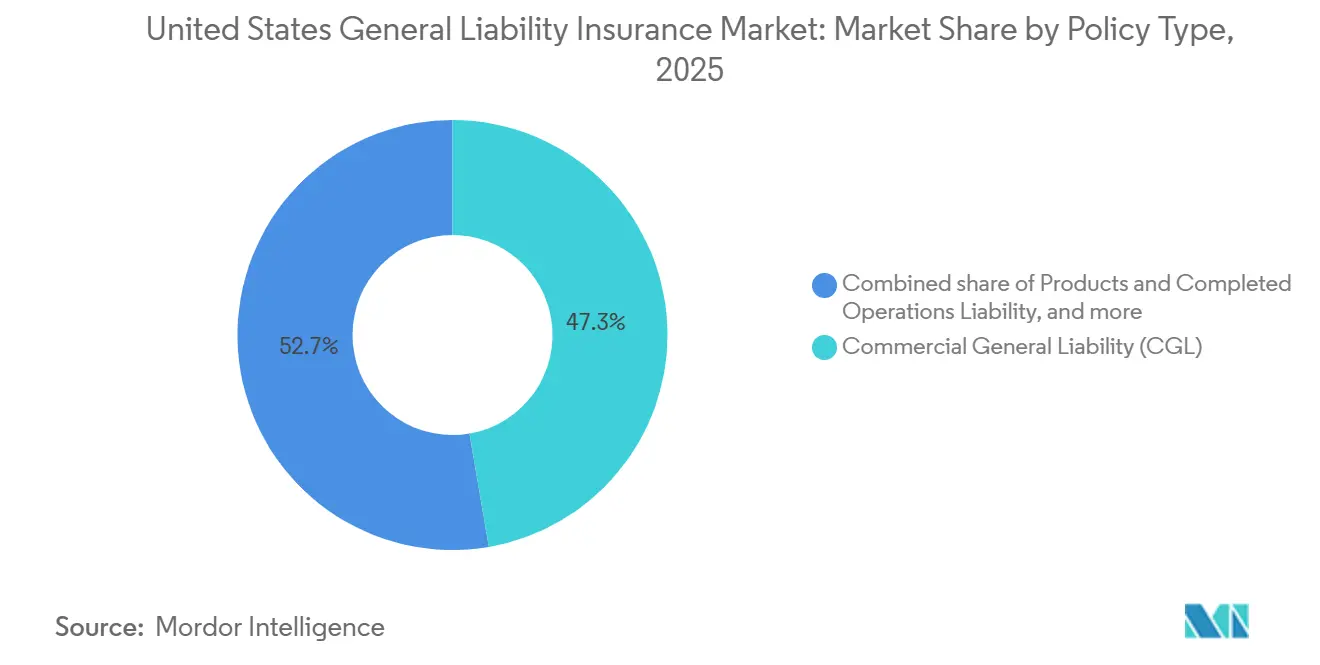
Commercial general liability held 47.3% of premiums in 2025 and remained the largest policy type in the United States general liability insurance market. It is widely used because contracts, leases, and licensing arrangements often require this form of coverage. The policy responds to common third-party bodily injury, property damage, and personal injury exposures. Products and completed operations liability is projected to grow at a 6.3% CAGR through 2031. Manufacturing reshoring, life sciences product launches, and construction activity are increasing completed operations exposure for insured businesses.
Personal liability coverage is gaining attention as households consider umbrella protection for larger personal exposures. Other general and business liability products can address coverage gaps that emerge when standard forms exclude new risks. Verisk ISO introduced generative artificial intelligence exclusion endorsements CG 40 47, CG 40 48, and CG 35 08, effective January 1, 2026. These changes encourage buyers to review whether standard policies address artificial intelligence-related exposures. HSB introduced affirmative artificial intelligence liability insurance for small and medium-sized businesses in March 2026. The United States general liability insurance industry is therefore separating traditional coverage from specialized products designed for emerging exposures.
By Policy Trigger: Occurrence Forms Remain the Standard Choice
Occurrence-based policies accounted for 82.1% of premiums in 2025, which made them the leading policy trigger in the United States general liability insurance market. These forms are accepted across standard commercial contracts and contractor licensing requirements. The ISO CG 00 01 form remains a familiar general liability policy for many buyers and agents. Claims-made policies are projected to expand at a 5.9% CAGR through 2031. Their shorter reporting structure can help insurers respond more quickly to changes in loss conditions.
Claims-made policies have greater relevance in healthcare, professional services, and specialty risks where policyholders understand the effect of long claims tails. TransRe noted that a claims-made facility launched with support from 3 leading insurers during 2025. These forms can give insurers and reinsurers greater flexibility when pricing conditions change. However, occurrence coverage remains embedded in commercial contracting practices and will retain a broad role. Buyers also need to consider retroactive dates, reporting periods, and tail coverage when moving between policy triggers. The United States general liability insurance industry will likely see gradual rather than abrupt movement toward claims-made structures.
By Policyholder Type: SMEs Provide the Broadest Premium Base
SMEs accounted for 44.8% of 2025 premiums, forming the largest policyholder group in the United States general liability insurance market. These firms operate across construction, retail, transportation, professional services, and local commercial activities. Their coverage needs are often connected to customer contracts, landlord requirements, and supplier relationships. The Small Business Administration reported that Texas created 108,441 small-business jobs in 2026. A growing base of small employers supports recurring insurance demand across commercial markets.
Households and individuals are projected to grow at a 6.5% CAGR through 2031. Personal umbrella protection, gig work, and platform requirements are increasing interest in personal liability coverage. Large enterprises typically pay higher premiums because their operations and contractual obligations are more complex. Public sector and nonprofit organizations provide a steadier policyholder base, although their purchasing decisions can be influenced by budget cycles. Embedded distribution can reduce the cost of reaching individuals and microbusinesses that may be costly to serve through traditional broker models. W. R. Berkley launched Berkley Embedded in 2025 to offer coverage alongside commercial transactions.
By Distribution Channel: Brokers Retain a Central Advisory Role
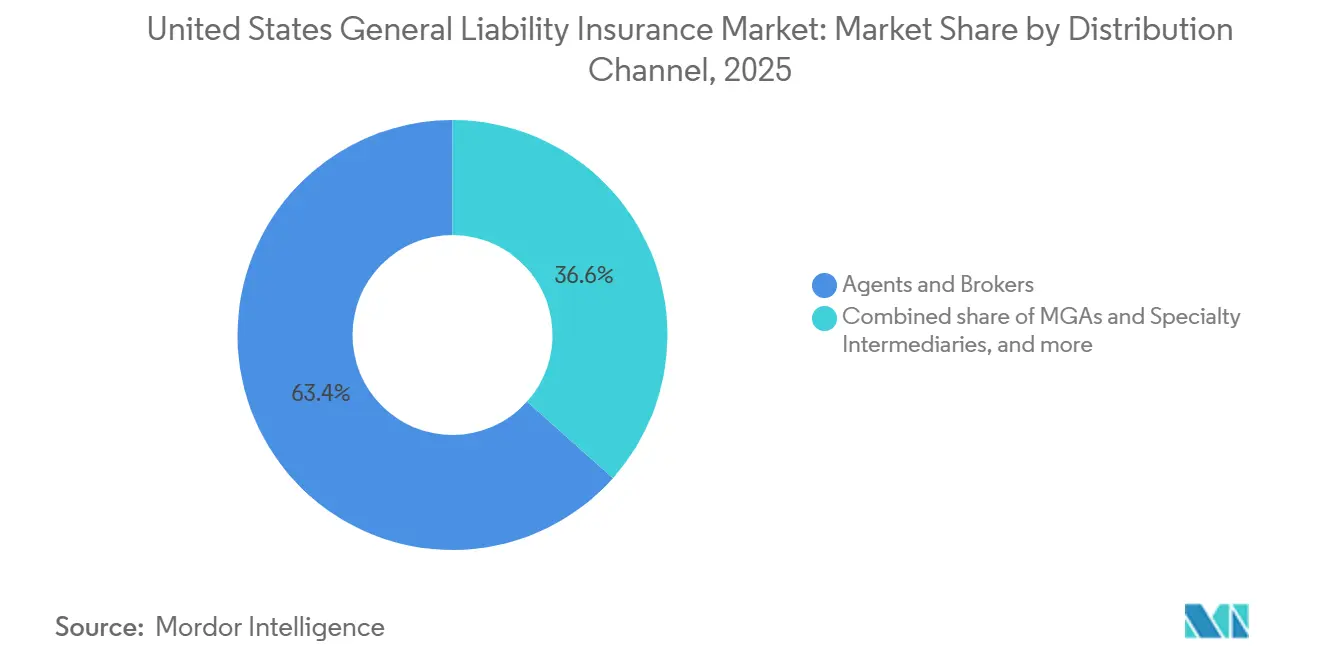
Agents and Brokers held 63.4% of premiums in 2025, making them the dominant distribution channel in the United States general liability insurance market. Their role remains important for certificates of insurance, endorsements, and contractual compliance. Many commercial buyers continue to need help matching policy terms with specific contractual obligations. MGAs and specialty intermediaries are also important because they can provide focused underwriting expertise for nonstandard risks. This channel is particularly relevant in excess and surplus lines, construction, professional liability, and specialty casualty business.
Bancassurance, Affinity, and Embedded channels are projected to grow at a 7.5% CAGR through 2031. These methods allow coverage to be offered at the time of contract signing, equipment purchase, or loan origination. Digital workflows can lower the administrative cost of placing simpler policies. The approach is most useful when the product is clear, and the buyer has a limited need for customized advice. Traditional brokers are likely to remain central for more complex accounts and higher liability limits. The United States general liability insurance market can accommodate both channels because they address different customer needs.
By Industry Vertical: Construction and Real Estate Lead Premium Demand
Construction and real estate accounted for 24.4% of premiums in 2025, the largest vertical share in the United States general liability insurance market. The sector combines active worksite risks with extended completed-operations exposure. Annualized construction spending reached USD 2.17 trillion in April 2026. Data centers, manufacturing facilities, transportation projects, and water infrastructure are supporting construction activity. These projects create insurance needs for contractors, developers, subcontractors, and specialized suppliers.
Healthcare and life sciences are projected to grow at a 6.0% CAGR through 2031. Medical professional liability premiums rose for a 7th consecutive year in 2025, with 39.9% of reported premiums increasing. Manufacturing, transportation and logistics, retail and wholesale trade, energy and utilities, hospitality, information technology, financial services, and public sector organizations make up the remaining premium base. Life sciences companies face product, clinical, and sales-related liability exposures that can require specialized coverage. Travelers completed a 50-state rollout of Travelers Synergy for life-sciences companies in July 2026. The United States general liability insurance market size for this vertical is supported by increasingly complex risks and more limited capacity in higher-severity venues.
Geography Analysis
The South and Southeast form the largest regional premium pool in the United States general liability insurance market. Texas, Florida, Georgia, and Louisiana combine new-business formation, commercial construction, and infrastructure activity. Texas recorded 23 nuclear verdict cases in 2024, while California recorded 17 cases. Florida's legal reforms have changed its liability environment, with first-half 2026 lawsuit filings down 20% year over year. Louisiana's 2025 reforms also addressed comparative negligence, uninsured-driver recovery, and commercial vehicle safety measures. The changes are recent, so their full effect on claims patterns remains uncertain.
The Northeast has a high population density because of financial services, healthcare systems, commercial construction, and dense business activity. New York, New Jersey, and Pennsylvania remain important states for underwriting and claims management. New York and Pennsylvania together produced 25 nuclear verdicts in 2024. Legal exposure in these states can require carriers to apply careful limits management and jurisdiction-specific pricing. Their share of nationwide premium demand reflects a concentration of larger commercial risks. Their economic density also supports ongoing demand for broker-led placement and specialized policy terms.
The West Coast, led by California, combines major construction activity with a sizeable life-sciences base. California had 17,000 life-science companies, creating a concentrated product and completed operations exposure base. California, New York, Pennsylvania, Texas, and Nevada accounted for 76% of nuclear verdicts in 2024. These states require more selective underwriting because loss outcomes can be severe. The Midwest and Western mountain states add demand through reshoring manufacturing and clean-energy infrastructure. The United States general liability insurance market continues to require local risk selection even as national insurers pursue wider geographic reach.
Competitive Landscape
The United States general liability insurance market is fragmented. W. R. Berkley reported USD 12.7 billion in net premiums written for full-year 2025 and a 90.7% combined ratio. Travelers reported USD 11.5 billion in net written premiums during the second quarter of 2026 and an 83.6% combined ratio. These results show the importance of underwriting discipline as well as premium growth. Technology-enabled SME platforms and affirmative artificial intelligence liability products are important areas of competition. The United States general liability insurance market rewards carriers that can manage claims uncertainty without limiting their distribution reach.
W. R. Berkley formed Berkley Meridian in August 2026 by combining Verus Specialty Insurance and Vela Insurance Services. The new platform brings construction, professional liability, casualty, and garage capabilities together for wholesale brokers. AIG has expanded its underwriting technology, including the Lexington underwriting assistant, which handled more than 370,000 submissions by the end of 2025. HSB introduced a standalone artificial intelligence liability product for smaller businesses in March 2026. These actions show that insurers are pursuing both operational efficiency and coverage solutions for risks excluded from standard forms.
Travelers expanded its product liability offering for life sciences companies to California in July 2026. This move broadened availability for medical-device, pharmaceutical, and related sales exposures. Larger carriers retain advantages in capital, claims expertise, and national broker relationships. Specialist insurers and MGAs can compete where product design, data, or underwriting expertise is more important than broad scale. The United States general liability insurance market remains competitive because each participant can focus on a different distribution channel or risk class.
United States General Liability Insurance Industry Leaders
-
Chubb Ltd Group
-
Travelers Group
-
Berkshire Hathaway Group
-
W. R. Berkley Corp Group
-
Fairfax Financial Group
- *Disclaimer: Major Players sorted in no particular order
Recent Industry Developments
- September 2026: Mosaic Insurance launched HALO, a modular AI-powered digital underwriting system for specialty GL and casualty SME risks, enabling automated quote-bind-issuance in minutes and combining broker trading activity, underwriting decisions, and portfolio outcomes in a single environment.
- August 2026: W. R. Berkley Corporation formed Berkley Meridian by combining Verus Specialty Insurance and Vela Insurance Services, creating a dedicated E&S platform covering construction, professional liability, casualty, and garage lines for the wholesale broker market, with integration extending into early 2027.
- July 2026: Travelers completed the 50-state rollout of Travelers Synergy product liability insurance for life sciences companies, adding California and introducing broader Sales Professional Liability coverage for medical-device and pharmaceutical sales representatives operating in clinical settings.
- March 2026: HSB, a Munich Re company, introduced AI Liability Insurance for small and medium-sized businesses, affirmatively covering bodily injury, property damage, and advertising injury arising from AI-generated content.
United States General Liability Insurance Market Report Scope
| Commercial General Liability (CGL) |
| Products and Completed Operations Liability |
| Personal Liability |
| Other General/Business Liability |
| Occurrence-Based |
| Claims-Made |
| Households and Individuals |
| Small and Medium-Sized Enterprises (SMEs) |
| Large Enterprises |
| Public Sector and Nonprofit Organizations |
| Agents and Brokers |
| MGAs and Specialty Intermediaries |
| Direct Sales |
| Bancassurance, Affinity and Embedded |
| Construction and Real Estate |
| Manufacturing |
| Transportation and Logistics |
| Retail and Wholesale Trade |
| Healthcare and Life Sciences |
| Information Technology and Telecommunications |
| Energy and Utilities |
| Hospitality, Leisure, and Entertainment |
| Financial Services |
| Public Sector and Nonprofit Organizations |
| Other Industry Verticals |
| By Policy Type | Commercial General Liability (CGL) |
| Products and Completed Operations Liability | |
| Personal Liability | |
| Other General/Business Liability | |
| By Policy Trigger | Occurrence-Based |
| Claims-Made | |
| By Policyholder Type | Households and Individuals |
| Small and Medium-Sized Enterprises (SMEs) | |
| Large Enterprises | |
| Public Sector and Nonprofit Organizations | |
| By Distribution Channel | Agents and Brokers |
| MGAs and Specialty Intermediaries | |
| Direct Sales | |
| Bancassurance, Affinity and Embedded | |
| By Industry Vertical | Construction and Real Estate |
| Manufacturing | |
| Transportation and Logistics | |
| Retail and Wholesale Trade | |
| Healthcare and Life Sciences | |
| Information Technology and Telecommunications | |
| Energy and Utilities | |
| Hospitality, Leisure, and Entertainment | |
| Financial Services | |
| Public Sector and Nonprofit Organizations | |
| Other Industry Verticals |
Key Questions Answered in the Report
What is the 2026 value of the United States general liability insurance market?
The market is valued at USD 109.5 billion in 2026 and is forecast to reach USD 136.5 billion by 2031 at a 4.5% CAGR.
Which policy type holds the largest premium position?
Commercial General Liability is the largest policy type, with a 47.3% share in 2025.
What is the fastest-growing policy type through 2031?
Products and Completed Operations Liability is forecast to grow at a 6.3% CAGR through 2031.
Why do businesses purchase general liability coverage?
Commercial contracts, leases, vendor agreements, and licensing arrangements often require businesses to carry liability coverage.
Which distribution channel is expanding the fastest?
Bancassurance, Affinity, and Embedded channels are projected to grow at a 7.5% CAGR through 2031.
Which vertical is growing the fastest through 2031?
Healthcare and Life Sciences is forecast to grow at a 6.0% CAGR through 2031.