
United States Electric Vehicle CNC Turning Centers Market Size and Share
Market Overview
| Study Period | 2020 - 2031 |
|---|---|
| Forecast Data Period | 2026 - 2031 |
| Base Year Market Size (2025) | USD 240 Million |
| Market Size (2026) | USD 268 Million |
| Market Size (2031) | USD 441 Million |
| Growth Rate (2026 - 2031) | 10.50 % |
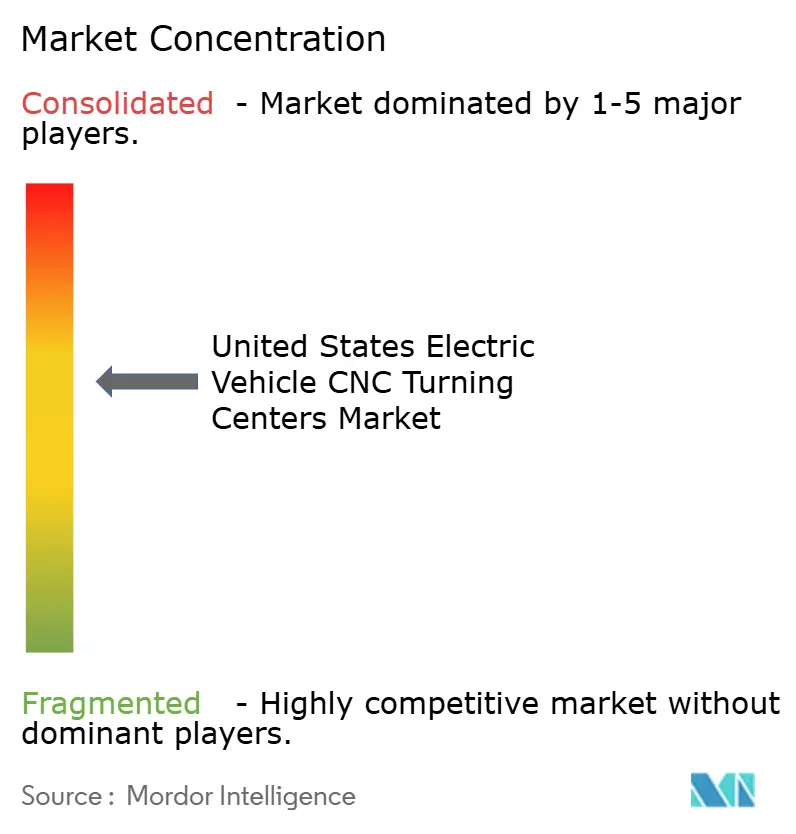
| Market Concentration | Medium |
Major Players *Disclaimer: Major Players sorted in no particular order Image © Mordor Intelligence. Reuse requires attribution under CC BY 4.0. | |
United States Electric Vehicle CNC Turning Centers Market Analysis by Mordor Intelligence
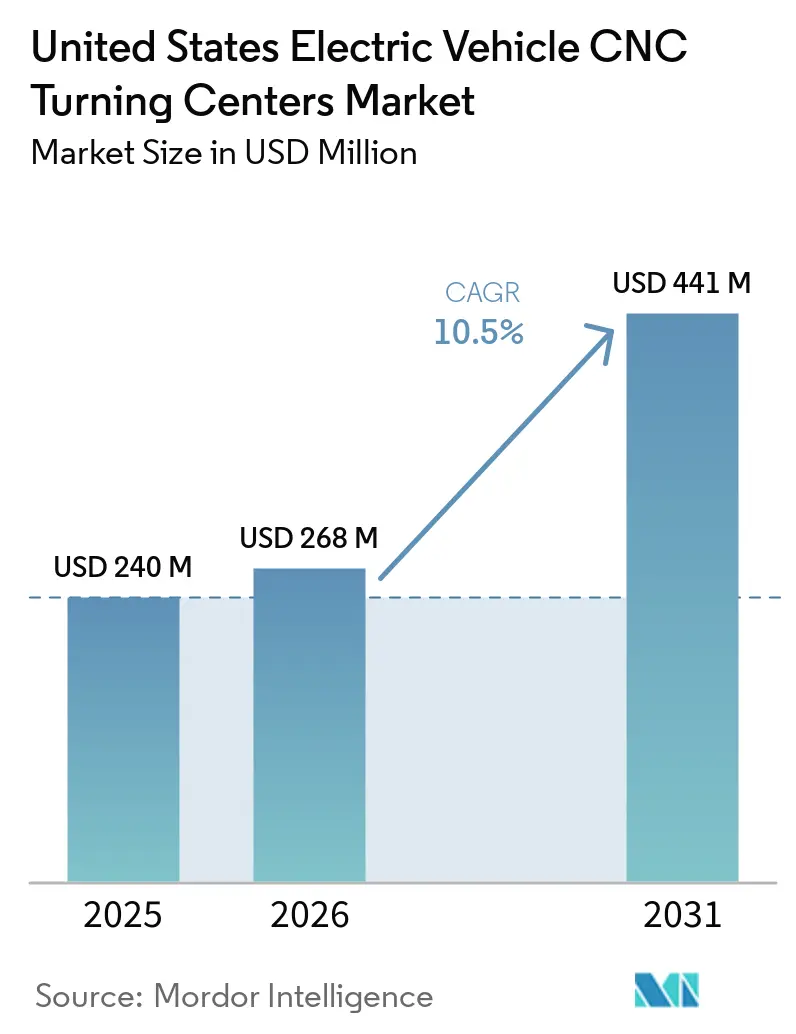
The United States electric vehicle CNC turning centers market size was valued at USD 240 million in 2025 and is estimated to grow from USD 268 million in 2026 to USD 441 million by 2031, at a CAGR of 10.5% from 2026 to 2031.
The United States electric vehicle CNC turning centers market is expanding as domestic EV production requires tighter tolerances for motor shafts, e-axle housings, and battery enclosure interfaces. Machine tool orders generally preceded production ramp-ups by 18 to 24 months, placing equipment for 2027 and 2028 output within the 2026 buying cycle. The Southeast attracted a rising share of new EV facilities, while the Midwest retained a large installed base that needed retooling for EV specifications. Federal manufacturing credits also encouraged suppliers to bring forward equipment decisions in the United States electric vehicle CNC turning centers market.
Key Report Takeaways
- By machine type, Horizontal CNC Turning Centers held 42.1% of the United States electric vehicle CNC turning centers market share in 2025, while Multi-Tasking Turn-Mill Centers recorded the highest projected CAGR at 12.3% through 2031.
- By component application, Electric Motor Components accounted for 34.2% of the United States electric vehicle CNC turning centers market size in 2025, while Battery System Components advanced at a 12.4% CAGR through 2031.
- By end user, EV OEM Manufacturing Plants held 40.0% of the United States electric vehicle CNC turning centers market share in 2025, while Tier-2 Component Manufacturers recorded the highest projected CAGR at 12.6% through 2031.
Note: Market size and forecast figures in this report are generated using Mordor Intelligence’s proprietary estimation framework, updated with the latest available data and insights as of January 2026.
United States Electric Vehicle CNC Turning Centers Market Trends and Insights
Drivers Impact Analysis*
| Driver | (~) % Impact on CAGR Forecast | Geographic Relevance | Impact Timeline |
|---|---|---|---|
| Domestic EV Manufacturing Expansion Fuels High-Precision Turning Demand | +2.3% | Southeast US, Midwest | Medium term (2-4 years) |
| Electric Powertrain Production Raises Precision Requirements | +2.0% | Southeast US, with spillover to Midwest and Southwest | Medium term (2-4 years) |
| Automotive Supply Chain Reshoring Accelerates CNC Investment | +1.7% | National, concentrated in Midwest and Southeast US | Short term (≤ 2 years) |
| Industry 4.0 Adoption Supports Smart CNC Machining | +1.5% | National | Long term (≥ 4 years) |
| Multi-Tasking CNC Demand Improves Production Efficiency | +1.2% | National, with early adoption in Southeast and Midwest EV clusters | Medium term (2-4 years) |
| Federal Manufacturing Incentives Support Machine Tool Modernization | +0.9% | National | Short term (≤ 2 years) |
| Source: Mordor Intelligence | |||
Domestic EV Manufacturing Expansion Fuels Demand for High-Precision Turning Centers
Large EV plant projects drove demand for precision turning centers because motor shafts operating above 18,000 RPM required ISO 1940 G1.0 dynamic balancing tolerances. Such tolerances required precision platforms with sub-micron thermal compensation. The Environmental Defense Fund reported USD 199 billion in cumulative EV manufacturing investment in the United States by mid-2024 and projected domestic capacity of 5.8 million vehicles annually by 2027. Rivian announced a USD 4.5 billion Department of Energy-backed loan in April 2026 for its Georgia facility, which targeted 300,000 vehicles annually and a 2028 production start. The announcement created a multiyear procurement requirement before the factory began vehicle production. BorgWarner selected Henderson County for a USD 74.9 million facility in October 2025, adding precision machining capacity near new OEM operations.[1]“BorgWarner Selects Henderson County for USD 75 Million Industrial Operations Expansion,” North Carolina Department of Commerce, commerce.nc.gov New plant programs required suppliers to align machining capacity with model launches rather than add equipment after vehicle output rose. This timing placed attention on thermal control, repeatability, and automated handling at the equipment selection stage. The United States electric vehicle CNC turning centers market consequently drew demand from OEM plants and their adjacent supplier networks.
Rising Production of Electric Powertrain Components Boosts Precision Machining Requirements
Battery plant construction created demand for machining operations that combined turning and milling in a single workholding cycle. Hyundai and SK On opened a USD 5 billion battery plant in Bartow County, Georgia, in July 2026, with an annual capacity of 35 GWh. The facility supported precision machining demand for cell casing interfaces, terminal components, and module housing features. Panasonic Energy designed its De Soto, Kansas facility for 32 GWh of annual production, which required machining of calender rollers and slot-die coating head components. These components required concentricity tolerances of a few microns, exceeding standard lathe capability. Battery System Components recorded the highest application CAGR at 12.4% through 2031 in the United States electric vehicle CNC turning centers market. The work involved housings, terminals, interfaces, and fittings that needed consistent dimensional control. These production requirements favored equipment that combined several processes without moving a component between separate machines. As cell production expanded, the same specifications extended through suppliers that made parts and production equipment.
Reshoring of Automotive Supply Chains Accelerates CNC Equipment Investments
Tariff-related supply chain restructuring encouraged automotive manufacturers and suppliers to return precision machining work to the United States. The United States electric vehicle CNC turning centers market benefited from both new facilities and upgrades to existing plants. American Axle & Manufacturing announced a USD 133 million expansion in Three Rivers, Michigan, in 2025, citing the importance of onshoring amid tariff-related changes. Stellantis committed USD 13 billion to United States production capacity through 2028 across 5 states, where driveline and EV component machining supported the investment program. OEM qualification practices increasingly require sub-tier suppliers to operate near production sites. This shift shifted purchasing decisions from centralized programs to individual facilities and broadened the customer base for turning center suppliers. It also made local applications more relevant when suppliers evaluated a new turning center. Existing plants required retrofits that maintained output while improving capability for EV components. Greenfield sites, by contrast, could design automation, gauging, and material flow around a new cell from the start.
Industry 4.0 Adoption Enhances Smart CNC Machining Across EV Factories
EV manufacturers integrated digital twins, AI-based tool wear monitoring, and robotic automation into CNC turning cells. DMG MORI launched the NLX 2500 | 1250 2nd Generation in September 2025 with digital twin integration, 12,000 RPM milling capability, 0.001° C-axis positioning accuracy, and radial thermal displacement limited to 7 µm during continuous operation. Mazak introduced the INTEGREX i-350S NEO in September 2025, combining turning, milling, and grinding in a single setup via the MAZATROL SmoothAi control and MAZATROL TWINS software. These capabilities changed the minimum technical requirements for new equipment in the United States electric vehicle CNC turning centers market. ISO 10791 accuracy standards and NIST smart manufacturing frameworks were increasingly relevant during vendor qualification. Digital tools gave users a clearer record of machine conditions and process changes. Robotic loading also addressed repeatable part handling, where manual intervention could limit throughput. These features strengthened the case for integrated cells in the United States electric vehicle CNC turning centers market.
Restraints Impact Analysis*
| Restraint | (~) % Impact on CAGR Forecast | Geographic Relevance | Impact Timeline |
|---|---|---|---|
| High Acquisition and Lifecycle Costs Limit SME Adoption | -1.3% | National, with greater pressure on Tier-2 and contract manufacturing clusters | Short term (≤ 2 years) |
| Persistent Skilled Machinist Shortages Constrain CNC Utilization | -0.8% | National, most acute in Midwest industrial regions | Long term (≥ 4 years) |
| Volatility in EV Production Plans Creates Uncertain Capital Spending | -0.7% | National | Medium term (2-4 years) |
| Long Lead Times for Premium CNC Machines and Critical Components | -0.5% | National, with import-dependent sourcing corridors most affected | Medium term (2-4 years) |
| Source: Mordor Intelligence | |||
High Acquisition and Lifecycle Costs Limit SME Adoption
Premium multi-tasking turn-mill centers and Swiss-type CNC machines required substantial upfront investment from smaller manufacturers. A fully configured turning center with robotic automation, in-process gauging, and a 5-axis milling headstock required capital outlays above USD 500,000 per unit. This level of expenditure strained Tier-2 and precision contract manufacturers with limited balance sheets. Federal Reserve industrial production data showed manufacturing capacity utilization near long-run averages in 2025.[2]“G.17 Industrial Production and Capacity Utilization,” Federal Reserve, federalreserve.gov Many shops, therefore, faced pressure from under-utilization rather than a simple shortage of equipment. Tooling replenishment, CAM software licenses, and preventive maintenance also reduced the per-part economics unless production volume supported broad fixed-cost amortization. The financial challenge was most pronounced for firms that needed advanced features before securing recurring EV orders. Leasing and structured financing could reduce the initial burden, but did not remove operating and maintenance expenses. This restraint affected the pace at which smaller suppliers could respond to OEM qualification requirements.
Persistent Skilled Machinist Shortages Constrain CNC Utilization
The precision machining workforce shortage limited the effective use of installed CNC turning capacity. The United States electric vehicle CNC turning centers market, therefore, faced a gap between equipment capability and realized output. There were 449,000 unfilled manufacturing jobs in the United States in March 2025, including CNC machinist and maintenance roles. It also projected up to 2.1 million unfilled manufacturing roles by 2030. Contract manufacturers had difficulty finding operators familiar with MAZATROL SmoothAi, Fanuc 31i, and Siemens SINUMERIK ONE controls. This limited utilization across turning center categories and slowed production ramp schedules at EV facilities. Multi-tasking equipment increased the challenge, as it required operators capable of managing multiple processes and control functions. Automation reduced some handling needs but still required skilled setup, programming, maintenance, and quality oversight. The labor constraint, therefore, remained relevant even where manufacturers adopted more advanced CNC cells.
*Our forecasts treat driver/restraint impacts as directional, not additive. The impact forecasts reflect baseline growth, mix effects, and variable interactions.
Segment Analysis
By Machine Type: High-Volume Turning Drives Platform Diversification
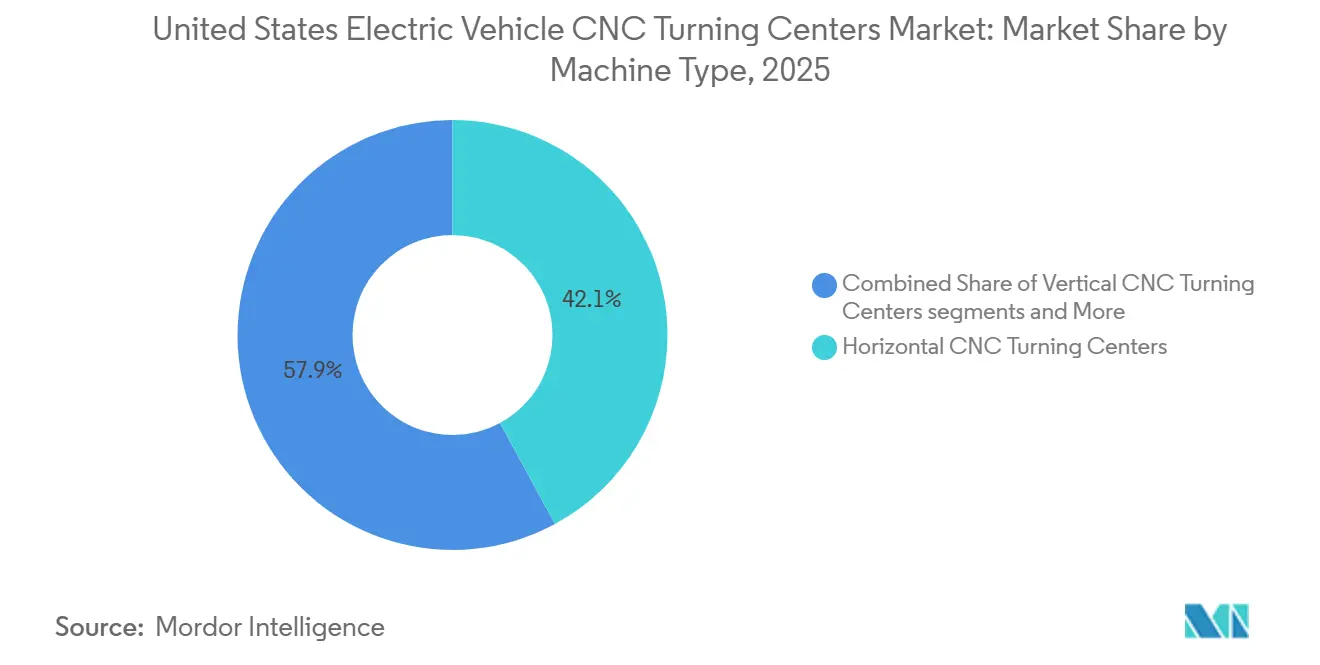
Horizontal CNC Turning Centers accounted for 42.1% of the United States electric vehicle CNC turning centers market share in 2025, making them the largest category in the market. They supported high-volume production of shafts and housings used in EV motors and e-axles. Their established tooling ecosystems helped manufacturers deploy standard processes at scale. Broad operator availability also supported their use across new turning lines. Robotic part-loading integration made these systems suitable for automated production cells. Vertical CNC Turning Centers served disc-type and short-chuck machining needs, including rotor end-plates and brake-by-wire housings. Swiss-Type CNC Turning Centers supported the machining of small-diameter workpieces for sensor shafts, connector pins, and fastener blanks. EV electronics integration maintained demand for these high-precision, small-diameter applications.
Multi-Tasking Turn-Mill Centers recorded the highest projected CAGR at 12.3% through 2031 in the United States electric vehicle CNC turning centers market. Manufacturers used these systems to consolidate operations, reduce work-in-process, and limit cumulative tolerance stack-up. DMG MORI positioned its September 2025 NLX 2500 | 1250 2nd Generation for EV, aircraft, and semiconductor work. Its 12,000 RPM BMT capability and digital twin integration reflected demand for compound machining. IATF 16949 qualification requirements encouraged suppliers to document process capability across multiple machined features. A single-clamping cycle supported this documentation while reducing handling between operations. The category thus served suppliers seeking both throughput and consistent process control.



By Component Application: Motor Components Lead, Battery Parts Accelerate
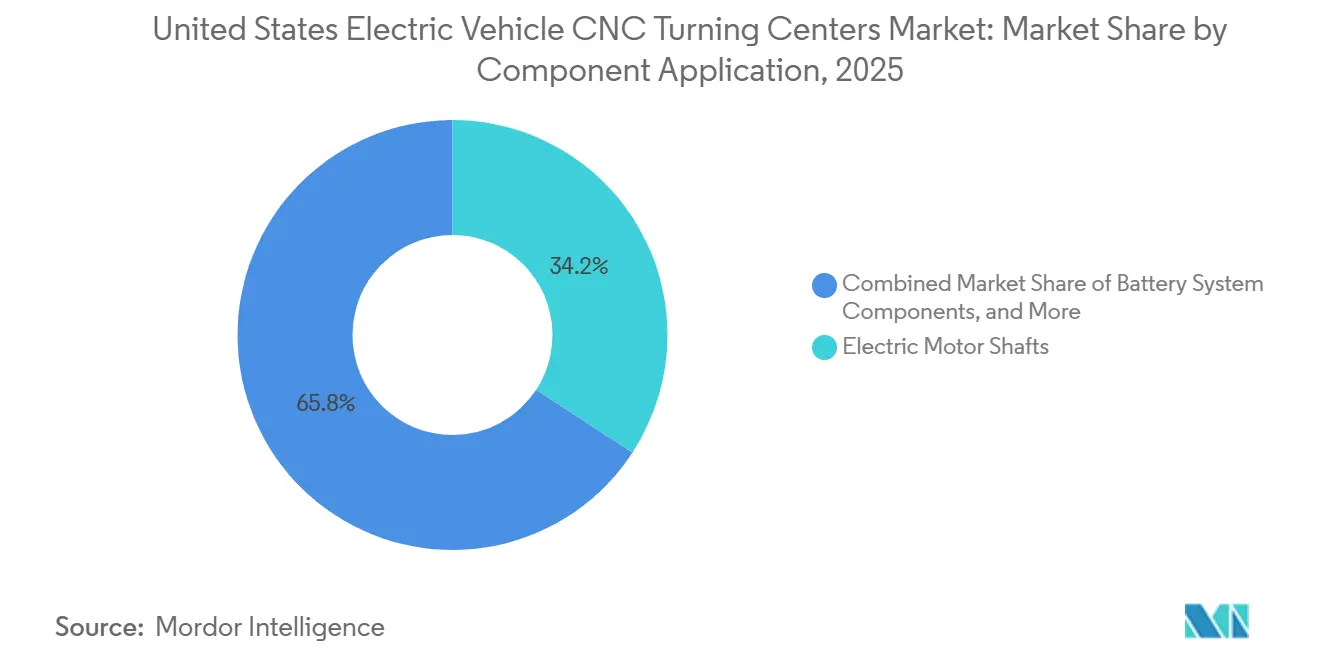
Electric Motor Components held 34.2% of the United States electric vehicle CNC turning centers market size in 2025. Motor shafts were the leading sub-category because EV drivetrains required high-RPM geometries that met ISO 1940 G1.0 balancing specifications. The shift from internal combustion engines to EVs increased tolerance requirements. It also moved the material mix toward lightweight aluminum alloys. These alloys required specialized tooling and active coolant temperature control. E-Axles and Transmission Components represented a significant share of the remaining demand. Integrated e-axle designs required the simultaneous turning of bearing seats and gear-mounting surfaces. This production profile supported demand for capable turning platforms in the United States' electric-vehicle CNC turning centers industry. Motor, e-axle, and transmission work also required suppliers to manage multiple surfaces within a repeatable sequence. The need for close control of shaft, bearing, and gear mounting features made machine stability a practical purchasing consideration. These requirements reinforced the role of established horizontal and multi-tasking platforms in automotive production.
Battery System Components advanced at a 12.4% CAGR through 2031, representing the fastest-growing application in the United States electric vehicle CNC turning centers market. Gigafactory projects created recurring demand for module interfaces, terminal housings, cooling manifold fittings, and sealing surfaces. Panasonic Energy designed its De Soto facility for 32 GWh of annual capacity. The facility illustrated the demand created by dedicated cell production, including equipment components that needed micron-level concentricity. UL 9540A and IEC 62619 requirements reinforced the need for dimensional consistency in battery enclosure components. CNC platforms with in-process dimensional documentation helped suppliers respond to those requirements. The multiplication of cell manufacturing sites increased the need for precision machining throughout battery supply chains. It also extended equipment demand beyond the battery plant to firms making tools, fixtures, and supporting components. Suppliers needed to sustain dimensional control as volumes rose. That requirement increased the value of process records and stable machining conditions.
By End User: OEM Plants Anchor Demand, Tier-2 Segment Drives Growth
EV OEM Manufacturing Plants held 40.0% of the United States electric vehicle CNC turning centers market share in 2025. This concentration reflected high-value CNC procurement at the top of the EV supply chain. OEM production volumes supported investment in automated turning cells with integrated gauging and robotic handling. Hyundai Motor Group committed USD 21 billion to growth in the United States from 2025 to 2028, including USD 9 billion for expanded domestic vehicle production. This commitment indicated multiyear machinery procurement across its Georgia facilities. Tier-1 Automotive Suppliers produced e-axle assemblies, motor housings, and battery pack structural components under long-term OEM agreements. Those agreements required documented process capability and supported continued investment in precision equipment. OEM plants also concentrated demand for cells that could handle volume with limited manual intervention. Their purchasing decisions affected downstream suppliers because common specifications traveled through the supply chain. This relationship kept OEM production plans closely connected to demand for advanced CNC equipment.
Tier-2 Component Manufacturers recorded the highest projected CAGR at 12.6% through 2031. OEM plant expansions required a dense network of nearby sub-tier suppliers with precision machining capabilities. Precision Contract Manufacturers invested in Swiss-type and multi-tasking turning centers even without direct OEM volume commitments. Automation became more important because all end-user groups faced workforce constraints. Machine builders that combined robotic loading with their equipment gained an advantage over standalone platform providers. This pattern broadened demand beyond the largest OEM plants in the United States electric vehicle CNC turning centers market. It also increased the importance of financing and support for smaller suppliers. Tier-2 growth therefore depended on both facility construction and the ability of suppliers to meet qualification requirements. These manufacturers needed flexible equipment because their work could cover several EV components and customer programs. Machines that shortened set-up time and supported documented quality offered a clearer fit for this operating model. The segment’s growth reflected the practical need to establish local capacity around expanding OEM footprints.
Geography Analysis
The Southeast had the highest concentration of new EV investment and was the strongest near-term source of demand for precision machining equipment. Georgia, South Carolina, Tennessee, and North Carolina formed the core of this regional cluster. Hyundai Motor Group operated its Georgia Metaplant with a capacity of up to 500,000 vehicles annually. Rivian’s Stanton Springs North project targeted 300,000 vehicles annually and was backed by a USD 4.5 billion Department of Energy loan. BMW targeted battery series production at Plant Woodruff in South Carolina during December 2026. This concentration brought the United States electric vehicle CNC turning centers market closer to new OEM and battery production sites.
The Midwest retained the largest installed base of CNC turning capacity nationally. Michigan, Indiana, Ohio, and Illinois were moving from internal combustion engine machining toward EV specifications. American Axle & Manufacturing announced a USD 133 million investment in Michigan in 2025, signaling upgrades to existing infrastructure. This approach required retooling to accommodate new materials and tighter tolerances, rather than complete greenfield construction.[3]“Advanced Manufacturing Production Credit,” Internal Revenue Service, irs.gov Stellantis committed USD 13 billion through 2028 across 5 states, including Indiana, Ohio, Michigan, and Illinois. The program maintained turning center demand from internal combustion production while supporting 5 new vehicle platforms.
The South-Central and Southwest regions emerged as secondary demand centers. Panasonic Energy’s De Soto facility in Kansas was designed for 32 GWh of annual battery production and supported demand for battery manufacturing equipment components. Tesla’s Gigafactory Texas supported a cluster of Tier-1 and Tier-2 suppliers along the I-35 corridor. These areas remained smaller in absolute equipment volume but provided opportunities for distributors with limited coverage in these locations.
Competitive Landscape
The United States electric vehicle CNC turning centers market had a moderately concentrated structure. Five to 7 global machine tool groups controlled a disproportionate share of advanced multi-tasking and high-precision equipment. A wider group of mid-tier builders competed on price and delivery for standard horizontal and vertical platforms. Japanese builders retained strengths in precision, repeatability, thermal stability, and integrated CNC controls, paired with robotic loading systems. German platforms focused on high-end turn-mill and multi-axis configurations, including platforms meeting ISO 10791-7 accuracy standards and IATF 16949 requirements.
Korean manufacturers gained Tier-2 demand through competitive pricing on horizontal platforms, with automation interfaces comparable to those of Japanese systems. AI integration became a clear point of differentiation in the United States electric vehicle CNC turning centers market. Mazak introduced Solid MAZATROL auto-programming from 3D models, AI spindle optimization, and MAZATROL TWINS software with its SmoothAi control in September 2025. Okuma announced an AI-automated robot cell featuring Intrinsic AI at IMTS 2026. These moves showed that unattended production was becoming a central requirement rather than a premium option.
Tier-2 and contract manufacturers remained under-equipped against precision requirements transmitted through OEM supply chain audits. Builders offering turnkey packages with robotic loading, in-process gauging, and tool life management were positioned to address this demand. DMG MORI demonstrated its Machining Transformation framework through the January 2026 premiere of the DMU 65 H monoBLOCK 2nd Generation with autonomous cell capabilities. Suppliers without automation and digital manufacturing plans faced stronger price pressure in standard horizontal equipment. The competitive structure still left room for mid-tier providers where delivery timing and acquisition cost mattered most. In higher-end projects, however, precision repeatability and the ability to link automation with process documentation became more important. This split supported a moderately concentrated position in advanced equipment while leaving broader competition in standard machines.[4]“U.S. Electric Vehicle Manufacturing Investments, Jobs Continue to Grow,” Environmental Defense Fund, edf.org
United States Electric Vehicle CNC Turning Centers Industry Leaders
Haas Automation
Yamazaki Mazak Corporation
DMG MORI
Okuma Corporation
DN Solutions
- *Disclaimer: Major Players sorted in no particular order

Recent Industry Developments
- July 2026: Okuma presented the MULTUS U1000 and MULTUS U2000 multitasking CNC machines at its European Open House, offering 5-axis simultaneous machining with tool magazines for up to 80 tools and compact footprints suited to EV supplier floor plans. The MULTUS U1000 features a 6,000 RPM main spindle and the MULTUS U2000 a 5,000 RPM main spindle, addressing shaft and housing geometries common in EV motor and e-axle production.
- June 2026: Mazak announced the Kentucky-designed VC-Ez 20 Vertical Machining Center for its IMTS 2026 exhibit, offering MAZATROL SmoothEz, SmoothG, and SmoothX control options for tight-tolerance work at accessible investment levels, targeting Tier-2 EV suppliers seeking to upgrade from commodity platforms.
- April 2026: Rivian announced an optimized capacity plan for its Stanton Springs North facility in Georgia, raising initial production from 200,000 to 300,000 vehicles annually, backed by a USD 4.5 billion DOE loan. Vertical construction commenced in spring 2026, with vehicle production slated for late 2028, creating an active cycle of CNC equipment and tooling procurement that was already underway in 2026.
- January 2026: DMG MORI premiered the DMU 65 H monoBLOCK 2nd Generation at its Pfronten Open House, delivering 5-axis horizontal machining with integrated automation solutions and GREEN energy management technology, targeting EV, aerospace, and semiconductor applications as part of its Machining Transformation (MX) strategy.


United States Electric Vehicle CNC Turning Centers Market Report Scope
The United States Electric Vehicle CNC Turning Centers Market is Segmented by Machine Type (Horizontal CNC Turning Centers, and more), by Axis Configuration (3-Axis, and More), by Automation Type (Manual, and More), by End-User Industry (Automotive Suppliers, and More), by Component Type (Electric Motor Components, Battery System Components, and More). The Market Forecasts are Provided in Terms of Value (USD) and Volume (Units).
| Horizontal CNC Turning Centers |
| Vertical CNC Turning Centers |
| Multi-Tasking Turn-Mill Centers |
| Swiss-Type CNC Turning Centers |
| Others |
| Electric Motor Components |
| E-Axles and Transmission Components |
| Battery System Components |
| Others |
| EV OEM Manufacturing Plants |
| Tier-1 Automotive Suppliers |
| Tier-2 Component Manufacturers |
| Precision Contract Manufacturers |
| By Machine Type | Horizontal CNC Turning Centers |
| Vertical CNC Turning Centers | |
| Multi-Tasking Turn-Mill Centers | |
| Swiss-Type CNC Turning Centers | |
| Others | |
| By Component Application | Electric Motor Components |
| E-Axles and Transmission Components | |
| Battery System Components | |
| Others | |
| By End User | EV OEM Manufacturing Plants |
| Tier-1 Automotive Suppliers | |
| Tier-2 Component Manufacturers | |
| Precision Contract Manufacturers |


Key Questions Answered in the Report
What is the projected value of United States electric vehicle CNC turning centers by 2031?
The value is projected to reach USD 441 million by 2031, from USD 268 million in 2026, at a 10.5% CAGR.
Which machine type leads demand for EV CNC turning centers?
Horizontal CNC Turning Centers held 42.1% of machine-type demand in 2025, supported by shaft and housing production.
Which application is growing fastest in EV CNC turning?
Battery System Components are projected to grow at a 12.4% CAGR through 2031 as battery production sites require precise interfaces and housings.
Which end user is expanding fastest?
Tier-2 Component Manufacturers are projected to grow at a 12.6% CAGR through 2031 as OEM expansions require nearby precision suppliers.
Why are multi-tasking turn-mill centers gaining adoption?
They combine operations in one setup, helping reduce work-in-process and tolerance stack-up, and are projected to grow at a 12.3% CAGR.
Which U.S. regions are most relevant for EV CNC equipment demand?
The Southeast has the highest concentration of new EV investment, while the Midwest has the largest installed CNC base and a major retooling requirement.
Page last updated on:





