
United States Confectionery Market Size and Share
Market Overview
| Study Period | 2021 - 2031 |
|---|---|
| Forecast Data Period | 2026 - 2031 |
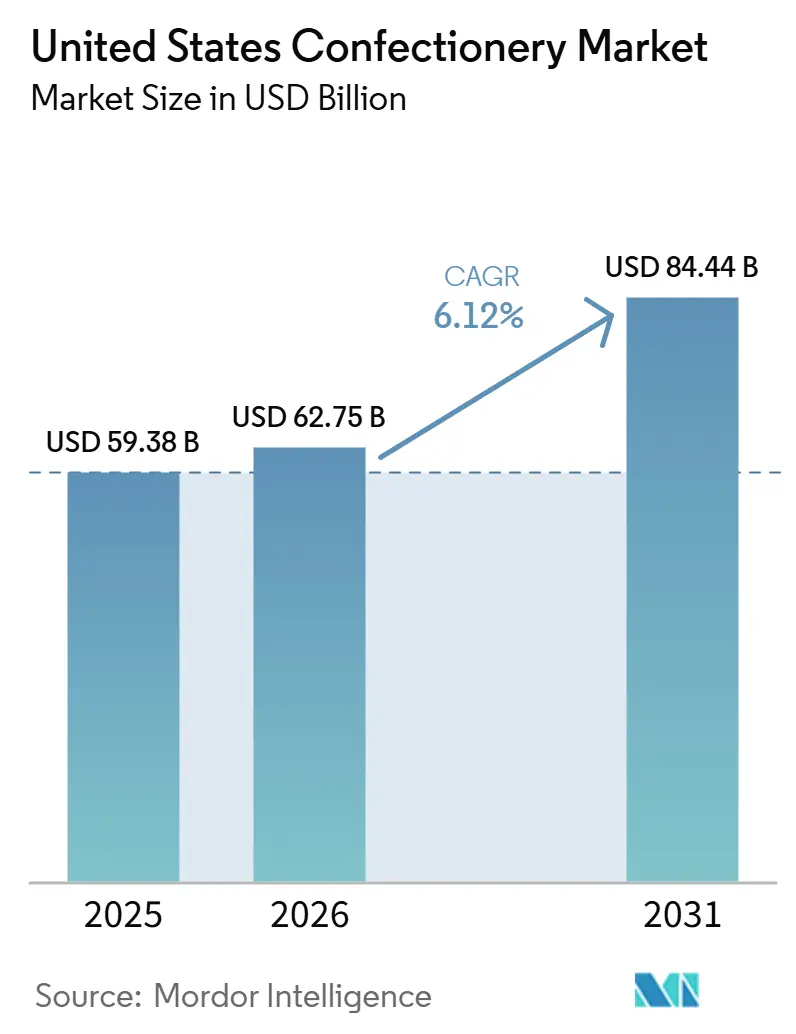
| Base Year Market Size (2025) | USD 59.38 Billion |
| Market Size (2026) | USD 62.75 Billion |
| Market Size (2031) | USD 84.44 Billion |
| Growth Rate (2026 - 2031) | 6.12 % |
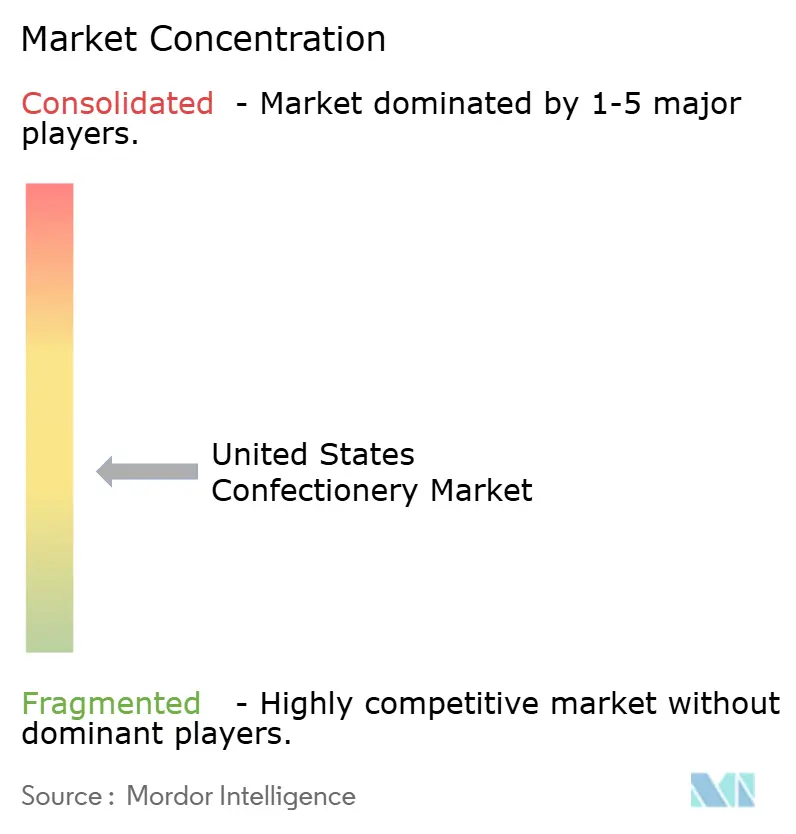
| Market Concentration | Medium |
Major Players
*Disclaimer: Major Players sorted in no particular order Image © Mordor Intelligence. Reuse requires attribution under CC BY 4.0. |
|
United States Confectionery Market Analysis by Mordor Intelligence
The United States confectionery market stood at USD 59.38 billion in 2025 and is valued at USD 62.75 billion in 2026, projected to reach USD 84.44 billion by 2031, expanding at a CAGR of 6.12% over the forecast period. Consumer engagement with the category remains near-universal, with 99.8% of US households purchasing confectionery at least once in 2025, according to the National Confectioners Association's (NCA) 2026 State of Treating report [1]Source: National Confectioners Association. "State of Treating 2026." candyusa.com. Mars, Incorporated's USD 36 billion acquisition of Kellanova in late 2025 has reshaped the competitive order, adding snacking portfolio breadth that gives the company unmatched retailer leverage across multiple adjacencies. Ferrero's USD 3.1 billion acquisition of WK Kellogg in September 2025 signals a similar multi-category ambition among challengers. Against this consolidation backdrop, mission-led and digitally native challenger brands, demonstrating more than 50% annual revenue growth in specific segments, are carving out permanent shelf positions by capturing Gen Z and Millennial demand for novelty, ethical sourcing, and sensory differentiation.
Key Report Takeaways
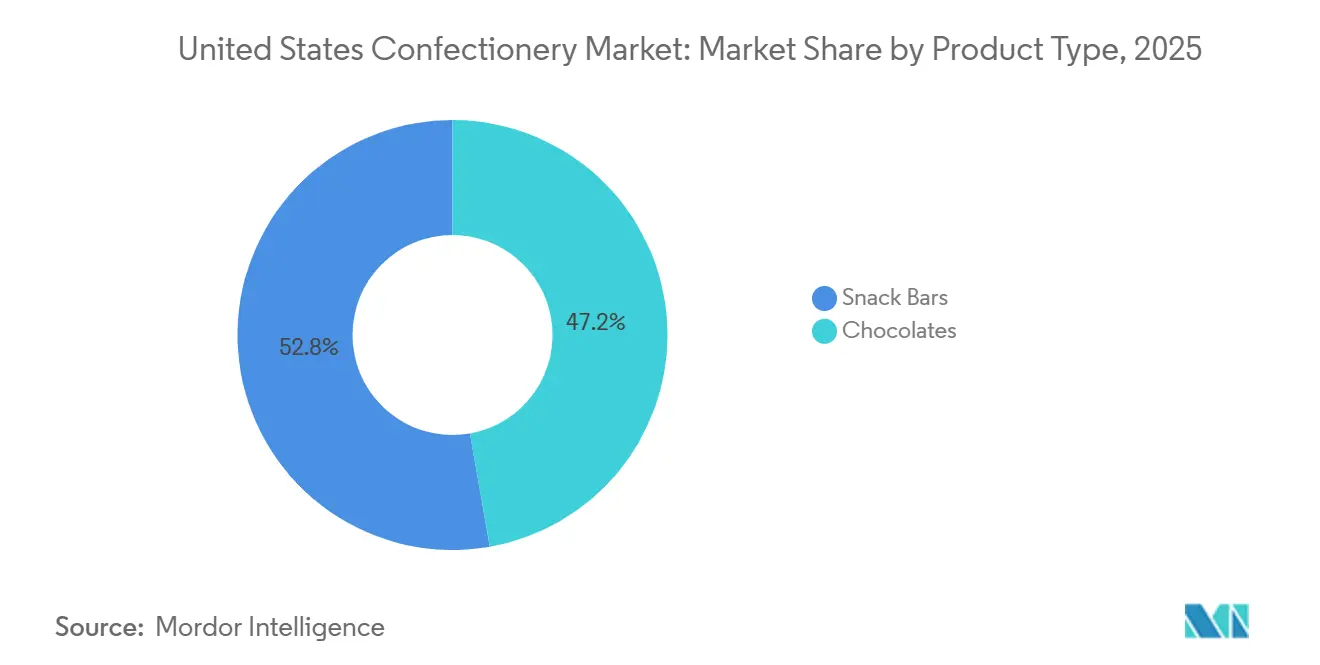
- By product type, chocolates held 47.22% of the United States confectionery market share in 2025, while snack bars are projected to record the highest CAGR of 6.88% through 2031.
- By packaging type, single-serve products accounted for 47.28% of the United States confectionery market share in 2025, while multipacks are forecast to grow at a 6.57% CAGR through 2031.
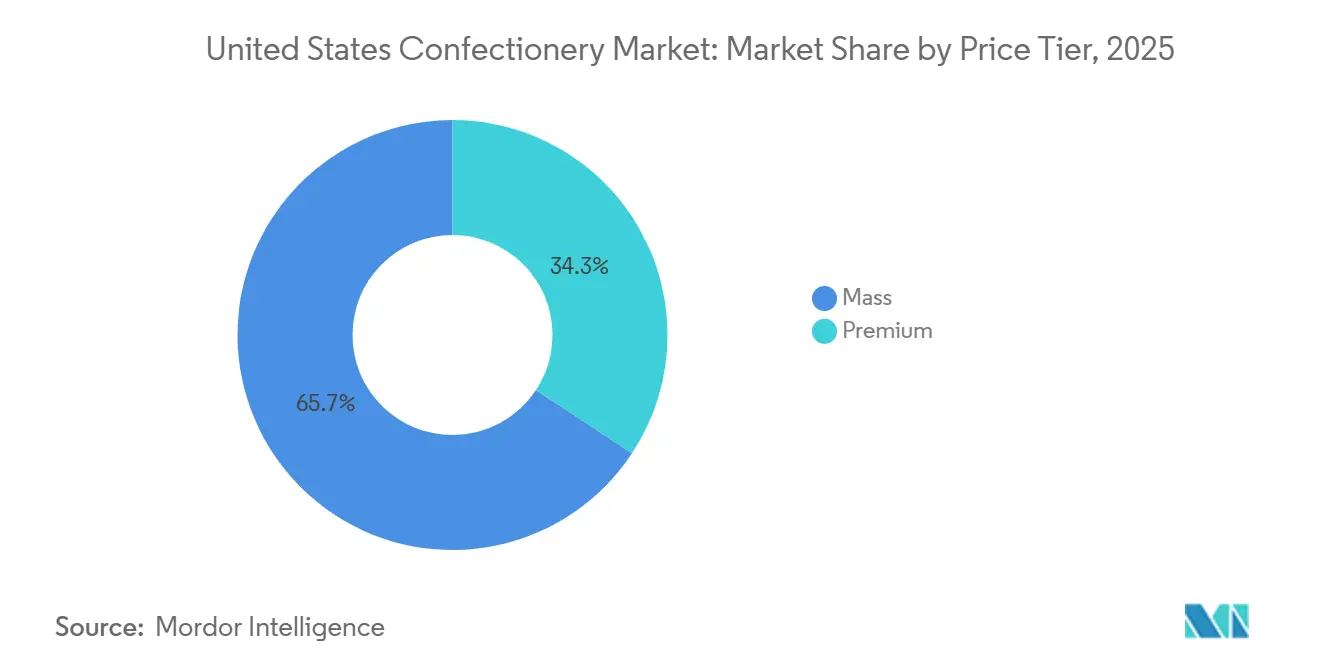
- By price tier, mass products held 65.73% of the United States confectionery market share in 2025, while premium products are expected to expand at a 6.93% CAGR through 2031.
- By distribution channel, supermarkets and hypermarkets captured 42.76% of the United States confectionery market share in 2025, while online retail stores are forecast to grow at a 6.74% CAGR through 2031.
Note: Market size and forecast figures in this report are generated using Mordor Intelligence’s proprietary estimation framework, updated with the latest available data and insights as of January 2026.
United States Confectionery Market Trends and Insights
Drivers Impact Analysis*
| Driver | (~) % Impact on CAGR Forecast | Geographic Relevance | Impact Timeline |
|---|---|---|---|
| Innovative flavours and formats driving product trials | +1.2% | National, strongest in urban metros and specialty retail corridors | Medium term (2–4 years) |
| Seasonal gifting and festive consumption boosting sales | +1.5% | National, with elevated concentration in suburban and mid-market mass retail | Short term (≤ 2 years) |
| Premium and artisanal confectionery gaining consumer interest | +1.3% | Coastal and urban markets; broadening to national through grocery and DTC channels | Medium term (2–4 years) |
| Social media marketing accelerates product discovery | +0.9% | National, disproportionate impact in 18–34 age demographics across all geographies | Short term (≤ 2 years) |
| Growing demand for novelty and limited-edition launches | +0.8% | National, with Gen Z and Millennial concentration in metropolitan areas | Medium term (2–4 years) |
| Convenience-driven snacking supports impulse confectionery purchases | +0.7% | National, with outsized growth in convenience and travel retail corridors | Short term (≤ 2 years) |
| Source: Mordor Intelligence | |||
Innovative Flavors and Formats Driving Product Trials
The willingness of U.S. consumers to experiment with unfamiliar textures and flavour combinations has become one of the most monetisable dynamics in the category. Circana's July 2025 shopper survey noted that flavour and format innovation, alongside omnichannel growth and pack-price flexibility, are among the five core forces sustaining confectionery category relevance. The less obvious implication is that format disruption, particularly the freeze-dried candy phenomenon, is creating micro-categories with standalone growth trajectories that are not captured in legacy segment data. TikTok's #freezedriedcandy hashtag had accumulated 4.7 billion views by early 2025, per confectionery trade publication data, and industry titans are already responding: The Hershey Company launched freeze-dried Jolly Rancher variants specifically to address the unmet demand for unique texture experiences that viral discovery had surfaced. Flavour mashups and co-branded formats are now accelerating new product development cycles, with innovation planning horizons at major manufacturers compressing from 18 to as few as 6 months to keep pace with trend velocity.
Seasonal Gifting and Festive Consumption Boosting Sales
The four major candy seasons, Valentine's Day, Easter, Halloween, and the winter holidays, accounted for the majority of all U.S. confectionery sales in 2025, according to the NCA's 2026 State of Treating report, a figure essentially unchanged from pre-pandemic levels and a sign that seasonal anchoring is structurally durable. The winter holidays alone generated approximately USD 7.5 billion in 2024, the largest single seasonal moment, while Halloween candy spending was projected at USD 3.9 billion in 2025 by the National Retail Federation [2]Source: National Retail Federation. "Halloween Data and Trends 2025." nrf.com. The second-order insight is that seasonal programming is now functioning as the primary growth driver for some manufacturers: Mondelēz International reported that seasonal confectionery accounted for all the company's U.S. confectionery category growth in 2025. This concentration effect means that supply chain agility, seasonal SKU management, and in-store activation capabilities are increasingly decisive competitive differentiators. The majority of consumers specified they want holiday-specific packaging, shapes, and flavours, which gives major brands with dedicated seasonal innovation pipelines a recurring structural advantage over value-only players.
Premium and Artisanal Confectionery Gaining Consumer Interest
Super-premium chocolate gained millions in incremental sales in 2025 from new-to-tier buyers alone, more than double the overall market pace. The critical strategic nuance here is that two-thirds of those super-premium dollars came directly from mainstream chocolate, not from organic growth: the category is cannibalising its own base rather than expanding the total confectionery pie. Lindt & Sprüngli North America grew organically by 8.9% in 2025 and accelerated to 12.7% organic growth in H1 2026, driven by Lindor, Excellence, and the Dubai Style chocolate rollout, according to the company's half-year results. Mars signalled its own premium commitment through the 2024 acquisition of Hotel Chocolat, deploying the UK brand's vertically integrated model, direct sourcing, strong DTC, and storytelling-driven retail as a template for premium credential-building within a mass portfolio. The FDA's proposed front-of-package nutrition labelling rule (Federal Register, January 2025), which would require Nutrition Info boxes flagging added sugars as Low, Medium, or High, is likely to accelerate reformulation in the mainstream tier, inadvertently strengthening the relative positioning of brands already marketing on clean-label or high-cocoa credentials[3]Source: US Food and Drug Administration. "Front-of-Package Nutrition Labeling: Proposed Rule." Federal Register, fda.gov.
Social Media Marketing Accelerates Product Discovery
Forty-eight percent of Gen Z consumers found new confectionery items via TikTok in 2025, compared with 58% of Boomers still discovering products in-store, according to the NCA's 2026 State of Treating report, a generational split that has direct implications for media investment allocation across the industry. TikTok has not only accelerated discovery but compressed the path from awareness to purchase: Pure Sugar Candy, a Massachusetts-based handcrafted candy company, attributed 50% of its total sales to online buyers after a single viral TikTok post driven by TV personality Bethenny Frankel's 3 million followers. The platform's influence on product development is underappreciated: BUBS, the Swedish candy brand, built its U.S. market entry strategy explicitly around TikTok viral demand before launching in Target, Walmart, Kroger, and Walgreens in August 2025, according to the company's press release. Circana data confirms that omnichannel buyers, those shopping both online and in-store, spend nearly twice as much on candy as single-channel shoppers, making social-to-shelf conversion a measurable revenue multiplier rather than simply a brand-building activity.
Restraints Impact Analysis*
| Restraint | (~) % Impact on CAGR Forecast | Geographic Relevance | Impact Timeline |
|---|---|---|---|
| Rising health concerns over sugar consumption | -1.2% | National; stronger among higher-income and college-educated demographics | Long term (≥ 4 years) |
| Volatile cocoa and sugar prices impact margins | -1.0% | National; most acute for mid-tier manufacturers with limited hedging capability | Medium term (2–4 years) |
| Stringent food labeling and regulatory requirements | -0.6% | National; compliance burden concentrated in mainstream and reformulating segments | Medium term (2–4 years) |
| Consumer shift toward healthier snack alternatives | -0.9% | National; outpaced by strong in snack bars, specialty, and BFY confectionery formats | Long term (≥ 4 years) |
| Source: Mordor Intelligence | |||
Rising Health Concerns Over Sugar Consumption
Sugar-related health concerns are exerting structural pressure on confectionery consumption frequency, even as per-occasion spending rises. What makes this restraint strategically complex is that it cuts differently across income bands: higher-income GLP-1 households reduced grocery spending by more, but Lindt simultaneously reported that US premium chocolate sales rose nearly 17% among GLP-1 users in 2025 versus 6.5% among non-users, suggesting that health-conscious consumers are reducing frequency but trading up sharply on the occasions they do indulge. The FDA's January 2025 proposed front-of-package rule, requiring packaged foods to display saturated fat, sodium, and added sugars as Low, Medium, or High on the principal display panel, is a compliance factor that will compel reformulation, particularly in the hard candy, gummy, and standard chocolate segments. The brazzein sweetener, approved by the FDA via a "No Questions" letter issued in April 2025, offers a precision fermentation-derived natural alternative that could enable manufacturers to achieve 20–40% sugar reduction without compromising sensory quality, but commercial-scale deployment at major brands is still several years away.
Volatile Cocoa and Sugar Prices Impact Margins
The U.S. confectionery industry remains highly exposed to fluctuations in cocoa and sugar prices, as these ingredients represent a significant share of production costs. Cocoa prices reached record levels during 2024–2025 due to supply disruptions and adverse weather conditions in major producing countries, prompting manufacturers such as Hershey to implement price increases and absorb higher input costs. Hershey reported that elevated commodity costs, including cocoa, reduced its confectionery segment margins despite strong sales performance, highlighting the pressure on profitability. Persistent raw material price volatility also limits manufacturers' ability to plan production and pricing strategies, particularly in the highly competitive mass-market confectionery segment.
Rising Health Concerns Over Sugar Consumption
Growing awareness of the health risks associated with excessive sugar intake is restraining demand for traditional confectionery products in the United States. According to the Centers for Disease Control and Prevention (CDC), excessive added sugar consumption is linked to obesity, type 2 diabetes, and heart disease, while more than three in five Americans consume added sugars above recommended levels. Consumer scrutiny of sugar content is increasing, with an International Food Information Council (IFIC) survey finding that 63% of Americans are concerned about the amount of sugar they consume. This trend is encouraging a shift toward reduced-sugar, sugar-free, and better-for-you snack alternatives, compelling confectionery manufacturers to reformulate products and invest in healthier offerings.
*Our forecasts treat driver/restraint impacts as directional, not additive. The impact forecasts reflect baseline growth, mix effects, and variable interactions.
Segment Analysis
By Product Type: Snack Bars Gaining Ground on Legacy Chocolate
Chocolates hold a commanding 47.22% share of the United States confectionery market in 2025, an enduring position built on deep brand equity, seasonal gifting cycles, and near-universal household penetration. Snack bars are the fastest-growing segment at a 6.88% CAGR through 2031, as protein-centric consumption shifts redirect snack occasions away from pure indulgence toward functional satisfaction. The Simply Good Foods Company's Quest brand, which operates within the protein bar sub-category, generated USD 863 million in net sales in fiscal 2025, a 13% increase on a 52-week basis and a compound annual growth rate of approximately 20% since its 2019 acquisition, according to the company's fiscal 2025 annual report filed with the SEC.
Within the snack bar segment, the protein bar sub-segment held the largest share in 2025, followed by cereal bars and fruit & nut bars; energy bars are the smallest sub-segment but benefit from fitness culture tailwinds and increasing distribution through convenience and specialty channels. Gums posted growth, while sugar confectionery, spanning hard candy, lollipops, mints, gummies, pastilles, and toffees, gained ground relative to chocolate for the third consecutive year. Non-chocolate candy's share rose in 2025, a trend driven by Gen Z and Millennials over-indexing for gummy, chewy, and freeze-dried formats versus Boomers' preference for traditional milk and dark chocolate. The BUBS viral launch and HARIBO's Wisconsin production ramp, moving from a 157,656 sq ft facility to a 447,216 sq ft warehouse near its Pleasant Prairie factory in Q2 2024, both reflect a supply-side response to surging US demand for gummy and sugar confectionery.



By Packaging Type: Multipacks Emerging as a Structural Growth Driver
Single-serve formats held 47.28% of the United States confectionery market in 2025, sustained by impulse purchasing at checkout counters, convenience stores, and vending channels where individual portioning and price-point accessibility are dominant purchase drivers. Multipacks are the fastest-growing packaging format, projected at a 6.57% CAGR through 2031, as household buying behaviour and club store expansion reshape the purchase occasion mix. Hershey identified multipacks as the "next growth frontier," backed by consumer research showing they represent a USD 20 billion-plus opportunity across total snacking, with 94% household penetration and 73.4% household penetration specifically in salty snacks, up 14% over four years, according to Hershey's 2025 NCA Sweets & Snacks Expo presentation. The less visible dynamic is that multipacks are functioning as a trip driver at retail: retailers are expanding shelf space to accommodate format growth, and manufacturers are launching multi-brand variety boxes to capture cross-category household baskets.
The shift toward multipacks also reflects a value-seeking behaviour pattern that emerged through successive years of confectionery price inflation. Circana data indicates that trips to value-forward channels, including hard discounters and club stores, increased in 2025, and multipacks are the default format in these environments. GLP-1 users are simultaneously emerging as a new demand driver for smaller portion multipacks: as GLP-1 adopters shift toward more controlled, bite-sized consumption occasions, pre-portioned multipack formats offer the right quantity per occasion without requiring full-size restraint.
By Price Tier: Premium Outpaces Mass Despite Value Headwinds
The mass tier dominated the United States confectionery market at 65.73% in 2025, underpinned by household budget constraints and the structural density of value-retail channels including dollar stores, club chains, and discount grocery. Premium is the fastest-growing price tier at a 6.93% CAGR through 2031, propelled by consumers who continue to prioritise their favourite treats even under economic pressure. NCA's 2026 survey found that 51% of U.S. consumers will pay more for a confectionery item if it is their favourite, and 42% will spend more for gifting purposes. This bifurcation creates a structural margin opportunity for manufacturers willing to invest in premium portfolio development, though with the risk of cannibalising mainstream consumers.
Lindt & Sprüngli's North America business, encompassing Lindt, Ghirardelli, and Russell Stover, achieved CHF 2.18 billion in revenue in 2025 with 8.9% organic growth, and the group accelerated to 12.7% organic growth in H1 2026, per the company's official results releases. Meanwhile, Mars's acquisition of Hotel Chocolat positions it to capture premium credentials in the DTC and experience-retail channel without disrupting its mainstream core. The tension between the two price tiers is likely to persist through the forecast period, with premium growth partly offset by mass-tier volume erosion as inflationary pressures slowly ease.
By Distribution Channel: Online Retail Gaining Share While Supermarkets Anchor Volume
Supermarkets and hypermarkets held 42.76% of the United States confectionery market in 2025, a position reinforced by high foot traffic, impulse placement at checkout, and the dominance of seasonal front-of-store activations that drive discretionary purchases. Online retail stores are the fastest-growing channel at a 6.74% CAGR through 2031, driven by subscription formats, bulk buying behaviour, and DTC access to limited-edition and premium brands with constrained physical shelf space. Circana's July 2025 data confirmed that omnichannel buyers spend nearly twice as much on candy as single-channel in-store buyers, which is creating pressure on brands to treat e-commerce as a primary discovery and retention engine rather than a secondary fulfilment channel.
Convenience stores remain a critical impulse channel, particularly for single-serve formats, while online retail is enabling challenger brands, including digitally native and international entrants, to establish national consumer relationships before achieving broad physical distribution. BUBS leveraged its TikTok-driven viral demand to negotiate shelf placement at Target, Walmart, Kroger, Albertsons, CVS, and Walgreens simultaneously at launch in August 2025, a go-to-market model that would have required years of regional broker-led distribution under legacy channel norms. The U.S. Census Bureau's Quarterly E-Commerce Report for Q1 2026 recorded e-commerce at 16.8% of total retail sales, and the structural trajectory of digital grocery is expected to continue redirecting confectionery discovery and purchase behaviours across all consumer segments.
Geography Analysis
The United States is the world's largest confectionery market in terms of revenue and absorbs the full output of major global manufacturers, including Mars, Hershey, Mondelēz, Ferrero, Lindt, and HARIBO, from their growing domestic production footprints. Seasonal demand cycles, with Valentine's Day, Easter, Halloween, and the winter holidays accounting for the majority of annual sales in 2025, create a highly predictable but also highly competitive promotional calendar in which shelf placement, pricing, and seasonal-specific SKU investment are decisive. The U.S. market benefits from a comprehensive multi-channel retail infrastructure spanning grocery, mass merchandise, club, convenience, drug, and e-commerce, a breadth that supports both impulse and planned purchase occasions across all price tiers.
Consumer behaviour within the US market has been shaped by a convergence of macroeconomic pressures and demographic divergence over the 2025–2026 period. Gen Z and Millennial cohorts, who collectively represent the next two decades of peak consumption, over-index heavily for non-chocolate formats, including gummy, chewy, sour, freeze-dried, and functional snack bars, while Boomers maintain their preference for traditional milk and dark chocolate. This generational split is driving a product portfolio bifurcation that is already visible in shelf resets: retailers are expanding gummy and functional snack bar adjacencies at the expense of standard candy bar facings, particularly in urban grocery formats.
Manufacturing investment within the U.S. accelerated meaningfully in 2025–2026, reflecting both tariff incentive structures and long-term growth confidence. HARIBO's Pleasant Prairie, Wisconsin factory, opened in 2023 as the company's first U.S. production site, was already scaling toward a phased expansion target of potentially 2 million square feet, with warehouse operations tripling capacity in Q2 2024. This wave of domestic investment is reducing import exposure, moderating tariff risk, and building the production agility needed to respond to trend-driven demand cycles at U.S. retail speed.
Competitive Landscape
The United States confectionery market's concentration score captures a meaningful tension: a dominant upper tier of three to five global multinationals controls the majority of shelf space and promotional budgets, while a fragmented lower tier of regional and challenger brands accounts for a disproportionate share of category dynamism and trend origination. The competitive dynamics are being reshaped by three concurrent forces in 2026: post-merger integration pressure at Mars following the USD 36 billion Kellanova acquisition; a wave of defensive portfolio diversification at mid-tier players like Hershey and Mondelēz; and a sustained insurgency by mission-led and digitally-native brands capturing Gen Z loyalty through ethical sourcing, viral social discovery, and DTC channel ownership. Mars now holds the broadest multi-category snacking portfolio in the market, with Snickers, M&M's, Twix, Skittles, and Kellanova's Pringles, Cheez-It, and RXBAR creating cross-aisle retailer leverage that challengers cannot easily match.
Patent and process innovation is also becoming a differentiator: Belgium-based Puratos has partnered with California Cultured on cell-based cocoa powder expected to reach US commercial scale by year-end 2026, per IFT Food Technology Magazine coverage, signalling that a new generation of cocoa supply security strategies is entering industrialisation. White space in the market remains concentrated in functional confectionery, where protein-fortified, fibre-rich, and GLP-1-compatible formats are converging snacking and confectionery demand. Hershey's USD ~750 million acquisition of LesserEvil in November 2025, adding organic puffs and snack bars including the R.E.D.D plant-based bar brand to its portfolio, reflects the clearest bet yet that a confectionery incumbent will compete directly in the better-for-you adjacency rather than watching that occasion migrate to non-confectionery companies.
Mondelēz is pursuing a parallel path: its Perfect Bar brand (20 grams of protein) and Hu premium vegan chocolate are beginning to show measurable retail traction in 2026, per CEO Dirk Van de Put's comments to investors in February 2026. Compliance with FDA labelling evolution, specifically, the front-of-package rule proposed in January 2025, is expected to create a short-term reformulation wave in the mainstream segment, disproportionately benefiting companies that have already invested in cleaner label credentials. Tony's Chocolonely's 50% year-on-year US revenue growth to EUR 75 million in the fiscal year ended September 2025 demonstrates that differentiated ethical positioning, open-chain sourcing, and slavery-free cocoa certification are a scalable competitive advantage in the US rather than a niche preference.
United States Confectionery Industry Leaders
-
Mars, Incorporated
-
The Hershey Company
-
Mondelez International, Inc.
-
Ferrero International S.A.
-
Chocoladefabriken Lindt & Sprüngli AG
- *Disclaimer: Major Players sorted in no particular order

Recent Industry Developments
- June 2026: Mondelēz International launched SOUR PATCH KIDS BESTIES, a shareable, social candy format in which four Sour Patch Kids are linked together, targeting Gen Z friendship occasions. The 7.17 oz peg bag is available nationally at USD 3.29 per the company press release.
- March 2026: Mars, Mondelēz, Nestlé, Hershey, and Lindt announced a joint initiative to transform cocoa supply chain practices and protect cocoa growers, per Confectionery News coverage of March 2026. The consortium signals industry-wide recognition that cocoa supply security requires coordinated action beyond individual procurement strategies.
- January 2026: Mars completed integration planning following its USD 36 billion acquisition of Kellanova (closed December 2025), establishing a new regional office hub in Chicago's Fulton Market District to support North American operations of the combined Mars and Kellanova portfolio. The deal, financed with a combination of loans and long-term debt, was approved unconditionally by US antitrust regulators.


United States Confectionery Market Report Scope
The confectionery market comprises chocolate, sugar confectionery, gum, and snack bar products manufactured and sold for indulgence, gifting, and everyday consumption. The United States confectionery market is segmented by Product Type (Chocolates, Gums, and More), Packaging Type (Single-Serve and Multipacks), Price Tier (Mass and Premium), and Distribution Channel (Supermarkets/Hypermarkets, Convenience Stores, and More). The market forecasts are provided in terms of Value (USD).
| Chocolates | Dark |
| Milk/White | |
| Gums | Chewing Gum |
| Bubble Gum | |
| Sugar Confectionery | Hard Candy |
| Lollipops | |
| Mints | |
| Pastilles, Gummies, and Jellies | |
| Toffes and Nougats | |
| Others | |
| Snack Bars | Protein Bar |
| Cereal Bar | |
| Fruit & Nut Bar | |
| Energy Bar |
| Single-serve |
| Multipacks |
| Mass |
| Premium |
| Supermarkets/Hypermarkets |
| Convenience Stores |
| Online Retail Stores |
| Other Distribution Channels |
| By Product Type | Chocolates | Dark |
| Milk/White | ||
| Gums | Chewing Gum | |
| Bubble Gum | ||
| Sugar Confectionery | Hard Candy | |
| Lollipops | ||
| Mints | ||
| Pastilles, Gummies, and Jellies | ||
| Toffes and Nougats | ||
| Others | ||
| Snack Bars | Protein Bar | |
| Cereal Bar | ||
| Fruit & Nut Bar | ||
| Energy Bar | ||
| By Packaging Type | Single-serve | |
| Multipacks | ||
| By Price Tier | Mass | |
| Premium | ||
| By Distribution Channel | Supermarkets/Hypermarkets | |
| Convenience Stores | ||
| Online Retail Stores | ||
| Other Distribution Channels | ||


Key Questions Answered in the Report
What is the projected size of the United States confectionery market?
The United States confectionery market is valued at USD 62.75 billion in 2026 and is projected to reach USD 84.44 billion by 2031, growing at a 6.12% CAGR.
Which product category leads confectionery sales in the United States?
Chocolates are the largest product category, with a 47.22% share in 2025. Their position reflects strong household penetration, established brand loyalty, and seasonal gifting demand.
Which confectionery segment is growing the fastest?
Snack bars are the fastest-growing product segment, with a projected CAGR of 6.88% through 2031. Protein-focused products are supporting demand for functional snacking occasions. Quest generated USD 863 million in net sales in fiscal 2025.
Why are premium confectionery products growing faster than mass products?
Premium products are forecast to grow at a 6.93% CAGR as consumers continue to spend on preferred treats and gifting occasions. The National Confectioners Association reported that 51% of consumers would pay more for a favorite confectionery item.
Page last updated on:





