
United Kingdom Quick Commerce Logistics Market Size and Share
Market Overview
| Study Period | 2020 - 2031 |
|---|---|
| Forecast Data Period | 2026 - 2031 |
| Base Year Market Size (2025) | USD 1.52 Billion |
| Market Size (2026) | USD 1.66 Billion |
| Market Size (2031) | USD 2.49 Billion |
| Growth Rate (2026 - 2031) | 8.45 % |
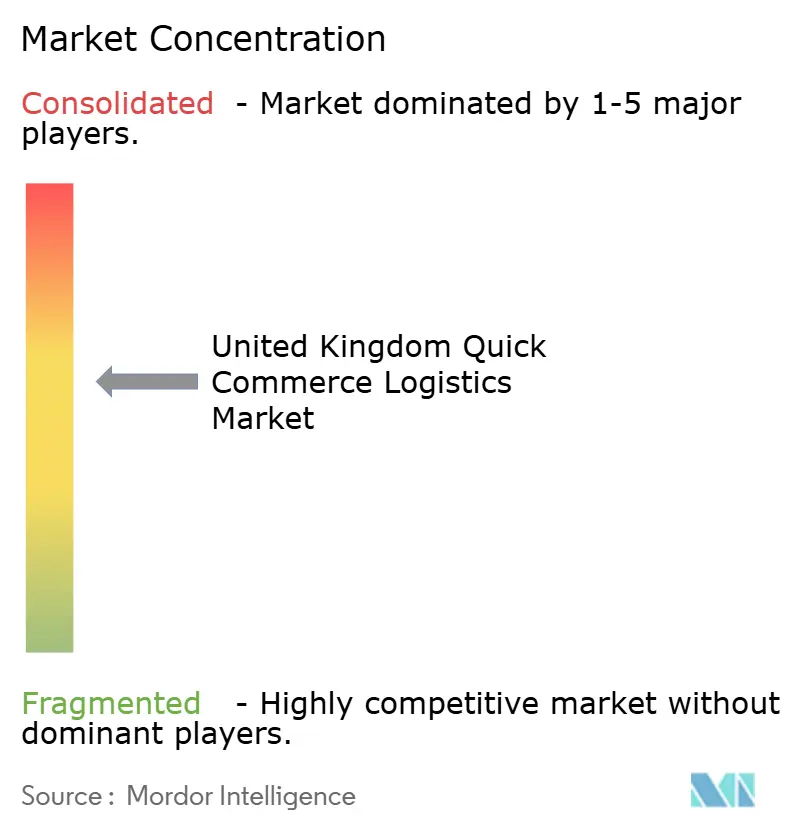
| Market Concentration | Medium |
Major Players *Disclaimer: Major Players sorted in no particular order Image © Mordor Intelligence. Reuse requires attribution under CC BY 4.0. | |
United Kingdom Quick Commerce Logistics Market Analysis by Mordor Intelligence
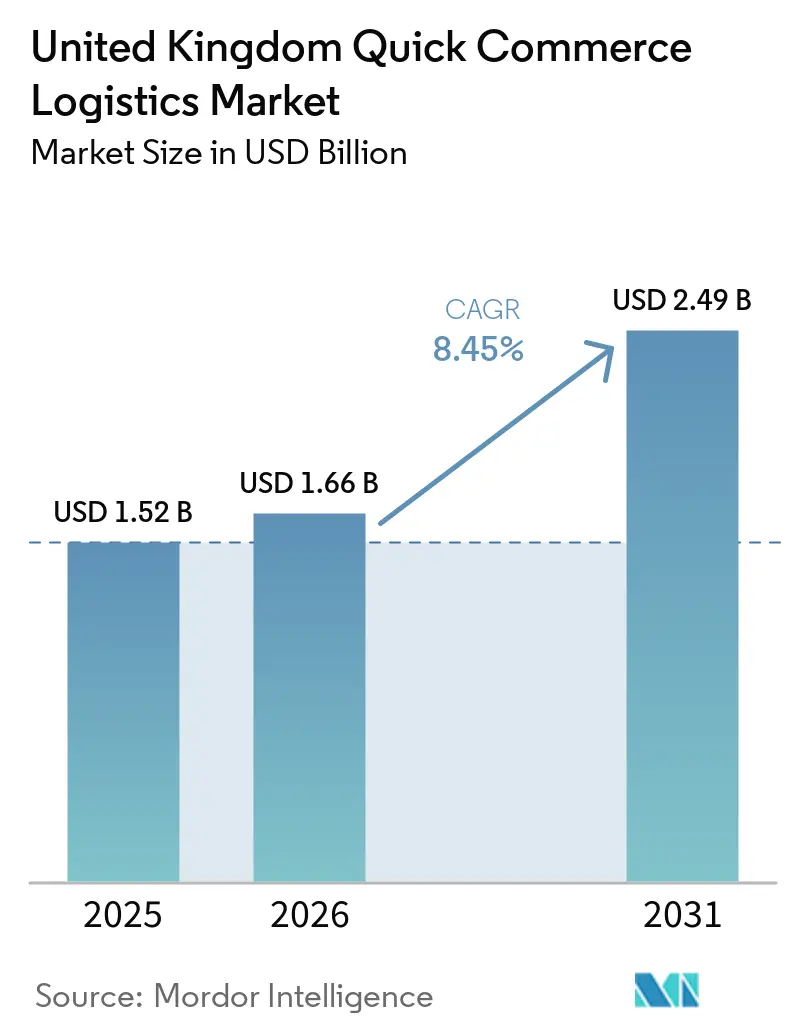
The United Kingdom quick commerce logistics market size was valued at USD 1.52 billion in 2025 and is estimated to grow from USD 1.66 billion in 2026 to reach USD 2.49 billion by 2031, at a CAGR of 8.45% during the forecast period (2026-2031).
Established retailers are making rapid delivery a continuing operating capability instead of treating it as a separate trial. The United Kingdom processed 4.2 billion parcels in 2024-25, 7% more than the prior year, and this volume exceeded the pandemic peak[1]“Best and Worst Parcel Firms for Customer Satisfaction Revealed 2025,” Ofcom, ofcom.org.uk. Dense urban grocery areas support shorter delivery routes and more frequent orders, which improve the economics of sub-hour fulfillment. Retailers with existing stores can extend geographic coverage without adding a dedicated dark-store lease to each local operation. The United Kingdom quick commerce logistics market also faces pressure outside major city corridors, where lower order density makes individual deliveries harder to support without revenue from denser routes.
Key Report Takeaways
- By service type, last-mile delivery services held 51.6% of the United Kingdom quick commerce logistics market share in 2025, while reverse logistics services are projected to grow at a 12.81% CAGR through 2031.
- By fulfillment model, retail store-based fulfillment held 34.99% of the United Kingdom quick commerce logistics market size in 2025, while micro-fulfillment center-based fulfillment is projected to grow at a 12.39% CAGR through 2031.
- By delivery model, B2C held 86.7% of the United Kingdom quick commerce logistics market share in 2025, while B2B is projected to grow at a 15.55% CAGR through 2031.
- By city tier, Tier 1 cities held 62.18% of the United Kingdom quick commerce logistics market size in 2025, while Tier 3 and below are projected to grow at an 18.40% CAGR through 2031.
- By region, England accounted for 80,04% of the United Kingdom quick commerce logistics market size in 2025, while Northern Ireland is projected to grow at a 15.41% CAGR through 2031.
Note: Market size and forecast figures in this report are generated using Mordor Intelligence’s proprietary estimation framework, updated with the latest available data and insights as of January 2026.
United Kingdom Quick Commerce Logistics Market Trends and Insights
Drivers Impact Analysis*
| Driver | (~) % Impact on CAGR Forecast | Geographic Relevance | Impact Timeline |
|---|---|---|---|
| Rising Demand for 10 to 30 Minute Grocery Fulfillment | +2.3% | England, especially London, Manchester, and Birmingham, with expansion into Tier 2 cities | Short term (≤ 2 years) |
| Retailer Conversion of Stores Into Local Fulfillment Hubs | +1.6% | National, with the highest adoption in England and Scotland | Medium term (2-4 years) |
| Amazon and Supermarket Reinforcement of Dense Dark Store Networks | +1.2% | Greater London, followed by Manchester and Birmingham | Medium term (2-4 years) |
| Growth of Platform-Led White Label Quick Commerce Partnerships | +1.0% | England and Scotland, with early gains in Wales and Northern Ireland | Medium term (2-4 years) |
| Expansion of Parcel-Rich Urban Micro Catchments in Tier 1 Cities | +0.8% | London, Manchester, Birmingham, and Edinburgh | Short term (≤ 2 years) |
| Retail Media and Loyalty Ecosystem Monetization Supporting Repeat Orders | +0.6% | National, especially digital retailers and platform operators | Long term (≥ 4 years) |
| Source: Mordor Intelligence | |||
Rising Demand for 10 to 30 Minute Grocery Fulfillment
Demand for sub-hour grocery delivery is visible in shopping behavior rather than preference surveys alone. This showed that quick-commerce use rose from 19% of United Kingdom shoppers in November 2024 to 22% in March 2026. This pattern supports more regular use for grocery needs instead of isolated convenience purchases. It also increases the volume that local fulfillment networks process across busy urban periods. The United Kingdom quick commerce logistics market benefits when recurring grocery orders make delivery routes and nearby inventory more productive.
Retailer Conversion of Stores into Local Fulfillment Hubs
Large grocery chains are using stores as local pick-and-pack locations because existing space and inventory reduce the need for dedicated facilities. Tesco Whoosh operates from 1,800 stores in 2026 and reaches more than 70% of United Kingdom households. Whoosh sales rose 51% year-over-year and exceeded USD 512 million. Retailers can use store employees to pick orders and connect with last-mile partners instead of financing a new site for every neighborhood. This structure lowers the capital needed to extend rapid delivery beyond the largest cities. It also gives established retailers a practical route into the United Kingdom quick commerce logistics market, where they already have local store coverage.
Growth of Platform-Led White Label Quick Commerce Partnerships
White-label delivery networks allow retailers and food brands to offer rapid delivery without building their own courier operation. In July 2026, Tesco announced that Whoosh would be available through Uber Eats and Deliveroo later in the quarter. The decision followed Sainsbury’s reported on-demand sales of more than USD 896 million in 2025, supported by listings across Deliveroo, Uber Eats, and Just Eat. In December 2025, the Freight Innovation Fund awarded nearly USD 1.4 million to 9 technology firms for capacity sharing, rail-freight courier integration, and lightweight freight solutions[2]“Government Boost for Businesses to Drive Freight Innovation,” GOV.UK, gov.uk. These tools can support shared fulfillment capacity and local delivery coordination. Platform partnerships can reduce the need for proprietary delivery assets while making customer data, loyalty activity, and local node coverage more important to the United Kingdom quick commerce logistics market.
Amazon and Supermarket Reinforcement of Dense Dark Store Networks
Amazon launched Amazon Now from a Southwark micro-fulfillment site in January 2026 and added several London locations before extending the service to Manchester in July 2026. The network included Bethnal Green, Battersea, Lewisham, Hampstead, Notting Hill, Haringey, Walthamstow, and Wembley during 2026. Amazon stated that it would invest USD 51.2 billion in the United Kingdom between 2025 and 2027. The investment program includes four fulfillment centers and upgrades to more than 100 operational buildings. The company repurposed former Amazon Fresh assets after closing 14 Fresh stores in September 2025. Tesco acquired 5 former Fresh locations for its own estate, showing that suitable urban sites can move between competing retail networks. These developments increase the availability of purpose-built local capacity in the United Kingdom quick commerce logistics market.
Restraints Impact Analysis*
| Restraint | (~) % Impact on CAGR Forecast | Geographic Relevance | Impact Timeline |
|---|---|---|---|
| High Cost to Serve in Sparse Demand Corridors | -1.5% | Tier 2, Tier 3, and rural areas across Wales, Northern Ireland, and Scotland | Long term (≥ 4 years) |
| Rider Availability and Peak Hour Capacity Constraints | -0.9% | National, concentrated in high-density urban areas | Short term (≤ 2 years) |
| Planning Friction for Inner City Fulfillment Nodes | -0.8% | England, particularly Greater London and urban areas | Medium term (2-4 years) |
| Profitability Pressure from Multi-Order Basket Dilution | -0.6% | National, affecting aggregator-dependent operators | Medium term (2-4 years) |
| Source: Mordor Intelligence | |||
High Cost to Serve in Sparse Demand Corridors
Rapid delivery outside major urban areas remains difficult when order density cannot support closely grouped stops. Lower route density raises the delivery cost for each order and limits the reach of dedicated dark-store models. The Employment Rights Act 2025 was implemented in phases in February, April, and August 2026. This identifies worker-status protections, statutory sick pay, paid annual leave, and pension auto-enrollment as factors that raise the labor-cost floor for platform delivery. Operators with dense routes and established workforce structures can manage this change more readily than thin-margin, gig-dependent services. Rider availability during peak periods and weak order economics from smaller baskets add to the operating challenge for the United Kingdom quick commerce logistics market in lower-density areas[3]“Plan to Make Work Pay and Employment Rights Act Timeline Update,” GOV.UK, gov.uk.
Planning Friction for Inner City Fulfillment Nodes
Dark stores and micro-fulfillment centers in inner cities still meet site-specific planning requirements. Before August 2026, England lacked a dedicated national policy that recognized logistics facilities and their operating needs. The August 2026 National Planning Policy Framework revision introduced Policy E3 for freight and logistics. The policy directs planners to consider strategic transport access, electric vehicle charging, night operations, and secure vehicle parking. The Chartered Institute of Logistics and Transport United Kingdom welcomed the change because it gives freight and logistics a clearer national policy position. Operators still need to address highways, ecological, flood-risk, and Green Belt matters, so the United Kingdom quick commerce logistics market retains site-level approval risks.
*Our forecasts treat driver/restraint impacts as directional, not additive. The impact forecasts reflect baseline growth, mix effects, and variable interactions.
Segment Analysis
By Service Type: Last-Mile Delivery Holds Scale, Reverse Logistics Posts Faster Growth
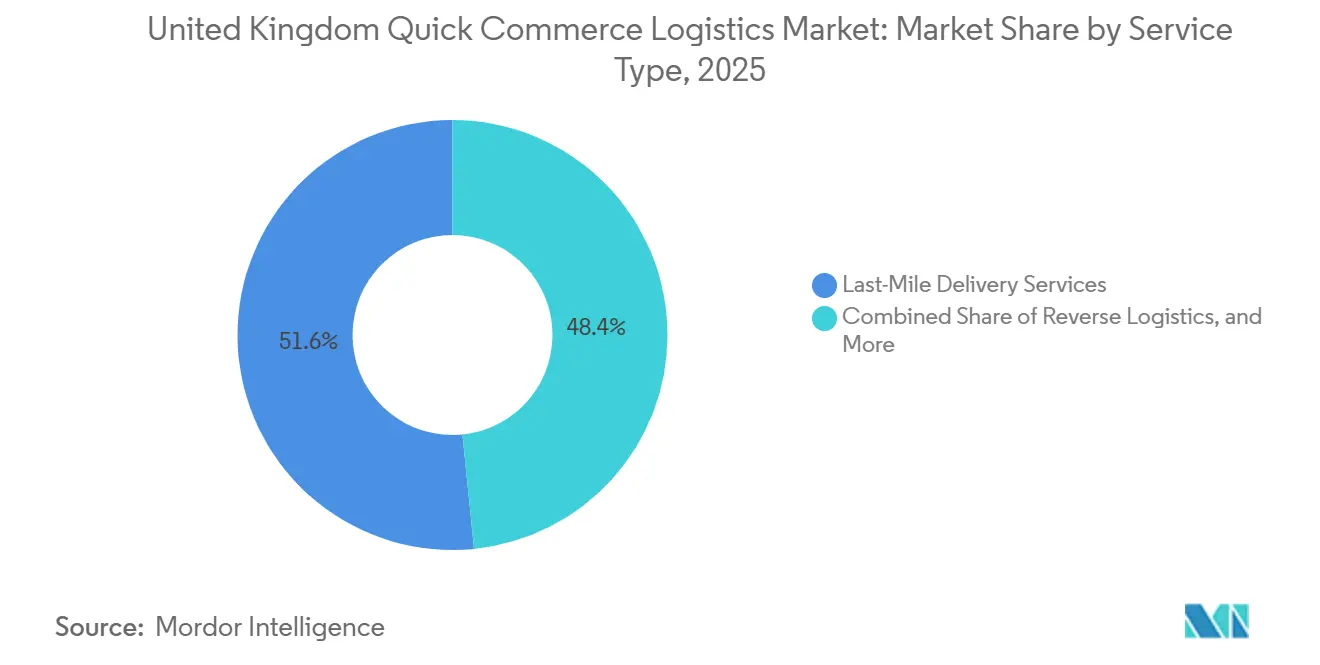
Last-mile delivery services accounted for 51.60% of the United Kingdom quick commerce logistics market size in 2025. The segment is the final and time-sensitive link in every sub-hour fulfillment chain. Order concentration in London, Manchester, and Birmingham can lower the cost per drop when multiple deliveries occur within the same local area. The CMA cleared the Evri and DHL eCommerce United Kingdom merger without conditions on September 4, 2025. The combined group has more than 30,000 couriers and van drivers, 12,000 additional staff, and 8,000 vehicles. Its scale supports capacity for more than 1 billion parcels each year and adds 15,000 out-of-home delivery points.
Reverse logistics services have the fastest projected service-type growth at a 12.81% CAGR through 2031. This indicates online return rates of 26% across the United Kingdom and 40% for fashion. DHL Supply Chain launched its Return Network in October 2025 with 11 purpose-built facilities for multi-product returns[4]“Evri DHL Merger Inquiry,” Competition and Markets Authority, gov.uk. The shared infrastructure is designed to shorten inspection and restocking for multiple retail clients. Fulfillment and dark-store operations, plus value-added logistics, account for the remaining service activity. Value-added work includes refurbishment, recommerce, and restocking of returned goods. This supports a larger role for returns processing within the United Kingdom quick commerce logistics market.



By Fulfillment Model: Retail Stores Lead, Micro-Fulfillment Centers Grow Faster
Retail store-based fulfillment held 34.99% of the United Kingdom quick commerce logistics market share by fulfillment model in 2025. Existing store space avoids the capital requirement of a purpose-built facility. Grocery retailers also have local inventory, store teams, and relationships with delivery platforms. These features make stores a readily available base for rapid delivery. Tesco’s 1,800-store Whoosh network demonstrates the scale that can be achieved with this approach. Sainsbury’s reported USD 896 million in 2025 on-demand sales through Deliveroo, Uber Eats, and Just Eat. Multi-platform access can increase the return on established store operations.
Micro-fulfillment center-based fulfillment is the fastest-growing model, with a projected CAGR of 12.39% through 2031. Dark store-based fulfillment has regained relevance through Amazon Now’s urban rollout. The model uses dedicated micro-fulfillment capacity, including sites under railway arches and in light-industrial units. Hybrid operations combine elements of store and dedicated-site fulfillment. Ocado deployed Swift Router across all 6 customer fulfillment centers by April 2026. The system processed 268 units each hour, 12% more than the previous year, and supported delivery windows as short as 100 minutes for a full-basket order. Automation can therefore strengthen dispatch speed where higher local volumes support the required investment.
By Delivery Model: B2C Provides Volume, B2B Expands Through Contracted Resupply
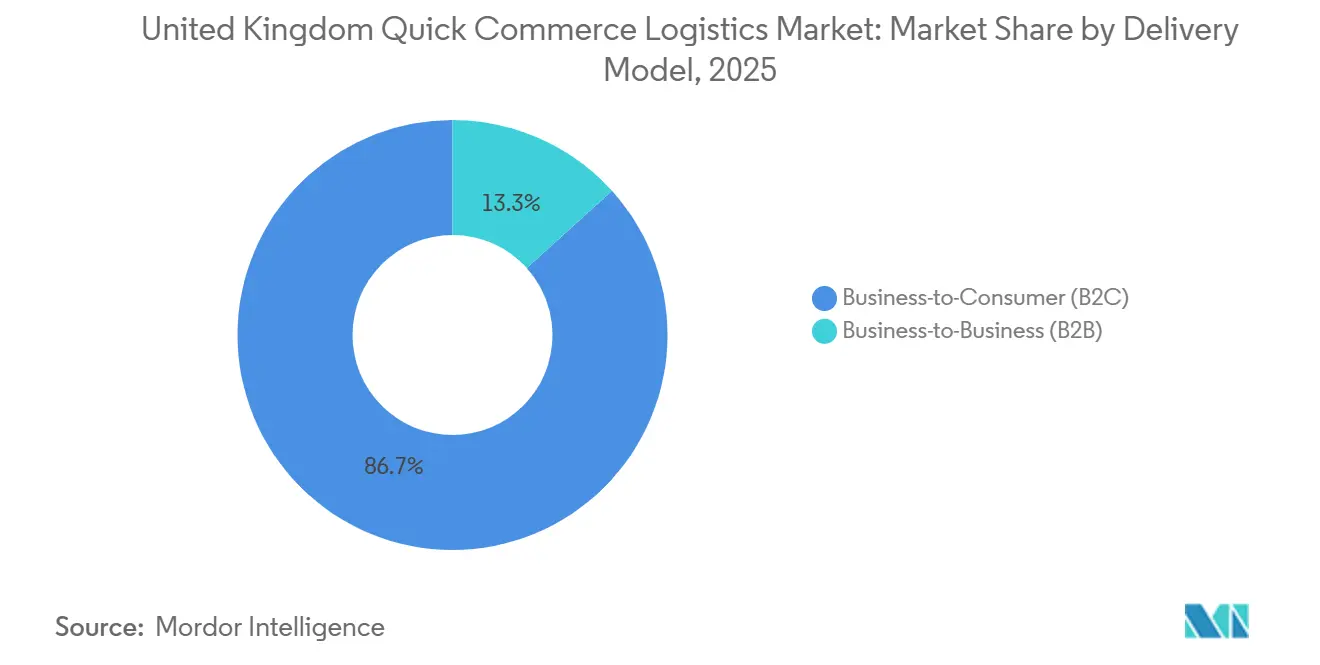
B2C accounted for 86.70% of the United Kingdom quick commerce logistics market share by delivery model in 2025. Grocery and household essentials remain the principal sources of rapid consumer order volume. Quick-commerce use reached 22% of United Kingdom shoppers in March 2026. Deliveroo, Uber Eats, and Just Eat serve as major customer interfaces for this demand. Their grocery retail partnerships extend rapid delivery beyond restaurant orders. Gophr reported a 38% year-over-year rise in London courier jobs in November 2025, with pharmaceutical deliveries up 101%. These results show that consumer rapid delivery includes healthcare and essential goods as well as groceries.
B2B is the fastest-growing delivery model, at a projected 15.55% CAGR through 2031. Its growth comes from planned rapid resupply for convenience retail, hospitality, pharmaceutical, and professional-service customers. Gophr’s activity included pharmaceutical runs, stock transfers for hospitality, and urgent print deliveries. CitySprint planned to extend its same-day delivery partnership with Wickes through 2027 for deliveries from more than 230 stores. CitySprint also launched a specialist haulage service in June 2026 for urgent oversized and high-value B2B freight. Contracted B2B volumes can offer more predictable operating demand than single consumer orders. This delivery stream gives the United Kingdom quick commerce logistics market a commercial base beyond household purchasing.
By City Tier: Tier 1 Cities Lead Current Activity, Tier 3 and Below Expands Faster
Tier 1 cities held 62.18% of the United Kingdom quick commerce logistics market share by city tier in 2025. High population density, digital shopping adoption, and established courier coverage support rapid fulfillment in these cities. London hosts Amazon Now’s micro-fulfillment footprint and has dense Tesco Whoosh, Sainsbury’s, and locker coverage. InPost had 15,000 automated parcel machines across the United Kingdom as of August 2026. The company targets more than 30,000 locations by the end of its program through 2029. Manchester became Amazon Now’s first location outside London, with sites in East Manchester, Salford, and Stockport. Uber Eats and Starship also moved robotic food delivery from Leeds to Sheffield during 2026.
Tier 3 and below is the fastest-growing city tier, with an 18.40% projected CAGR through 2031. Tier 2 cities are gaining rapid-delivery capacity through platform partnerships and existing stores. These cities do not always require dedicated infrastructure during early expansion. Crowdshipping, locker collection and returns, and convenience-store partnerships support this growth. In 2026, Shopopop announced its plan to discuss partnerships with Asda, Co-op, Morrisons, and Tesco to serve rural and smaller local areas. HIVED expanded from London to Bath, Bournemouth, Brighton, Bristol, Poole, Portsmouth, Southampton, and Worthing in September 2025. Electric delivery operators can meet Clean Air Zone requirements while serving geographic areas that have less established rapid-delivery capacity.
Geography Analysis
England held 80.04% of the United Kingdom quick commerce logistics market share in 2025. Greater London remains the main testing ground for new fulfillment formats, from dark stores to lockers and B2B courier operations. Amazon Now’s London network gives the capital a concentrated base of micro-fulfillment capacity. England’s Policy E3 took effect on August 17, 2026, and created a standalone national planning policy for freight and logistics. This policy supports consideration of the facilities needed for rapid fulfillment. Manchester’s Amazon Now launch and Birmingham’s confirmed 2026 expansion place other United Kingdom Tier 1 cities at the center of network growth.
Scotland represents a secondary area for platform-led infrastructure development. Spar Scotland launched Spar Dash in July 2026 through Snappy Shopper and CJ Lang & Son’s network of 300 stores. The initiative extends on-demand coverage through convenience stores rather than a dedicated dark-store network. GXO extended its transport partnership with Greene King for 10 years across England, Scotland, and Wales. The agreement covers distribution across Greene King’s estate of more than 2,600 pubs. It shows that fast-moving food distribution also has a role in Scotland’s hospitality supply chain. Wales and Northern Ireland currently account for smaller portions of the United Kingdom quick commerce logistics market.
Northern Ireland is the fastest-growing geography, with a projected CAGR of 15.41% through 2031. Iceland Foods extended its Amazon arrangement to Belfast in early 2026, giving consumers access to same-day or next-day grocery delivery through Amazon. The expansion also covered Cardiff and Edinburgh, giving the service broader national reach. Wales benefits from United Kingdom-wide supply-chain investment after operators develop dense English city networks. Policy E3 applies to England, yet national investment decisions can still include Wales and Northern Ireland as expansion areas. Both areas need additional locker networks and convenience-store partnerships before they can support the same range of rapid-fulfillment services found in Tier 1 English locations.
Competitive Landscape
The United Kingdom quick commerce logistics market is moderately concentrated in infrastructure and more fragmented in last-mile delivery and technology services. Large logistics groups and platform aggregators control substantial parcel capacity and fulfillment resources. The Evri-DHL eCommerce United Kingdom merger was cleared by the CMA in September 2025. The combined group has capacity for more than 1 billion parcels a year and access to 15,000 out-of-home points. This network coverage is difficult for smaller carriers to duplicate without comparable investment. DHL and GXO have established logistics operations that can accommodate changes in employment rules more readily than gig-dependent platforms.
GXO agreed in August 2026 to transfer 6 United Kingdom grocery logistics sites to DP World as a condition of its Wincanton acquisition. The transfer was expected to move more than 2,000 employees and expand DP World’s grocery-distribution coverage. GXO also extended its transport arrangement with Co-op for 5 years across Avonmouth, Andover, and Lea Green. The contract supports deliveries to more than 1,000 Co-op stores. These longer-term grocery contracts give major providers recurring volumes. They also make retailer relationships a central point of competition in the United Kingdom quick commerce logistics market.
Electric last-mile delivery, B2B rapid resupply, and returns processing remain areas for smaller specialists. HIVED’s 2025 expansion outside London illustrates a route for electric-only operators in secondary cities. The Freight Innovation Fund has invested USD 5 million, in 29 firms since 2023, and those firms later raised more than USD 128 million, in follow-on funding. The program supports capacity-sharing, autonomous delivery, and lower-carbon freight solutions. InPost announced its plan of a transaction with FedEx and Advent. The transaction is expected to be completed in the second half of 2026. Its targeted locker expansion would offer a collection-and-returns alternative to home delivery. The competitive structure therefore combines large-scale network operators with specialized providers serving local and technology-intensive needs.
United Kingdom Quick Commerce Logistics Industry Leaders
DHL Group
La Poste Group
GXO Logistics
Stuart
International Distribution Services plc
- *Disclaimer: Major Players sorted in no particular order

Recent Industry Developments
- August 2026: DP World reached an agreement with GXO Logistics to take over 6 United Kingdom contract logistics sites serving grocery customers, with the transfer mandated by the CMA as a condition of GXO’s Wincanton acquisition, and expected to be completed by September 2026. The move expands DP World’s national grocery distribution footprint by more than 2,000 employees and deepens competition in contract logistics serving quick commerce retail supply chains.
- July 2026: Amazon expanded its Amazon Now ultra-fast delivery service to Manchester, operating through micro-fulfillment centers in East Manchester, Salford, and Stockport. The expansion marked the first city outside London to receive the sub-30-minute service and formed part of Amazon’s USD 51.2 billion, United Kingdom investment commitment from 2025 to 2027.
- June 2026: GXO Logistics signed a 5-year transport contract extension with Co-op covering operations at Avonmouth, Andover, and Lea Green. The agreement supports deliveries to more than 1,000 Co-op stores and extends a supply-chain relationship of more than 20 years.
- April 2026: Ocado Group deployed Swift Router across all 6 United Kingdom customer fulfillment centers. The technology supports grocery delivery in as little as 100 minutes from a full-basket order and processes 268 units an hour, 12% more than a year earlier.


United Kingdom Quick Commerce Logistics Market Report Scope
| Fulfillment and Dark Store Operations |
| Last-Mile Delivery Services |
| Reverse Logistics Services |
| Value-Added Logistics Services |
| Dark Store-Based Fulfillment |
| Micro-Fulfillment Center (MFC)-Based Fulfillment |
| Retail Store-Based Fulfillment |
| Hybrid Fulfillment Model |
| Business-to-Consumer (B2C) |
| Business-to-Business (B2B) |
| Tier 1 |
| Tier 2 |
| Tier 3 and Below |
| England |
| Scotland |
| Wales |
| Northern Ireland |
| By Service Type | Fulfillment and Dark Store Operations |
| Last-Mile Delivery Services | |
| Reverse Logistics Services | |
| Value-Added Logistics Services | |
| By Fulfillment Model | Dark Store-Based Fulfillment |
| Micro-Fulfillment Center (MFC)-Based Fulfillment | |
| Retail Store-Based Fulfillment | |
| Hybrid Fulfillment Model | |
| By Delivery Model | Business-to-Consumer (B2C) |
| Business-to-Business (B2B) | |
| By City Tier | Tier 1 |
| Tier 2 | |
| Tier 3 and Below | |
| By Geography | England |
| Scotland | |
| Wales | |
| Northern Ireland |


Key Questions Answered in the Report
What is driving quick commerce logistics demand in the United Kingdom?
Demand is supported by sub-hour grocery delivery, growing consumer use, and retailers using local stores to fulfill orders.
How large is the United Kingdom quick commerce logistics sector?
The sector was valued at USD 1.52 billion in 2025 and is projected to reach USD 2.49 billion by 2031 at an 8.45% CAGR.
Which service is largest in rapid delivery logistics?
Last-mile delivery services held 51.60% of the sector in 2025 because every rapid order requires a time-sensitive final delivery.
Which fulfillment approach is growing fastest?
Micro-fulfillment center-based fulfillment is projected to grow at a 12.39% CAGR through 2031, supported by automation and faster dispatch.
Why is B2B rapid resupply expanding?
B2B is projected to grow at a 15.55% CAGR as hospitality, pharmaceutical, and convenience businesses use contracted urgent delivery services.
What limits expansion beyond major cities?
Lower order density, peak-hour rider capacity, planning requirements, and rising delivery labor costs make smaller-area operations more difficult.
Page last updated on:





