
United Kingdom Payments and Settlements Market Size and Share
Market Overview
| Study Period | 2020 - 2031 |
|---|---|
| Forecast Data Period | 2026 - 2031 |
| Base Year Market Size (2025) | USD 98.76 Billion |
| Market Size (2026) | USD 104.43 Billion |
| Market Size (2031) | USD 142.01 Billion |
| Growth Rate (2026 - 2031) | 6.34 % |
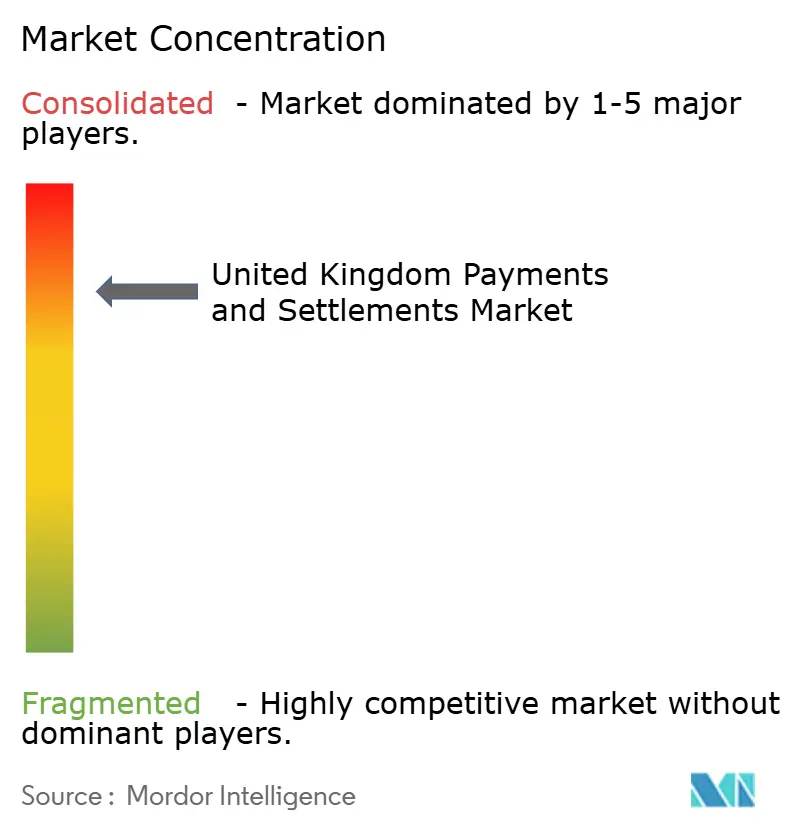
| Market Concentration | High |
Major Players *Disclaimer: Major Players sorted in no particular order Image © Mordor Intelligence. Reuse requires attribution under CC BY 4.0. | |
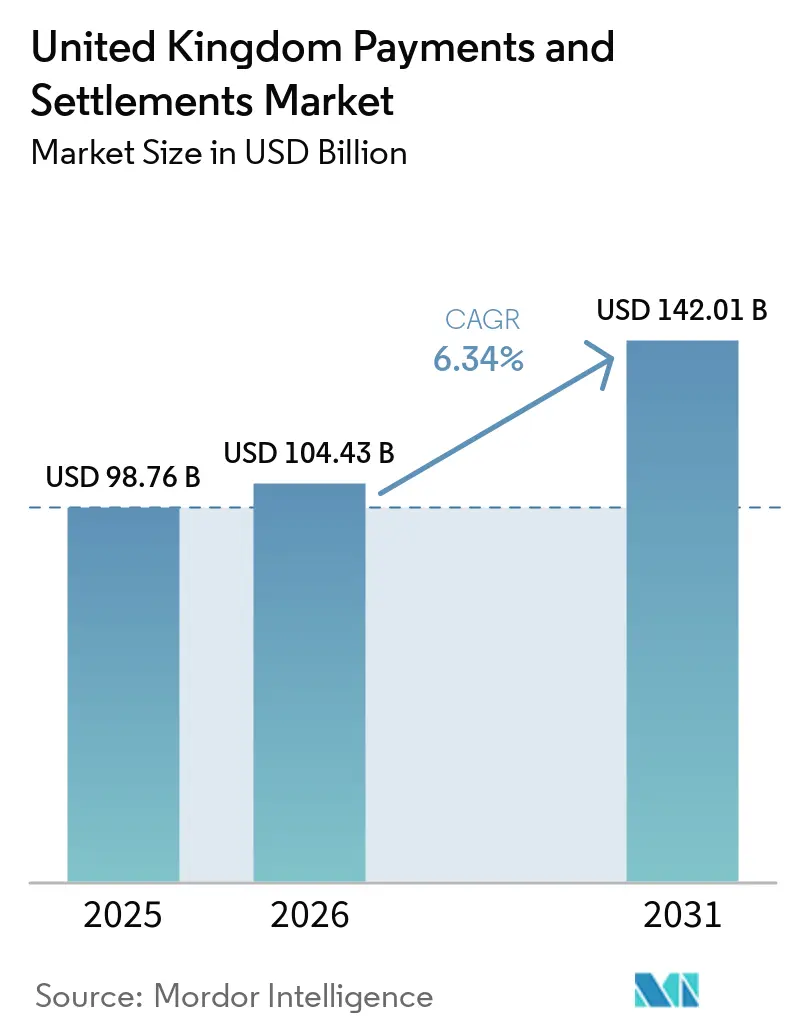
United Kingdom Payments and Settlements Market Analysis by Mordor Intelligence
The United Kingdom Payments And Settlements Market size is projected to be USD 98.76 billion in 2025, USD 104.43 billion in 2026, and reach USD 142.01 billion by 2031, growing at a CAGR of 6.34% from 2026 to 2031.
Payment activity continues to move away from cash and legacy batch processes toward cards, Faster Payments, mobile wallets, and account-to-account services. New rules for stablecoins, open banking, and deferred payment credit are also reshaping the United Kingdom's payments and settlements market. These changes create opportunities for firms that can support real-time processing, fraud controls, and clearer payment choices for merchants and consumers. Infrastructure investment remains important because payment firms must manage multiple new systems and regulatory schedules simultaneously. The direction of travel is clear, but uncertainty around the digital pound, commercial variable recurring payments, and stablecoin implementation could delay some settlement modernization decisions.
Key Report Takeaways
- By mode of payment, card payments led with 40.78% of the United Kingdom payments and settlements market share in 2025, while digital assets, stablecoins, and tokenized payments are forecast to grow at a 15.89% CAGR through 2031.
- By payment type, domestic payments held 78.34% of the United Kingdom payments and settlements market share in 2025, while cross-border payments are expected to record the highest CAGR at 8.56% through 2031.
- By transaction type, Consumer-to-Business payments accounted for 43.87% of the United Kingdom payments and settlements market share in 2025, while Business-to-Consumer payments are forecast to advance at a 9.45% CAGR through 2031.
- By end-user industry, retail and e-commerce held 36.05% of the United Kingdom payments and settlements market share in 2025, while transportation and mobility is expected to grow at a 10.34% CAGR through 2031.
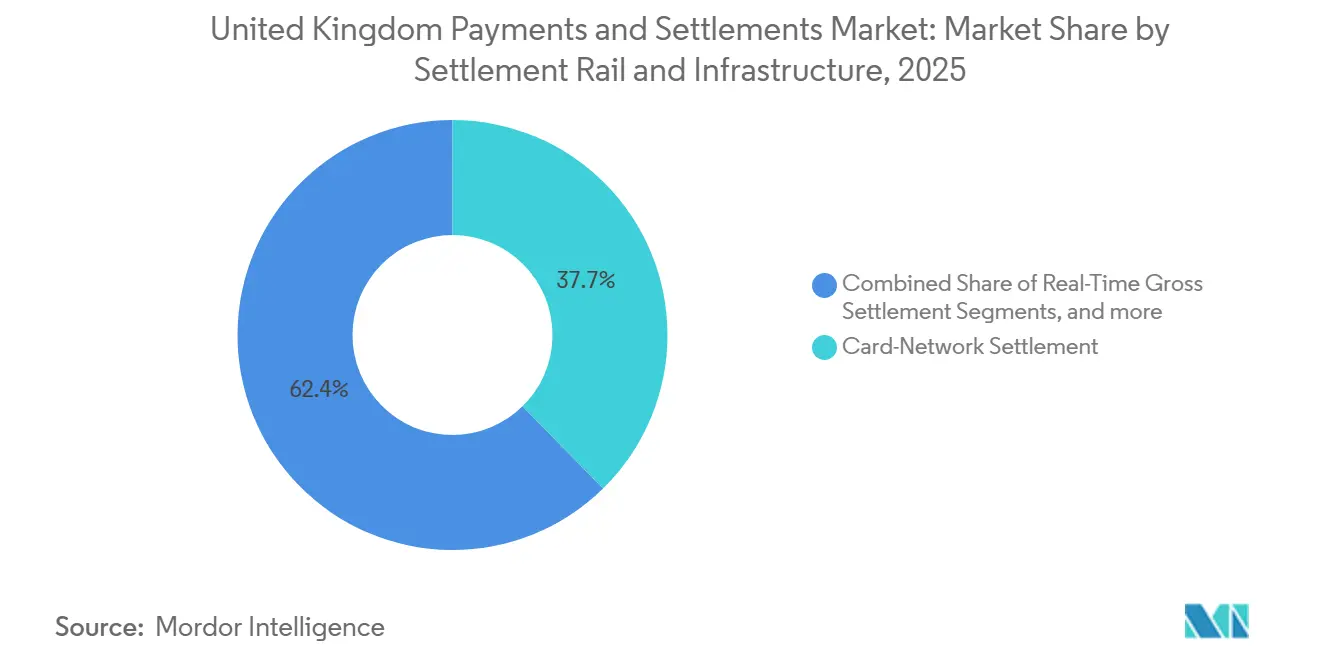
- By settlement rail and infrastructure, card-network settlement held 37.65% of the United Kingdom payments and settlements market share in 2025, while tokenized and distributed-ledger settlement is expected to expand at an 18.24% CAGR through 2031.
- By geography, England held 83.56% of the United Kingdom payments and settlements market share in 2025, while Scotland is forecast to grow at a 7.43% CAGR through 2031.
Note: Market size and forecast figures in this report are generated using Mordor Intelligence’s proprietary estimation framework, updated with the latest available data and insights as of January 2026.
United Kingdom Payments and Settlements Market Trends and Insights
Drivers Impact Analysis*
| Driver | (~) % Impact on CAGR Forecast | Geographic Relevance | Impact Timeline |
|---|---|---|---|
| Migration From Cash and Cheques to Electronic Payments | +1.0% | National, with higher cash dependency in Wales, Northern Ireland, and rural England | Short term (≤ 2 years) |
| Faster Payments and Account-to-Account Adoption | +1.4% | England-centric, with spillover to the Scottish fintech corridor | Medium term (2-4 years) |
| United Kingdom Open Banking and Variable Recurring Payments Rollout | +1.1% | National, with early commercial traction in London and Edinburgh | Medium term (2-4 years) |
| Contactless, Mobile Wallet, and Embedded Checkout Expansion | +0.9% | National, with the strongest use among urban consumers aged 18 to 44 | Short term (≤ 2 years) |
| United Kingdom Settlement Infrastructure Modernization and ISO 20022 Adoption | +0.8% | National, with the highest relevance for CHAPS participants in the City of London | Long term (≥ 4 years) |
| Merchant Demand for Lower-Cost Direct Bank Payments | +0.6% | National, with early adoption among e-commerce and subscription merchants | Medium term (2-4 years) |
| Source: Mordor Intelligence | |||
Faster Payments and A2A Adoption Displace Batch-Based Business Payment Rails
The United Kingdom payments and settlements market is benefiting as businesses use real-time payments for a larger share of routine transfers. Faster Payments accounted for 50% of the United Kingdom business payments in 2024, surpassing Bacs Direct Credit for the first time [1]UK Finance, “UK Payment Markets Report 2025 Summary,” UK Finance, ukfinance.org.uk. This shift requires settlement banks to manage liquidity throughout the day and night rather than around end-of-day cycles. Account-to-account payments remain underpenetrated in the United Kingdom e-commerce ecosystem compared with broader European markets, highlighting significant growth headroom as consumers and merchants increasingly adopt direct bank payment solutions that offer lower transaction costs, faster settlement, and enhanced payment security. Merchants have a clear reason to test these services because they can reduce reliance on card processing fees while retaining access to immediate confirmation.
United Kingdom Open Banking and VRP Rollout Enter Their Commercial Phase
Open banking payments reached 351 million in 2025, up 57% from the prior year. Sweeping variable recurring payment volumes grew 98%, while user connections reached 16.5 million by December 2025. Payment Initiation Service API calls increased 53%, more than twice the pace reported for Account Information Service calls [2]Open Banking Limited, “Open Banking in 2025 Now Part of the UK’s Everyday Financial Life,” Open Banking Limited, openbanking.org.uk. The UKPI commercial VRP scheme went live on June 2, 2026, and Wave 2 for general e-commerce is targeted for the end of 2026. VRPs accounted for 16% of open banking transactions, indicating that the use of recurring payments is becoming a meaningful part of the United Kingdom's payments and settlements market. The FCA plans to consult on the longer-term open banking framework before the end of 2026, making regulatory readiness central to scheme participants' operating plans.
Bank of England RT2 and ISO 20022 Adoption Position CHAPS for Cross-Border Interoperability
The renewed RTGS service has significantly modernized the United Kingdom's core payment infrastructure, strengthening the resilience, efficiency, and scalability of high-value payment settlement. The introduction of ISO 20022 messaging standards enhances data quality, supports greater interoperability, and enables richer payment information across the financial ecosystem. In parallel, the RT2 Synchronisation Lab is enabling financial institutions to test simultaneous payment and asset exchange, accelerating readiness for tokenized securities settlement and more seamless cross-border payment interoperability. Collectively, these developments establish a stronger domestic payments infrastructure that aligns with the G20 objective of improving cross-border payments by enhancing speed, transparency, and interoperability.
Contactless and Mobile Wallet Expansion Accelerates Across Demographic Groups
Contactless payments accounted for 39% of all payments in the United Kingdom in 2024, supported by 153 million contactless cards and 18.9 billion transactions [3]UK Finance, “Annual Fraud Report 2025,” UK Finance, ukfinance.org.uk. Barclays reported that 94.6% of eligible in-store card payments were contactless in 2024, and users made an average of 236 contactless transactions. Consumers aged over 65 were the fastest-growing group of contactless users for the fourth consecutive year. The FCA removed the compulsory GBP 100 per-tap limit on March 19, 2026. Mobile wallets can already use biometric strong customer authentication for purchases above the former physical-card limit. That feature supports broader wallet use in the United Kingdom payments and settlements market, especially for customers who want faster checkout without constraints on lower-value transactions.
Restraints Impact Analysis*
| Restraint | (~) % Impact on CAGR Forecast | Geographic Relevance | Impact Timeline |
|---|---|---|---|
| Authorized Push Payment Fraud and Reimbursement Exposure | -0.5% | National, with systemic liability across Faster Payments participants | Short term (≤ 2 years) |
| Legacy Core-Banking Constraints at United Kingdom Tier-2 Institutions | -0.4% | National, concentrated outside the CMA9 institutions | Long term (≥ 4 years) |
| United Kingdom Card Scheme Fee Inflation and Merchant Switching Friction | -0.3% | National, especially among small and medium-sized merchants with limited bargaining leverage | Medium term (2-4 years) |
| Fragmented Regulatory Transition for Open Banking and New Payment Technologies | -0.3% | National, affecting firms working across FCA, PSR, and HM Treasury requirements | Medium term (2-4 years) |
| Source: Mordor Intelligence | |||
APP Fraud Reimbursement Liability Restructures Payment Firm, Cost Models
The mandatory authorized push payment (APP) fraud reimbursement framework has fundamentally reshaped fraud risk management across the United Kingdom payments ecosystem by introducing shared liability between sending and receiving payment service providers for eligible fraud losses. The regulation increases financial accountability for payment providers, requiring stronger fraud prevention strategies, enhanced risk provisioning, and more robust operational controls to protect profitability. As purchase fraud remains the most common form of APP fraud, payment service providers are increasingly investing in real-time fraud detection, merchant verification, and enhanced pre-payment authentication to reduce fraudulent transactions before payment authorization.
Legacy Core-Banking Architecture Limits Real-Time Participation at Tier-2 Institutions
Many Tier-2 banks still operate systems designed for end-of-day net settlement rather than continuous processing. This limits their ability to provide the full real-time services expected by users of Faster Payments and RT2. Core-banking replacement projects take 5 to 7 years and carry substantial integration risk, which can delay approval of modernization programs. These constraints can restrict open banking API features, ISO 20022 data handling, and participation in the commercial VRP scheme. Cloud-native providers, including Modulr Finance, Starling Bank, and ClearBank, use this gap to supply payment infrastructure to fintechs that cannot access faster rails directly. RT2’s open-platform design could expand non-bank access to central-bank settlement during the forecast period.
*Our forecasts treat driver/restraint impacts as directional, not additive. The impact forecasts reflect baseline growth, mix effects, and variable interactions.
Segment Analysis
By Mode of Payment: Tokenized Rails Challenge Card-Network Settlement
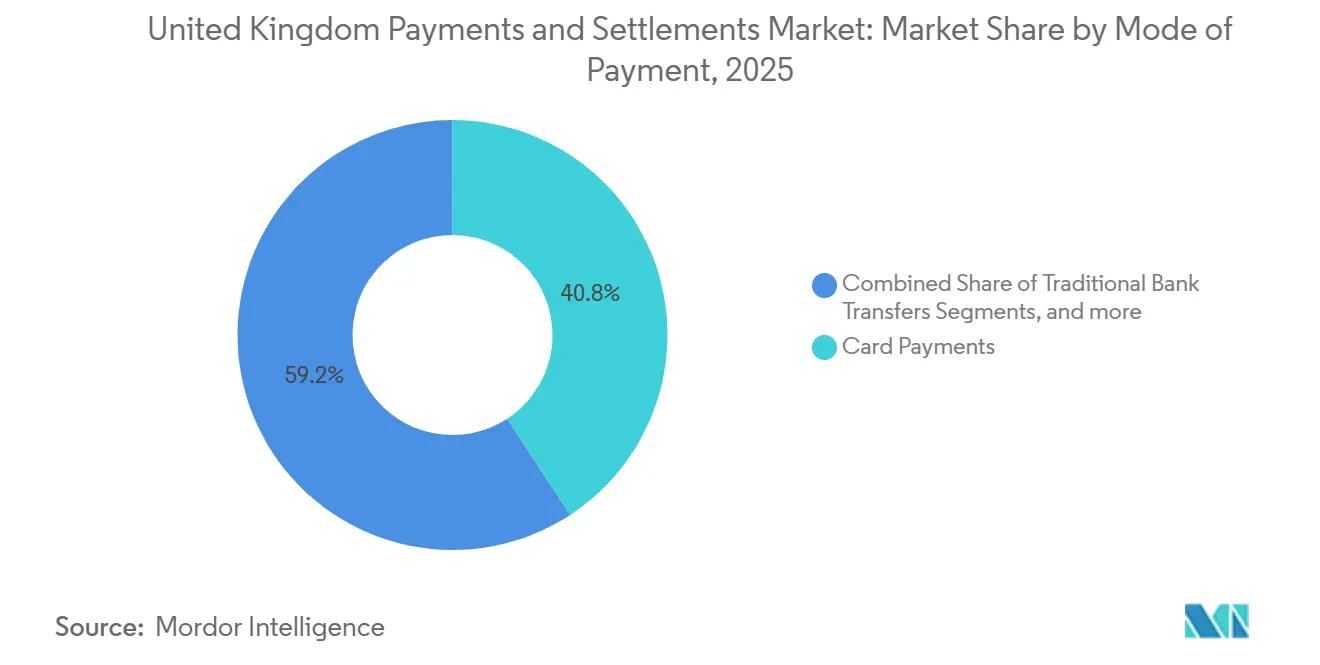
Card payments held 40.78% of the United Kingdom payments and settlements market share in 2025. Debit cards accounted for 26.1 billion of the 48.8 billion payments made in the United Kingdom in 2024, equal to 53% of all payments. The segment remains central to daily spending because it is accepted across retail, travel, and recurring purchases. Digital Wallets were the second-largest mode, with 57% of the United Kingdom adults registered for mobile wallets in 2024, up from 42% in 2023. BNPL and Embedded Credit reached 25% adoption among adults in 2024, up from 14% in 2023. Regulation of deferred payment credit began on July 15, 2026, requiring authorization, affordability assessments, and access to the Financial Ombudsman Service for millions of users. Account-to-account and instant payments continue to scale through open banking, while traditional bank transfers are losing share of volume. These shifts show why payment acceptance providers need to support multiple consumer payment options rather than rely on a single instrument.
Digital assets, Stablecoins, and Tokenized Payments are forecast to grow at a 15.89% CAGR from 2026 to 2031. The FCA published final rules for the United Kingdom-authorized stablecoin issuers in June 2026, which will apply from October 2027. The Bank of England and FCA also set out a joint approach for systemic stablecoin issuers. These frameworks give institutional issuers clearer boundaries for developing sterling stablecoin products. A regulated sterling stablecoin could offer programable high-value settlement and embedded compliance information. The United Kingdom payments and settlements market will still need strong controls because these products must meet both regulatory and operational requirements. The cost of those controls is likely to support investment in issuer, custody, and settlement infrastructure. Card payments will remain important, but their lead is being tested by rails designed for direct account transfer and digital assets.



By Payment Type: Domestic Flows Anchor Volume, Cross-Border Captures Value Growth
Domestic payments held 78.34% of payment-type volume in 2025. CHAPS processed GBP 87.5 trillion (USD 111 trillion) in 2024, representing 88% of the United Kingdom's sterling payment value. Bacs Direct Debit continued to support 4.9 billion recurring instructions each year. These domestic flows provide a stable base for the United Kingdom's payments and settlements market, as households and businesses rely on them for regular collections and transfers. Their scale also explains why changes to the United Kingdom clearing systems have broad effects beyond consumer checkout. Domestic providers must balance reliability, immediate confirmation, data requirements, and fraud prevention. Large corporate and financial transactions remain concentrated in high-value systems, while routine payments increasingly move through real-time rails.
Cross-Border payments are forecast to grow at an 8.56% CAGR through 2031. Incumbent banks continue to process most high-value correspondent transactions, while Wise processed more than USD 240 billion in cross-border transactions during the financial year 2026. The pound became the third-most-active currency in non-eurozone SWIFT cross-border flows in January 2026. SWIFT’s retail payments framework has commitments from more than 70 global financial institutions for live implementation in 2026. Online spending accounted for 50.5% of total United Kingdom card spending in September 2025, increasing the relevant volume of card-not-present cross-border payments[4]Office for National Statistics, “Industry-to-Industry Payment Flows in the UK 2019 to 2025,” Office for National Statistics, ons.gov.uk. The United Kingdom payments and settlements market benefits from this activity, but providers need transparent pricing and traceable payment status to compete for consumer and small-business flows. Cross-border services will also face rising expectations for speed, confirmation, and compliance data.
By Transaction Type: B2C Disbursements Scale on Real-Time Infrastructure
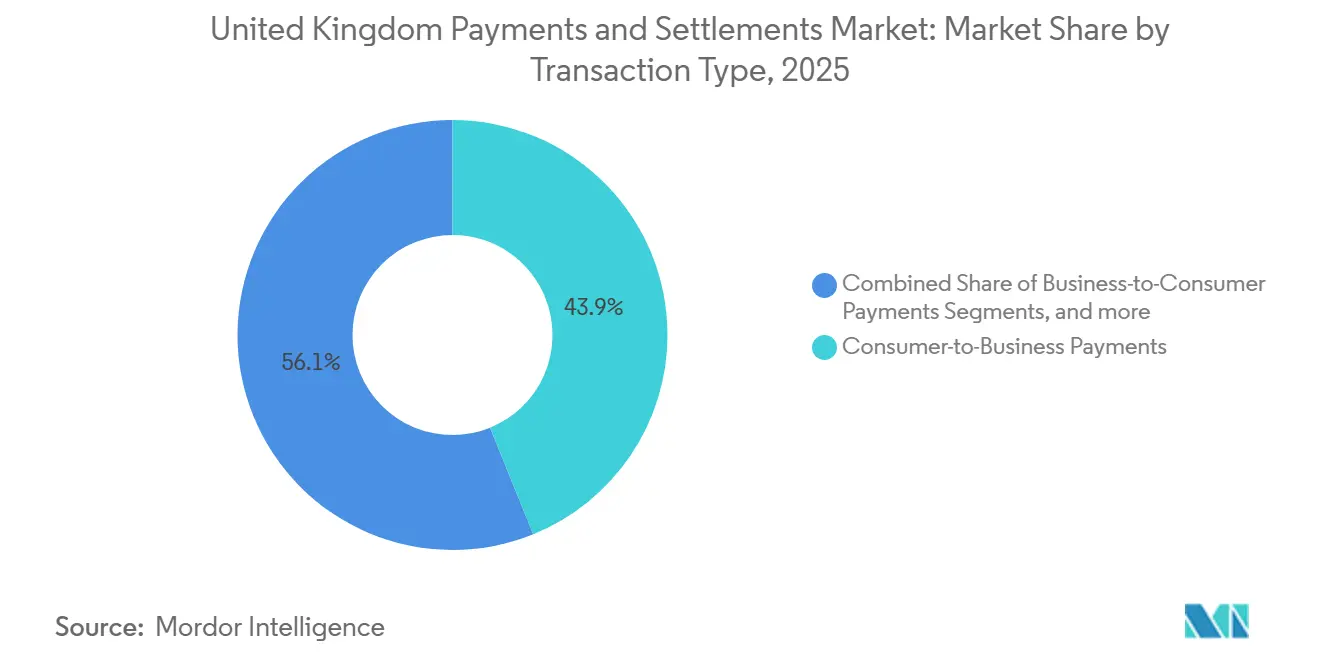
Consumer-to-Business payments held 43.87% of transaction-type volume in 2025. The segment is supported by the country’s high level of retail spending, subscriptions, and utility collections. Business-to-Business Payments remain the highest-value activity because CHAPS processed GBP 87.5 trillion (USD 111 trillion) in 2024, much of it linked to corporate, interbank, and property settlements. Consumer-to-Consumer Payments remain the smallest category, although open banking payment initiation is expanding the technical base for peer transfers. The United Kingdom payments and settlements market must therefore serve very different payment needs, from low-value household purchases to high-value corporate transfers. Consumer-to-business transactions require broad acceptance and convenient payment selection. Business-to-business flows require dependable processing, clear data, and settlement certainty.
Business-to-Consumer payments are forecast to grow at a 9.45% CAGR from 2026 to 2031. Insurance claims, gig-economy disbursements, and government transfers are moving from overnight batches to continuous payment services. RT2 is scheduled to extend its operating hours to 1:30 a.m. starting in September 2027. This change can reduce the delay for payments initiated during overnight periods. ISO 20022 purpose-code data also helps beneficiary banks classify incoming credits in real time. Clearing banks serving platform businesses may use this data in their API design and customer notification processes. The United Kingdom payments and settlements market is consequently becoming more useful for organizations that need to send money quickly and provide recipients with clear payment information. Fraud controls will remain essential because faster payment speeds also reduce the time available for intervention.
By End-User Industry: Retail Anchors Volume While Mobility Payments Set the Pace
Retail and e-commerce held 36.05% of end-user demand in 2025. Online retail represented 28.1% of the total United Kingdom retail value in April 2026. Digital wallets accounted for 40% of the United Kingdom's e-commerce value in 2026. Banking and financial services, healthcare, government, and hospitality each use different settlement arrangements. Healthcare and government organizations are gradually shifting benefit and insurance disbursements toward Faster Payments. Visa reported that 77% of United Kingdom consumers use debit cards, while 45% of small businesses said better payment tools actively supported their growth. The United Kingdom payments and settlements market needs to combine broad acceptance with services that address the specific payment cycles of these sectors.
Transportation and mobility are forecast to grow at a 10.34% CAGR through 2031. The Better-Connected strategy supports integrated contactless ticketing across major city regions through Project Coral by 2030. Account-based ticketing provides transport operators with real-time travel information to support pricing and loyalty programs. It also raises the commercial value of the payment relationship beyond the individual journey. Providers seeking transport contracts will need reliable processing and clear passenger protections as the United Kingdom's payments and settlements market extends across urban transit systems.
By Settlement Rail and Infrastructure: Distributed-Ledger Settlement Scales Against Incumbent Rails
Card-Network settlement held 37.65% of the settlement rail market in 2025. The PSR found that Visa and Mastercard did not face effective competition in scheme and processing fees. The regulator is implementing transparency measures in 2026 and has proposed mandatory regulatory financial reporting from 2027. RTGS settles GBP 790 billion each day. Correspondent banking and SWIFT-based systems remain important for high-value cross-border payments. This mix of rails gives the United Kingdom a resilient payments and settlements market, but also creates a need for clearer interoperability.
Tokenized and Distributed-Ledger settlement is forecast to grow at an 18.24% CAGR through 2031. The RT2 Synchronisation Lab is testing simultaneous payment and asset transfers with 18 participant organizations. This capability is relevant to tokenized bonds and money-market fund transactions because it addresses settlement finality. SWIFT’s retail framework is bringing more than 70 global banks into coordinated cross-border implementation in 2026. Fast and instant payment systems increased 8.9% by volume in 2025. Payment-system interlinking is also becoming more relevant as the G20 cross-border targets approach in 2027. The United Kingdom payments and settlements market may gain from these developments if firms can connect newer settlement services to the reliability expected of established rails.
Geography Analysis
England accounted for 83.56% of the United Kingdom's payments and settlements market in 2025. London remains the center for CHAPS high-value settlement, cross-border treasury activity, and digital banking. CHAPS processed GBP 87.5 trillion (USD 111 trillion) in 2024, and much of that activity originated in London. The Better Connected strategy is extending integrated contactless tickets to Manchester, Birmingham, and Leeds by 2030. This gives local authorities a route to expand the use of payments beyond the capital. The ONS regional payment-flow dataset covered 2.3 million organizations through Bacs and Faster Payments data between 2019 and 2025. It provides detailed evidence of England’s significant role in electronic business payment volumes and values.
Scotland is forecast to grow at a 7.43% CAGR from 2026 to 2031. FinTech Scotland reported that the cluster grew from 120 firms in 2020 to more than 260 firms in early 2026. Scotland’s Technology Council expects fintech revenue to reach GBP 2.1 billion (USD 2.67 billion) by 2031. FinTech Scotland launched its Centre of Excellence in Distributed Ledger Technology in 2025, with work on digital assets, payments, and tokenization. This supports a stronger base for settlement-infrastructure innovation. Scotland’s position reflects the growing role of its fintech community alongside the United Kingdom's payments and settlements market centered in England.
Wales has a higher dependence on cash than England, leaving room for further adoption of electronic payments. Northern Ireland has a different demand pattern because trade with SEPA-integrated Ireland creates cross-border account-to-account payment needs. These differences mean that national providers cannot use the same adoption approach nationwide. Rural and cash-dependent areas may need payment services that maintain accessibility while digital use expands. Northern Ireland requires services that work well with cross-border trade and payment standards. The United Kingdom payments and settlements market should therefore treat regional payment behavior as an operational consideration rather than a single national pattern. Payment activity remains concentrated in England, but regional needs can influence where providers focus product design and partnership activity.
Competitive Landscape
The United Kingdom payments and settlements market is concentrated in merchant acquiring and fragmented at the point where payments begin. Global Payments completed its acquisition of Worldpay after CMA approval in October 2025, combining 2 of the United Kingdom’s 3 largest merchant acquirers. Barclaycard and Adyen remain important in card acquiring. Visa and Mastercard retain strong positions in scheme and processing services, although the PSR’s remedies are intended to improve fee transparency. GoCardless, Trustly, and the UKPI VRP scheme provide direct bank payment alternatives that can reduce merchants' exposure to card fees. Worldpay expanded its embedded payments service to the United Kingdom in July 2025, targeting vertical software providers by offering card, direct debit, and wallet services through a single integration.
The neobank tier competes through settlement features as well as consumer-facing accounts. Revolut received a full United Kingdom banking license in March 2026, allowing it to offer deposit and lending products in the country. Wise processed more than USD 240 billion in cross-border transactions in the financial year 2026. Monzo, Starling Bank, and Wise compete with established banks for customer payment activity. Visa launched Click to Pay for eligible Revolut Visa cardholders in June 2026. This move shows how card networks are working with digital banks to preserve cards' relevance among app-based users. The United Kingdom payments and settlements market remains open to firms that can combine established acceptance with a digital customer experience.
Merchant-grade account-to-account acceptance is a significant gap, particularly for merchants seeking protection standards comparable to those for card payments. Fraud-resistant instant disbursement is another area, as insurance and gig platforms need fast transfers without increased fraud losses. An interoperable digital identity can also support variable recurring payment authorization at scale. Competition is increasingly shifting toward payment orchestration and interoperability. Alongside ACI Worldwide and Fiserv, Juspay's Hyperswitch enables merchants to connect multiple payment providers, optimize routing, and improve authorization rates, supporting more resilient and efficient payment operations.
United Kingdom Payments and Settlements Industry Leaders
Visa Inc.
Mastercard Incorporated
Worldpay Group Limited
PayPal Holdings, Inc.
Barclays PLC
- *Disclaimer: Major Players sorted in no particular order

Recent Industry Developments
- July 2026: HM Treasury published a consultation on Modernising Payment Services Regulation on July 14, 2026, proposing a unified framework for traditional and tokenized payments, Open Banking, and AI-agent-enabled commerce. The consultation is expected to replace the Payment Services Regulations 2017.
- June 2026: Wise acquired Expatica, deepening its cross-border customer infrastructure. In the financial year 2026, Wise processed over USD 240 billion in cross-border transactions, serving 19 million customers globally.
- June 2026: The Retail Payments Infrastructure Board launched a public consultation on the design of next-generation retail payment infrastructure, with responses due September 11, 2026.
- June 2026: The UKPI commercial VRP scheme went live on June 2, 2026. It is the United Kingdom’s first new payment scheme since Faster Payments in 2008, and its second wave for general e-commerce is targeted for the second half of 2026.


United Kingdom Payments and Settlements Market Report Scope
| Card Payments (Debit, Credit, Prepaid) |
| Digital Wallets & Mobile Money |
| Account-to-Account & Instant Payments |
| Traditional Bank Transfers |
| Buy Now, Pay Later & Embedded Credit |
| Digital Assets, Stablecoins & Tokenised Payments |
| Other Payments |
| Domestic |
| Cross-Border |
| Business-to-Business Payments |
| Consumer-to-Business Payments |
| Business-to-Consumer Payments |
| Consumer-to-Consumer Payments |
| Retail and E-Commerce |
| Banking and Financial Services |
| Healthcare |
| Hospitality, Travel, and Tourism |
| Government and Public Sector |
| Education |
| Transportation and Mobility |
| Manufacturing and Industrial Services |
| Professional Services and Business Services |
| Other Industries |
| Card-Network Settlement |
| Automated Clearing House Settlement |
| Real-Time Gross Settlement |
| Fast / Instant Payment Systems |
| Correspondent Banking and SWIFT-Based Settlement |
| Payment-System Interlinking |
| Tokenized and Distributed-Ledger Settlement |
| England |
| Scotland |
| Wales |
| Northern Ireland |
| By Mode of Payment | Card Payments (Debit, Credit, Prepaid) |
| Digital Wallets & Mobile Money | |
| Account-to-Account & Instant Payments | |
| Traditional Bank Transfers | |
| Buy Now, Pay Later & Embedded Credit | |
| Digital Assets, Stablecoins & Tokenised Payments | |
| Other Payments | |
| By Payment Type | Domestic |
| Cross-Border | |
| By Transaction Type | Business-to-Business Payments |
| Consumer-to-Business Payments | |
| Business-to-Consumer Payments | |
| Consumer-to-Consumer Payments | |
| By End-User Industry | Retail and E-Commerce |
| Banking and Financial Services | |
| Healthcare | |
| Hospitality, Travel, and Tourism | |
| Government and Public Sector | |
| Education | |
| Transportation and Mobility | |
| Manufacturing and Industrial Services | |
| Professional Services and Business Services | |
| Other Industries | |
| By Settlement Rail and Infrastructure | Card-Network Settlement |
| Automated Clearing House Settlement | |
| Real-Time Gross Settlement | |
| Fast / Instant Payment Systems | |
| Correspondent Banking and SWIFT-Based Settlement | |
| Payment-System Interlinking | |
| Tokenized and Distributed-Ledger Settlement | |
| By Geography | England |
| Scotland | |
| Wales | |
| Northern Ireland |


Key Questions Answered in the Report
What is driving growth in the United Kingdom's payments and settlements?
The forecast CAGR is 6.34% through 2031, supported by faster payments, open banking, mobile wallets, and settlement modernization.
Which payment mode is growing fastest in the United Kingdom?
Digital Assets, Stablecoins, and Tokenized Payments are forecast to grow at a 15.89% CAGR through 2031.
What payment type holds the largest share in the United Kingdom?
Domestic Payments accounted for 78.34% of payment-type volume in 2025, supported by high CHAPS and Bacs activity.
Why are account-to-account payments important for merchants?
They can offer direct bank payments and reduce reliance on card processing fees, while Faster Payments supports immediate confirmation.
What is changing in the United Kingdom settlement infrastructure?
RT2 is live on ISO 20022, and its Synchronisation Lab is testing payment-and-asset exchange for tokenized settlement.
Which end-user sector is expanding fastest?
Transportation and mobility are forecast to grow at a 10.34% CAGR through 2031 as account-based and contactless transit ticketing expands.
Page last updated on:





